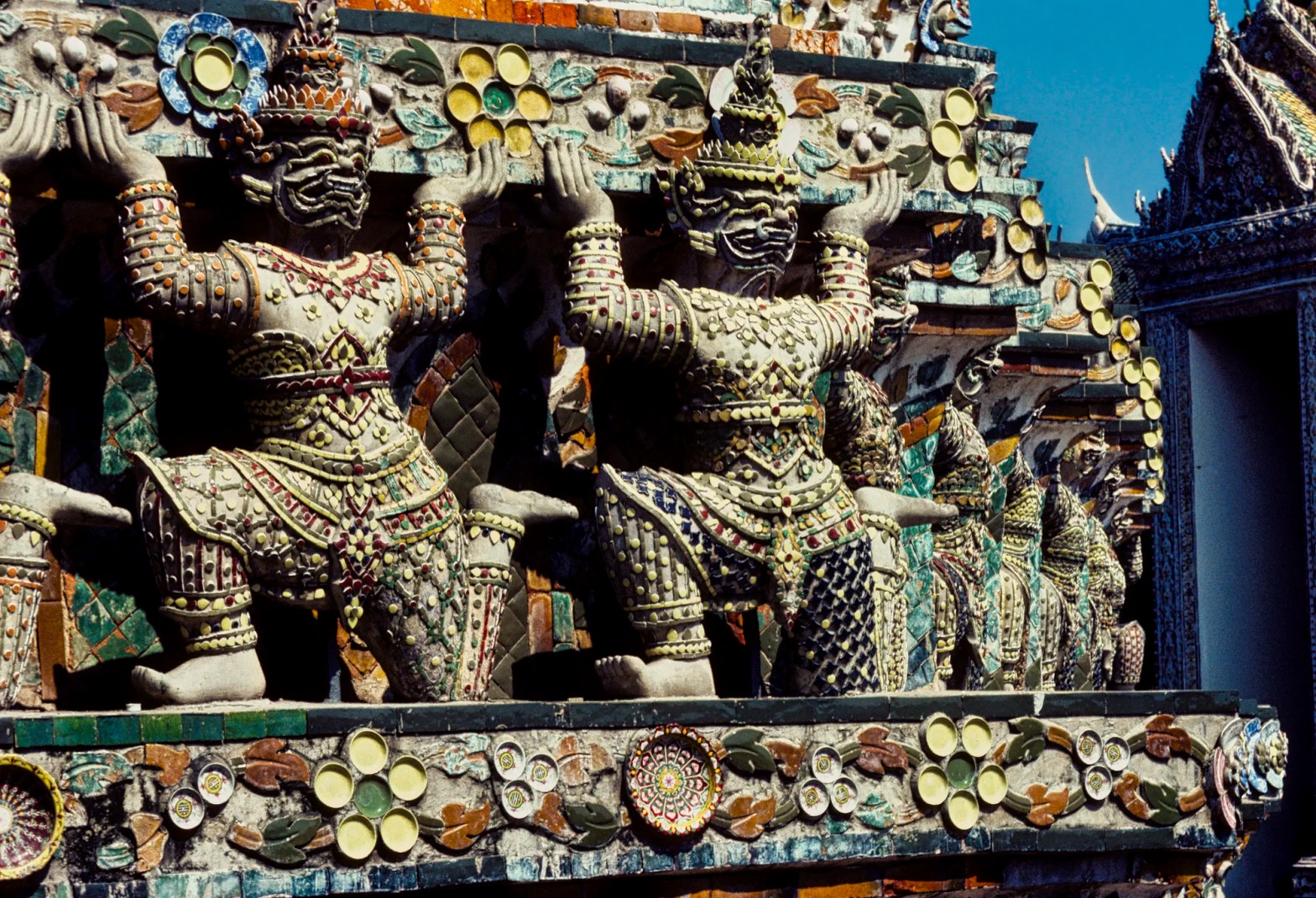
Are Wat Pho and Wat Arun worth visiting?
Bangkok is a noisy, frenetic, traffic-clogged city. It is easy to forget that there are some truly spectacular sights and wonderful wats from a mother-of-pearl Reclining Buddha to a golden swan Royal Barge. As an extra plus, all these sights are on the Rattanakosin Island – not that you will realize there is an island – in the same location as Khao San Road and the Grand Palace. Finally, do not miss eating at the night markets in the Rattanakosin area.
The Bangkok National Museum, Wat Pho, and Wat Arun are all amazing places to see. They will give you a glimpse of what the Thai Empire was like before the ancient capital of Ayutthaya was destroyed.
Author & Photographer: George Mitchell

Our recommendations are not influenced by affiliate links – we have none. Our advice is derived from our personal experience and knowledge based on spending five months in Thailand as well as travelling three years around the world..
All of our recommendations are top-rated by Google Maps Ratings, which is based on everyone, not just tourists. Each place recommended in our custom Bangkok Google map is appended with a Google Maps Rating (G0 to G5).
Bangkok National Museum
Address: 4 Na Phrathat Road Phra Nakhon
Open: 09:00 – 16:00 hrs. Wed-Sun
Fee: THB 200 = USD 5.60; free for age > 60 years old
Tours: Free 09:30 hrs Wed-Thu
Website: Bangkok National Museum
Some people find the Bangkok National Museum (G4.6) boring. Others feel it has a wealth of antiquities. But, if it is Wednesday or Thursday, we highly recommend you start at the National Museum because they offer free English (and other) language tours at 09:30 hrs. Here is where we learned about Thai Buddhist culture, the Indianization of Southeast Asia, and Thai art and architecture.
On our first trip to Thailand, we were very fortunate to have the enthusiastic and bubbly expat Kay de Groot as our guide. We did three morning tours. She went longer than the allotted hour. Afterwards, we spent more time with her discussing where to visit in Thailand, where to buy hill tribe crafts, and the books to read. You never realize when you travel the impact of the people that you meet. It is the tours that make the National Museum worth visiting.
Buddhaisawan
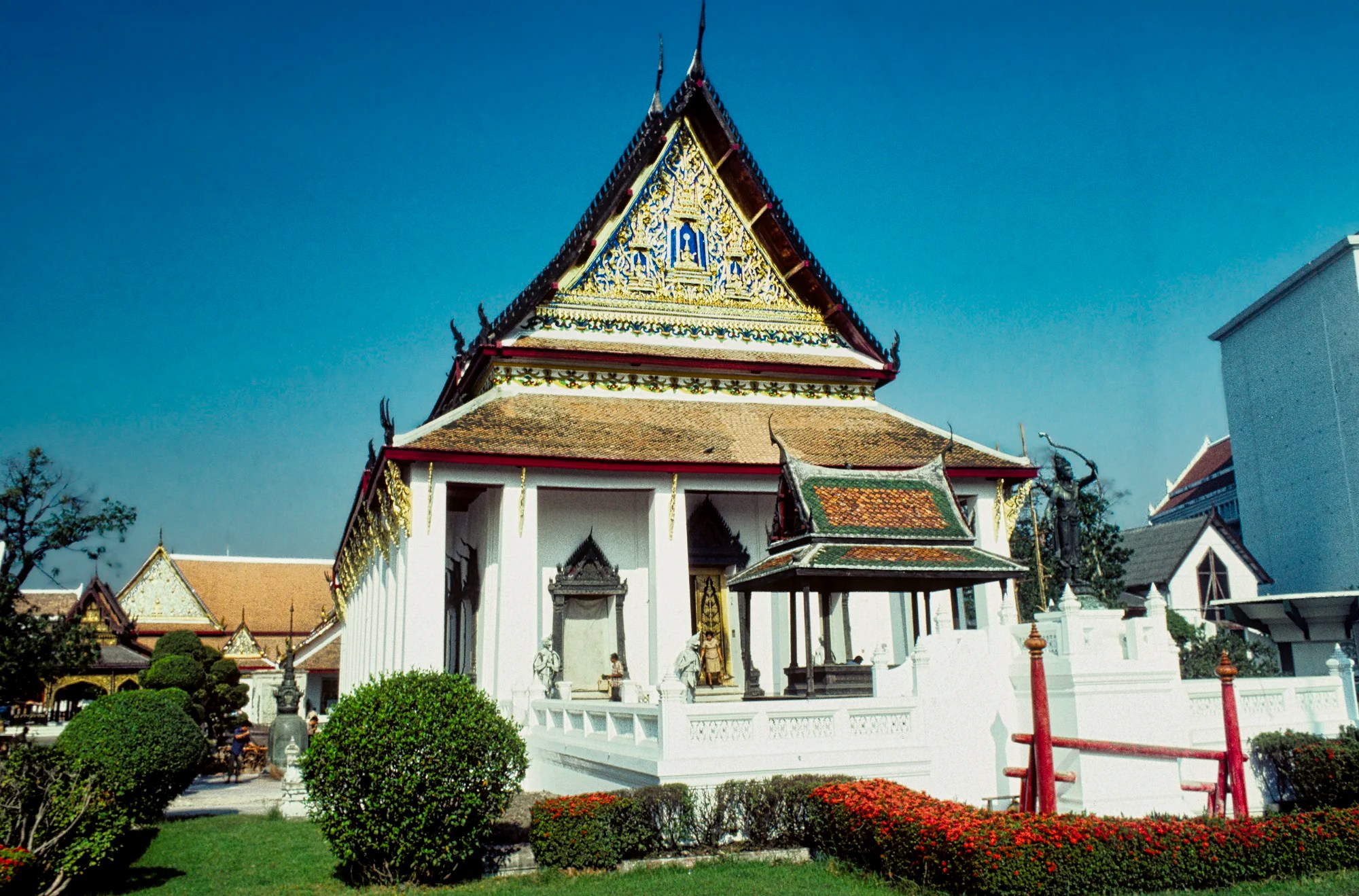
The museum was formerly the Palace of the Prince Wang Na, in other words, the palace of the king’s brother or successor if the king died. He would screen petitioners and decide if they should be granted an audience with the king.
An elephant would be hitched to the slanting red post outside, ready to take petitioners to the king at the Grand Palace. Buddhaisawan Hall (G4.9), behind the red hitching post, is perhaps the most beautiful building in the palace complex. It is particularly good in the morning when the sun reflects on the gold figures embedded in coloured glass tiles in the pediment.
Lacquerware Doors and Windows
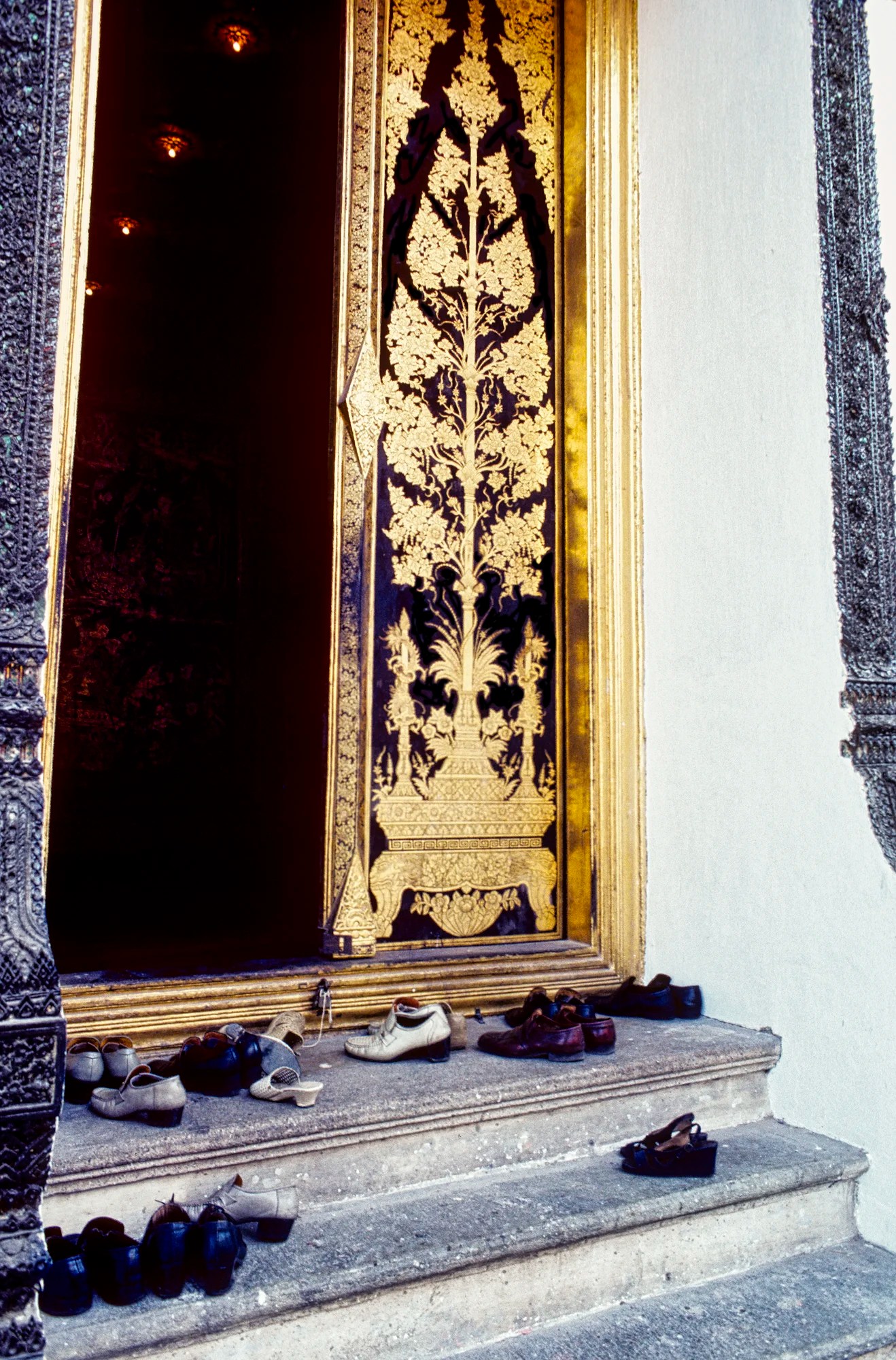
Even though this is not a wat, take your shoes off wherever the Thais do. This hall houses the Phra Phuttha Sihing, the second most revered Buddha image of Thailand.
Doors and window shutters are important portals from the mundane to the divine world. They are ornately decorated with auspicious symbols or guardian deities to ward off the entry of evil spirits.
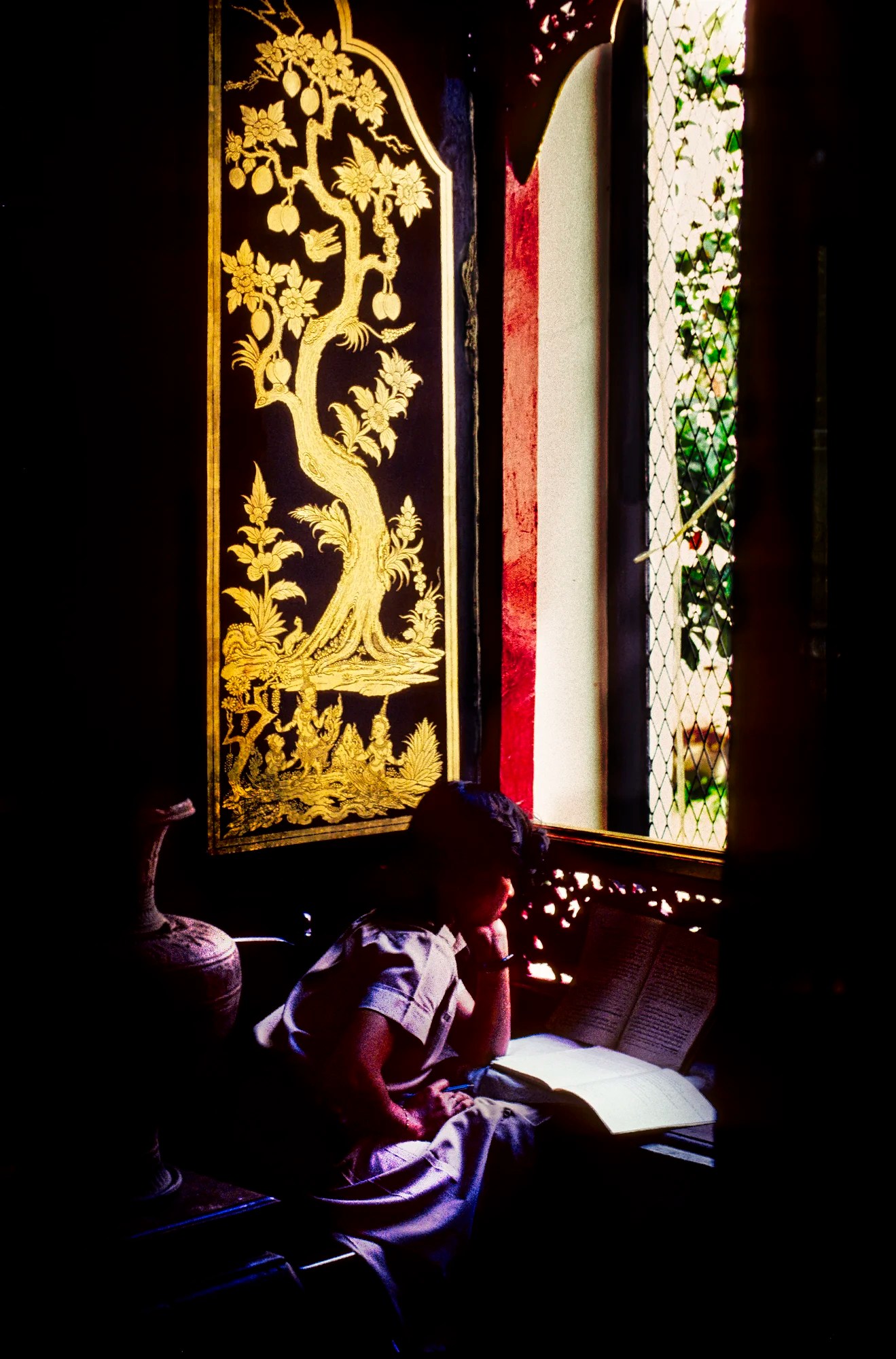
Thai lacquer is made from the highly toxic sap of the Ton Rak tree. The clear lacquer is colored black with the addition of charcoal. Lacquer is shiny and resistant to heat and moisture.
Buddha Statues
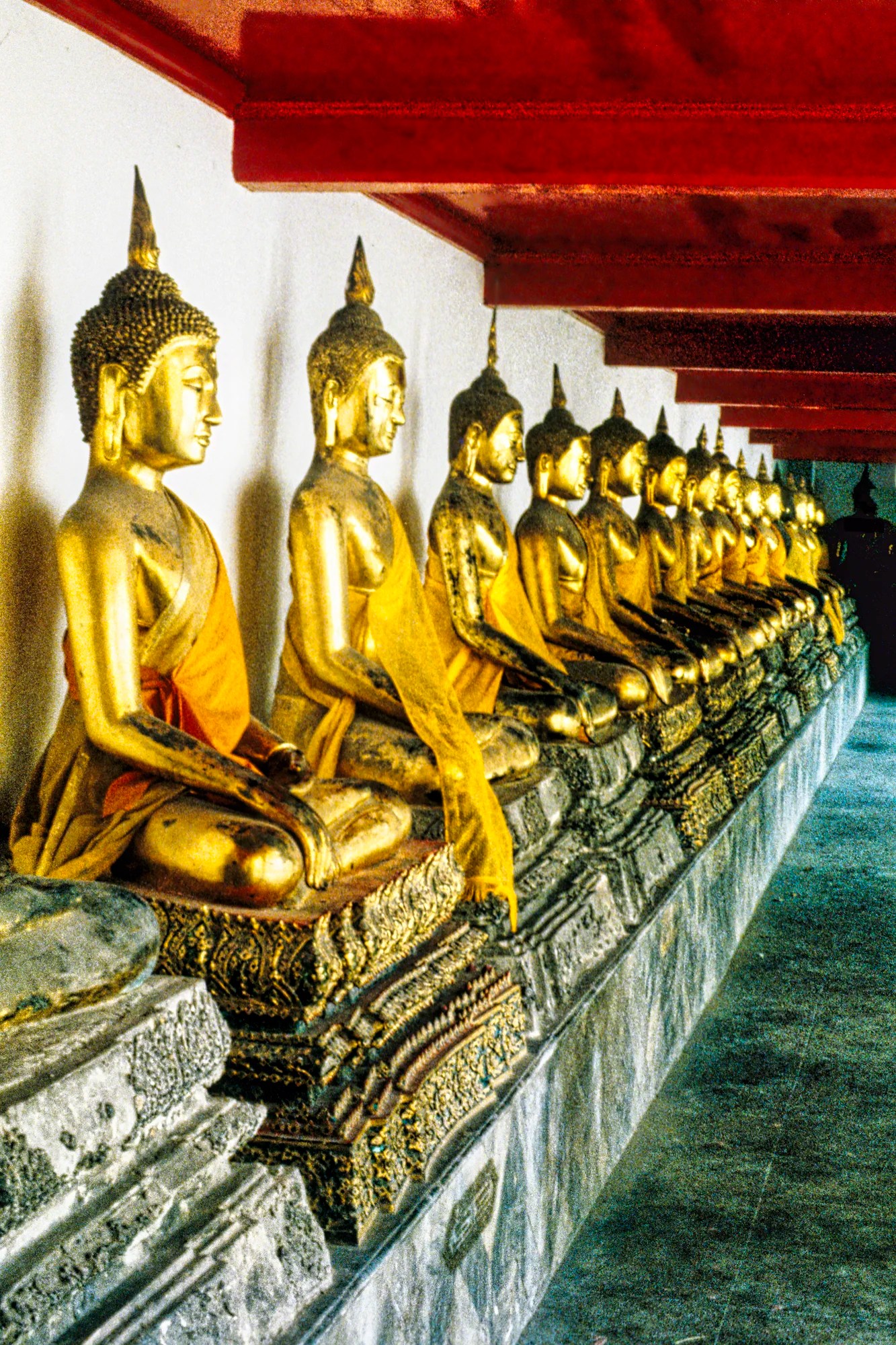
If you do not understand Buddhist symbolism, then all the statues and artwork seem to look the same. Why did the first representations of Buddha appear only ca. 500 years after his death? Buddha discouraged the sculpting of statues of himself because he wanted to be remembered for his teaching, not his image. None of the statues represent what the Buddha really looked like. They depict a stylized version with prescribed elements that all Buddhist art follows.
Gandhara Buddha Statue
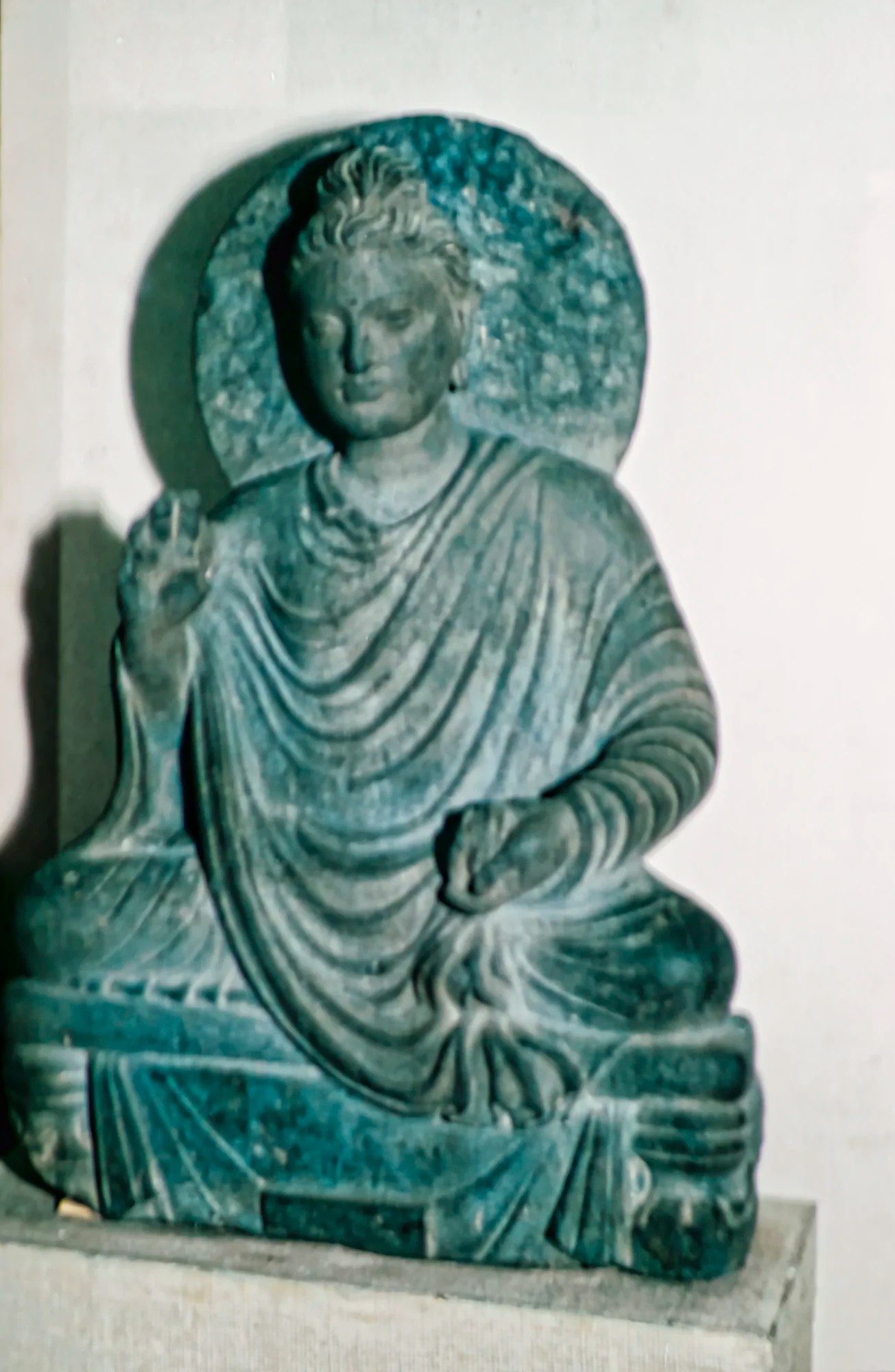
So why are there so many Buddha statues today? Blame it on the Greeks! It was Alexander the Great who changed Asian history. In 325 BC, Alexander’s army conquered as far as Gandhara, which was a city as well as the name of a major kingdom. The city is now called Kandahar, Afghanistan.
Gandhara was a major centre of Buddhism. Alexander brought sculptors with him — he was a narcissist and renamed many cities in the old world to Alexandria. He loved to create statues of himself as he went along!
But wait, the first statues of Buddha were made much later in the 1st century CE. It was the Indo-Greek descendants of these sculptors who created the first sculptures of Buddha, who wore Greek chitons (togas)! This statue uses the abhaya mudra (pose) with the right hand raised and palm facing outwards. This is used to dispel fear or inspire courage.
Srivijaya Avalokiteshvara Statue
Srivijaya was an empire based in Sumatra that ruled Indonesia, Malaysia, and Southern Thailand between the 7th and 13th centuries. It controlled the silk trade (maritime) route between India and China. They were influenced by Indian culture.
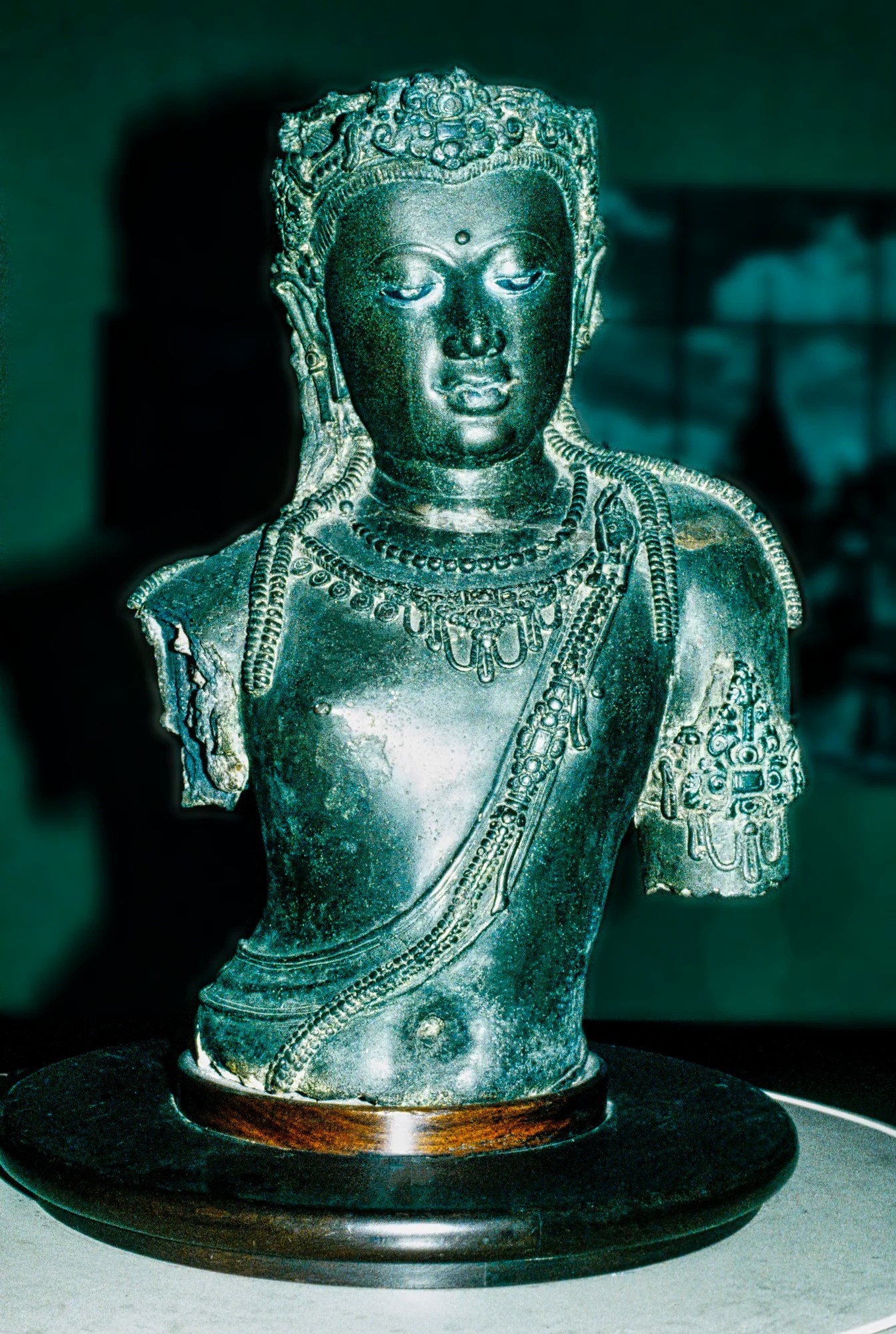
This 8th-century bronze torso depicts the revered Avalokiteshvara, the Bodhisattva (incarnation of Buddha) of compassion. He is called Guanyin in Chinese Buddhism. The statue was found in Surat Thani, Southern Thailand. Srivijayan art is known for its naturalistic style, ideal body proportions, and natural pose reminiscent of Classical Art. Srivijaya statues are also remarkable for their carved jewelry and elegance.
Dvaravati Buddha Statue
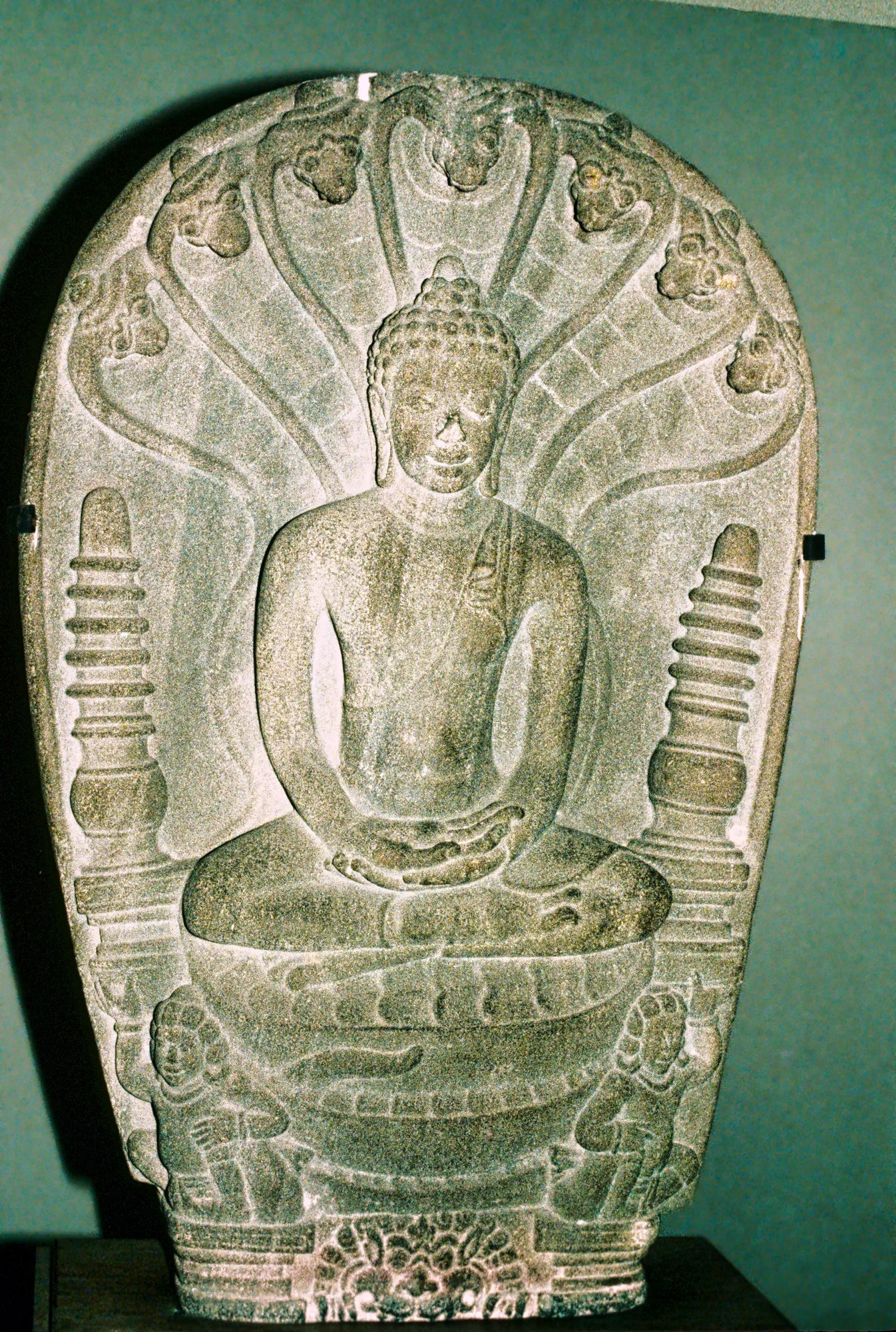
Dvāravatī (8th to 10th centuries) was the oldest Thai kingdom. It was led by the Mon ethnic group from lower Burma, who were heavily influenced by Indian culture and art styles. Dvaravati statues show characteristics of the Mon people, like broad faces, full lips, and a gentle smile.
This statue depicts the Buddha in the Dhyana Mudra: lotus position with his hands resting on top of each other. In other words, Buddha is meditating while being protected by the hood of a multi-headed nāga. The word nāga is derived from the Sanskrit naja, which means cobra, known for its hood.
Sukhothai Buddha Statue
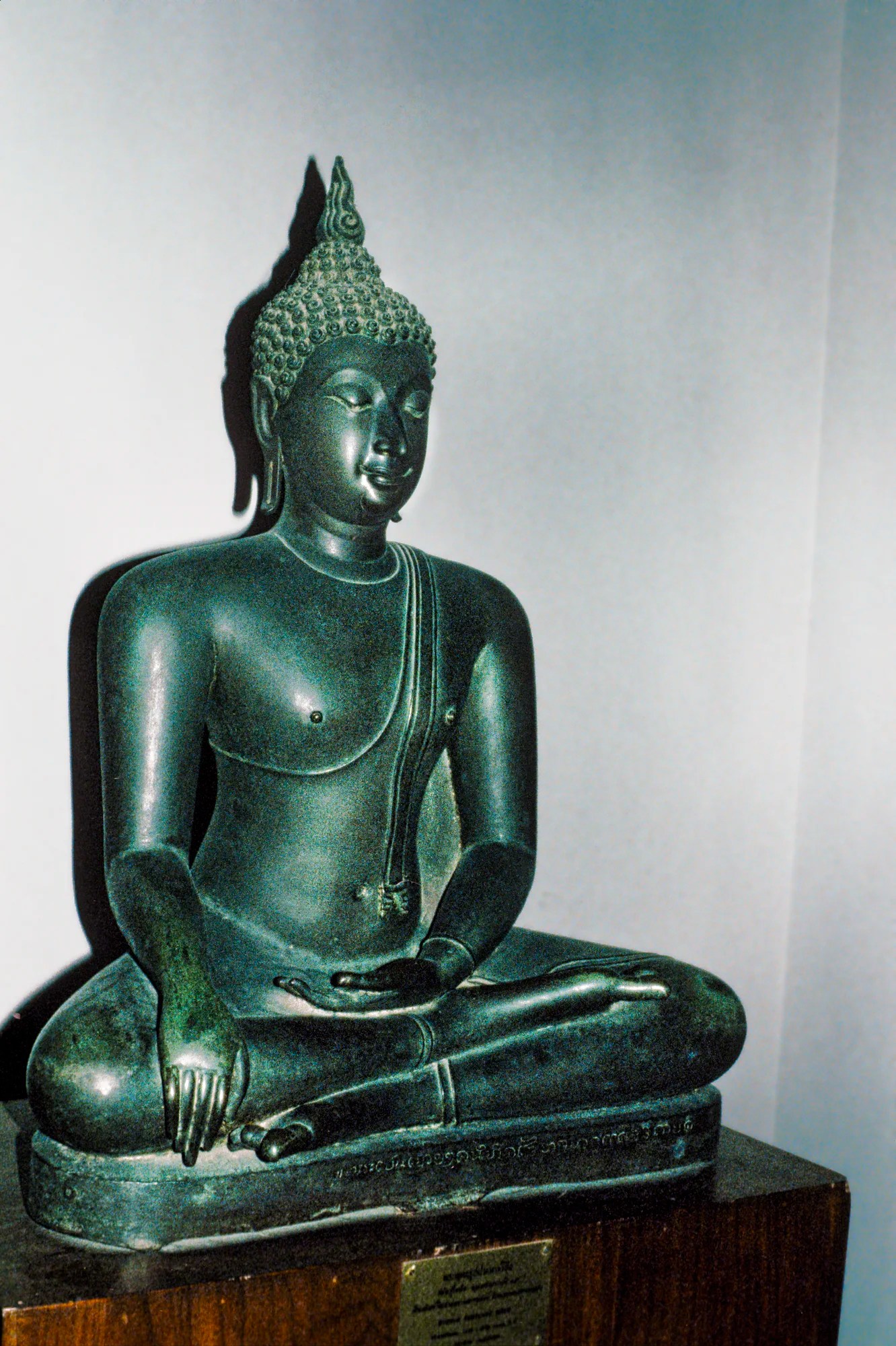
After liberation from the Khmer Empire in the 14th century, Sukhothai became the first Thai-based kingdom of Thailand. They adopted Theravāda Buddhism, which was adapted from Sri Lanka.
This classical Buddha image displays the Subduing Mara mudra, which is a reminder of the story of Mara and his army trying to prevent Buddha from achieving enlightenment. Buddha points his right hand downwards to call the Earth Goddess to bear witness to his good deeds. She wrings water from her hair representing all his good deeds, and the flood drowns Mara and his army.
Elements of the Sukhothai style are an egg-shaped face, downward-looking eyes, and shell-shaped hair curls. The influence of Sri Lanka is shown by the flame-like ushnisha or bump on the head of the Buddha. Originally, the bump was a topknot of hair. Later, the ushnisha symbolizes the supreme power of the Buddha’s enlightenment or his spiritual energy.
Buddha Mother of Pearl Panel
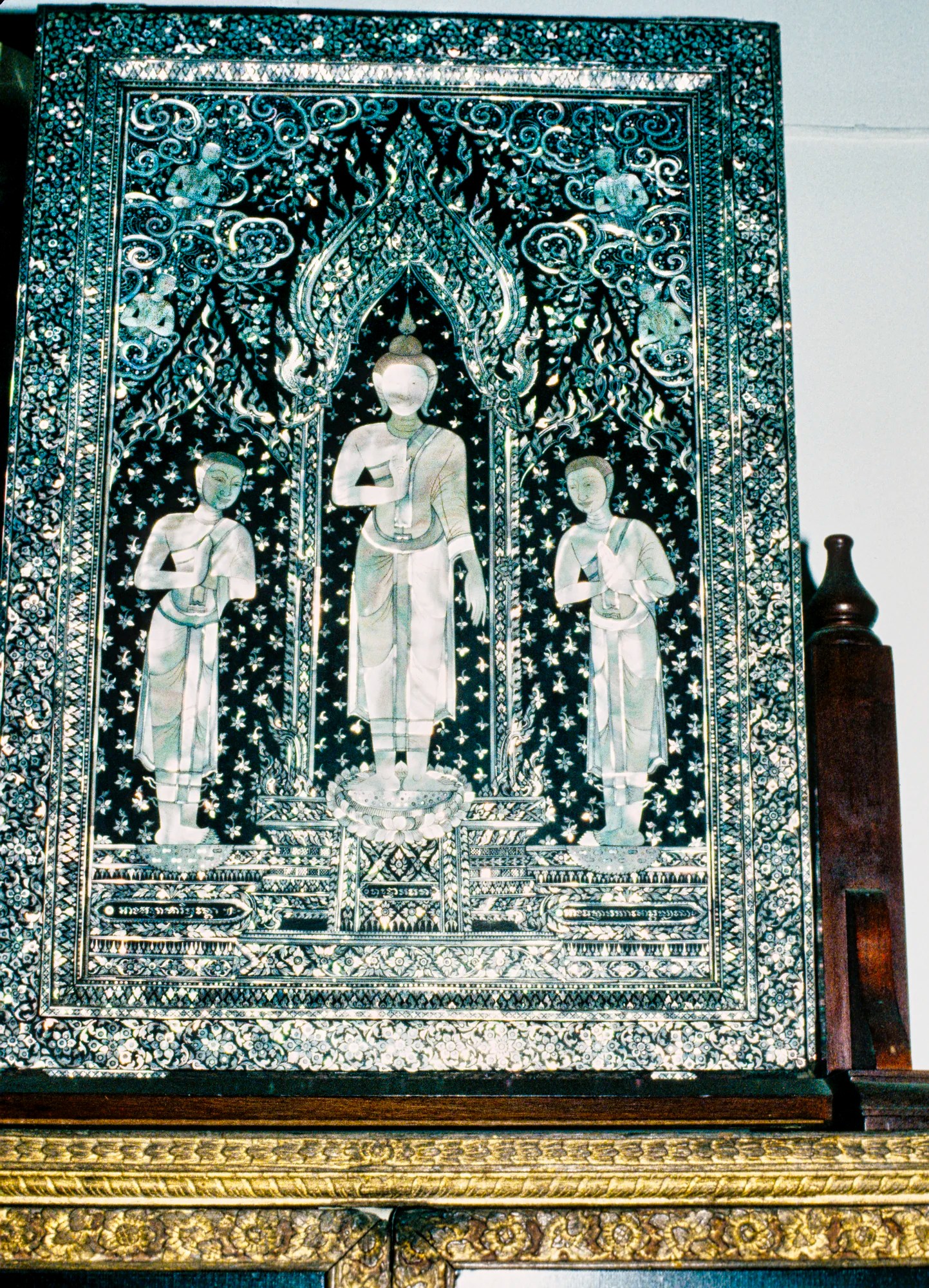
This exquisite wood panel with mother-of-pearl inlay depicts Buddha and two disciples.
We hope this synopsis has “enlightened” you to appreciate that not all images of the Buddha are the same. Moreover, because Buddhism preaches tolerance, Thai art and architecture have incorporated ideas and motifs from animism, Hinduism, and various Buddhist neighbours, even though they were often military opponents.
Elephants
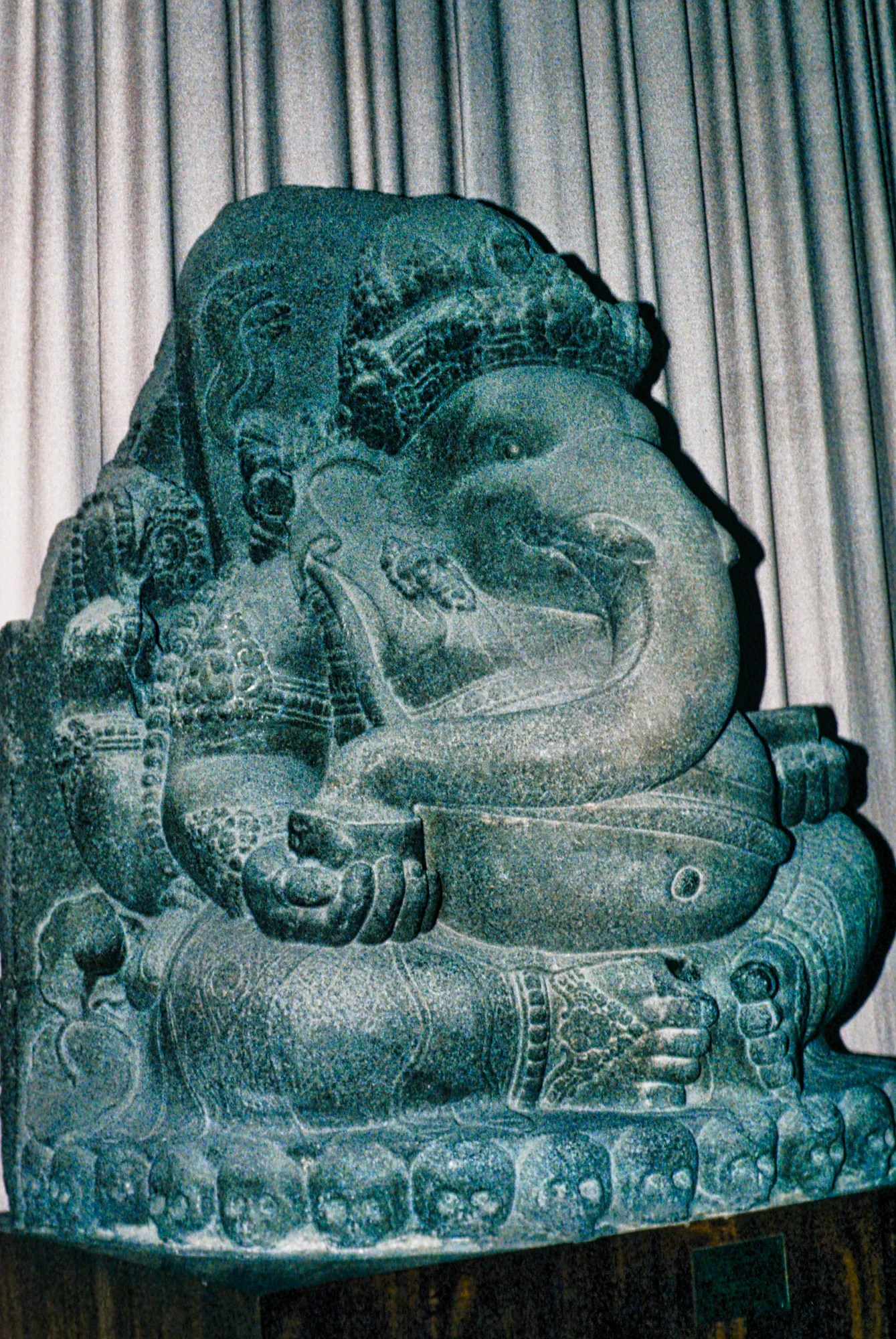
Not all museum artifacts are of the Buddha. This is a 10th-century Javanese statue of the Hindu god Ganesh.
Indianization
India was the most advanced country in ancient times (322 BC to 1279). During the Indianization Period of SE Asia, the tribes emulated their more advanced neighbour and adopted first Hinduism and then Buddhism.
Hindu deities and motifs are still part of Thai Buddhism. Besides religion and architecture, Indian culture has made a major impact on Thailand as well as Southeast Asia:
- Culture — marriage and ordination ceremonies, merit making;
- Art and Literature — influenced by Hindu epics like the Ramayana;
- Cuisine.
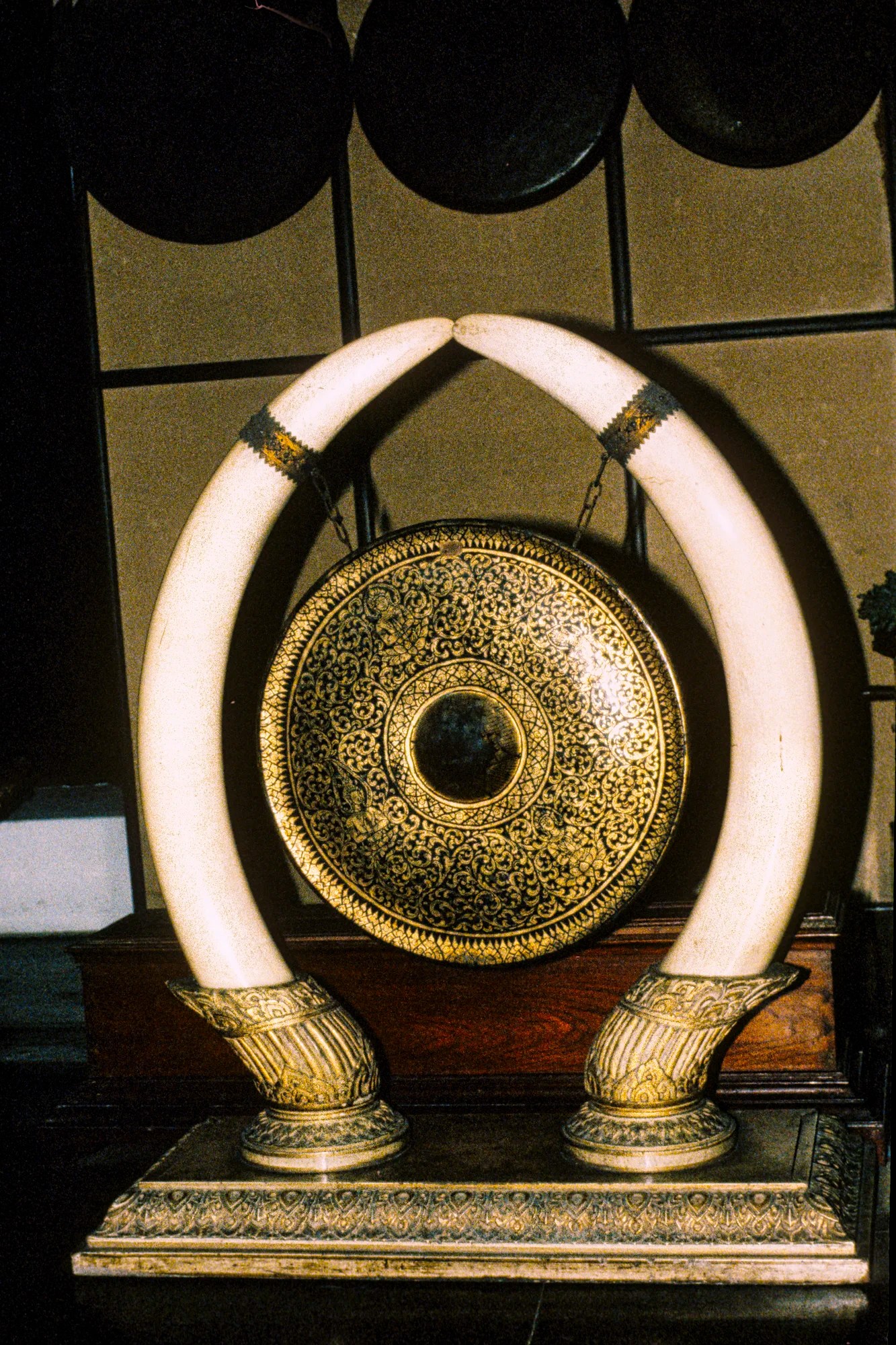
In addition to this gong hanging from elephant tusks, there was a room with a forest of huge elephant tusks. Elephants were used for agriculture, forestry, and warfare, and so they are integral to Thai culture and history.
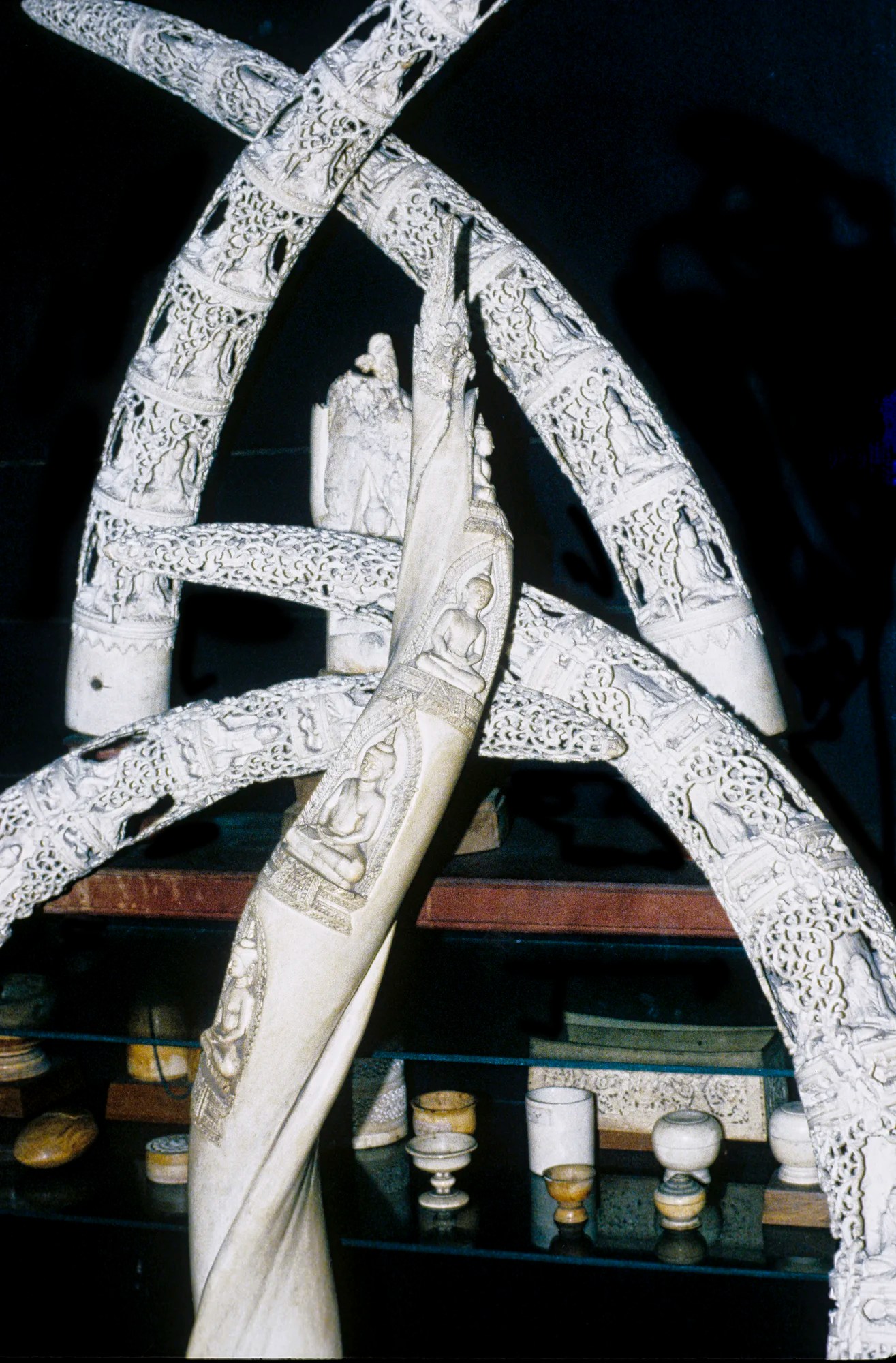
Superb examples of ivory carving can be found in the National Museum. These were done in the late 19th and early 20th centuries by craftsmen patronized by the royal palace or powerful families. These usually have Buddhist themes.
Benjarong Pottery
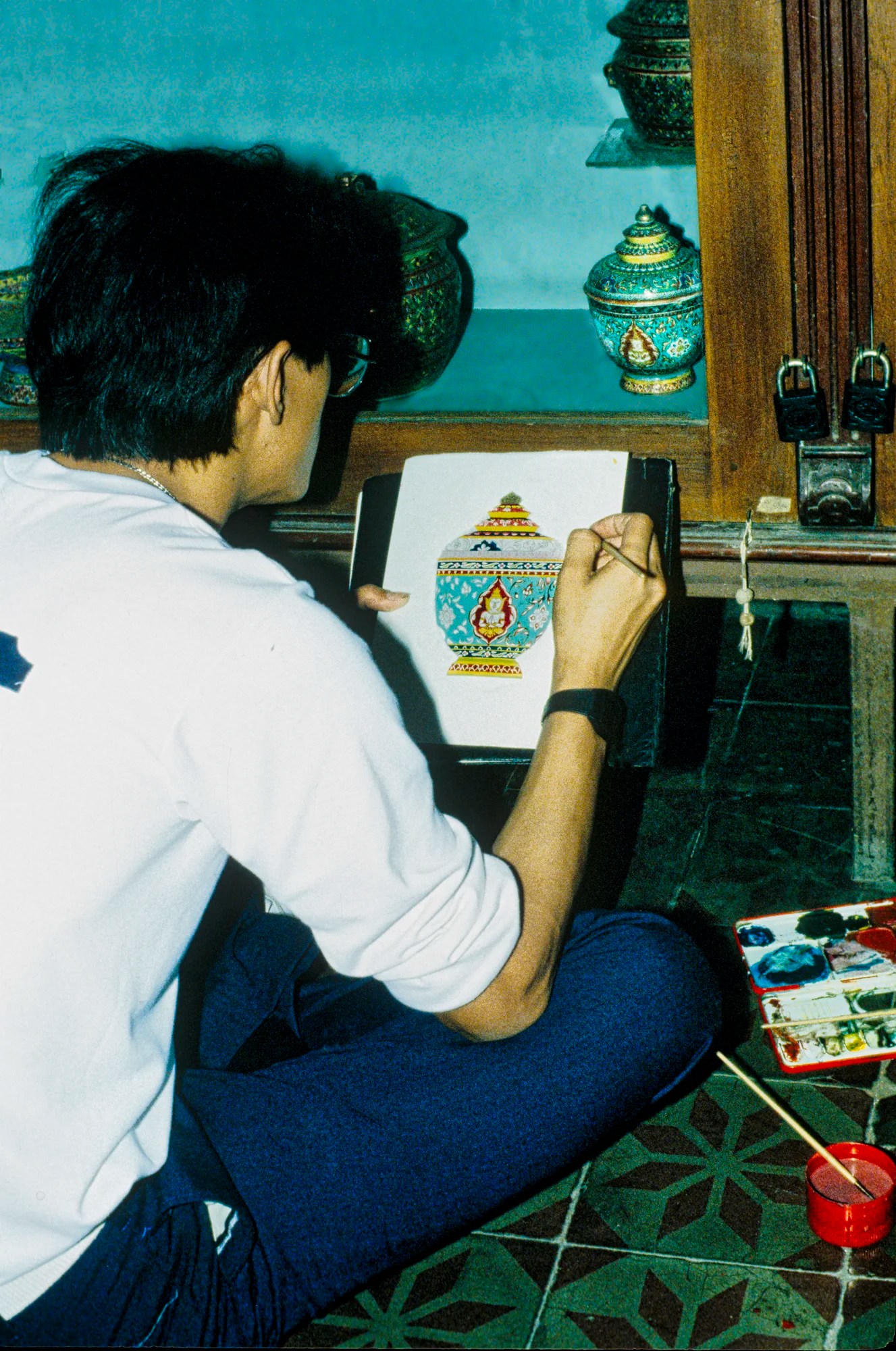
The clay in Thailand is not as fine as in China, so pottery never reached the same height. Thais started to produce porcelain after they discovered their own source of kaolin.
Benjarong (or Bencharong) was invented in Zhejiang province, China (Hangzhou area). Benjarong means “five colours” but as many as eight colours may be used. After firing the blank pottery, a pattern is drawn on the white porcelain. Each enamel colour is applied one at a time and fired, always starting with the colour needing the highest temperature. Gold, when used, would be fired last. This results in very brilliant colours as well as a swelling effect over the surface. Production is extremely labour-intensive.
Unlike Chinese asymmetrical designs, Thai pieces were symmetrical with repeating motifs, often of mythological creatures. Benjarong ware was mostly used for rice bowls, jars, and tea sets.
Khon Masks
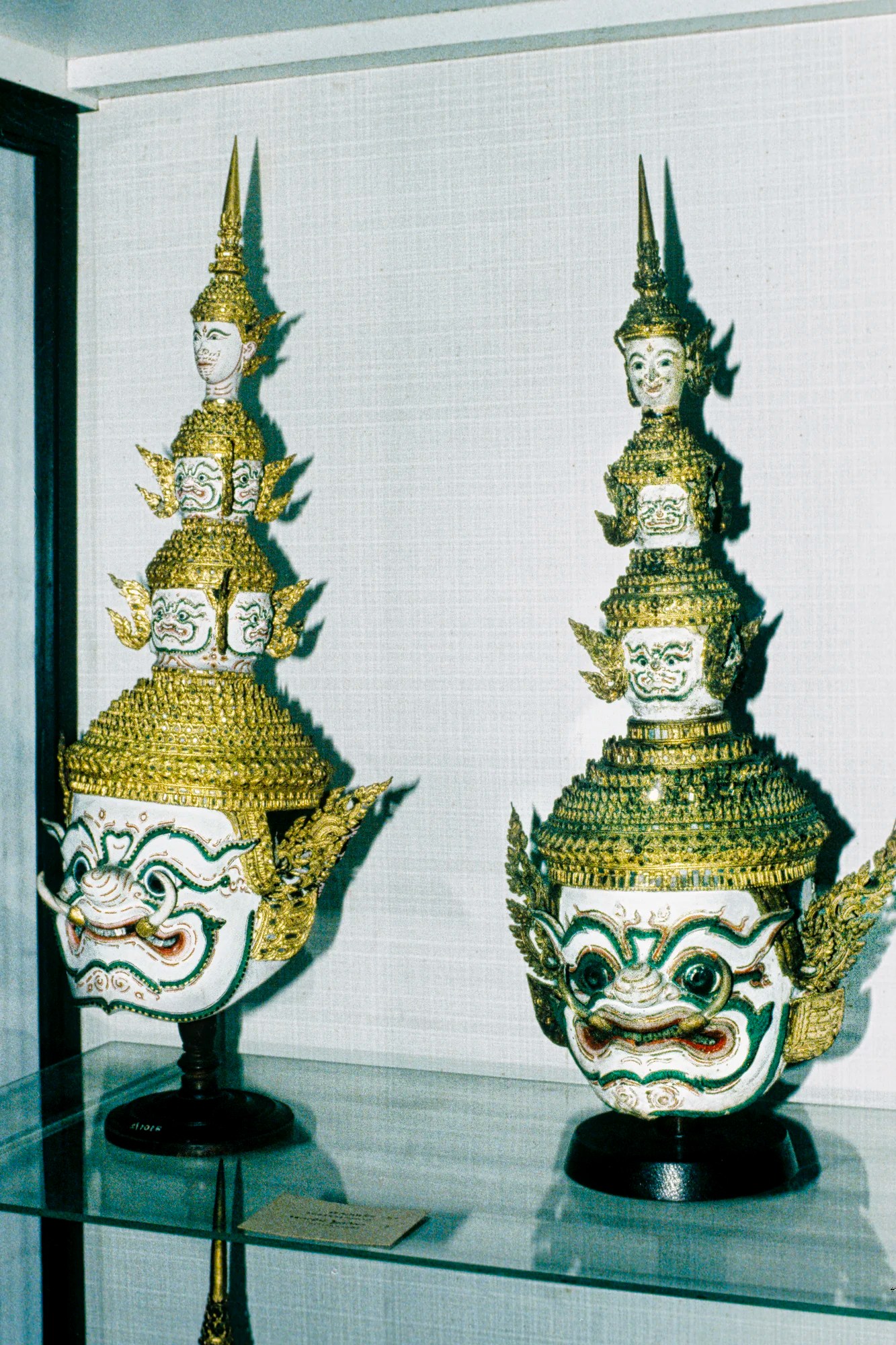
In ancient times, males performed all the roles in Thai traditional dance. Khon is a form of masked dance and drama that is based on stories of the Ramakien. Khon originated during the Ayutthaya Kingdom (1350-1767). The Khon masks, colours, and costumes are not just elaborate but a way to communicate the characters being portrayed.
Classical Dancers Temple Rubbing
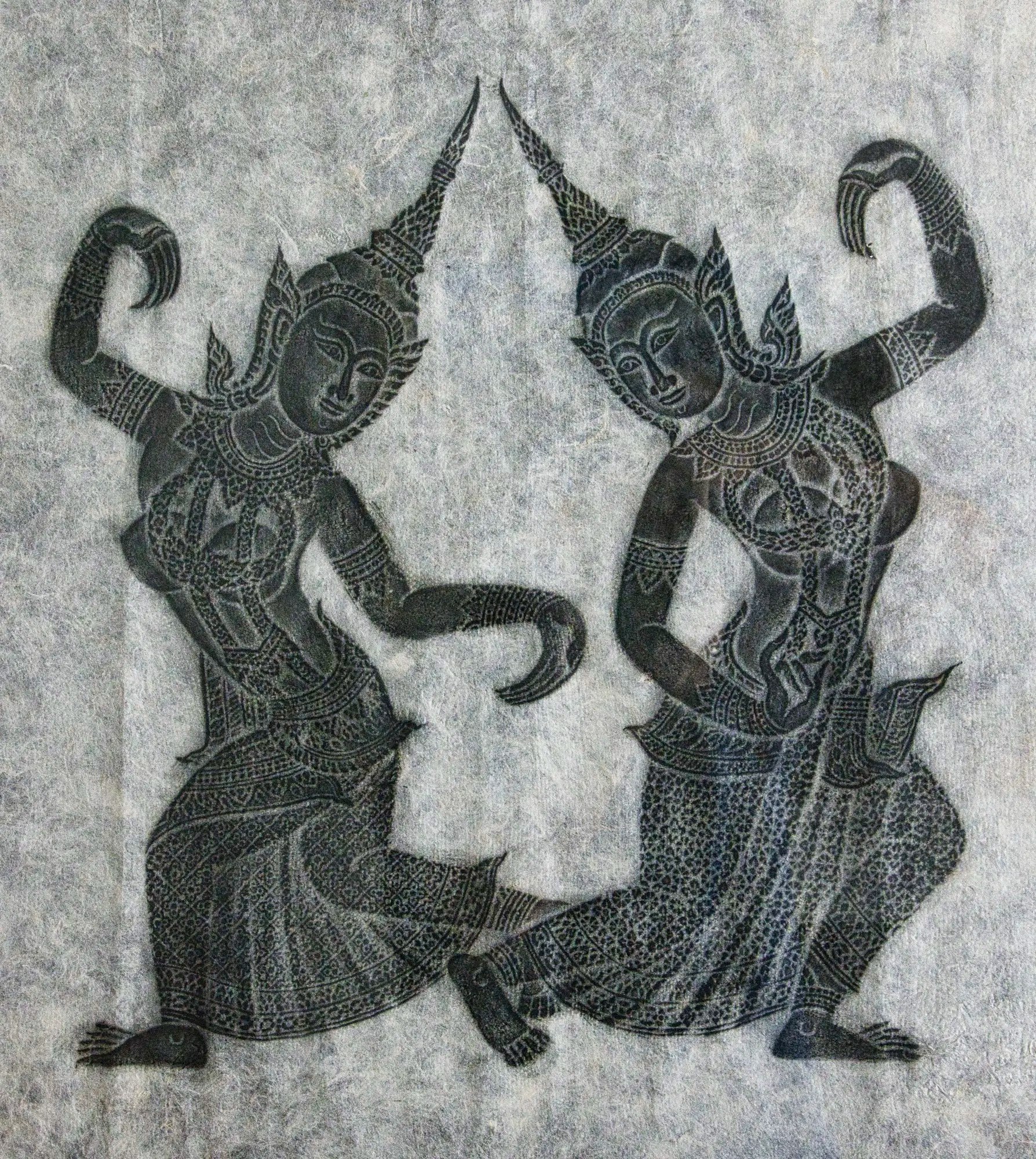
The graceful movements of Thai classical dance are shown in this temple rubbing we purchased on our first trip to Thailand. The dances are derived from Hindu literature about apsaras and the Ramayana. It reminded me of the Kathakali dancing/drama we saw in Kerala, India. Could this be another adaptation from India? So I did further research. Khon originates from the word “koll” or “goll” in Tamil (southern India).
Khon Mask
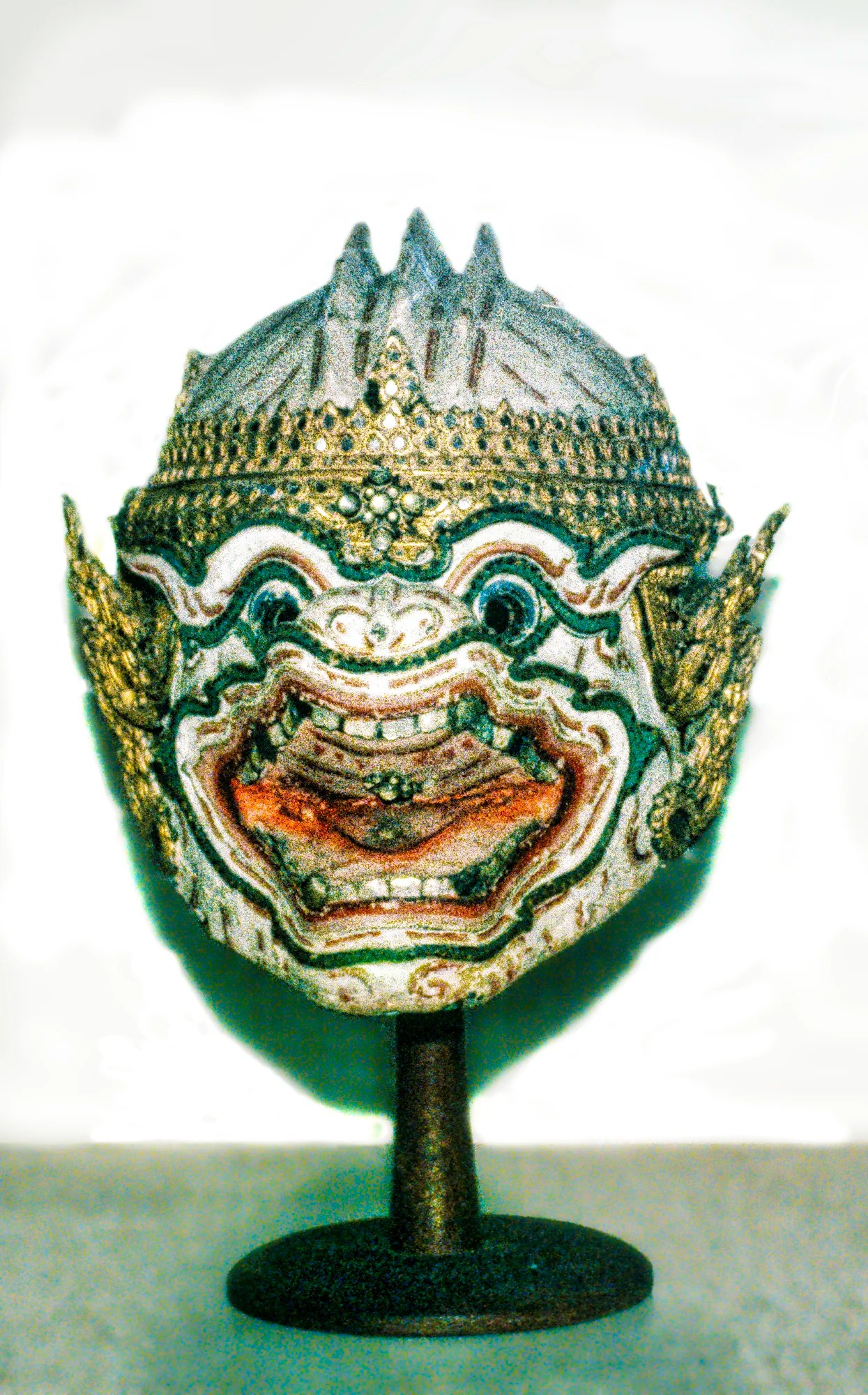
When the Khmer Empire fell, the Thais kidnapped their artisans and dancers and brought them to Ayutthaya, which probably led to the introduction of Khmer dancing, which in turn was inspired by Indian classical dancing. A white-faced mask represents Hanuman, king of the monkeys.
Kathakali Dancer
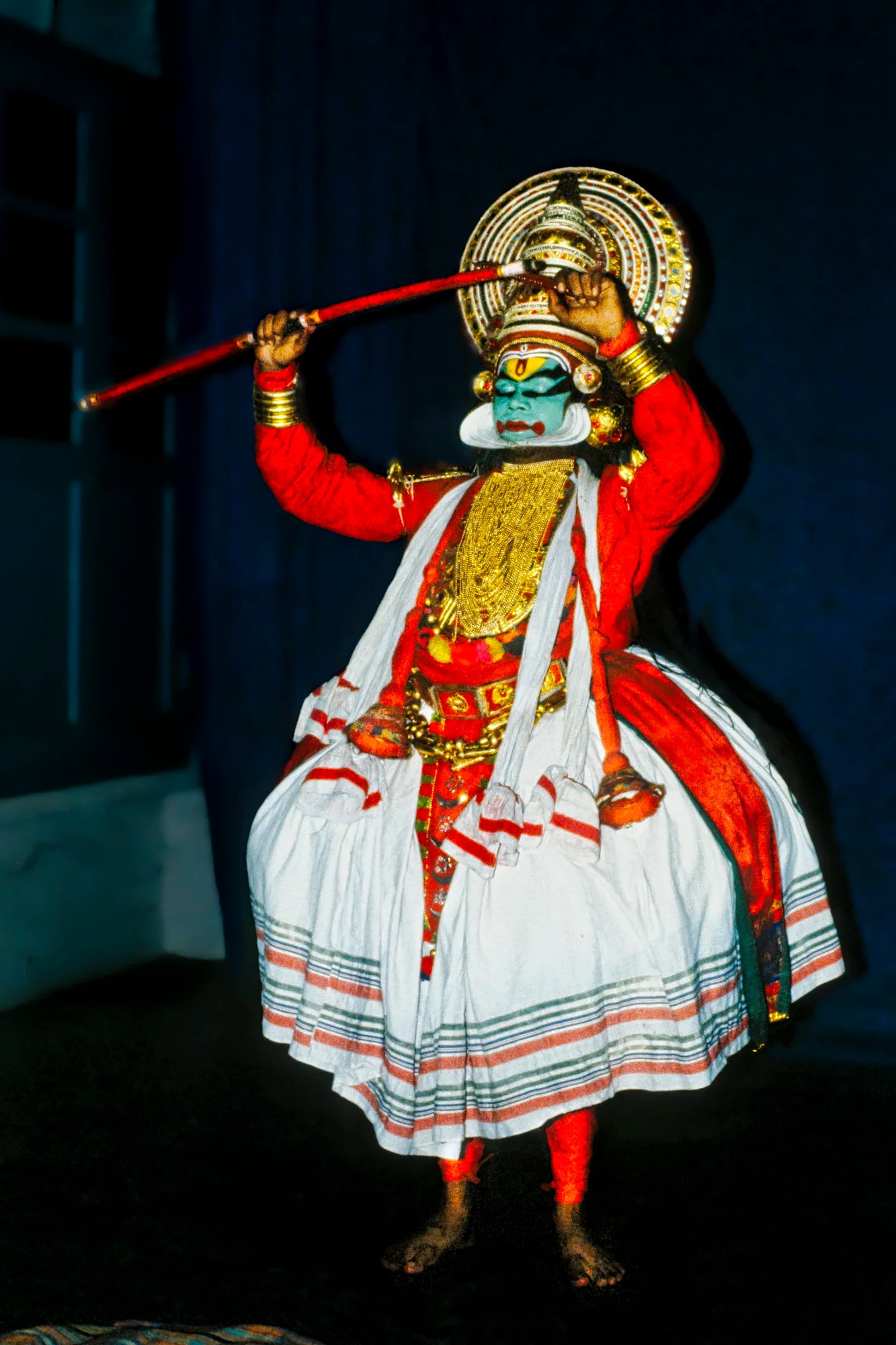
Rather than use masks, Kathakali uses makeup to paint the faces the required colours and patterns. We watched one of the main actors apply his paint and costume for over an hour before the performance. It turned out that our host was one of the “good guys”. Green makeup (pachcha) with red lips is used to portray heroes such as Krishna, Vishnu, Rama, or Arjuna.
Chariots
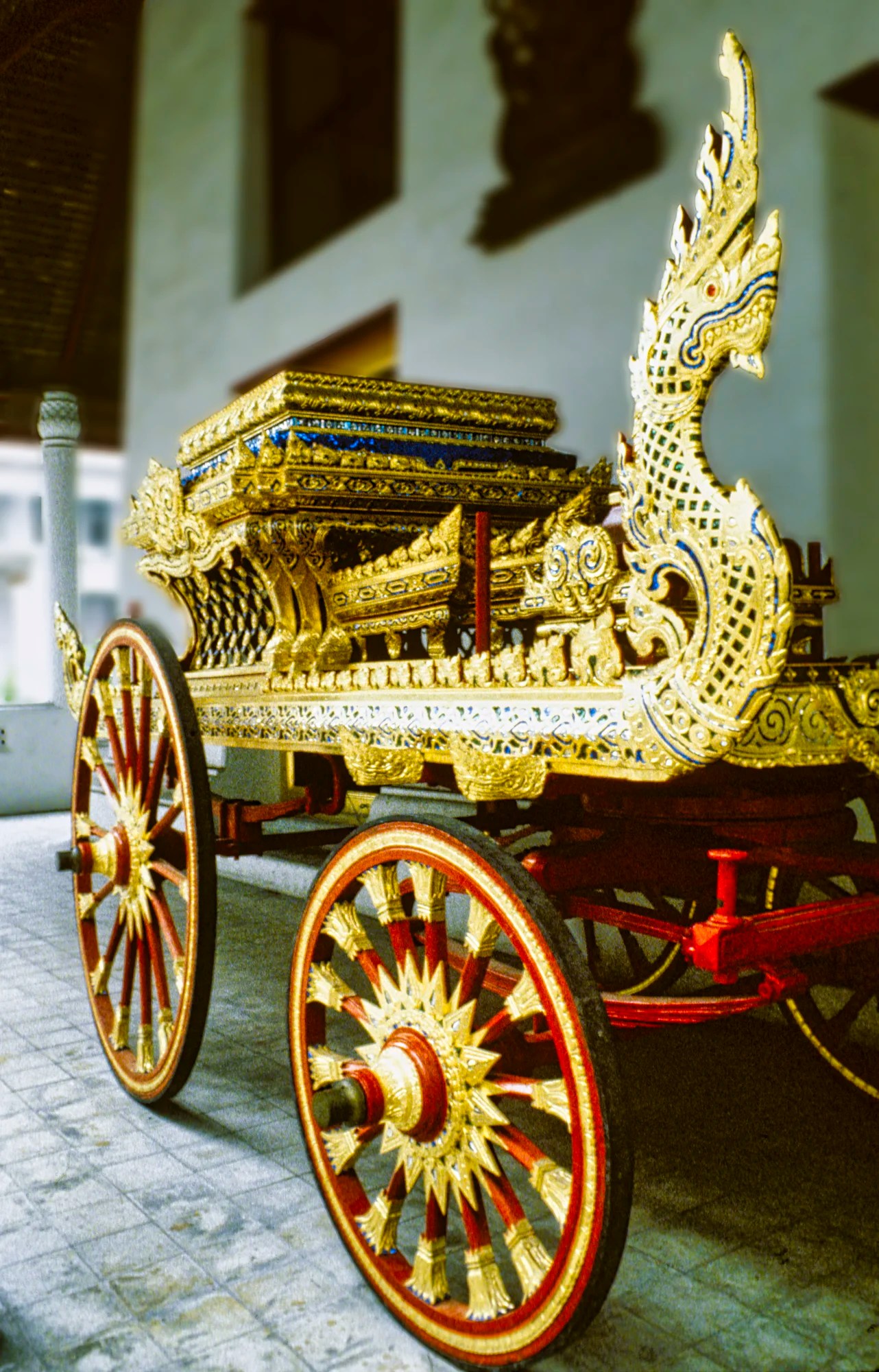
Chariots are built of teak and are as ornately carved and gilded as a wat. Despite the term “chariot”, they have four wheels. It is assumed that the front wheels are smaller because the chariot was actually lifted up and pulled by as many as 160 men, with another 30 men behind the chariot to act as brakes!
Chariots were used since the Ayutthaya Kingdom, but they were destroyed during the sack of Ayutthaya in 1767. New chariots were commissioned by King Rama I. They take 8 months to build. The current-day monarchs have stopped this tradition as it is too costly for the country.
Generally, these chariots were used for funeral processions. This one was built for the funeral of Princess Malinee Nopdara in 1924. The boat-like platform with naga railings carries a layered throne-like structure.
Wat Pho
Address: 2 Sanam Chai Road
Open: 08:00 to 18:30 daily
Tickets: THB 200 = USD 5.60
Wat Pho (G4.6), the largest temple complex in Bangkok, occupies 20 acres (80,000 sq m) immediately south of the Grand Palace. Wat Pho was built by King Rama I. It took 20,000 workers 7 years to rebuild the original Wat Pho! It was also the first public school and university.
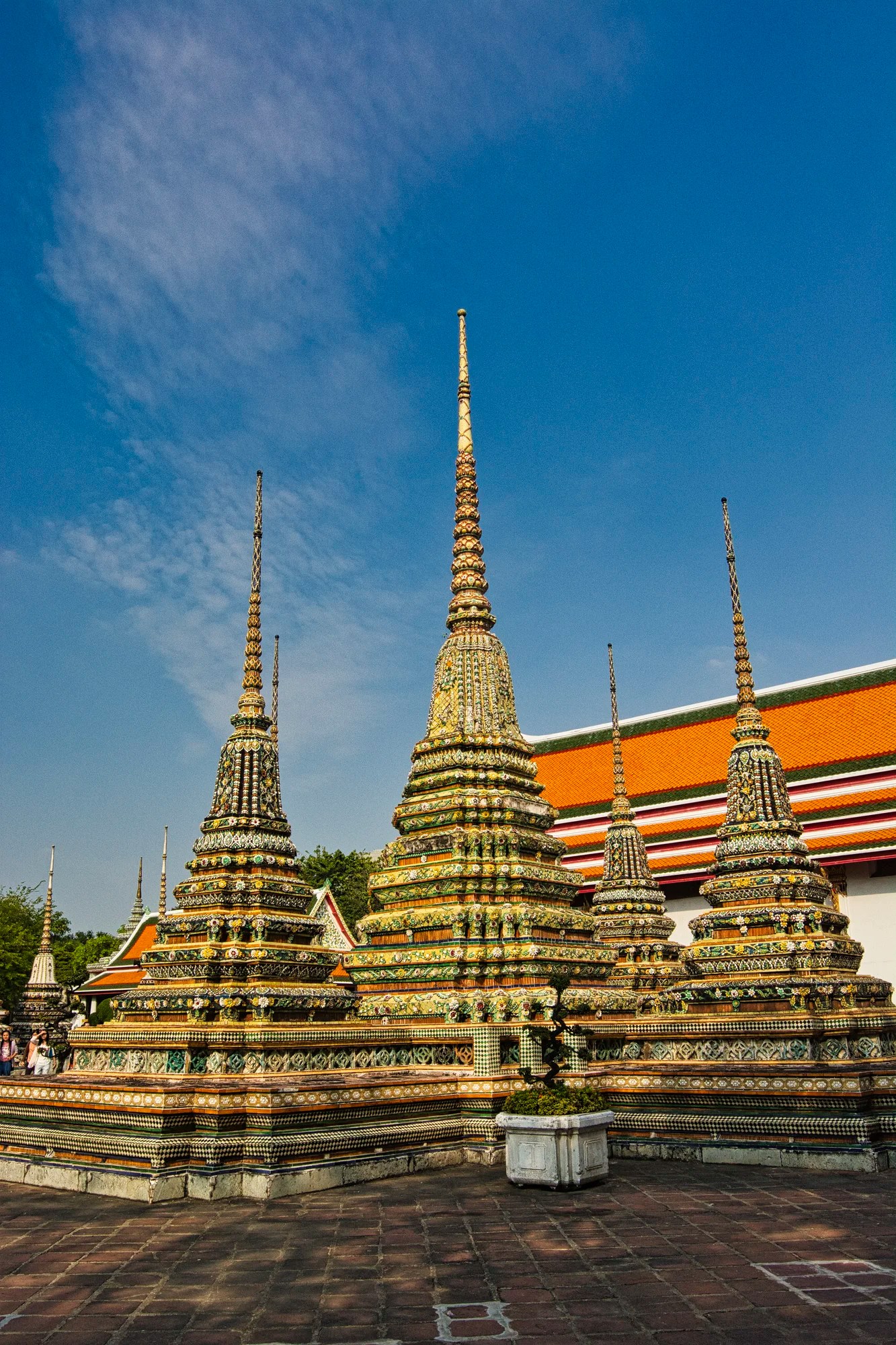
Note that the “h” in Thai is silent, so Pho is pronounced Po. Its’ full name is Wat Phra Chetuphon Wimon Mangkhalaram Rajwaramahawihan.
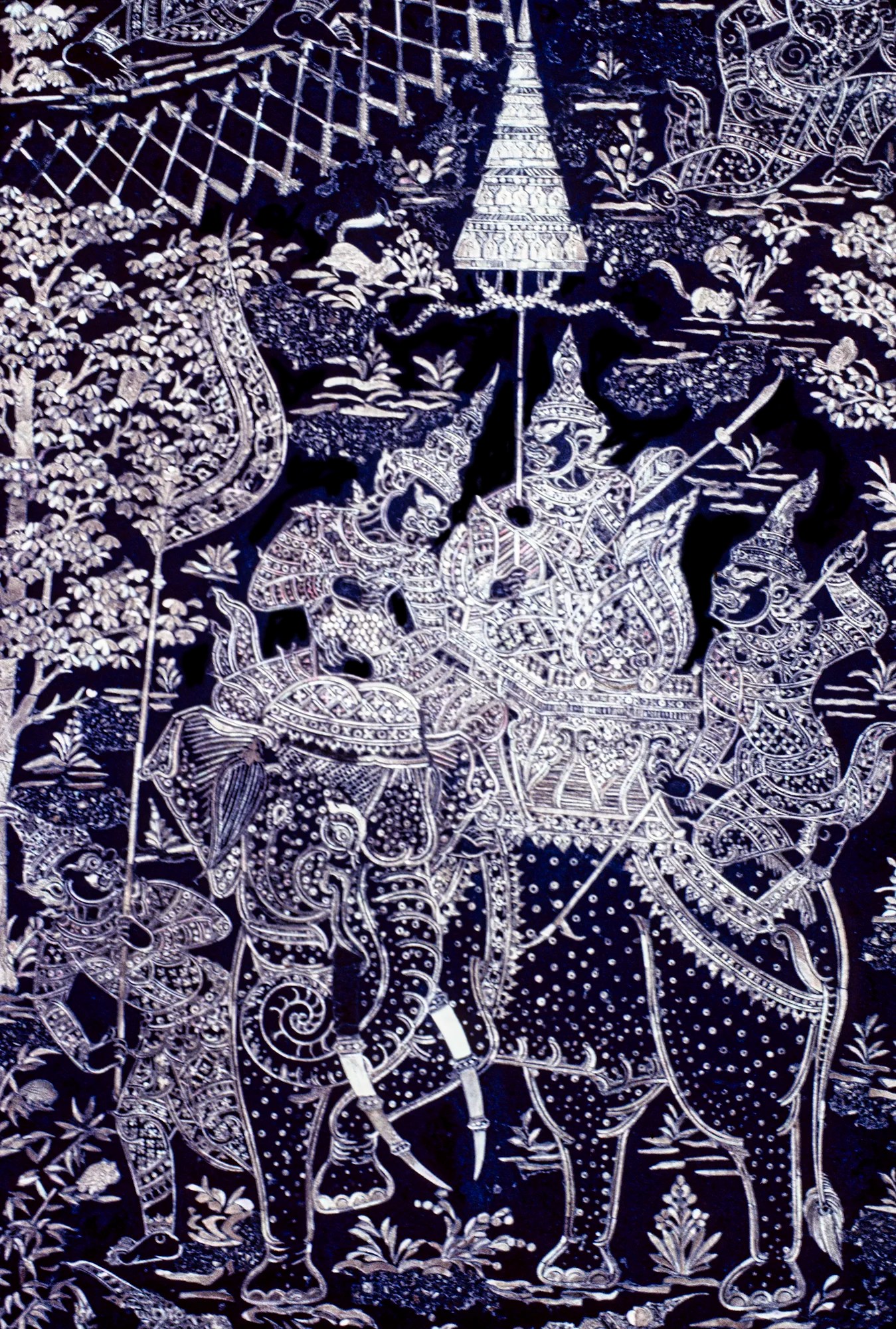
We found this elephant mother-of-pearl inlay on the west door of the ubosot. It appears to be a scene from the Ramakien, perhaps portraying Hanuman, king and general of the monkey army.
King Rama I salvaged 1248 Buddha images from the sacked capital of Ayutthaya, and a large number (400) were installed in Wat Pho. In the cloisters are rows of Buddha statues — see photo in the Buddha Statues section above. You will be excused for thinking all Buddha statues are the same.
Reclining Buddha Statue
Major renovations to Wat Pho were made by King Rama III, which took over 16 years! Most importantly, he built the most famous viharn. The highlight of this hall is the massive Reclining Buddha (G4.7). This place is extremely popular, but is it just because of name recognition? Do tourists know why they are visiting this statue?
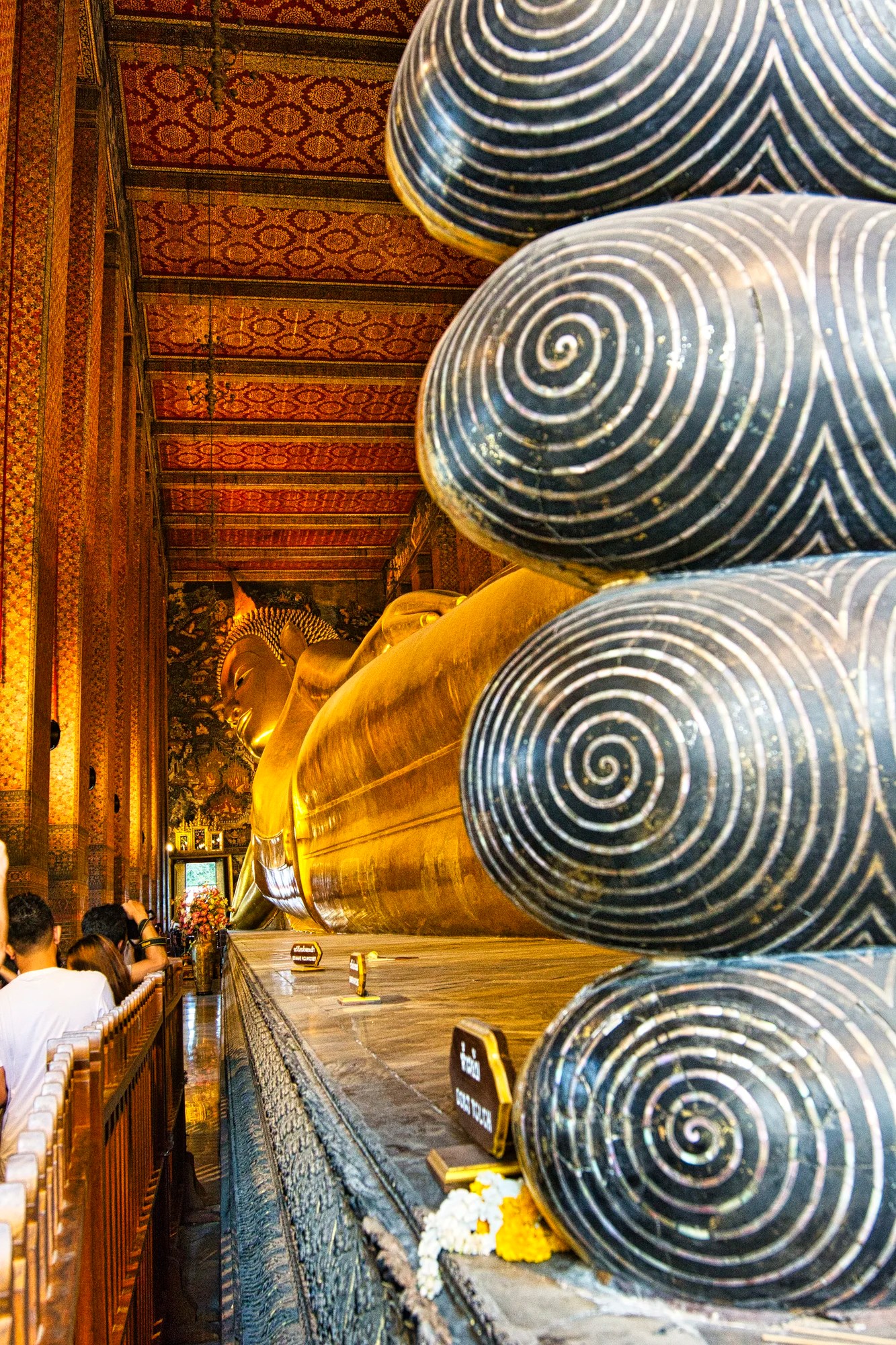
Reclining statues portray Buddha’s protracted death due to food poisoning. The statue really needs a large open space, and the viharn is very narrow with too many tourists. It is difficult to get a photo of the whole 46 m long image due to all the people.
Buddha’s Head
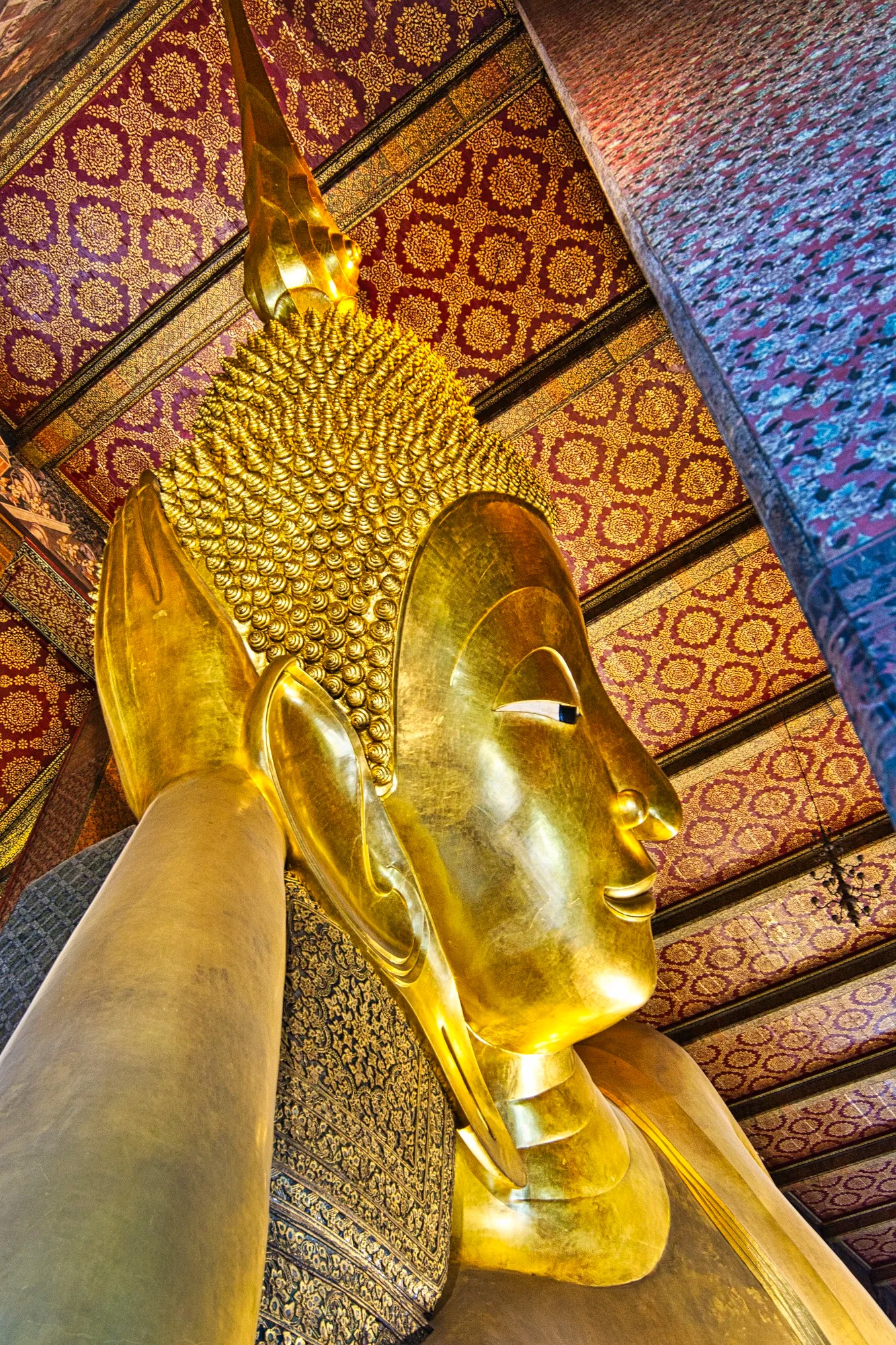
The best part of the sculpture is the Buddha’s head. It follows the prescribed norms for portraying the Buddha. The protuberance of his head is called ushnisha. It was originally a topknot but later became a symbol of the supernatural, symbolizing his enlightenment. The curls of his hair represent the fact that he cut his long hair when he renounced the throne. His long ear lobes represent the heavy earrings Prince Siddhartha used, which would elongate the ear lobes.
It is also very dark. In fact, I used the Luminar Neo editor to increase the light in my photo.
Buddha’s Mother of Pearl Feet
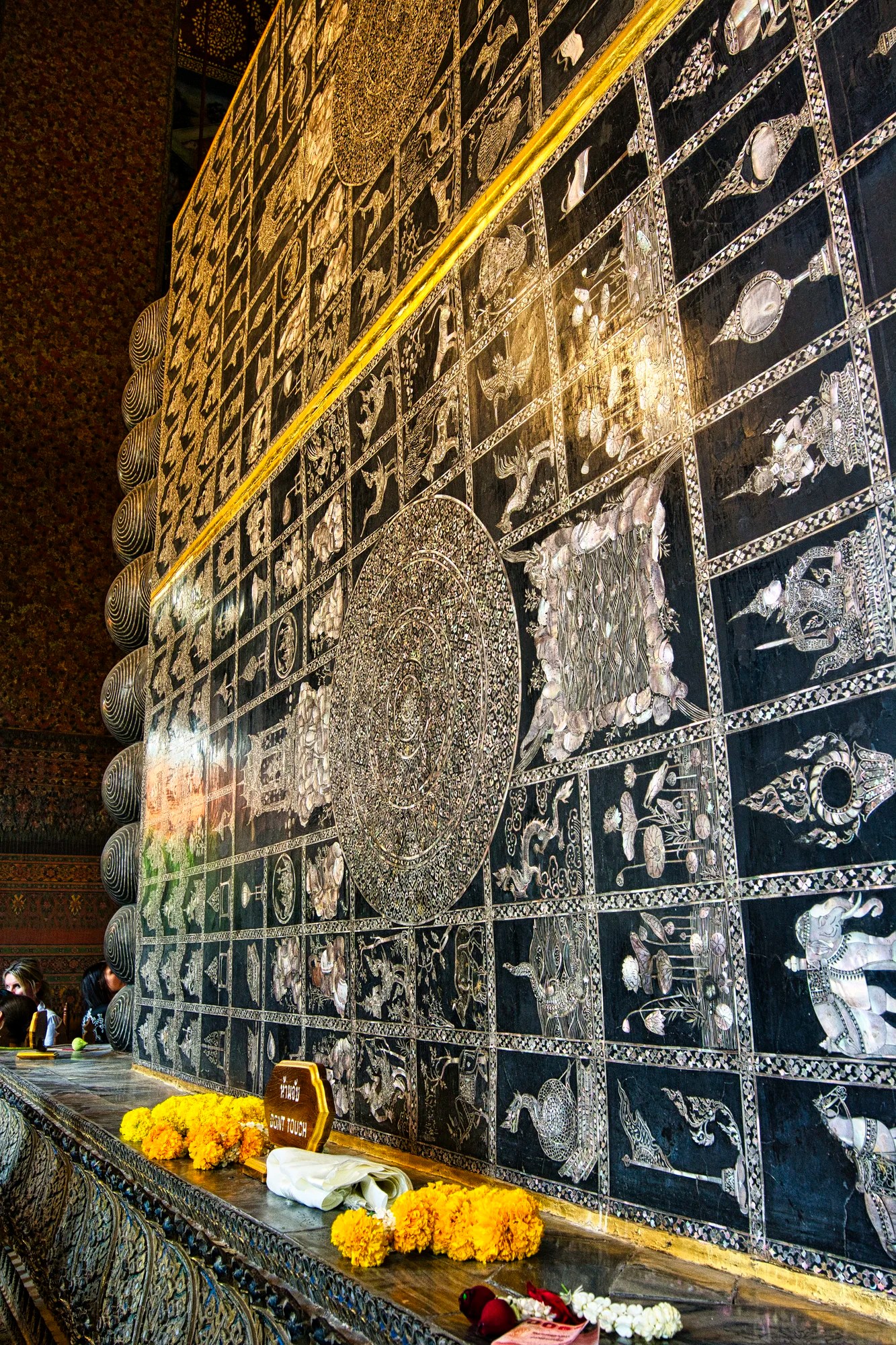
But, the real highlight of the statue is the 3 m (yards) high by 4.5 m (yards) long feet of the Buddha. Spend most of your time appreciating the incredibly delicate “paintings” in mother-of-pearl inlaid on a black background.
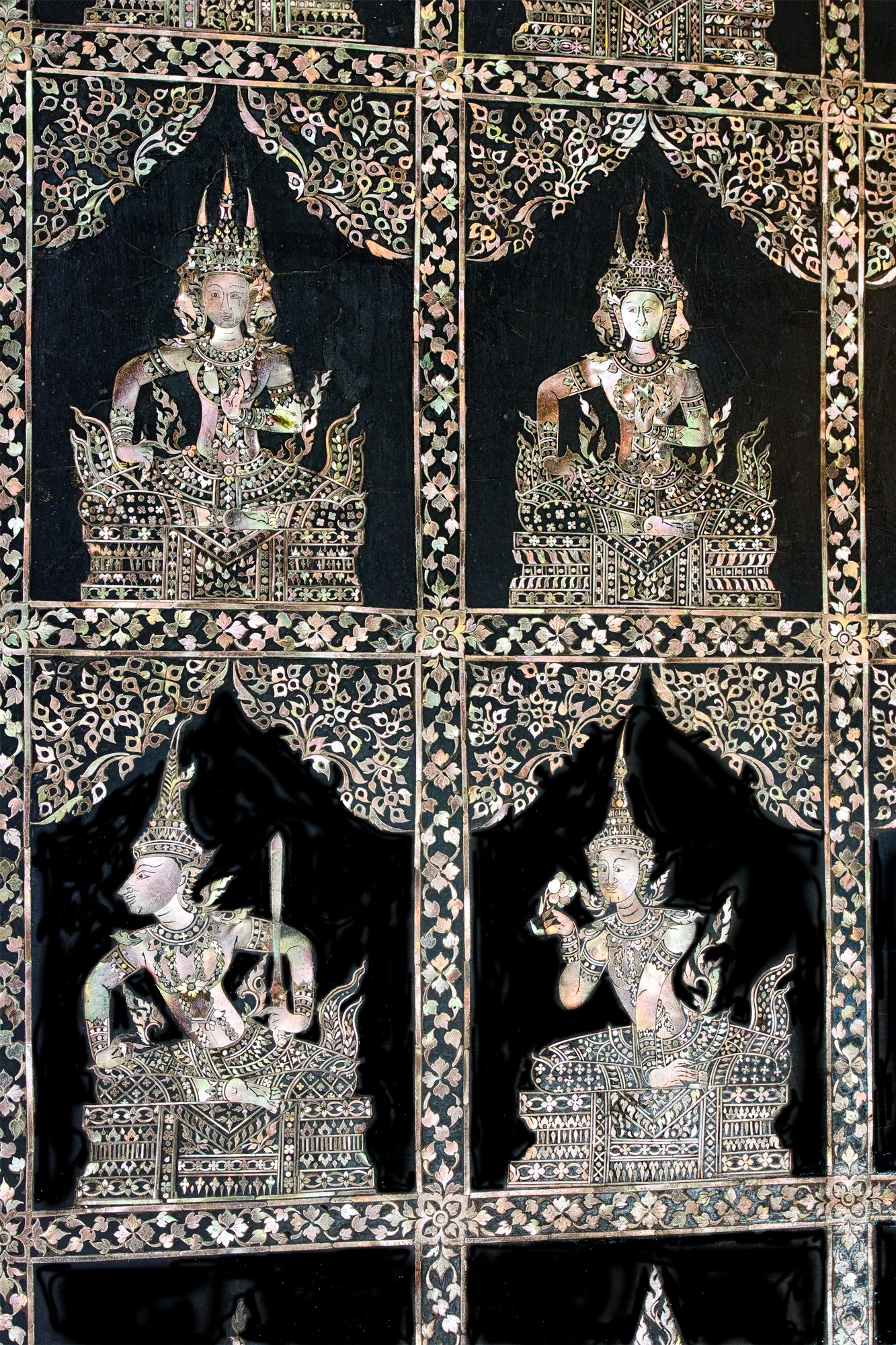
Every centimetre is meticulously decorated. The soles of the feet are divided into 108 “panels” depicting lakshanas (Sanskrit for auspicious mark or quality) that are linked to the Buddha. I could not find any detailed descriptions of all these symbols. Here are a few examples with descriptions that you can look for:
Dharmachakra Mother of Pearl
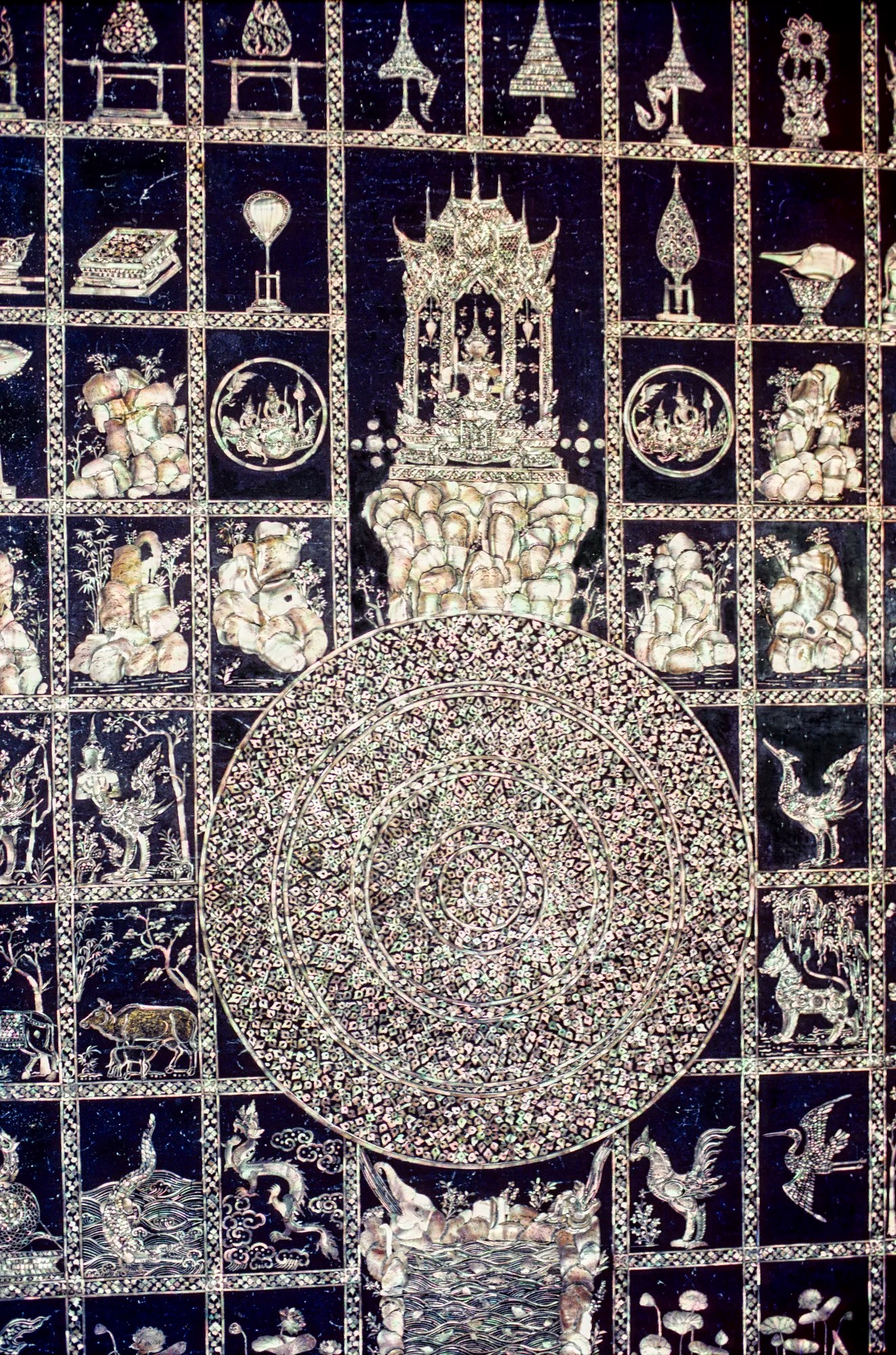
The most dominant symbol is the large Dharmachakra at the centre of the sole. This depicts a wheel, which originated from Vedic tradition but has become iconic in Buddhism. It usually has eight spokes, which represent the Eight Fold Path, the basic values behind Buddhism. Above the Dharmachakra, Buddha sits on a throne in the shape of a prasat temple. There are several umbrella lakshanas at the top of the photo.
Makara, Naga and Lotus Mother of Pearl
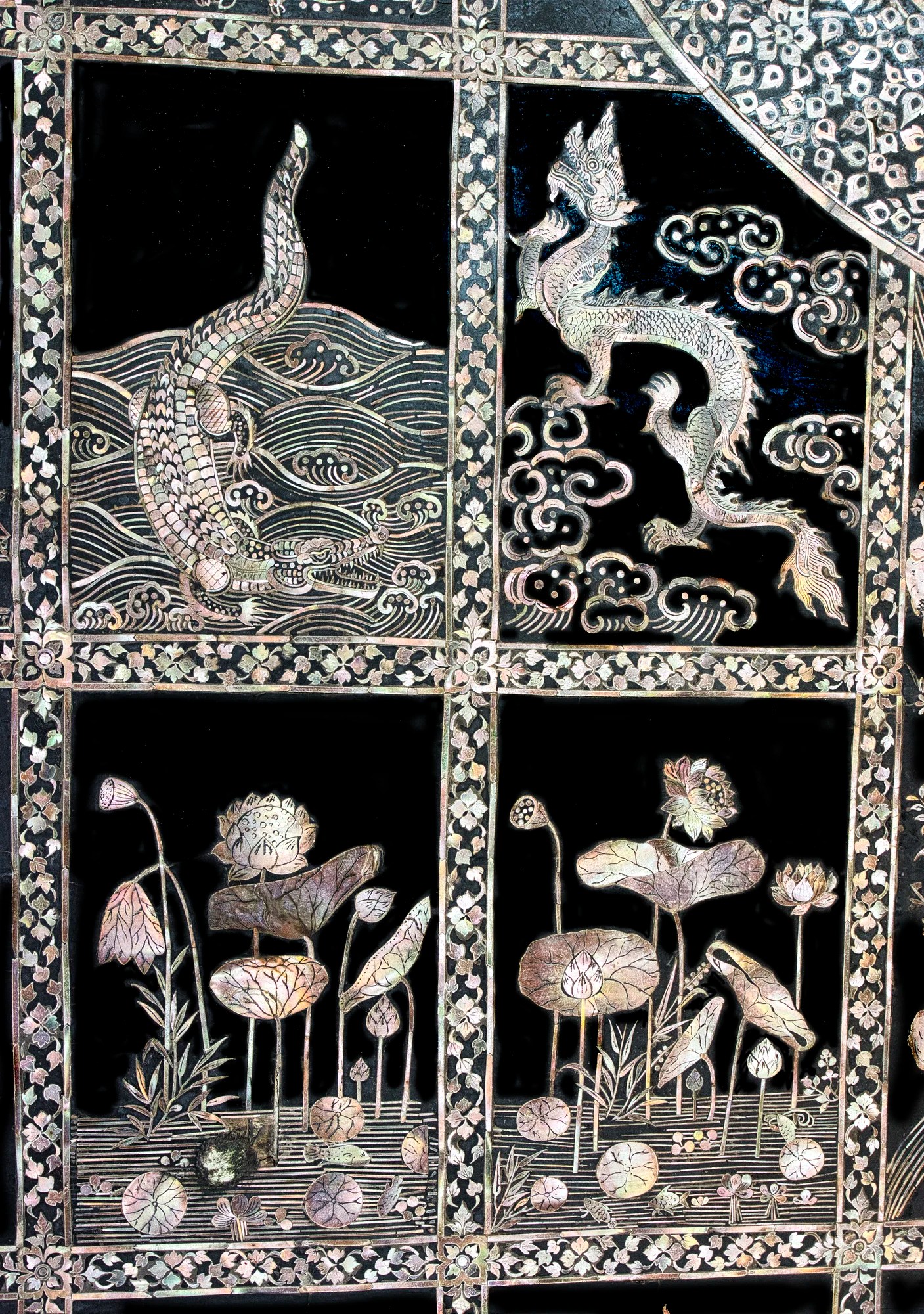
The upper left panel shows a makara, which is a mythological crocodile associated to the sun. The upper right panel shows a nāga, which is a mythological snake associated with water. The two creatures are revered because they ensure good harvests, important for an agrarian economy. The bottom two panels depict the lotus, which symbolizes purity because it rises from the mud untouched.
Elephant Mother of Pearl
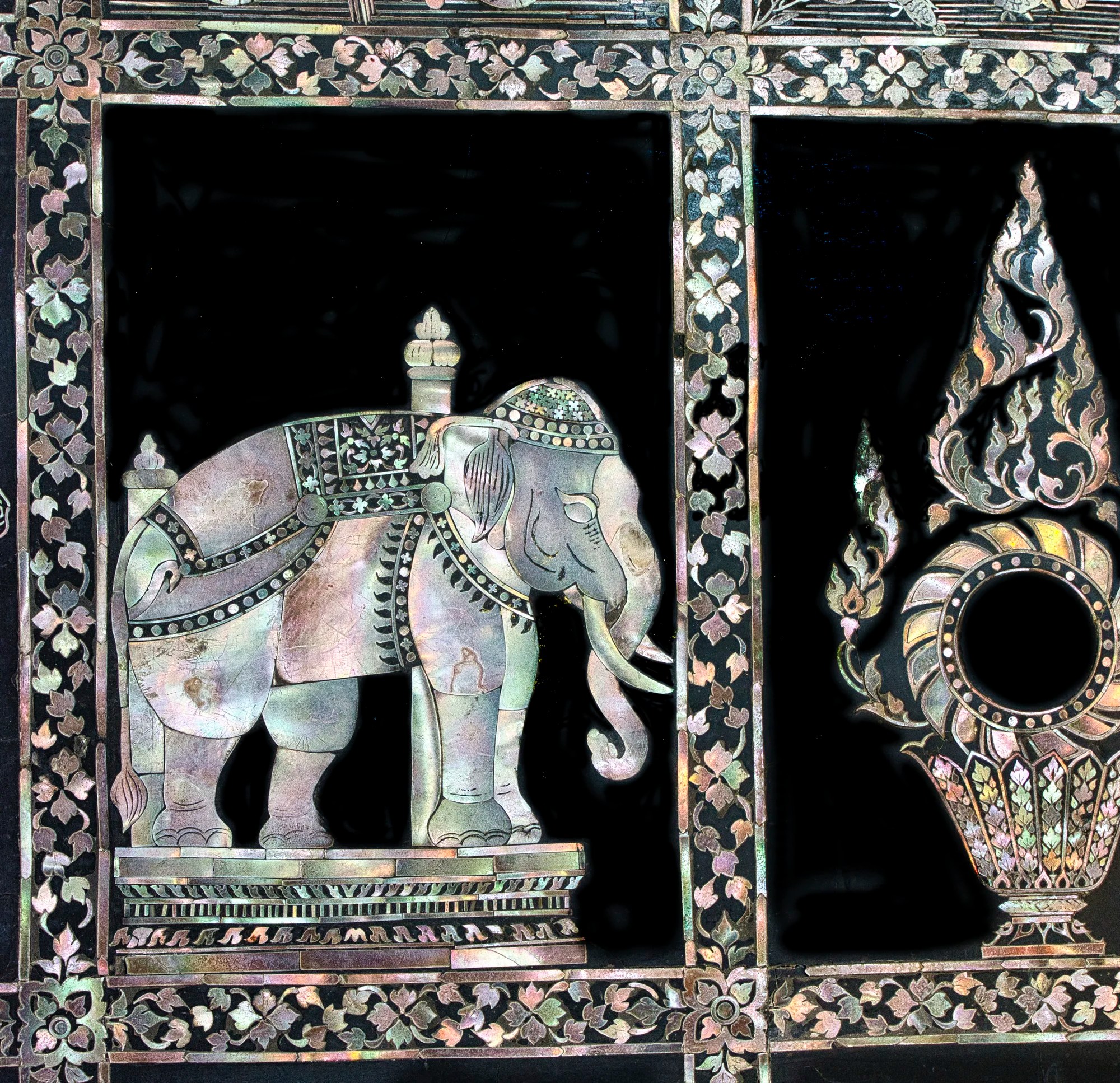
The elephant is linked to the Buddha. The rare white elephants contain the soul of the Buddha. Elephants symbolize wisdom, mental strength, responsibility and royalty in Thai culture. These same attributes apply to the Hindu elephant god Ganesh.
The elephant panel is one of my favourites. In fact, it is the Mother of Pearl feet that make Wat Pho worth visiting.
Phra Maha Chedi Si Rajakarn
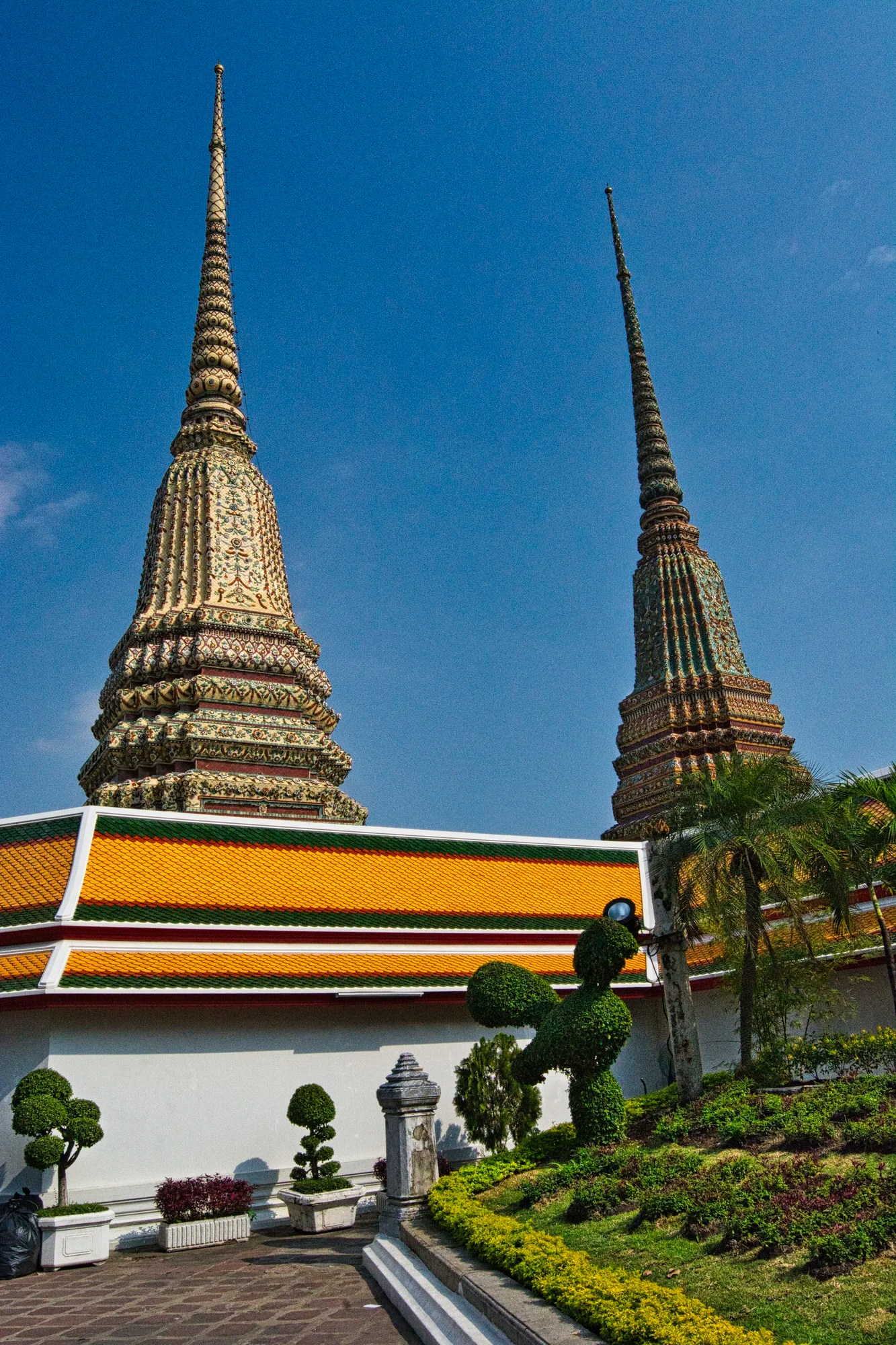
Four royal (Phra) large (Maha) chedis commemorate the first four kings of the Chakri (Bangkok) Dynasty. Chedis or stupas symbolize prehistoric burial mounds used to hold the remains of royal people or holy artifacts.
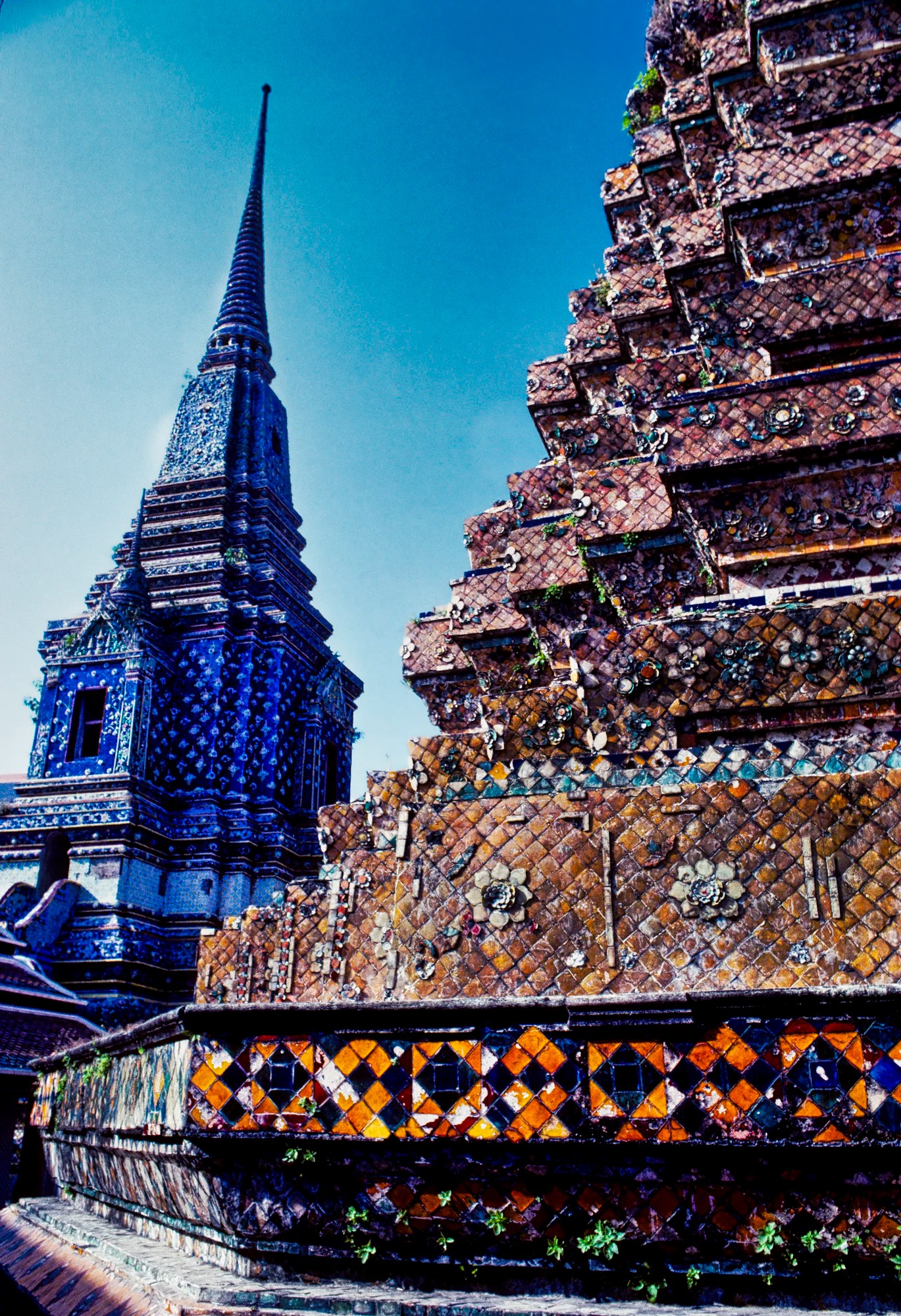
The chedis are covered in Chinese pottery and mosaics. As always in Thailand, the colour, quantity and pervasiveness of decoration are overwhelming. The Blue Chedi was built by King Rama IV.
Phra Chedi Rai
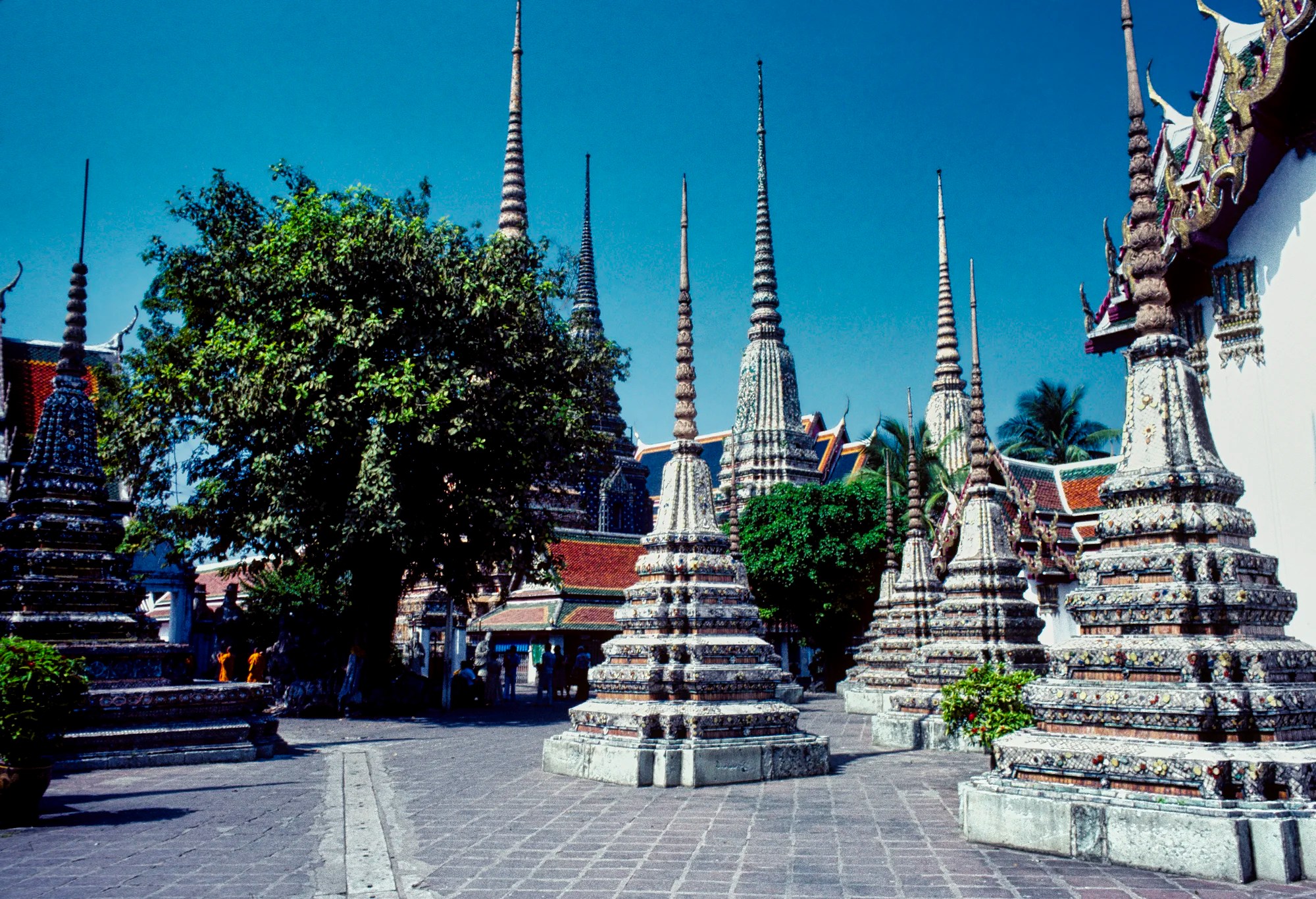
The small Phra Chedi Rai are dotted around the cloisters. I called this Chedi Alley in our diary. One thing in Thai architecture is that not enough empty space is allotted around the wat buildings. Every square centimetre is utilized and decorated. This is quite a contrast to Japanese art and architecture.
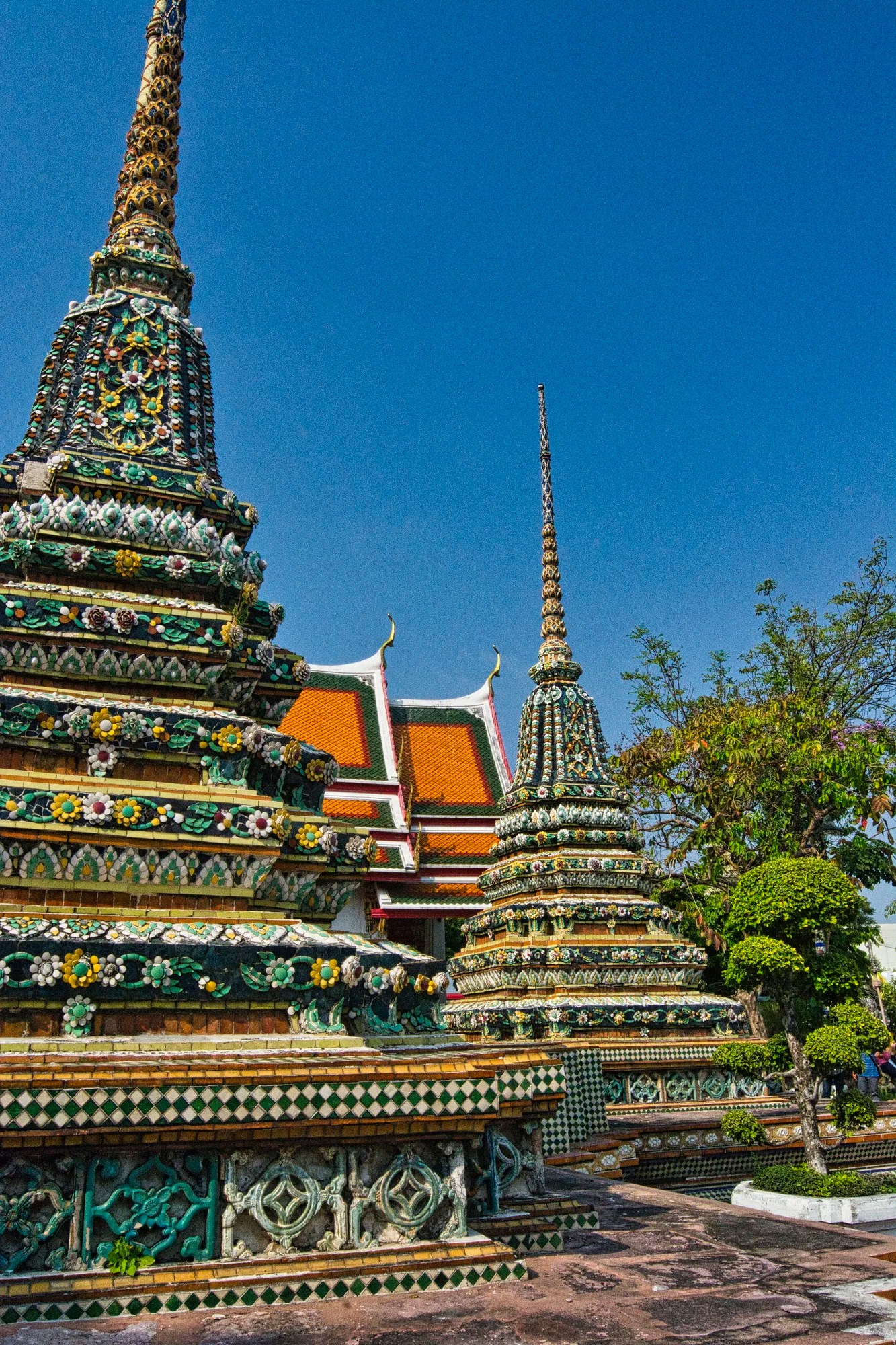
The grounds are also decorated with bonsai trees and Chinese stone warriors and philosophers. Some statues are dressed in European style, which was associated to the Marco Polo effect. I did not take photos of the statues, but you cannot miss them.
These sculptures were used as ballast by Chinese trading ships. The Thais took them out and used them for decoration! The statues are interspersed with miniature mountains. These unusual but natural rocks are called shanshui (mountains and water) in Chinese art and garden design. This style is used to decorate gardens and palaces.
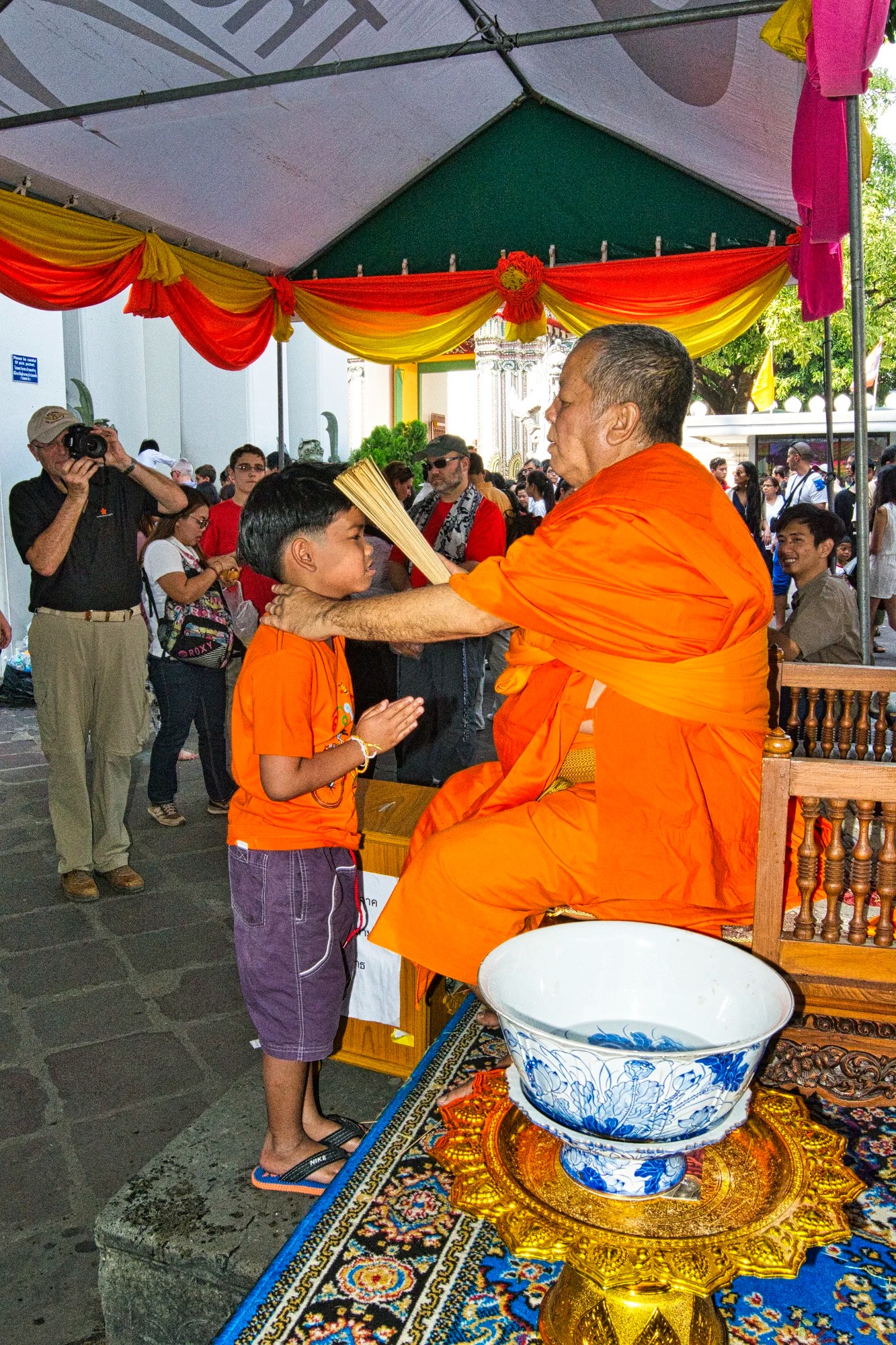
Unlike the royal Wat Phra Kaew, here you will see monks walking or blessing people in this complex. The boy with his hands to together is not offering a prayer but is giving the wai greeting to the monk. Wai can be used to say hello, thank you or sorry. Those with higher status, including monks, will not return your wai.
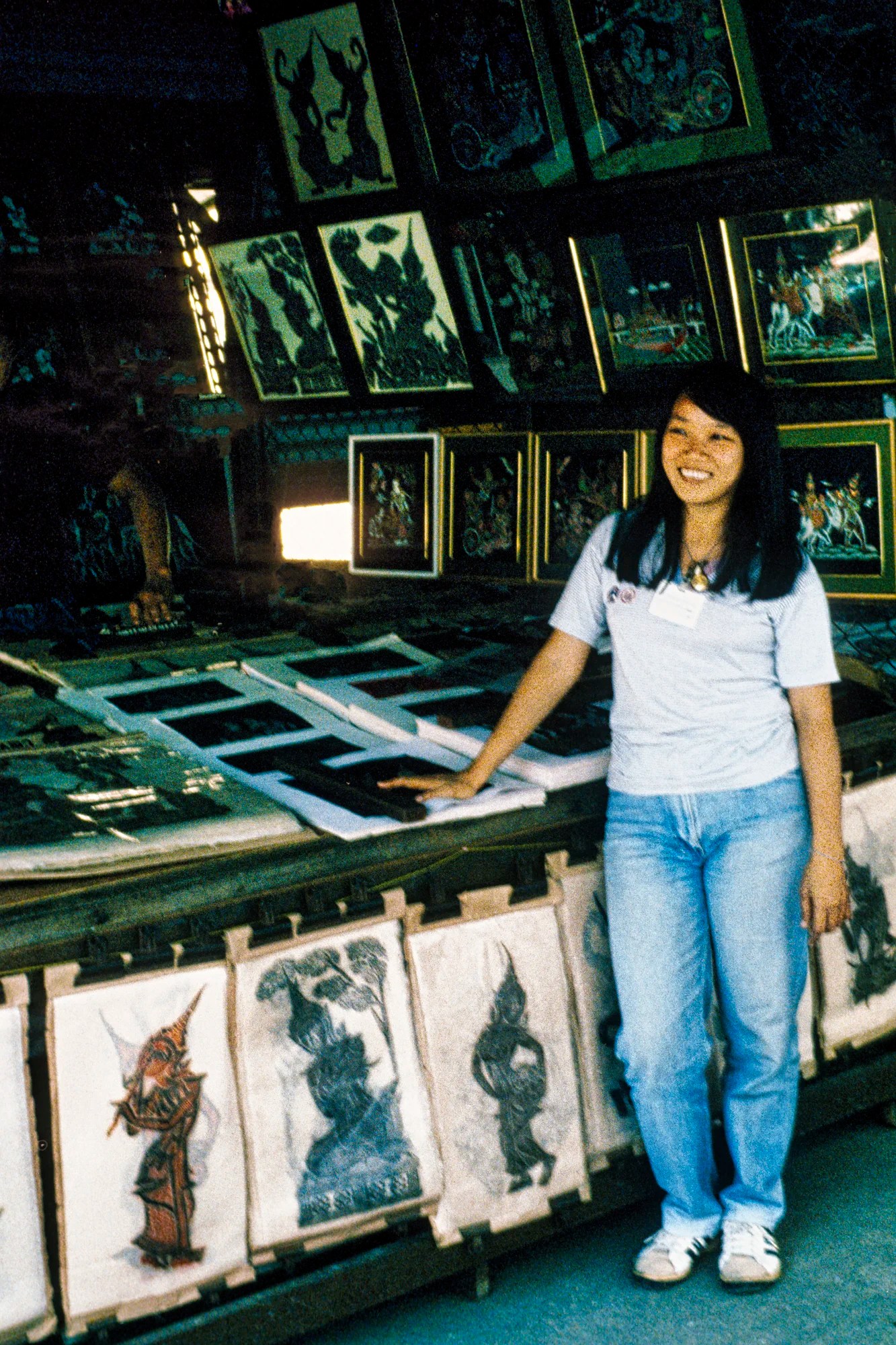
Wats always come with hawkers. On our first trip, one woman gave us our first taste of mangosteen. It was truly delicious. At this stall, we purchased our Classical Dancers Temple Rubbing above.
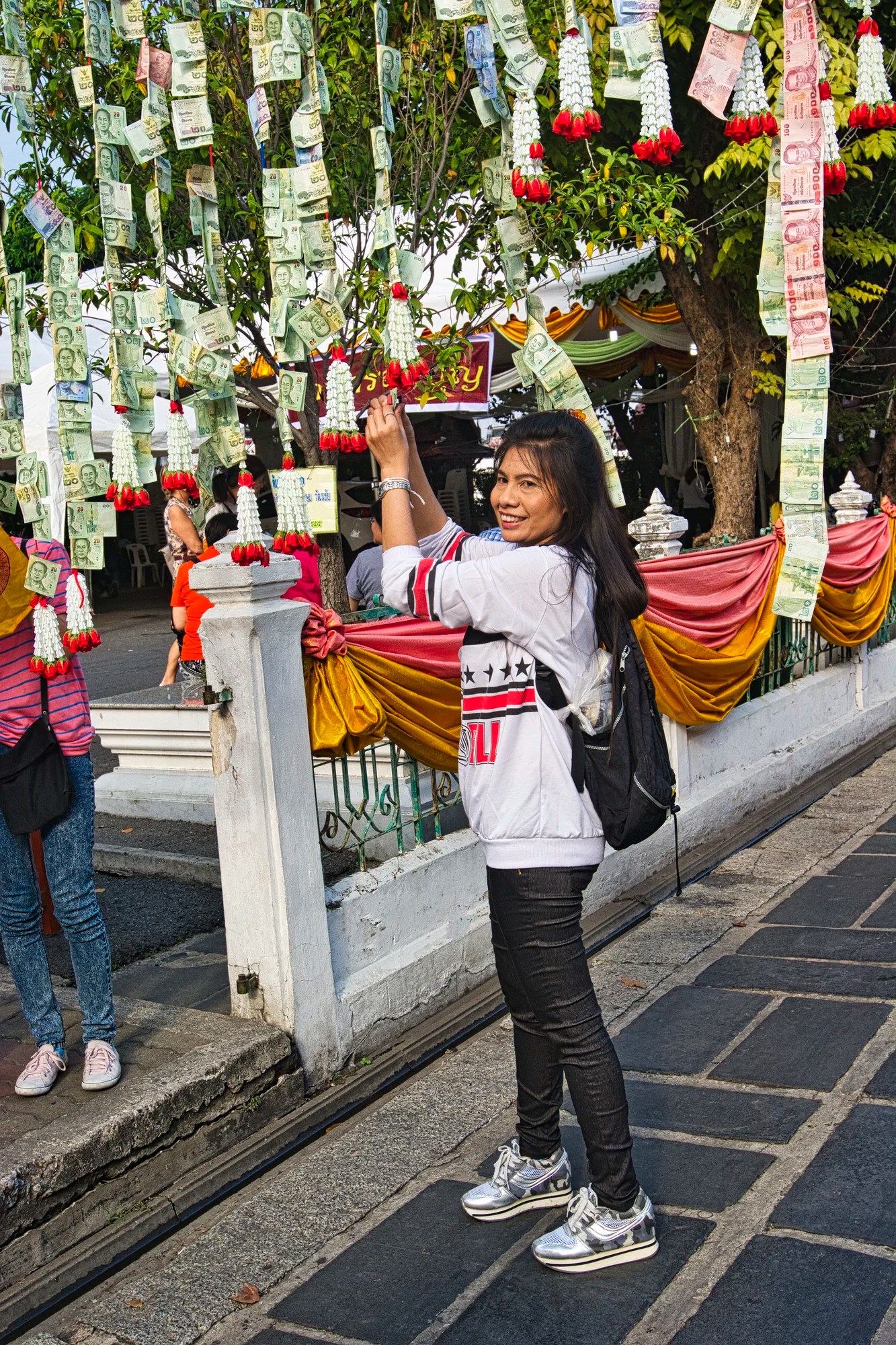
Many lay persons combine efforts by collecting cash donations for the maintenance of their local temple. Such donations are vividly arranged on a “money tree” which looks rather like a colourful Christmas tree bedecked with banknotes as the “foliage”.
Wat Arun
Address: 158 Wang Doem Road
Open: 08:30 to 17:30 daily
Tickets: THB 100 = USD 2.80
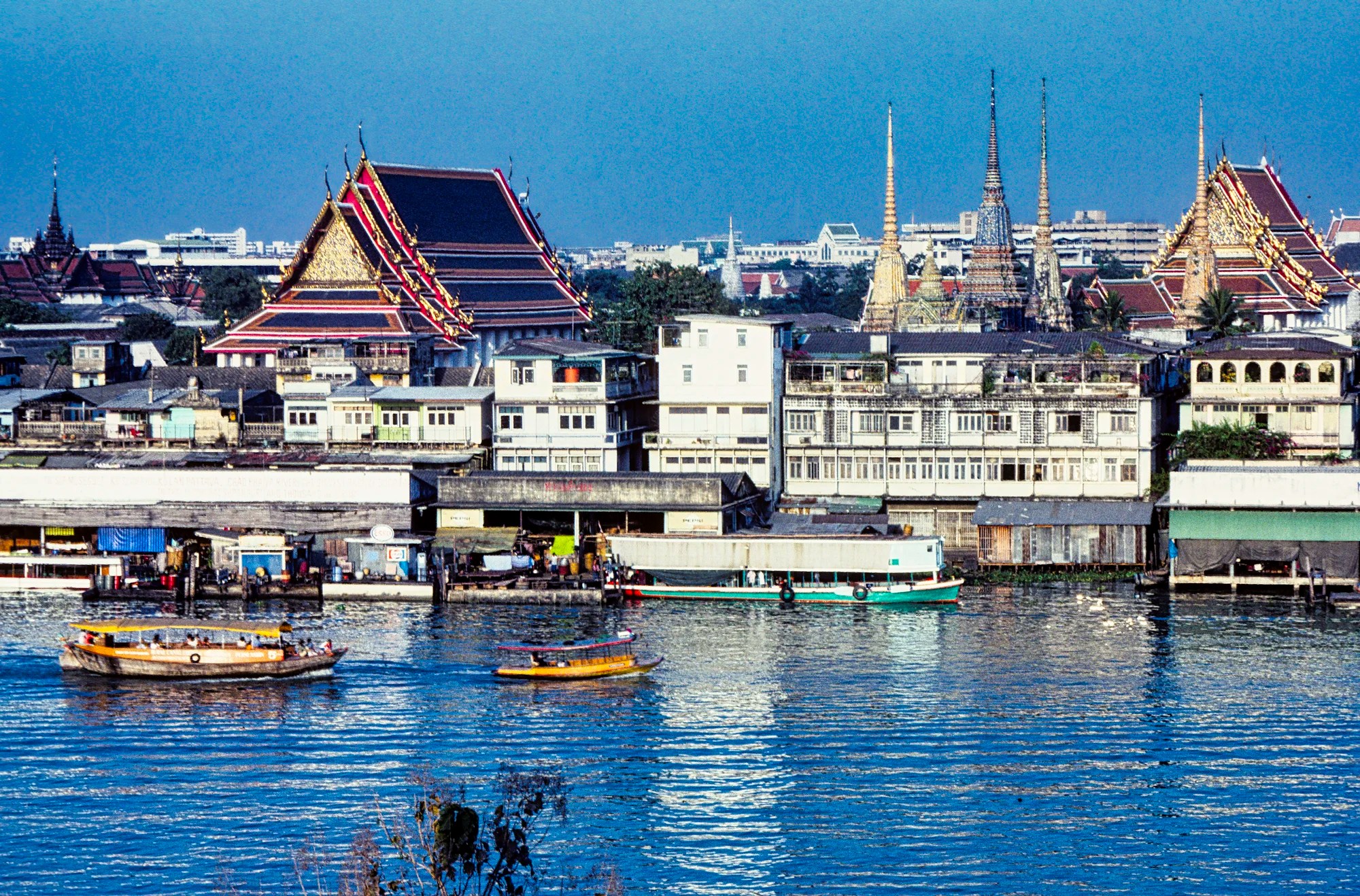
One good reason to visit Wat Arun (G4.6) is that you get to cross the Chao Phraya River, the major transportation route in the history of Thailand. Take the ferry from Thai Wang Road pier for a short ride.
The real name is Wat Arun Ratchawararam Ratchaworamaha Wihan. It is named after the Indian God Aruna, who drives a chariot carrying the sun across the sky. Aruna (Sanskrit) is the Hindu Sun god Surya and brother of Garuda! Aruna is Helios in Ancient Greece and Apollo in Ancient Rome. Everything is interrelated thanks to the common root in the Proto-Indo-European tribes.
Because Aruna brings the sun each day (dawn), the wat is also called the Temple of the Dawn. Several of the architectural elements of Wat Arun are related to Hinduism, even though the temple itself is Buddhist.
It is a short walk from the ferry to one of the most stunning wats in Bangkok. What you notice right away is how quiet it is compared to central Bangkok. You are now in Thonburi, which was the temporary capital after the sack of Ayutthaya. Wat Arun is where the Emerald Buddha resided until Wat Phra Kaew was completed. The Royal Palace of King Taksin was also located here until the Grand Palace was built.
Wat Arun East Gate
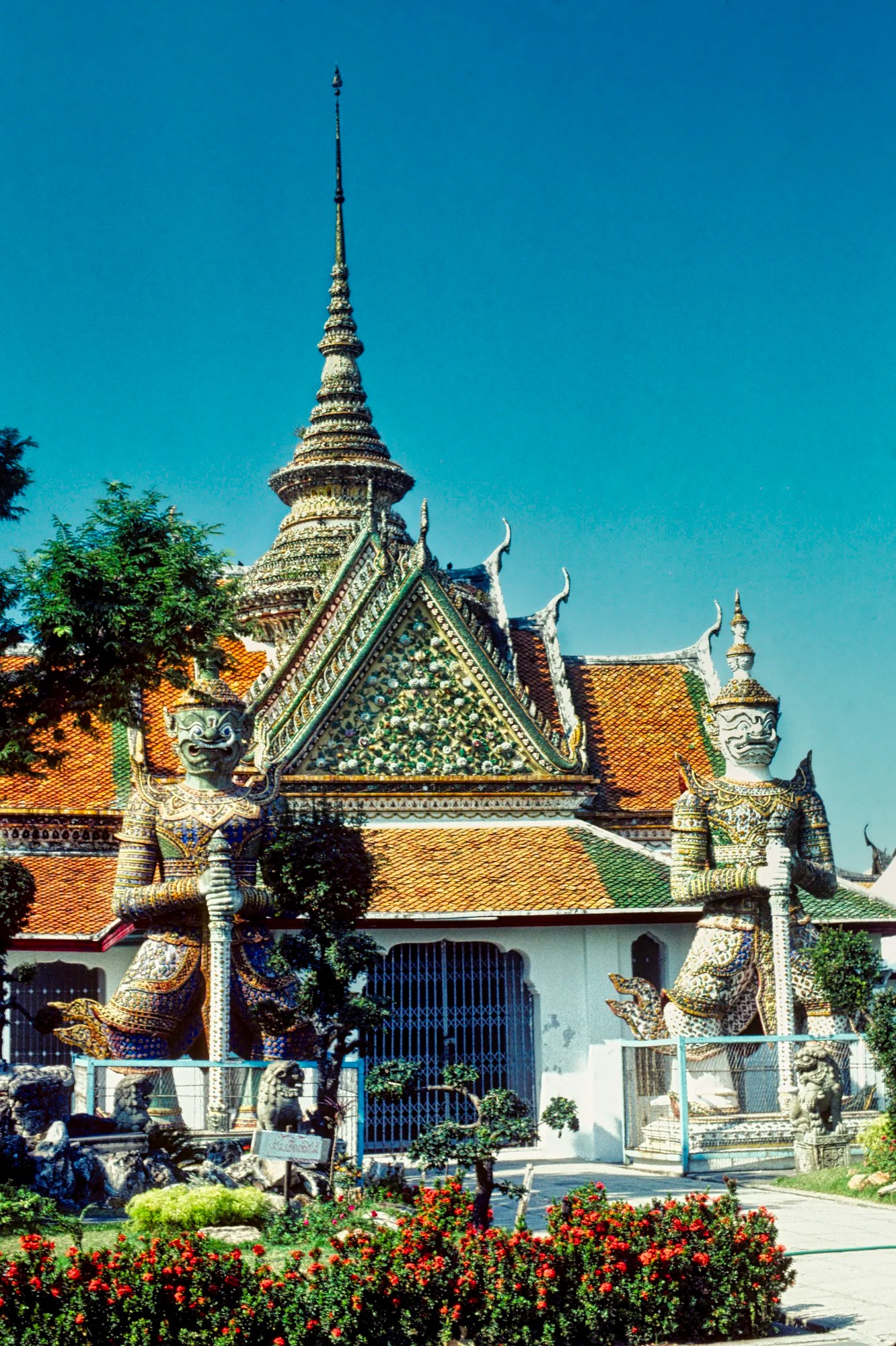
If you are an evil spirit, think twice about entering the Eastern Gate of Wat Arun. It is guarded by two mythical giant demons, the green-bodied Thotsakan and the white-bodied Sahatsadecha. Thotsakan is the King of the Demons from the epic Hindu story, the Ramayana.
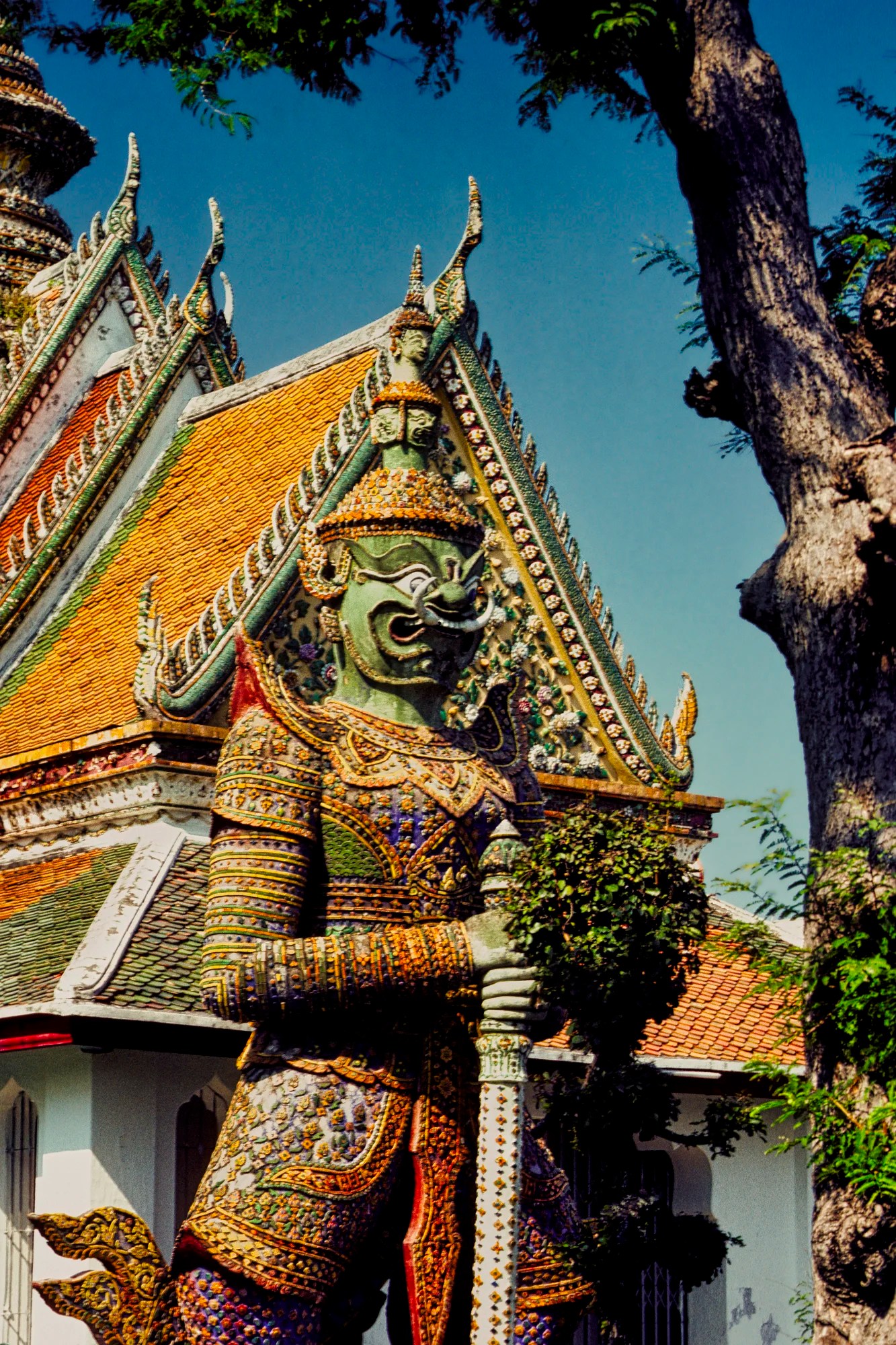
While they are antagonists from the Ramakien epic, they now serve as guardians of Buddha! Thailand is an amalgam of animism, Hinduism and Buddhism. Demons, spirits and superstitions were just too popular to stop. It was easier to convince people to convert to Buddhism by recasting spirits and demons as part of Buddhism. So demons like Thotsakan became defenders of Buddha.
If you are still skeptical, just look at how often this happens around the world. There are historical artifacts like the Interpretatio Christiana that confirm that early Christians adapted pagan cultural beliefs and said they were part of Christianity to win over the pagans. The best example is the Ancient Roman Festival of Saturnalia which is celebrated throughout the world. We call it Christmas today.
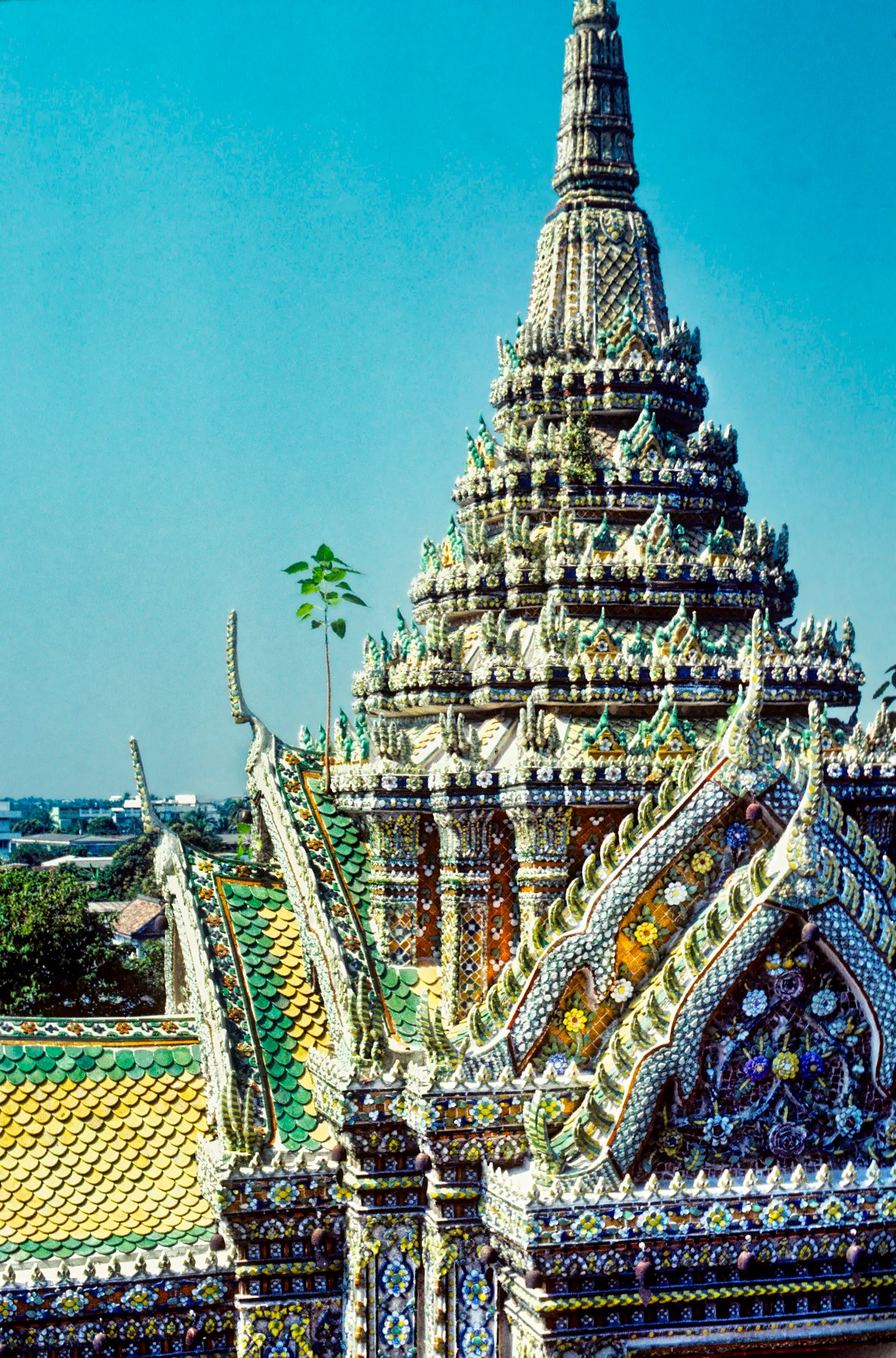
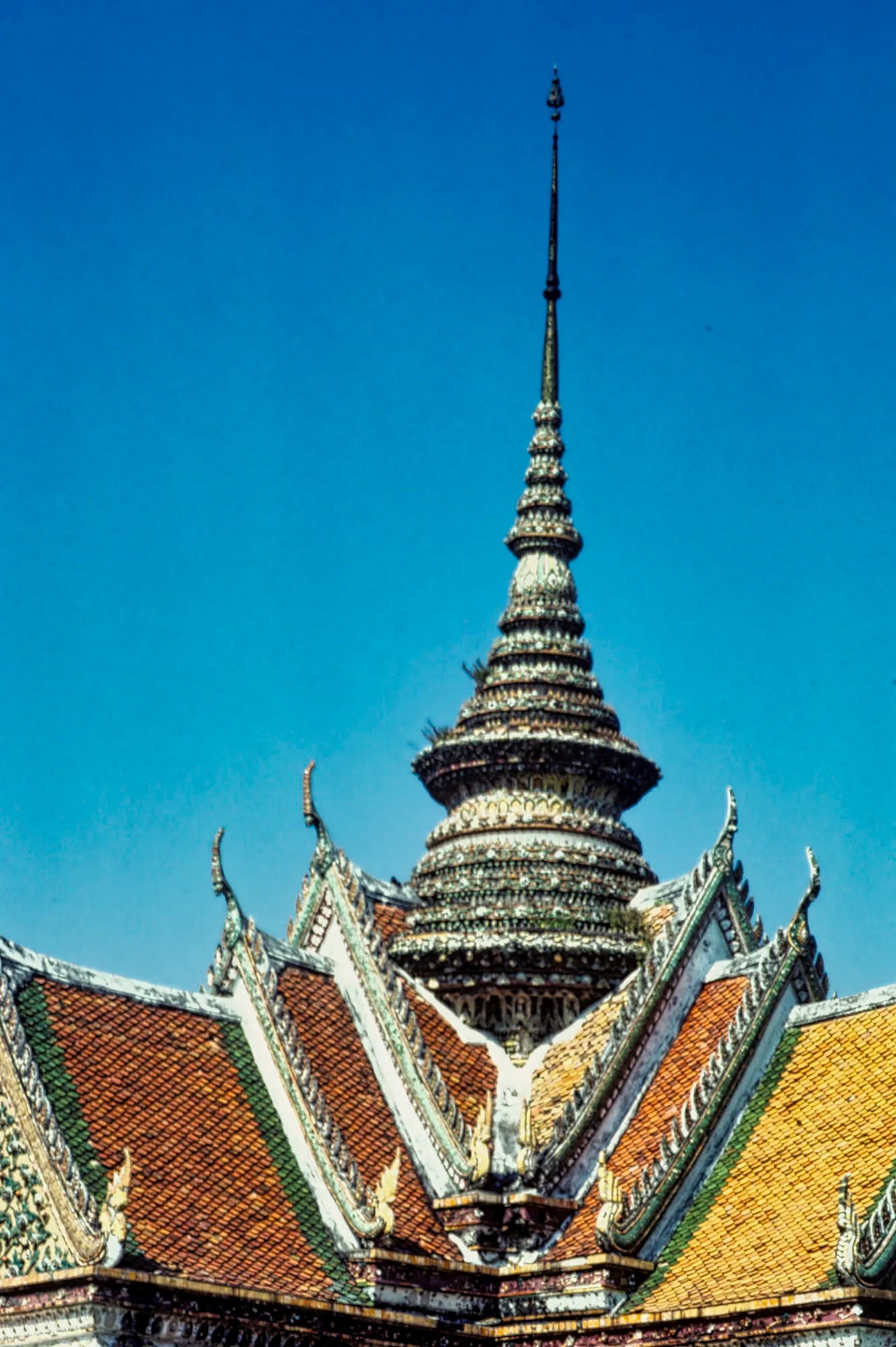
The Phra Mondop was very attractive with its multi-coloured floral ceramic tiles. It is a library of Buddhist scriptures on palm leaves.
Wat Arun Prangs
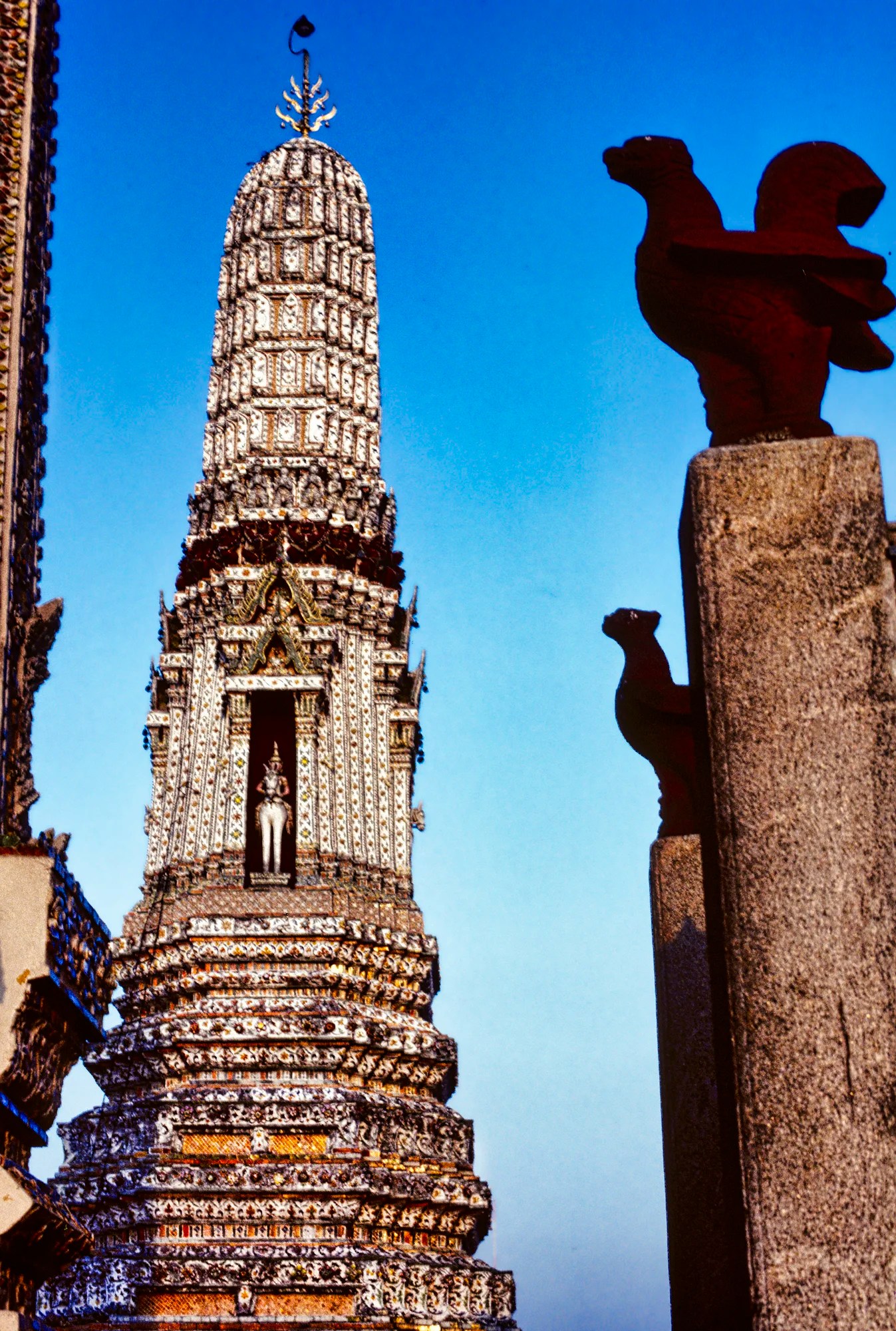
The prangs (G4.6) are what make Wat Arun worth visiting. They provide a glimpse of what the ruined prangs of Ayutthaya used to look like. There is one very large prang surrounded by four smaller prangs.
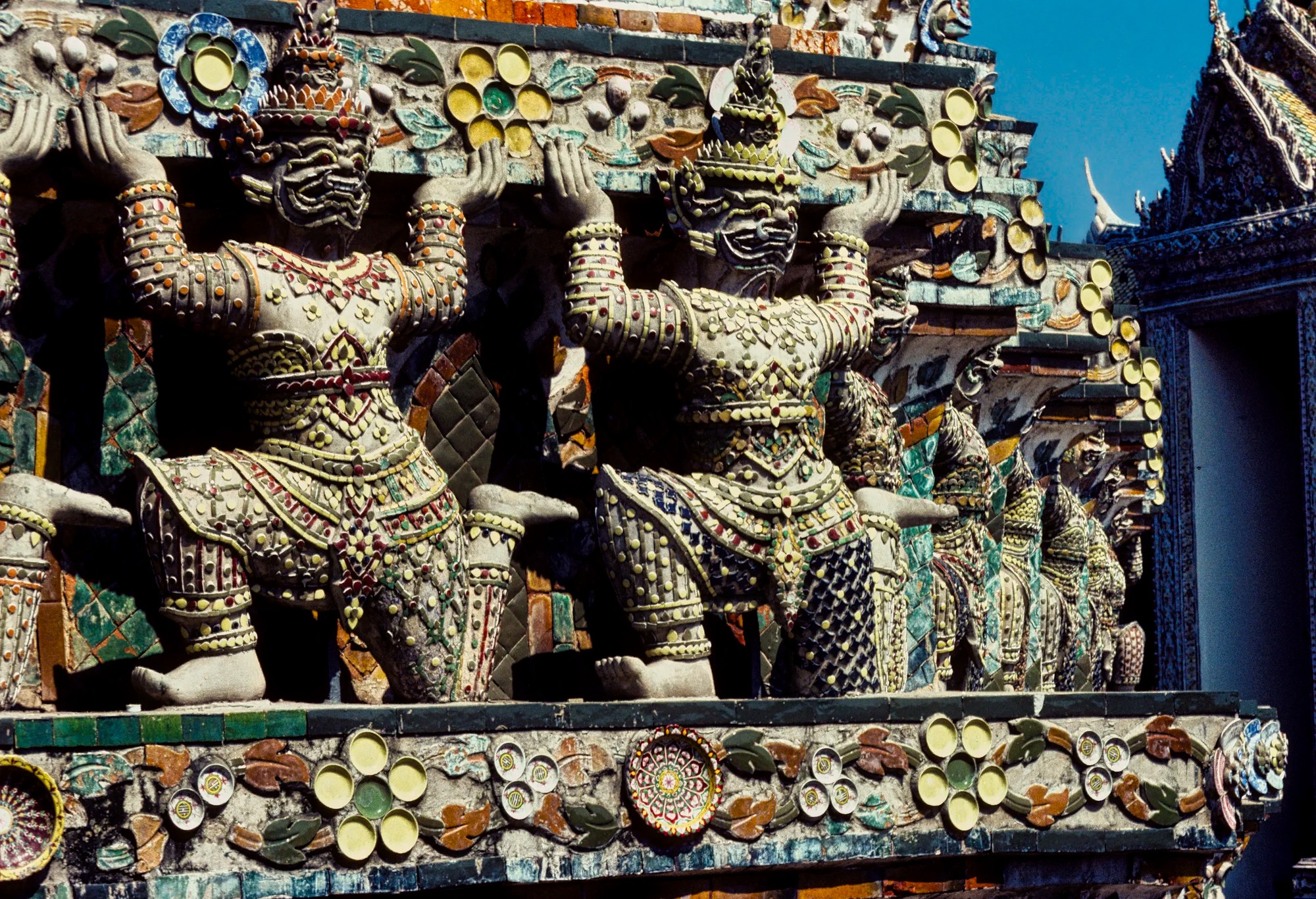
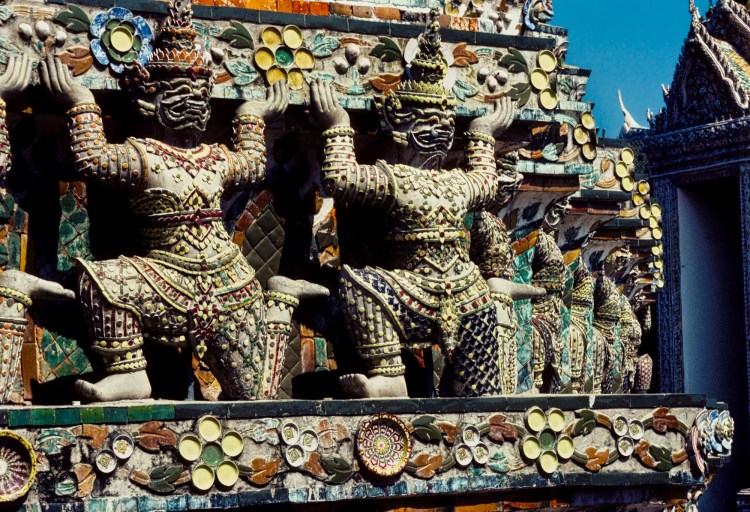
The prang appears to be supported by yaksha (giants or ogres) and monkey figures from the Ramakien, the national epic of Thailand. These are not mosaic tiles. They are decorated with porcelain shards.
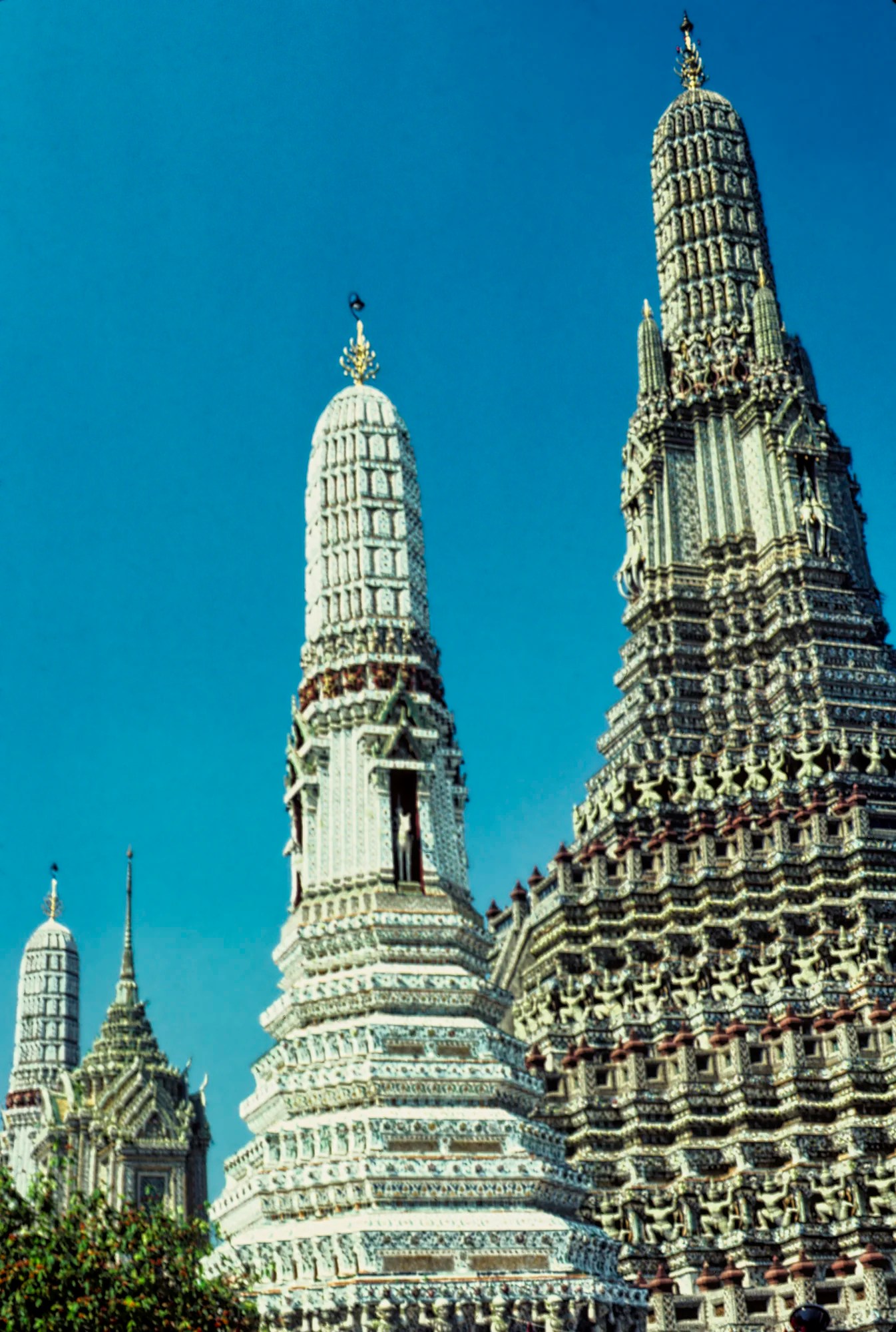
The larger, central prang on the right represents the cosmological centre of the Buddhist universe. At the top of the staircase on the right is the Hindu chief god Indra mounted on the three-headed elephant, Erawan. In other words, it represents the mountain where the gods reside.
The centre prang represents Mount Meru in Hinduism or Mount Olympus in Ancient Greece and Ancient Rome. This was part of the religious beliefs of their common ancestors, the Proto-Indo-European (PIE) tribes (formerly called the Aryans).
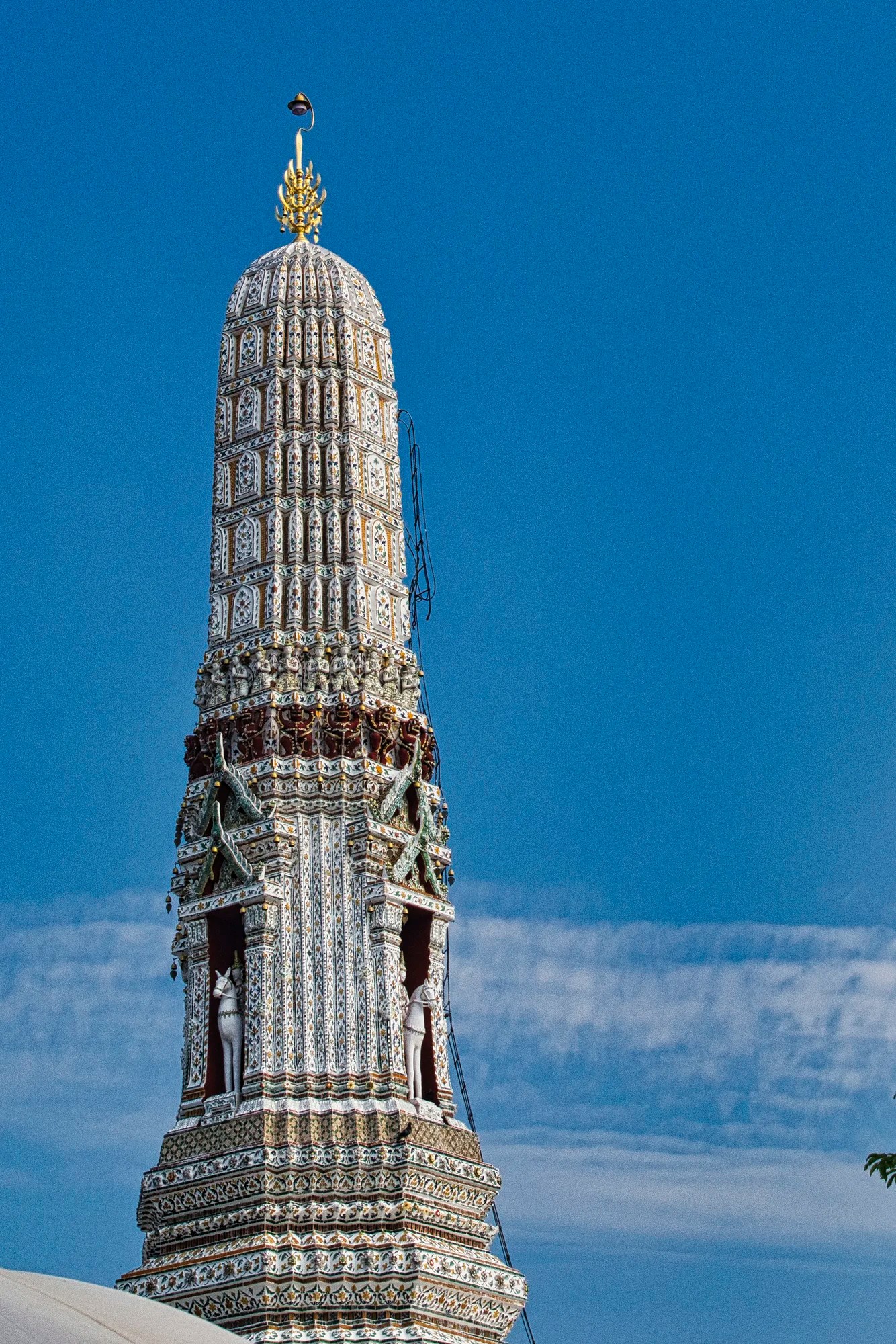
The four smaller prangs around it represent the four continents. The five prangs were built on top of a raised platform surrounded by eight chedi-shaped chapels.
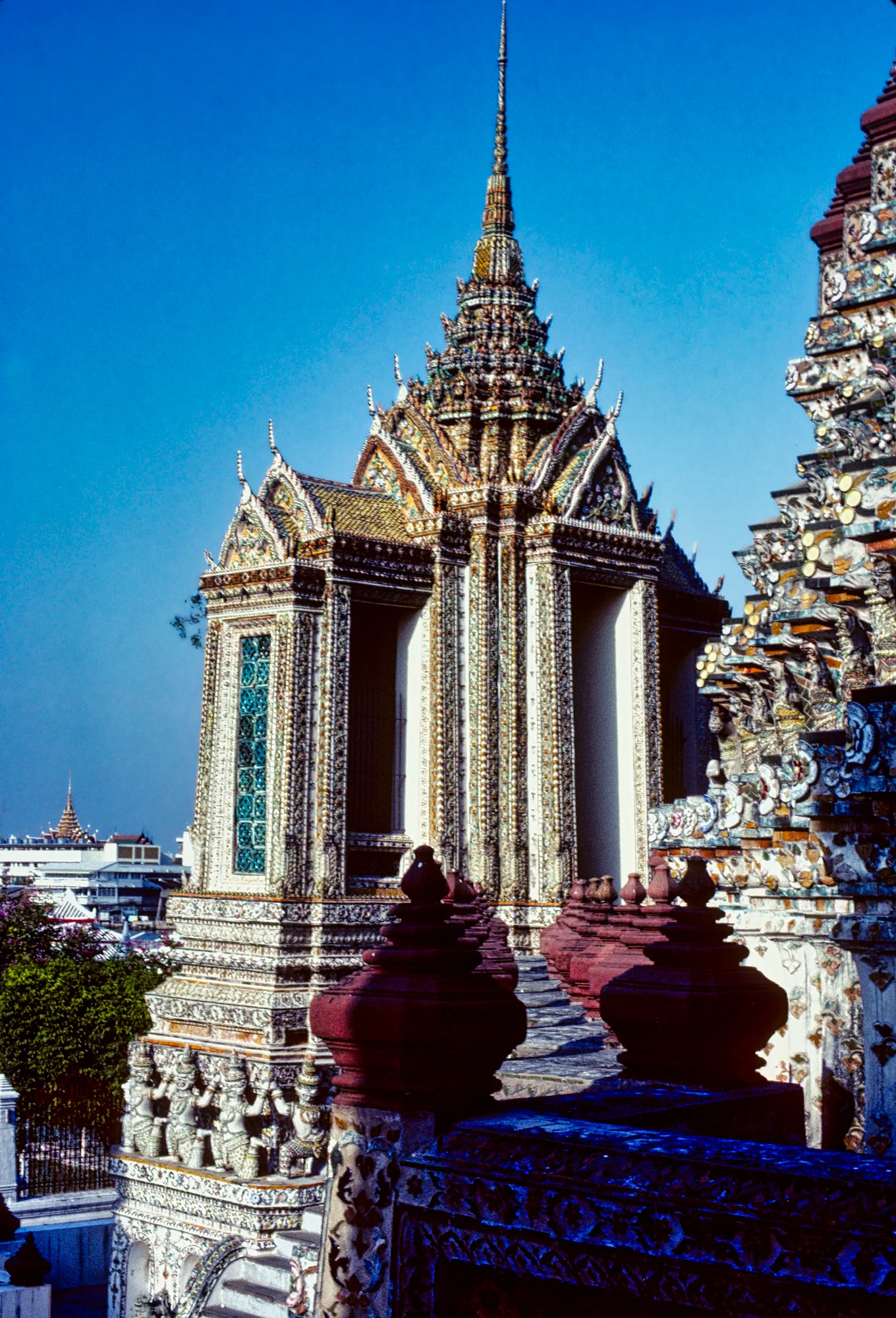
The Khmer-style chedis are ornately covered with multi-coloured broken pieces of pottery and porcelain. Much of this pottery came from Chinese ships, which used pottery as ballast.
Wat Arun Views
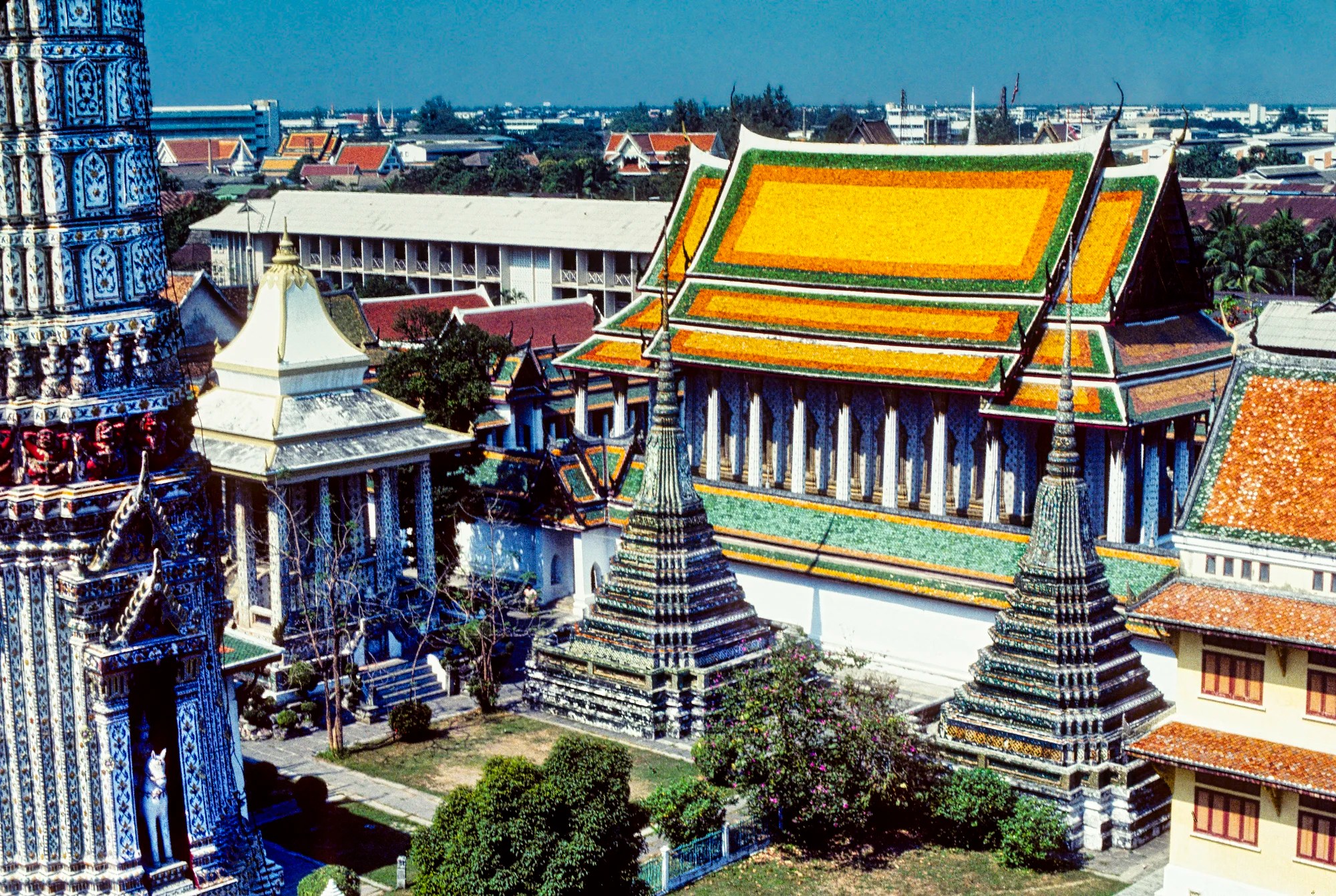
It was worthwhile climbing the steep, high stairs of the central chedi, Phra Prang (Royal Prang). From the top, we got a better view of the surrounding Khmer-style chedis.
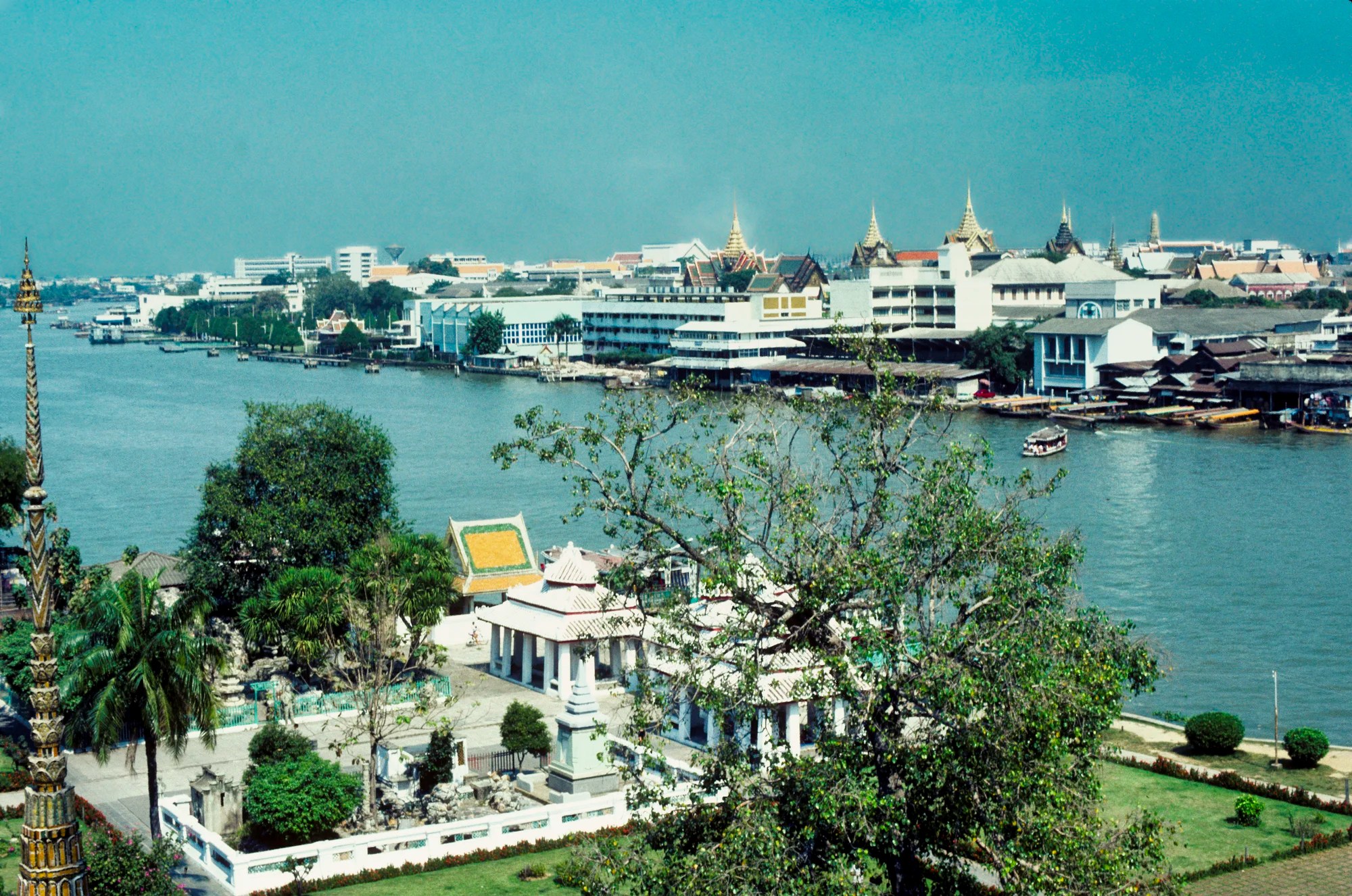
There was a good view of the city and an endless number of boats speeding along the river. You will also see the View of Wat Pho (see photo above), where the magnificent spires of the wat contrast with the ugly buildings along the east shore of the Chao Phraya.
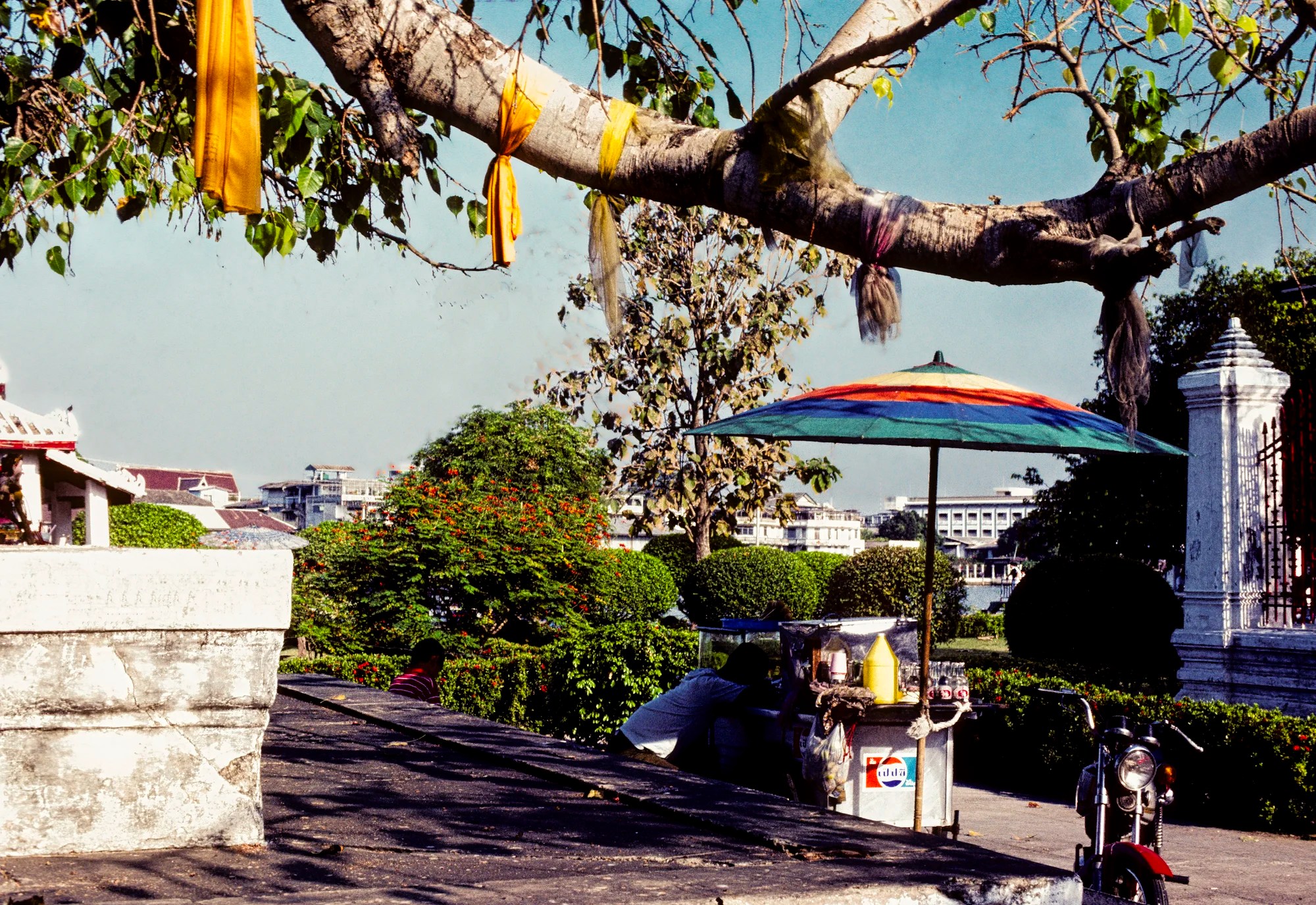
On the other hand, there is some green space and trees within the wat enclosure. The tree with the saffron ribbons is revered as it is a bodhi (fig) tree, under which the Buddha meditated and achieved enlightenment. On our first trip, a young monk practiced his English with us.
Traditional Thai Costume Photo Shoot
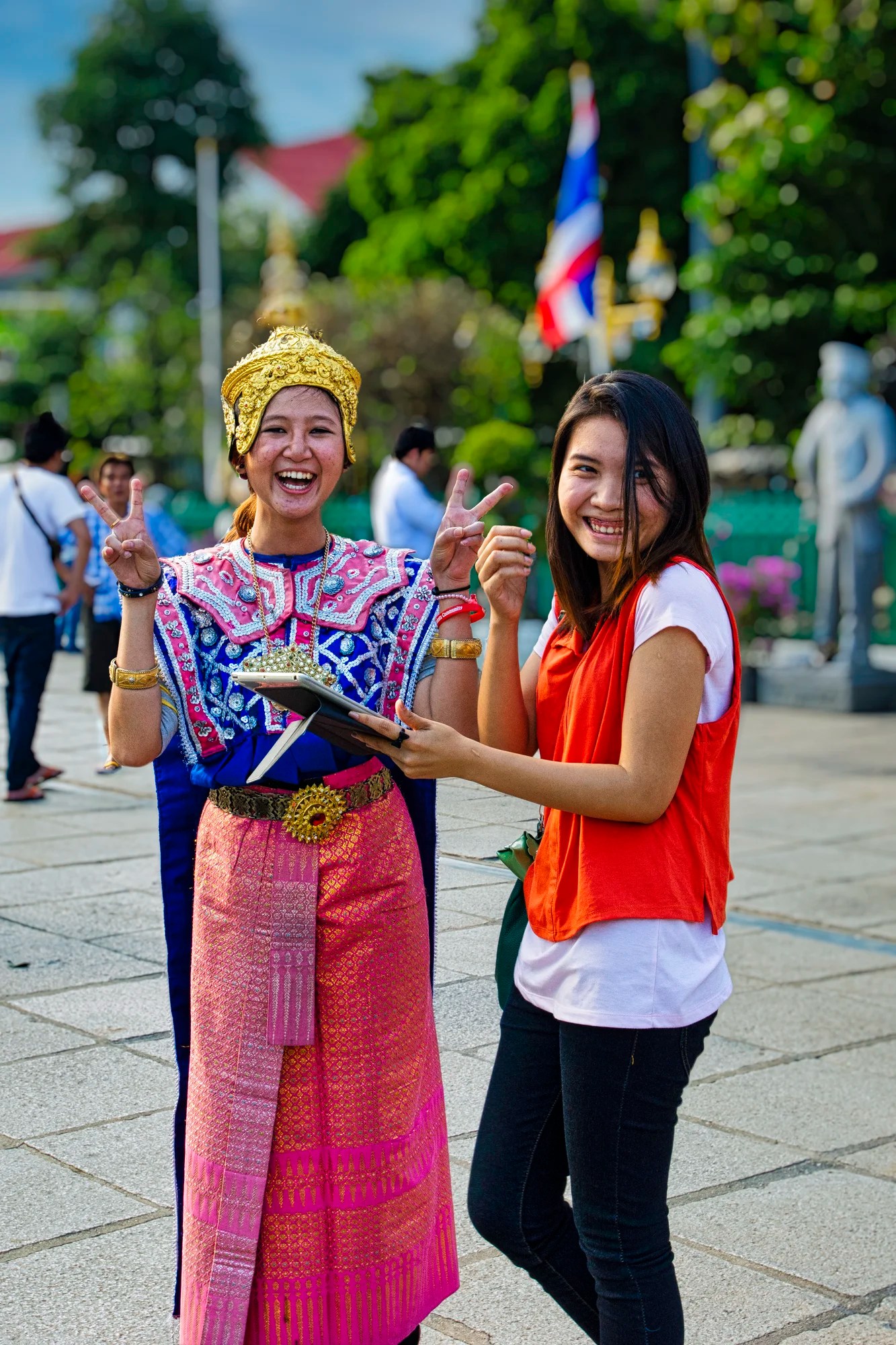
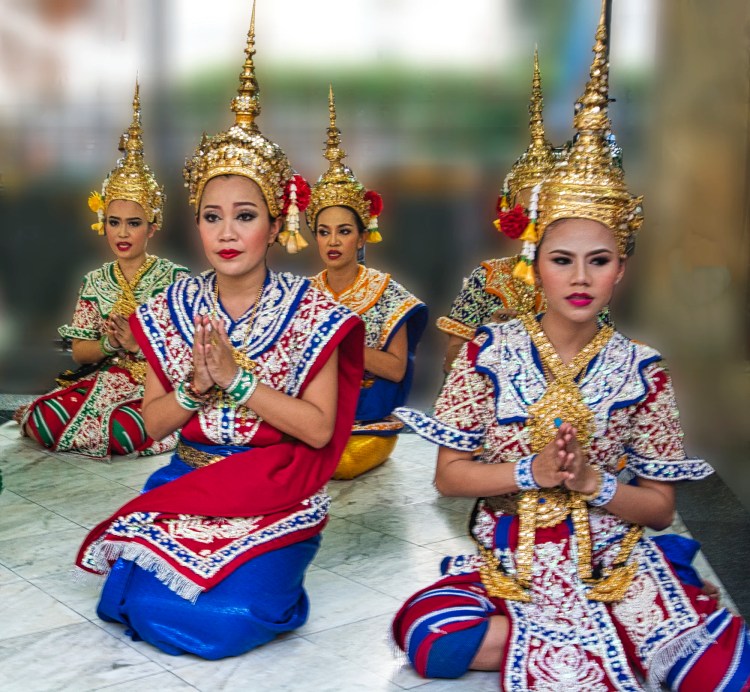
There are rental shops near the temple that offer you the chance to be photographed wearing traditional clothing during your visit.
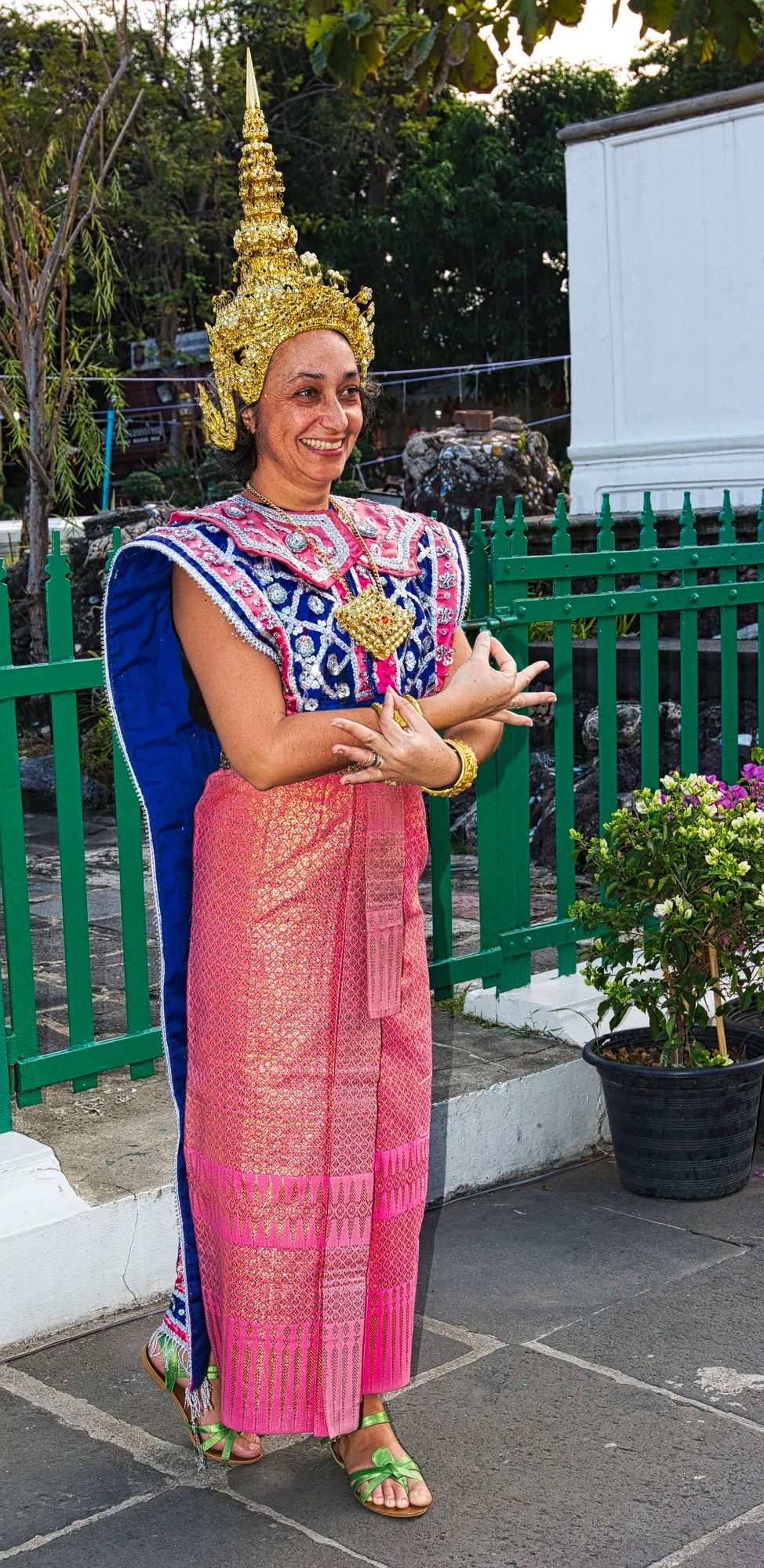
I decided to do my own photo shoot!
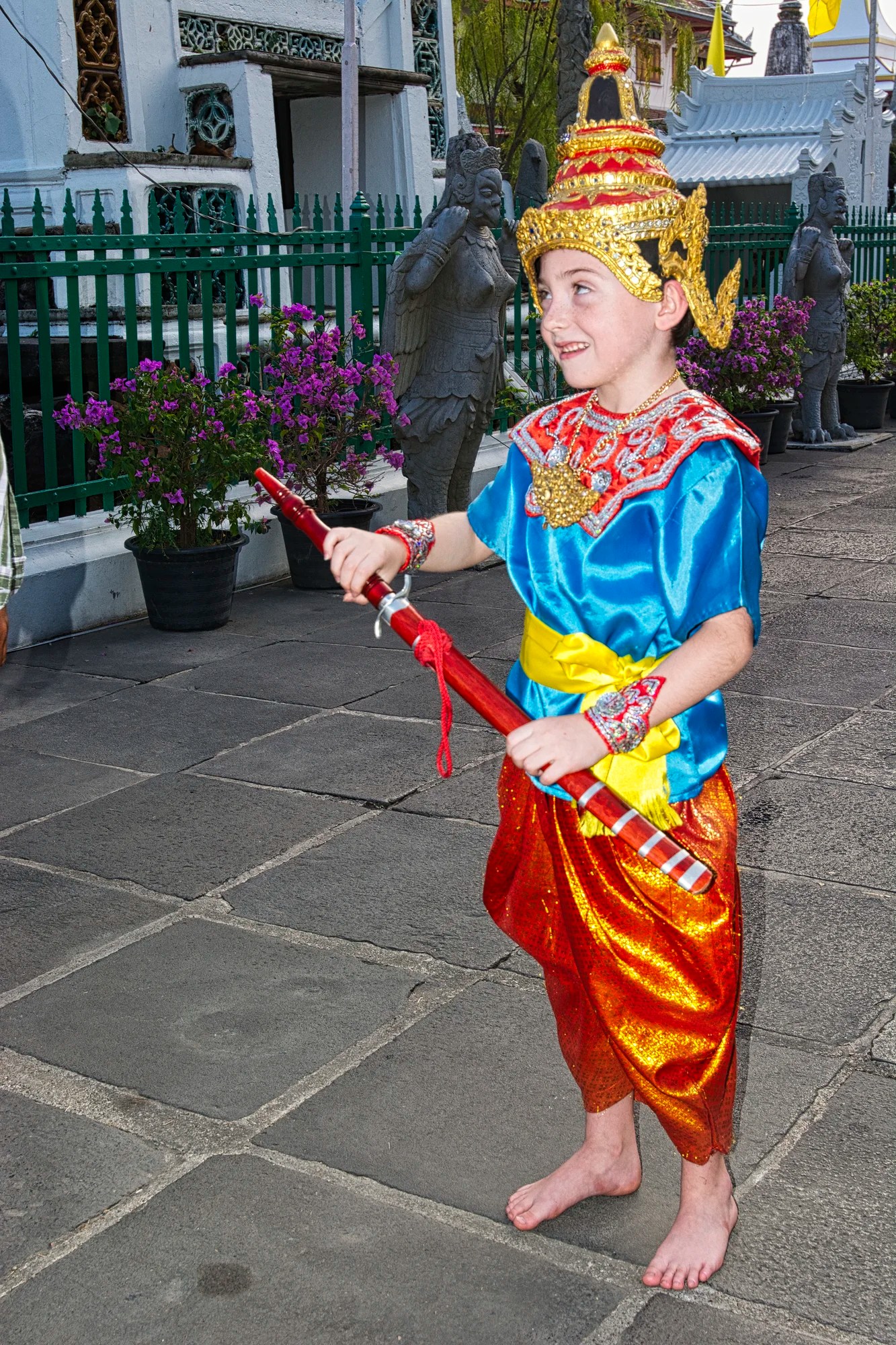
The costumes cost around THB 150 to 400 for two hours. There are at least four costume rental stores just west of the Wat Arun complex.
Royal Barges
Rivers were the highways of ancient Thailand. Royal barges have been used to transport the Thai kings during ceremonies since the Sukhothai Kingdom. They were restored after damage during World War II, and eight are stored in a museum (G4.2) near Bangkok Noi Canal on the west bank of the Chao Phraya River. They represent important symbols like naga, hamsa, and garuda that glitter with gold. Each boat is just under 45 m (yards) long.
Address: 80 1 Thanon Arun Amarin, west of Phra Pinklao Bridge
Open: 09:00 to 16:00 Monday-Sunday
Fee: BHT 30
Suphannahong Barge
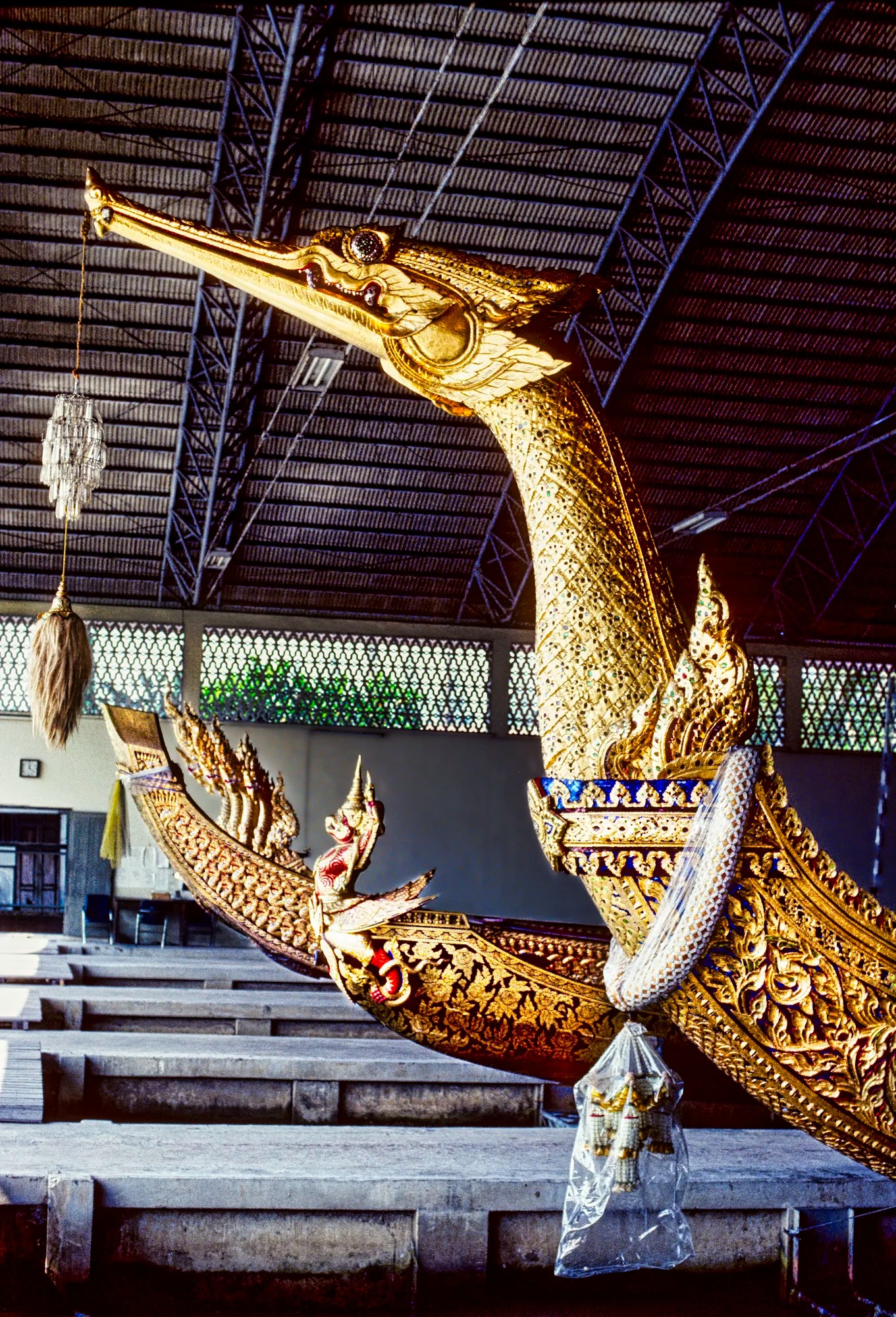
The Royal Barge Suphannahong (1911) has the prow of a hamsa, a swan or goose. This is the King’s personal barge, when he makes his river procession for the Kathin Ceremony – a Buddhist tradition held during a thirty-day period at the end of the rainy season (usually October). The offering of new saffron robes, utensils, and toiletries to the monks is an important way to make merit.
Anantanagaraj Barge
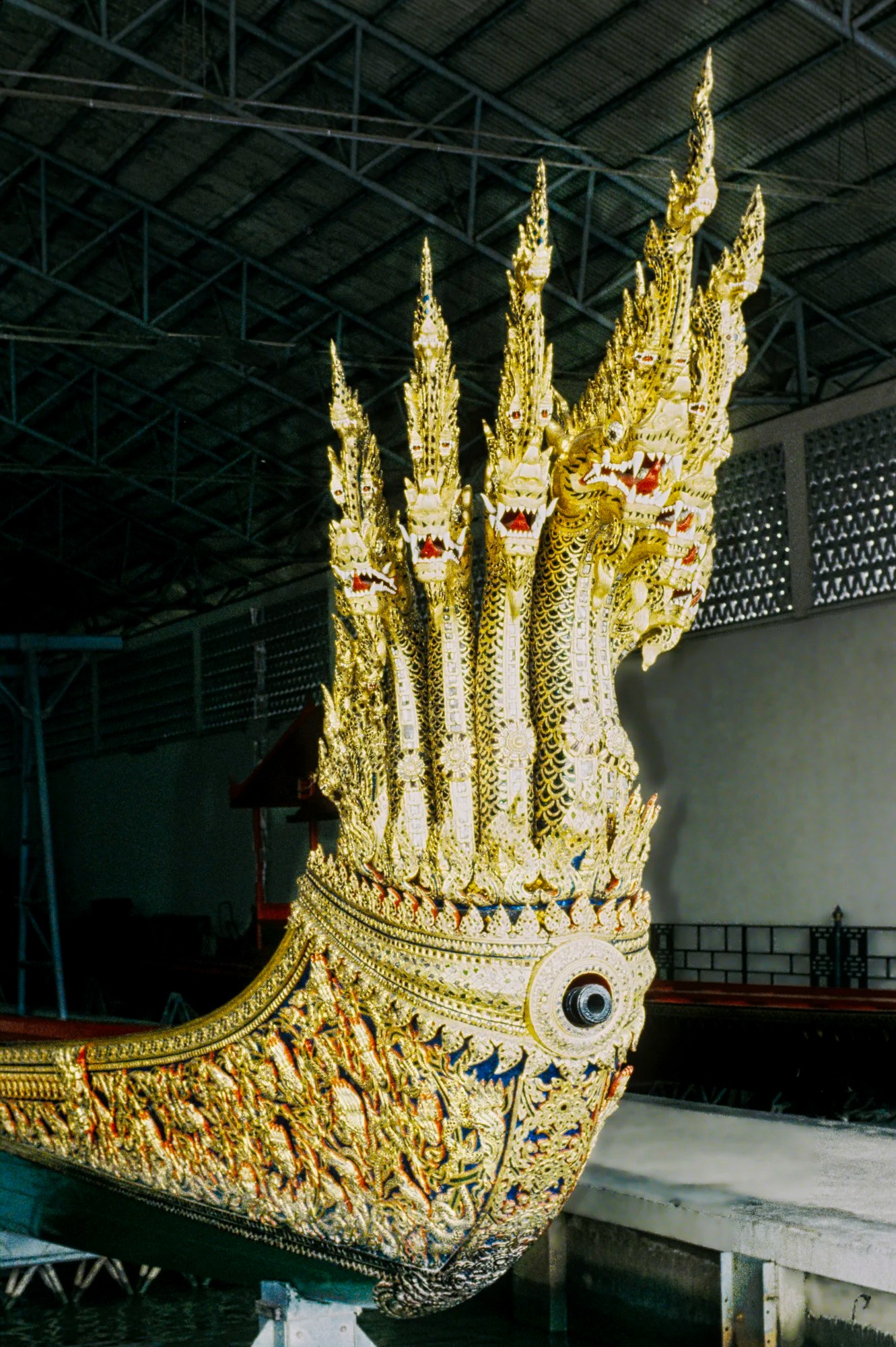
The Royal Barge Anantanagaraj has a prow with a very ornate seven-headed naga. What is unique here is that each naga is wearing a pointed crown that is used by Thai royalty.
The hull is green outside and red inside, but your eyes only see gold embedded with glass. It is used to carry important Buddha images or robes for the monks in the Kathin Ceremony.
Final Comments
We hope this post has encouraged you to visit the amazing Bangkok National Museum, Wat Pho, and Wat Arun. They will give you a glimpse of what the Thai Empire was like before the ancient capital of Ayutthaya was destroyed. You will learn about Thai temples and culture.
Subscribe
Please subscribe to Terra Encounters because we offer valuable insights to improve your understanding and enhance your travels. We offer itinerary-based guides packed with the best sights and hidden gems. Let our knowledge help you fully appreciate every moment of your amazing journey.
Get travel tips and advice delivered directly to your inbox. The best part is that it is free.
This was only a taste of Bangkok. What questions do you have? If you have been to Thailand, share your experiences with us. How long is/was your trip?
Itinerary Map & Resources
Bangkok Google map – our custom map with our points of interest
Bangkok National Museum website
The Artistic Heritage of Thailand, book by National Museum Volunteers, Sawaddi Magazine, ca. USD 12.58
TH is the ISO Country Code for Thailand.
THB is the ISO Currency Code for Thai Bahts.
THB 100 = CAD 3.86, EUR 2.59, GBP 2.25, USD 2.83
Google Maps Ratings
Google Maps provides a rating from 0 to 5 for all sights, hotels and restaurants (but not cities). All of our recommendations are appended with the rating (prefixed with a G) from Google Maps. As it is based on feedback from tourists and locals, it is much more reliable than travel booking websites. We consider a score of 4 to 4.39 to be Very Good; 4.4 to 5 to be Excellent.
Other Posts You May Like
Explore Bangkok in four posts, one for each day.
Bangkok’s Top 4 Self-Guided Walks

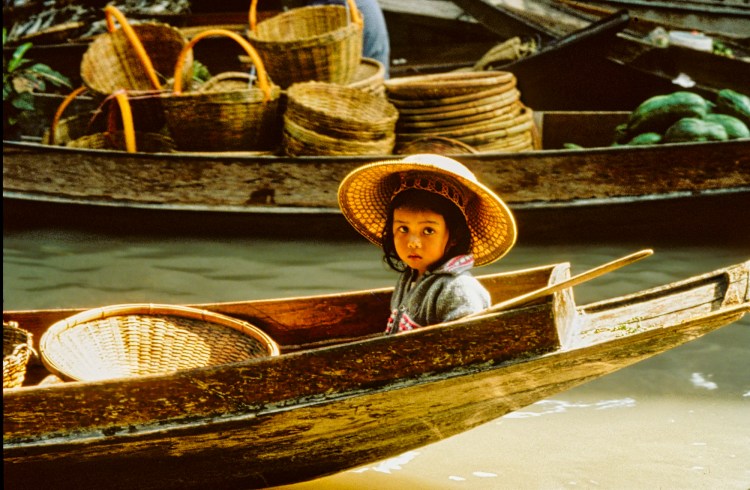
Understanding Thai Buddhist Culture
Read these articles to learn about and understand Thai Buddhist culture that permeates all of Thailand.
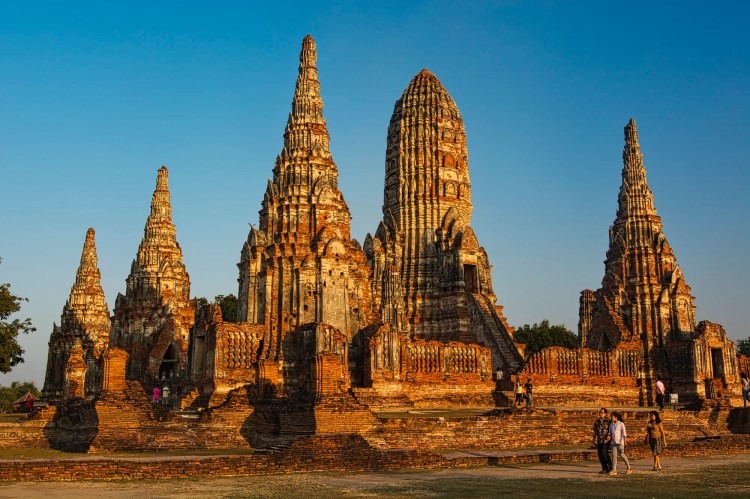
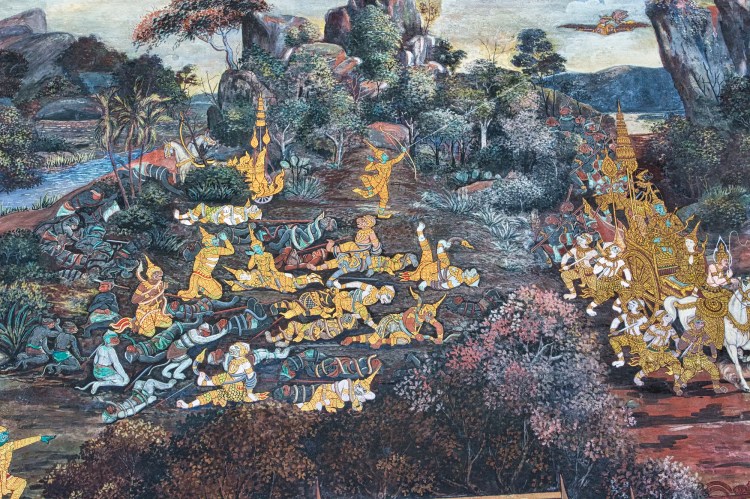
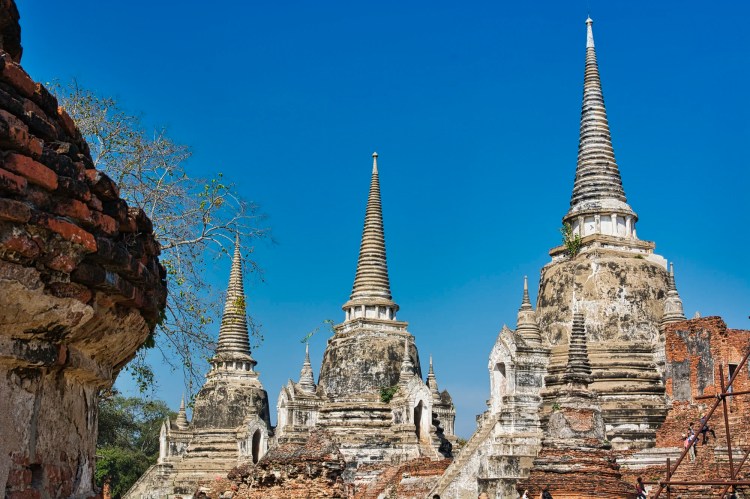
When is the Best Time to Visit?
Based on average maximum temperatures from NOAA:
| Month | Season | Max Temp | Rain Days |
|---|---|---|---|
| Nov-Feb | Cool | 30 to 33°C | Nov = 4 |
| Mar-May | Hot | 34 to 35°C | 5 to 13 |
| Jun-Oct | Rainy | 31 to 33°C | 9 to 17 |
The data supports the fact that November-February is the best season to visit.
How to Get Around Bangkok?
On our first trip to Thailand, we walked all around the old city. We used buses to go to more distant sights. There are also taxis and even an LRT. We would not recommend driving a rental car in Bangkok unless you are from Cairo or Manila. Rent a car just before driving around the countryside,
On our first trip to Thailand, we usually took the bus to travel between cities. In those days, the bus destination was only in Thai script. So we always made sure to find out the bus number, which uses the same Arabic numerals as we do. There are also trains.
We dropped our car off at the airport outside the city and took the bus into the centre.
Is Thailand Safe?
According to the Numbeo Safety Index, Thailand is a very safe country.
 Terra Encounters
Leave a comment