
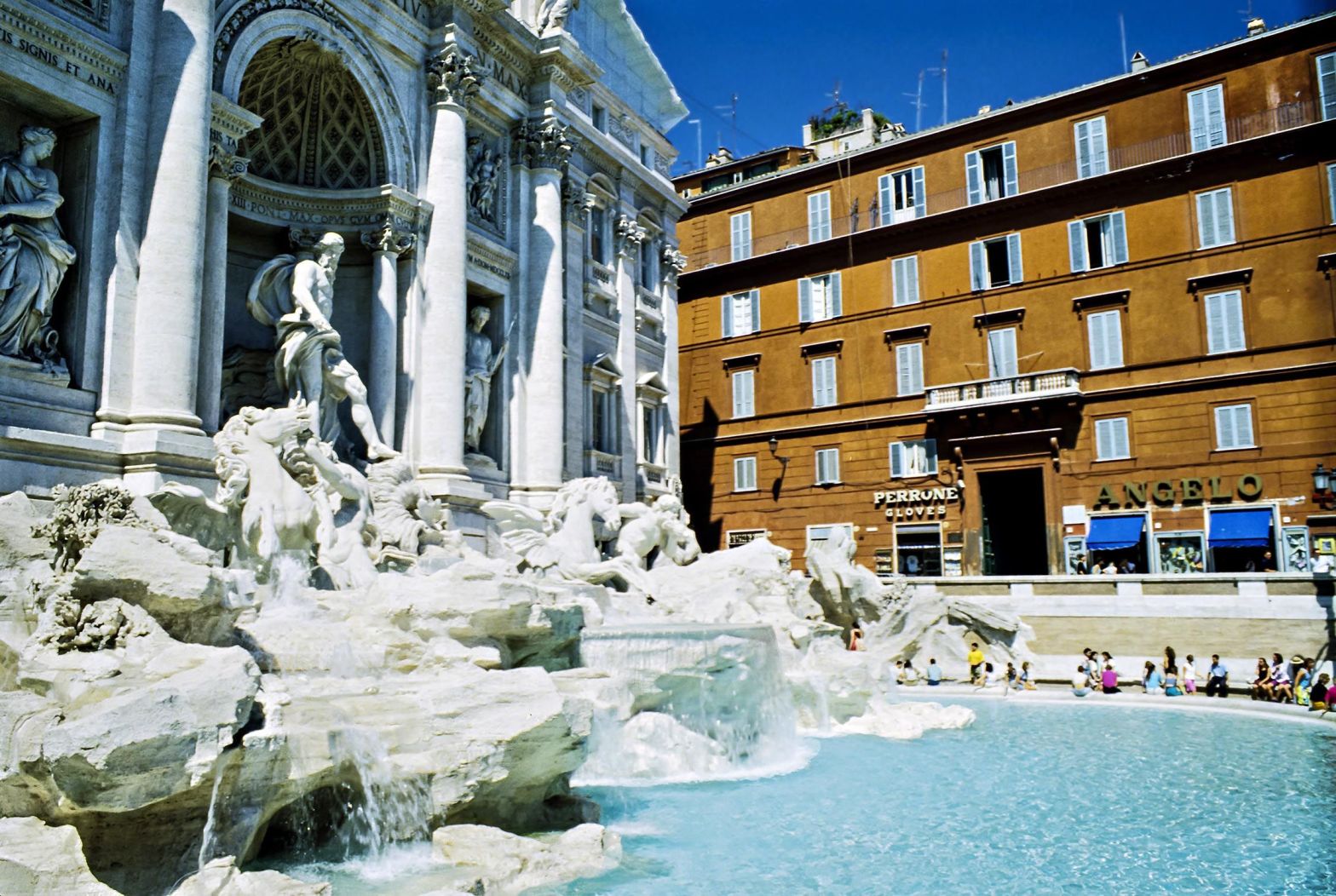
Why is Rome the place to see Baroque Art?
When you think of the typical ornate palaces of Europe, you are awed by examples of Baroque architecture. Why is Rome the place to see Baroque art and architecture? The Catholic Church began and sponsored the Baroque Era to regain its followers after the Reformation!
The Baroque Blowout Walk brings you to the best museum and churches with stupendous Baroque art and architecture. First and foremost, the Galleria Borghese is one of our favourite galleries in the city with sculpture masterpieces by Bernini and Canova as well as many other paintings and artifacts. This will be followed by some ornate churches that are museums to the Baroque Era.
As this itinerary is quite a distance from Centro Storico (historic centre), it’s best to use transportation to get close to the museum.
You only get two hours in the museum, so you need to reserve an entry time first, then rearrange this itinerary accordingly. The alternatives are described later. See route 6 on the Roman Itineraries Map. Note that the map route starts at Santa Maria della Vittoria, since that is best done first if you reserved the 11:00 entry time.
Author & Photographer: George Mitchell

Our recommendations are not influenced by affiliate links – we have none. Our advice is derived from our personal experience and knowledge based on living in Rome for four years and studying its art, architecture, and culture. All the places recommended in this post are pinned on our Roman Itineraries Map. The place names are appended with the Google Maps Rating (G0 to G5).
Where is the Art?
The first thing to understand as a traveller is that you do not get to see the grand tourist sites without money. No, I do not mean what you paid to get there. I mean the money spent by the state, city, church or nobility to finance art and architecture.
Besides Venice, during the Middle Ages the Catholic Church was the main entity funding art and architecture, so art was primarily religious. By the 16th century the Catholic Church had become immensely wealthy, especially selling indulgences to turn a blind eye to the sins of the wealthy. The extravagance of the papal court contrasted with the poverty of the people. This led to the Reformation in 1517 and even wars. It took a while for the Catholic Church to respond to the grievances and start a Counter-Reformation (1563).
Patrons of Art
Once you have wealth, you need motivation to invest it in the arts. The city-states want to glorify their rule, the nobles and merchants want to show off their wealth, and in the 1500s the Catholic Church wanted to recover from the Reformation.
To make the Catholic faith more appealing, the Papacy began a program of art and architecture to make Rome the glorious centre of the Spiritual Empire. They wanted to impress and move their followers.
Baroque Era
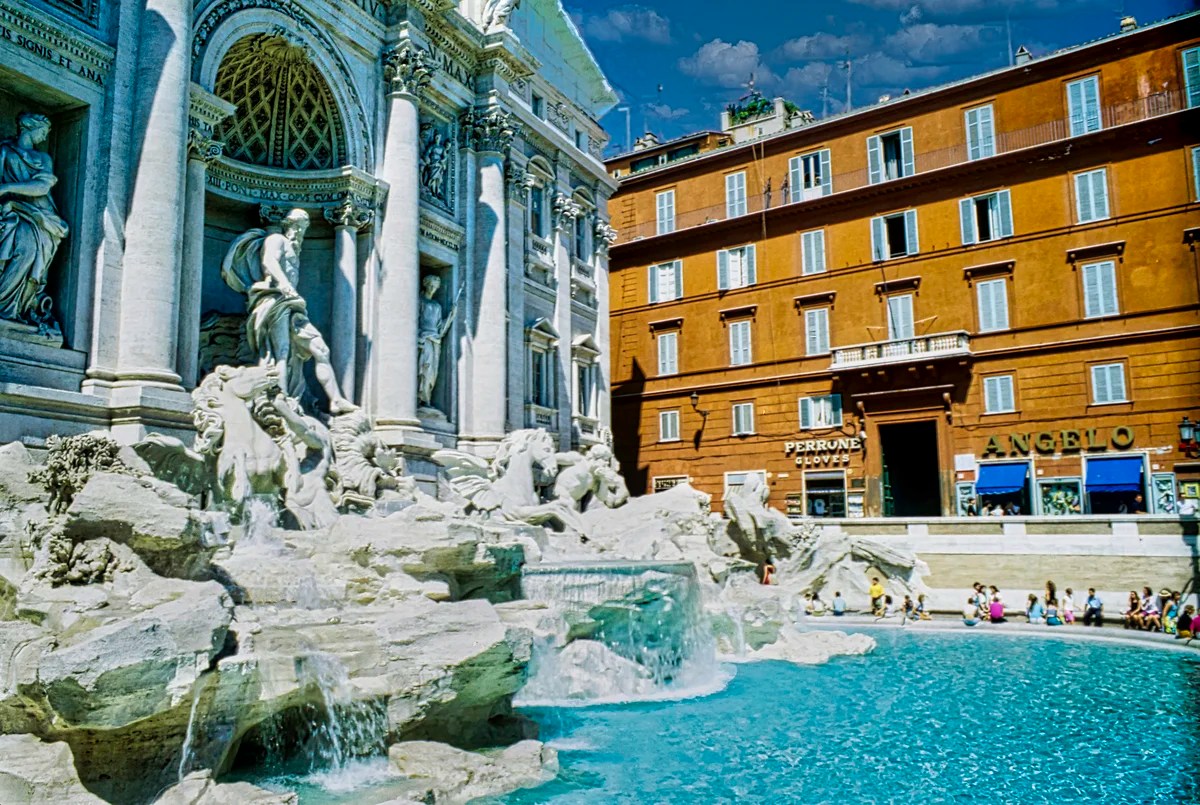
The Baroque Era was a dramatic artistic style of the period from 1600 to 1750. Some art historians argue that it is the final phase of the Renaissance. But most people view it as a separate art period. Baroque art broke the rules of the Renaissance to produce grandiose decoration with innovative features rather than pure classical form.
While Firenze (Florence) was the vanguard of the Renaissance; Rome was the birthplace of Baroque because the Catholic Church wanted to improve its image in a post-Reformation world and make Rome the most beautiful city in the world. History note: at that time the Pope was also the ruler of the Papal States, the central part of Italy.
To fulfill its propaganda role, the Church sponsored monumental wall-paintings, ceiling frescoes and sculpture. A major feature of Baroque art is the use of dynamic movement, especially diagonal movement through three-dimensional space.
Some painters used rich colours and bright light to dazzle the viewers. Other painters used chiaroscuro and tenebrism to control light and shade. This enhanced the atmosphere or highlighted the subject while the background is hidden in shade.
Baroque architecture was designed to create spectacle and illusion. Thus, the straight lines of the Renaissance were replaced with flowing curves, while domes/roofs were enlarged, and interiors carefully constructed to produce spectacular effects of light and shade. Architecture, painting and sculpture were to work together to create a unified effect.
The Baroque Era in painting really began with the arrival in Rome during the 1590s of Annibale Carracci and Caravaggio. Their presence sparked a new interest in realism as well as antique forms, both of which were taken up and developed by Bernini (in sculpture and architecture). Bernini sculpted, architected and even wrote operas simultaneously.
Rembrandt and other Dutch artists were influenced by both Caravaggio and Bernini, especially their use of chiaroscuro. The great Flemish painter, Peter Paul Rubens, actually lived in Rome until 1608.
Serpentinata
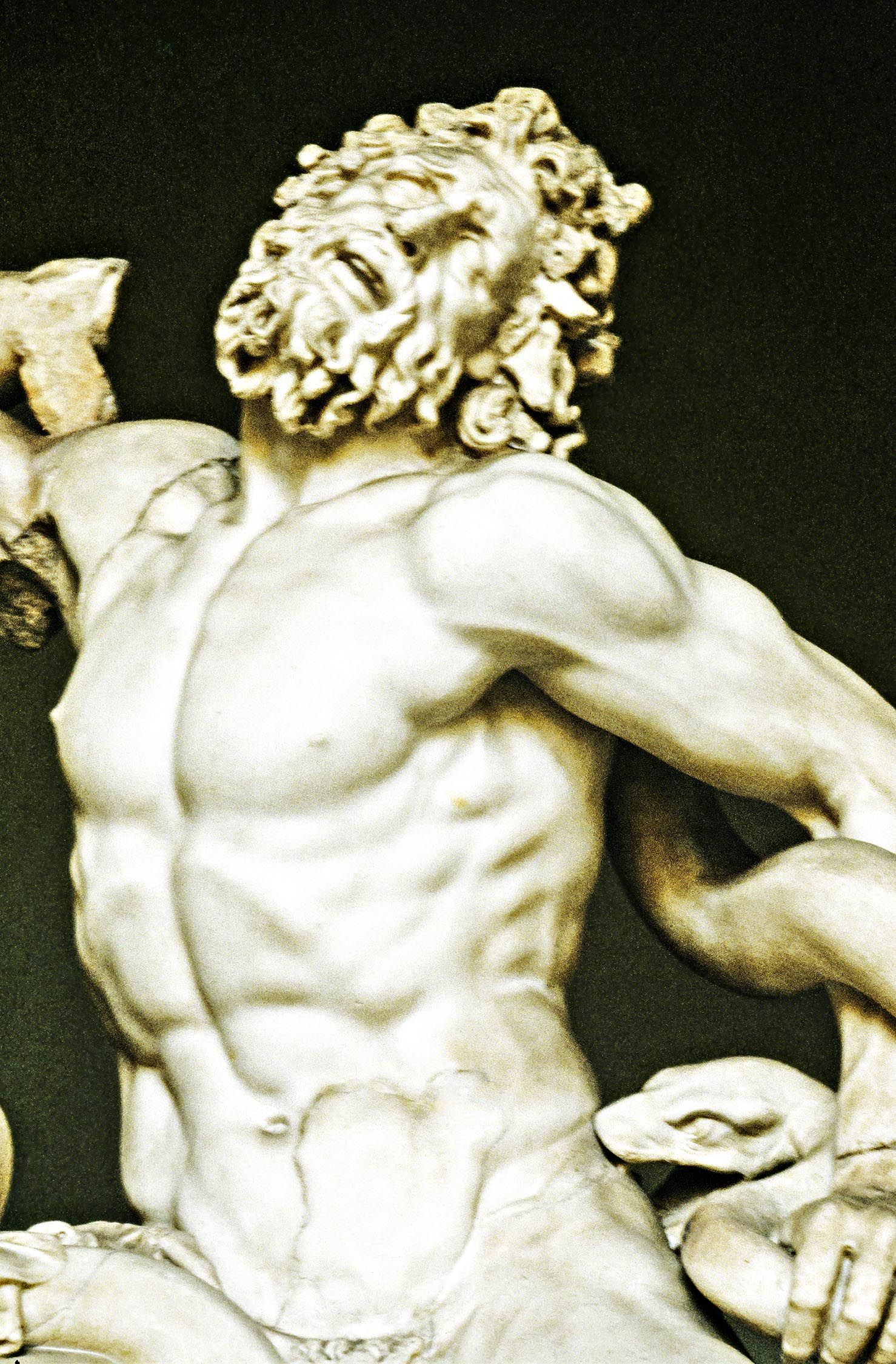
Another major influence was not an artist but an ancient sculpture, the Laocoön. It was only unearthed in 1508 and was considered the supreme depiction of grief ever. The expression on his face was used in paintings of martyrs and the dying Jesus. The use of serpentinata (S-shaped forms and lines) is an essential element of Renaissance Art, and that was still true of Baroque Art. But the biggest aspect of Baroque is the striving to depict the full range of human emotion.
Galleria Borghese
Hours: Mon – Fri 09:00 to 18:00, Sat until 13:00; last entry at 17:00. Maximum: 360 people for each two-hour visit; so you must reserve for 09:00, 11:00, 13:00, 15:00 and 17:00 hrs.
Cost: €15 including reservation fee; there are EU student discounts. Check out the Roma Pass at the bottom of this post.
Borghese Origin
The villa and its park were completed in 1605 for Cardinal Scipione Borghese. He gained a lot of wealth from family businesses and acquired one of the finest collections of art in Italy, if not Europe. What is clear is that he had an extremely good sense of what is good art. Most of the collection was his.
Borghese Masterpieces
Mosaic of the Gladiators
Main Floor: 4th Century AD
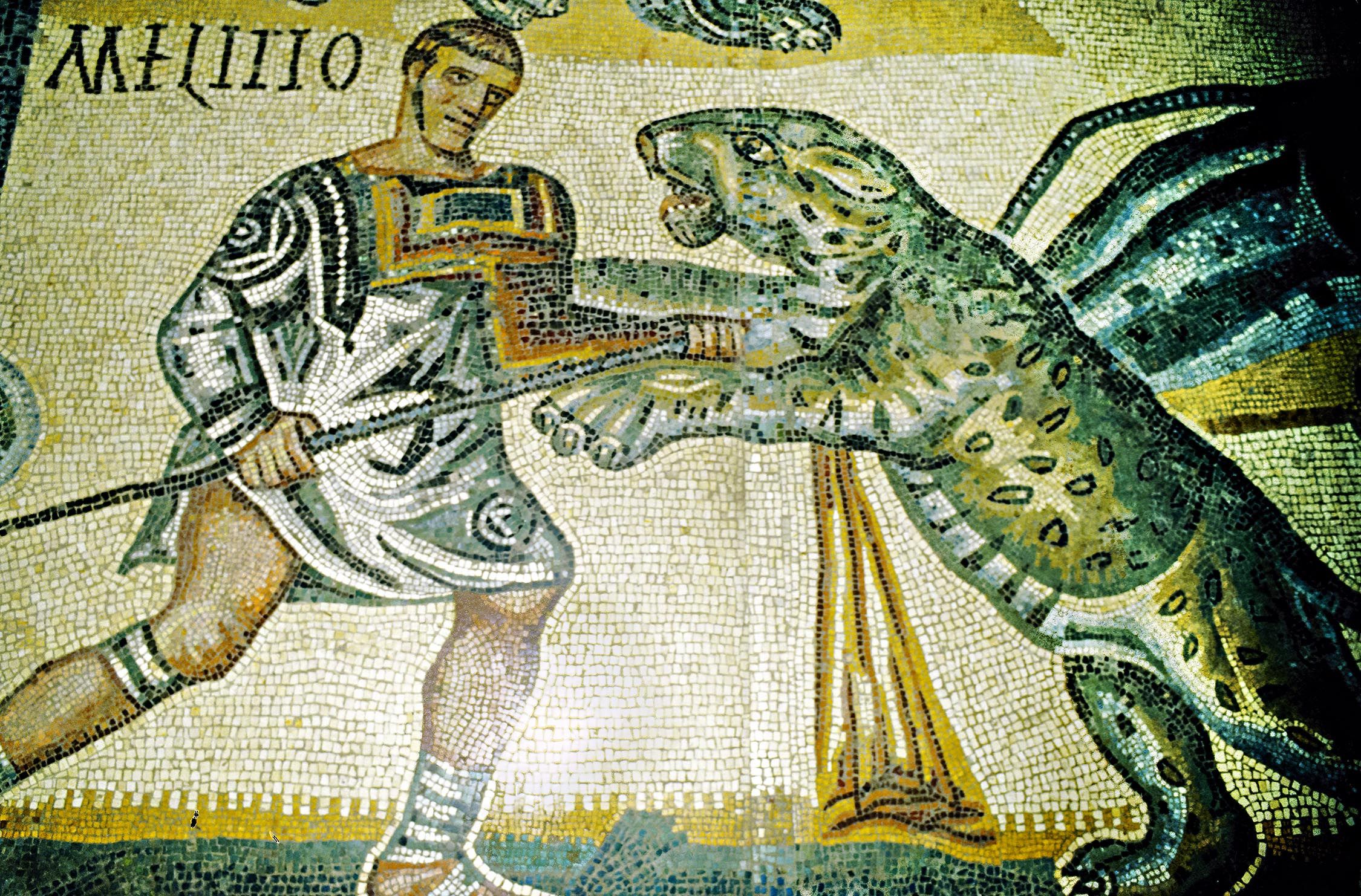
This large 28 m mosaic was only discovered in 1834 on another Borghese estate. Each gladiator has a unique face and name, which implies that these are actual portrayals. A Greek letter θ, theta, means the gladiator has died. Melitio, shown above, obviously killed the tiger. In fact, it is claimed (though I doubt there are any hard facts) that 1 million animals were killed in the Colosseum and an estimated 400 to 500,000 people.
Pauline Borghese as Venus
Room 1: Antonio Canova 1805
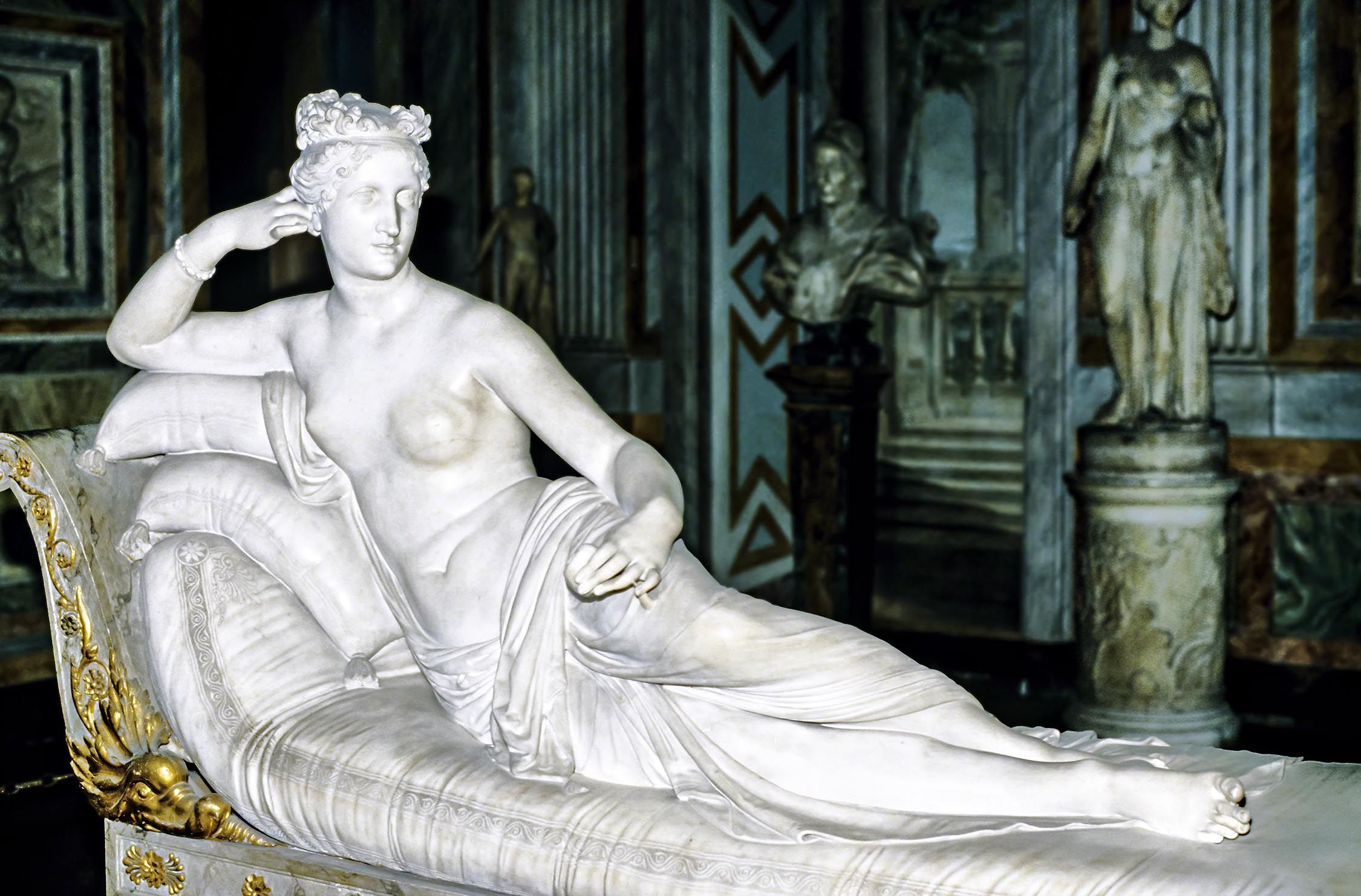
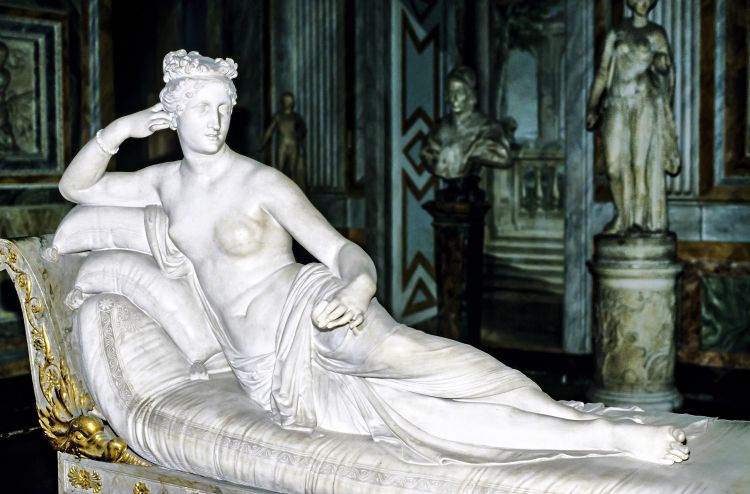
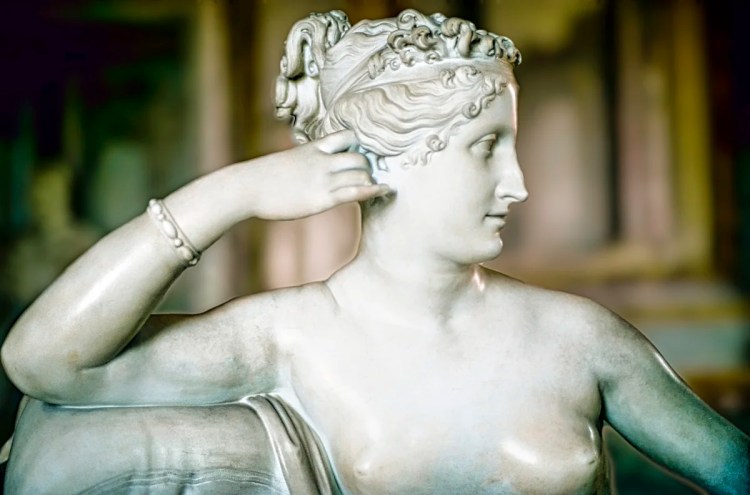
Pauline Borghese, sister of Napoleon, is portrayed as Venus, the goddess of love, holding the apple given to her by Paris. The apple was inscribed “for the fairest one”. Three goddesses claimed the apple: Hera, Athena and Aphrodite. Hera, wife of Zeus, was widely regarded by the Greek myths to be the most beautiful.
Paris, a mortal citizen of Troy, was asked to judge by Zeus, who wisely declined. Each goddess attempted to bribe him. They offered him kingdoms and wisdom. After that, they stripped naked. Aphrodite, the goddess of love and sexuality, offered him the most beautiful mortal woman, Helen of Sparta. Paris awarded the apple to Aphrodite, and Helen was the mythological cause of the war with Troy. Because Athena lost, she joins with the Greeks to defeat Troy.
Canova’s neoclassical masterpiece is so real you can feel the folds in the soft mattress made of hard marble. The drapery of the toga looks so real. The pose is so languorous. It was Pauline who commissioned the sculpture for her husband, Camille Borghese. So Pauline is portrayed as the partially nude Venus (Roman name for Aphrodite). Very sensual for that era, the work created such a scandal that Pope Paul closed the gallery to the public. Pauline had a reputation for promiscuity and probably enjoyed the scandal. The Borghese claim to be descendants of the founder of Rome, Aeneas, the son of Venus!
Aphrodite
1st Century AD
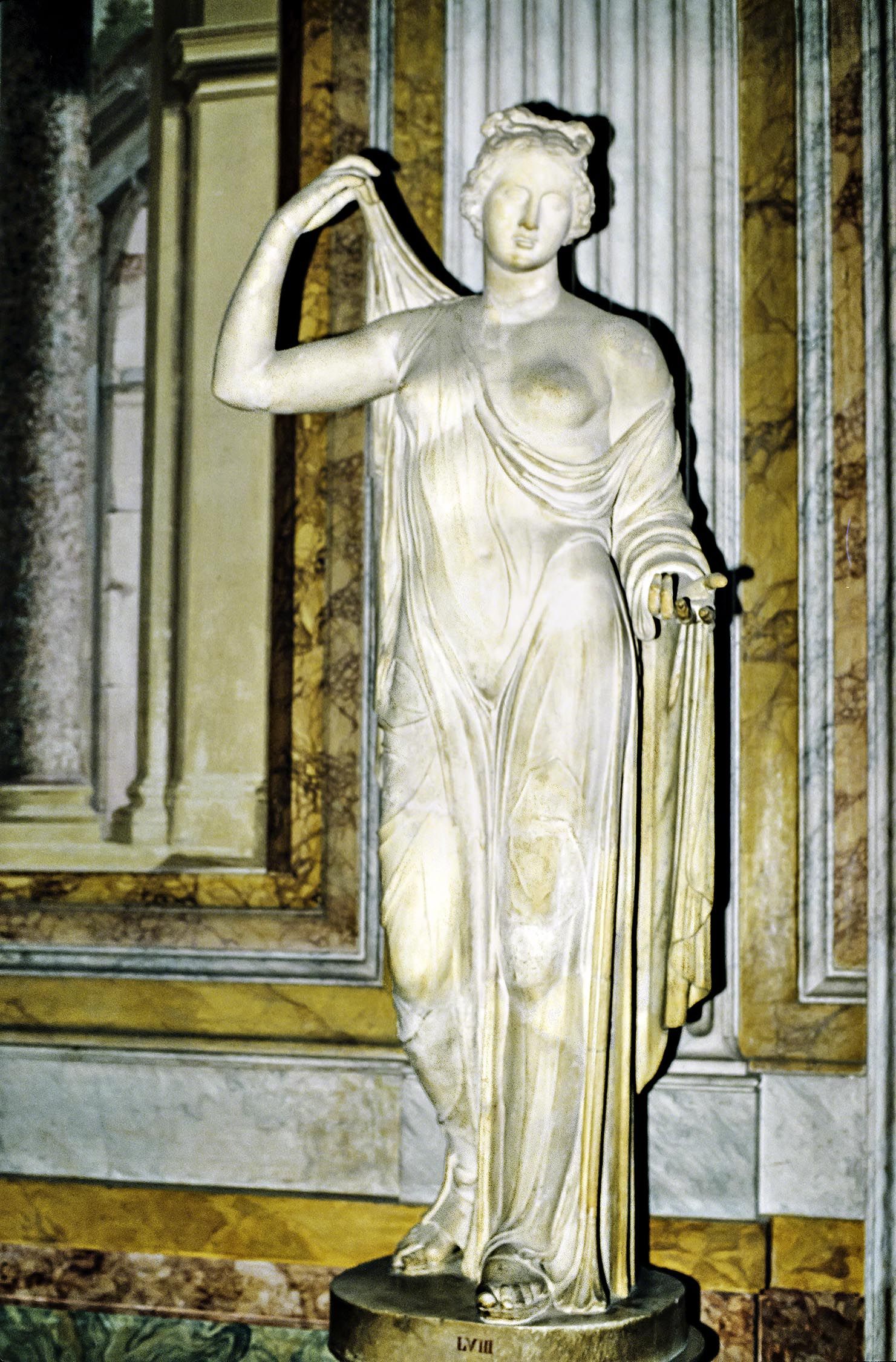
Aphrodite is the goddess of love from the Classical Era. Actually, it is a Roman copy of a famous Greek statue by Callimachus. Its Greek style is shown by the chiton (typical clothing of that era) worn by the goddess. The drapery and contrapposto pose emphasizes the sensual figure of the goddess. Her clinging, sheer chiton serves to highlight her contours rather than conceal her body. That reinforces the story of the Judgment of Paris myth.
David
Room 2: Gian Lorenzo Bernini 1624
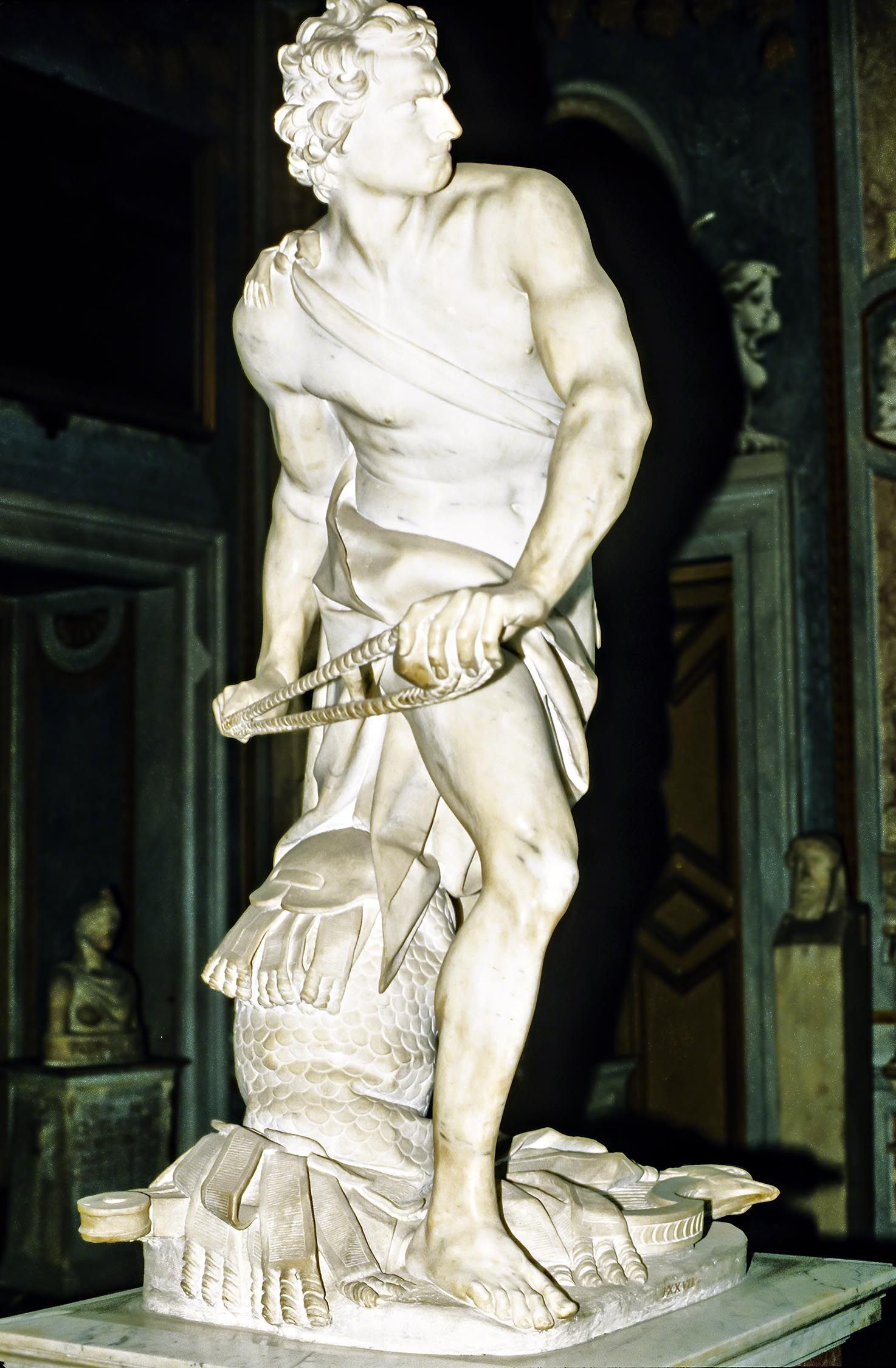
Cardinal Scipione Borghese was the first to recognize the talent of Bernini and commissioned this sculpture of David. Interestingly, the 25-year-old Bernini sculpted his own face.
Portraying David at the point he hurled the stone at Goliath is far more dramatic than the static pose used for David in the past.
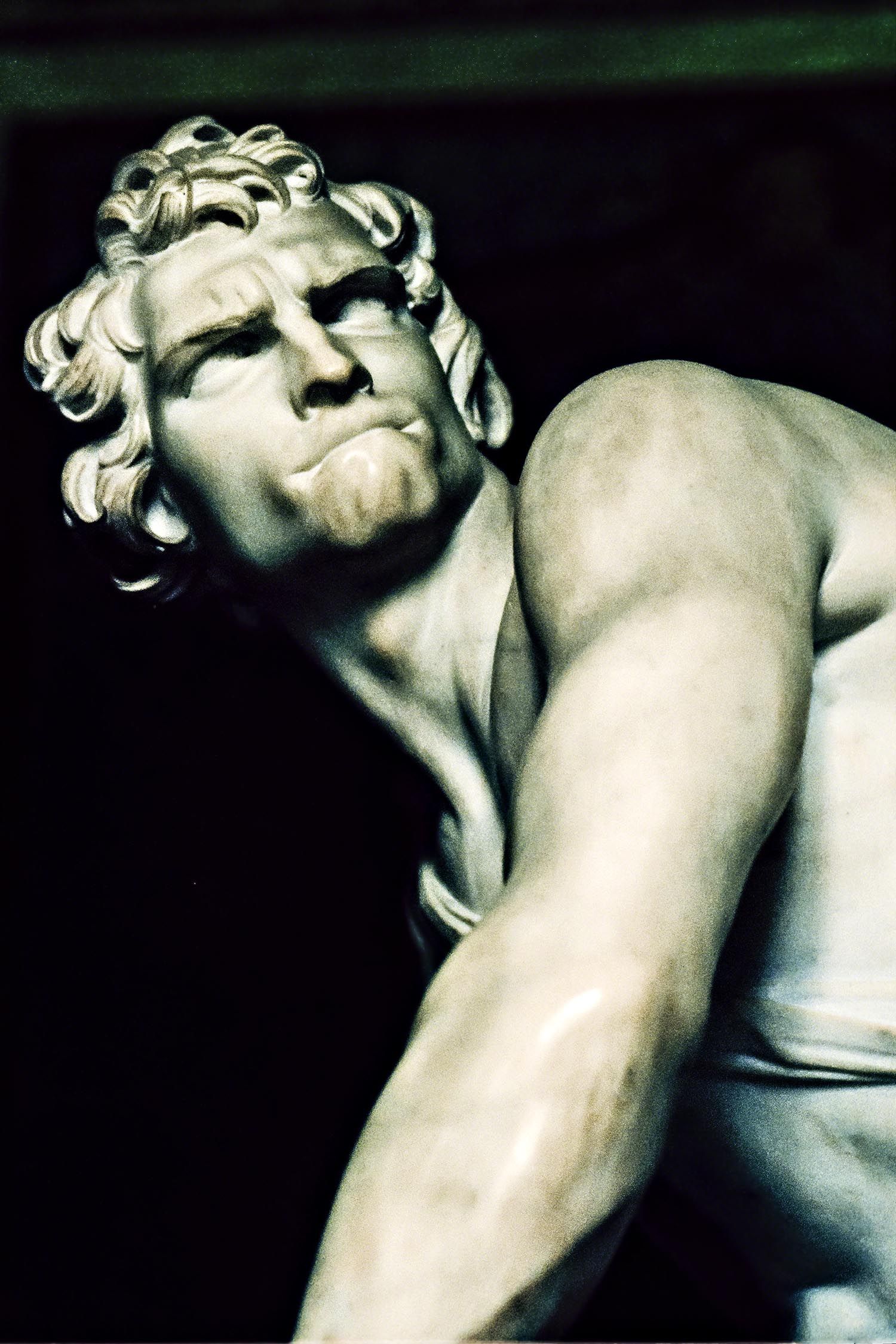
Bernini captures both motion and emotion. It is charged with passion and determination to defeat the implied but invisible enemy, Goliath. It feels theatrical. In fact, this was one of the first Baroque statues and set the tone for the Baroque Era.
Sarcophagus with the Labours of Hercules
2nd Century AD

This funerary monument was made in Anatolia (Turkey). This depicts the 12 Labours of Hercules (Greek Heracles). The first two tasks shown in the photo are: Slay the Nemean lion and slay the nine-headed Lernaean Hydra.
The name Hercules is well known, but it originated from a Greek poem dating back to 600 BC. Driven mad by Hera, the Queen, the God, Hercules killed his wife and children. He went to the famous Delphi Oracle. After praying to Apollo for guidance, they told Hercules to serve his cousin, the king of Mycenae, for 12 years. During this period, Hercules was given twelve difficult feats, called labours, by the king. Two labours were fetching the Golden Apples of Hesperides and capturing Cerberus, the same three-headed hound of Hades that is part of the Rape of Proserpina statue in Room 4 below!
This myth celebrates the Bronze Age foundation of the Mycenaean civilization by the Indo-European tribes described in Amazing Rome – Ancient Hidden Gems Walk 3. The Mycenaeans evolved into the classical Ancient Greek culture.
Apollo and Daphne
Room 3: Gian Lorenzo Bernini 1625

After being shot by Cupid’s golden arrow, Apollo falls in love with Daphne, who was shot with a lead arrow so she hates Apollo. The myth of Apollo and Daphne can be seen as a battle between chastity (Daphne) and sexual desire (Apollo). Apollo lustfully pursues Daphne, who sacrifices herself to escape from the persistence of Apollo.
The sculpture shows the exact moment when Daphne is transformed into a laurel tree. Apollo turns her chastity into a cultural symbol, creating a wreath from her laurel branches. This is the origin of presenting a laurel wreath after a triumphal procession or Olympic competition. This is a good example of how the art of the past has affected the culture of today!
Rape of Proserpina
Room 4: Gian Lorenzo Bernini 1622

When Italians led the rebirth of classical art, they also revived interest in Greek and Roman mythology. To understand these works of art, we have to first understand the myths behind them. The Greek story of the abduction of Persephone may be derived from an ancient Sumerian story. Proserpina was the goddess responsible for vegetation and the fertility of the soil. The gods Hermes and Apollo had wooed the beautiful Persephone, but her mother Demeter, rejected their gifts and hid her daughter away. Zeus permitted Pluto, who was in love with Persephone, to abduct Proserpina as Demeter was not likely to allow her daughter to go down to Hades. Pluto wants her to become queen of the underworld. While in Hades, Persephone is guarded by the three-headed dog Cerberus, shown at the bottom of the sculpture.
Demeter (aka Ceres), the god of agriculture, was so upset at the loss of her daughter, she forbade the earth to produce. Pressed by the cries of the hungry people, Zeus forced Pluto to return Persephone. But Pluto tricks Persephone into tasting the food of the underworld. So she was obliged to spend a third of each year (the winter months) there. This is a story to explain the seasons.

This is considered one of the best sculptures in the world. What is unique about this statue is that you can feel Pluto’s hand sinking into the thigh of Proserpina. The stone is made to feel like real flesh. You can see individual strands of hair. You can feel the strength of Pluto, thanks to his strong muscles. You can almost hear Cerberus barking. The sculpture exudes emotion, tension, movement, and theatricality. Bernini is famous for portraying the most poignant moment in a story in the most dramatic way possible, using movement and facial expressions.
Sala degli Imperatori

Sala degli Imperatori (room of the emperors) displays 12 busts of emperors. They were made in 1683 but follow Roman iconography. Everything is alabaster and porphyry, especially the busts.

This room also displays four marble craters (vases) for each of the seasons. Sculpted by Cardelli in 1785, they were modelled after the ones in Chiesa Santa Cecilia in Trastevere. This one is about autumn as it shows the vendemia, the wine grape harvest.
Other Rooms
In terms of the paintings on the first floor, see
Room 9 for Raphael’s Deposition 1507;
Room 10 for Cranach’s Venus with Cupid;
Room 14 for Caravaggio’s St Jerome Writing: Cardinal Scipione Borghese recognized the genius of Caravaggio and bought his paintings when other patrons had turned him down. The average person did not like him portraying biblical people as ordinary humans in a realistic setting. It was a major break with the past. The warm orange robe draws our attention. The Dalmatian priest is shown writing because he is the one who translated the Bible into Latin.
Be sure to pay homage to the bust of Cardinal Borghese for whom we owe our thanks for this amazing collection. The image has so much vitality, it appears as if he is about to speak to us.
Room 19 for Correggio’s Danae: Note the wonderful rendering of the draperies and flesh tints. This painting journeyed all over Europe before Prince Borghese bought it in 1823 for £285. That is equivalent to USD 34,522 in 2018.
Room 20 for Titian’s Sacred and Profane Love, an allegory of spring.
Villa Borghese Park
If you plan to walk to Centro, then you should walk southwest through the Villa Borghese Park, the largest park in Rome. You will pass a hippodrome, the Giardino del Lago with its landscaped garden and lake, and then walk on Viale delle Magnolie. This is the only route through the city wall. You end up in the Pincho Gardens at a classic view of Rome, Terrazza del Pincio. From here head southeast down the Viale della Trinita dei Monti. Suddenly, you are at the church of that same name.
Spanish Steps – Piazza di Spagna
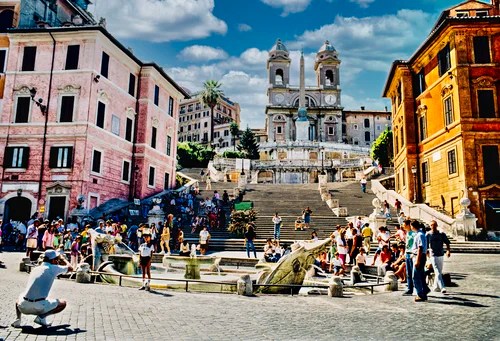
Its Italian name is Scalinata di Trinità dei Monti, stairs to the Trinità church at the top. But tourists call it the Spanish Steps as it starts at Spanish Square. In the centre of Piazza di Spagna is an early Baroque fountain by Bernini: not the famous one but his father.
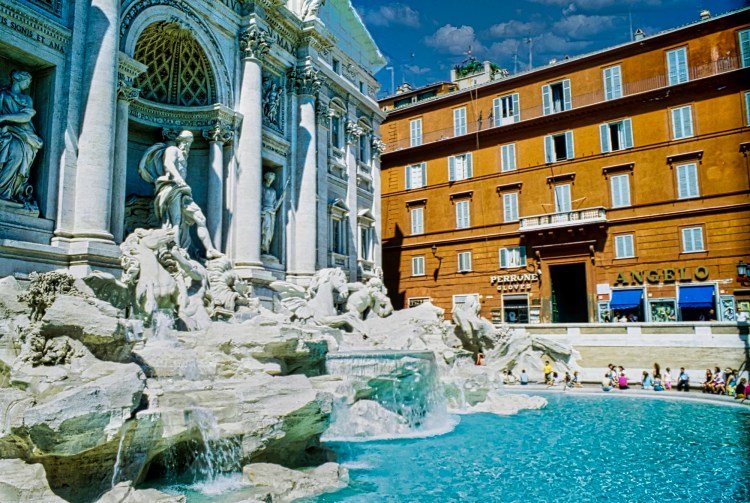
Other than the view of the stairs, this is just a touristy sight in the middle of a boutique shopping area with lots of people. If it’s late, head directly to Santa Luigi dei Francesi for a fitting climax to this Baroque Blowout Walk. If you have lots of time, continue to the Eternal Rome Walk 7, which starts at Fontana Trevi.
Chiesa Santa Maria della Vittoria
Head south from the Borghese Gallery to this church (chiesa) to see the Capella (Chapel) Cornaro. Your mission is to appreciate The Ecstasy of St. Teresa by Giovanni Lorenzo Bernini (1652). If this does not make you ecstatic then you need to look at the details.

Theresa of Avila described how an angel had pierced her heart with a golden arrow: “The pain was so great I screamed out loud; but at the same time I felt such infinite sweetness that I wished the pain to last forever”.
Now look at the sculpture and see what Bernini portrayed. Its’ purpose was to convey spiritual strength of the Catholic faith. The flowing robes and posture shows a major break with classical restraint. Instead, we can almost feel voluptuous trance of Theresa lying on a cloud. The figures appear to be illuminated by the faux window above with golden rays to emphasize the illusion. To represent the true intensity of Teresa’s experience, Bernini shows her swooning in near-erotic rapture, with eyes closed and mouth open, and both her visible limbs hanging limp.
This work was influenced by the sculpture of St. Cecilia in Trastevere on the Amazing Rome – Ancient Hidden Gems Walk 3. It is considered one of the top Baroque sculptures. Several years later Bernini uses the same compound art form including the golden sun rays on much larger scale behind the altar of St. Peter’s in the Vibrant Vatican Walk 4B.
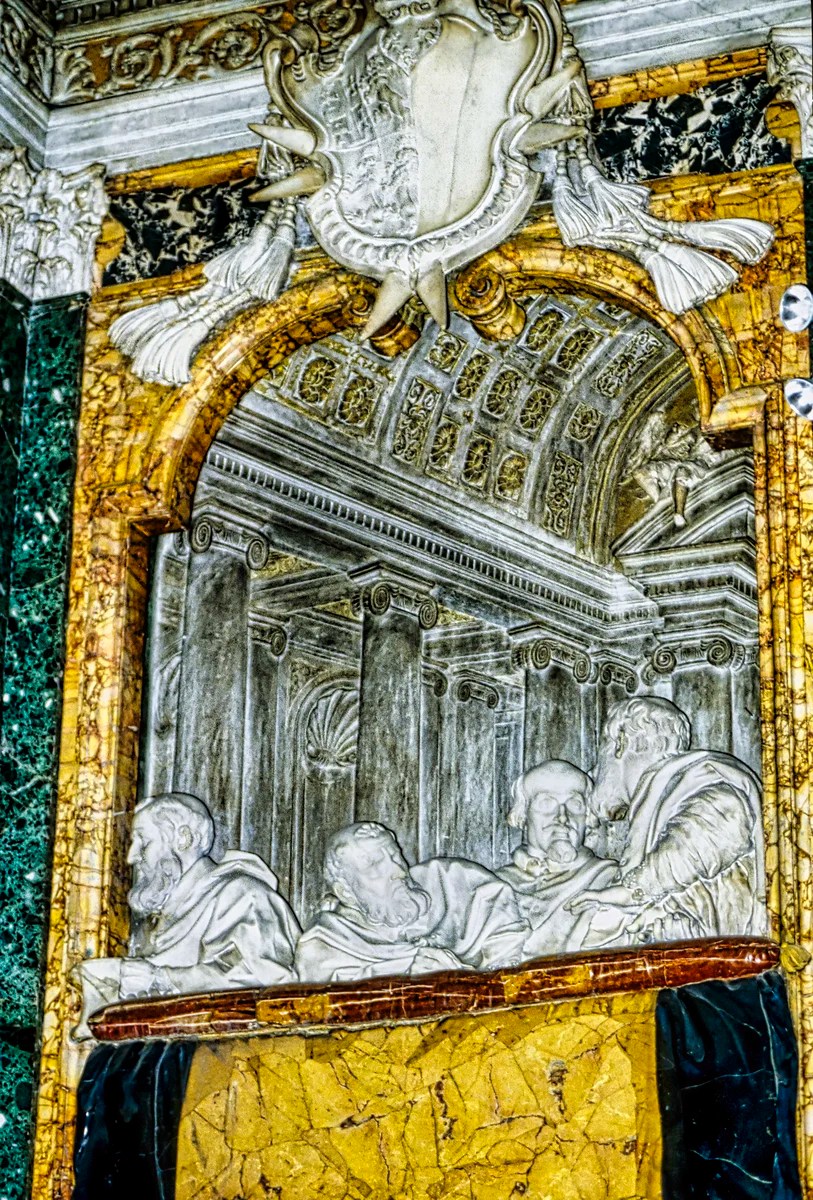
Bernini’s fee for the whole chapel was 12,000 scudi, an enormous sum at the time. A government official would earn 100+ scudi per annum, double that of bricklayers, artisans and other trades! The Cornaro Chapel also has a faux theatre box on the side filled with the Cornaro family watching the ecstasy scene play out. The Cornaro family was very rich, as it included a cardinal and the Doge (leader) of Venice.
Santa Luigi dei Francesi

The church of St. Louis of the French is a shrine to Michelangelo Merisi, better known as Caravaggio, the name of his hometown. He painted huge canvases in 1598.
The Calling of St. Matthew above depicts the tax collector with his men in a very down-to-earth setting, counting the money they collected. They are dressed in very richly coloured clothing. In comes two simply dressed poor people, one points at Matthew, who points to himself, asking, “Who, me?” By his commanding gesture, we realize it is Jesus calling. Only later do we recognize the faint halo above Jesus. His hand is a direct copy of God’s pointing hand in the Sistine Chapel, an influence of Michelangelo. The other figure BTW is St. Peter.
Artists pay attention to detail, and both paintings are struck by a beam of sunlight coming from the same direction as if lit by the window in the chapel. The selective beam of light on Jesus was unique at that time. Caravaggio had a profound influence on Rembrandt, who is renowned for chiaroscuro. Caravaggio was admired by other artists and art connoisseurs, but not by the general public.

The painting, The Inspiration of St. Matthew, was mostly shadow except for the angel and the saint, whose bright orange robes dramatically stand out. St. Matthew as he jumps up pushes the stool out into the viewer’s space.
St. Matthew, as a tax collector, would have been despised by the Jewish population as a collaborator of the occupying Romans. He supposedly wrote the Gospel of St. Matthew, but in fact, that was only claimed in the 3rd century.
It is interesting that the subject, Matthew, is the namesake of the sponsor, Cardinal Matteo Contarelli. The cardinal was rich and had already paid a large sum towards the façade and the altar.
Baroque Architecture featured opulent use of colour and ornaments, lots of gold and marble, huge ceiling frescoes , some using trompe l’oeil (illusion). The nobility adopted Baroque art in Palazzo Farnese and soon this spread throughout Rome and the rest of Europe.
Itinerary Options
If you get into the Galleria Borghese for 11:00 then you could start with Santa Maria della Vittoria, which is somewhat on the way to the gallery.
If you get into the gallery in the late afternoon or if you still have time after the Galleria Borghese — and hopefully energy — two of the more interesting options are:
- Villa Giulia is a superb Etruscan museum on the other side of the huge Villa Borghese park
Final Comments
If you love Baroque sculpture, then this is the walk for you. Bernini is just an incredible sculptor.
Subscribe
Please subscribe to Terra Encounters because we offer valuable insights to improve your understanding and enhance your travels. We offer itinerary-based guides packed with the best sights and hidden gems. Let our knowledge help you fully appreciate every moment of your amazing journey.
Get travel tips and advice delivered directly to your inbox. The best part is that it is free.
This was only a taste of Rome. What questions do you have? If you have been to Rome, share your experiences with us. How long is/was your trip?
Itinerary Map & Resources
Roman Itineraries Map — our custom Google Map
What Should You Read about Rome
Baroque and Rococo, Germain Bazin, Thames & Hudson
Caravaggio, Giorgio Bonsanti, Scala
The Companion Guide to Rome, Georgina Masson is too in-depth for tourists. But it is great for expats, budding archaeologists and art historians living in Rome.
The Golden Book of Rome, Casa Bonechi – classic tourist booklet
History of Art, H. W. Janson, Prentice Hall – is for learning about art and architecture. It is not for lugging around on your trip. It weighs about 20 kg – OK, would you believe 2.6 kg (5.7 lbs)?
Roma Pass
The 48-hour pass is probably not worthwhile. The 72-hour pass costs €38.50 and includes two museums and free metro/bus. Public transit ticket costs €1.50 per trip. After you use the two free tickets, you will get discounts on additional museums so always use the pass for the more expensive fees. The passes start at whatever time you first use it; e.g. bus or metro triggers it too.
The Roma Pass lets you skip the very long line (for buying tickets). But, you can also skip the line by buying your tickets online. Most major museums in Rome are included, except the Vatican Museums! Note that some places like the Colosseum and the Roman Forum/Palatine Hill are two sites, but they count as one.
Google Maps Ratings
Google Maps provides a rating from 0 to 5 for all sights, hotels and restaurants (but not cities). All of our recommendations are appended with the rating (prefixed with a G) from Google Maps. As it is based on feedback from tourists and locals, it is much more reliable than travel booking websites. We consider a score of 4 to 4.39 to be Very Good; 4.4 to 5 to be Excellent.
Rome’s Top 8 Self-Guided Walks
Here are eight itineraries to explore Rome in more detail:
Understanding Italy
The Italy FAQ post answers your questions, such as:
- When should I go?
- What is the best season for travel?
- Where should I go?
- Can I see everything in a week?
- How much time do I need for Italy?
- How much cash should you take to Italy?
- Should I pay in Euros or my own currency?
- How safe is Italy?
- Should I rent a car? Take a Taxi?
 Terra Encounters
Leave a comment