

Why You Should Do the Glorious Glendalough Drive
Glendalough was a special find of an archaeological site, plus a scenic drive in the countryside. Do not miss it!
Glendalough is pronounced Glendaloch, as in the Scottish loch and means valley of two lakes. This enjoyable excursion was only spoiled by the cold (9°C) and dreary day.
Author & Photographer: George Mitchell

Our content and advice are derived from our personal experience and knowledge, gained from living in Europe for seven years and studying its art and architecture. Our recommendations are not influenced by affiliate links – we do not have any. Ireland is one of our favourite destinations.
All of our recommendations are top-rated by Google Maps, which is based on the opinions of everyone, not just tourists. Each place recommended in our posts and custom maps is appended with a Google Maps Rating (G0 to G5).
Glendalough Monastery
Glendalough Monastery was started in the 6th century by St. Kevin. After seeing a short film, we went with a free guide to tour the site. We walked as far as Kevin’s Kitchen, the only intact building with a stone roof. Maureen, the guide, unlocked the room and locked us in! After Maureen’s superb and final talk, a large group from the Univ. of Calgary sang the famous Leonard Cohen song, Hallelujah. Their powerful voices reverberated off the barrel roof. It was very powerful. So powerful that when we left the church, the clouds parted and the sun drenched the ruins for perfect photography.

This double entrance gate uses stones fitted together without mortar, and it is still standing over a thousand years later. This served as the gatehouse to control who could enter. Inside, ecclesiastical law was supreme. So, convicted people could flee the laws of the nobility and claim sanctuary. But it was not all roses. Their land was forfeited to the King, and their wife was considered to be a widow. They could not leave, or they would face arrest

The most unique building is the Round Tower. Oscar Wilde’s father rebuilt the conical roof using the original stone that was destroyed by lightning.
It was used as a watch tower and a treasure room. Its front door requires a ladder to enter. During Viking invasions, they could pull up the ladder to protect the wealth stored inside. But its primary purpose was as a bell tower, a tradition of Campanile in Roman Catholic Italy – the Tower of Pisa is an example. Bells were a way to tell clergy and workers the time of day.
There is a large cemetery dating from the 6th century. Only four families still have the right to be buried here, including our guide, Maureen. Most tombstones have a Celtic cross with Celtic knots that have no beginning or end. These originated in Ancient Rome if not earlier.
The Celtic cross is a combination of a cross and a Druid sun. The early Christian missionaries thought the easiest way to convert the Irish heathens was to combine their symbolism with the Cross. This syncretism approach was common to early Christianity, which adopted the symbolism and customs of Mithraism and Roman customs. In particular, they adopted the winter solstice festival of Saturnalia as described in Discover the Secrets of Ancient Rome. Everyone in the world is familiar with this festival. It is now called Christmas!!

The photo shows the Round Tower and St Kevin’s Kitchen, the only two buildings not destroyed by English forces in 1398 (King Richard II).
Wicklow Mountains

We drove to the Upper Glendalough but parked on “highway” (1.5 lanes) to avoid a second EUR 4 parking charge. There are some interesting walks here, but we just had lunch and left. It is not worth driving here unless you go hiking. The high mountains were not spectacular for us compared to our hikes around the world.
The afternoon we spent driving through the Wicklow Mountains. First we took road R756 to Wicklow Gap. There was an OK view from the parking area in the desolate pass down to the verdant green valley floor.

Military Road
Then we went along R115, also called the Military Road, which was built by the British after the 1798 Rebellion. It was used to counter the Irish rebels fighting for a free Ireland.
Glenmacnass Waterfalls

The Glenmacnass Waterfalls are by far the most scenic spot along the whole one-hour trip to the M50 motorway surrounding Dublin. Unfortunately, there is no parking lot until after the falls. So we squeezed into one of the small pull-offs and had a great view. It is just as good as Powerscourt Waterfalls, but you are much further away. What makes it dramatic is the contrast between the craggy rocky cliff and the verdant green farm fields – see photo above.
Sally Gap

Another favourite spot was the contrast of the brilliant yellow gorse and the emerald green grass, both in the foreground and the background. A few sheep added to the atmosphere.
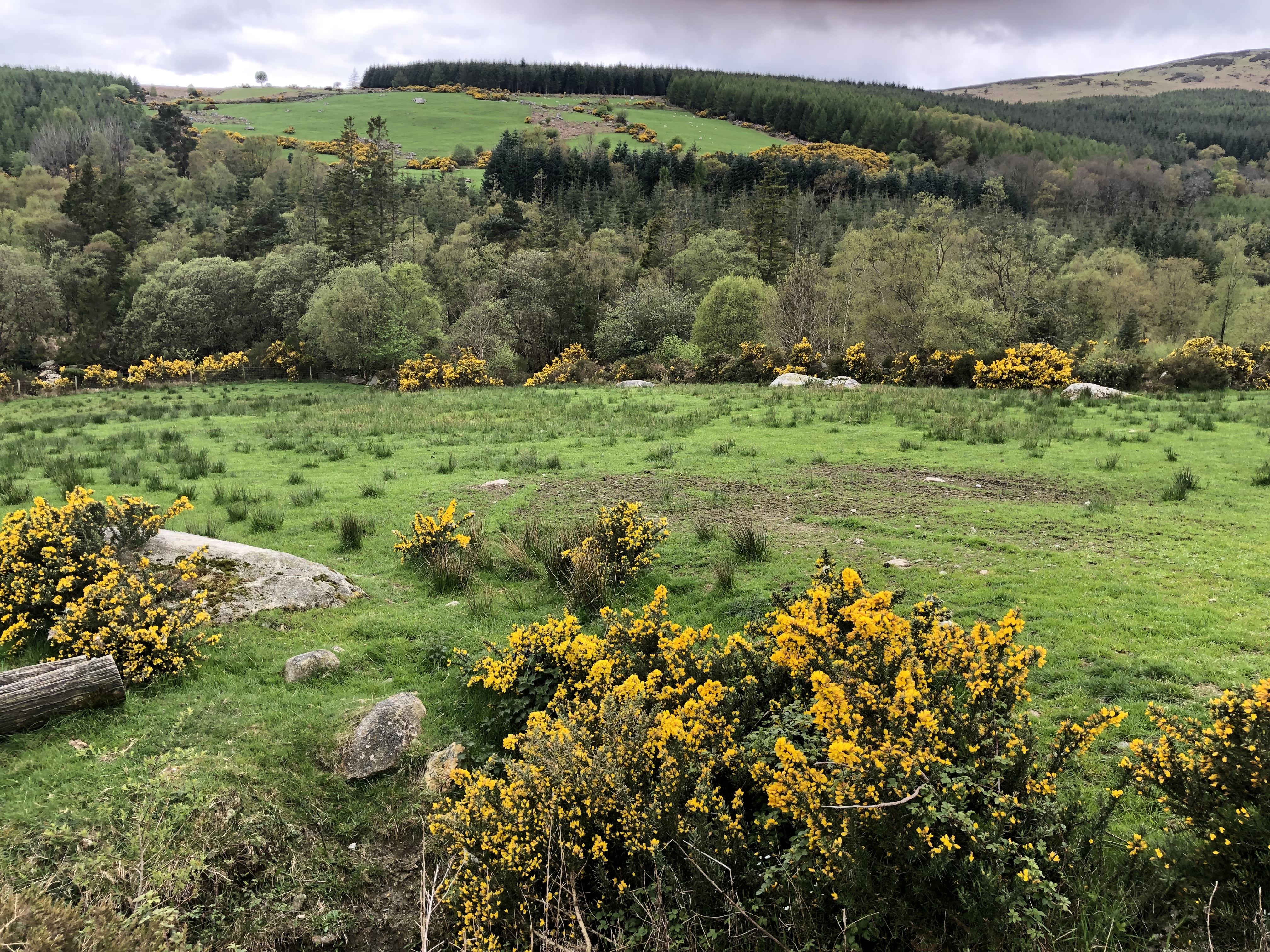
Sally Gap was utter desolation. It was wide open, but it lacked the close and photogenic feel of Lindis Pass in South New Zealand. But in many ways, there are a lot of similarities between Ireland and New Zealand – including sheep farming and verdant grassland.
Final Comments on this Itinerary
This is an exciting day trip you can do from Dublin. This is a combination of archaeology and nature.
Subscribe
Get travel tips and advice delivered directly to your inbox. The best part is that it is free.
What things fascinate you? How long is your trip? What questions do you have?
Itinerary Maps & Guides
This day trip can be part of any of our ready-made itineraries. If you have more time in Dublin, then you can add day trips to Trim, Newgrange, and the nearest sights in the Ireland East itinerary.

Google Maps Ratings
Google Maps provides a rating from 0 to 5 for all sights, hotels and restaurants (but not cities). All of our recommendations are appended with the rating (prefixed with a G) from Google Maps. As it is based on feedback from tourists and locals, it is much more reliable than travel booking websites. We consider a score of 4 to 4.39 to be Very Good; 4.4 to 5 to be Excellent.
Ireland FAQ
The Ireland FAQ post answers Frequently Asked Questions (FAQ) like:
- Where should I go in Ireland?
- What is the best season for travel?
- What is the best clothing?
- Where should I go? What are the must-sees?
- How much time do I need for Ireland?
- Can I see everything in a week?
- How safe is Ireland?
- How much cash should you take to Ireland?
- Should I pay in Euros or my own currency?
- What apps are useful for travel?
- Should I rent a car? Take a Taxi?
 Terra Encounters
Leave a comment