
Is the Chiang Mai Region Worth Visiting?
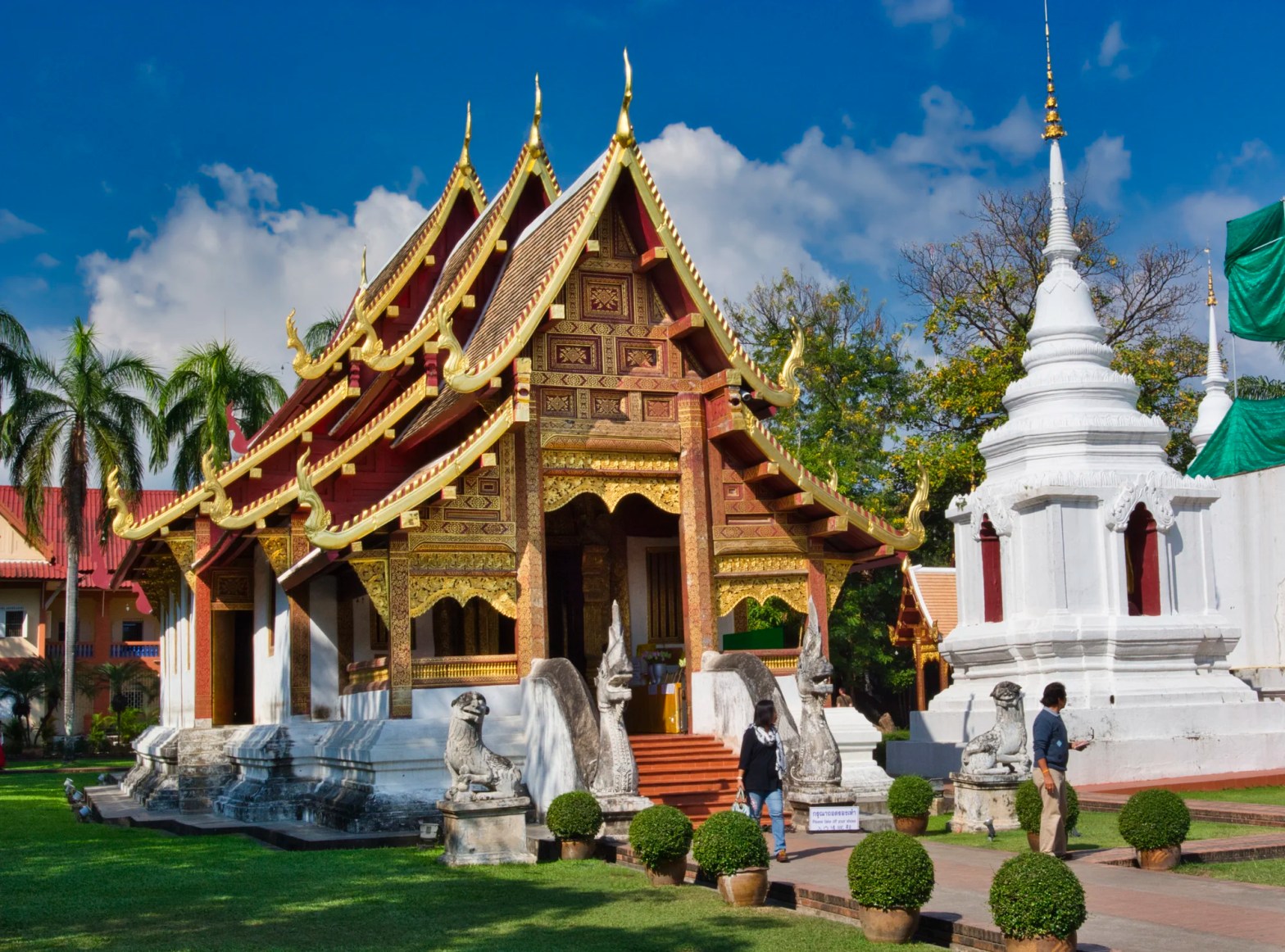
Chiang Mai is an absolute gem! The Chiang Mai region in Northern Thailand is worth visiting for six reasons:
- Rich Culture & History — ancient temples with stunning architecture;
- Friendly people — easy to meet and talk with the locals;
- Delicious Food – street food and night markets that are both cheap and mouth-watering;
- Coffee and fruit drinks — enjoy the laid-back atmosphere;
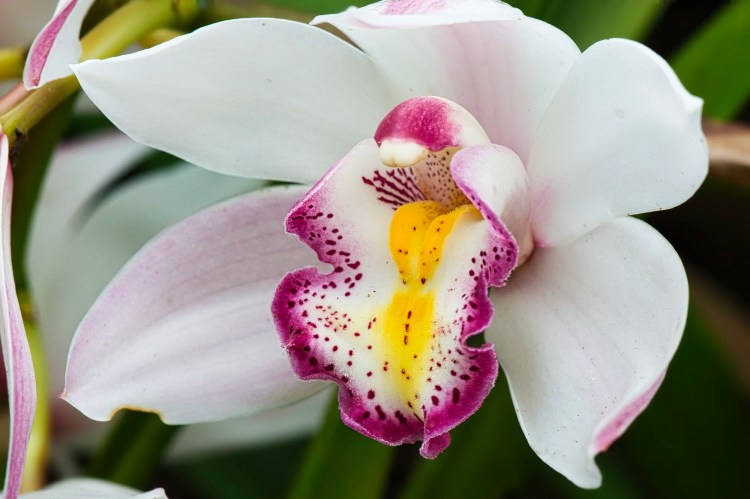
- Flowers and festivals — don’t miss the flower festival;
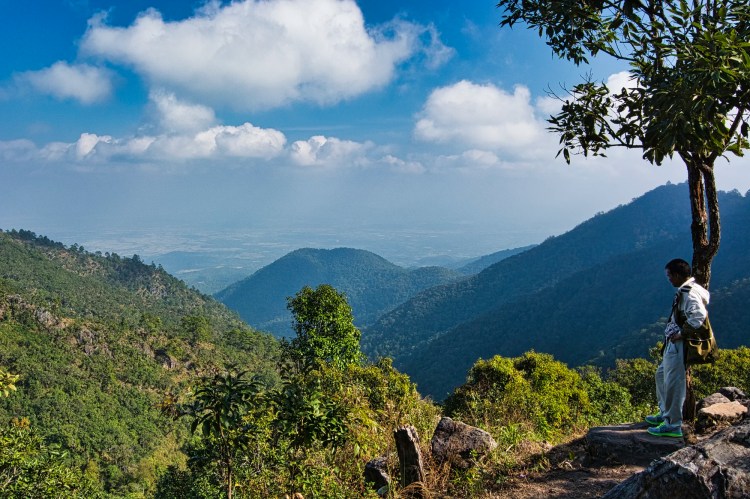
- Breathtaking Nature — flora and fauna, waterfalls and mountain views in the nearby national parks.
Author & Photographer: George Mitchell

Our recommendations are not influenced by affiliate links – we have none. Our advice are derived from our personal experience based on spending five months in Thailand as well as travelling three years around the world.
What is there to see in Chiang Mai?
The city of Chiang Mai is the best place to learn about Thai art, architecture, culture and cuisine. There are over 120 wats to visit. Some sources say over 200 wats! There is no way you can see them all. You may get templed out after going to just a few of them!
What are the best places to see and the best things to do in Chiang Mai? Sure, we could easily just list the ten best wats:.
Wat Chedi Luang, Wat Phra Singh, Wat Phantao, Wat Lok Moli, Wat Bupparam, Wat Inthakin, Wat RatchaMonthian, Wat Saen Fang, Wat Phan On, and Wat Sri Suphan
But what is a wat? What is a naga? What is a garuda? Why are there so many nagas and garudas throughout Thailand?
This post goes beyond curating a list of places to visit into an itinerary. It tries to explain what is significant about what you are seeing. Thai temples are not museums, so there are no labels explaining the artwork.
Many tourists told us they hate Bangkok — it’s a large, modern, noisy, and high-traffic city. By contrast, the original old city of Chiang Mai is very compact and walkable. The restaurants are superb.
Chiang Mai Itinerary
The sights and the itinerary route are shown on our custom TH Chiang Mai Map. The sights are split into two segments:
- Wat Chedi Luang to Wat RatchaMonthian is 4 km
- Wat RatchaMonthian to Wat Sri Suphan is 5 km
One plus of this post is that the sites are described in order of a self-guided walk. It is unlikely that you can finish this walk in one day – just continue the rest the next day.
An excellent measure of which sights, restaurants and hotels are better is the Google Maps Rating (from G0 to G5). We have appended the ratings to all place names in this post and our map. There are frequently multiple spellings for the same place. It was assumed that Google Maps provides the most accurate and official names.
3 Sis Hotel
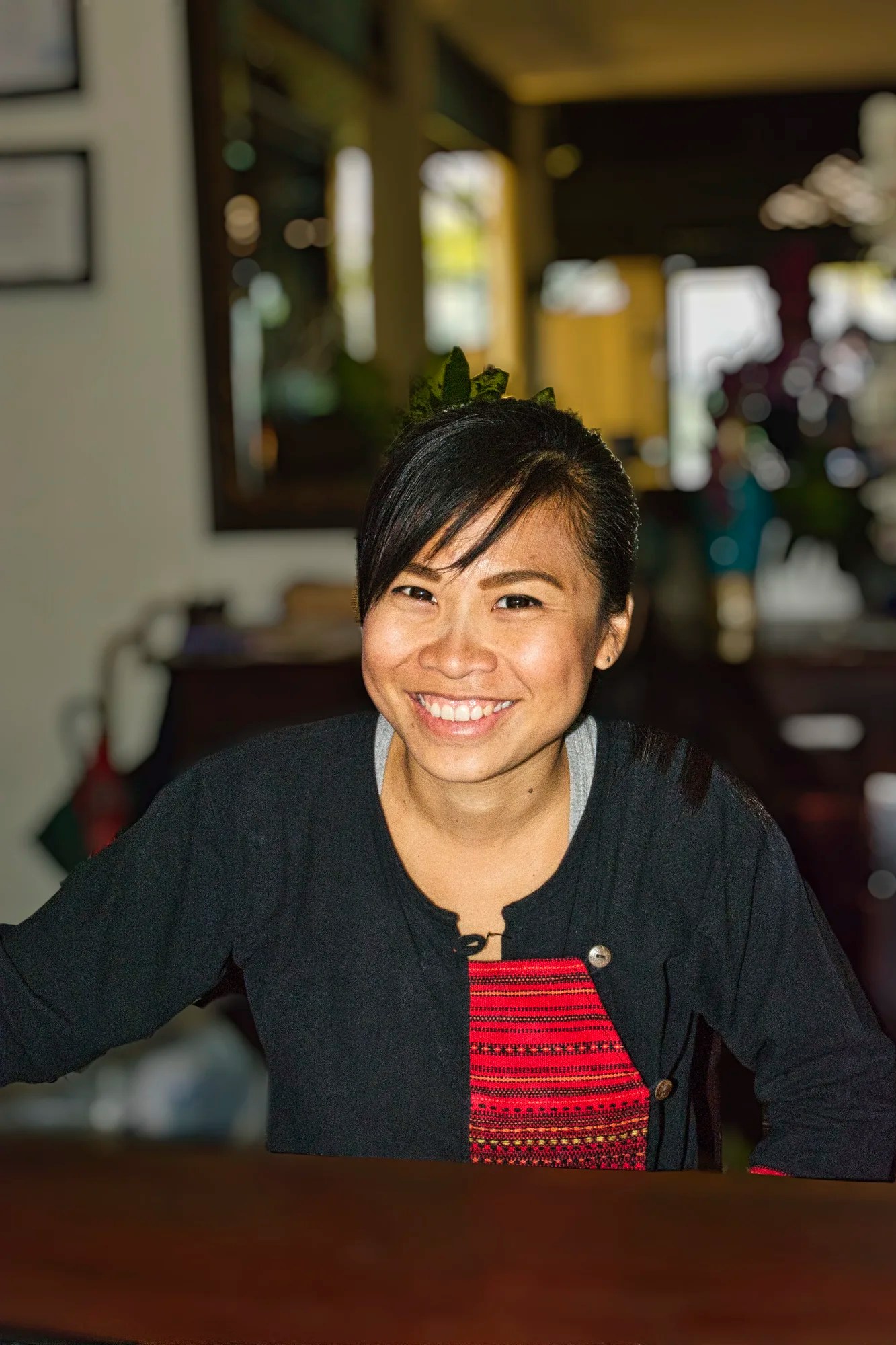
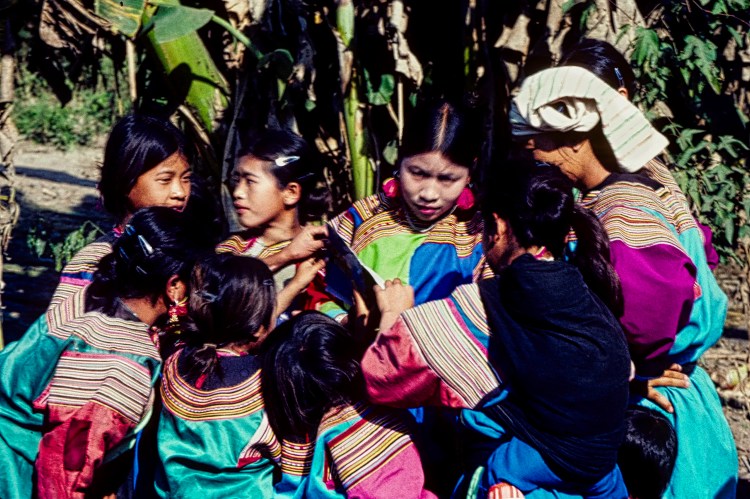
On our third trip to Thailand, we had a delightful stay at the 3 Sis (G4.2), where we spent a week for our son to fly into Chiang Mai. Our host’s outfit reminds us of the colourful costumes worn by the Akha tribe we saw on our Tribal Trek many years ago in Northern Thailand.
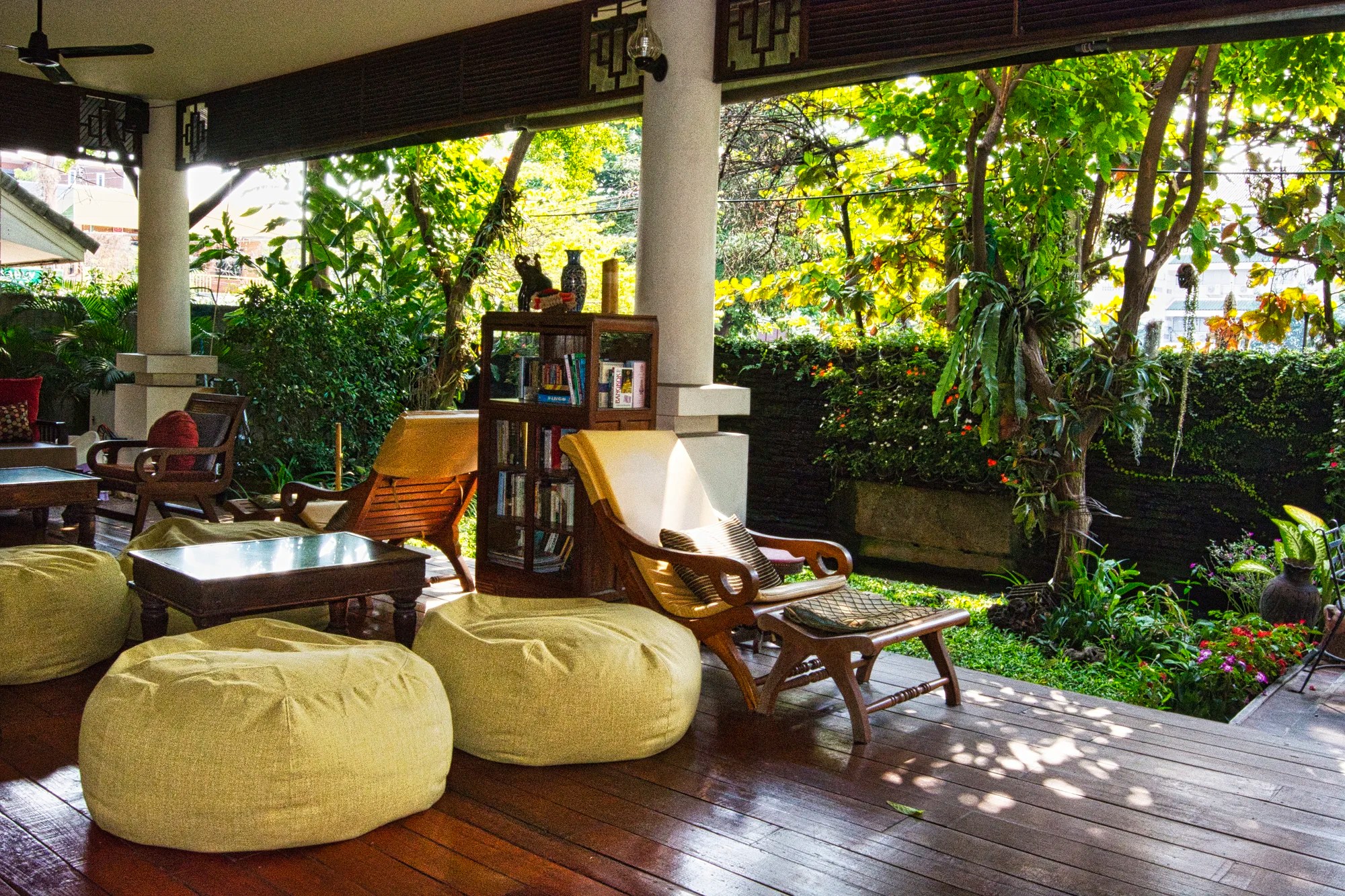
There is a beautiful outdoor lounge area where we used to chat with our hosts.
Spirit Houses
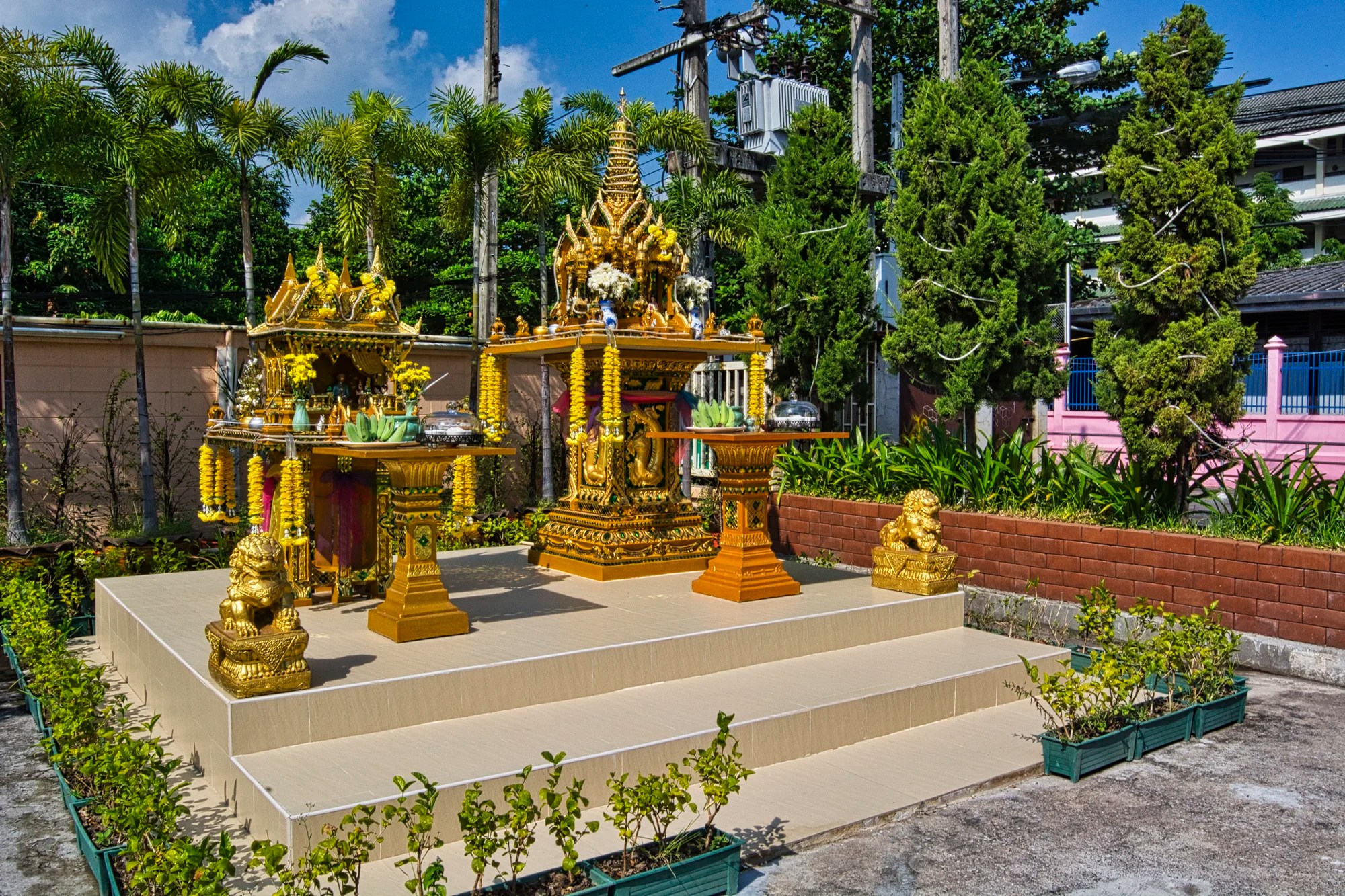
We went first thing to the money exchange east of 3 Sis and saw these elaborate spirit houses. Why does a Buddhist culture believe in spirits?
During the Indianization Period, the Thai tribes adopted first Hinduism and then Buddhism. However, many Thais still believe in spirits. Before they construct any building, they hold ceremonies to try to appease the spirits of the land. They build elaborate, temple-like spirit houses, always on pedestals, accompanied by food offerings.
Morning Alms for Monks
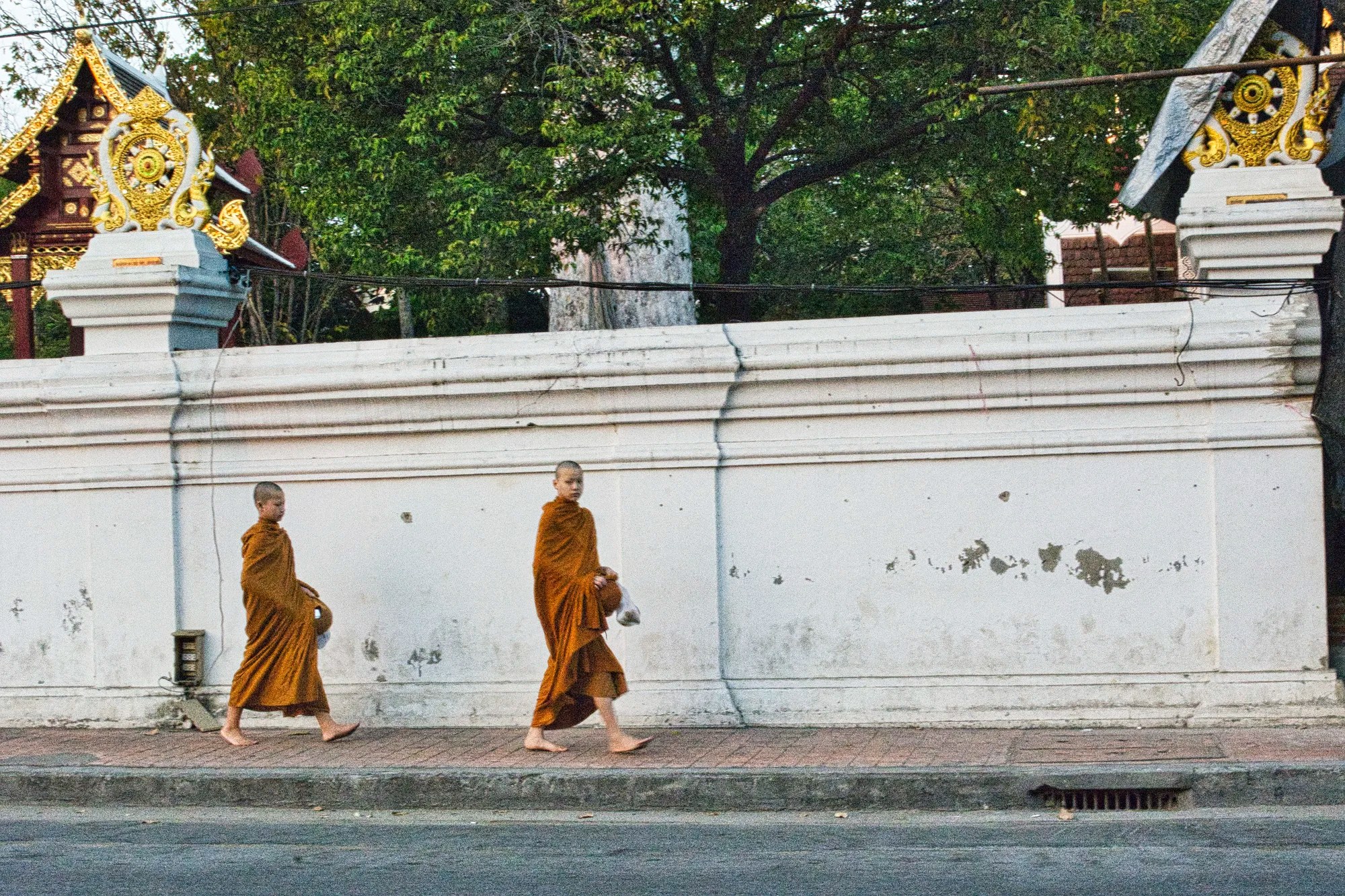
Some sources say to go to the 3 Kings Monument to see the early morning alms given to the monks. However, you can see this in many places. In our case, we got up early and walked to Prapokkloa Road at nearby Wat Chedi Luang. There were no other tourists with us.
The monks in saffron robes walked barefoot on the sidewalk. This custom was initiated by the Buddha so that the monks would always be close to the people.
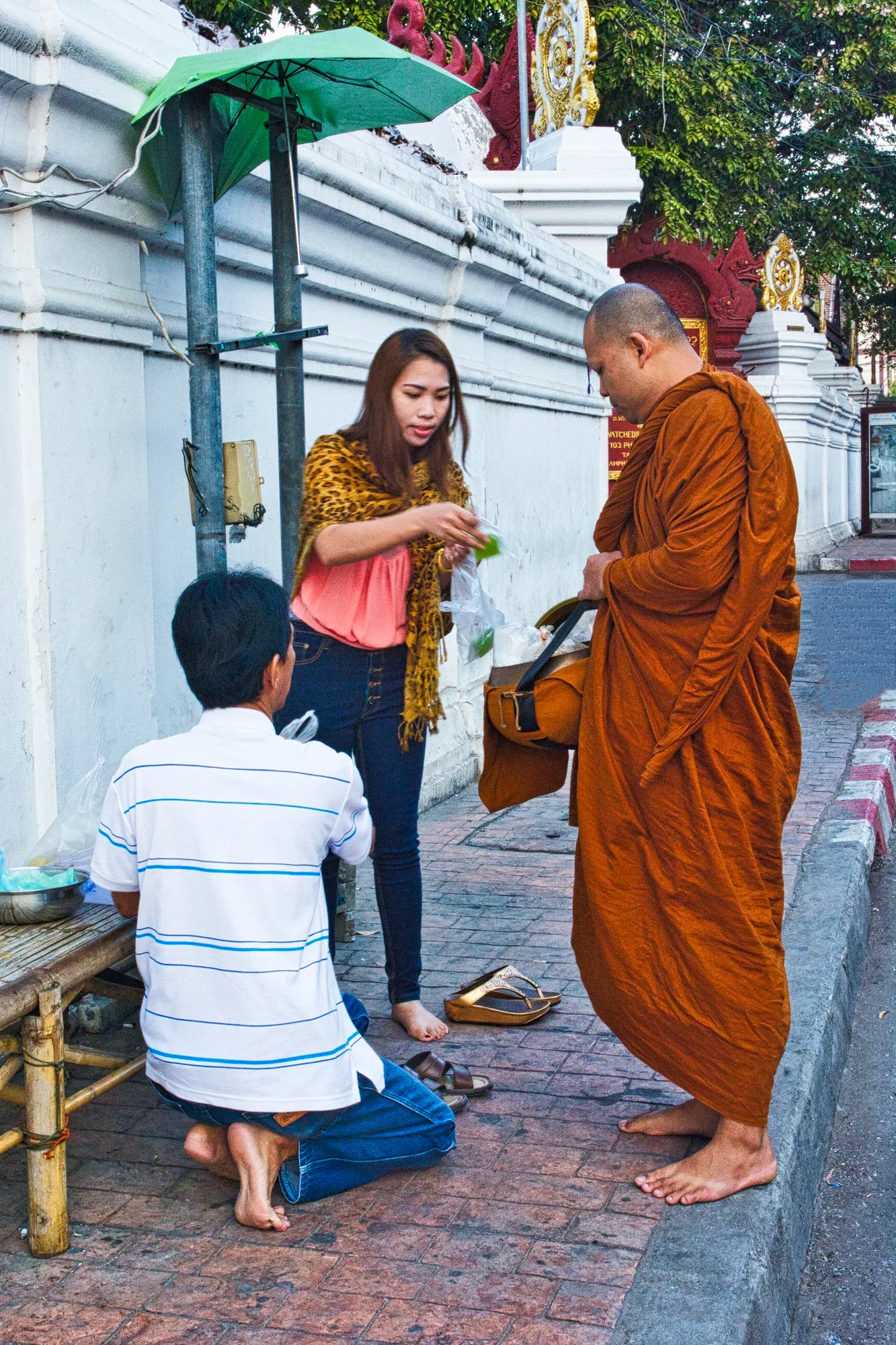
Lay people only provide cooked food like rice, curries and deep-fried fish. The monks are not supposed to cook for themselves. Because lay people do this to make merit, the monks do not say thank you. Because people do this to make merit, the monks must eat at least some of the food from every person!
Wat Chedi Luang
Wat Chedi Luang (G4.7) is one of the five must-see wats in the city. Our itinerary starts here because it is around the corner from our hotel. The main temple is spectacular. You will not be forgiven if you don’t wander through all the other buildings. Wat means temple complex, not a single building.
Viharn Luang
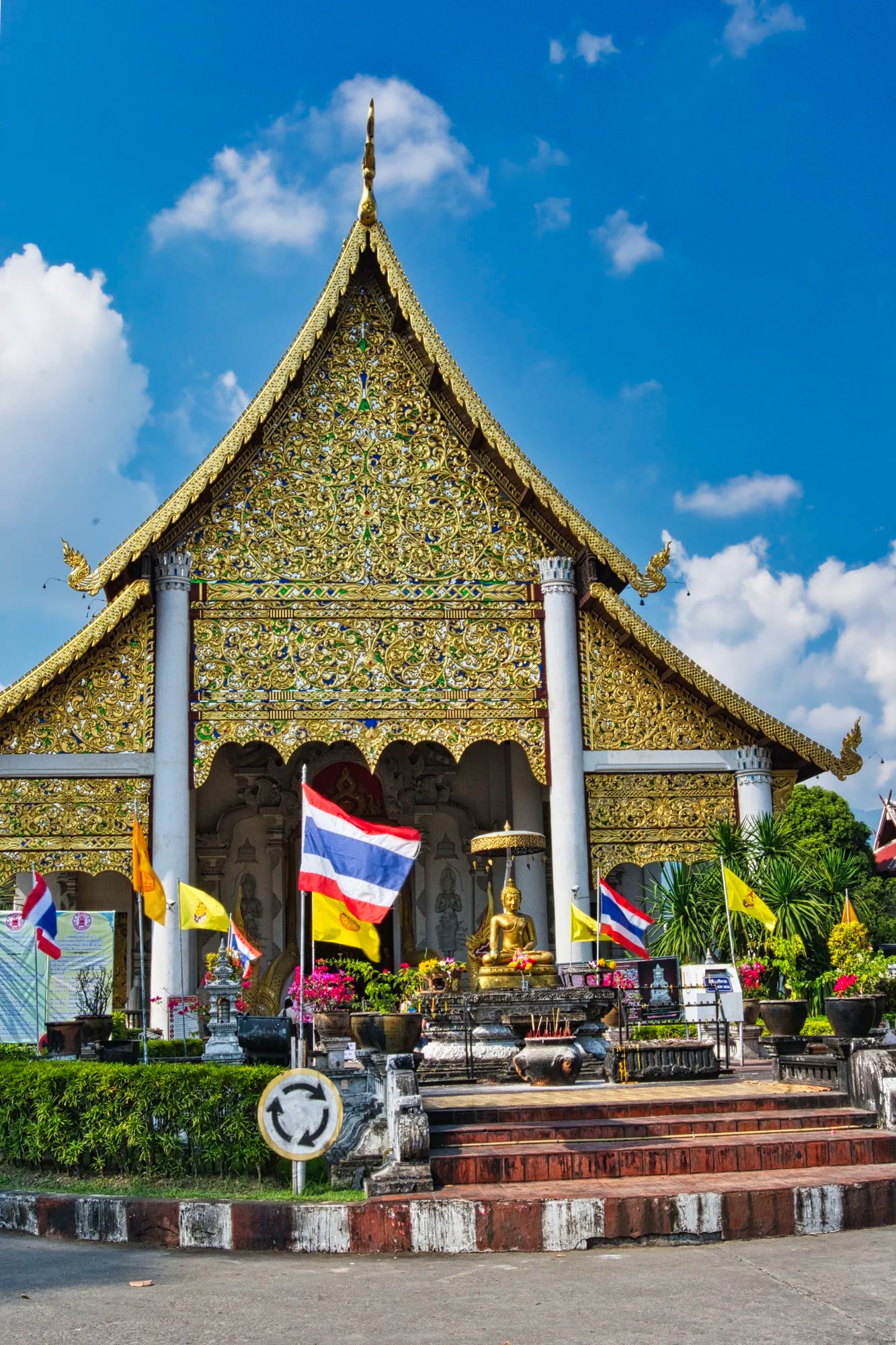
The main hall you see after you enter the grounds is not Wat Chedi Luang, which is the whole complex. It is Viharn Luang. In fact, Venerable (luang) Hall (viharn) is a name commonly used by many wats for their main hall. It contains an important image of the Buddha. Everyone must take off their shoes before entering any sacred building.
The ornate decoration of the viharn is intended to create a palace-like setting for the venerated statue. It is simply spectacular. The facade is sensory overload. Gold is everywhere. The viharn is more ornate than a Baroque church.
Sao Inthakin Hall
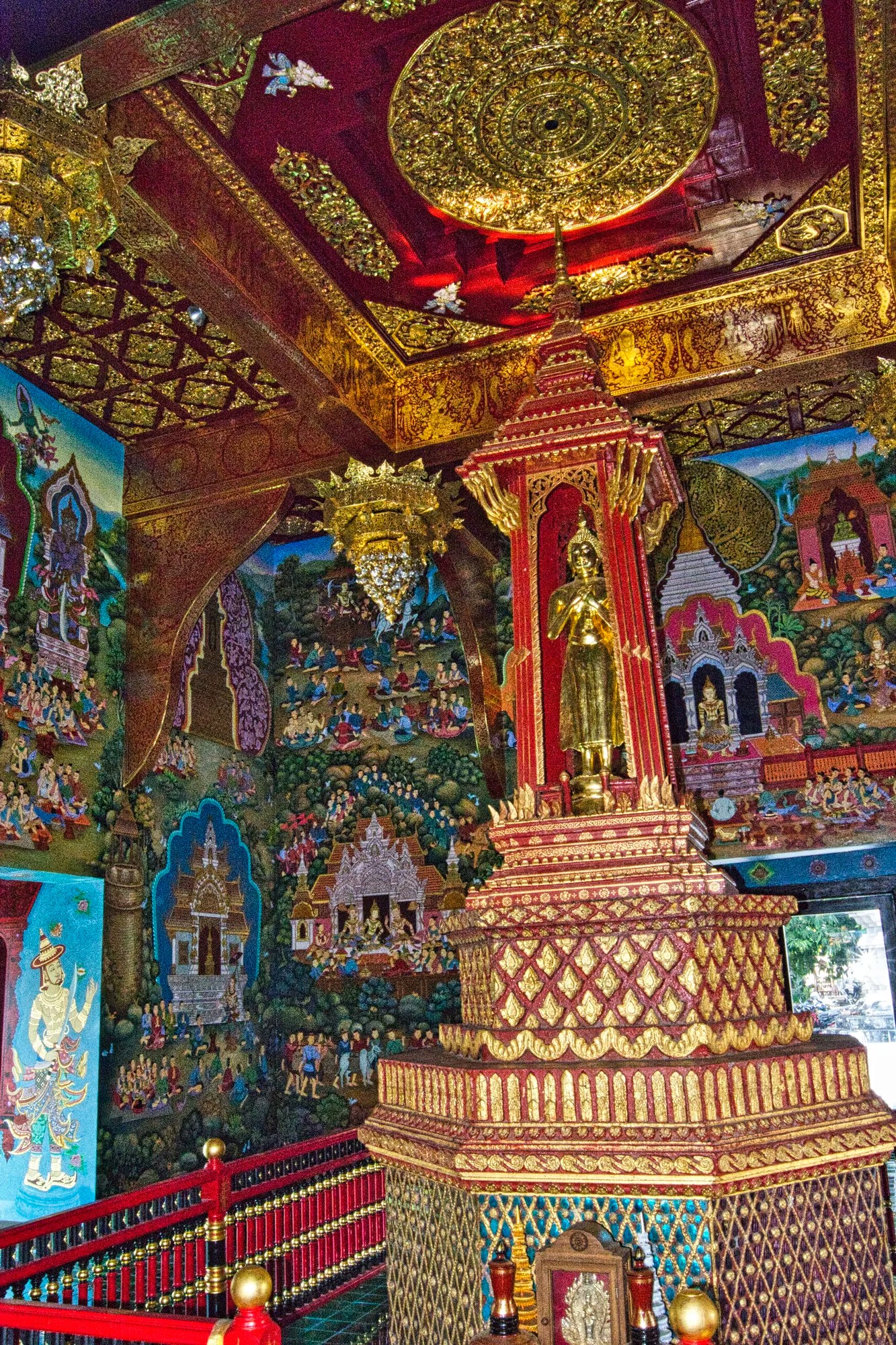
The Sao Inthakin Hall (G4.5) houses the city pillar or column (sao). It was created in 1296 on the founding of Chiang Mai by King Mangrai. More a sculpted figure than a column, it is associated to guardian spirits of the city that must be venerated each year to protect the city from harm. The pillar is paraded to Wat Inthakin during the eight-day Sao Inthakin festival. It is around May but the date varies as it is based on the lunar calendar.
This is another example of the adoption of Indian culture as described in Thailand — A Traveller’s History. Inthakin, which is also spelled Inthakhin, means Indra’s Pillar. Indra is associated with the sky and thunder and usually carries a vajra or thunderbolt.
Indra is the king of the gods in Hinduism and other Proto-Indo-European (PIE) tribes, including the people of Ancient Rome.
The interior is very ornate, but unfortunately, people who menstruate (women) are not allowed to enter the hall.
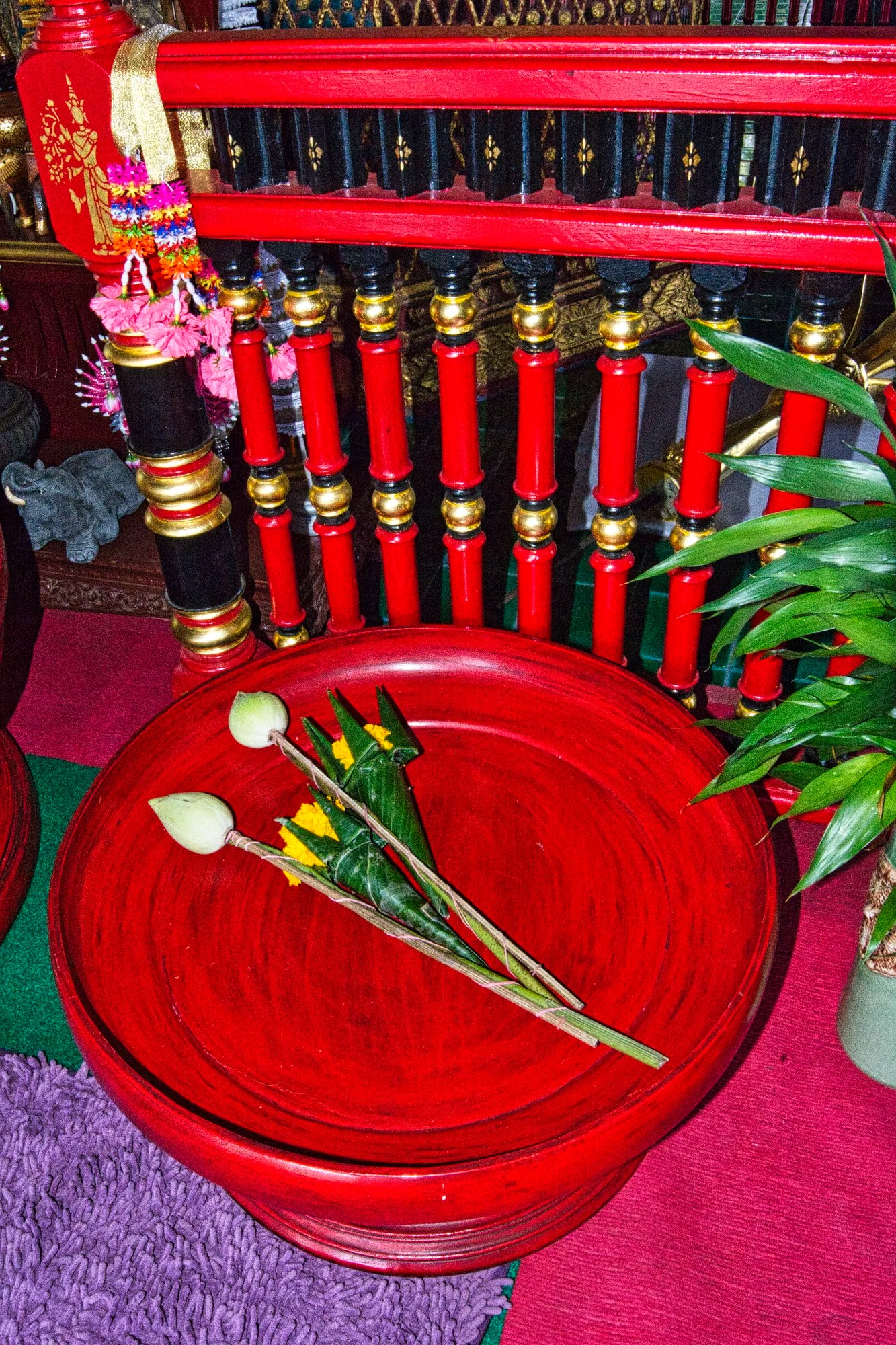
Indian lotus flowers rest on a red lacquerware plate. They symbolize divine perfection and purity because they rise unstained from the muddy water, which symbolizes material attachment and physical desire.
Sao Inthakin Murals
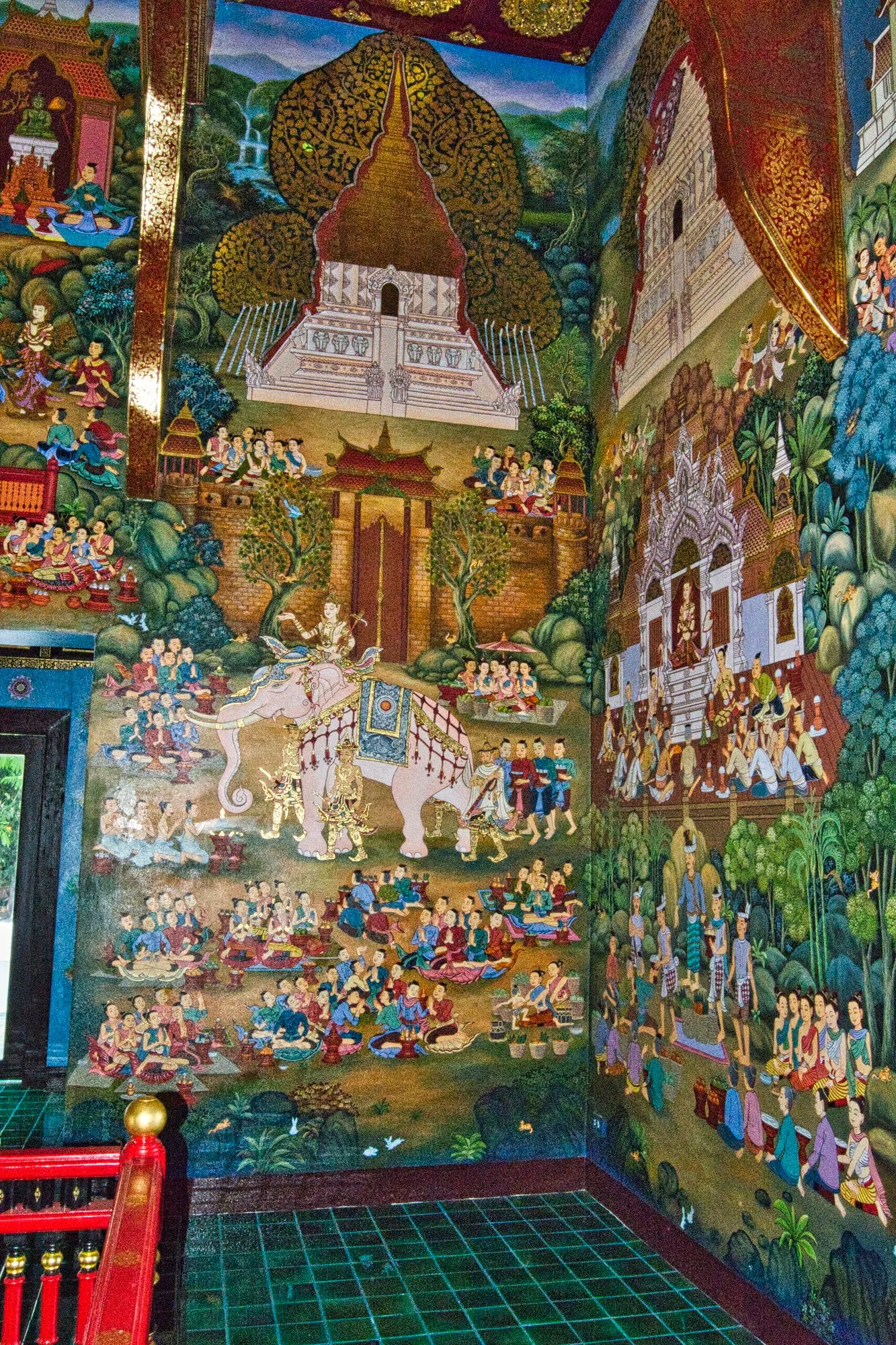
Thai murals in temples and palaces depict scenes from Buddhist mythology or jātaka stories about the past lives of the Buddha. They play an important role in teaching Buddhist values. One of the most popular of the 537 jātakas illustrates the virtue of generosity. Buddha gained more and more karmic merit by giving away his possessions, in this case his prized, rain-making white elephant. Brahmins in the Jatakas are symbols of human vice. This is probably because Hinduism and Buddhism were a reaction against the privilege and corruption of the Brahmin caste.
Prince Vessantara
Jataka Synopsis: Prince Vessantara of Sivirattha was born at exactly the same moment as a beautiful white elephant named Peccaya. With magical rain-making ability, Peccaya guaranteed a good harvest in the kingdom. Several Brahmins were sent by the king of Kalinga, whose land had been suffering from a prolonged drought. They beg Prince Vessantara to give them his elephant so that they can save their own country from drought and famine. in order to attain perfection, Prince Vessantara needed to donate to those in need all that was precious to him. Prince Vessantara is shown pouring water onto the hands of the Brahmins, signifying the gift of the elephant. Naturally, the people of Sivirattha were angry at the loss of their precious rain-bringing elephant. They petitioned King Sanjaya to return to the throne and to send Prince Vessantara into religious exile. For more details, see A Jataka Tale Retold: Prince Vessantara.
White elephants are especially revered as symbols of kingship and purity. They are considered the personal possessions of the kings of Thailand.
King Kawila Statue
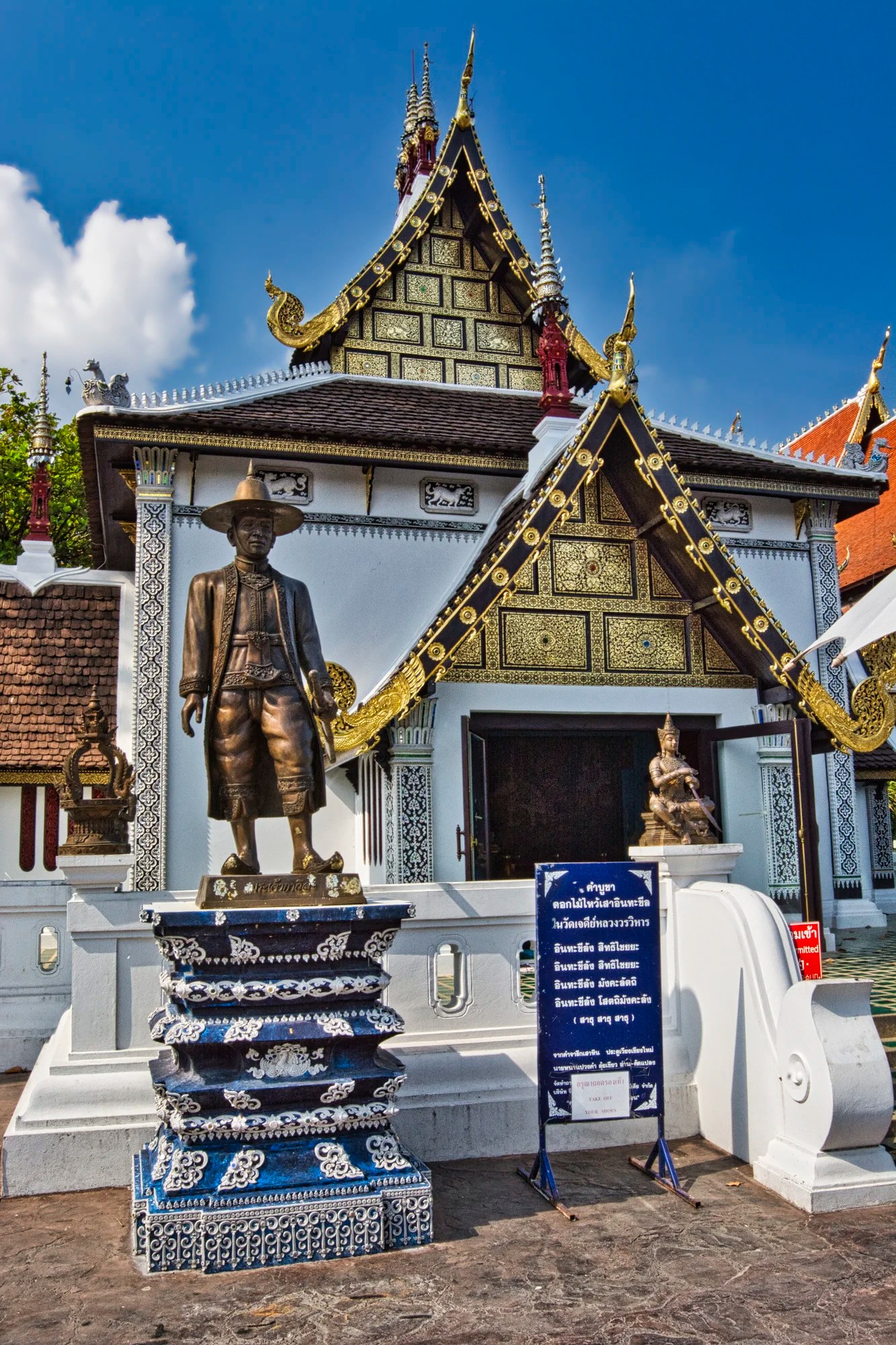
Outside the hall is a statue of King Kawila (1742-1816). He was the ruler of the Chiang Mai Kingdom, home of the Lanna people. He freed Northern Thailand from two centuries of Burmese rule in 1774. In 1800, Kawila moved the pillar from Wat Inthakin to this hall in Wat Chedi Luang.
Chedi Luang
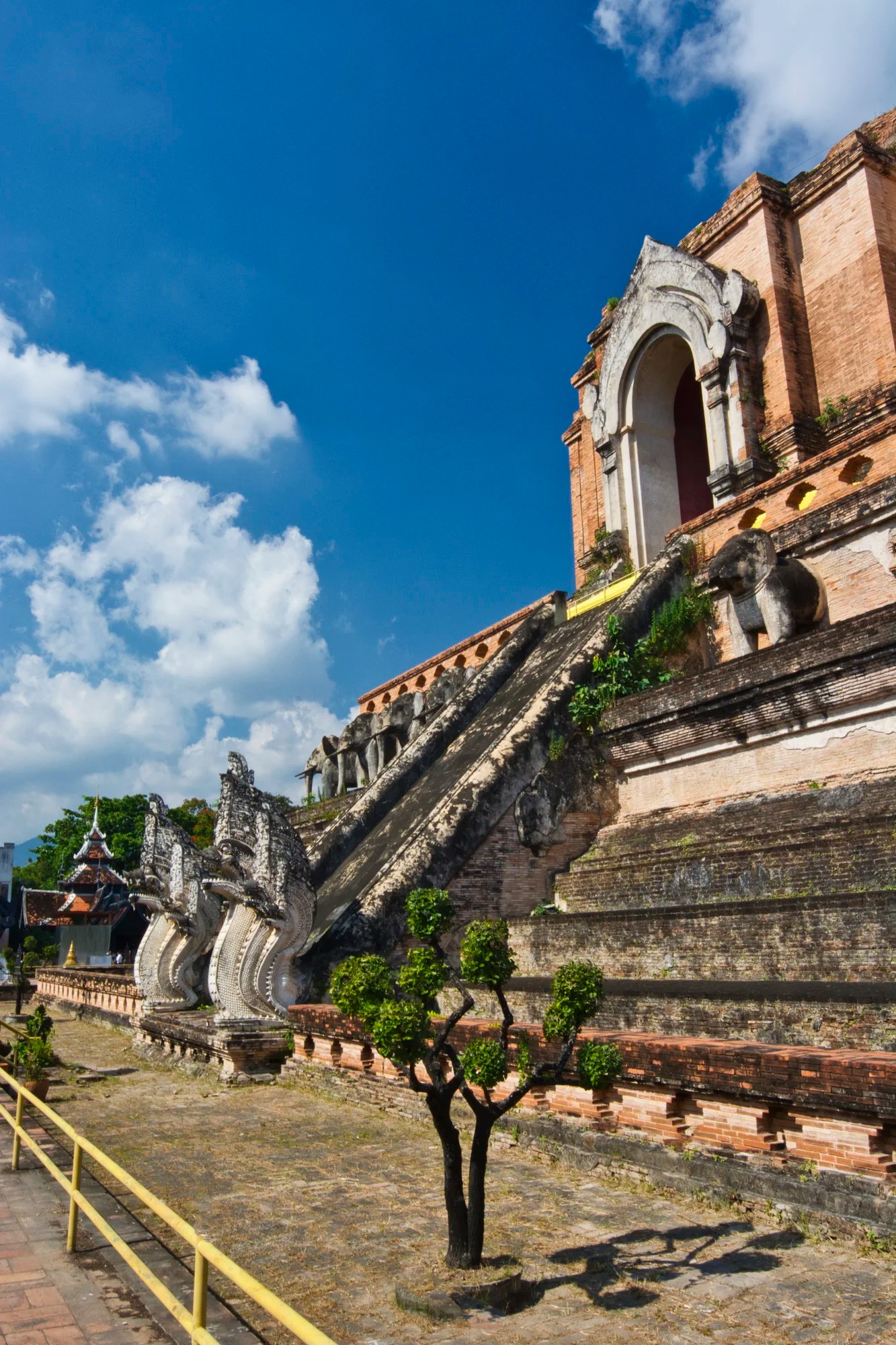
Damaged in a 1545 earthquake, Chedi Luang was rebuilt in the 1990s. Chedi is the Thai word for stupa, which originated in India as a burial mound for holy persons, including the Buddha. It became an architectural form used in most major wats. The chedi was built with bricks and then covered in white plaster. with nagas
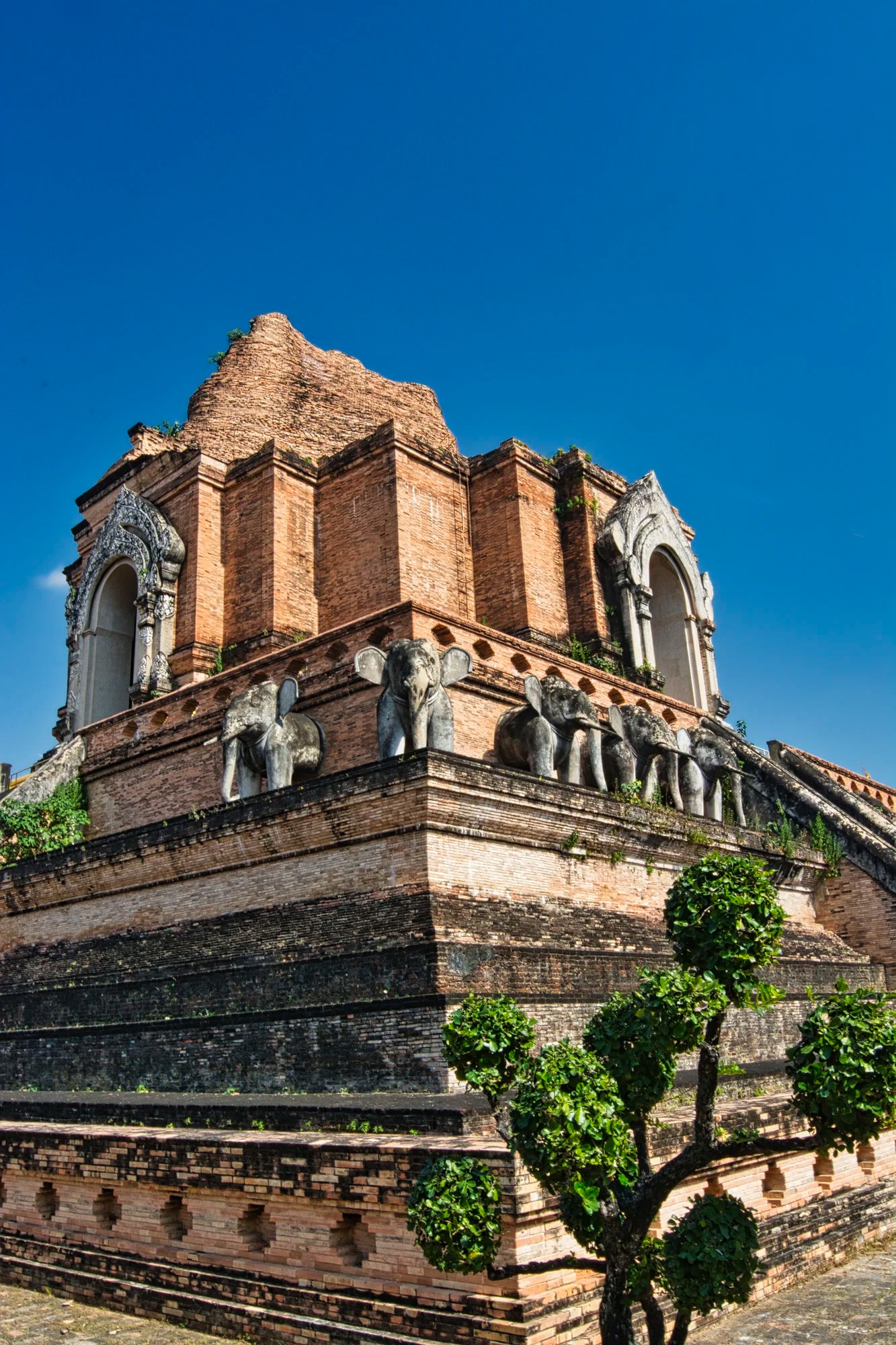
However, as with all things Thai, a plain chedi is not the norm. It was decorated with elephants, which symbolize strength, loyalty, wisdom, and royalty, as well as associated with the Buddha.
Burridatto Viharn
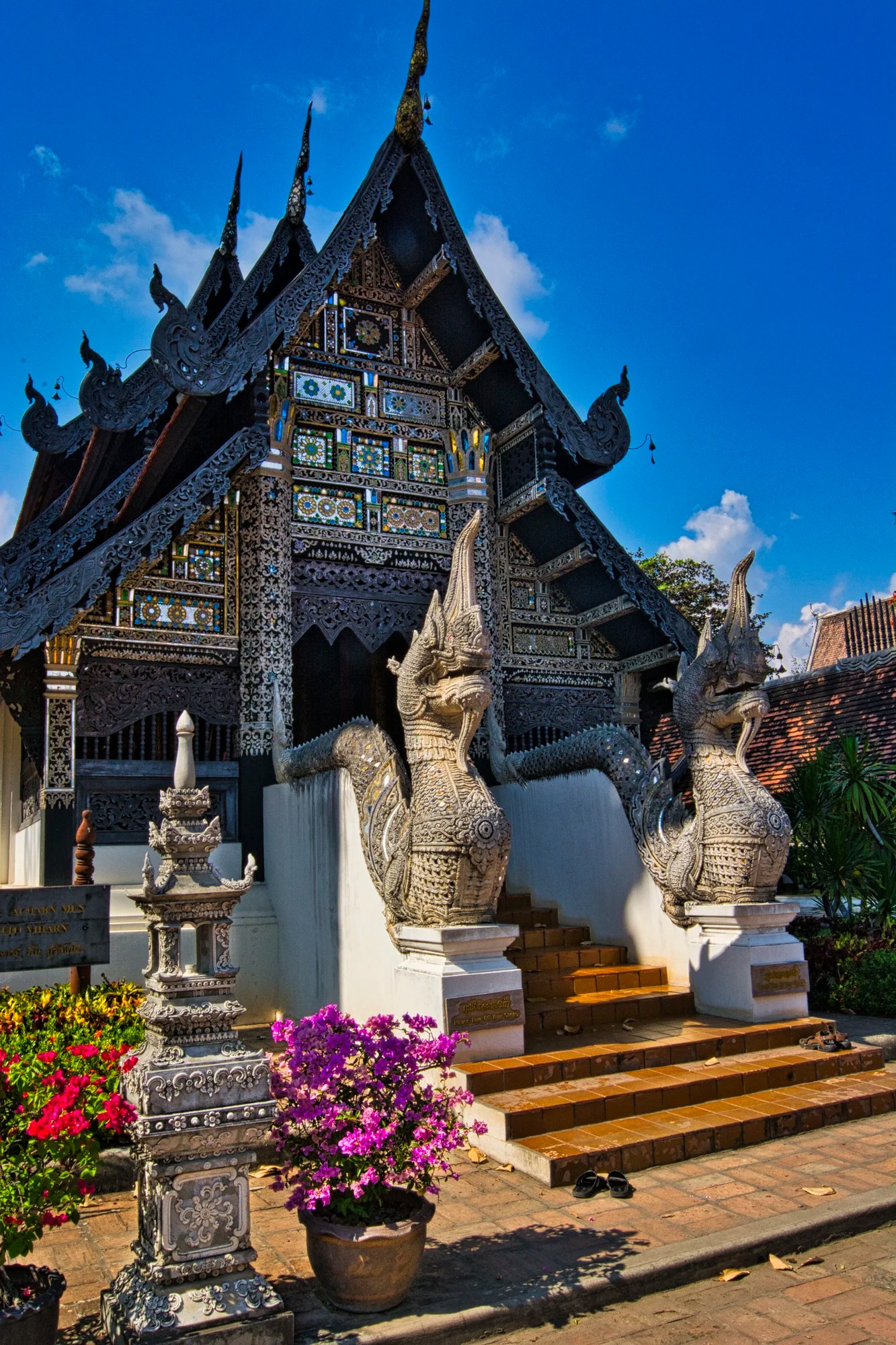
The inlays and wood carvings in the viharn facade are very beautiful.
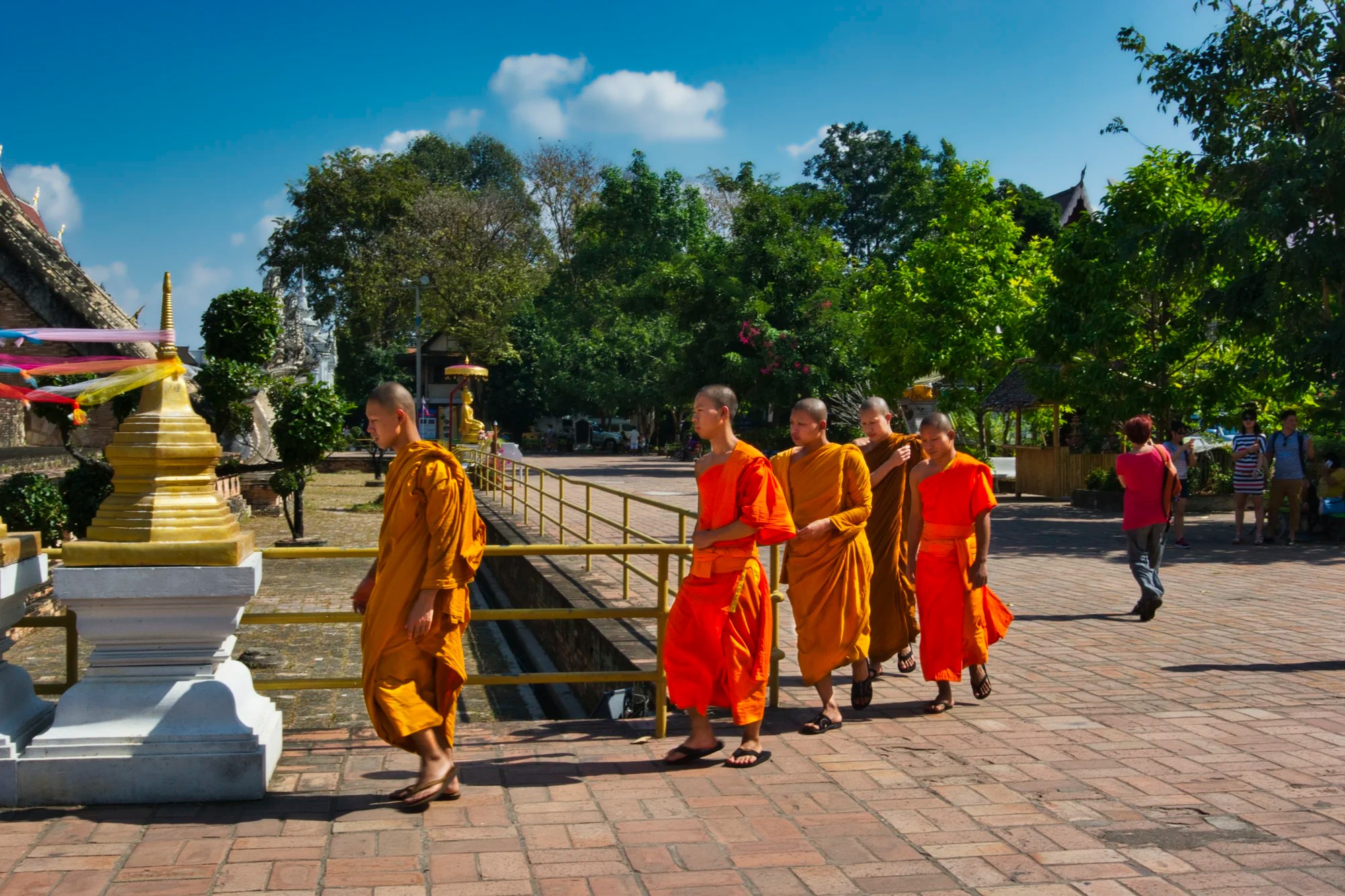
You will see lots of monks walking around the wat, which also contains a university.
Door and Window Decoration
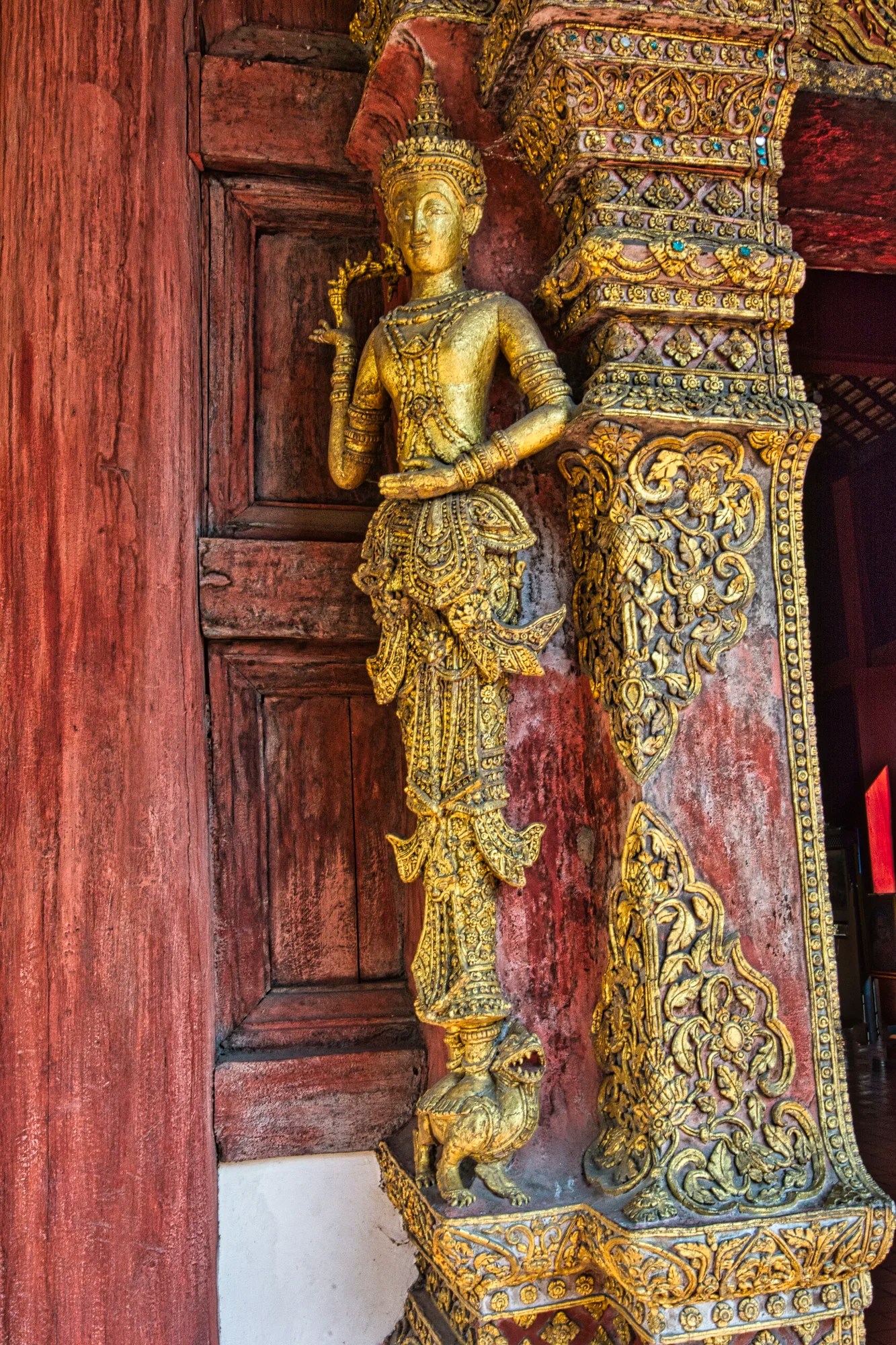
The status of palaces and temples is amplified by the elaborate decoration of doors and windows. As they provide a passage between the mundane and the divine, doors and windows are decorated with guardian motifs to ward off evil spirits.
Manjushri
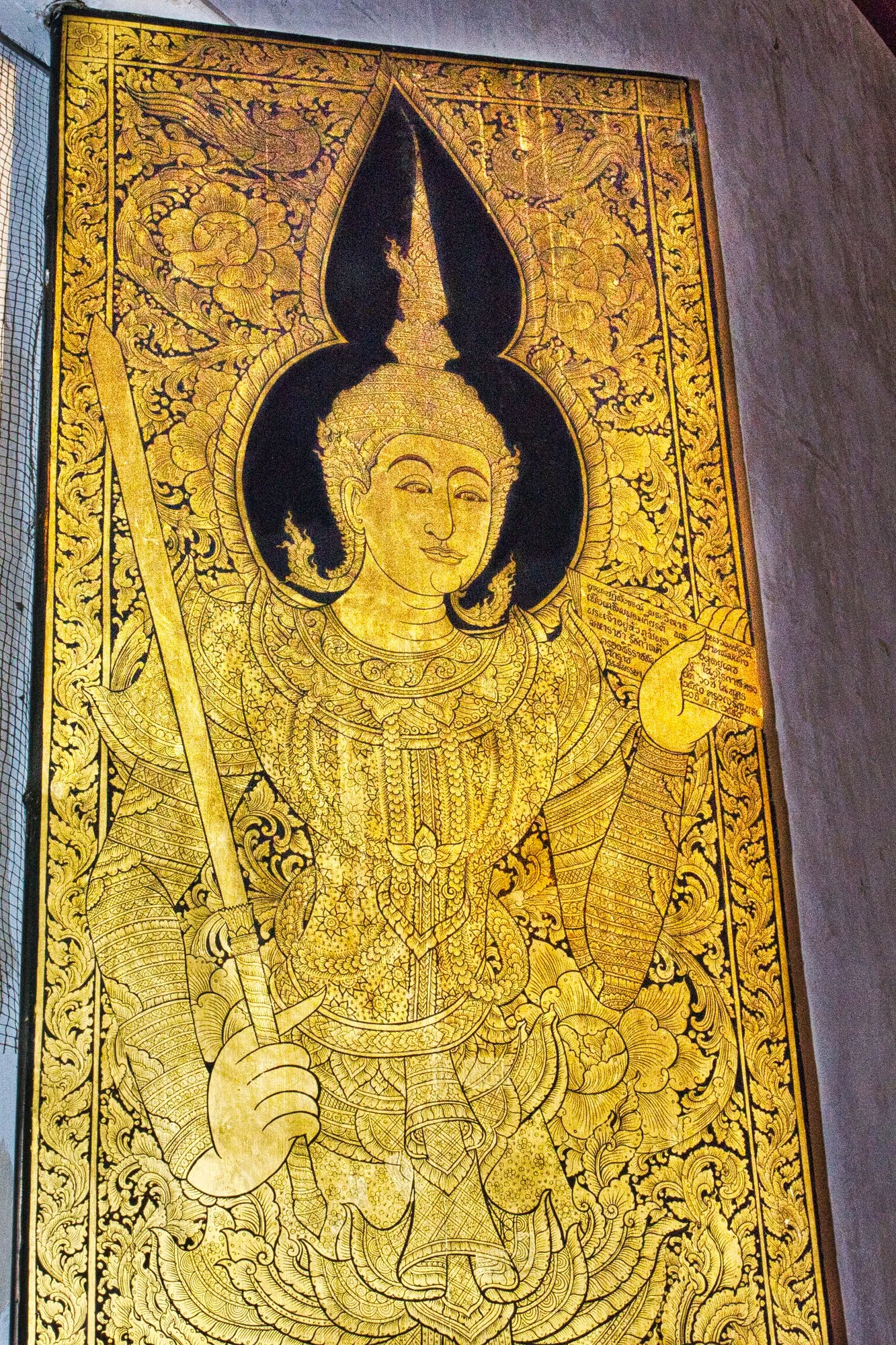
In this gold on black lacquerware door, Manjushri is depicted as a youth representing purity and innocence. In his right hand, he carries a vajra (thunderbolt) sword, which cuts through ignorance and discrimination. In his left hand, he holds a sutra scroll representing the perfection of wisdom.
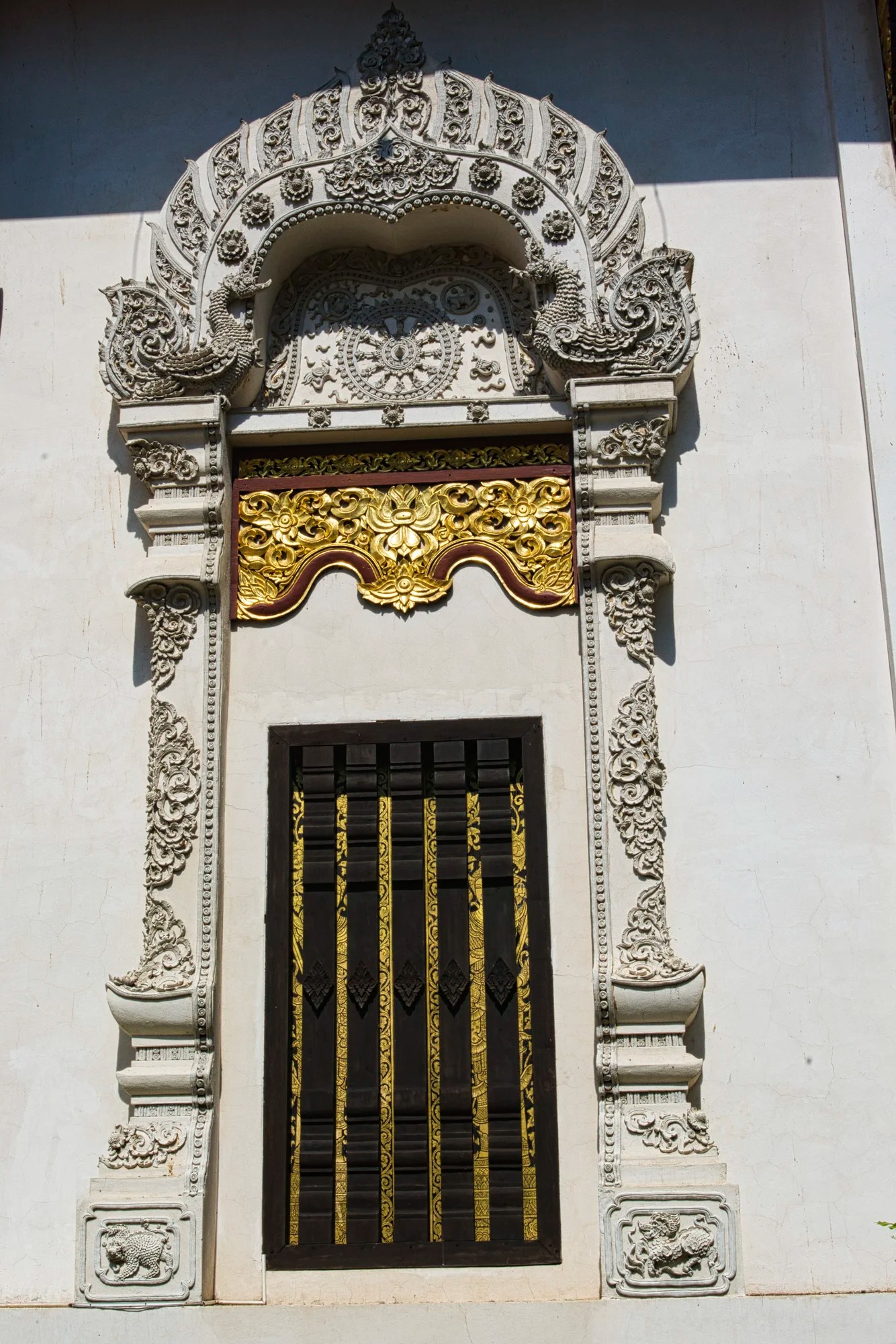
Do not forget to look at the details on the outside of the temples, especially the gorgeous windows.
Makara and Naga Guardians
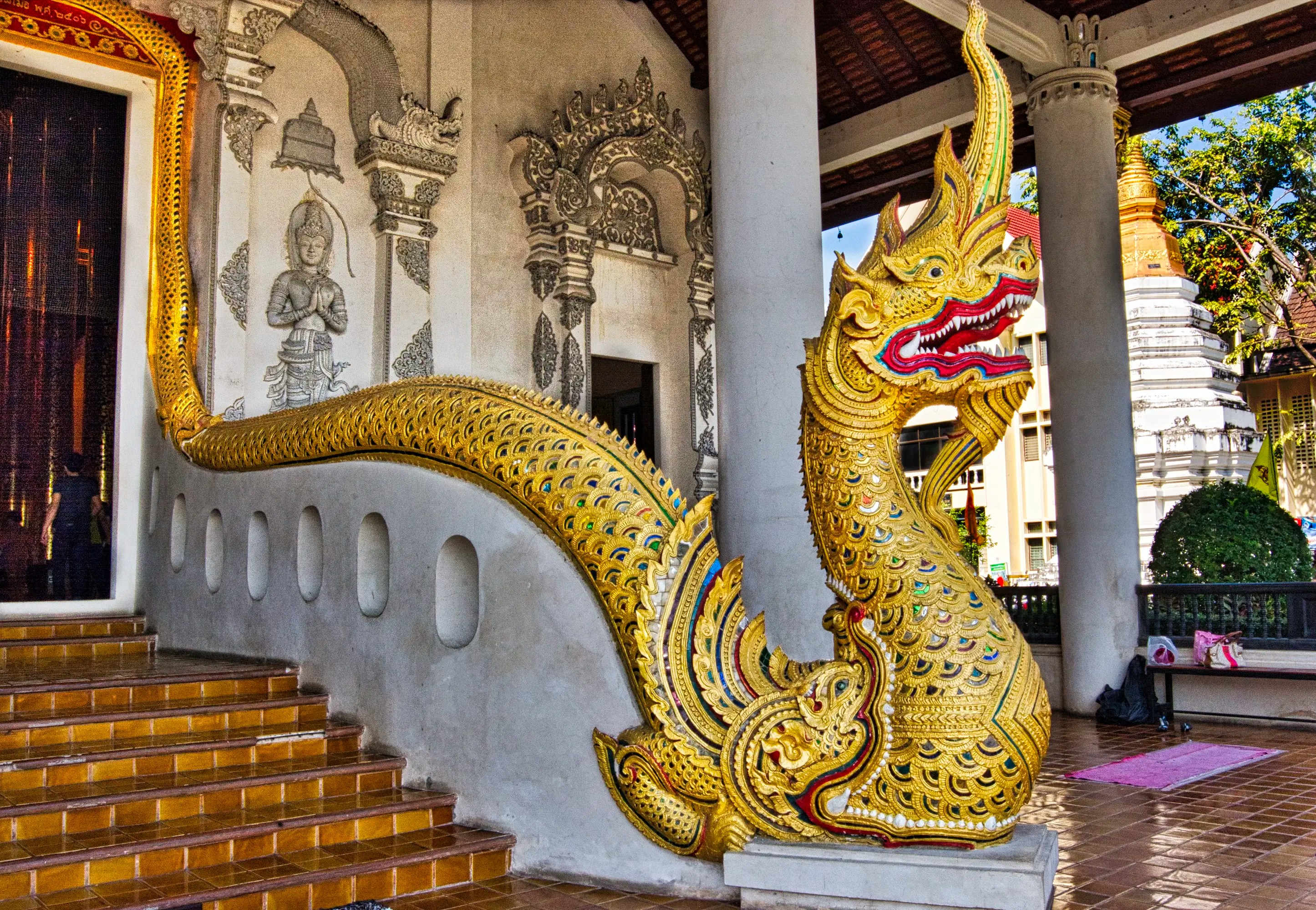
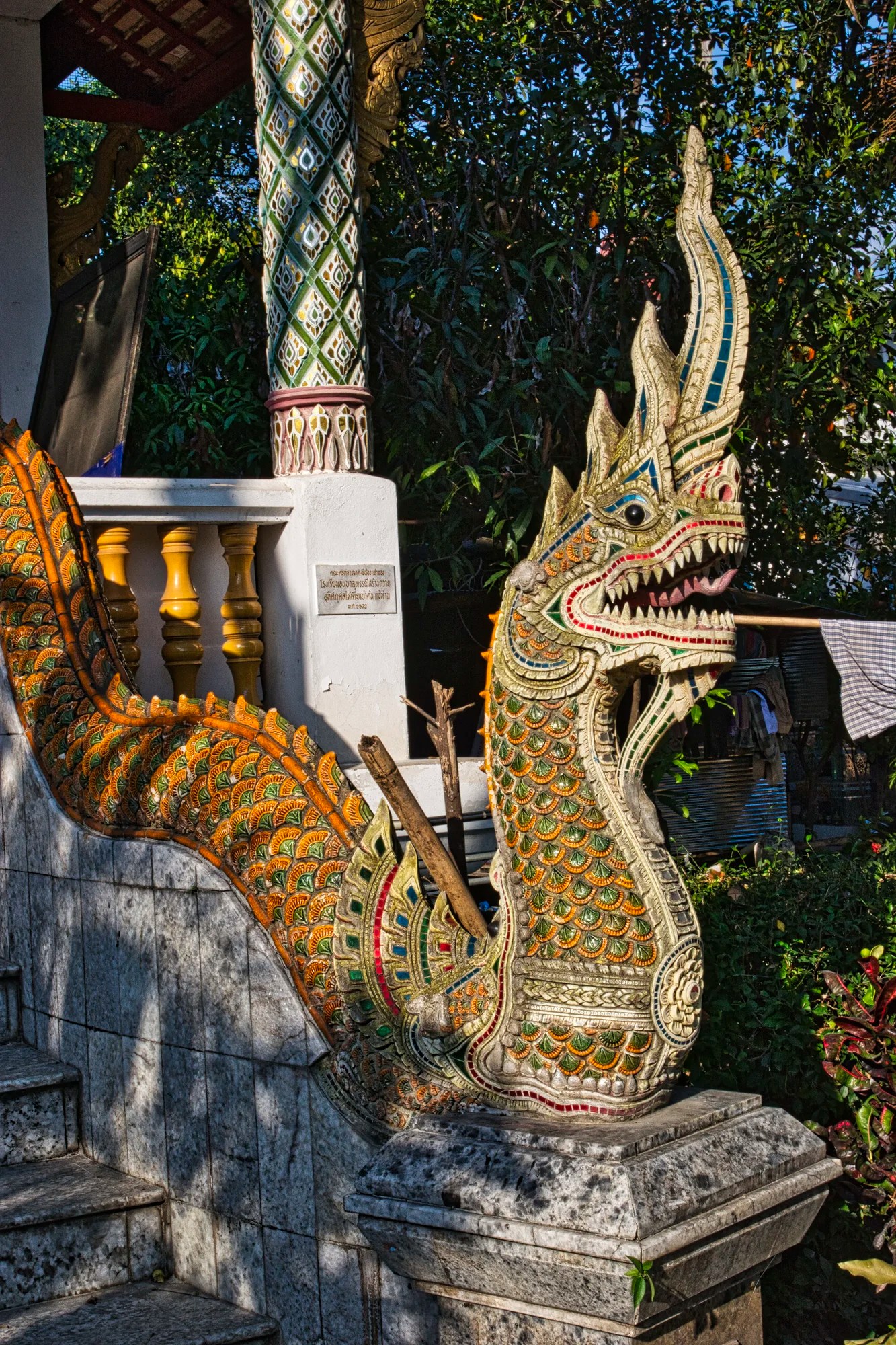
These are my favourite nagas, which are guarding the stairway. The elegant red and gold naga contrasts with the neutral background,
Naga is a deity associated with water and brings either rain or drought — there is always a duality. Since rain is critical to agriculture, nagas symbolize abundance. Images of nagas are found along stairs and roofs of temples because they are the protectors of the Buddha and guardians against evil spirits.
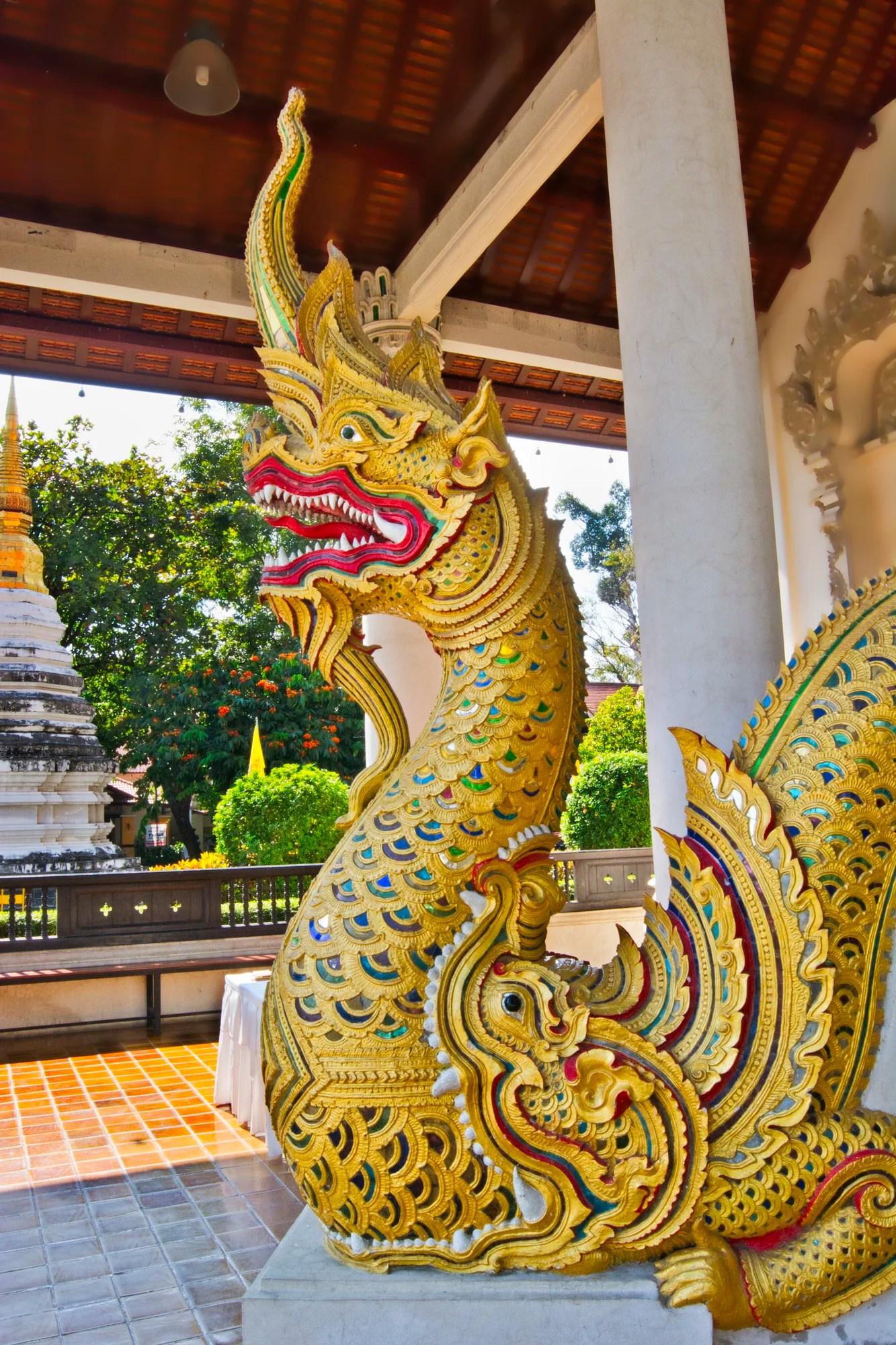
But did you notice that there are actually two creatures? The naga is being disgorged out of a Makara, a mythical creature that resembles a crocodile.
Why are there makaras and nagas everywhere? The prosperity of the kingdom depended on agriculture, especially rice fields. Rice could be viewed as hydroponic grass. The naga symbolizes water, and the makara symbolizes the sun. These propitious animals magically produce the correct proportion of rain and sunshine to ensure a prosperous harvest.
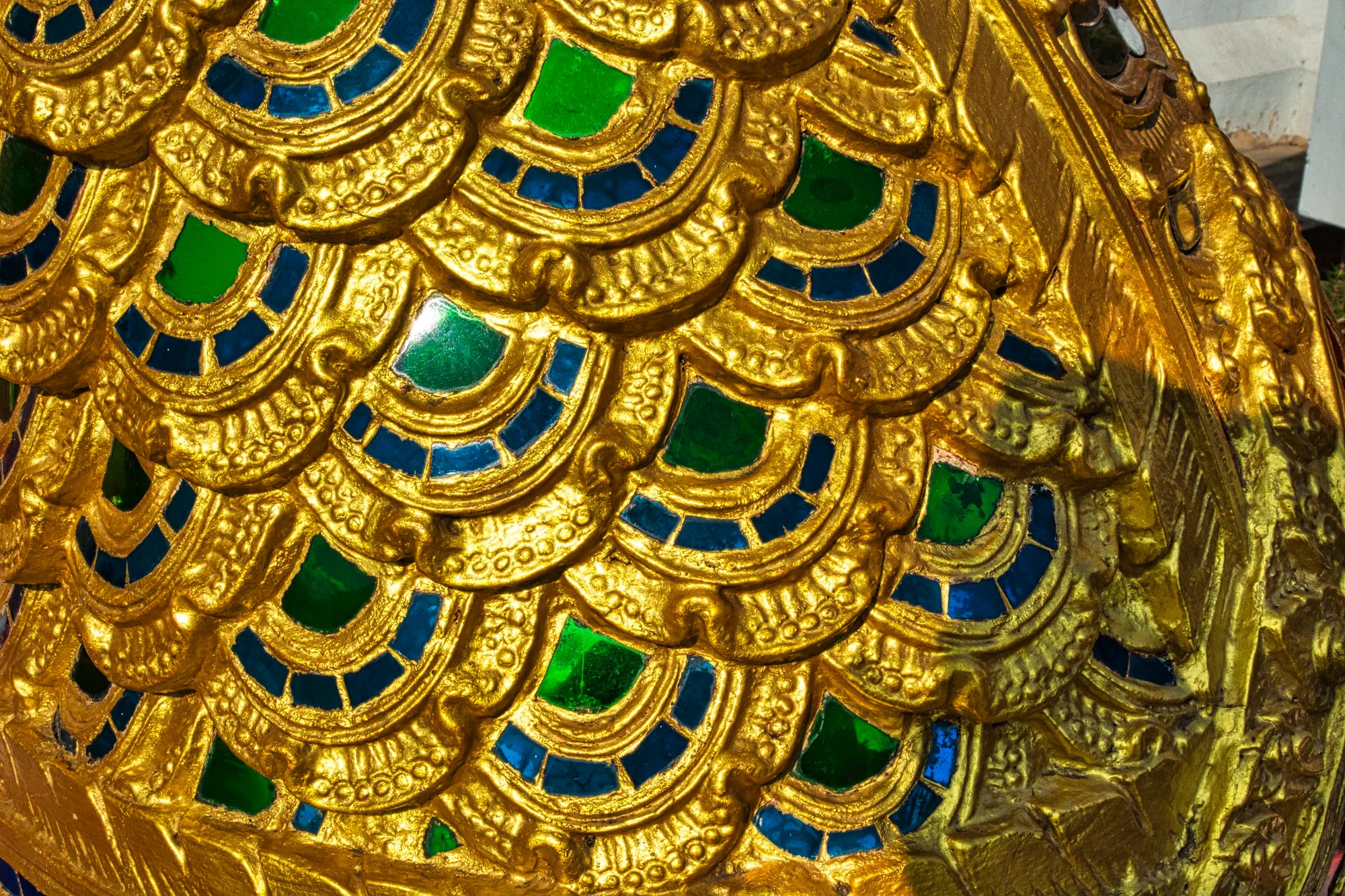
If you look closely, you will see that the nagas are not made purely of gold. They have tiny blue and green glass mosaics embedded throughout the body.
Wai Gesture
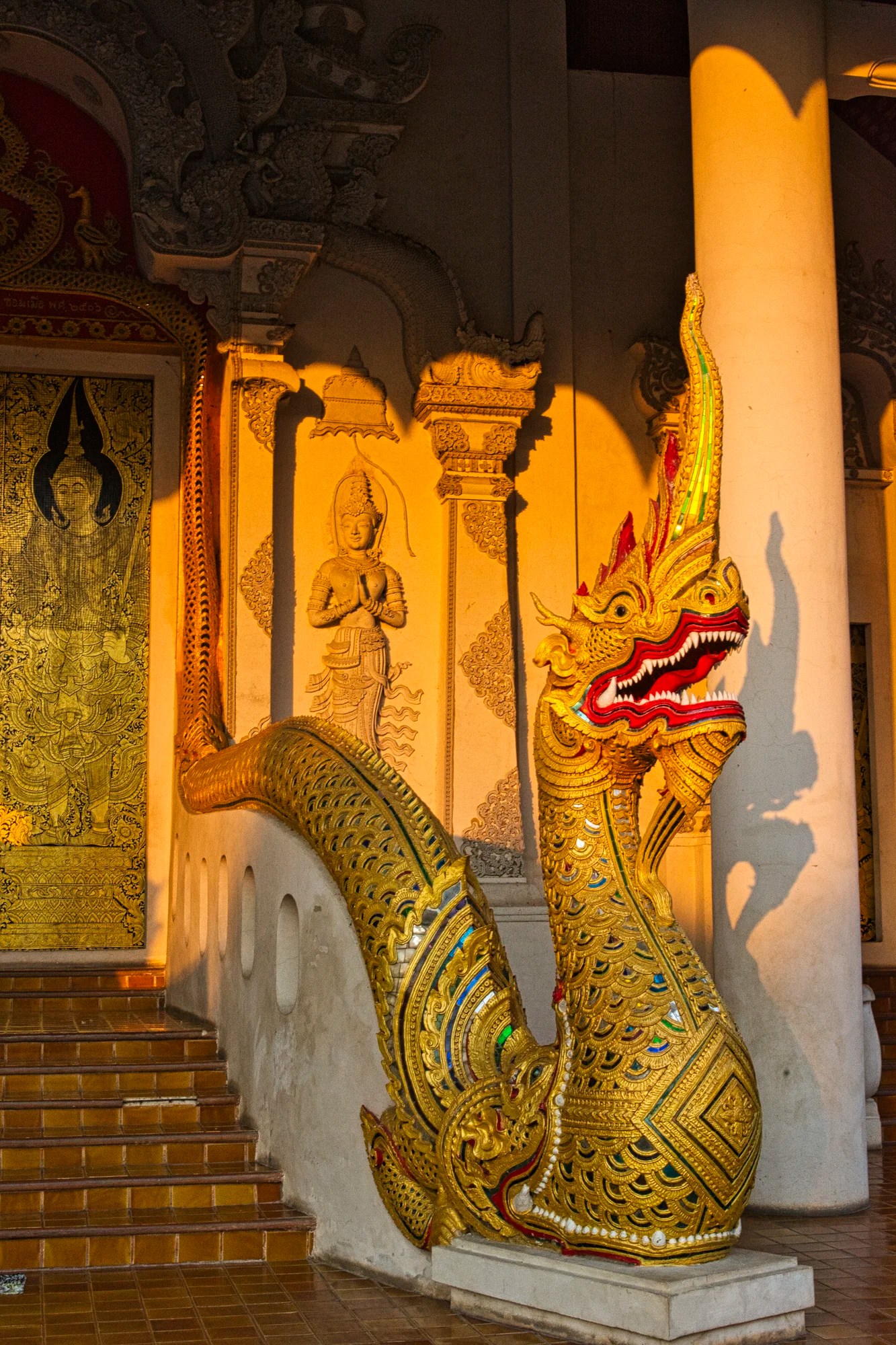
Look carefully above the makara body at the background. Here, you will see an apsara, a beautiful, youthful and elegant female spirit of clouds and water derived from Hinduism. The apsara folds her hands together in the namaste greeting or Añjali Mudrā, which means I bow to the divine in you.
The similar wai (pronounced “why”) gesture in Thailand originates from the namaste gesture of India. Wai could be used to say hello, thank you or sorry. Those with higher status, including monks, will not return your wai. Giving a wai to children, bartenders, or others of lower status is not appropriate and will indicate that you do not know Thai customs.
Wat Chedi Luang Address and Hours
Address: Prapokkloa Road
Open: 06:00 to 18:00 hrs daily
Wat Phantao
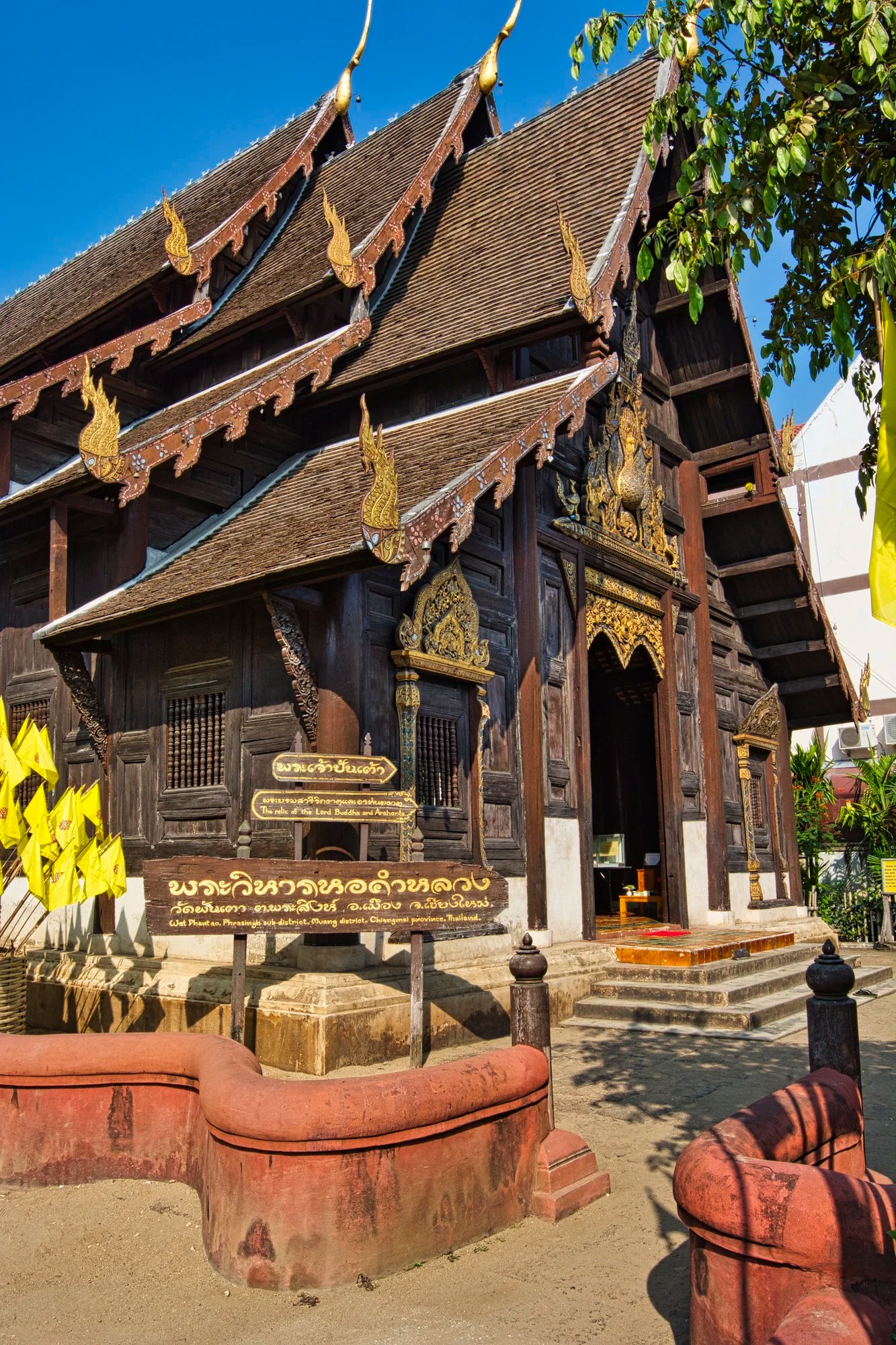
Wat Phantao (G4.6) is one of the few wooden temples in Thailand. It is made of teak wood, which is resistant to termites, other pests, and most weather conditions due to the teak oil contained in the wood. However, you cannot see the beautiful teak grain. As a sign of our times, commercial harvesting of teak from natural forests is currently prohibited in Thailand. The largest teak exporters today are Indonesia and Myanmar.
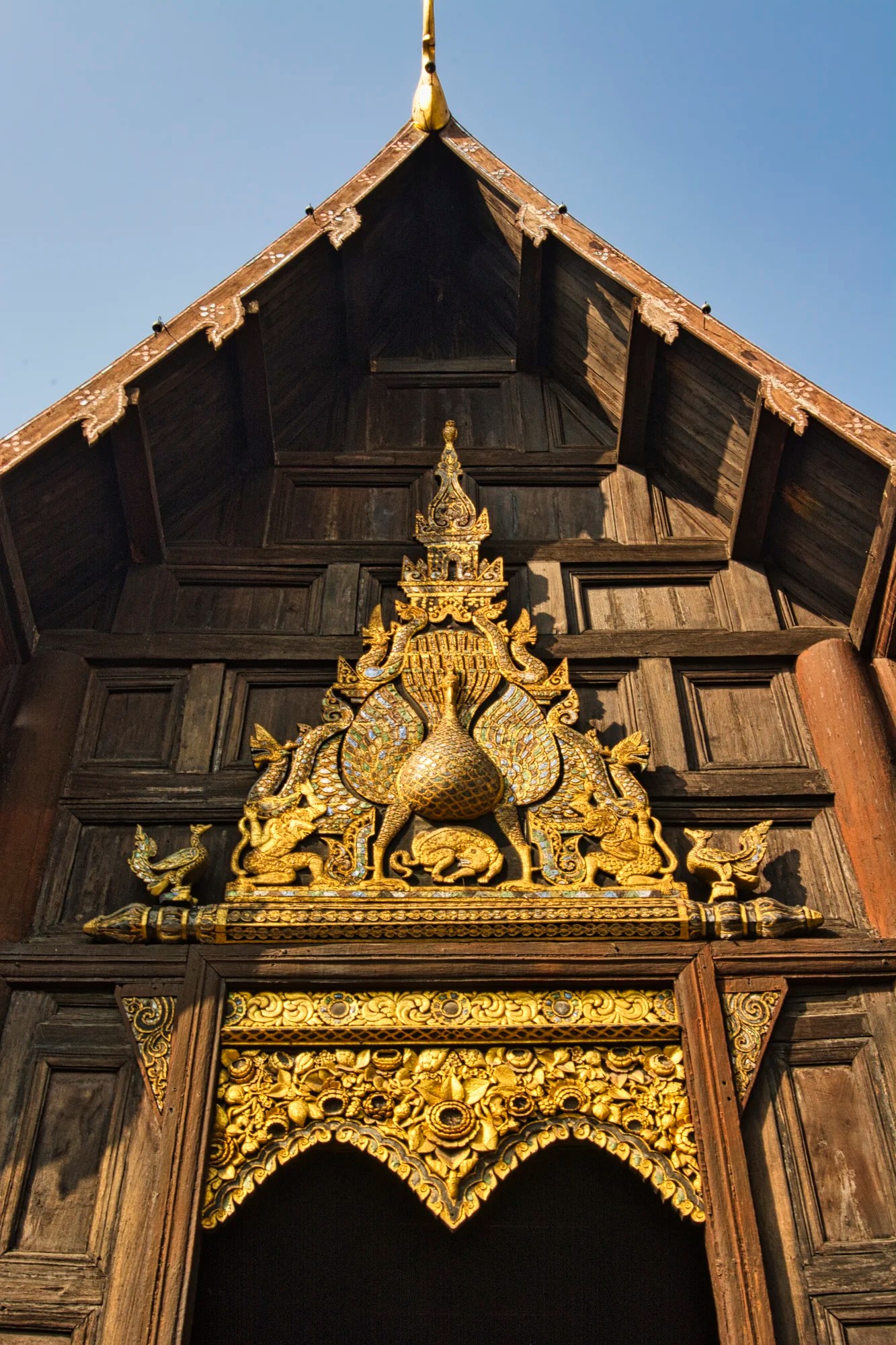
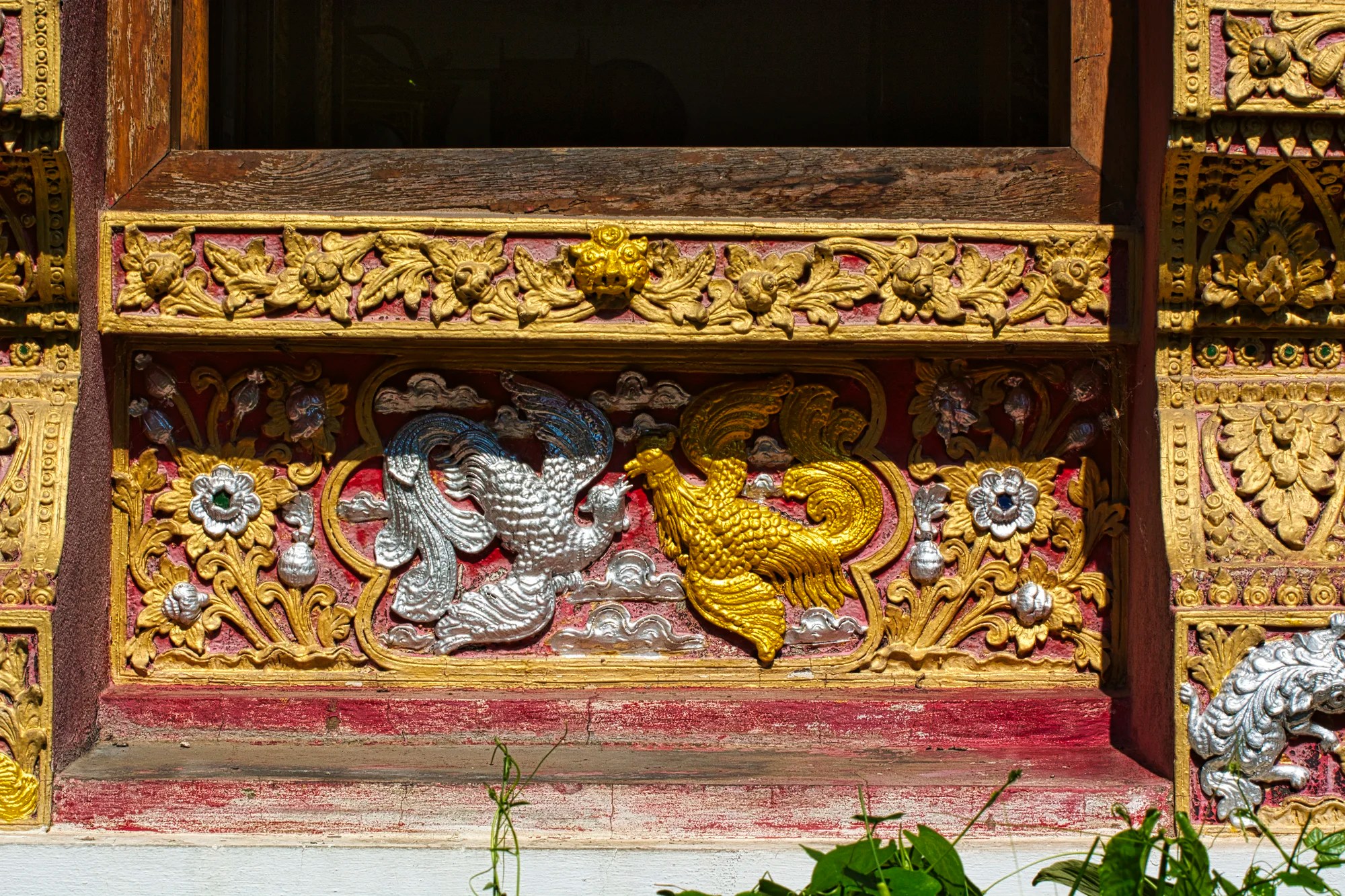
Spend some time admiring the entrance pediment and transom with intricate carved flower motifs. The most important part is a carved wooden phoenix on top of a dog, which is believed to be the king’s zodiac sign. The phoenix is a mythological creature common to Asia. It symbolizes rebirth and immortality, peace and tranquility.
The phoenix is analogous to the Hindu deity Garuda. Both serve as the vehicle of the Hindu god Vishnu, one of the three main gods of Hinduism. The blue god Vishnu is called “the Preserver” — protector of good and destroyer of evil. You may have heard the names Narayana and the blue god Krishna – these are variants or avatars of Vishnu. Because of his role as the Preserver, the god Vishnu was adopted as the symbol of the king’s duty and power. Therefore, this tells us that this wat was once part of a royal palace.
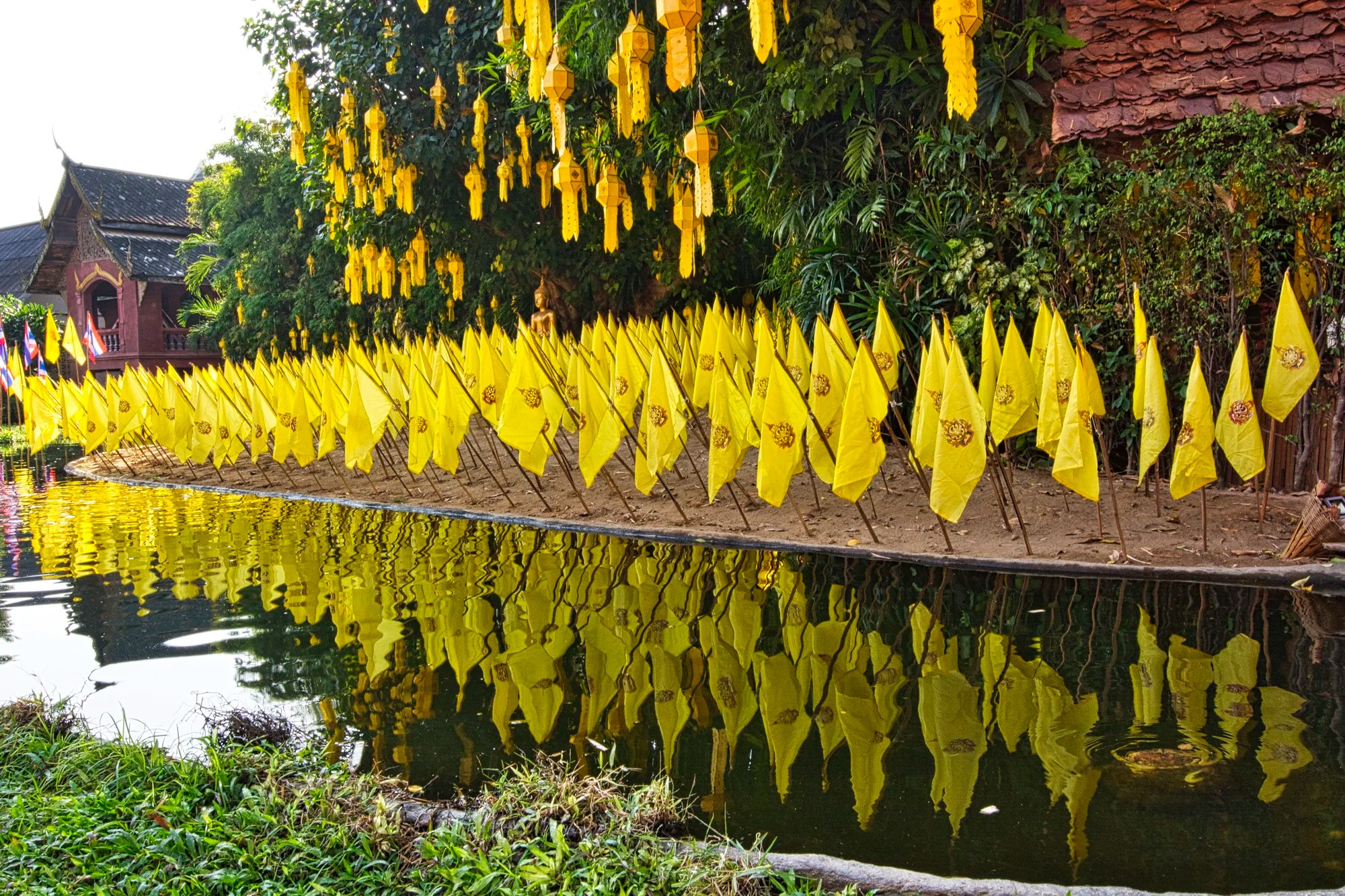
Enter the wat grounds to the south of the temple. Here you will be swarmed by rows of yellow flags. Yellow is a special colour of Buddhism. The saffron robes of monks were chosen by Buddha as a symbol of his humility and renunciation. Yellow also signifies the Middle Path.
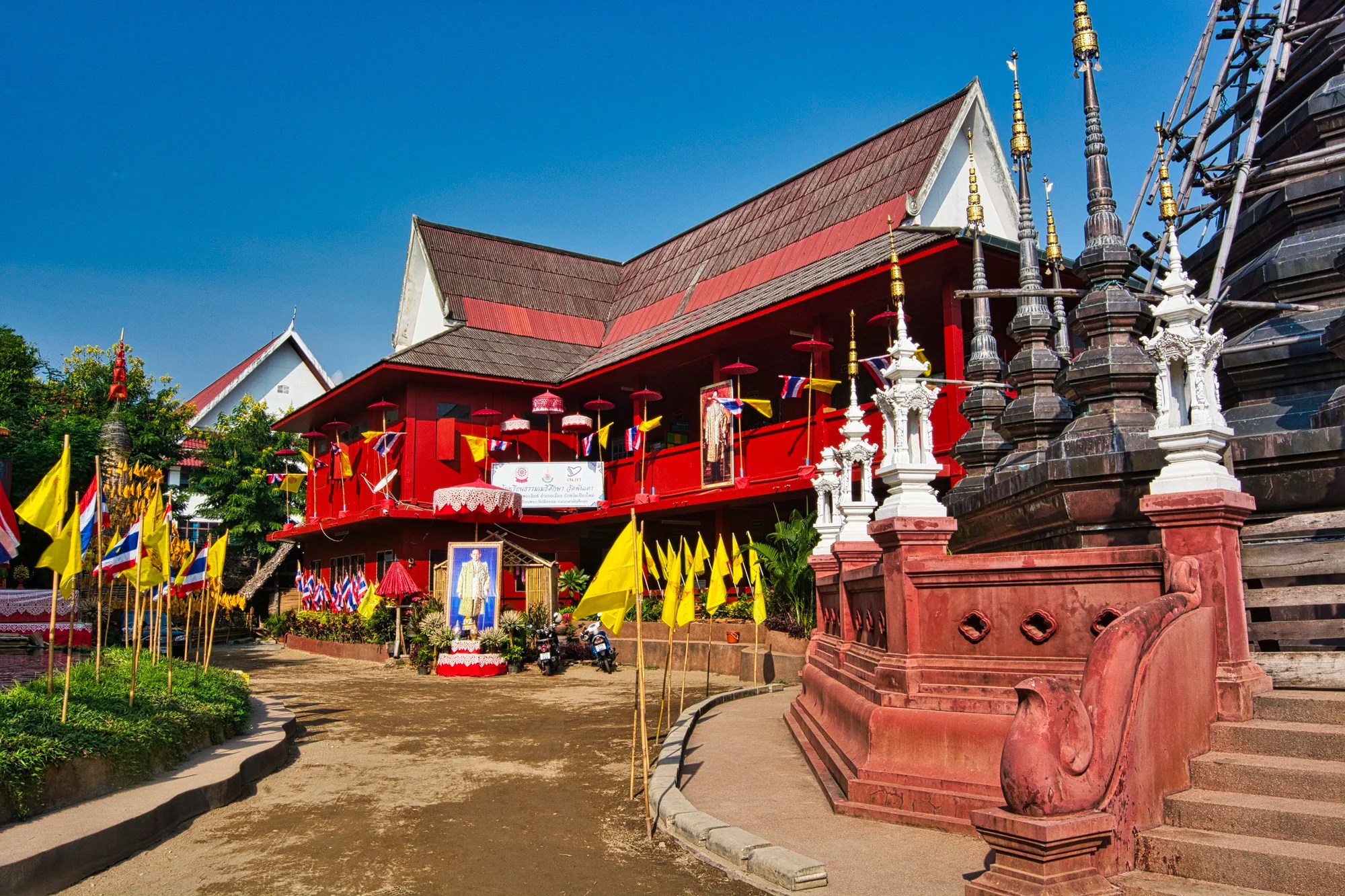
At the end of the path is the reason for the yellow flags. Phonrat Witthayakon is a centre for Buddhist teaching and religious studies. You are allowed to walk along the pond but cannot enter the school building.
Wat Phra Singh
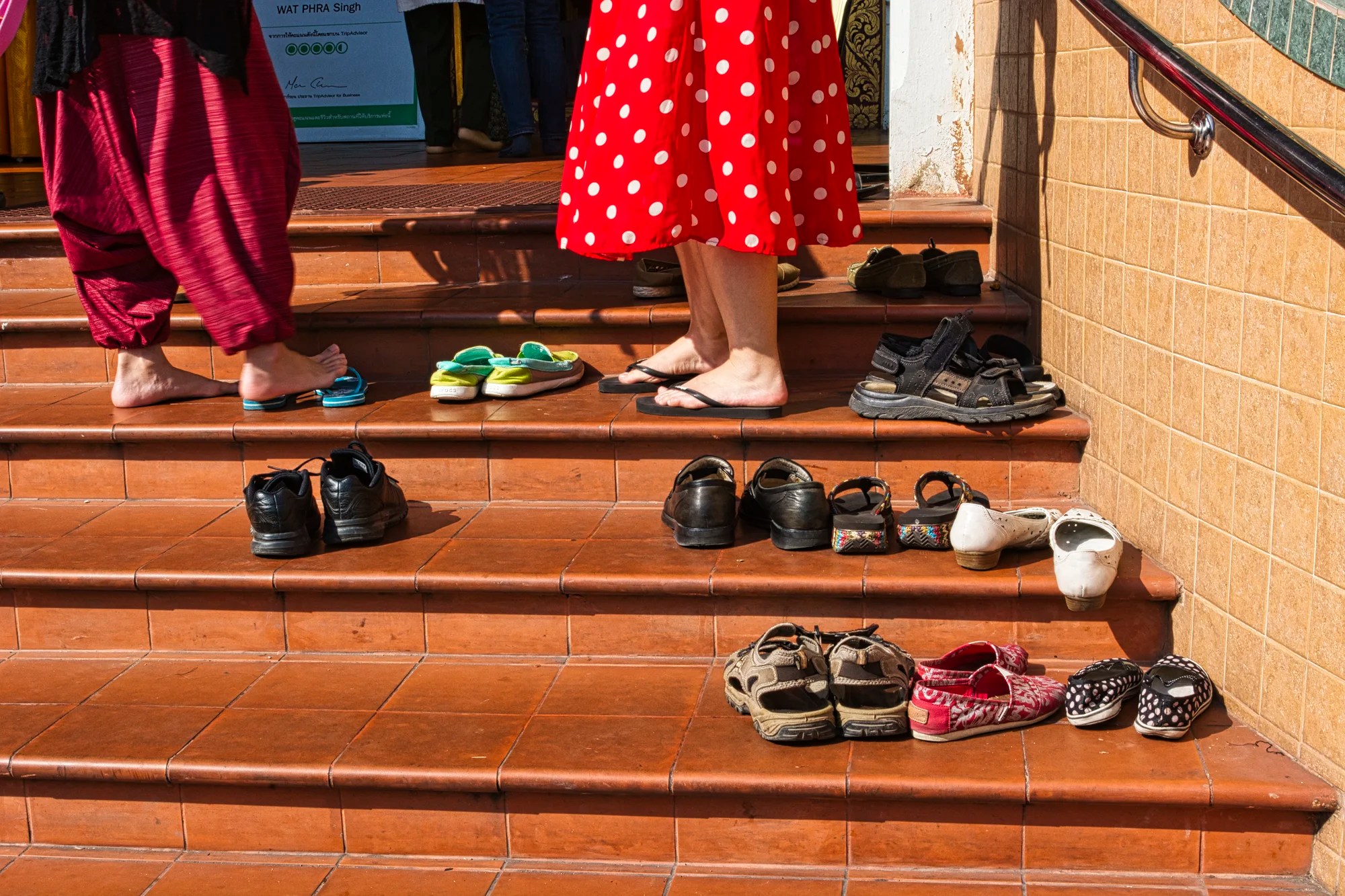
Wat Phra Singh (G4.7) is one of the best and most famous temples in Chiang Mai. Everyone must take off their shoes before entering any sacred building.
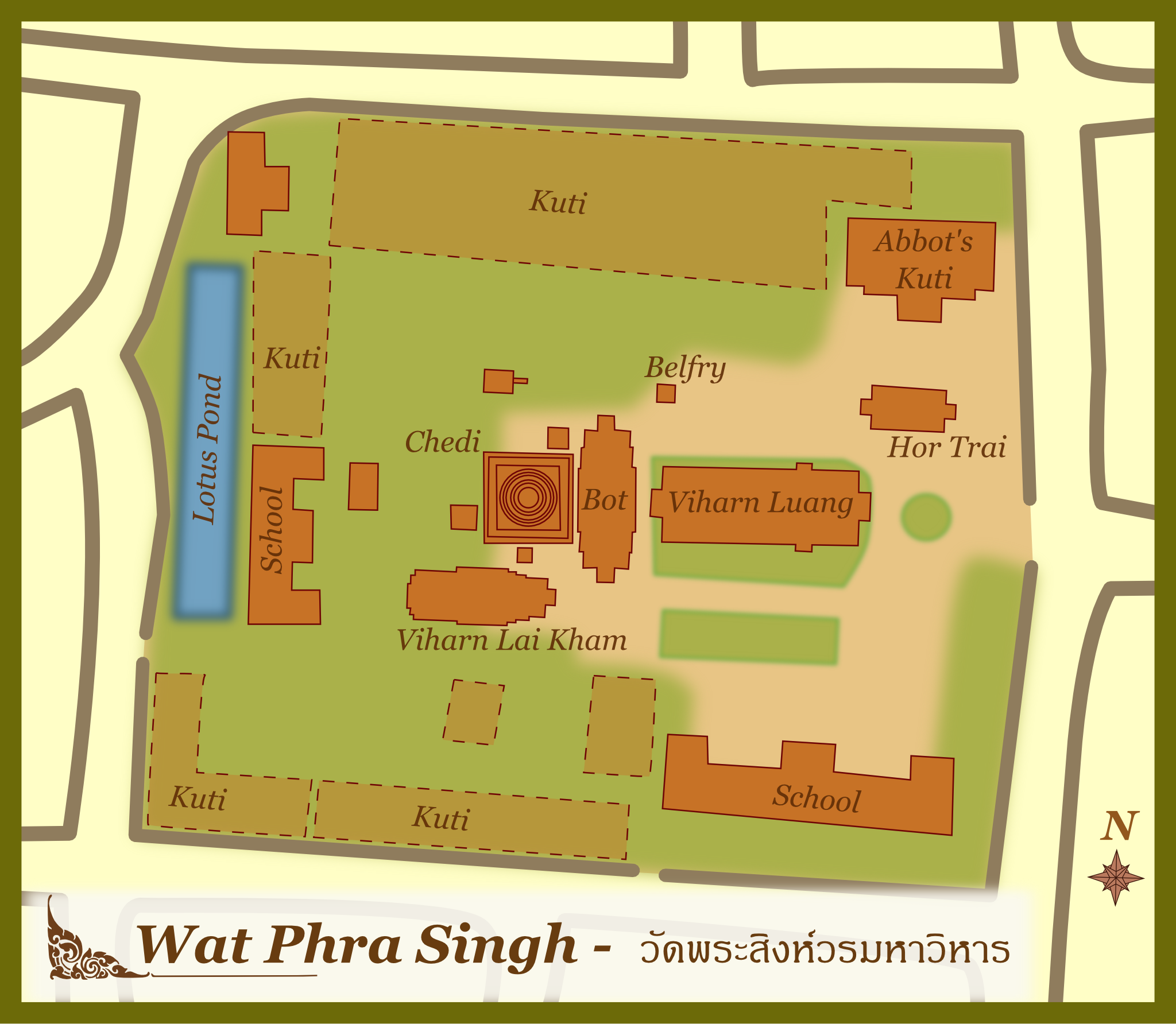
The street entrance is guarded by lions. As far back as the 6th century BC, the lion was associated with royalty. In Buddhism, the lion symbolizes the royal origins of Buddha Shakyamuni (his clan). Wat Phra Singh means Wat of the Lion (Singh) Buddha (Phra).
Viharn Luang
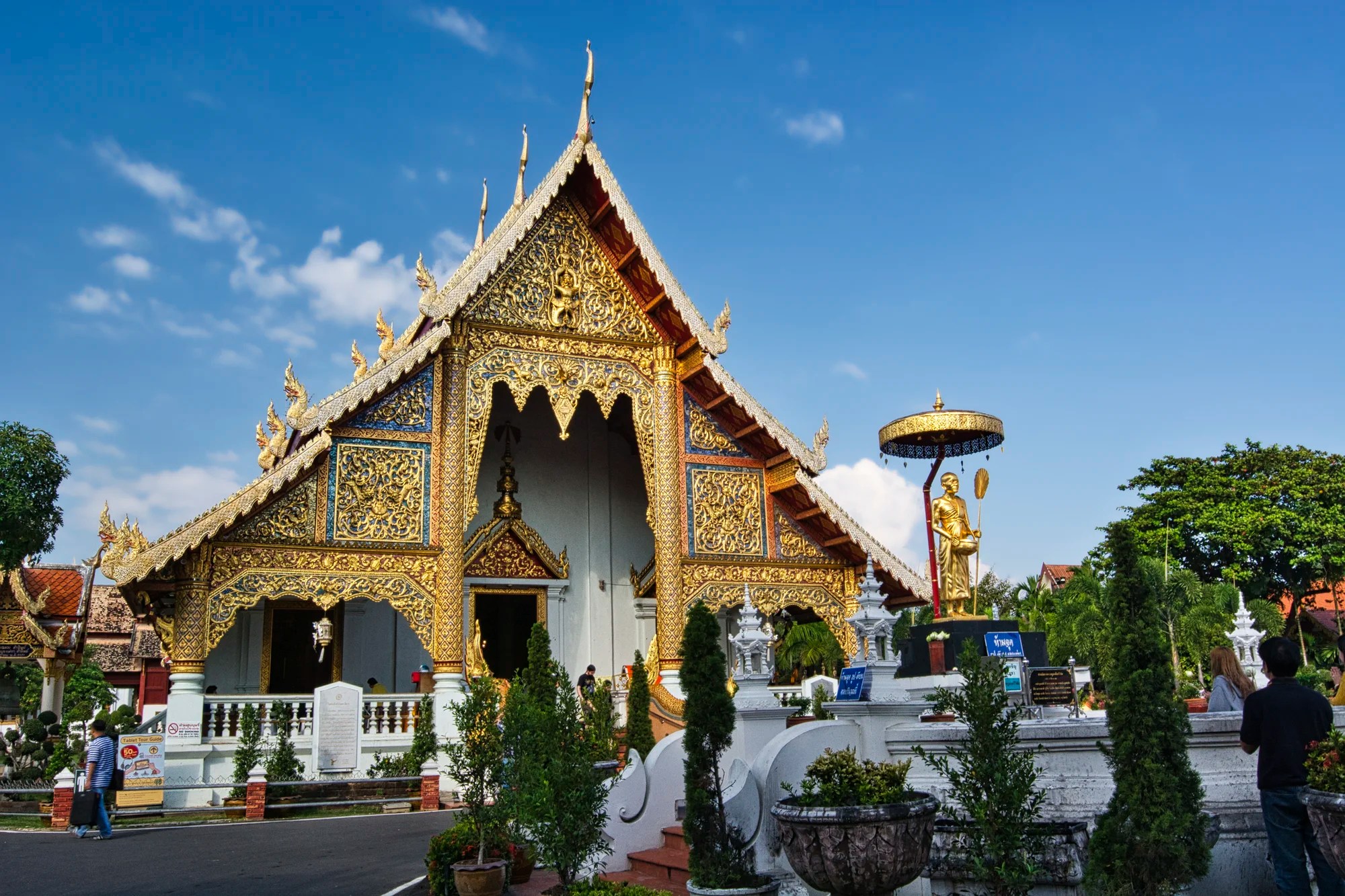
Venerable (luang) Hall is the main sermon or assembly hall. It is an exquisite example of Lanna Thai architecture style.
Garuda Pediment
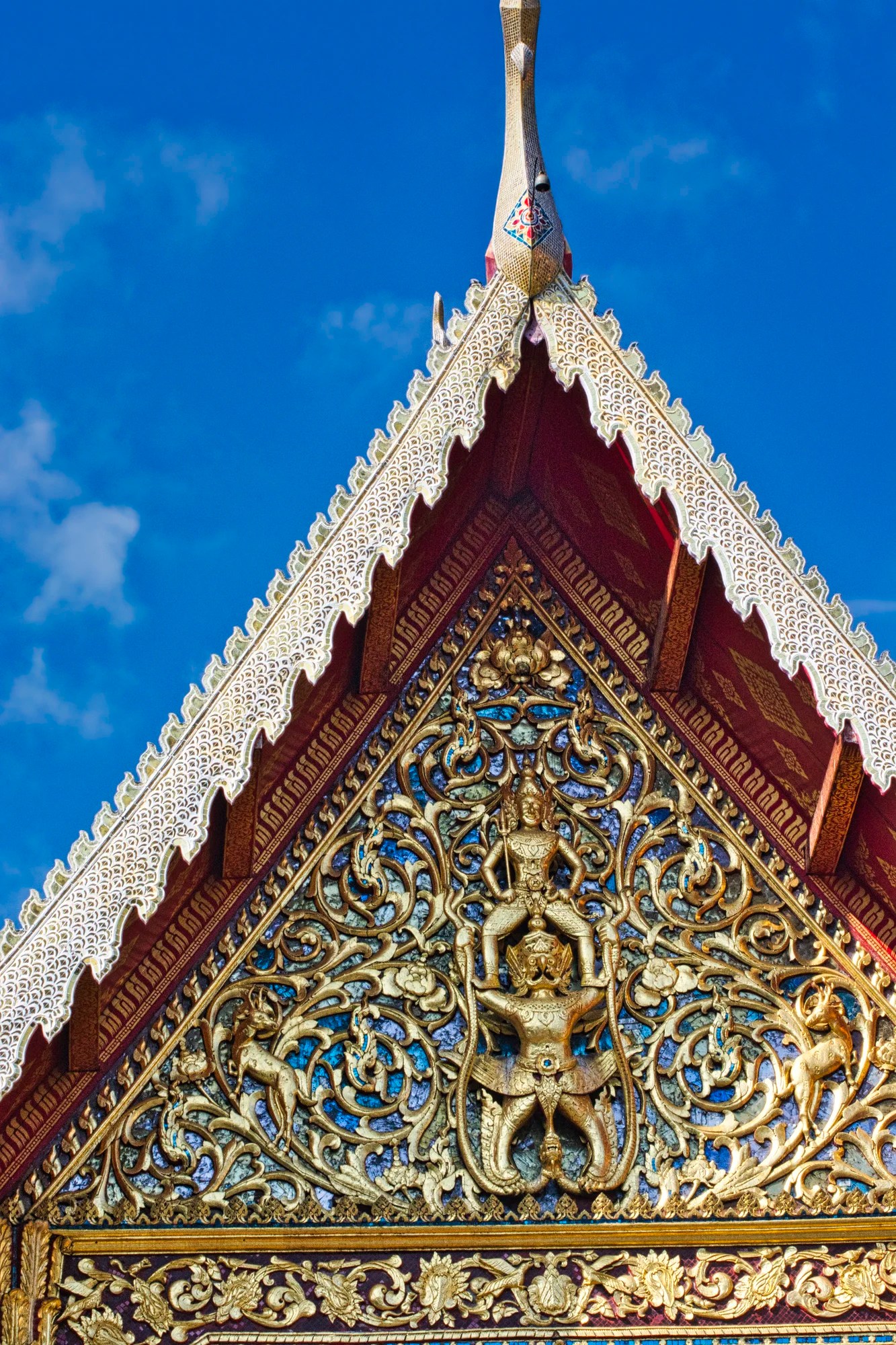
The entrance wall is the most prominent surface area and thus the most decorated. In fact, there is no “white space” or unused area as the whole pediment is filled with floral and geometric motifs. It is so busy you may not focus on the primary subject. In this case, there is a gold figure riding on Garuda. These deities are derived from Hinduism, aka Proto-Indo-European, mythology so the rider would be the god Vishnu since the Garuda is his mount.
Roof Tiers and Finials
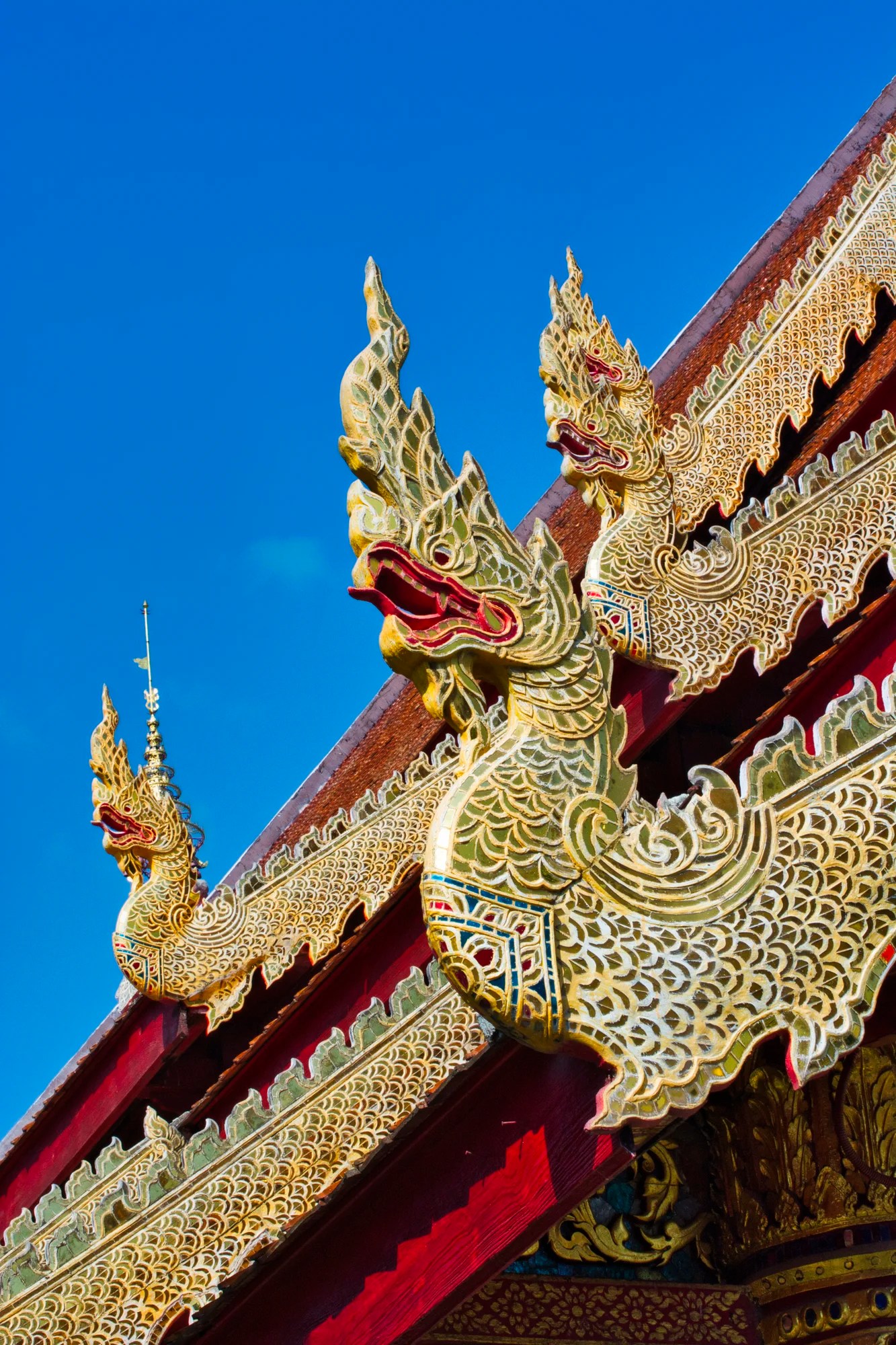
Multi-tier roofs are used to symbolize the prestige of the building. The more ornate the roof, the higher the status of the building. They are not supposed to be used in commercial buildings. Most viharns are very large and multi-tiered, breaking up what would be a bulky-looking roof. Similarly, a tier is frequently covered in patterns of colourful ceramic tiles, which break up the appearance of the roof.
Every roof edge has stylized artifacts that protect against evil influences. The roof finials also break up the linear structure and add sculptural decoration. Most of the finials are nagas. Focus on the details because there can be differences. Sometimes, they may be styled in flame-like kranok motifs. At the roof (tier) peaks are stylized curved bird beaks, usually symbolizing garudas.
Ho Trai Library
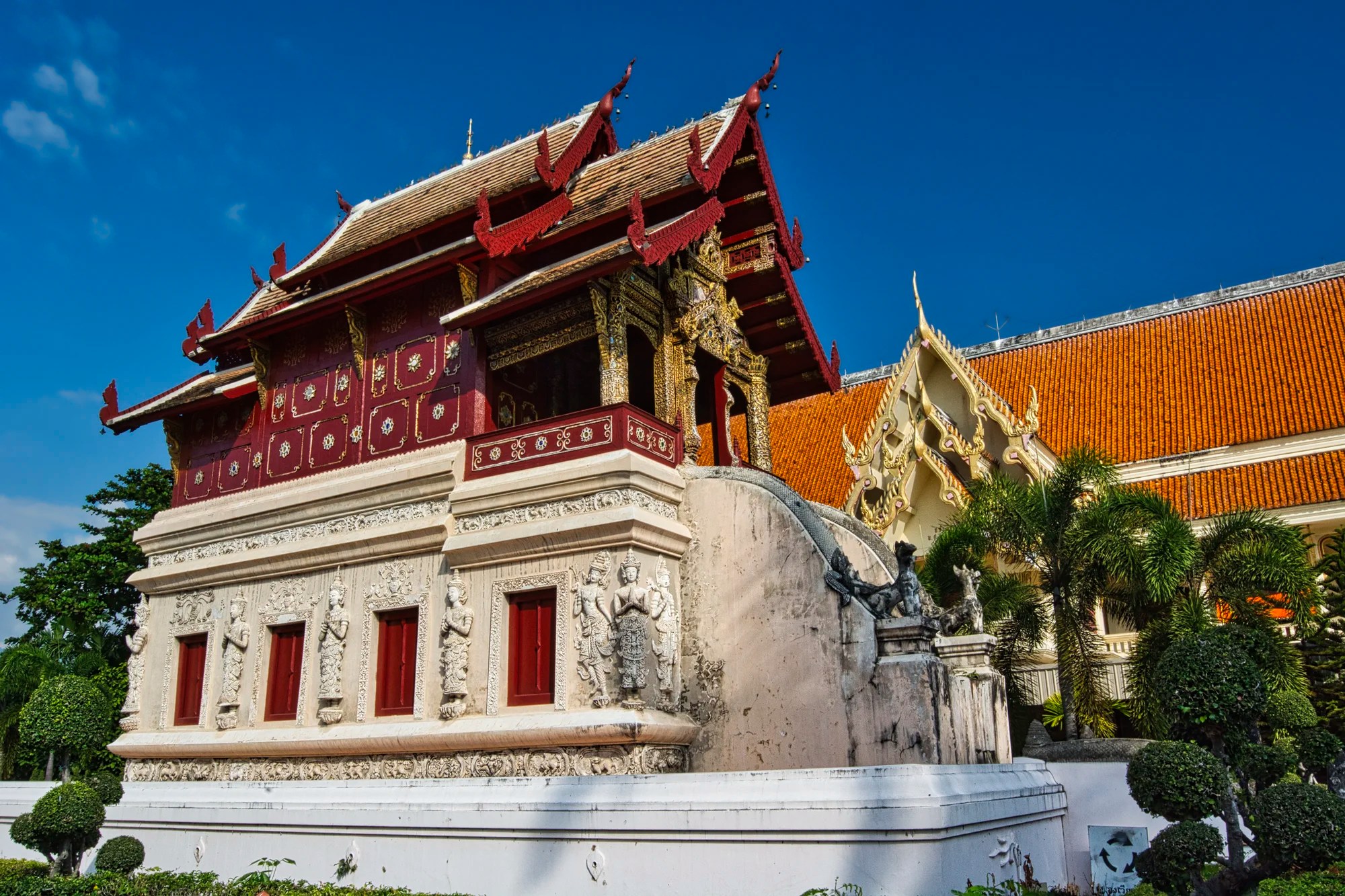
One of our favourite places is the Ho Trai Library, which sits on the north side of the courtyard near the Viharn Luang. Constructed in the 15th century, the gold and red wood building contrasts with the stark off-white platform.
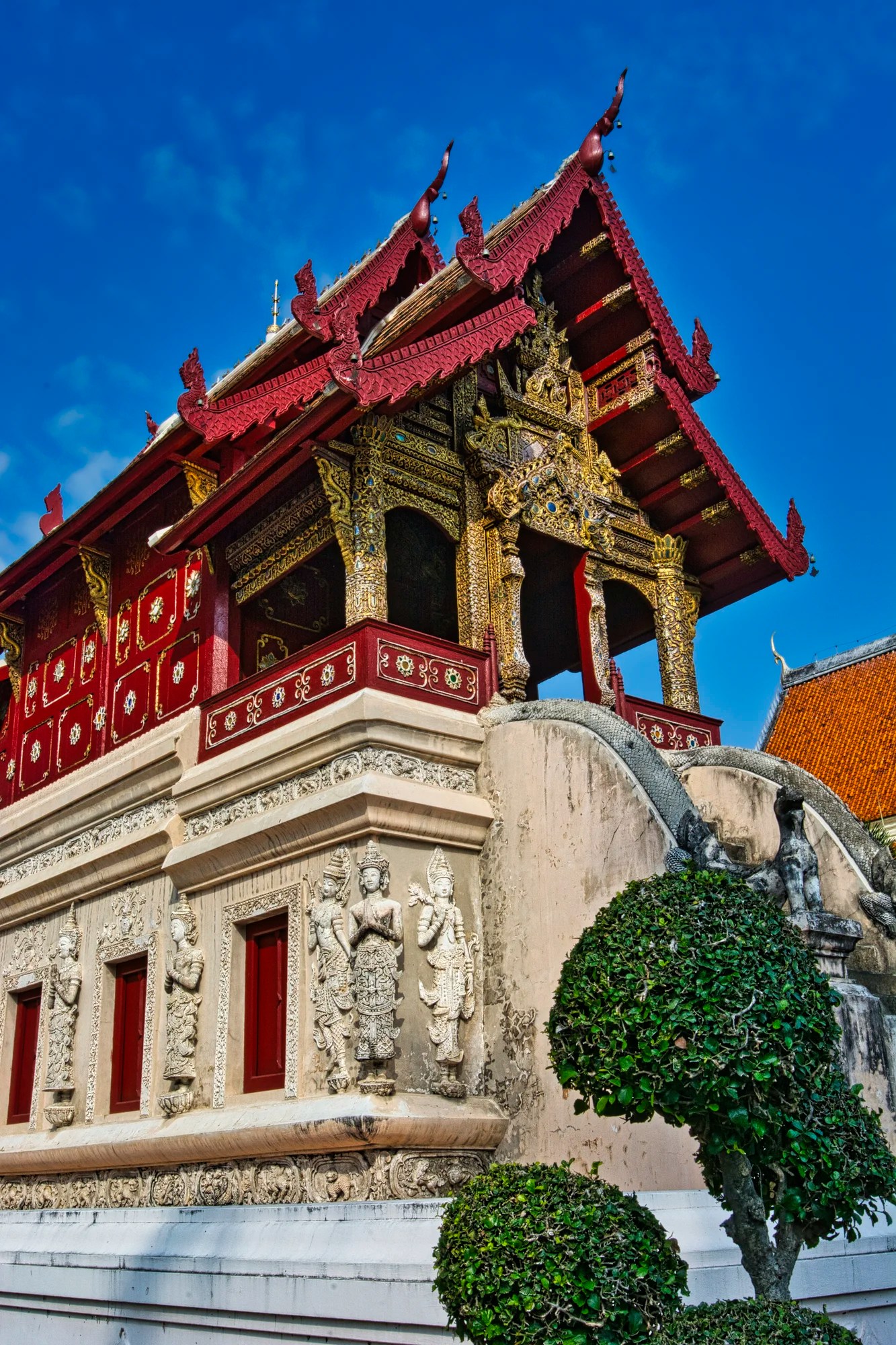
Why was it built so high up? The library preserves the Tipiṭaka Buddhist scriptures written on fragile palm leaves against humidity, floods, termites, and other pests. The library was built above ground on columns. Bricks were preferred to deter termites. The stairs leading to the Ho Trai are guarded by Makara disgorging Naga figures.
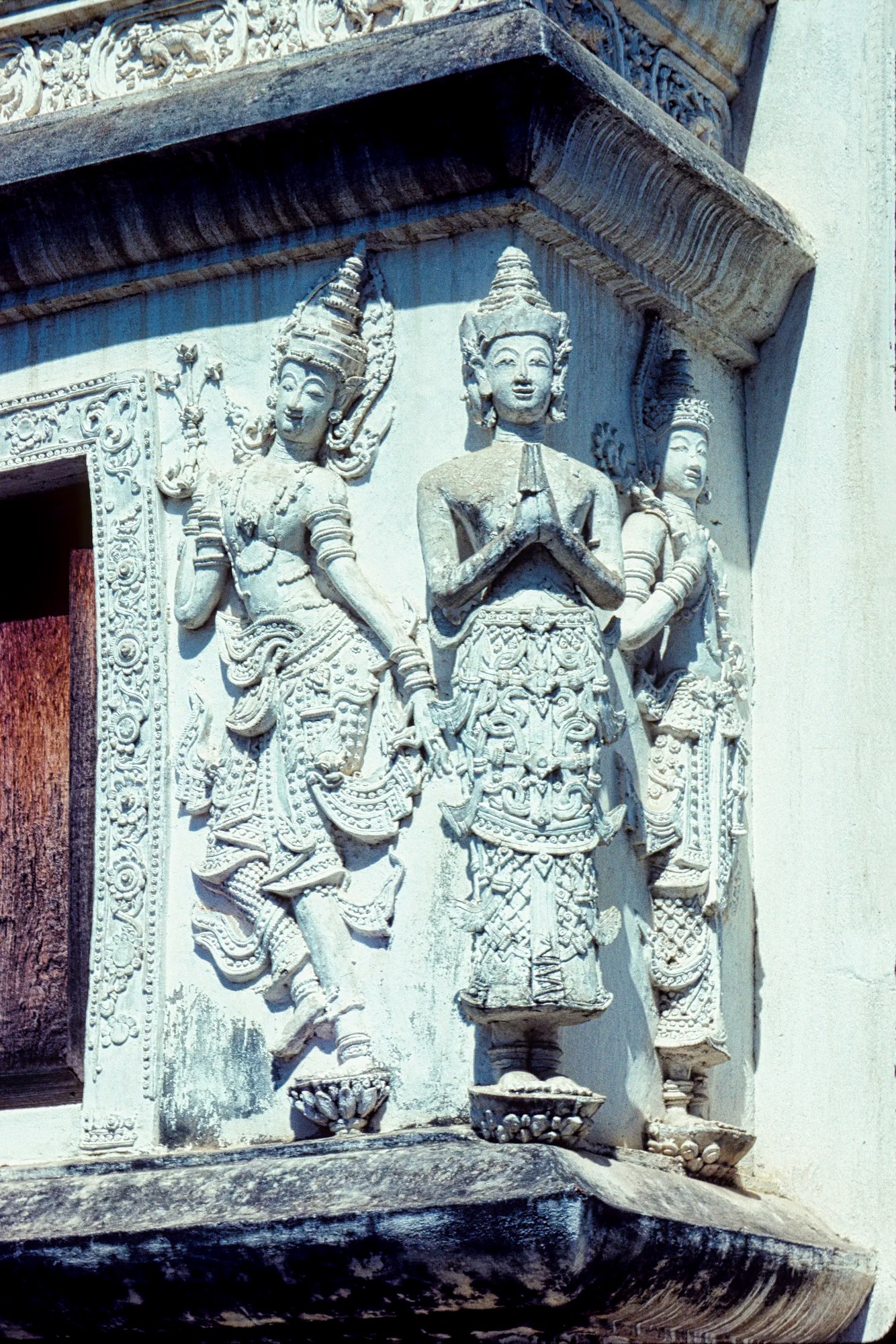
The base is decorated with carvings of Devata figures, sort of guardian angels. The central figure is in the namaste pose.
Viharn Lai Kham
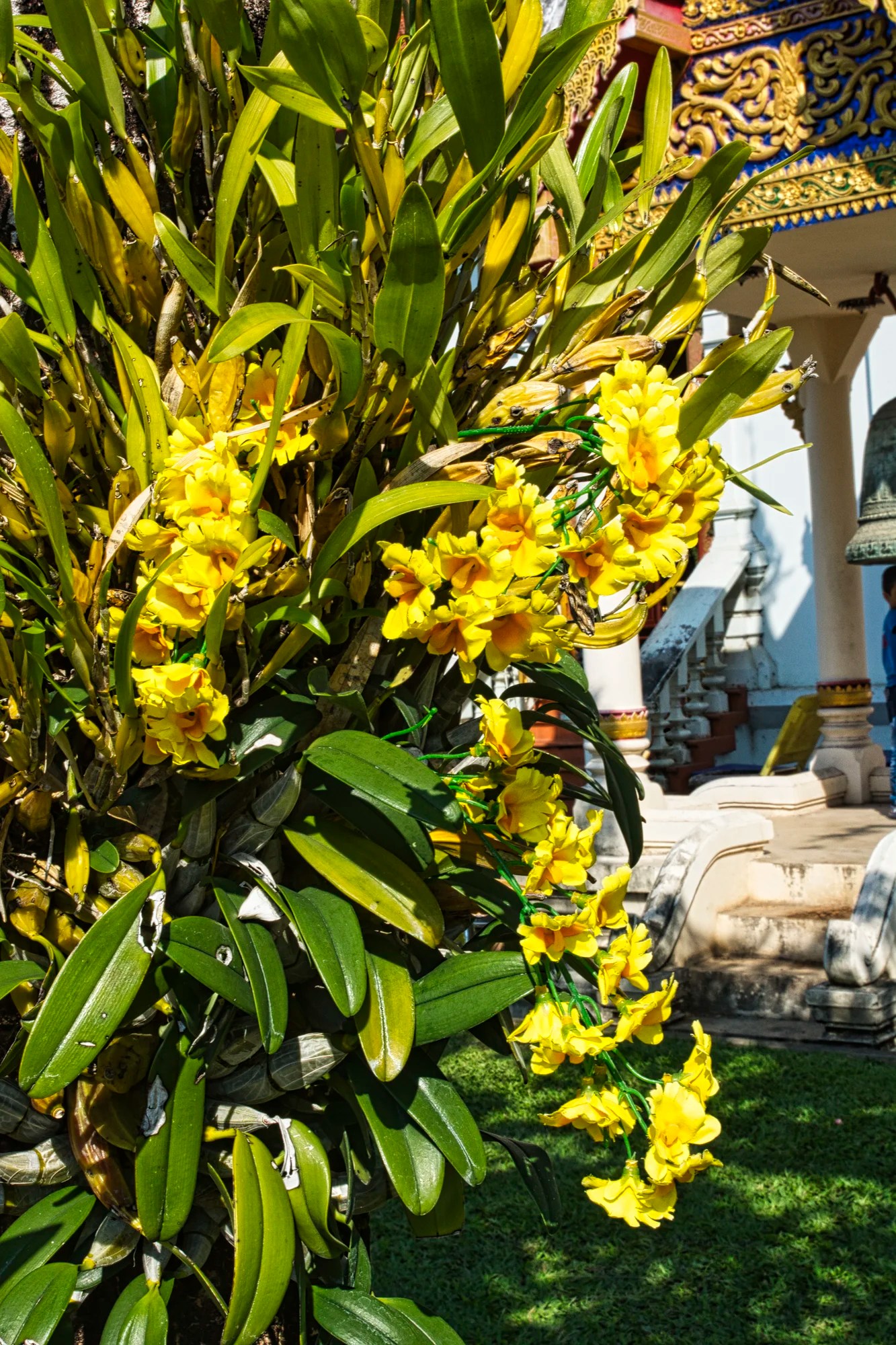
Walk around the south side of the Sermon Hall, where you will find flowers and shaped trees.
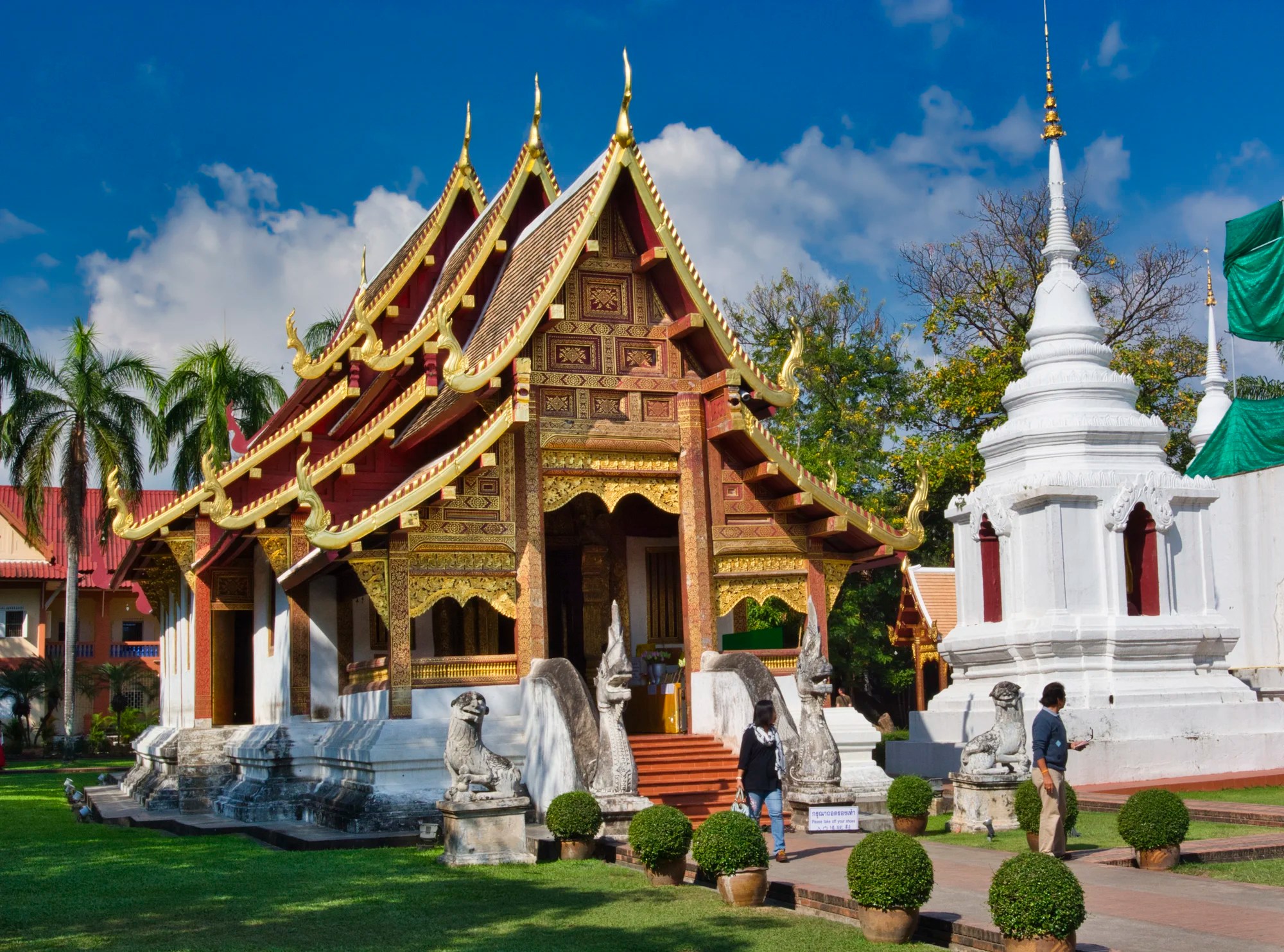
Head towards the back for the iconic view of the beautiful Viharn Lai Kham. This classic Lanna-style architecture hall was built by the Mangrai Dynasty in 1345 to house the famous Phra Singh or Lion Buddha statue. The viharn, which is made from teak wood, has a three-tiered roof.
Each roof peak has a golden curved chofah, which is a stylized Naga. The chofah originated in the Angkor Wat (Khmer) Empire and spread throughout Southeast Asia.
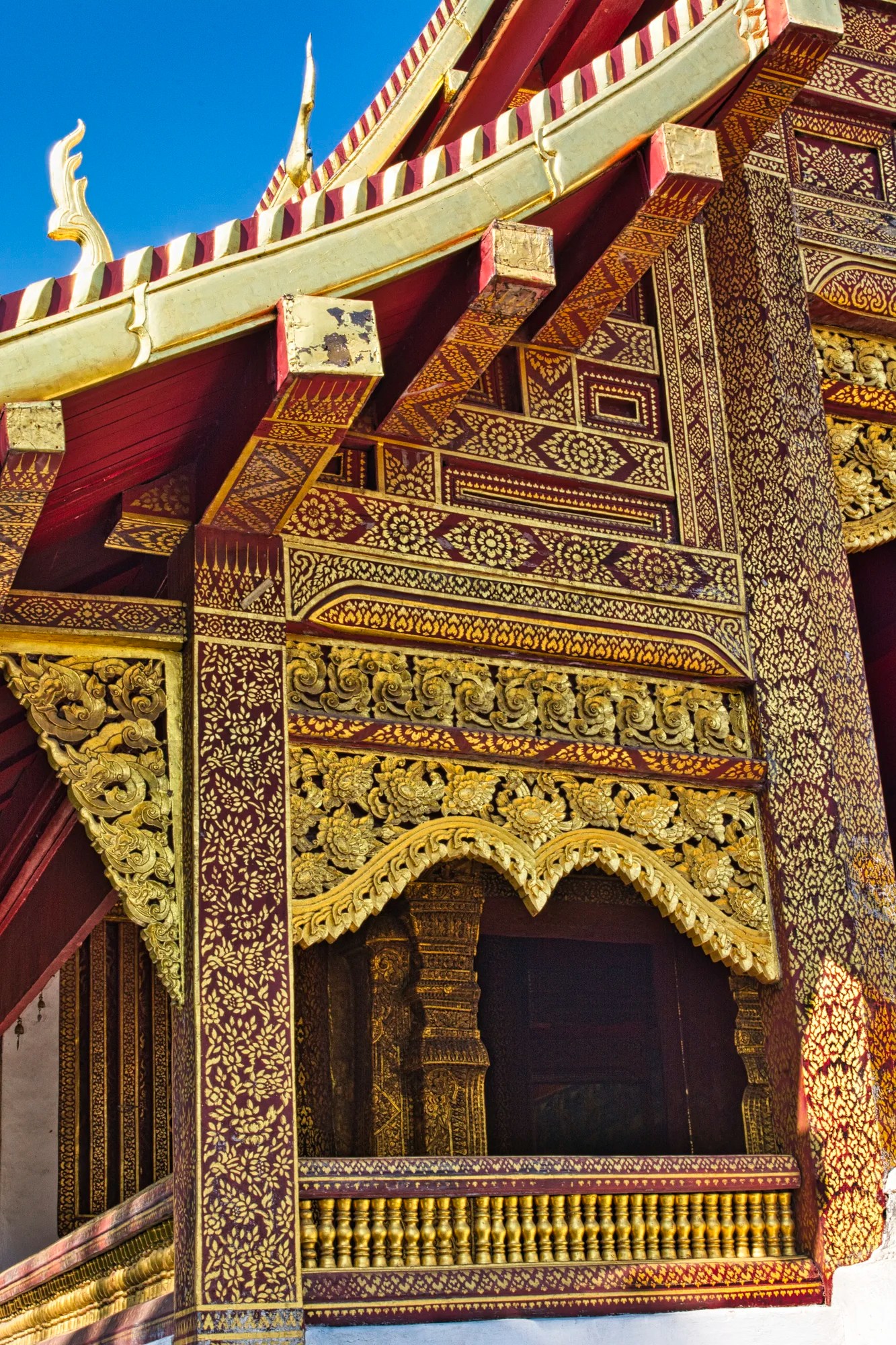
The simple white structure is contrasted with a very ornate entrance wall decorated in gold and red colours.
Viharn Lai Kham Murals
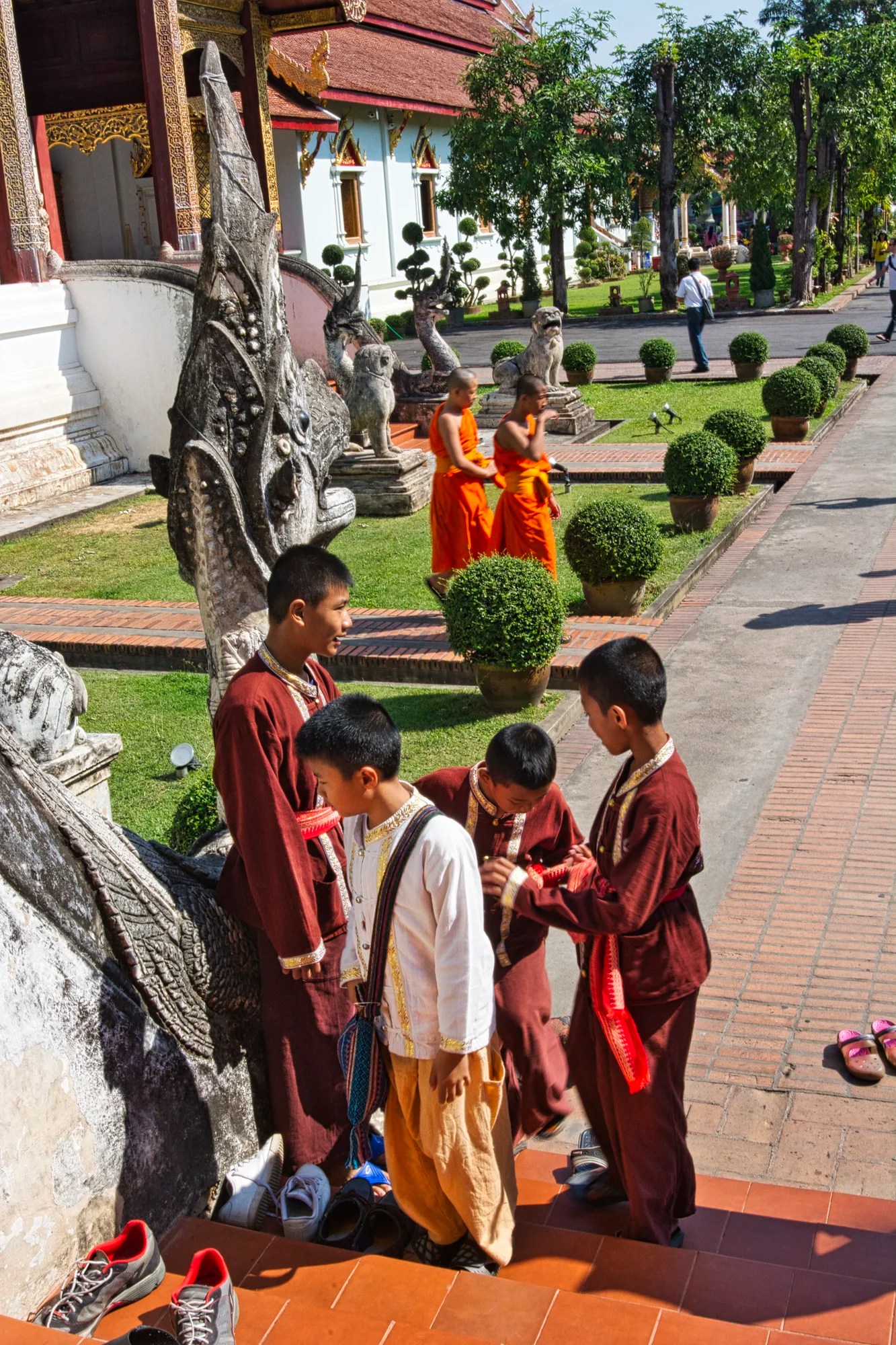
Young monks are coming to visit the interior walls covered in colourful, 1820s frescoes. Only Buddhist monks could read literature and sacred texts written in either Pali or Sanskrit languages. The Thai lay people were illiterate. Murals were used to illustrate scenes from the Jataka, Indian tales about the previous lives of the Buddha.
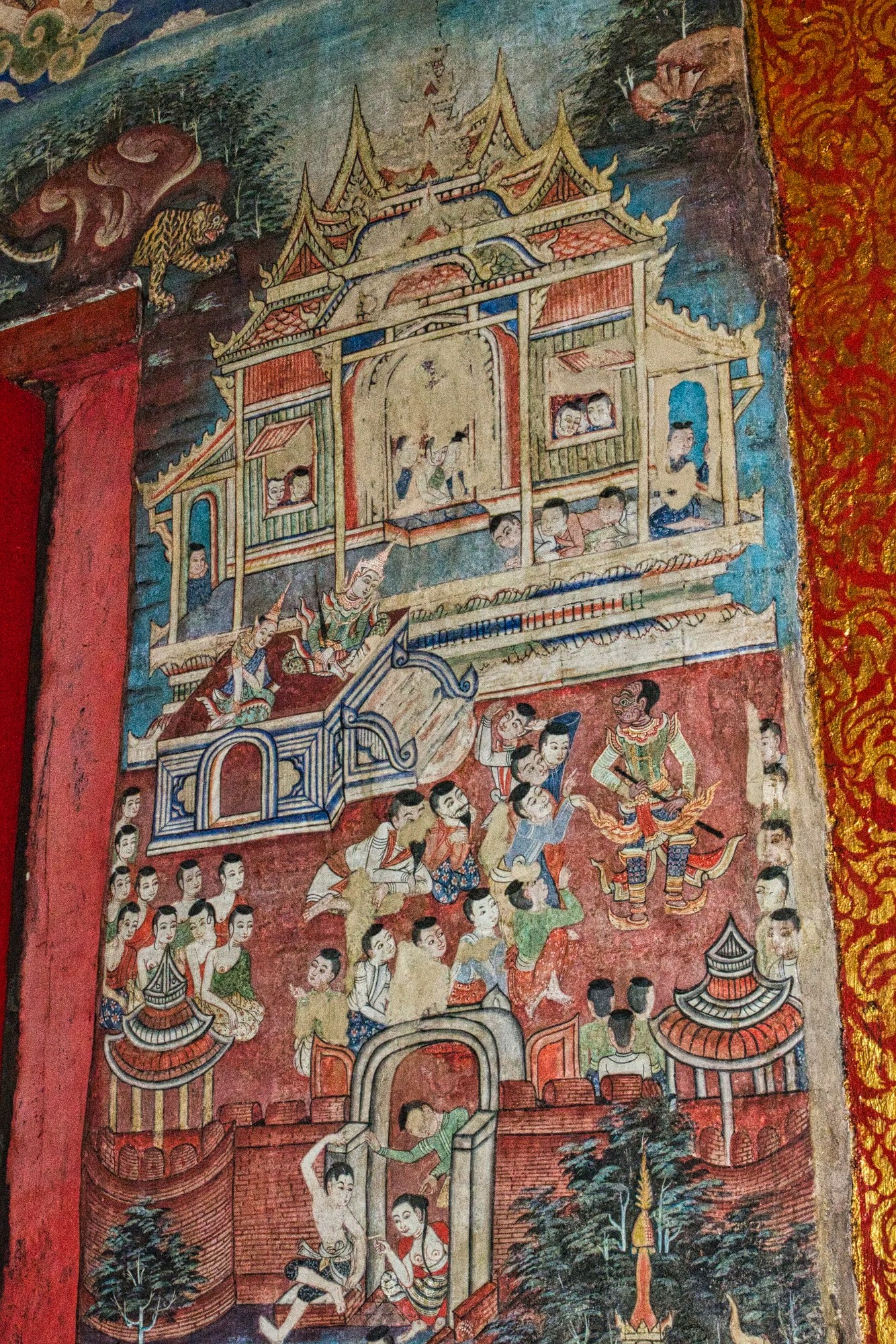
It’s quite dark, so the photo of the Suwanee Hongse mural is brighter and more vibrant than when you visit.
Synopsis: On the right wall is the story about a princess of a fierce ogre king. Her father commands his other daughters to murder Prince Suwanee Hongse. The prince dies, and the brokenhearted princess seeks mystical help to bring him back to life.
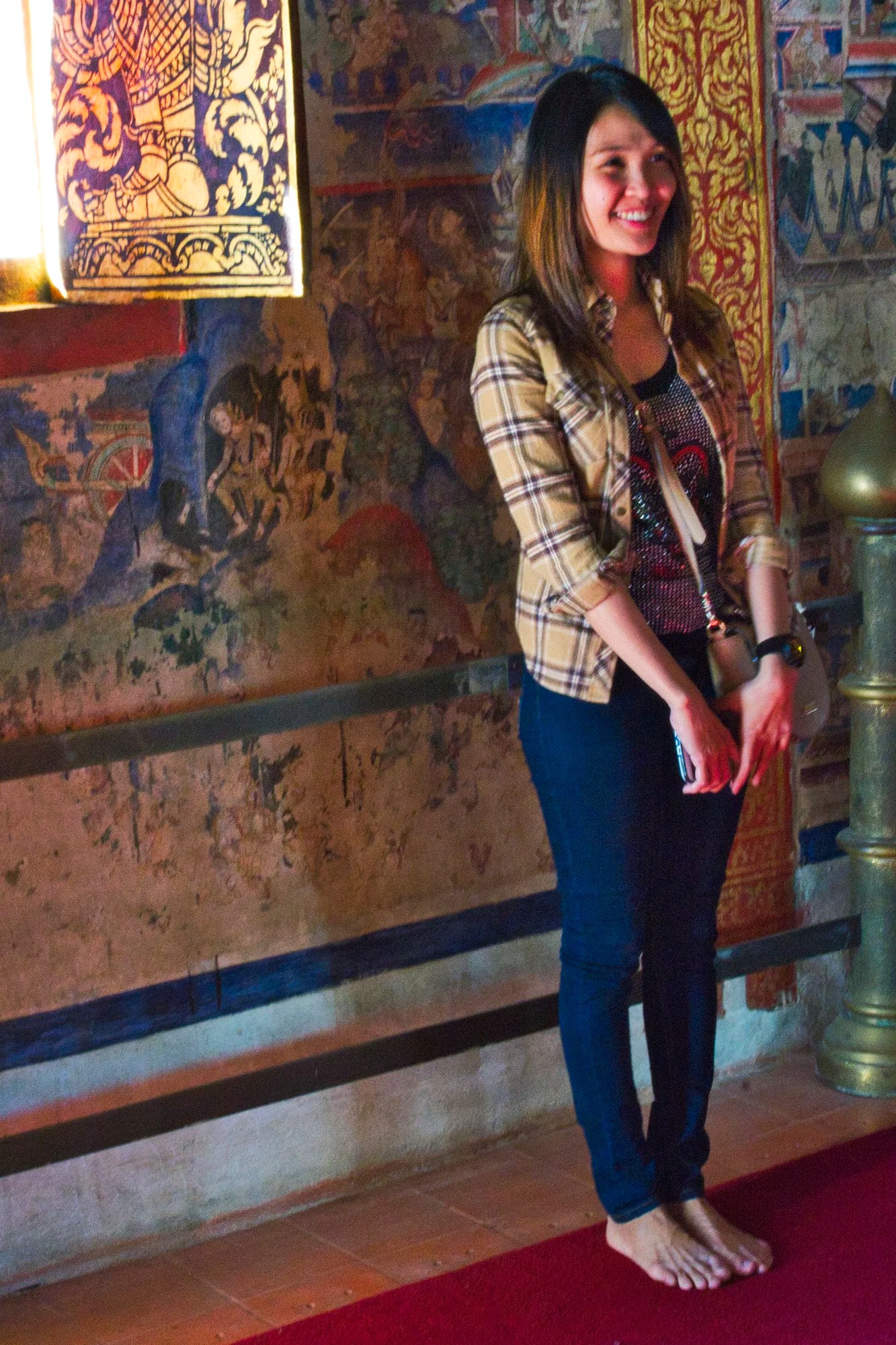
Even the locals are taking photos. The mural on the left depicts the story of Songthong, a Southeast Asian folktale inspired by the Paññāsa Jātaka.
Synopsis: After acquiring a golden countenance, Prince Sang Thong disguises himself with an ugly Negrito mask and visits a nearby kingdom where the king seeks a husband for his daughter. At a ceremony, Princess Rodjana sees through his mask and selects Sang Thong as her husband. He later saves the kingdom of his father-in-law.
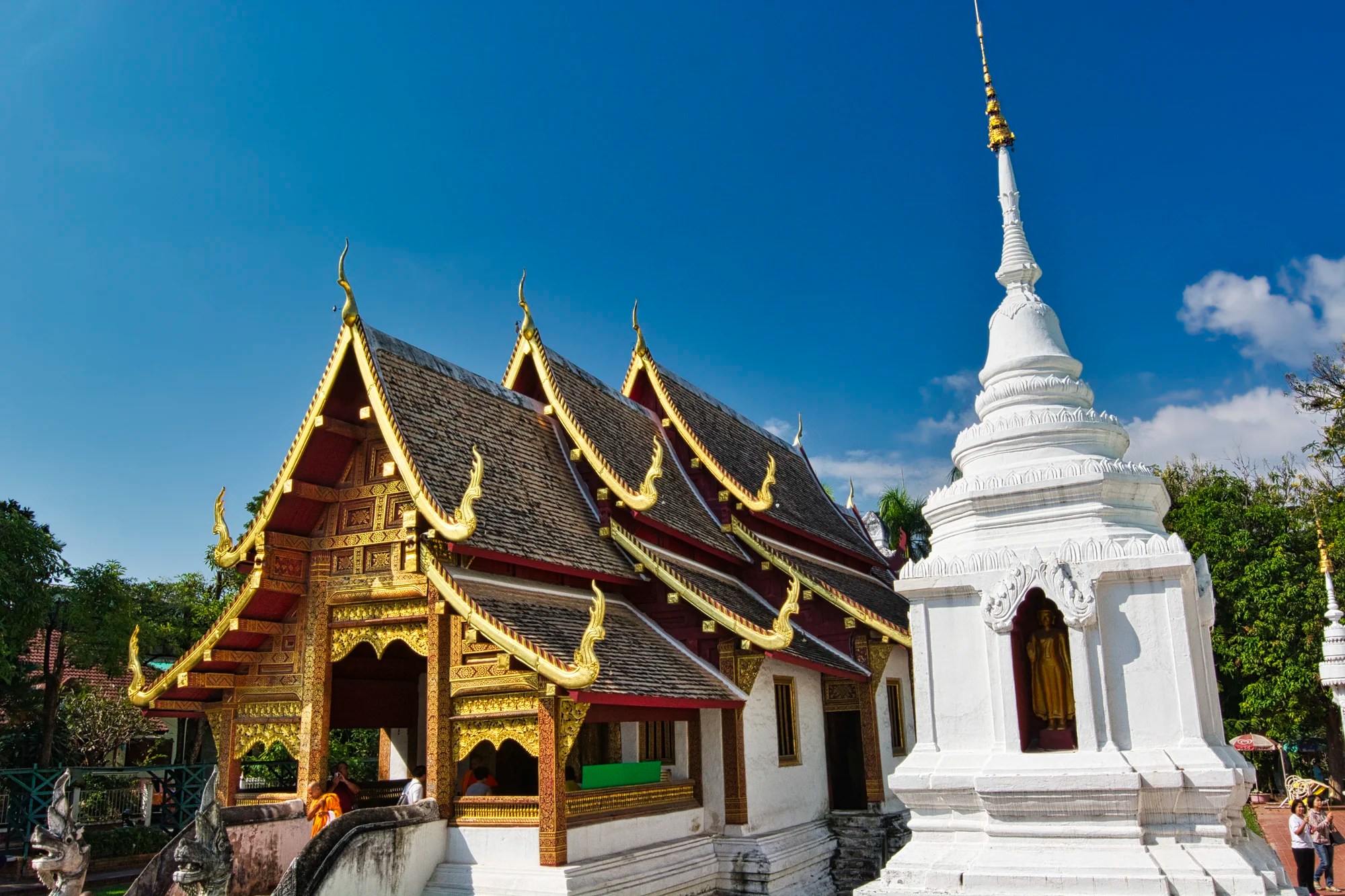
On the right is the white-washed Kulai Chedi built by King Mueangkaeo (1495-1525) that once contained royal funeral urns.
Wat Phra Singh Ubosot
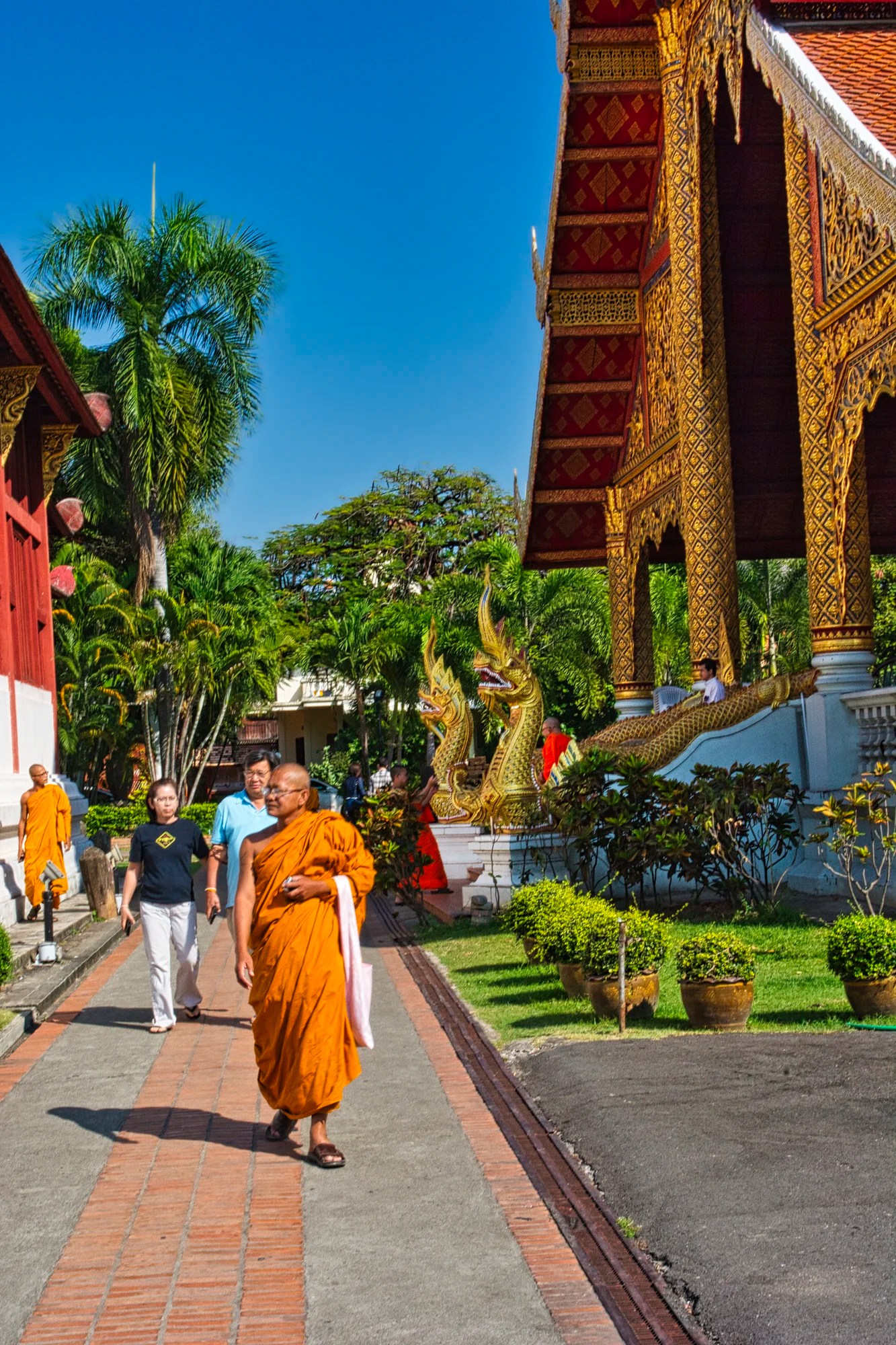
To the right of the monk is the ubosot, where monks get ordained.
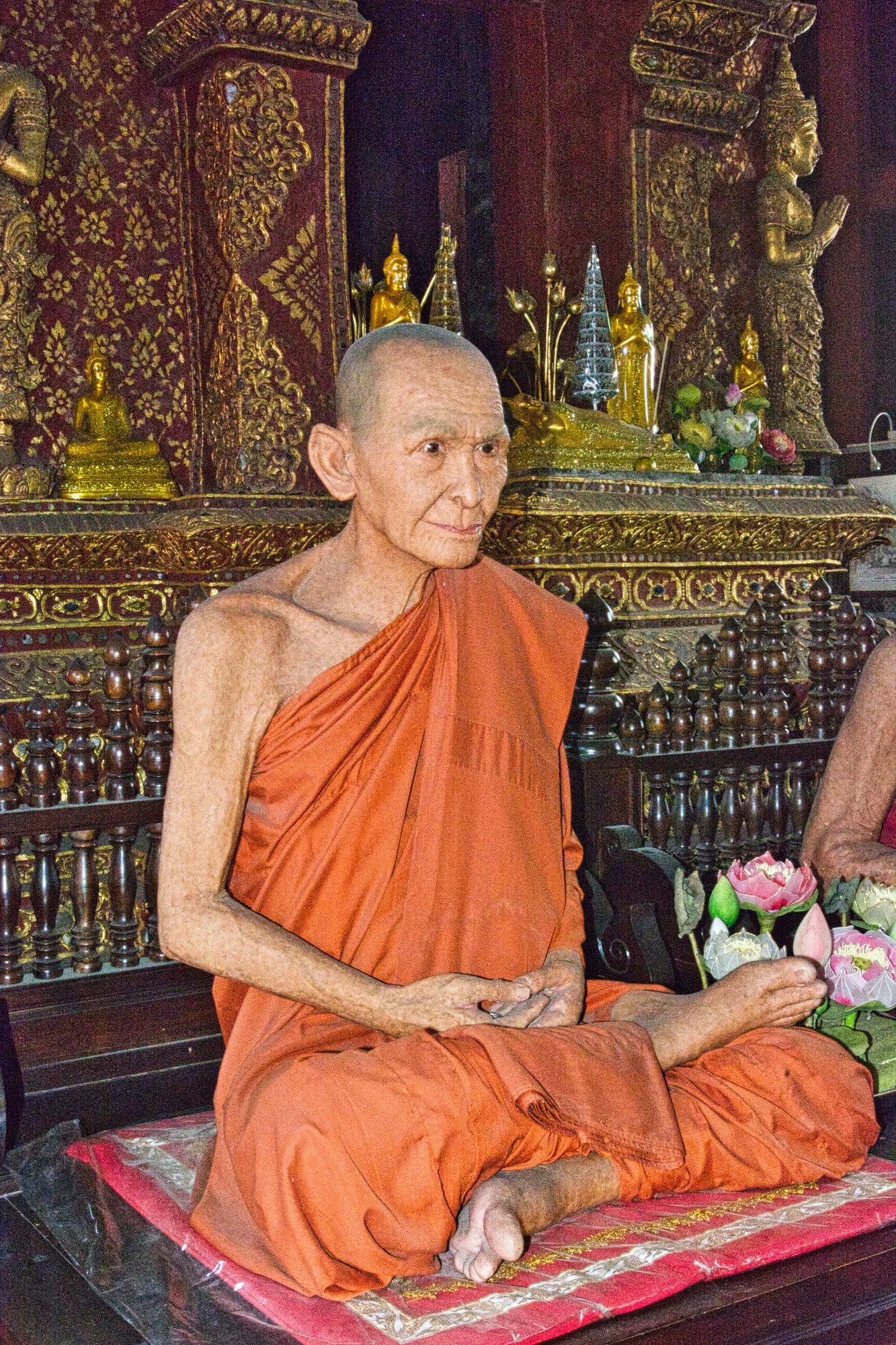
Inside, we saw several monks sitting very still in the lotus position. Then we realized these were incredibly lifelike wax images. It was uncanny how real they looked. There is also a long reclining Buddha Statue.
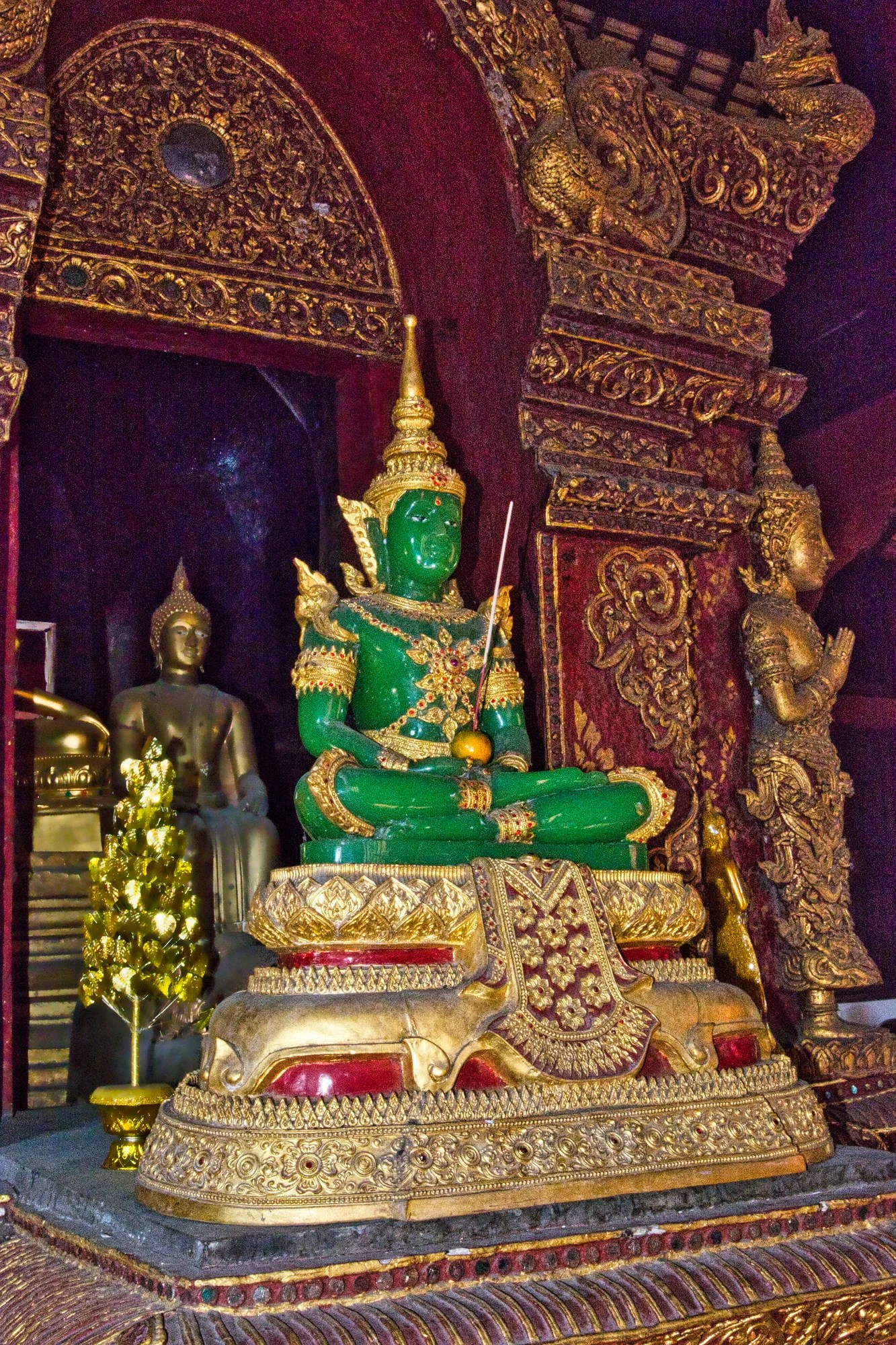
At the north end of the ubosot is a copy of the famous Emerald Buddha. Wat Phra Singh was the original location of this statue before it was moved to Wat Phra Kaew, Bangkok.
Wat Phra Singh Address and Hours
Address: Ratchadamnoen Road.
Open: 06:00 to 17:00 hrs daily and lit up at night
SP Chicken Restaurant
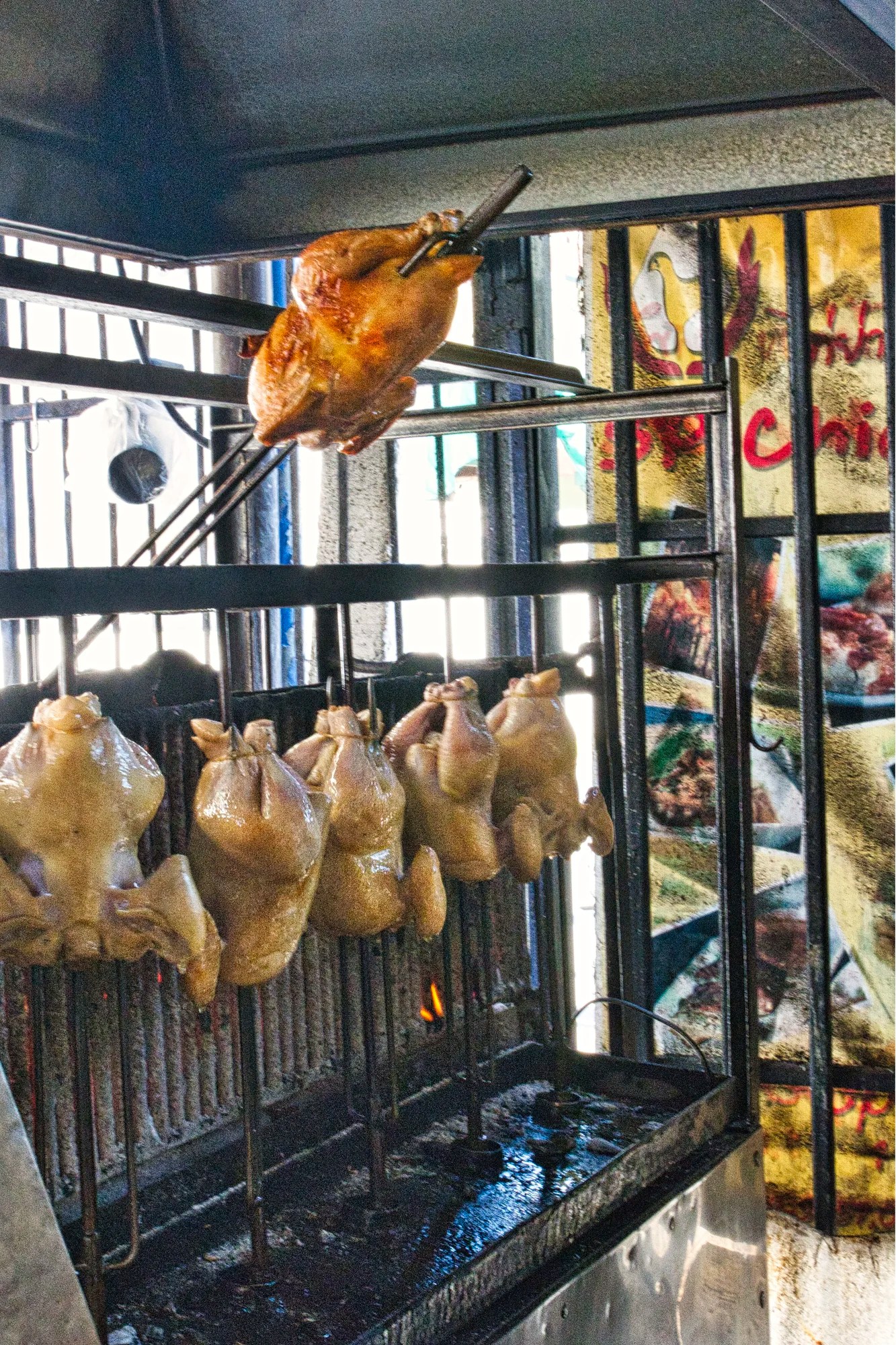
By now, we were hungry, so we headed literally around the corner to SP Chicken (G4.2). Its primary dish is gai yang, a delicious grilled chicken. But it is not simply BBQ. This is Isaan cuisine (Northeast Thailand) and comes with Nam Jim Jaew sauce. Typically, Thai cuisine combines sweet, salty, sour and spicy flavours into one dish. The major ingredients are nam pla (fish sauce) and lime juice. Other quintessential spices of Thai cuisine are lemongrass, cilantro, Thai basil, and garlic.
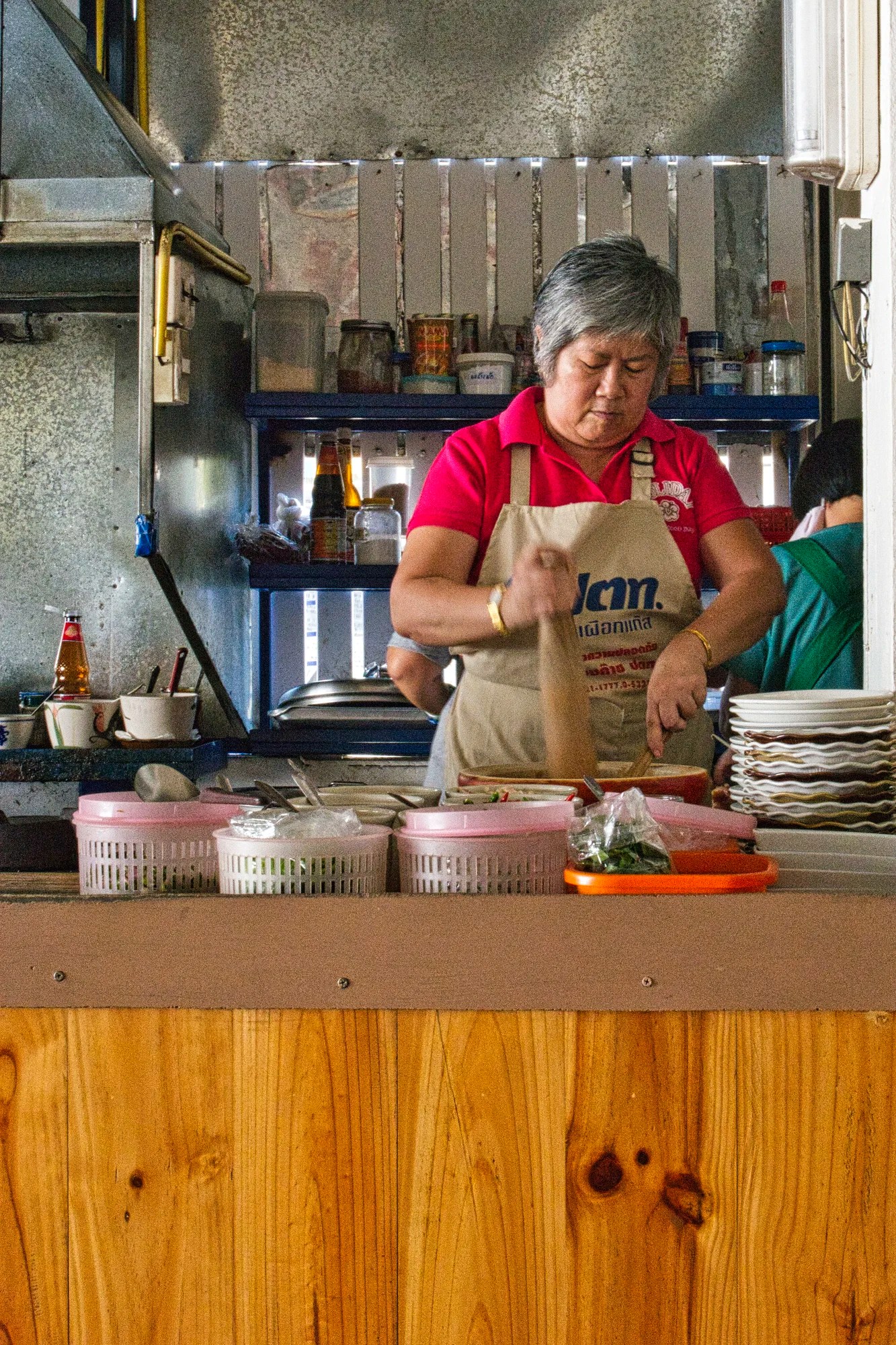
We also ordered khao neow (sticky rice) and som tam, spicy green papaya and dried shrimp salad sprinkled with peanuts. We watched the chef pound Thai peppers, ginger, garlic, dried shrimp, and lime juice in a mortar and pestle. This traditional Thai salad can be found at any good Thai restaurant. But we found out that it is an Isaan specialty and originated from neighbouring Laos. Even more amazing is that papaya was native to the Americas and was introduced by Spanish and Portuguese explorers in the 17th century!
SP Chicken Address and Hours
Address: 9/1 Samlan Rd, Soi 1
Open: 11:00 – 21:00 hrs Cost: THB 100-200
Wat Inthakin
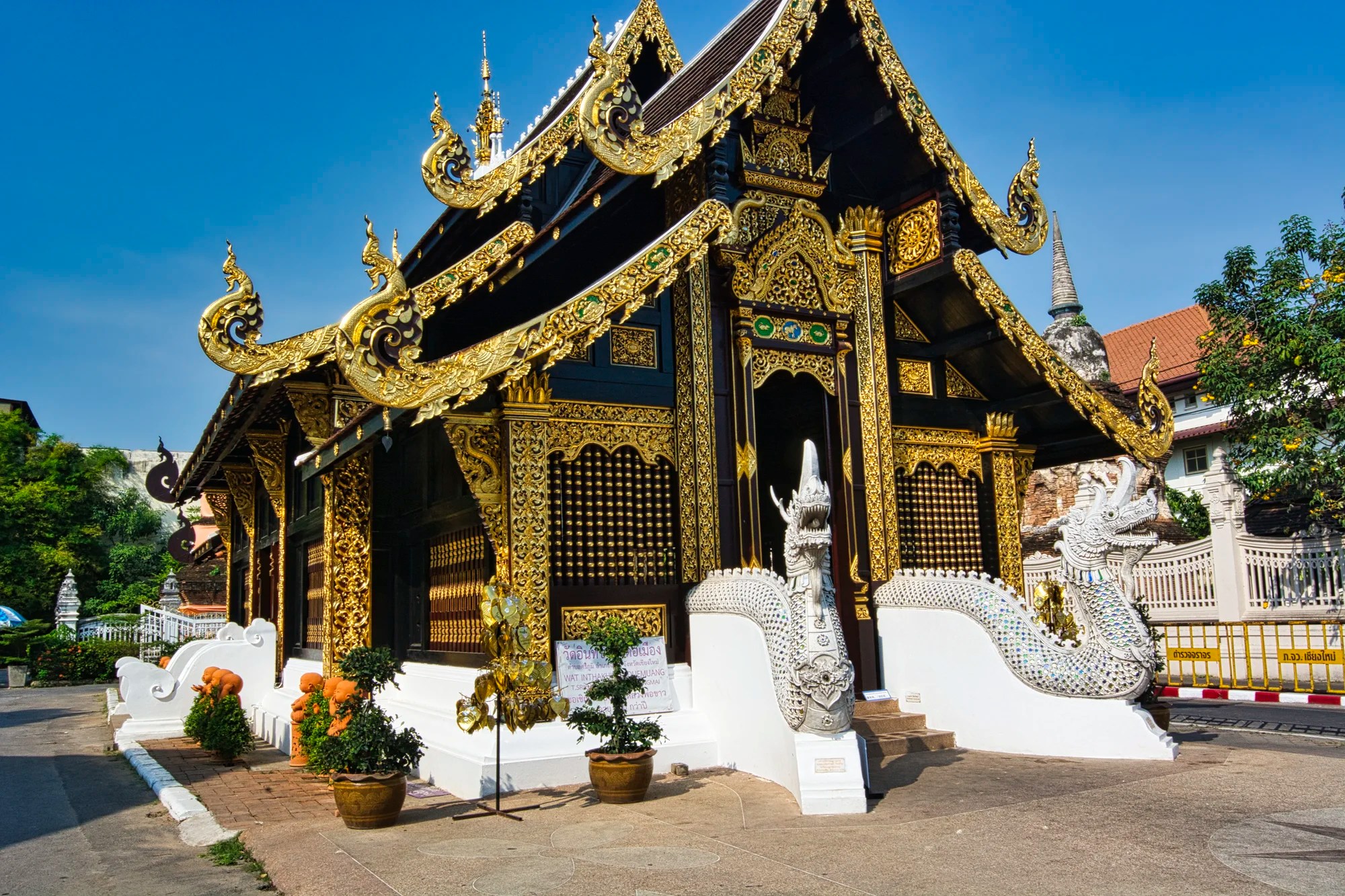
Wat Inthakin is another spectacular wat with surprisingly few tourists, considering its G4.6 Google rating. It has a very ornate entrance where two white nagas contrasting with the dark brown teak wood walls covered with opulent gold geometric panels. The multi-tiered roofs are lined with golden nagas. Enjoy a close-up look at the intricate craftsmanship.
It is also very significant historically. Wat Inthakin was the original hall where the Sao Inthakin pillar was housed. Because this wat was run down during the Burmese occupation, King Kawila moved the Inthakin to Wat Chedi Luang. Clearly, the building has been restored!
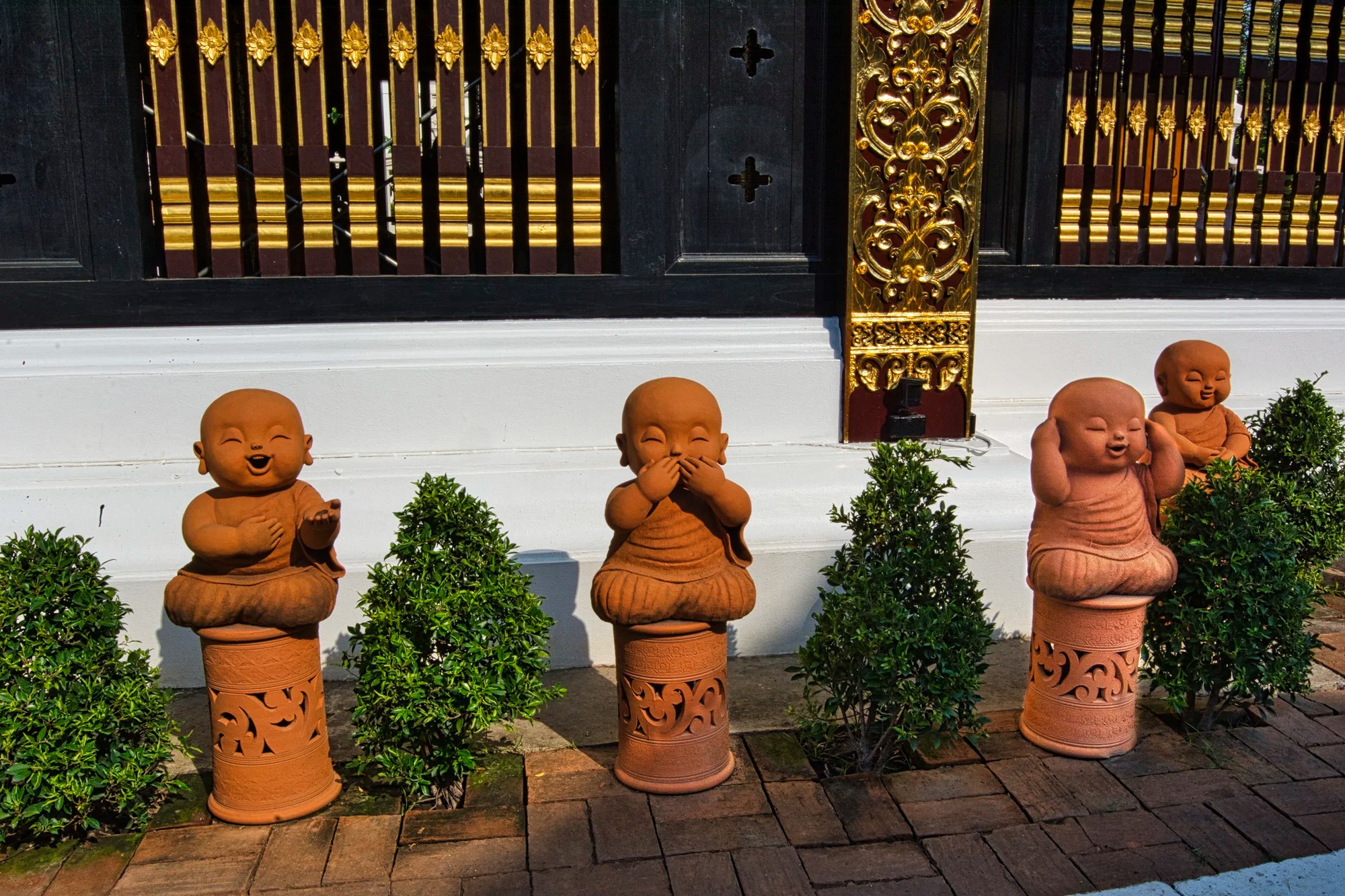
Here is a connection we made because we have travelled throughout Asia. We stopped to photograph these three modern statues of children in three poses: eyes closed, mouth covered, and ears covered. We recognized the theme from our trip to Japan.
Three Wise Monkeys Carving, Tōshō-gū
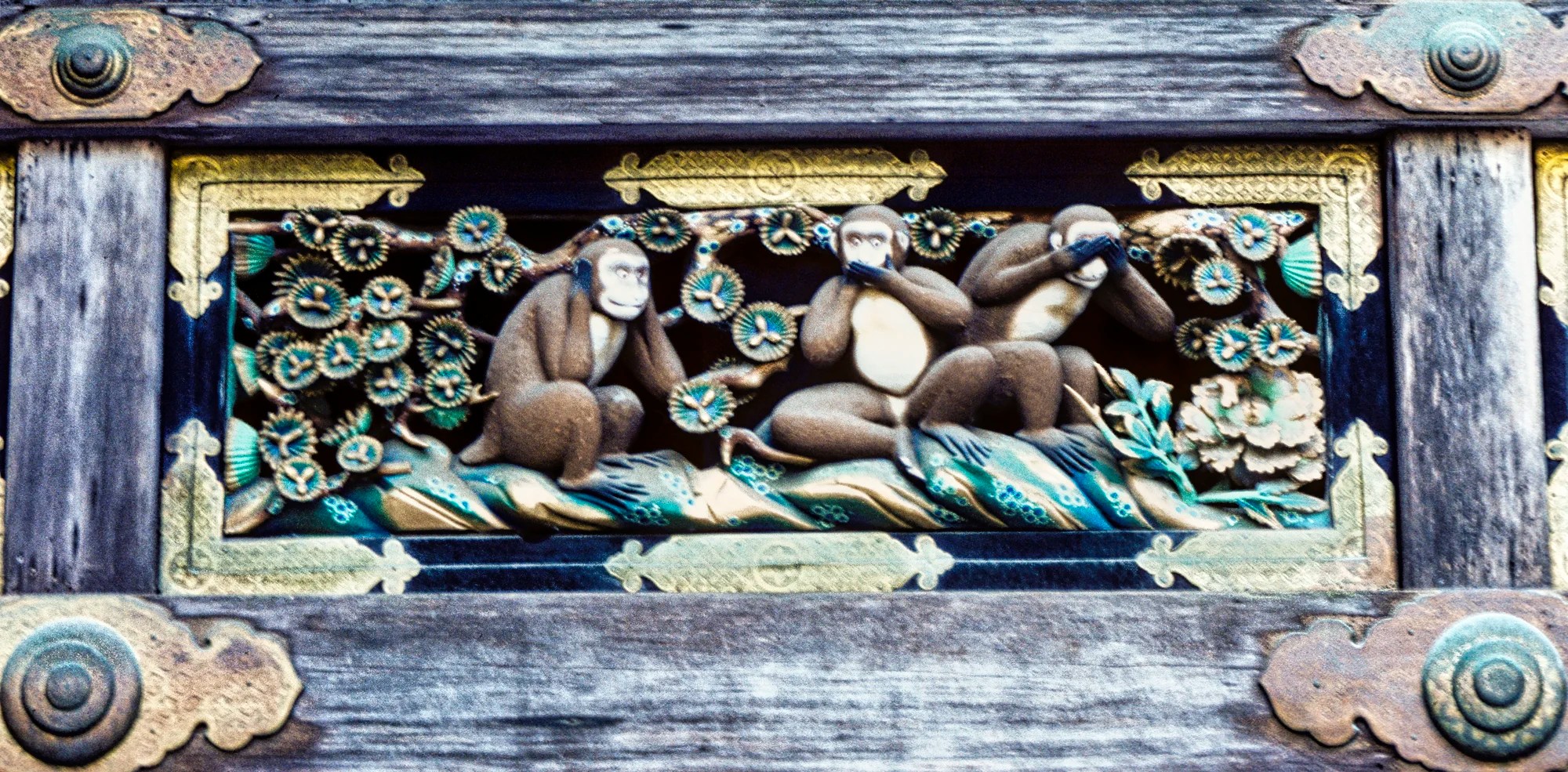
We visited the Tōshō-gū shrine (G4.5) in Nikko (Japan) dedicated to Tokugawa Ieyasu, the founder of the Tokugawa shogunate (1603 to 1868) and the subject of James Clavell’s excellent book Shogun.
The phrase “See no evil, Hear no evil, Speak no evil” originated from this carving of the Three Wise Monkeys on the Toshogu Shrine (1617). The moral is to not turn a blind eye to evil or ignore wrongdoing.
Dvarapala Statue
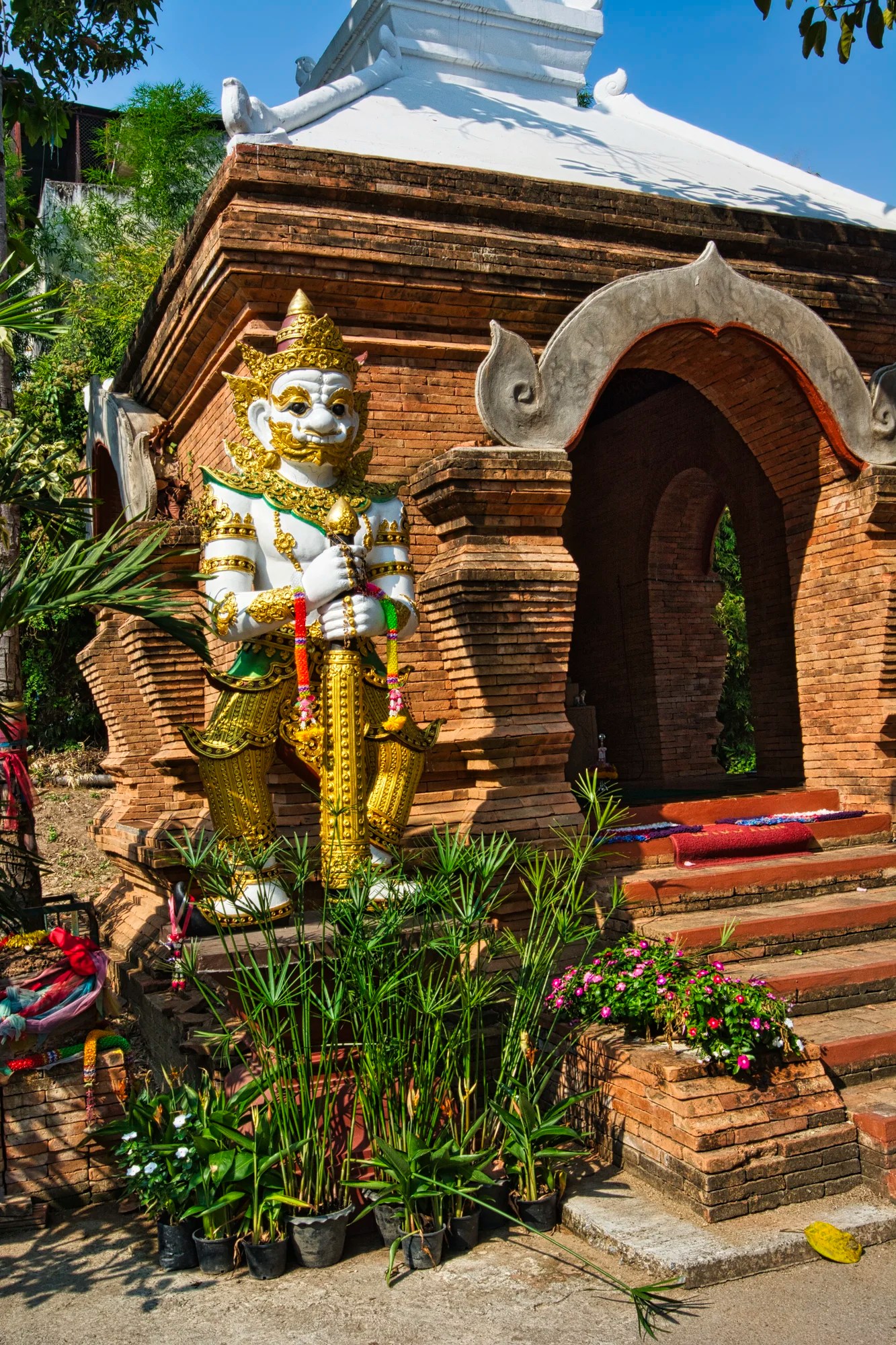
Nearby in a forest-like setting, is an example of the incorporation of animistic beliefs of the Lanna and Thai tribes into the Buddhist religion. Here were a couple of pavilions protected by guardians assumed to be Dvarapala (Sanskrit, “door guard”), portrayed as a white-bodied warrior armed with a club. These are not the fierce looking yakṣa demons with bulging eyes, protruding fangs, and green complexion shown guarding Wat Arun, Bangkok.
Three Kings Monument
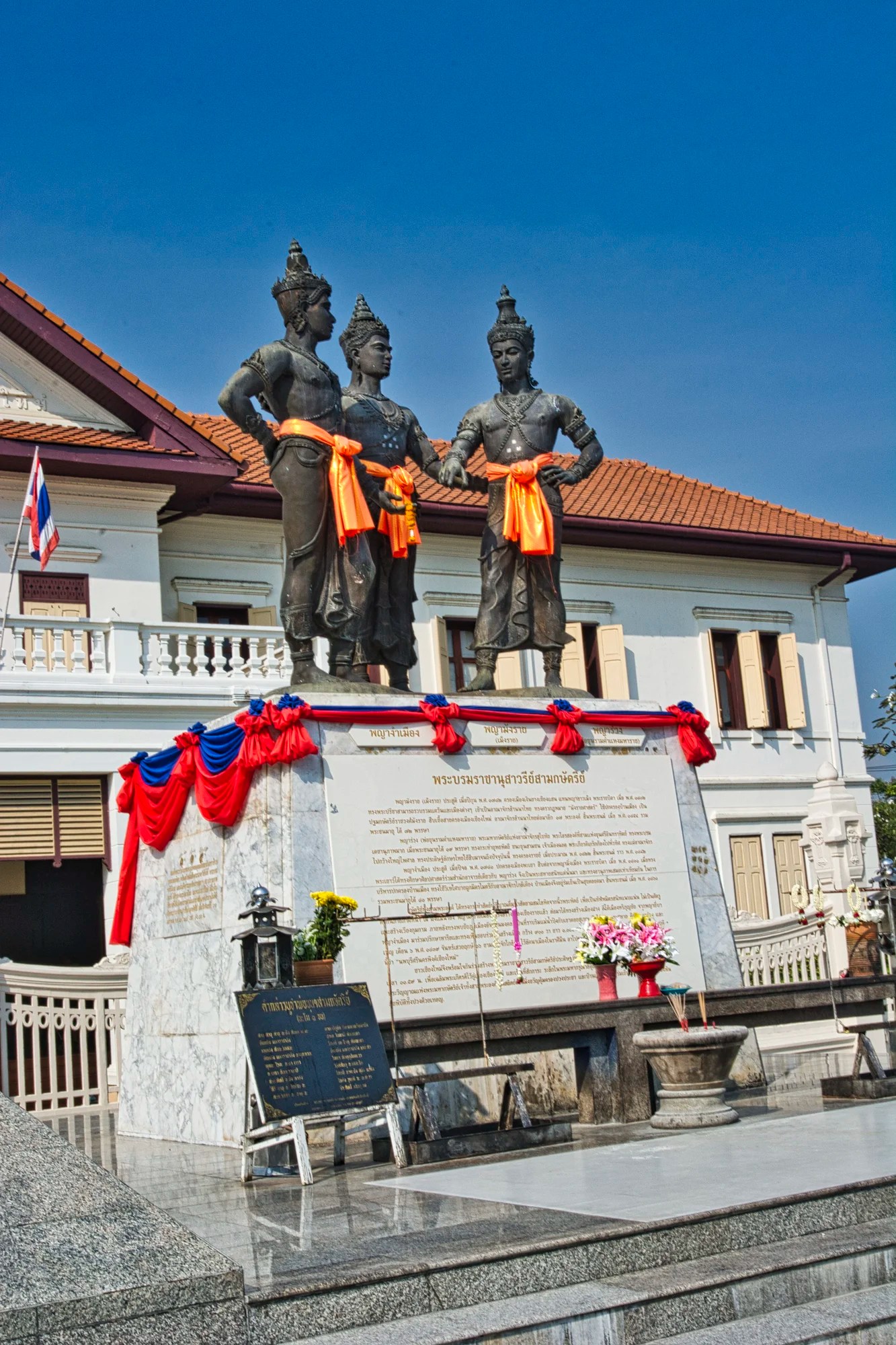
The Three Kings Monument (G4.3) consists of three bronze sculptures in 14th-century costumes. The statues are of King Mengrai, founder of Chiang Mai (1296), King Ramkamhaeng of Sukhothai, and King Ngam Muang of Payao. They are believed to have worked together to build the city. The square in front of the monument is a venue for many festivals.
Wat Lok Moli
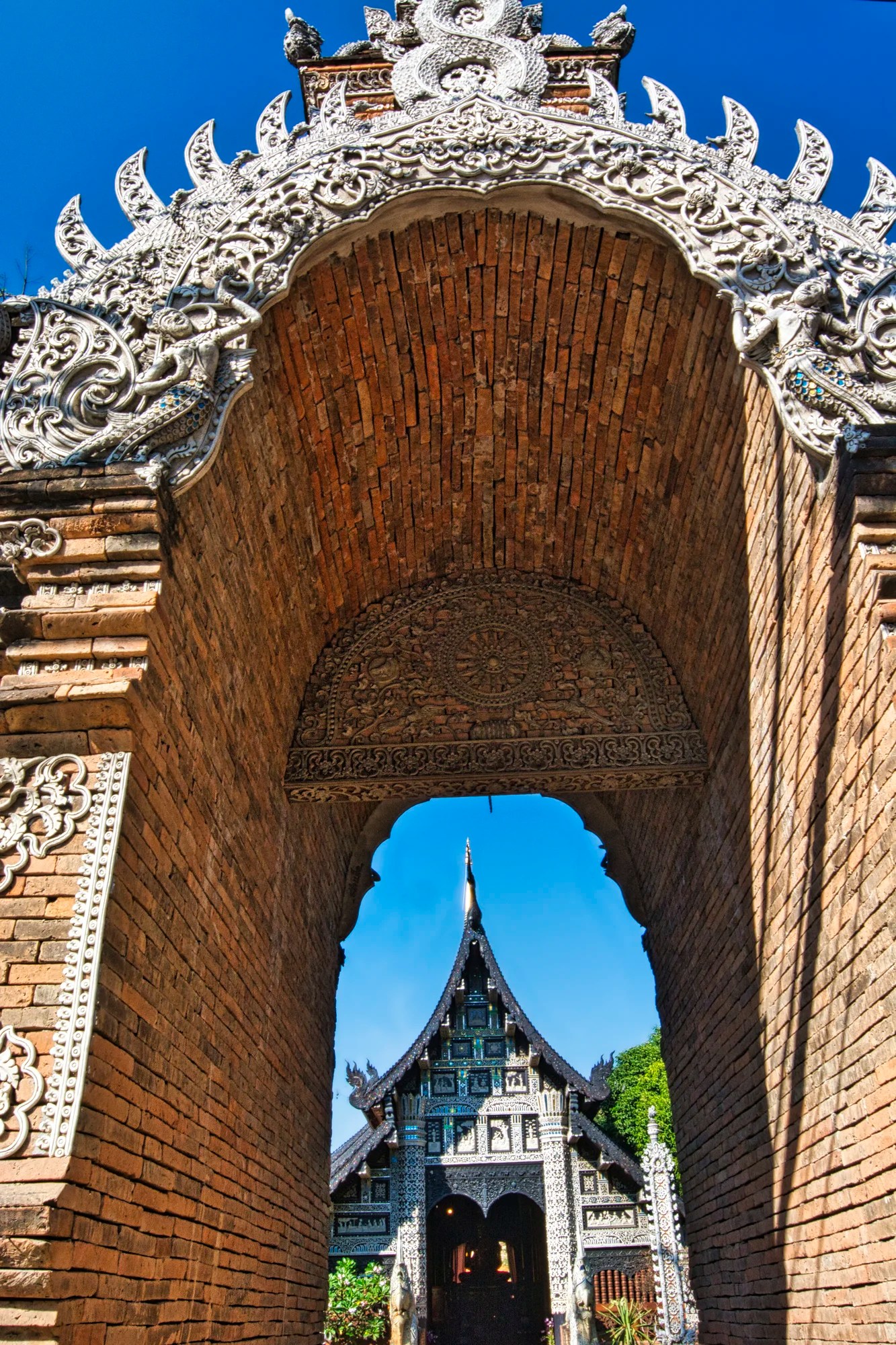
Wat Lok Moli (G4.6) temple complex may not be the most visited wat, but it is definitely worth going. We really enjoyed our quiet experience there. In ancient times, you would have entered through this highly ornamented spire-like gate.
Wat Lok Moli Viharn
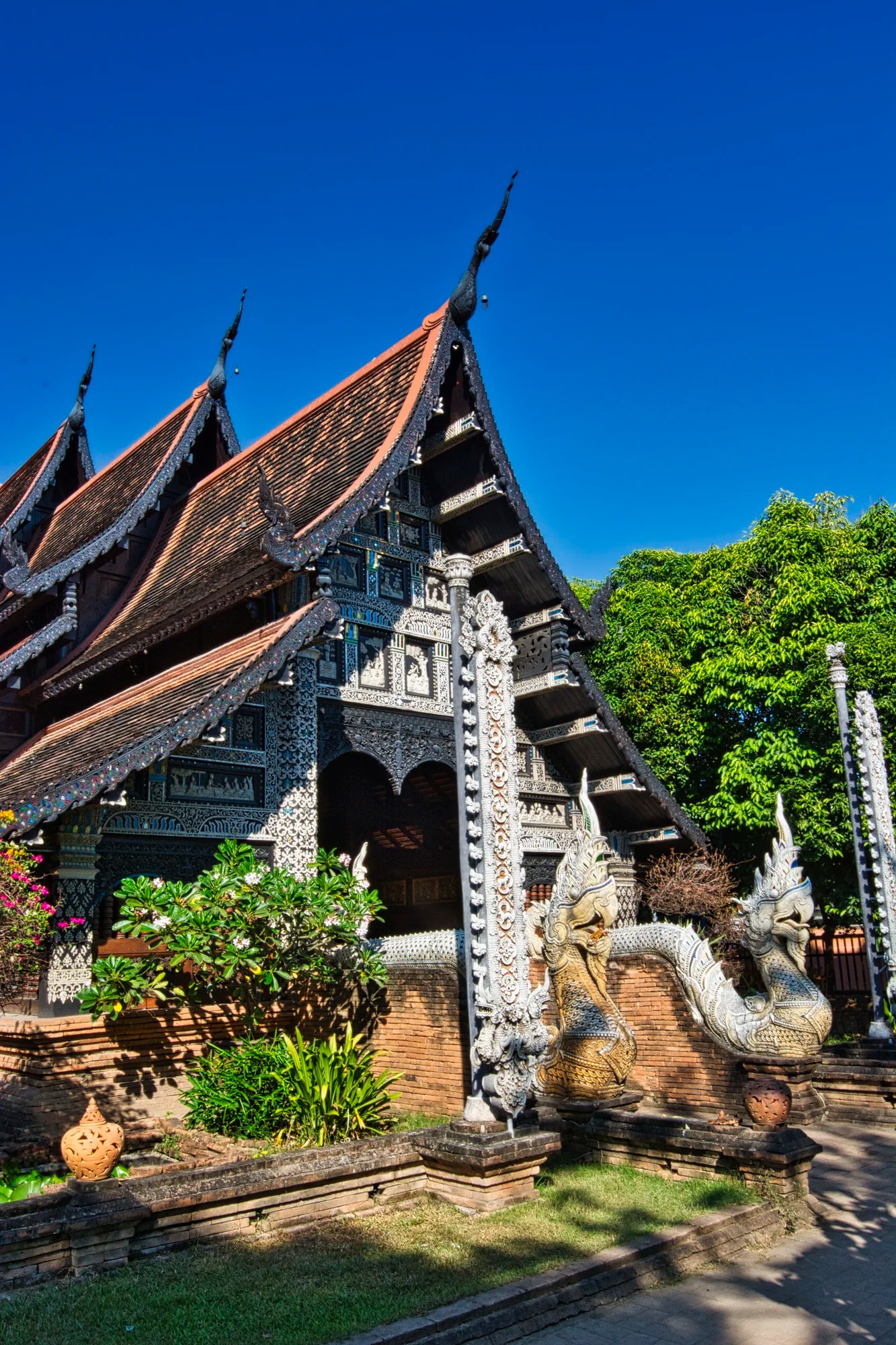
You would then be greeted by two large nagas, guardians of the viharn.
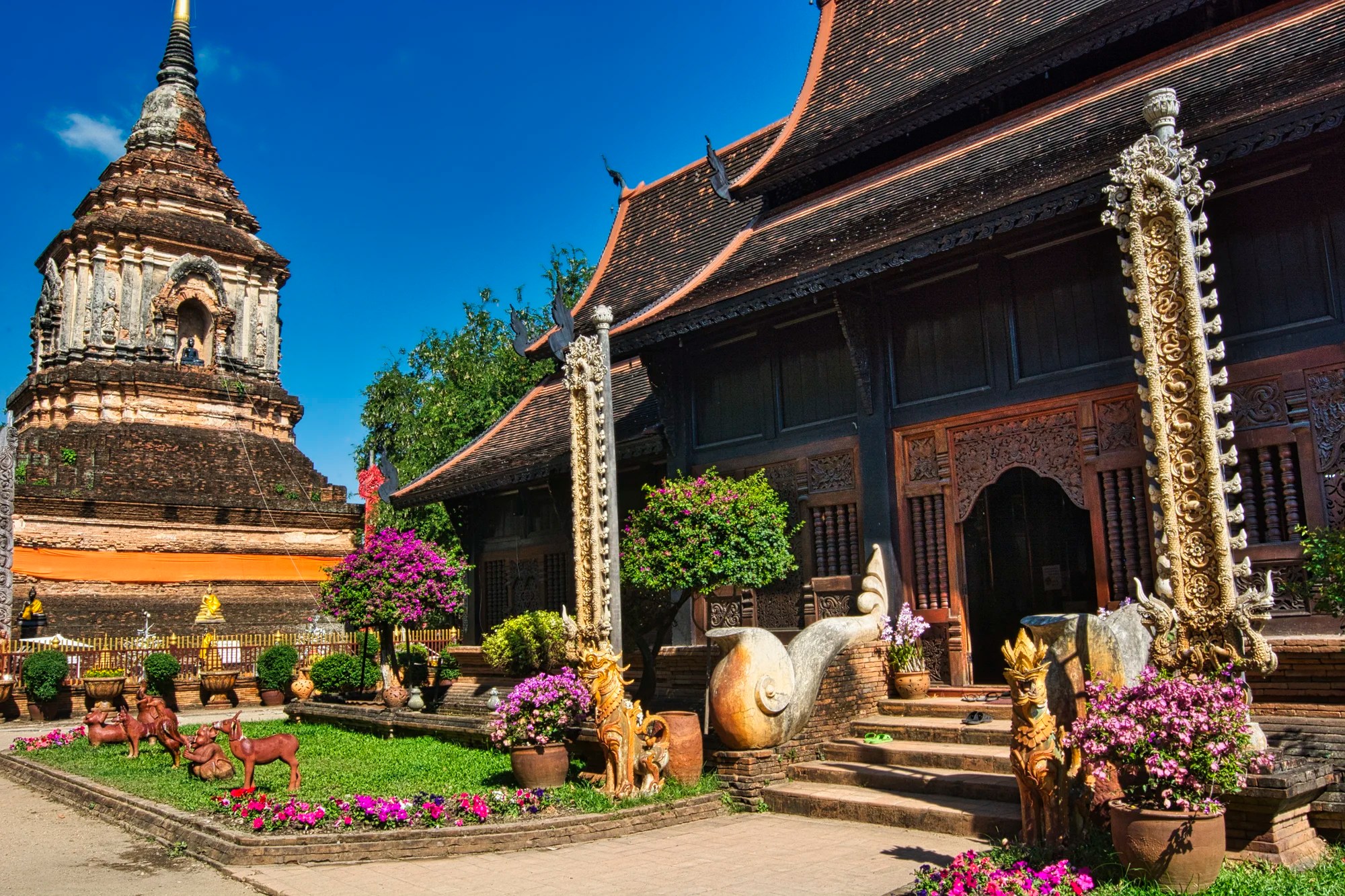
After appreciating the elaborately decorated viharn entrance, walk around the outside. The “lawn” is adorned with flowers and ornamental animals, and an ancient chedi is seen in the background. The grounds were a Royal Palace until 1397, when it converted to house 10 monks brought from Burma to spread Buddhism.
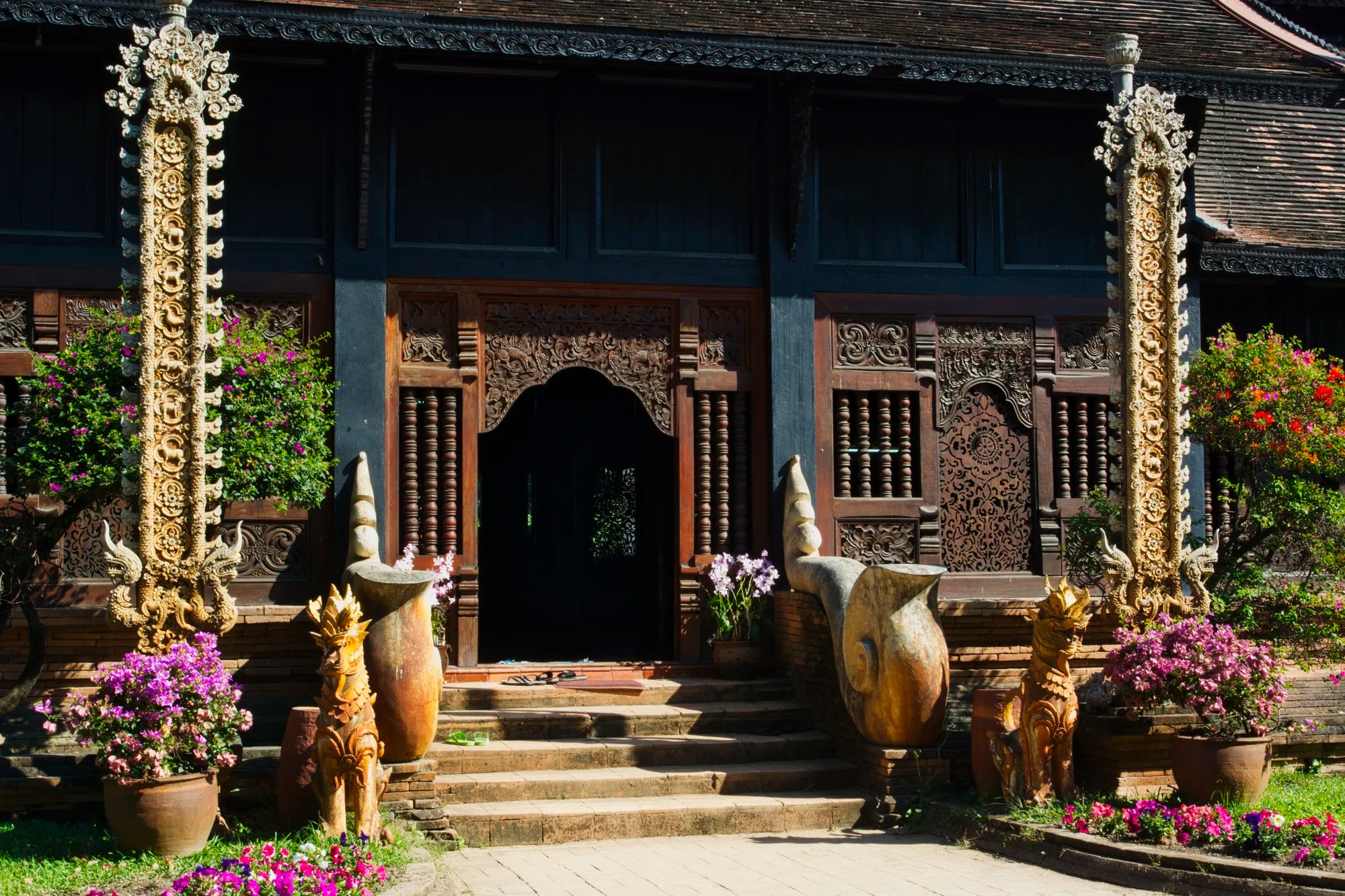
This wooden structure is built in the traditional Lanna architectural style with beautiful carvings around the doors and windows.
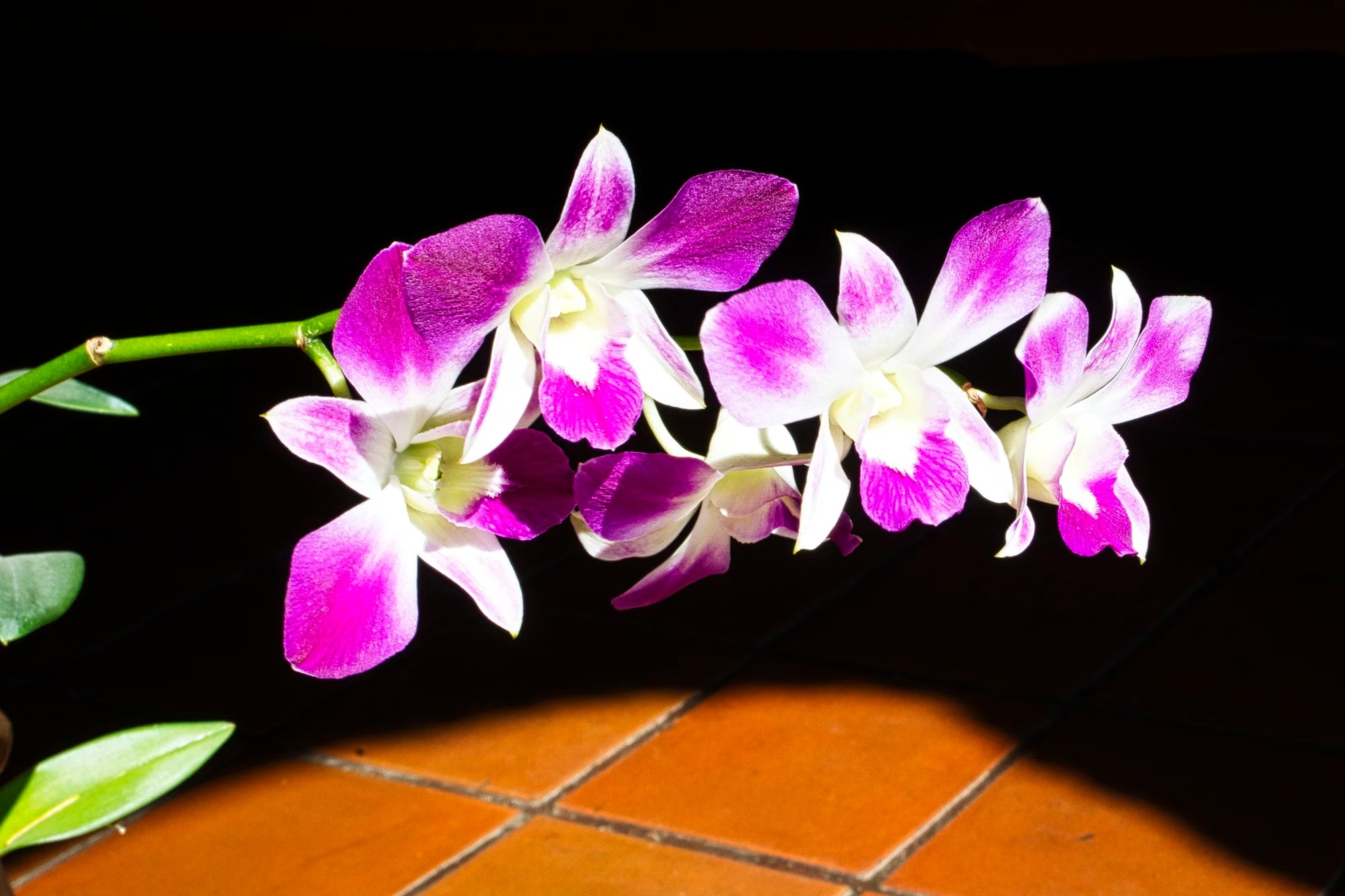
Walk inside and enjoy the delicate Dendrobium orchids, which originated in Sikkim, NE India. Flowers are everywhere in Thailand.
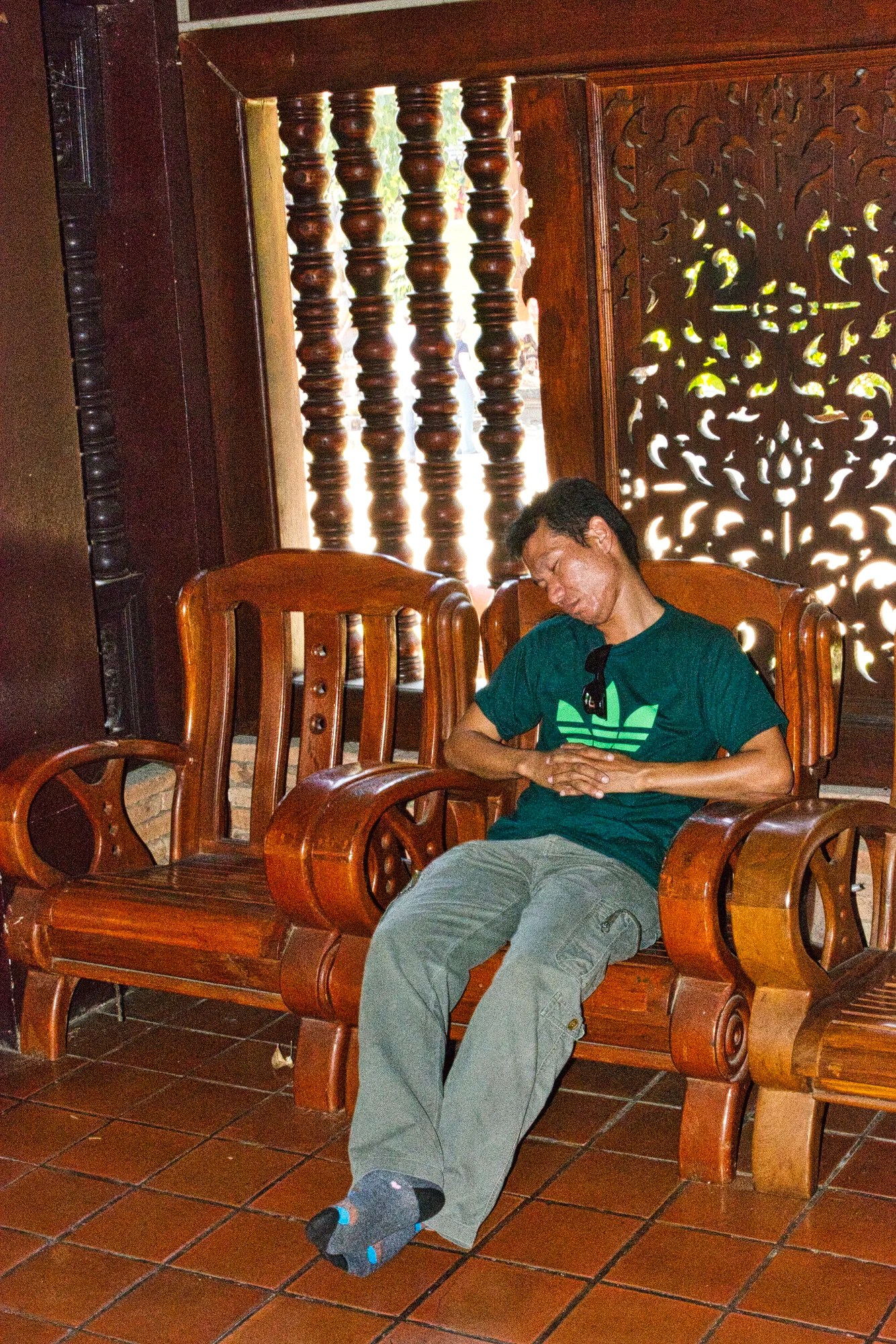
A tired-out local visitor is sleeping in front of the wall carvings. Sit down, but don’t fall asleep. Instead, look up and admire the elaborately carved wood ceilings.
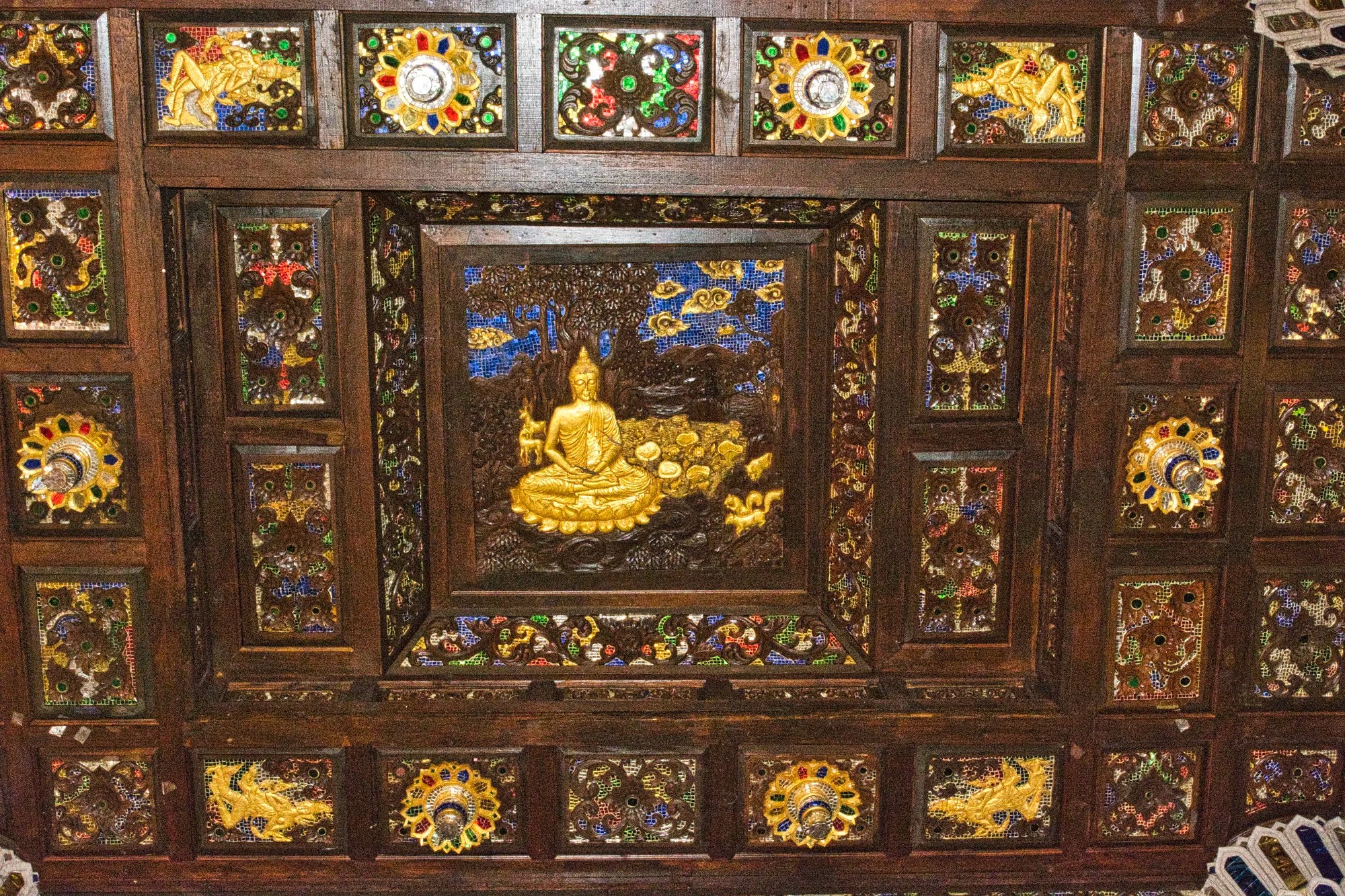
The centrepiece is a bas-relief of the Buddha in the dhyana (meditation) mudra with his hands resting on top of each other. This is Prince Siddhartha meditating under the bodhi tree (a fig) in Bodh Gaya, India, just before he achieved enlightenment.
Wat Lok Moli Chedi
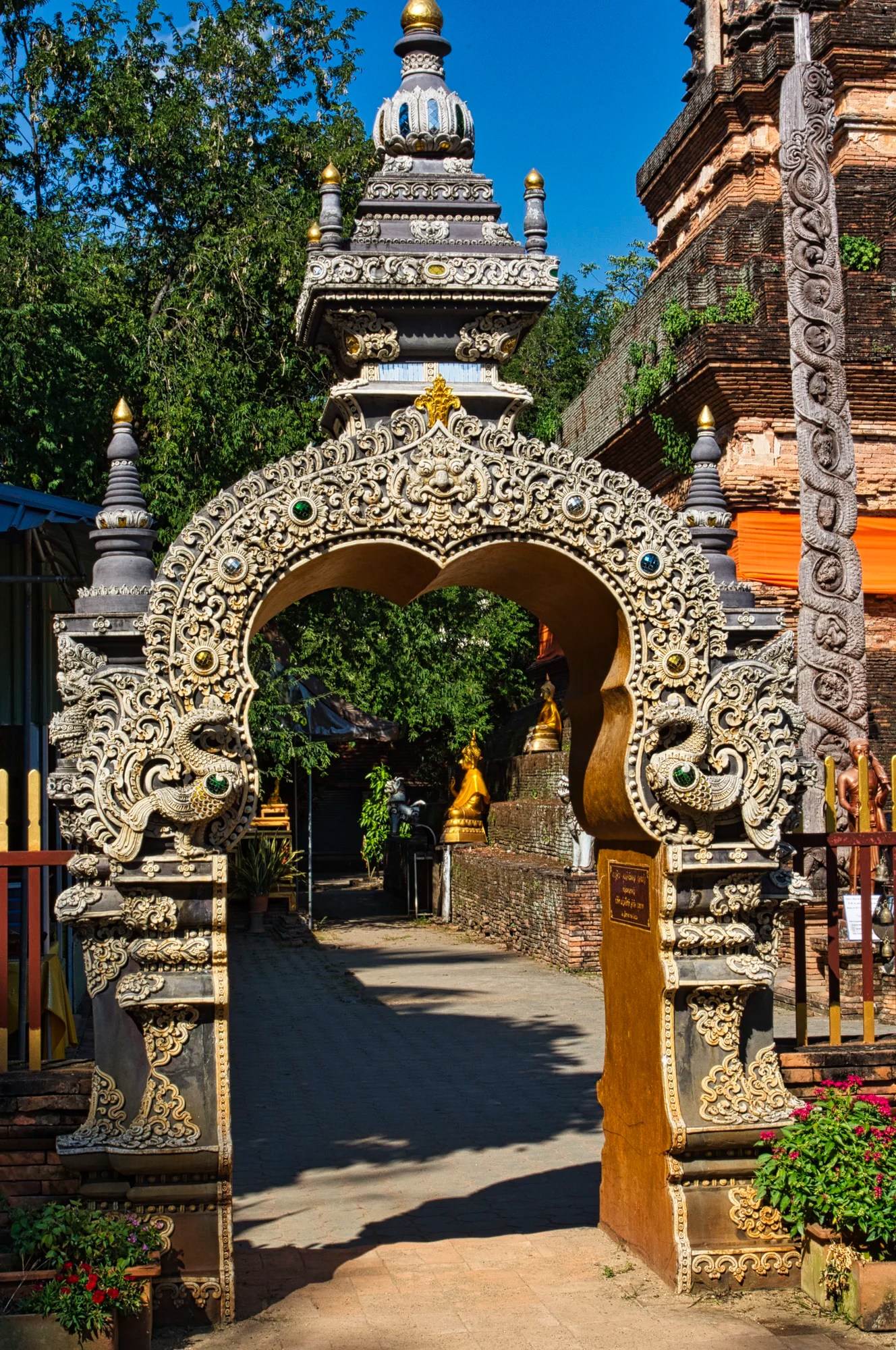
Walk through the beautifully decorated spire arch gate to the massive chedi built in 1527. It was restored several times. Each side of the upper part of the chedi has a niche that contains a Buddha image. The brickwork of the large chedi is left mostly bare in contrast to the more recent stuccoed chedis.
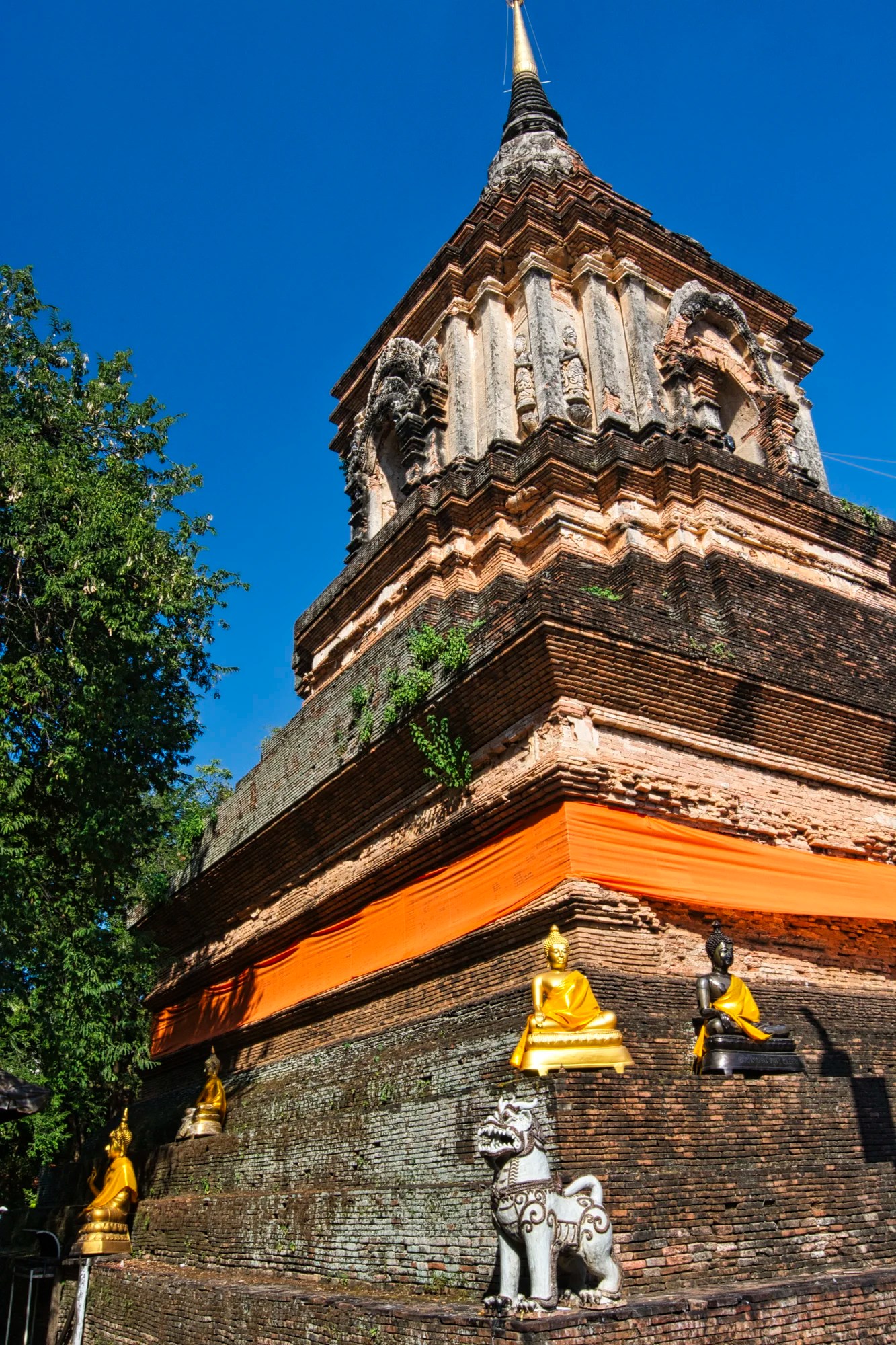
The chedi contains the ashes of several Kings of the Mengrai dynasty, who ruled the Lanna Kingdom from the end of the 13th century until 1556 when the Burmese invaded the Kingdom. The Burmese occupied Chiang Mai for 224 years but left the wat untouched.
Wat Lok Moli Address and Hours
Address: 289/1 Soi Maneenopparat 2
Open: 06:00 to 17:00 daily
Hua Lin Corner Wall
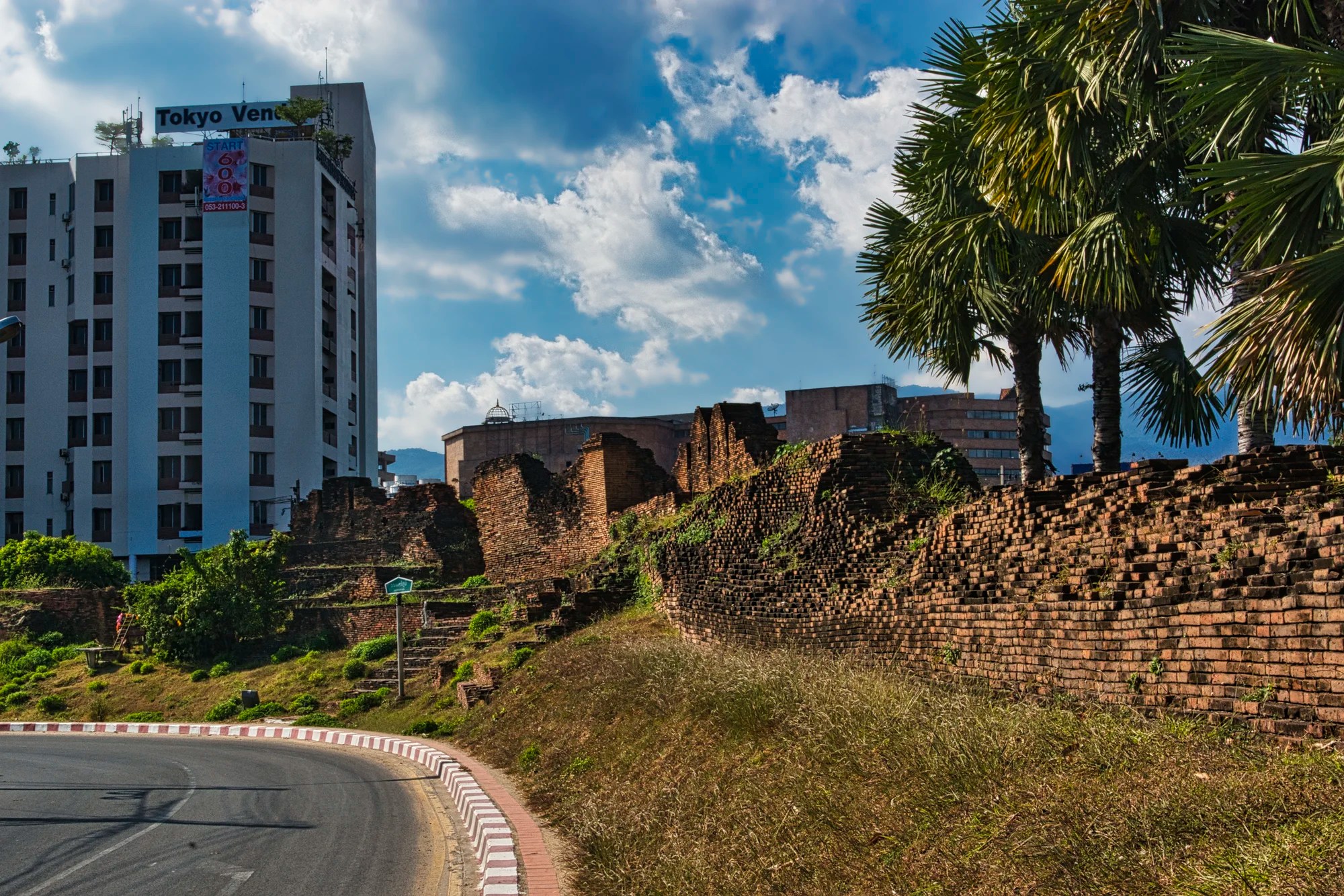
The ancient city of Chiang Mai was built inside a square moat – the moat still exists but the wall has disintegrated. The section of wall leading to Hua Lin Corner (G4.2) looks old and atmospheric – however, it is a 1970s reconstruction.
Wat Khuan Khama
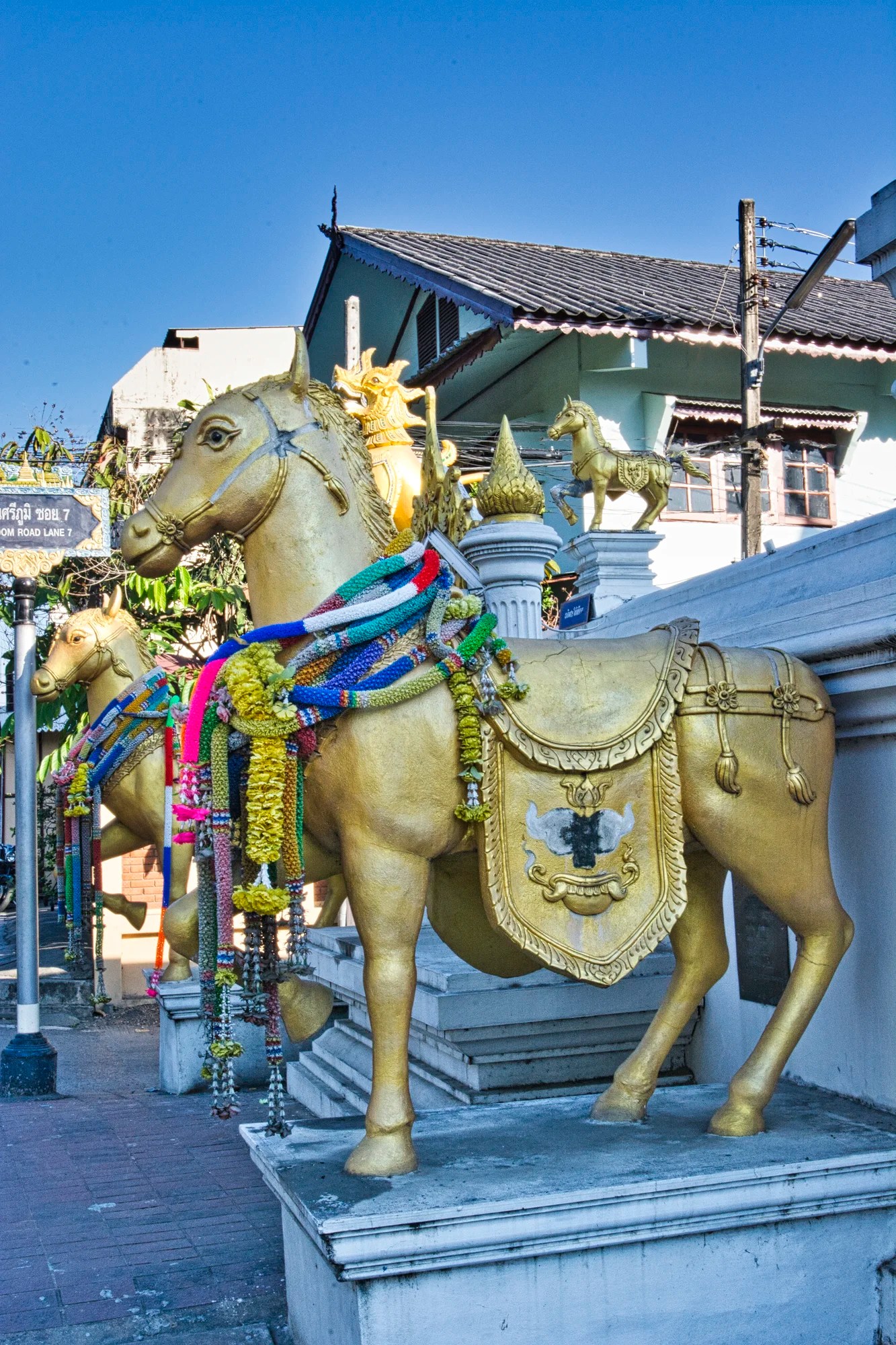
You cannot miss this complex as golden horse statues surround the exterior walls of Wat Khuan Khama (G4.1 golden horse temple). Why are there so many horse statues? A horse groom and soldier lost his beloved horse. In 1492, General Jaomun Damtuang decided to build a new temple to honour horses.
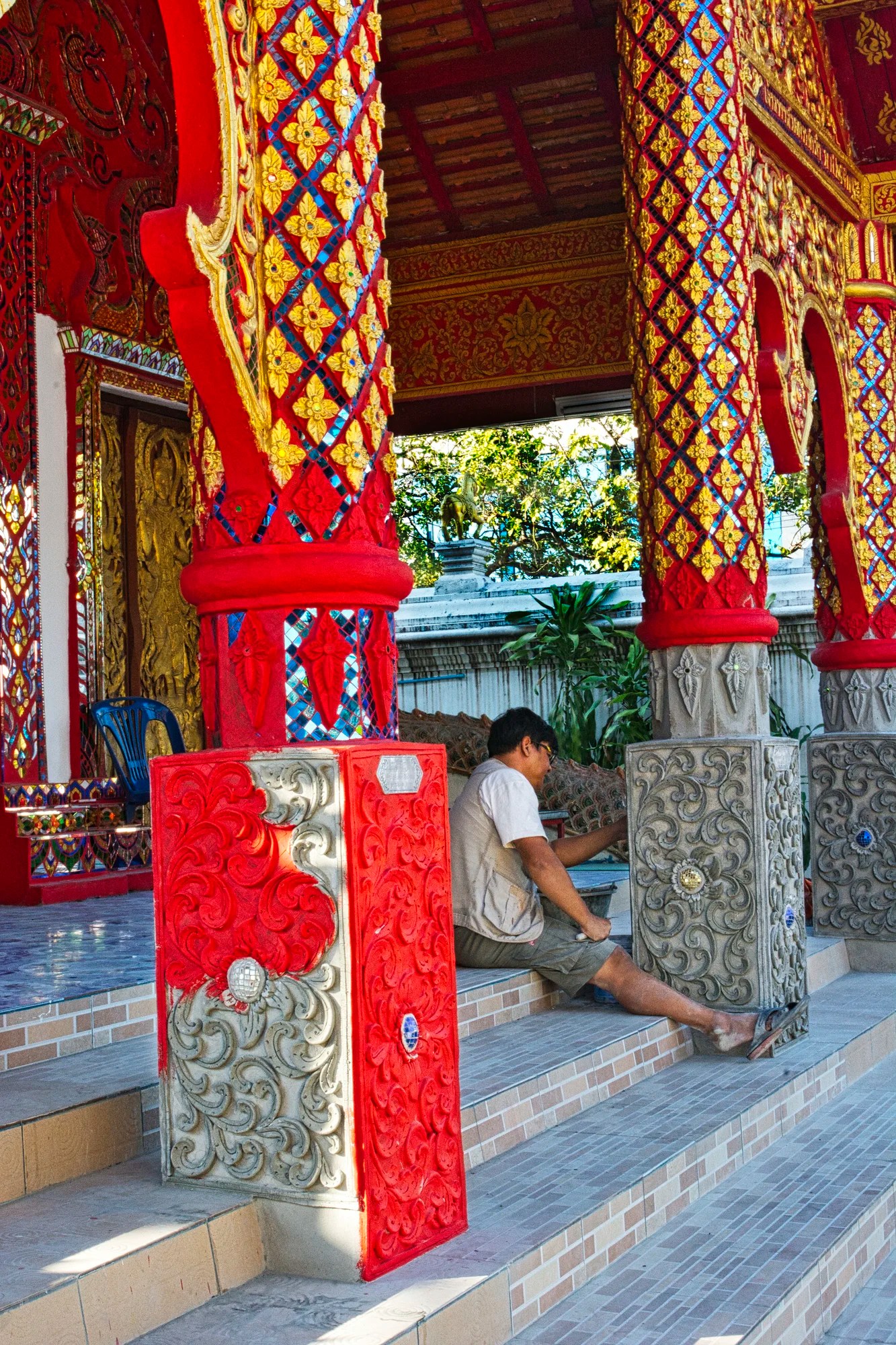
A Thai is making merit by painting the temple columns.
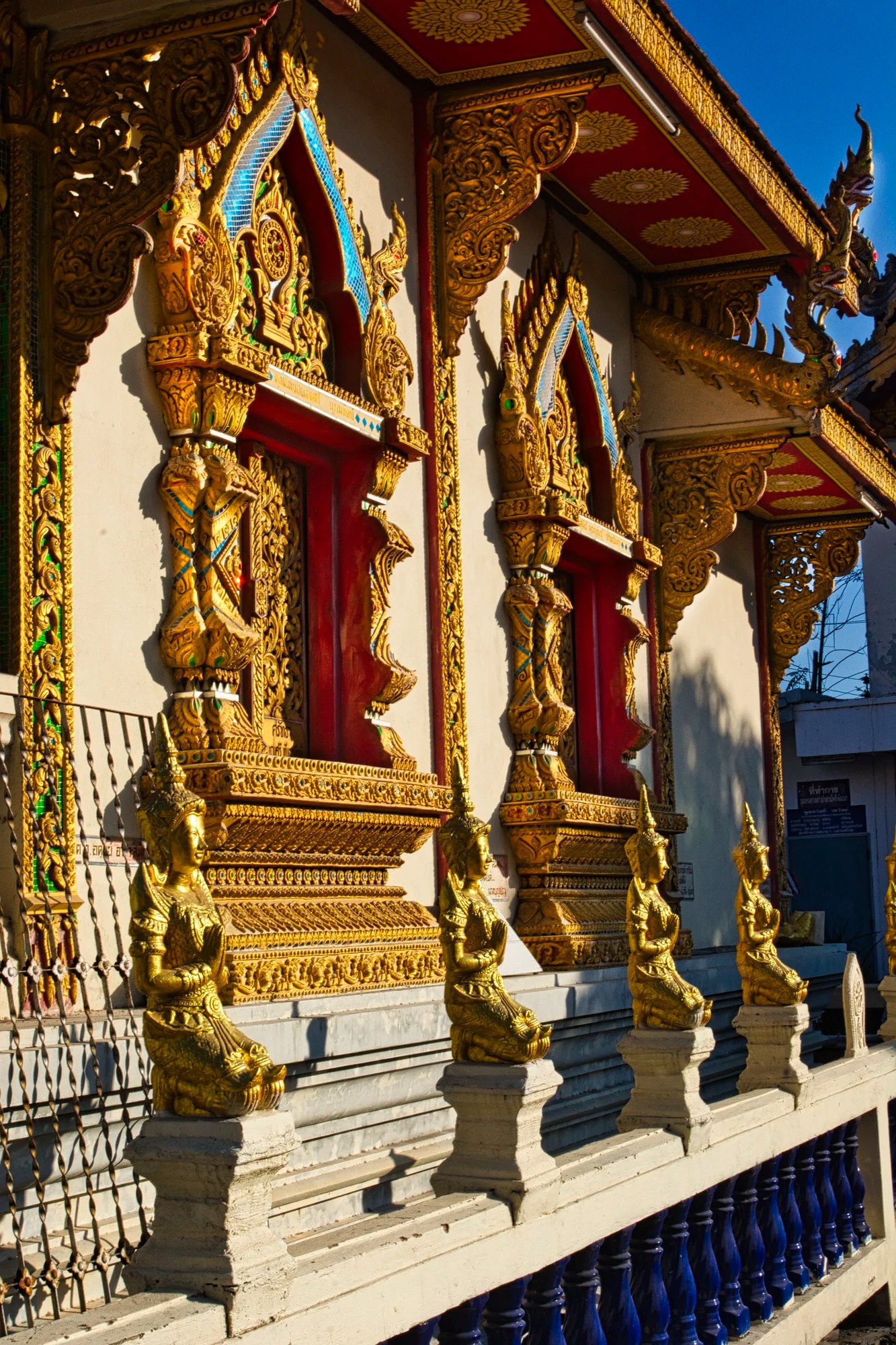
While this may not be an important wat to visit, one should always look for interesting details to admire and/or photograph. What grabbed my attention in this wat were the ornate gold-trimmed windows contrasting with the red paint. On the boundary wall there are numerous gold stucco Devata (deities for every type of human activity) figures in kneeling position.

The viharn entrance is as ornate as it gets. Notice the frequent use of green glass mosaics to reflect the ugly images of the demons so that they will be repelled from entering the temple. Green and gold is a common colour theme in Thai wats.
Wat Khuan Khama Address and Hours
Address: Thanon Sri Poom
Open: 06:00 to 18:00 daily
Wat RatchaMonthian

Wat RatchaMonthian (G4.6) or Dragon Temple is one of the more colourful temples in Chiang Mai. Large maroon spires stick out of the walls surrounding the temple. Even the stairs and platform are red.

Red and gold dragons guard the steep stairs as well as the temple entrance. On the raised platform is a massive Buddha statue in white starkly contrasting to the predominant red theme.
Wat RatchaMonthian Buddha Statues

It’s worth a closer look at this statue. In Buddhism, images are done in a proscribed, purposeful way that spans across the globe. All attributes are more symbolic than realistic. No one knows what the Buddha really looked like. The Buddha is always shown with a symbolic gesture or pose called a mudra. The purpose of the mudra is to teach a story about the Buddha.

The mudra used both outside and inside the viharn is also the most common. In the earth witness mudra, the Buddha is seated, and his right hand reaches over his knee towards the earth. This mudra symbolizes the story of the Buddha’s moment of enlightenment when he was attacked by Mara, the demon of desire, and his army. He asked the Earth Goddess to bear witness to his worthiness to reach enlightenment. She wrung water from her hair, and the flood washed away Mara and his army.
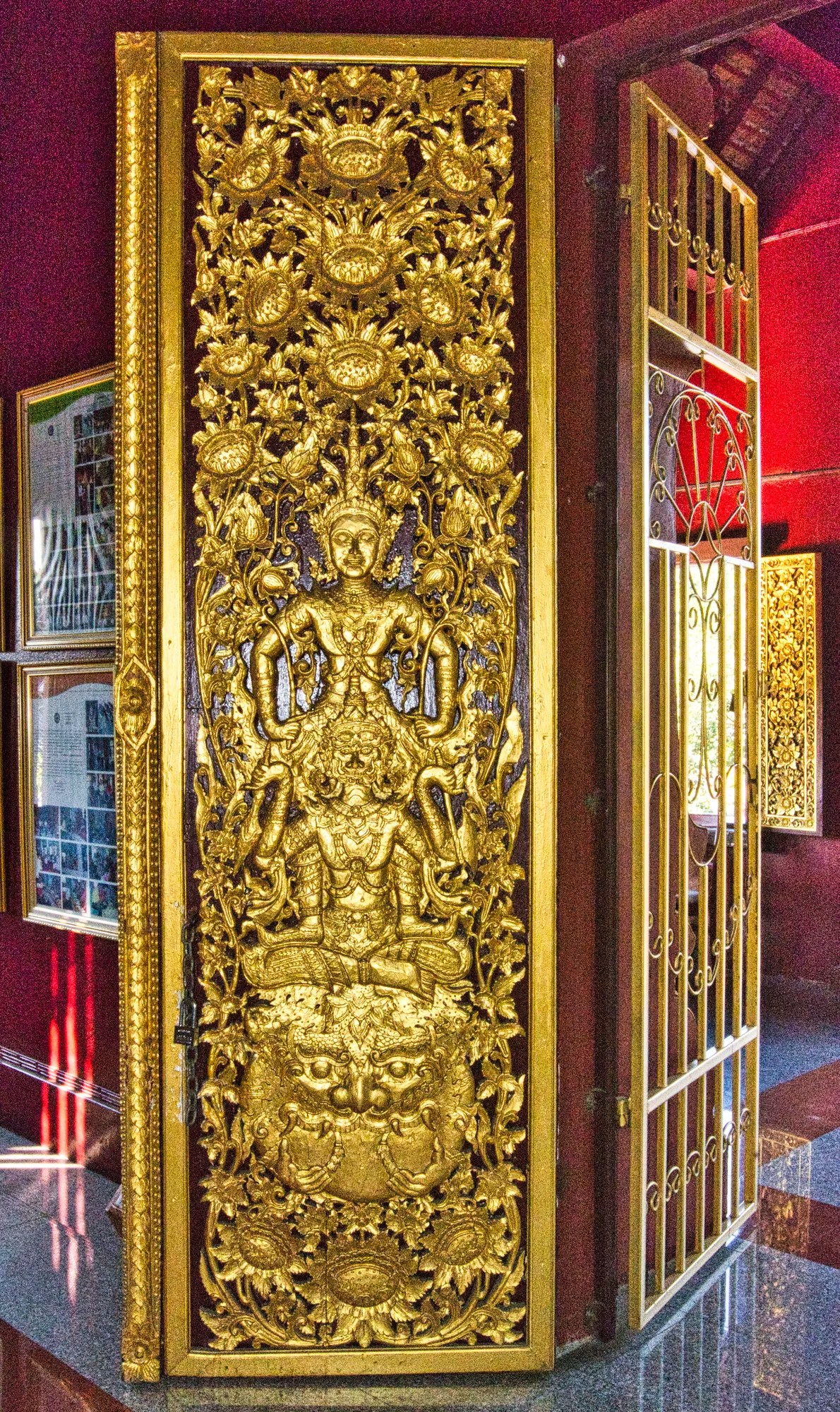
The red and gold theme continues inside the viharn hall.
Wat RatchaMonthian Address and Hours
Address: 149 Sri Phum
Open:
Wat Chiang Man
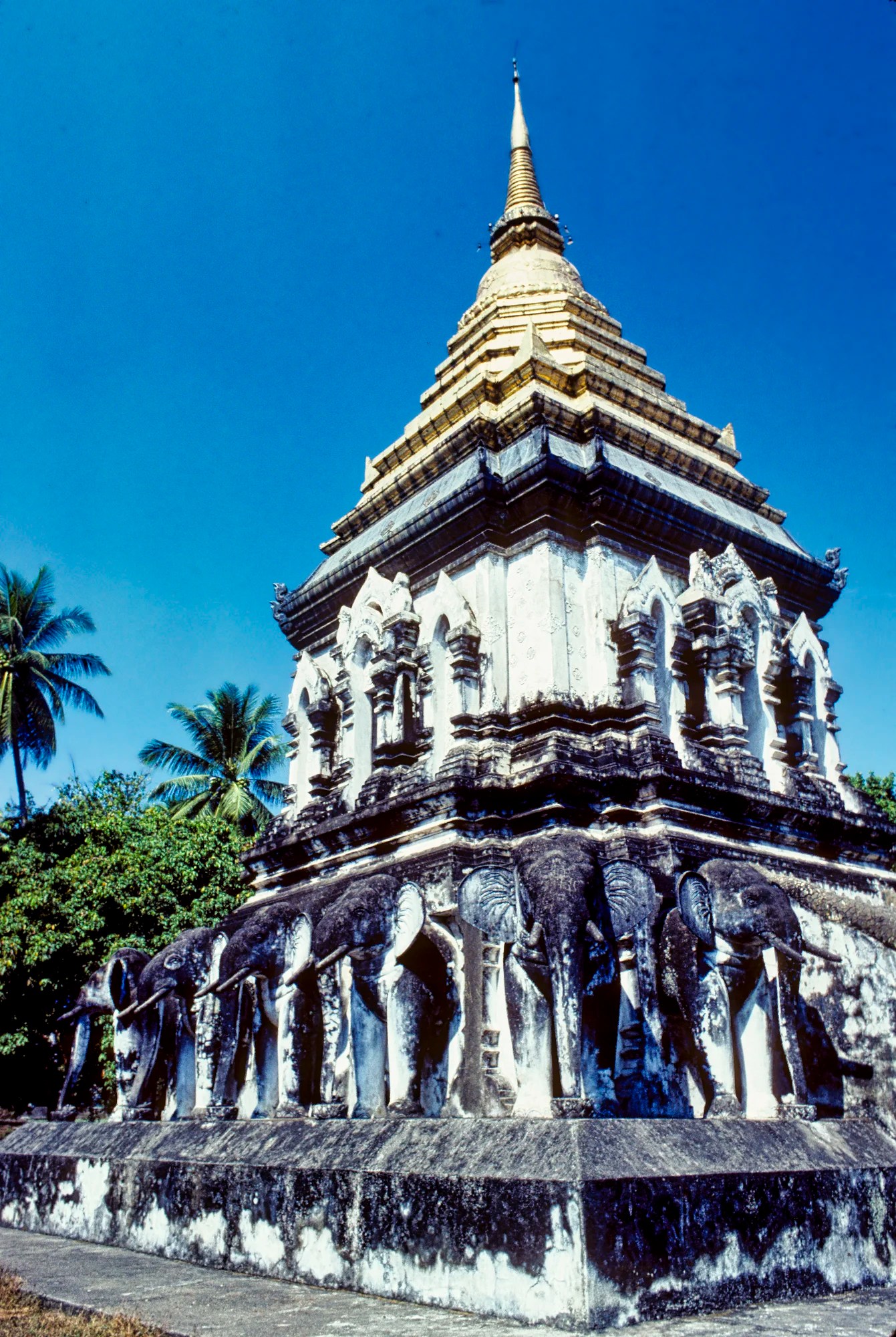
Wat Chiang Man (G4.6) is the oldest temple in Chiang Mai (1297). The intact Chedi Chang Lom, supported by a row of 15 life-sized brick-and-stucco elephants, is the most outstanding artifact. Elephants were used for agriculture, forestry, and warfare, and so they are integral to Thai culture and history.
Wat Chiang Man Address and Hours
Address: 171 Ratchapakhinai Rd
Open: 06:00 to 17:00 daily
Wat Phan On
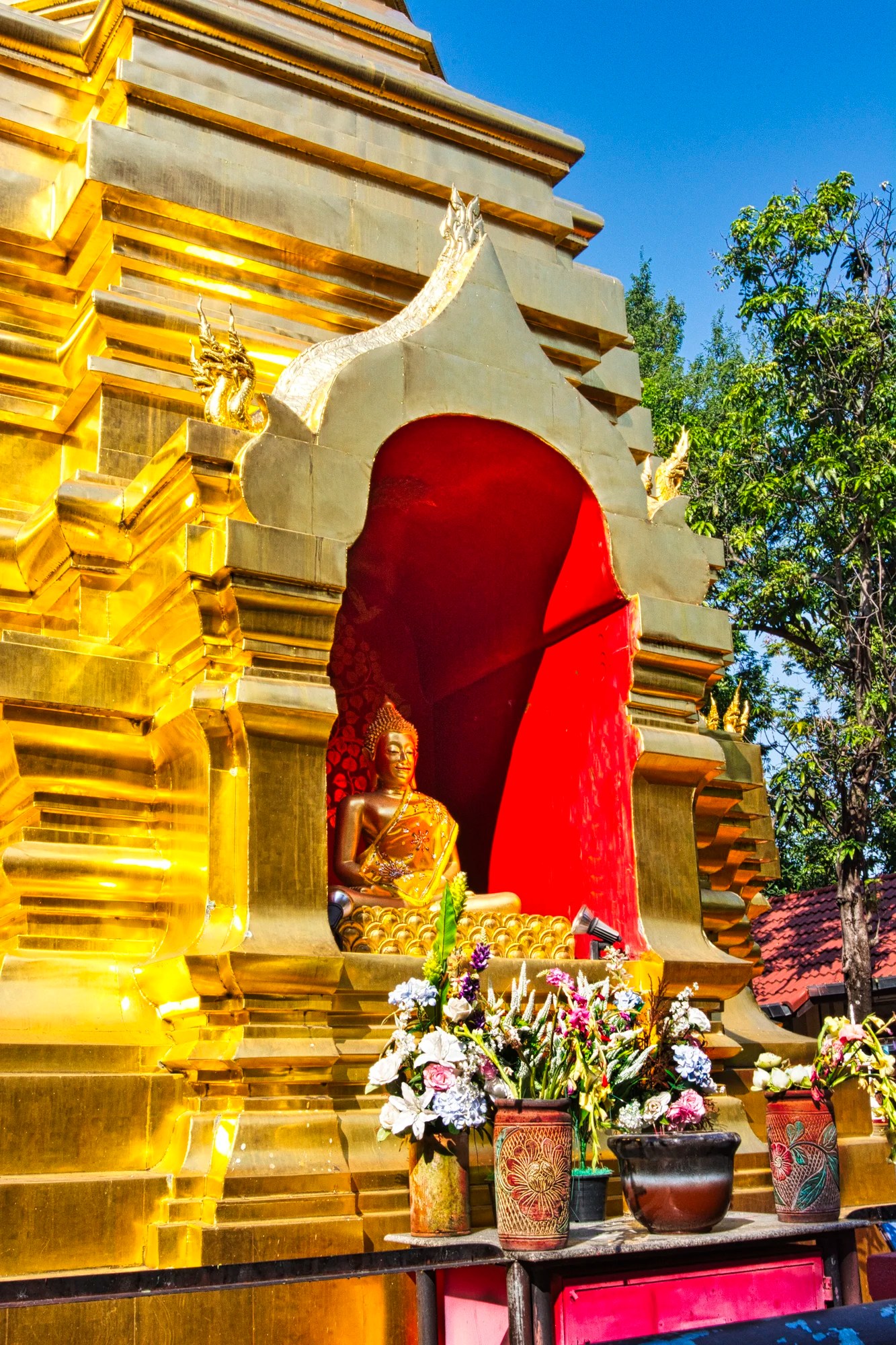
Wat Phan On (G4.4) was built in 1501, with a golden chedi built in 2007 and looking very modern. The viharn makes this temple well worth stopping by.
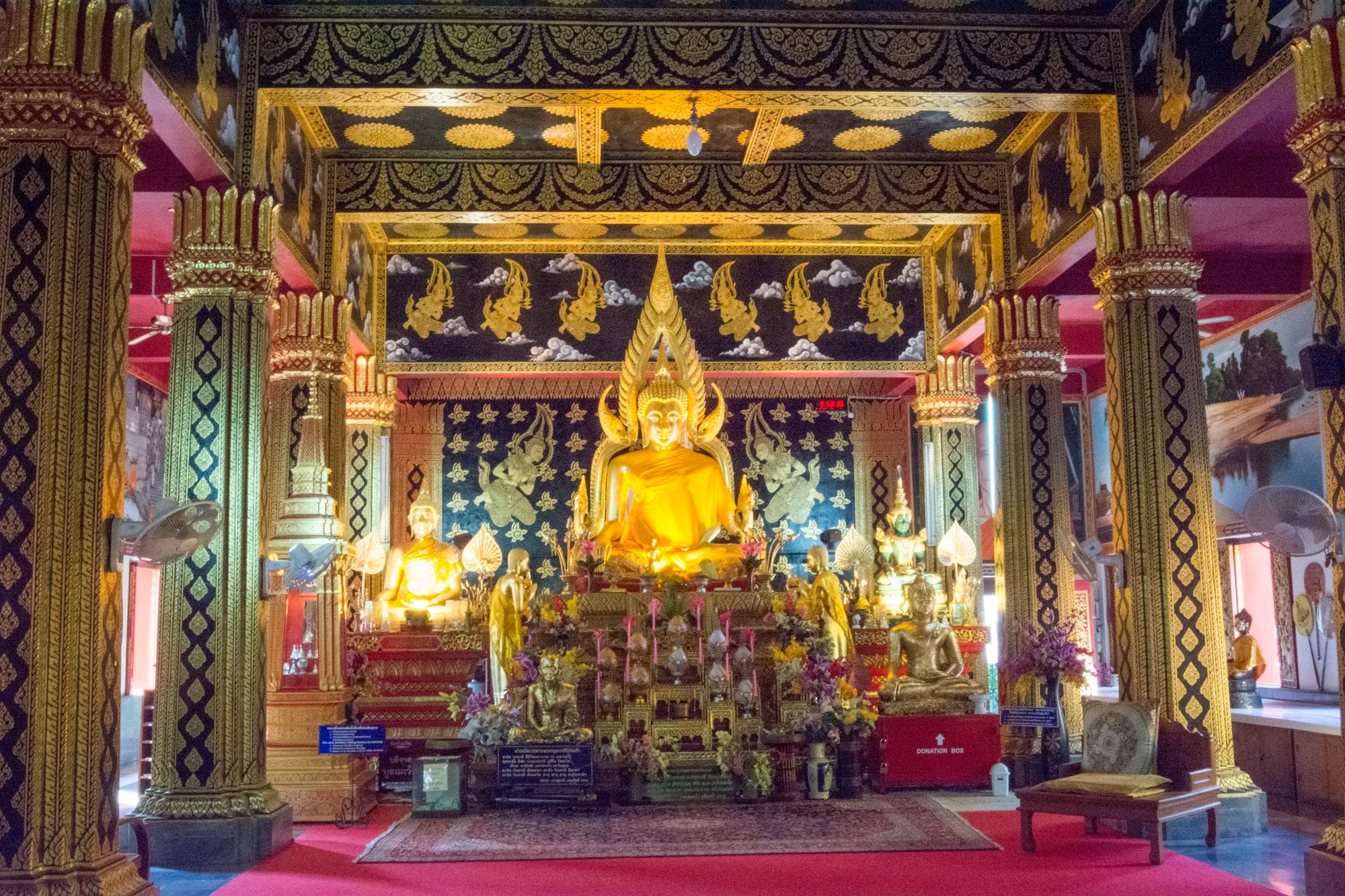
The interior is rich in gold decoration, accentuated by black lacquer.
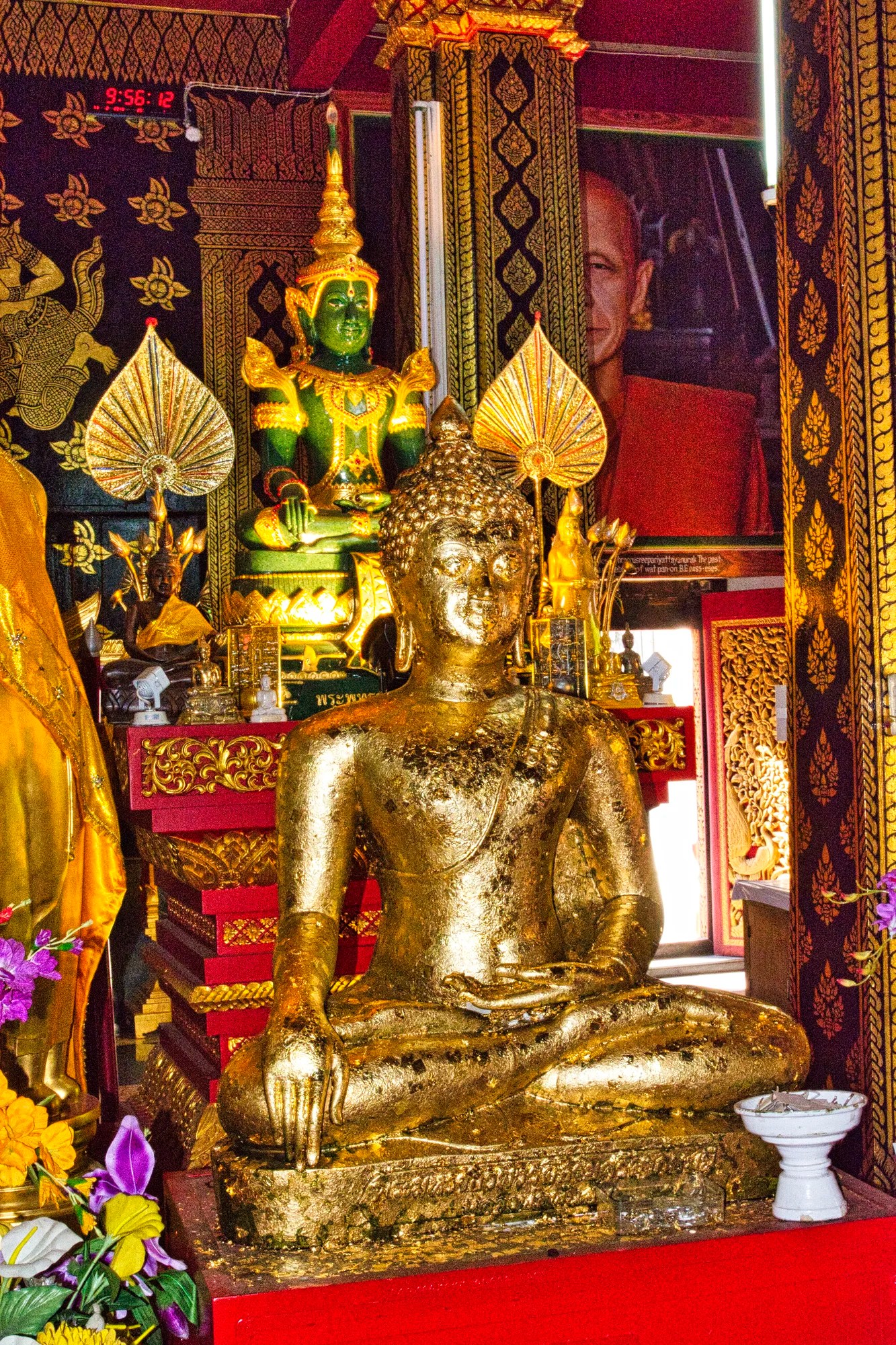
The alter has a Buddha image in the earth witness mudra that is adorned with gold leaf applied by the Thais to make merit. Why are his ears so elongated? This symbolizes that he was a prince and wore heavy earrings that would have stretched his earlobes.
In the background, between two bejewelled fans, there was a statue resembling the famous Emerald Buddha (actually done in jasper stone) in Bangkok. This striking statue was made of green granite.
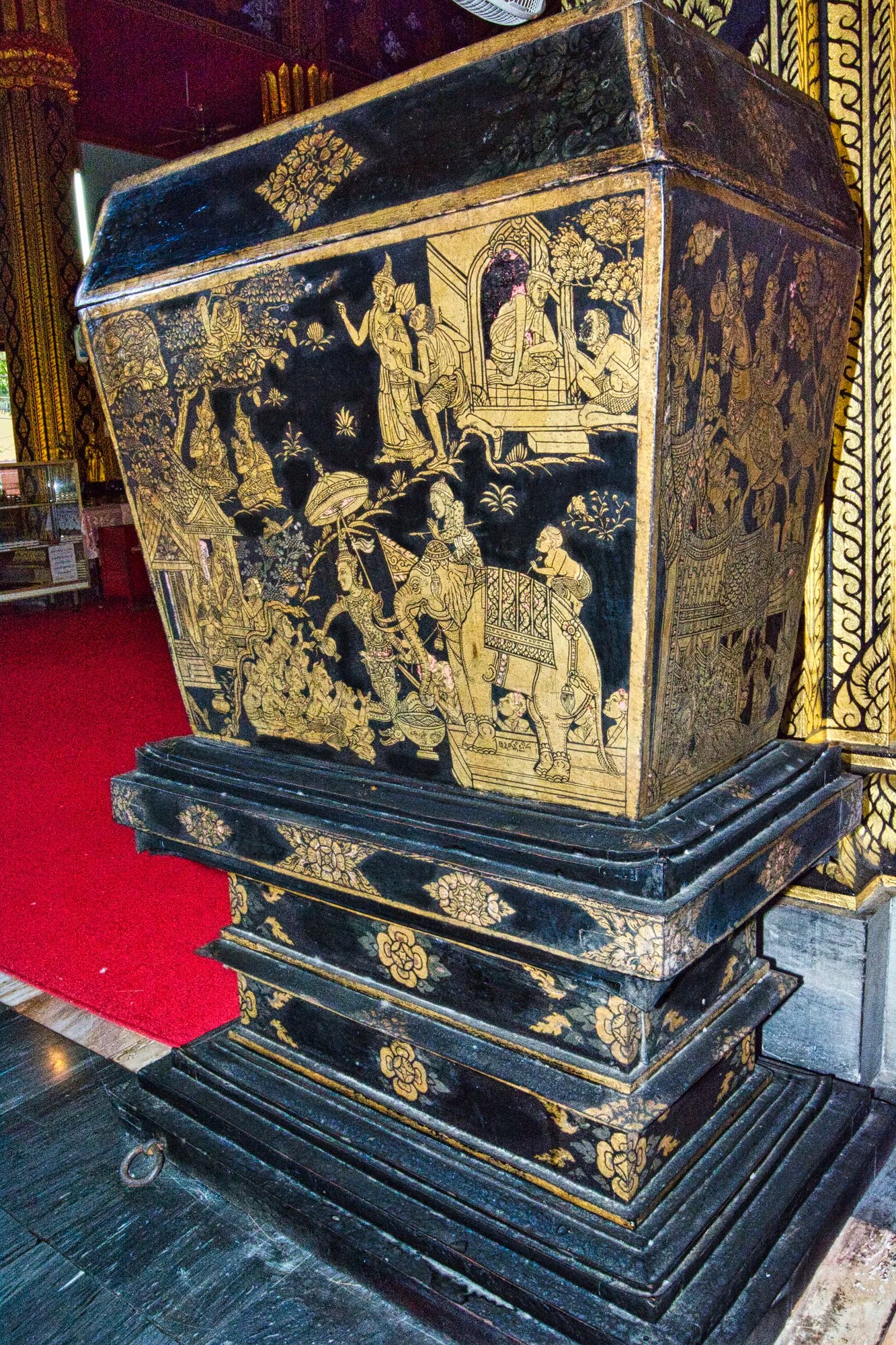
But what we liked the most was this antique gold on black lacquerware chest. It is assumed that this was used to store ancient texts. As shown in the photo’s background, the columns are covered in gold on black lacquer.
Wat Phan On Address and Hours
Address: 75 Ratchadamnoen Road
Open: 06:00 to 18:00 daily
Wat Buppharam
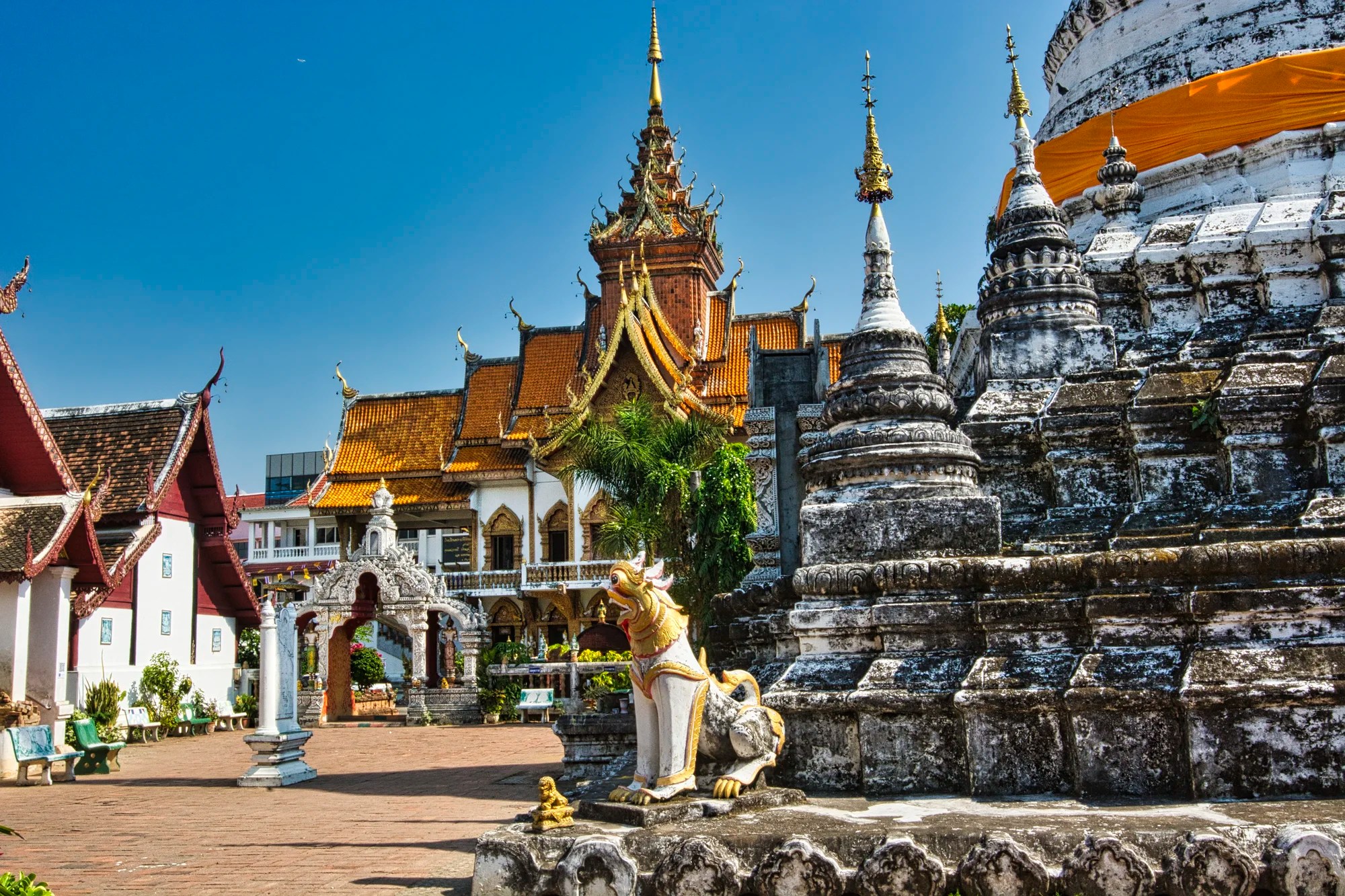
We came to this wat thinking Wat Buppharam (G4.5) was a complex dating to 1497. This was the temple where King Kawila began a ritual circuit of Chiang Mai to mark the end of two centuries of Burmese rule. The art and architecture were incredible but then we found out that the oldest hall was built in 1819. You will be forgiven for thinking this is beautiful, even if it is not old. Some people may find Thai temples to be ostentatious, like over-the-top, Baroque architecture.
Wat Buppharam Chedi
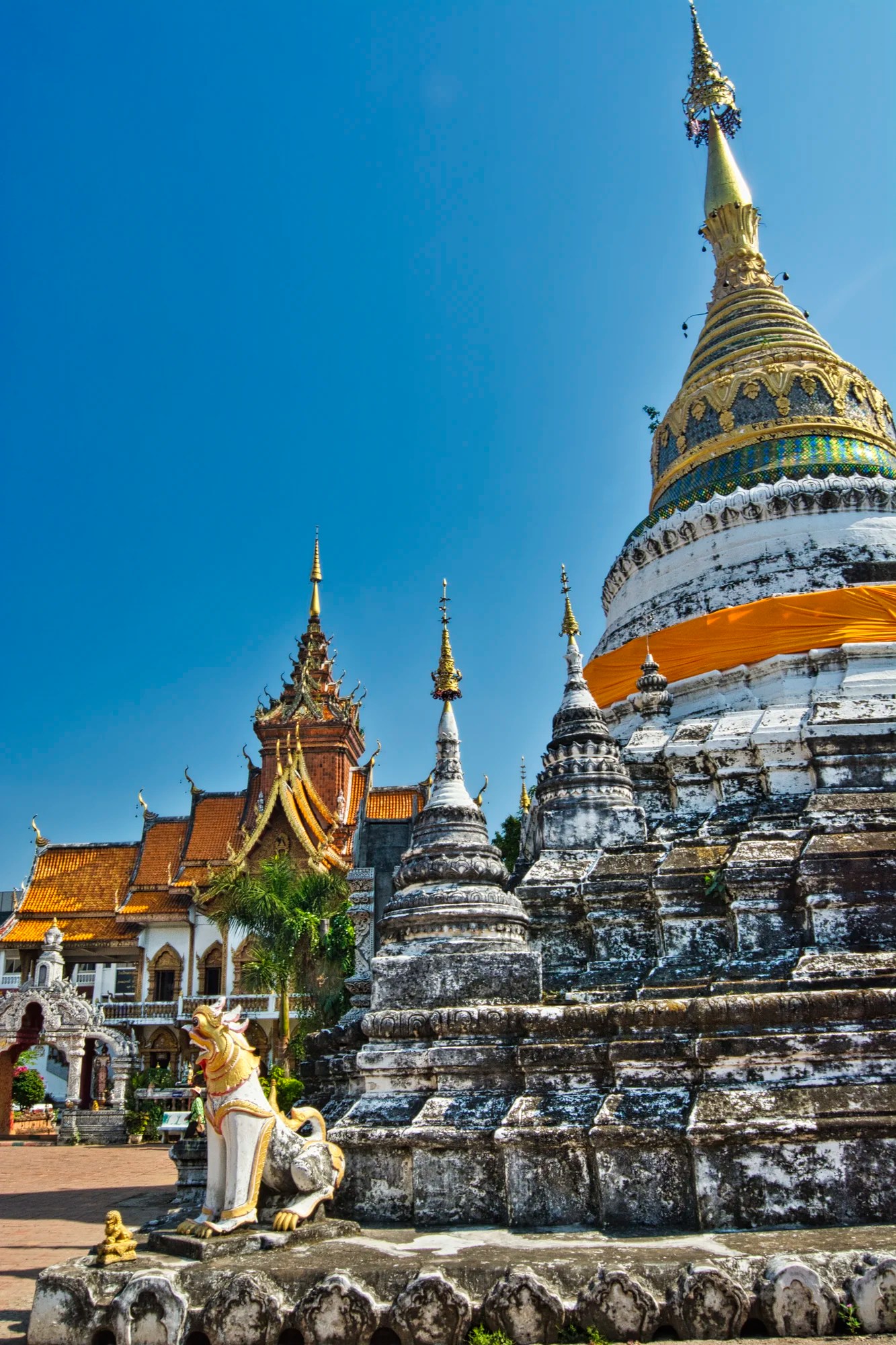
The ornate chedi was rebuilt in 1958! It is beautifully decorated with green pottery and glass mosaics and gold trim and topped with a hti, a Burmese umbrella finial.
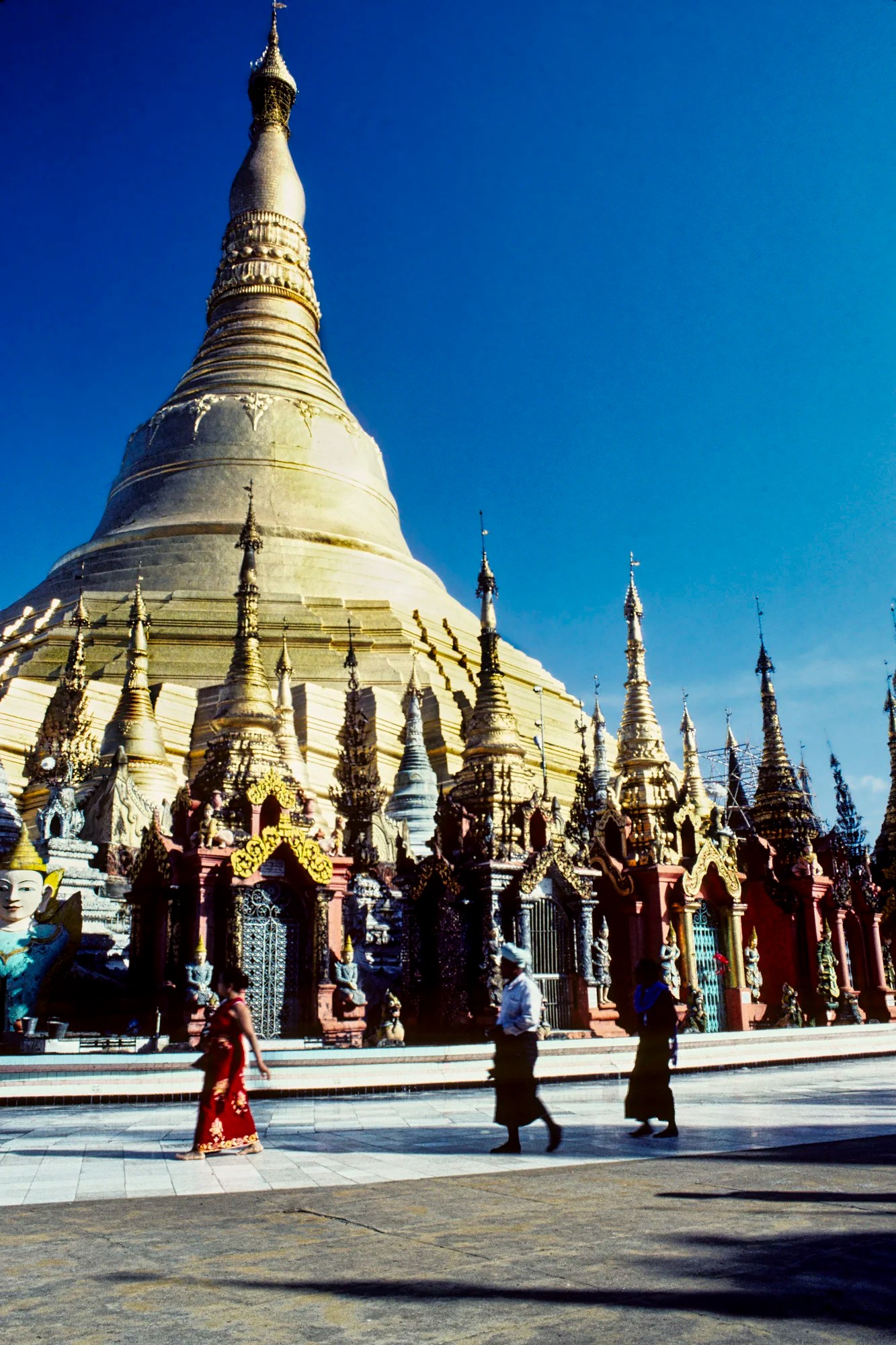
It is also called Burmese-style because it has a bell shape similar to the world-famous Shwedagon in Rangoon (Yangon). On our first trip, it puzzled us that they called Shwedagon a pagoda, not a stupa. Dagon means pagoda.
The stupa (Sanskrit) or chedi (Thai) is used to bury holy people or store relics. The rounded shape represents the ancient burial mound. Unlike its present-day connotation, pagoda meant tomb in Sanskrit. In other words, a pagoda serves the same purpose as a stupa. So, how did a rounded mound become a multi-tiered tower? The stupa originated ca. the 3rd century BC. The origin of the pagoda could possibly be based on the 120 m (400 ft) high tower-like stupa built of wood by the Kushan king Kanishka during the 2nd century CE.
Ho Monthian Tham
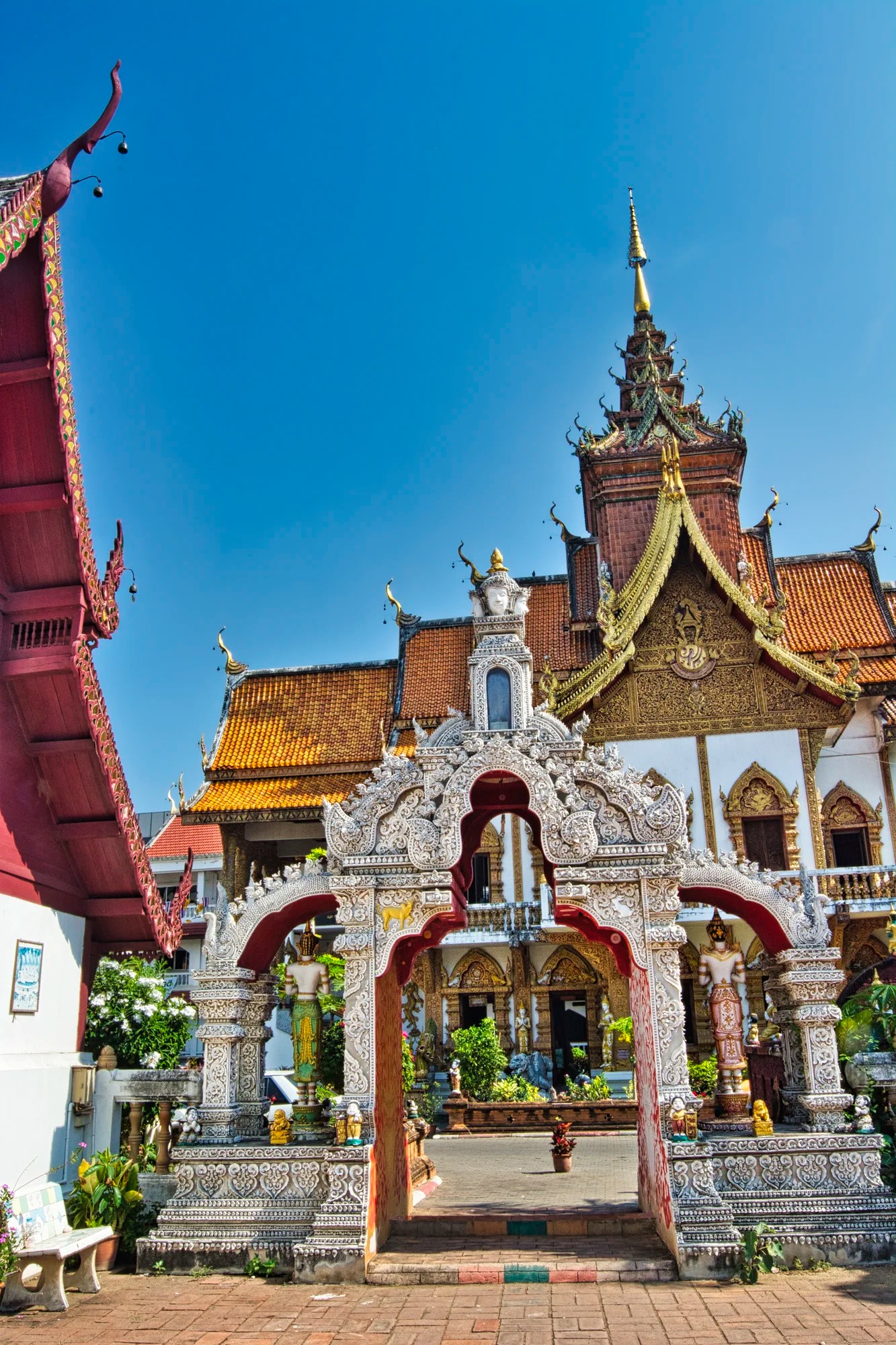
An ornate gate leads to the Dhamma (lecture) Hall. The large structure in the background is the two-story Ho Monthian Tham.
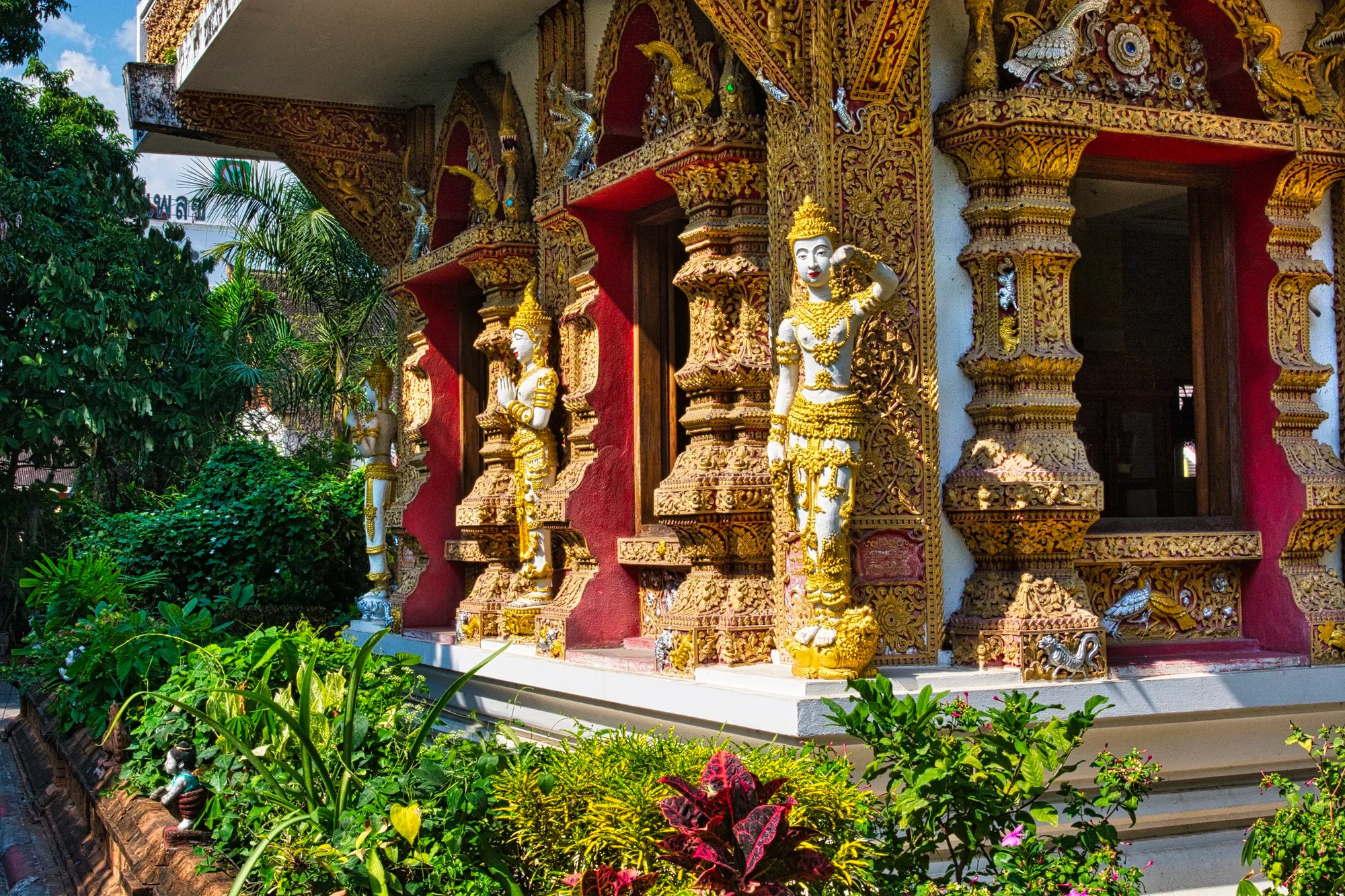
It looks really old, but the Dhamma hall was completed in 1996.
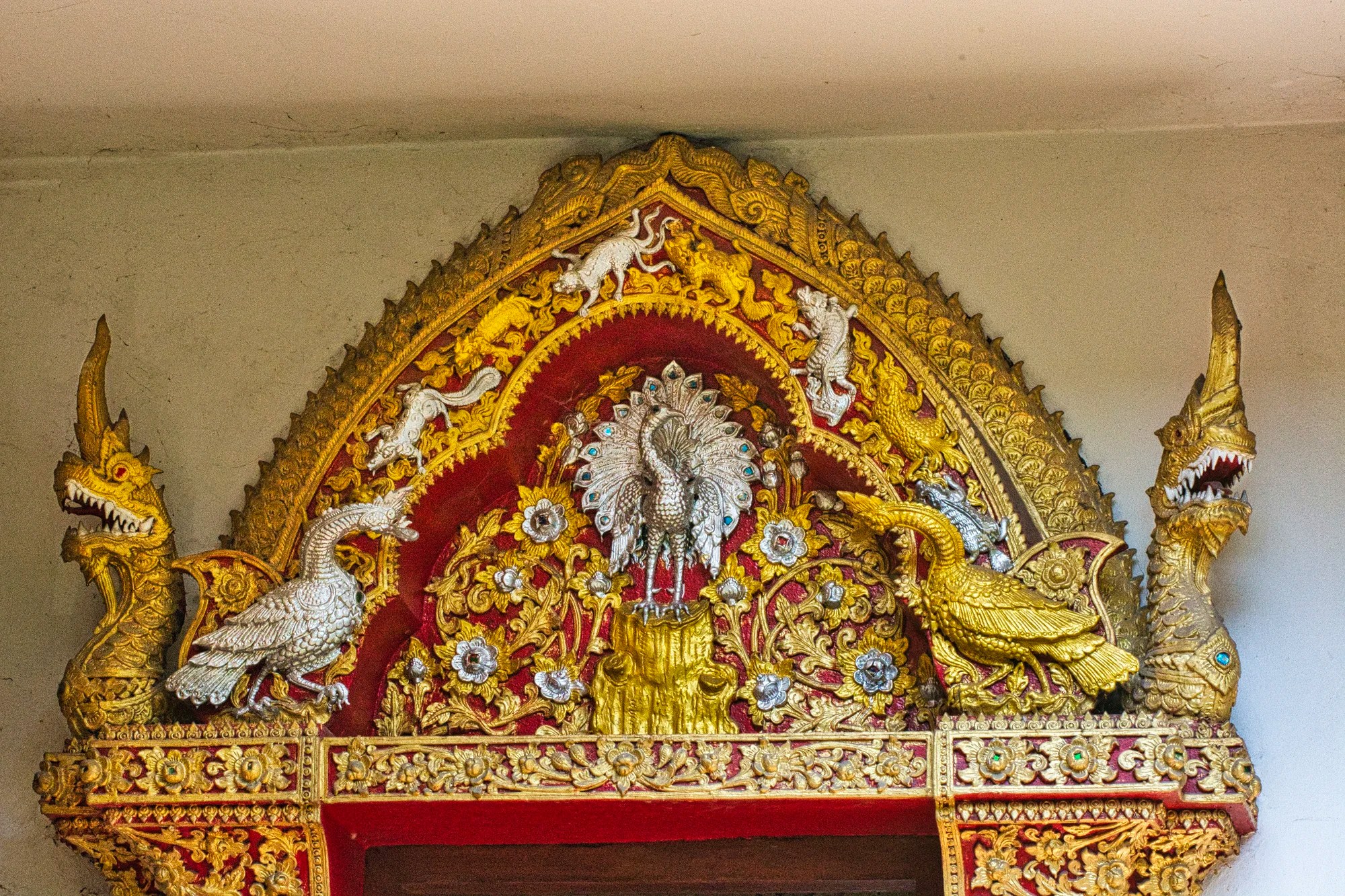
The hall was built in Lanna-style with its use of teak and glass inlay mosaic. The phoenix in this bracket is silver while the nagas, et al., are in gold.
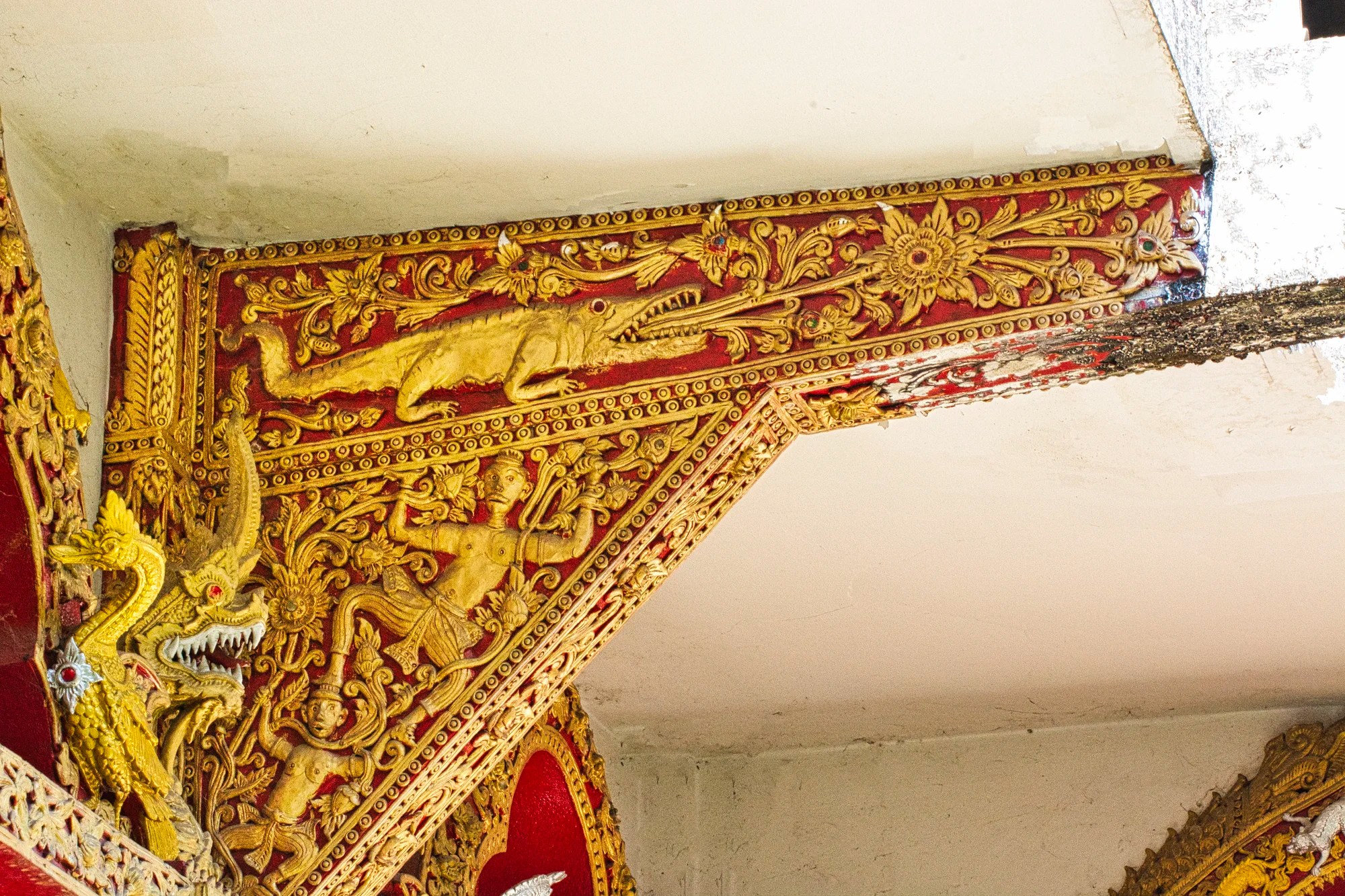
The makara in this bracket actually looks like a crocodile. Yes, there are crocodiles in Thailand.
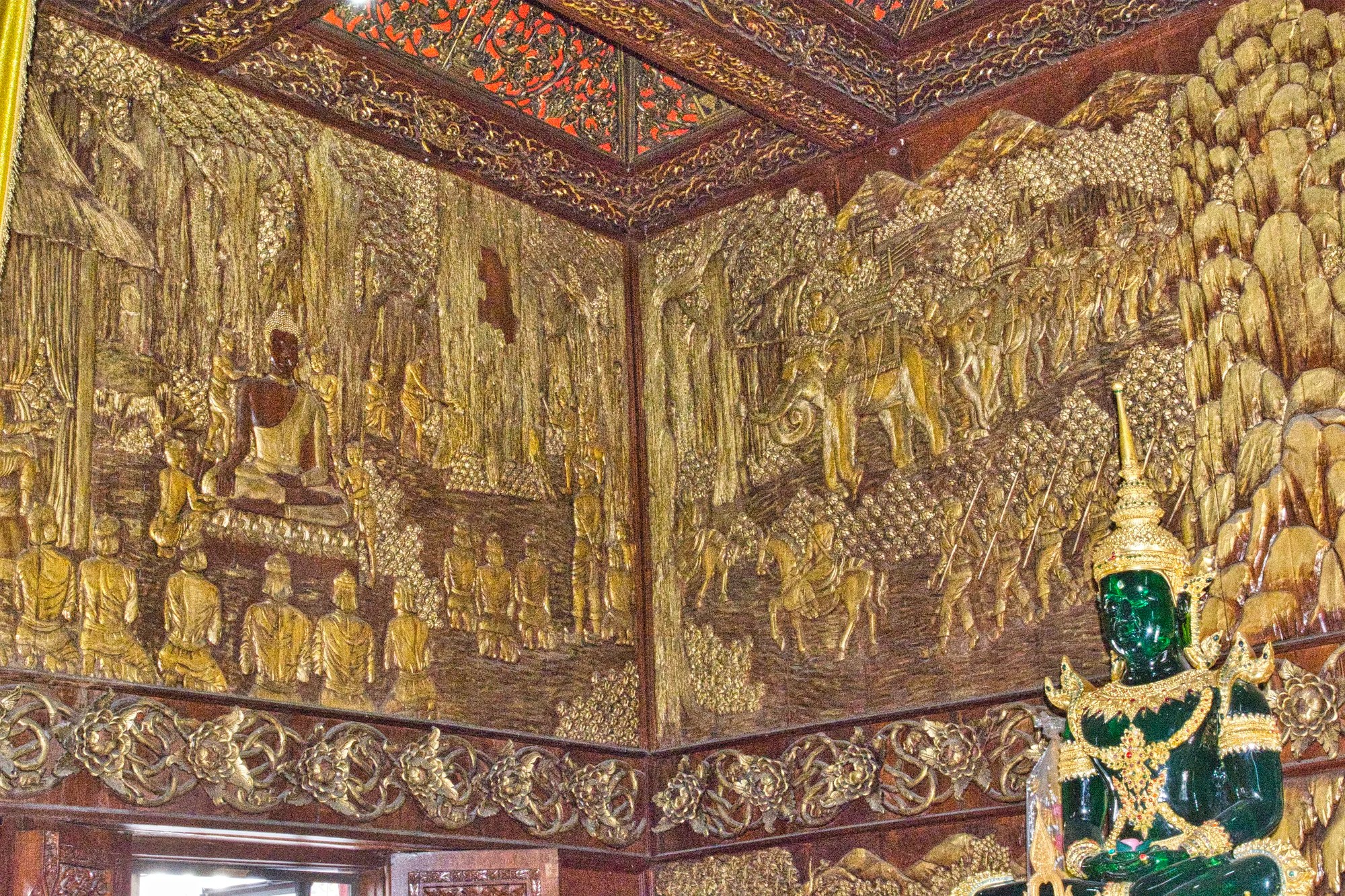
The main hall resembles an ornate palace with gold-embossed red murals and a green Buddha.
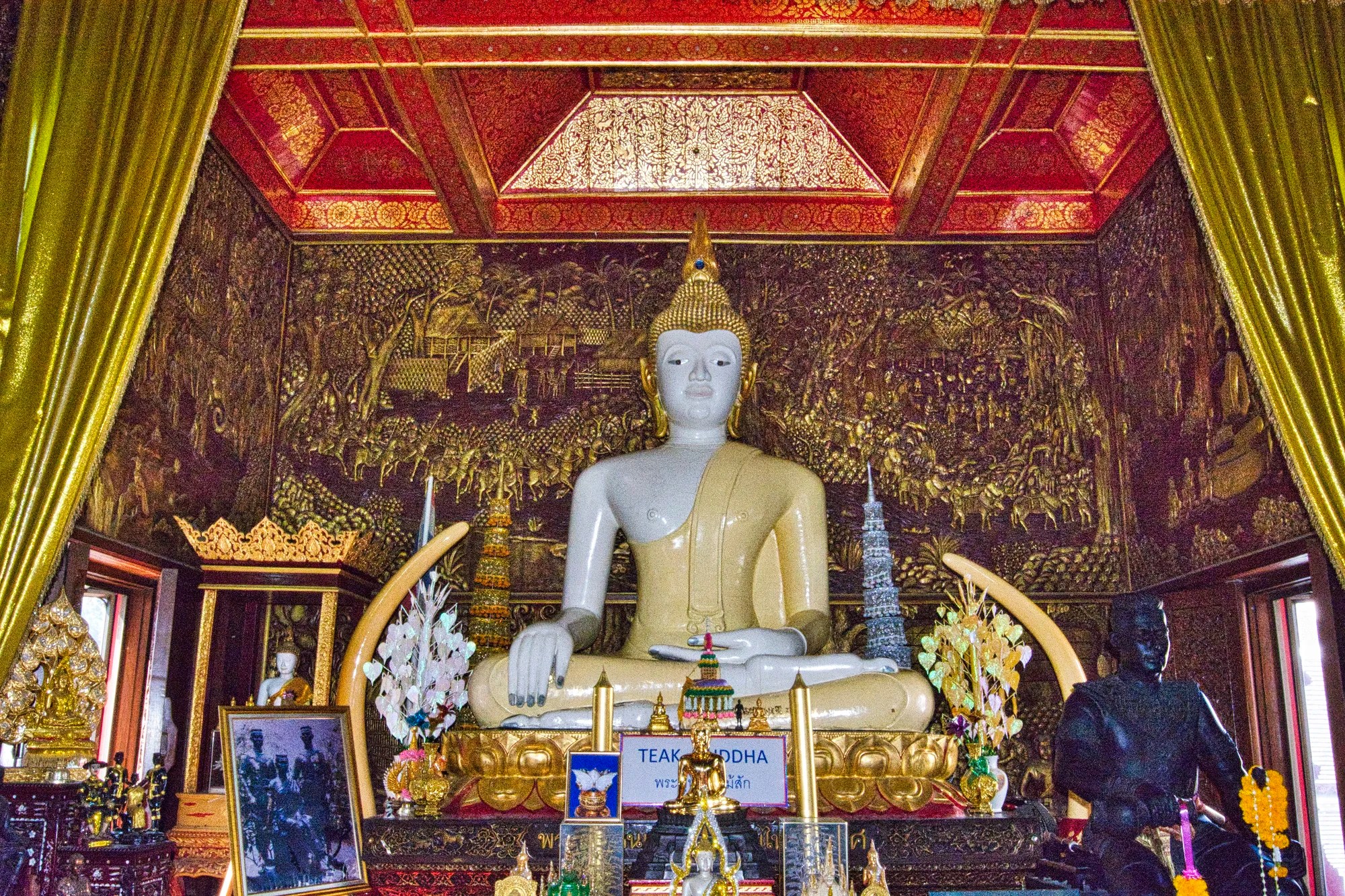
The main Buddha statue is crowned and dressed in a yellow robe in the calling earth witness mudra. The Chakravartin style represents the ideal leader who rules ethically and benevolently over the entire world at a time when the Buddhist Dharma was adopted everywhere.
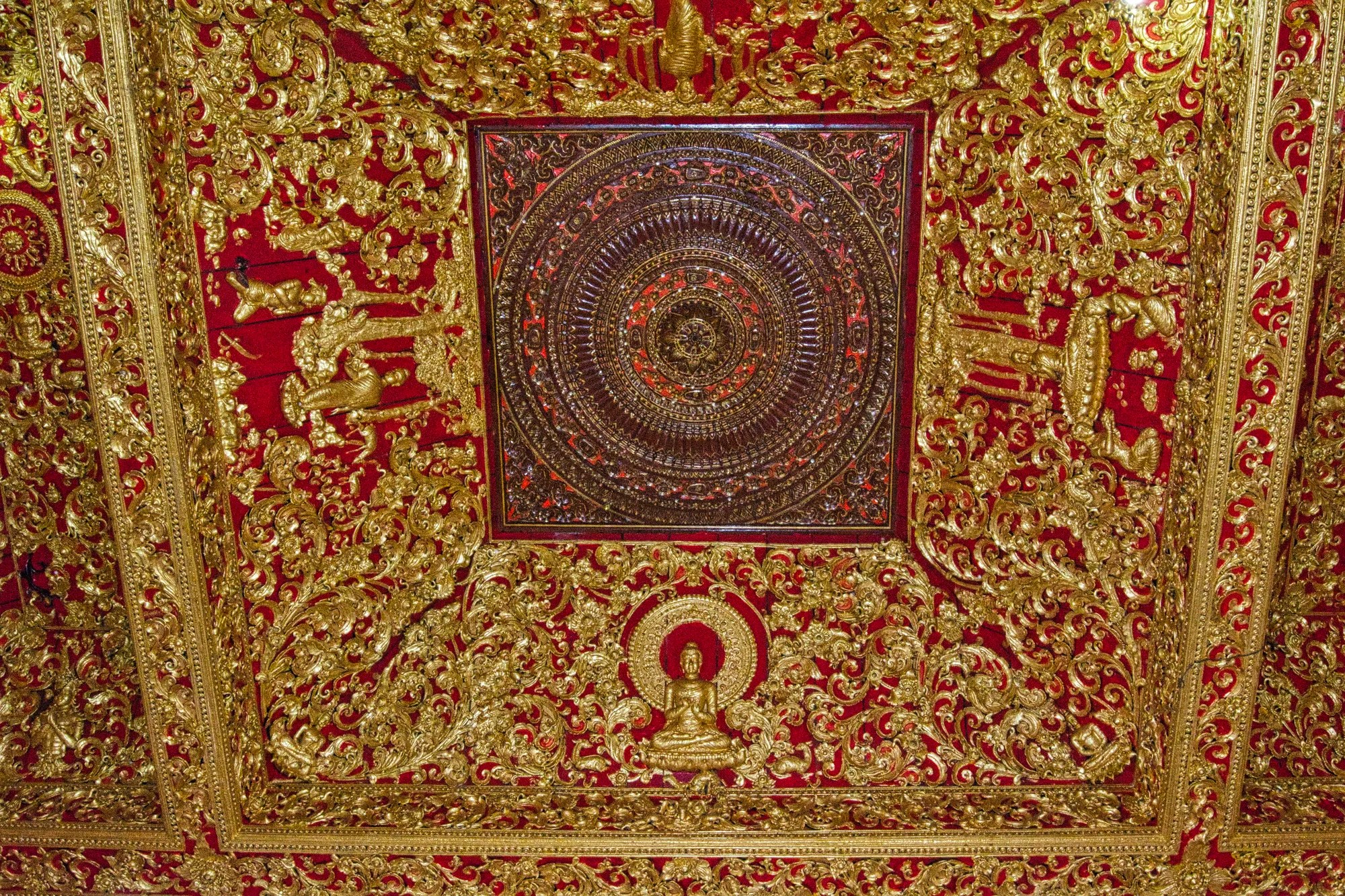
Do not forget to look up at the ornate gold and red ceiling.
Gandharva Carving
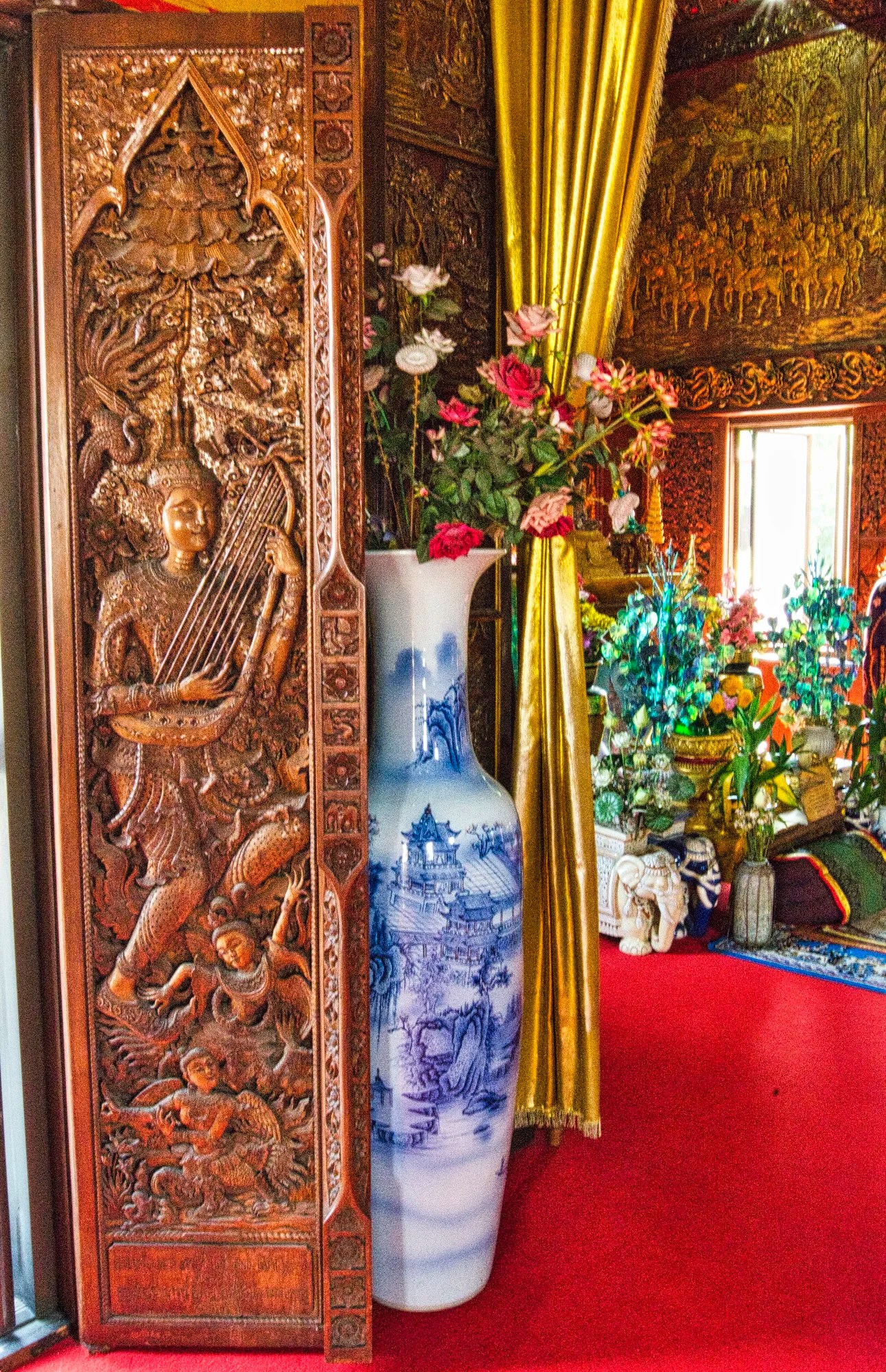
Beside a huge blue on white urn, my attention was riveted to a beautiful wooden carving of a gandharva, a divine musician with six string instrument. The name Gandharva is associated with Gandhara (now Kandahar in Afghanistan).
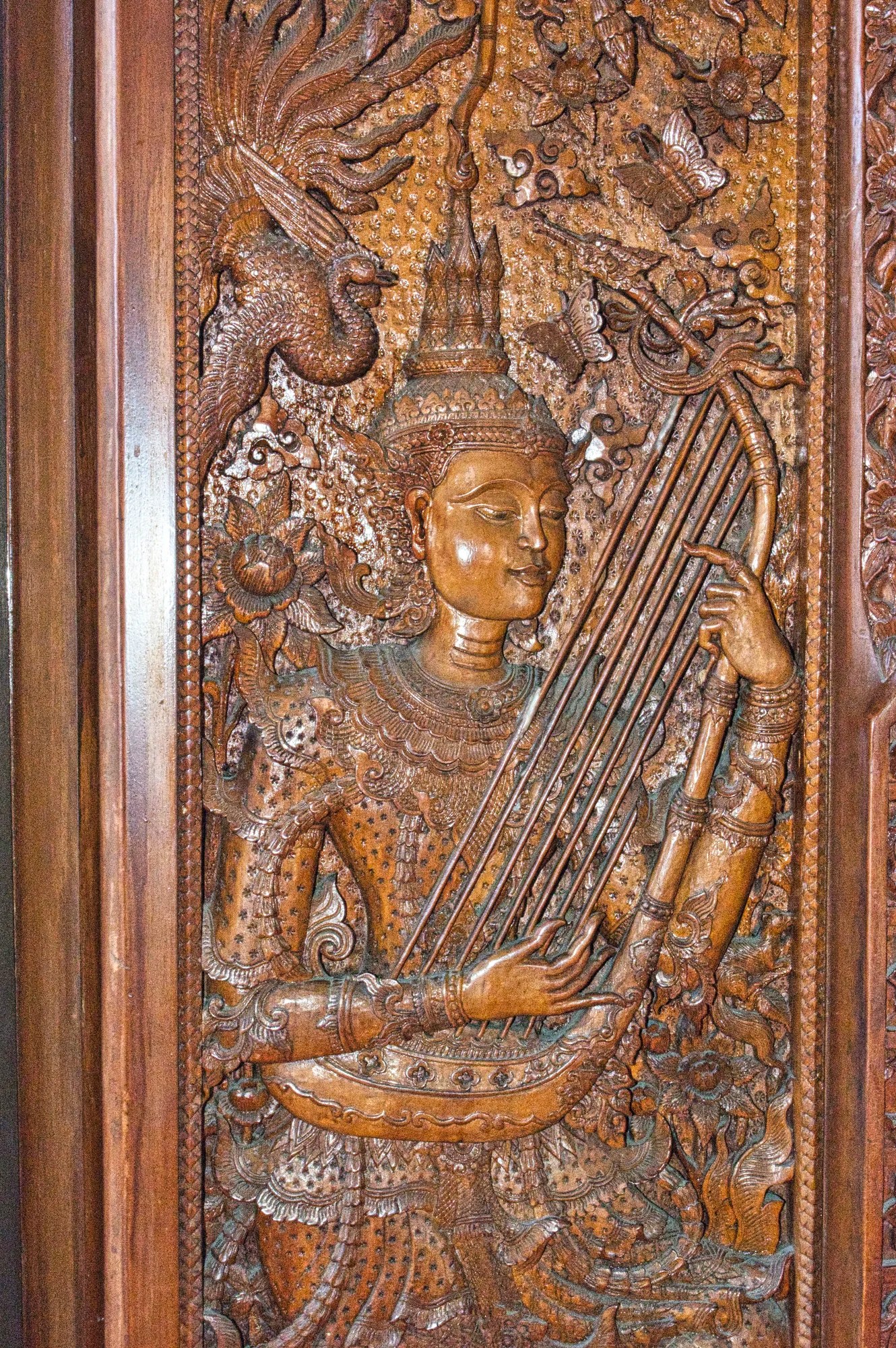
Gandharvas originate from Hinduism, where they serve in the court of the chief god, Indra. We had no idea of what it symbolized at the time. There were two things that I did notice — the slender fingers and the feminine-looking face.
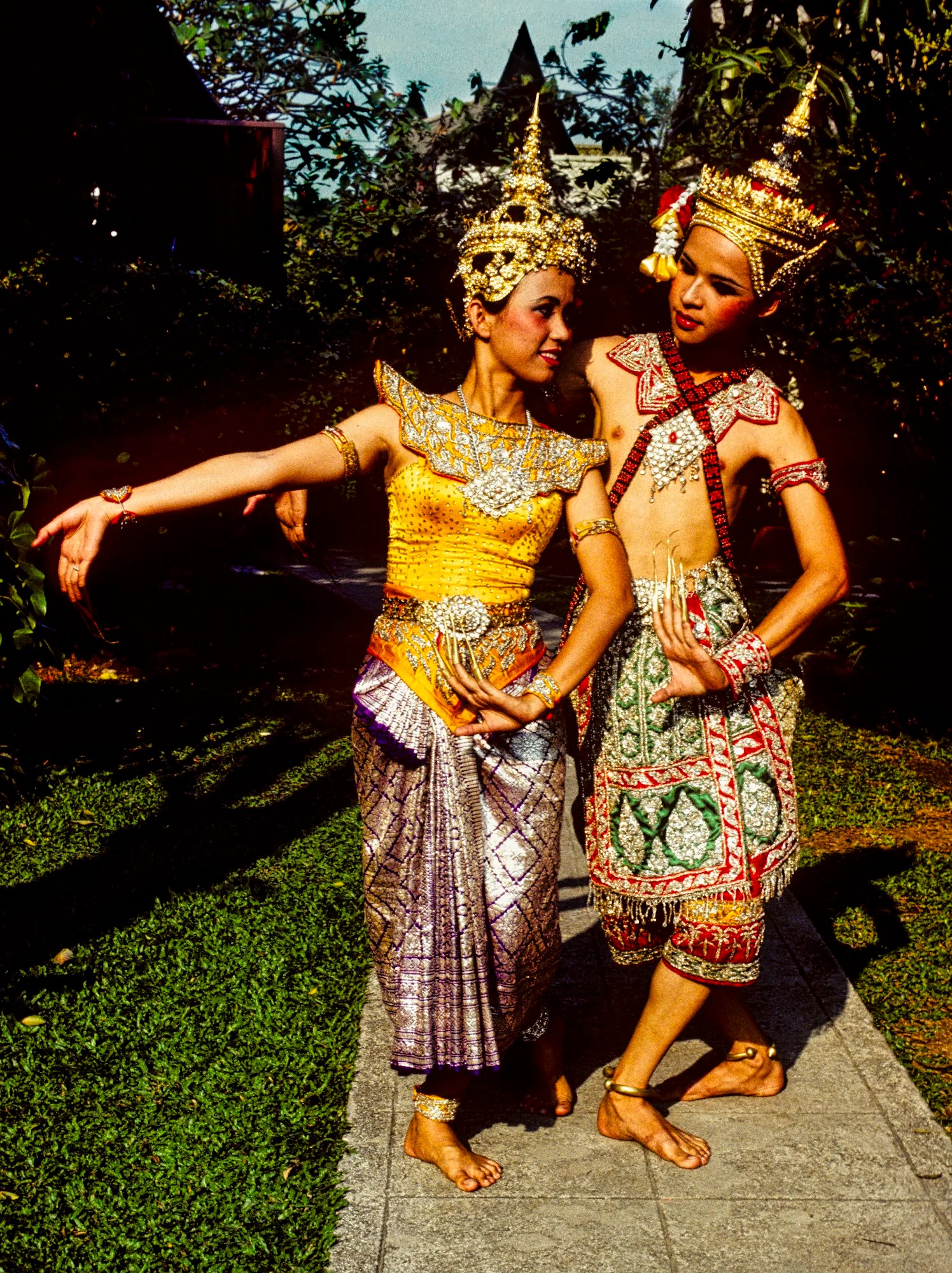
We had seen traditional Thai dancers in previous trips and the males are very graceful and feminine-looking.
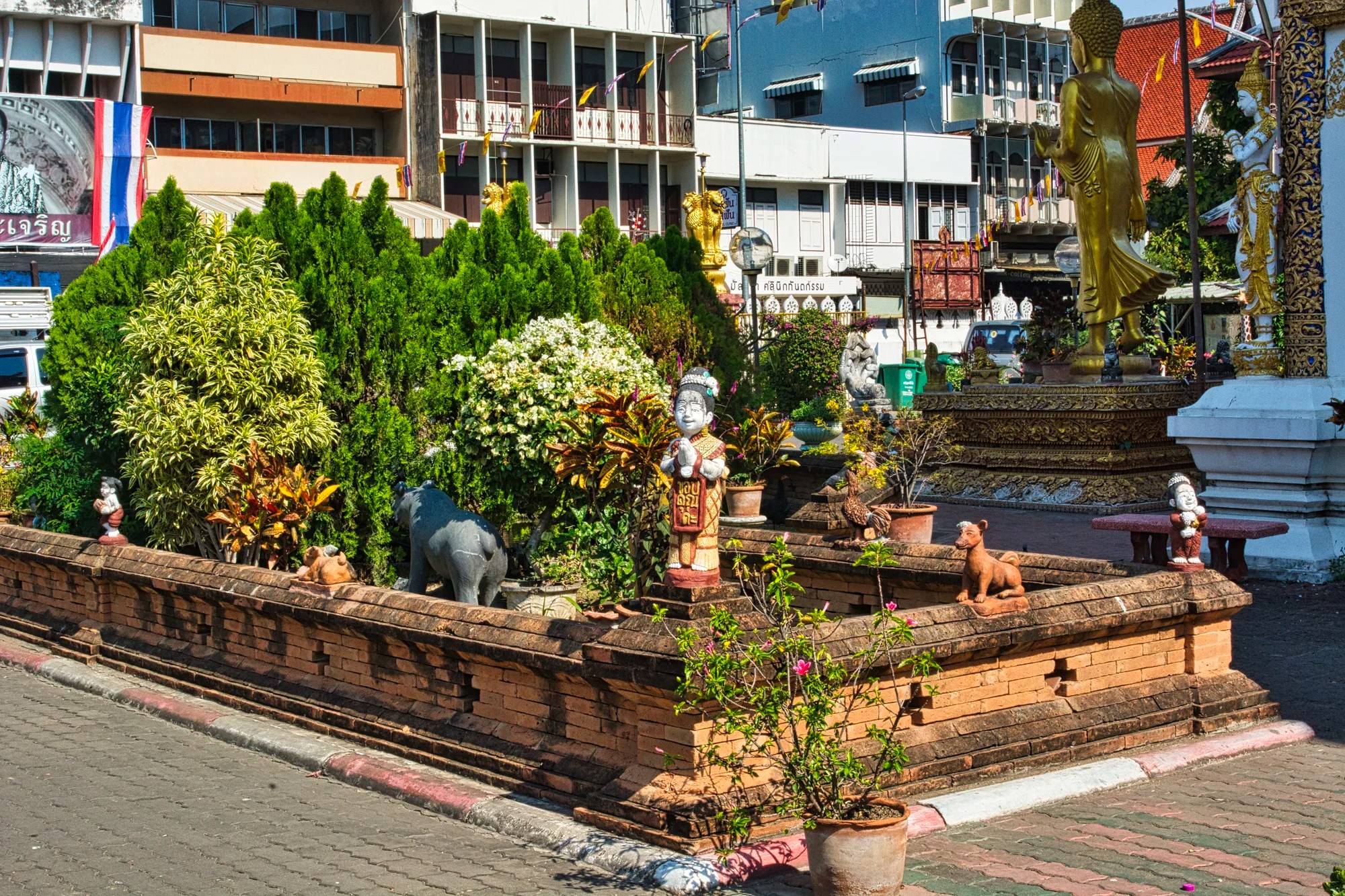
Outside, take a look at the whimsical garden with animal statues. You are reminded that you are on a busy street in a major city.
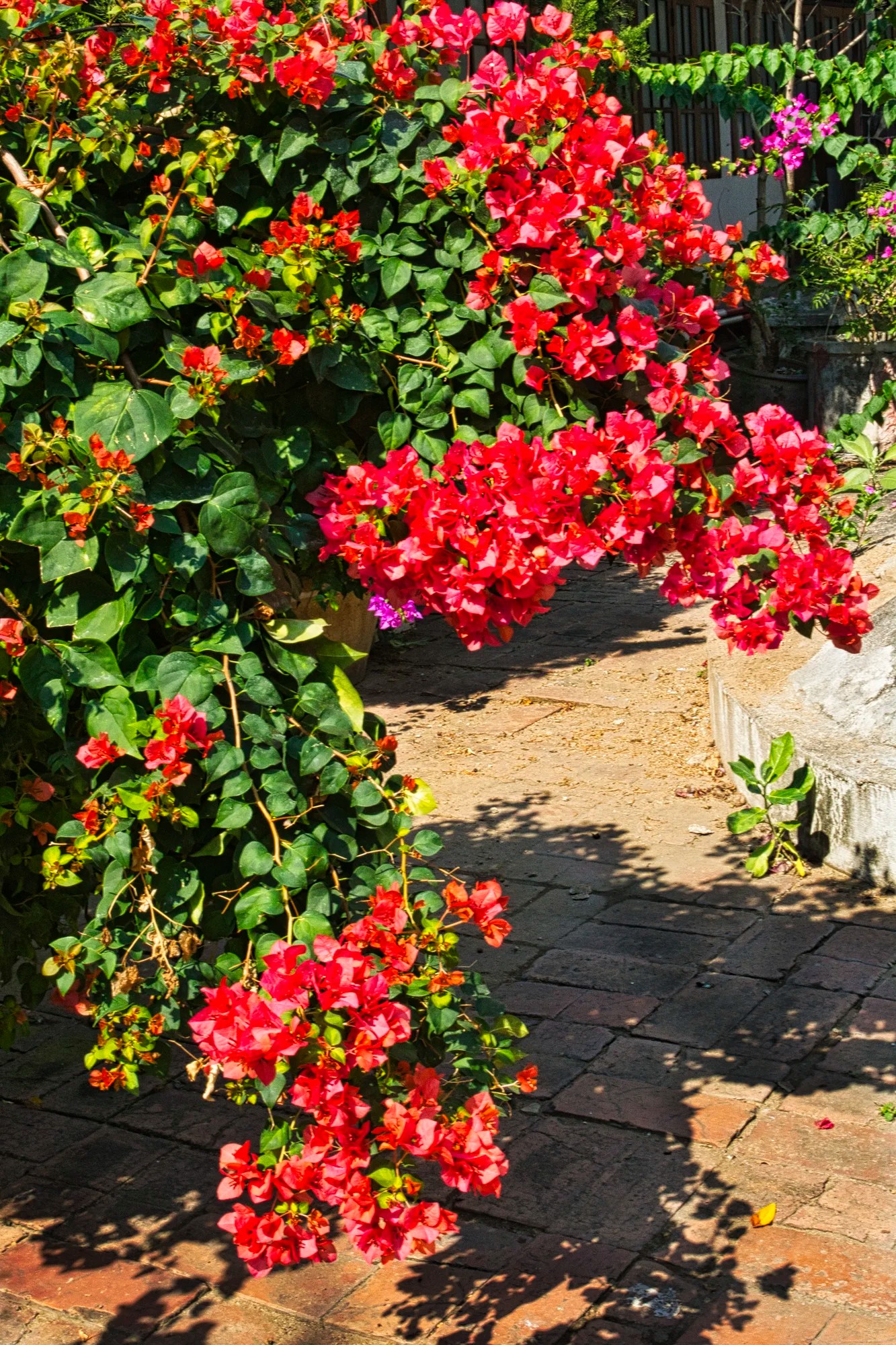
There are several flowers, such as this red Bougainvillea.
Wat Buppharam Address and Hours
Address: 143 Tha Phae Road
Open: 06:00 to 17:00 daily
Wat Saen Fang
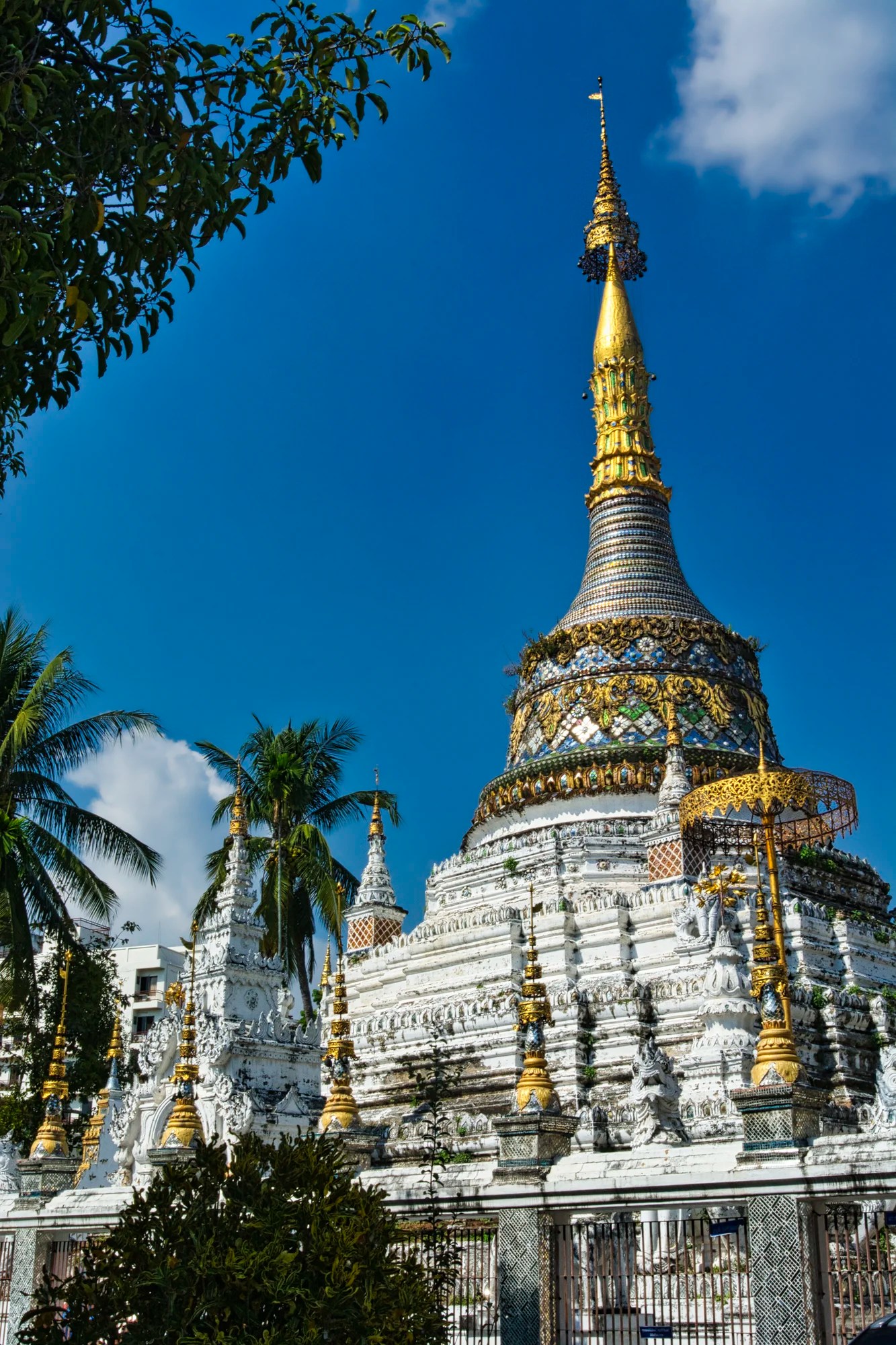
From Tapae Road, we walked down a narrow lane guarded by a sinuous naga along each wall. The quiet sanctuary of Wat Saen Fang (G4.4) was filled with white chedis. The chedis blend the bell shape of the Burmese style with colourful floral mosaics of the Lanna style.
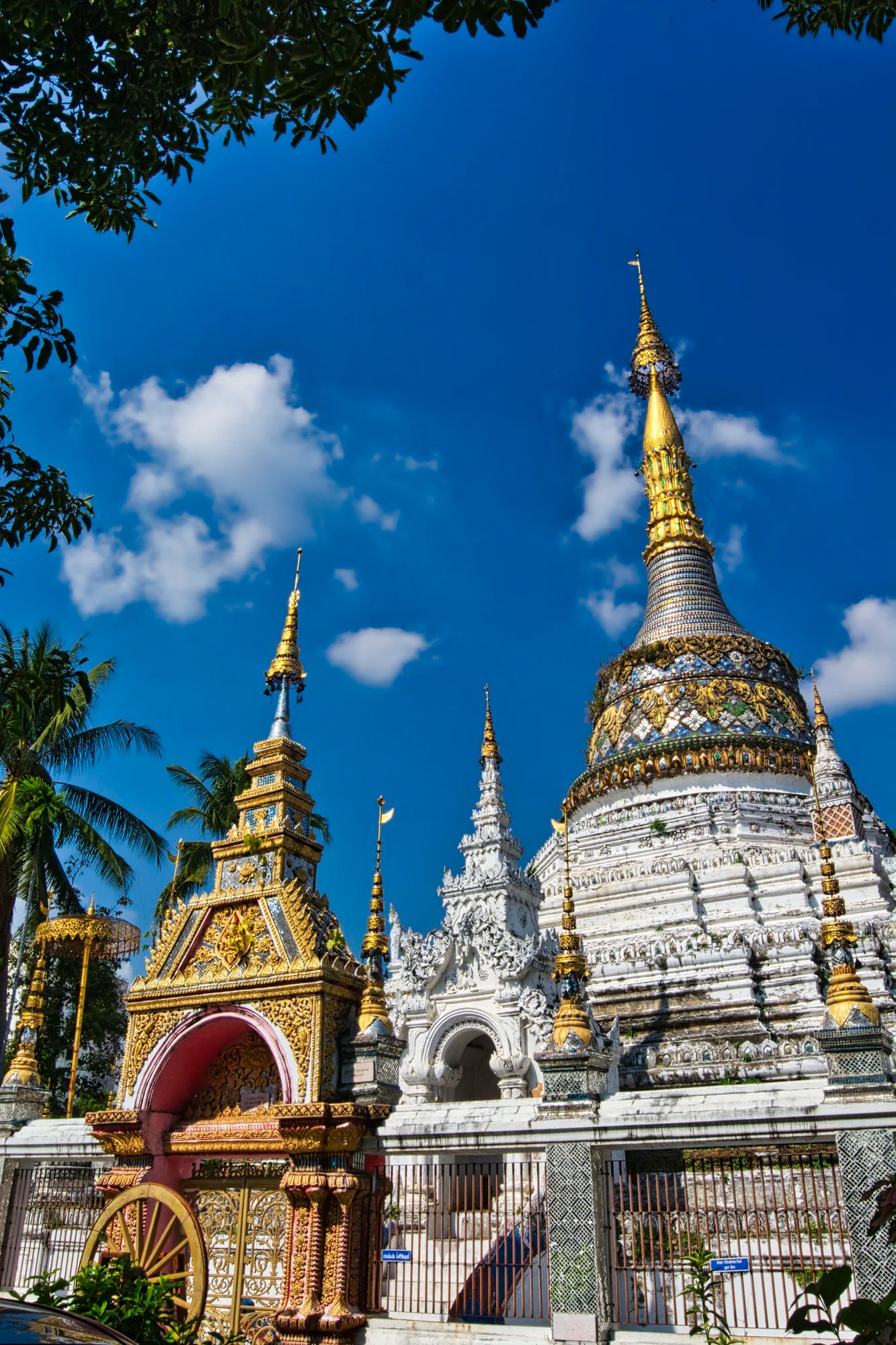
At the top of the chedi is an elaborate golden hti, or umbrella. Bells are attached to the hti to attract good spirits. An umbrella is an auspicious symbol in Buddhism.
Along the low wall in the foreground are ca. 40 stupika, little stupas that contain votive tablets.
Wat Saen Fang Address and Hours
Address: 188 Tha Phae Road
Open: 06:00 to 17:00 daily
Wat Pha Khao
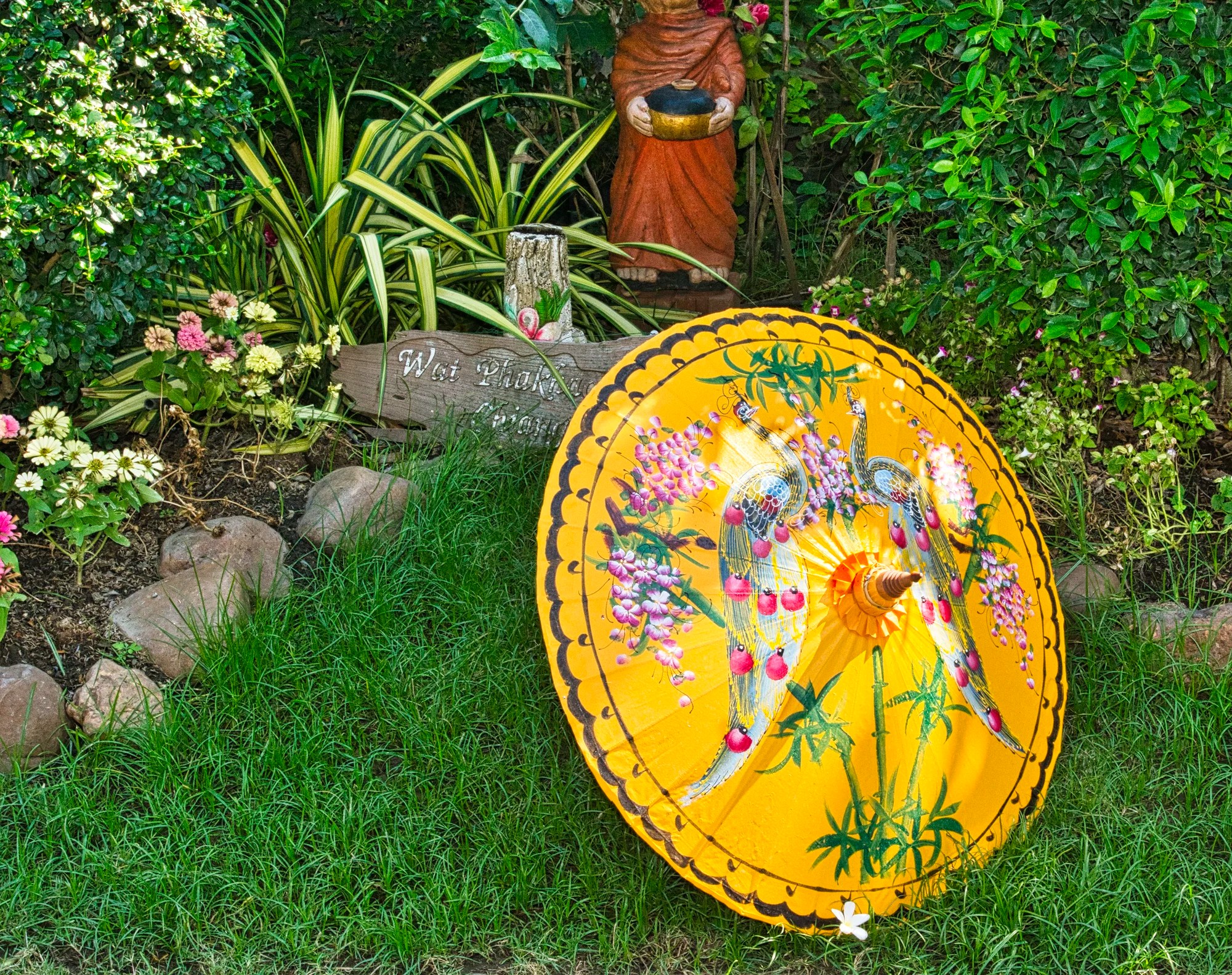
Wat Pha Khao (G4.4) is a small, quiet temple (1491) located on Ratchapakhinai Road. It is set in a lovely garden. A chedi, built with a Lanna-style octagonal shape, is covered in dazzling gold sheeting.
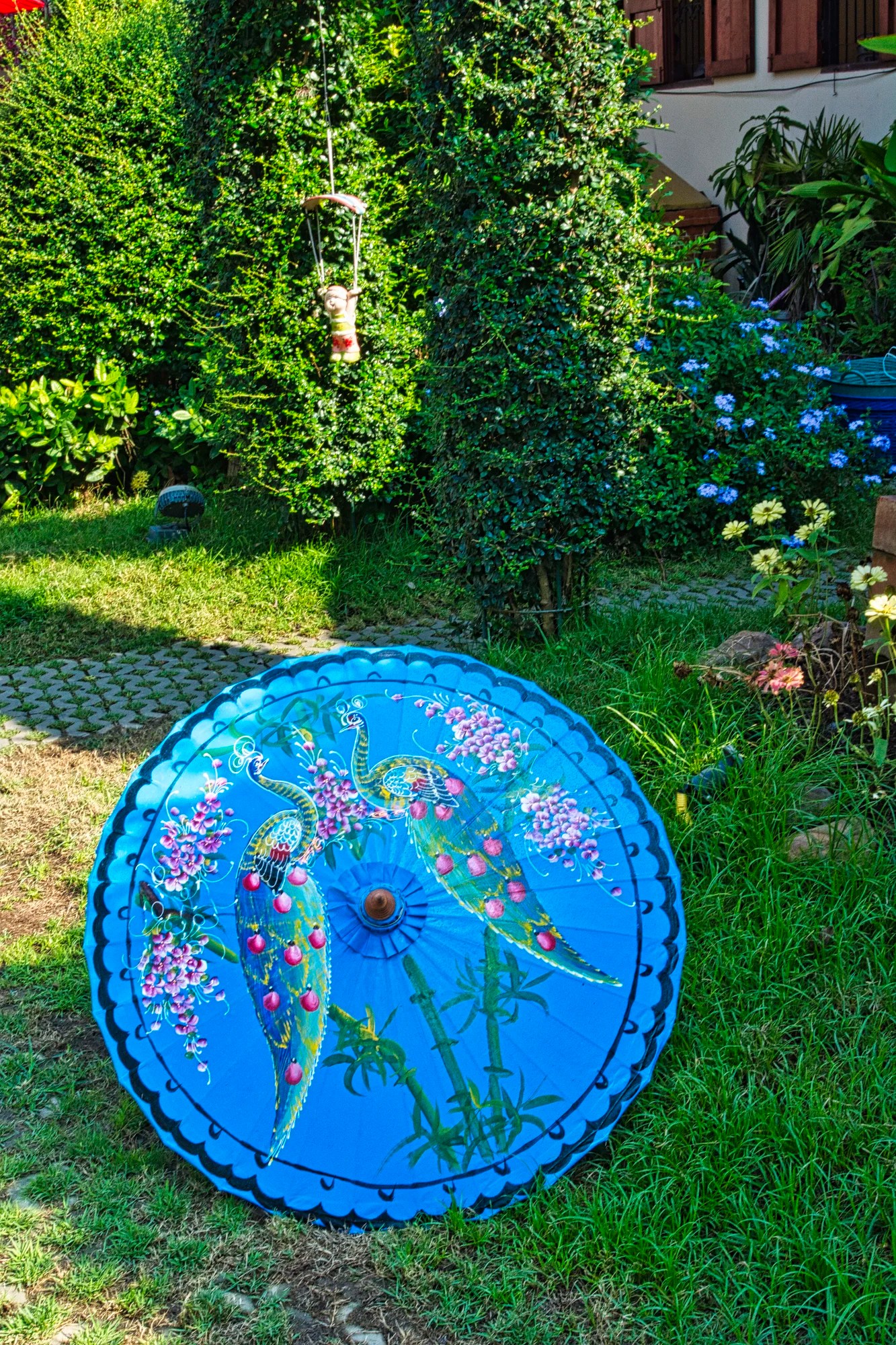
But the reason we dropped in was the brightly coloured umbrellas. On a previous trip, we had visited Bo Sang, a craft town east of Chiang Mai that specializes in umbrella making. It is really an art form. When we did our 3-year Round The World Trip, we bought an umbrella to enable us to sightsee in the mid-day 40+ °C heat in India.
Wat Pha Khao Address and Hours
Address: Rachadamnoen Soi 2
Open: 08:30 to 18:30 daily
Tuk Tuk, the Thai Taxi
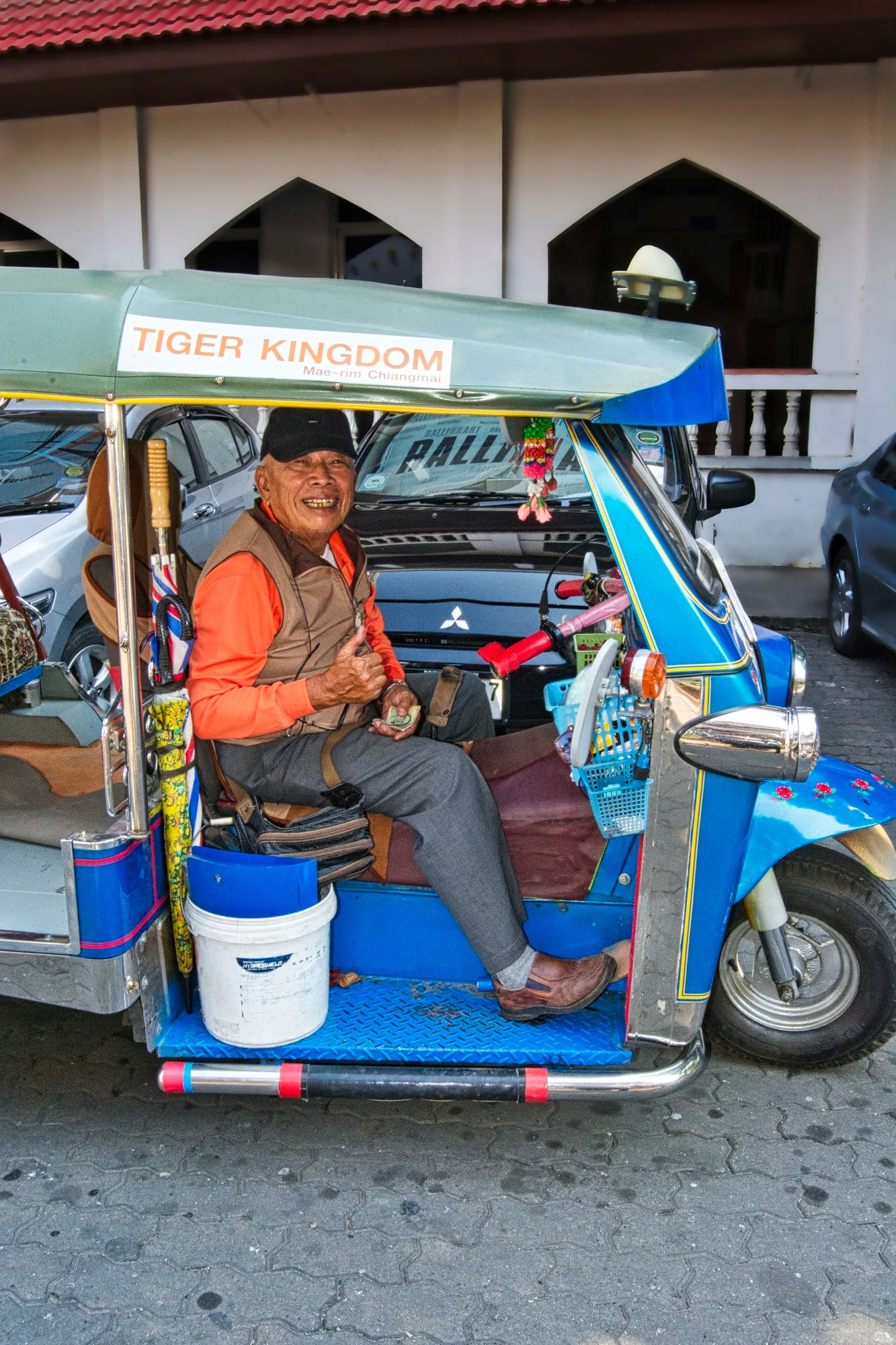
Tuk-tuk is a unique feature of Thailand. They are inexpensive and the easiest means to go to distant places. We walked everywhere, but you will need to take a tuk-tuk to get to the next highlight as the wat is 3 km south of Wat Pha Khao.
We usually asked our hotel hosts how much they should cost. We confirmed the cost before taking the ride and simply said no if they tried to overcharge. The drivers usually lowered the price dramatically once they knew that we were not to be taken lightly.
Chiang Mai now has their own version of Uber called Grab.
Wat Sri Suphan
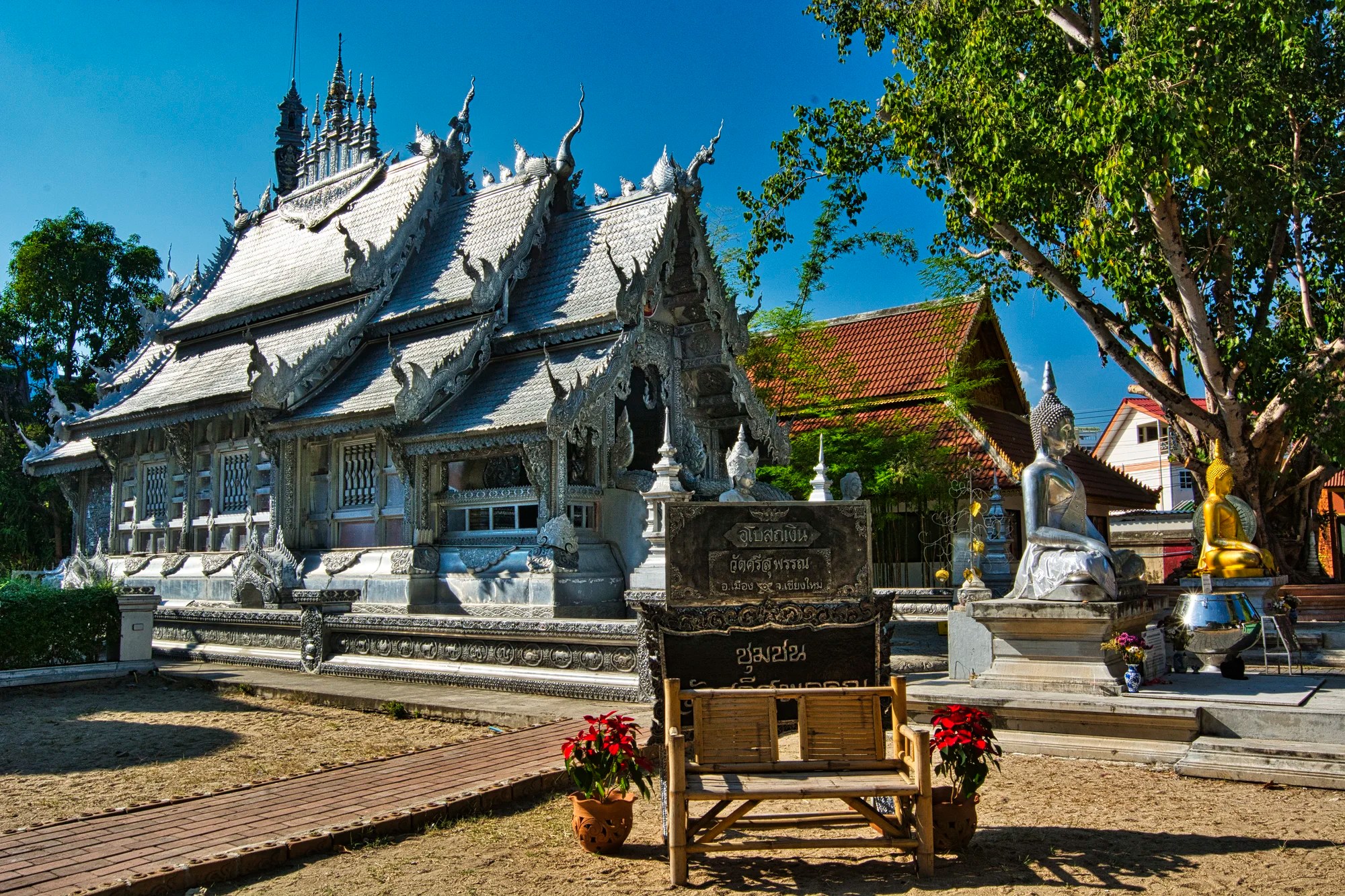
Wat Sri Suphan (G4.5) is located near Wua Lai Road. The wat was originally built between 1495 and 1525. It is one of the must-sees of Chiang Mai, and yet there were very few tourists visiting when we were there.
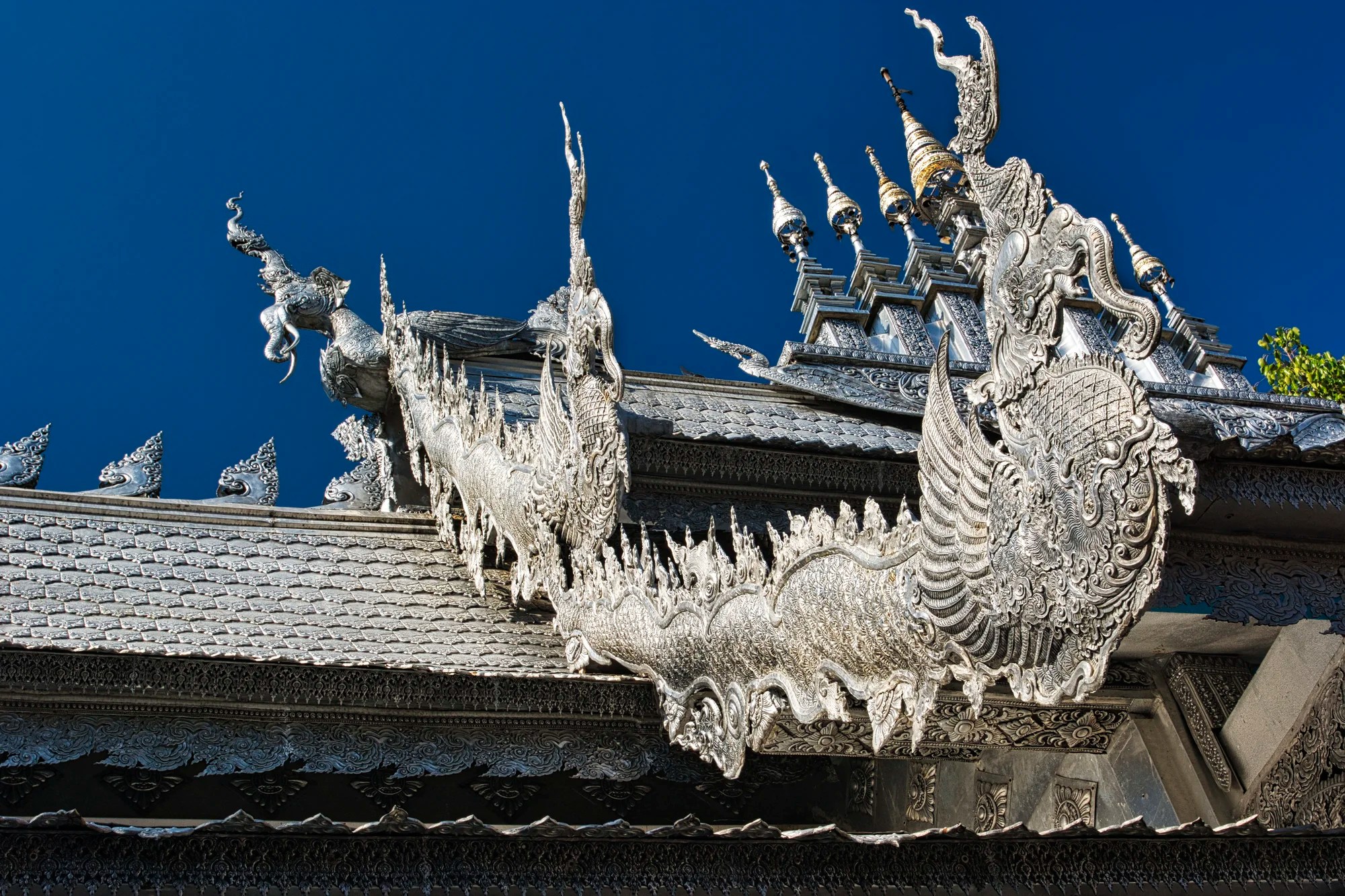
The walls and roofs are covered in ornate silverwork. The shiny silver nagas not only take your breath away; they also blind your eyes.
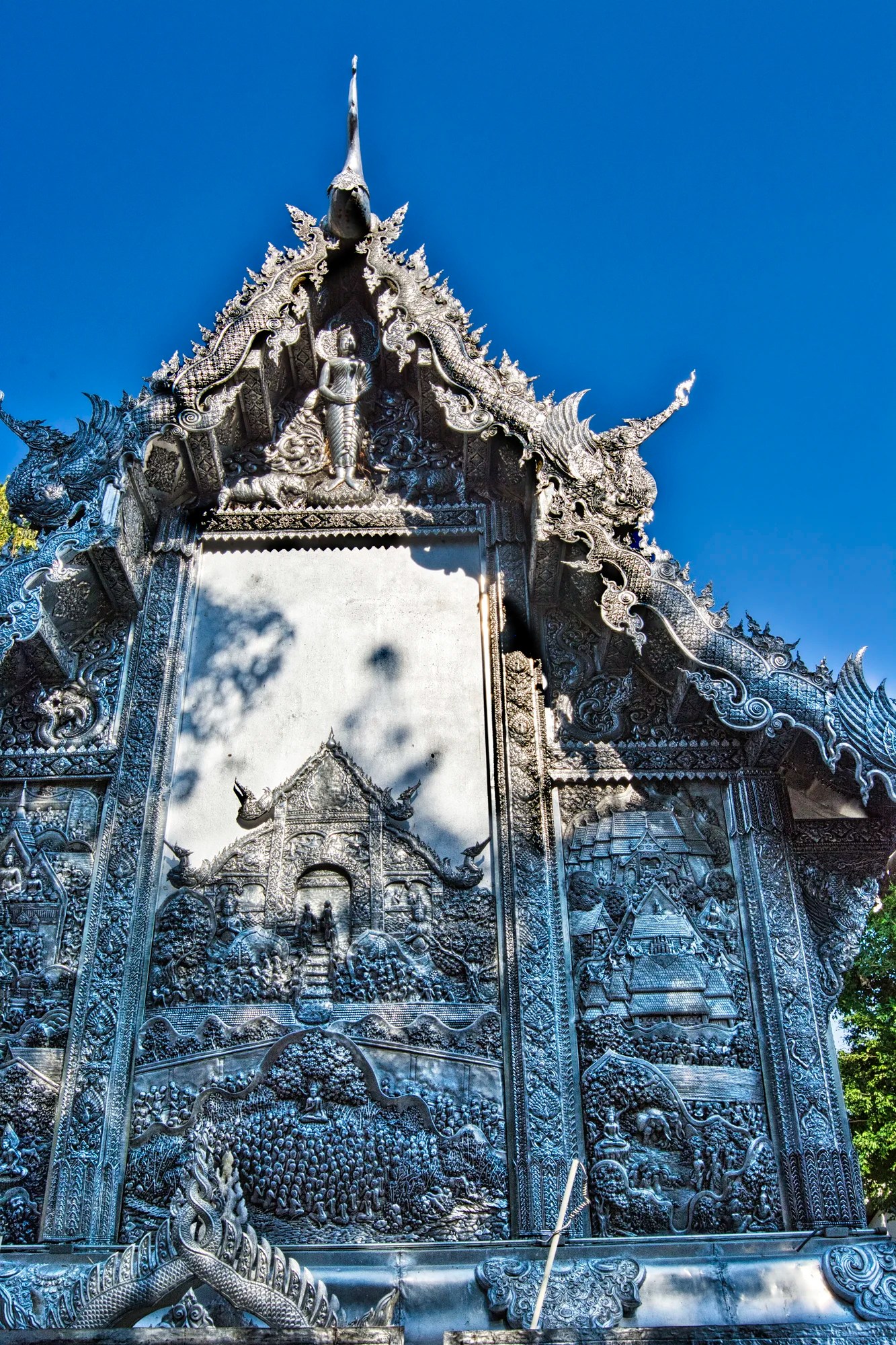
A major renovation was begun in 2004 using panels made from melted-down coins offered by the local community. What an amazing way to involve the public and a way for the lay people to make merit.
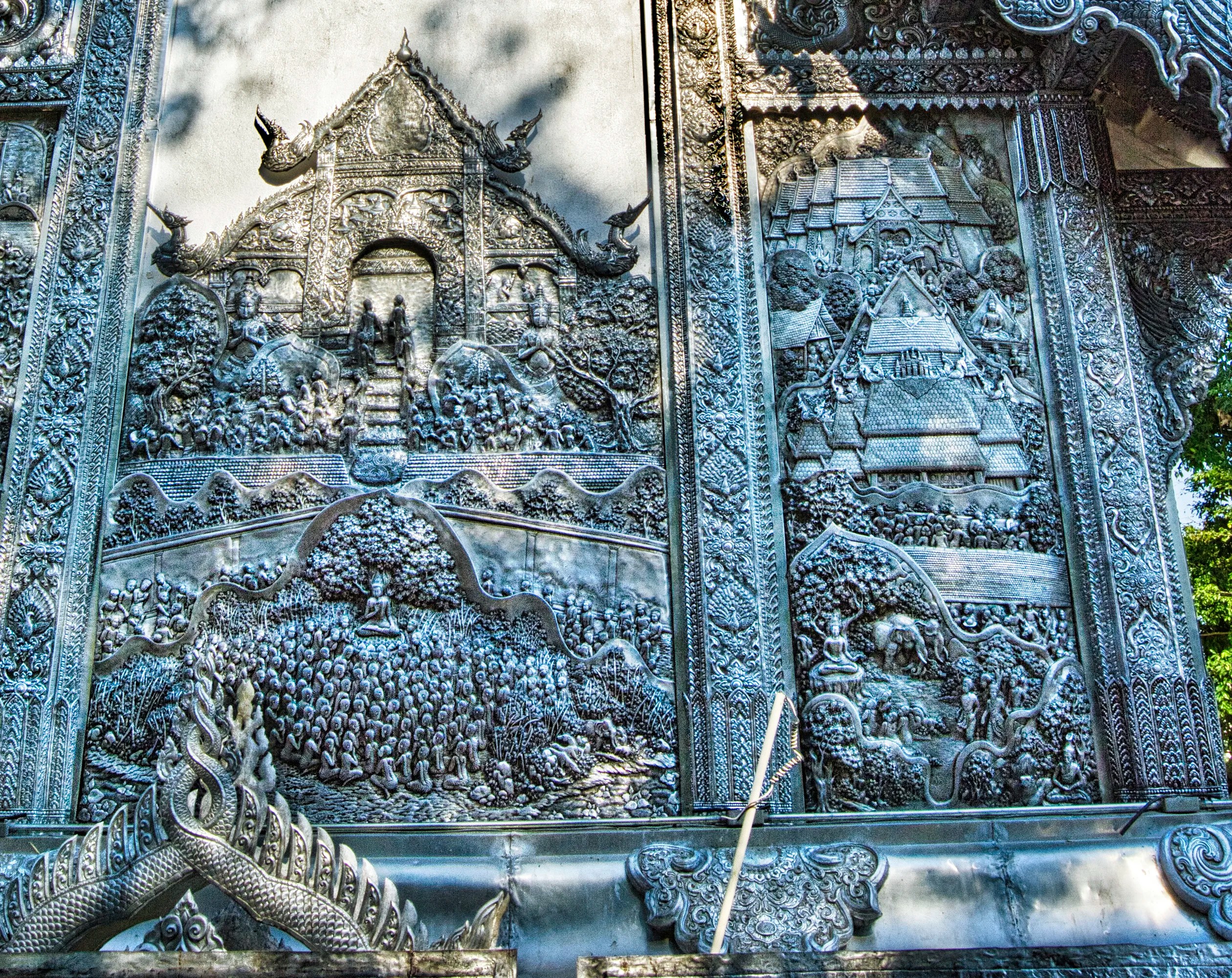
While it is called the Silver Wat, the temple is not covered in pure silver. A combination of silver, nickel, and aluminum is used.
Wat Sri Suphan Ubusot
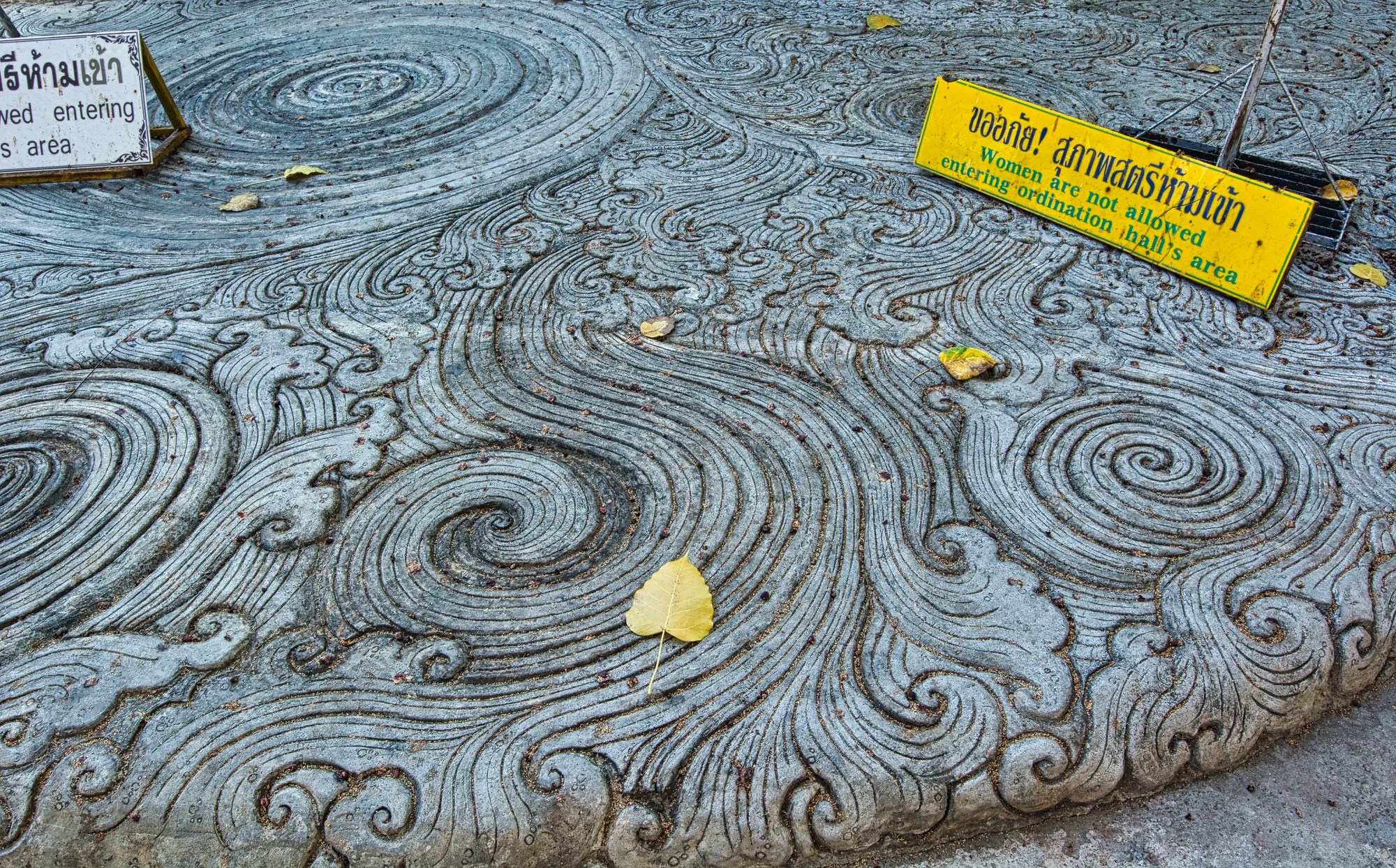
Note the intricately carved stone with cloud patterns and the sign stating that females are forbidden to enter the ubusot (ordination hall). This is an ancient cultural value going back to the Vedic Era in India, which you must respect.
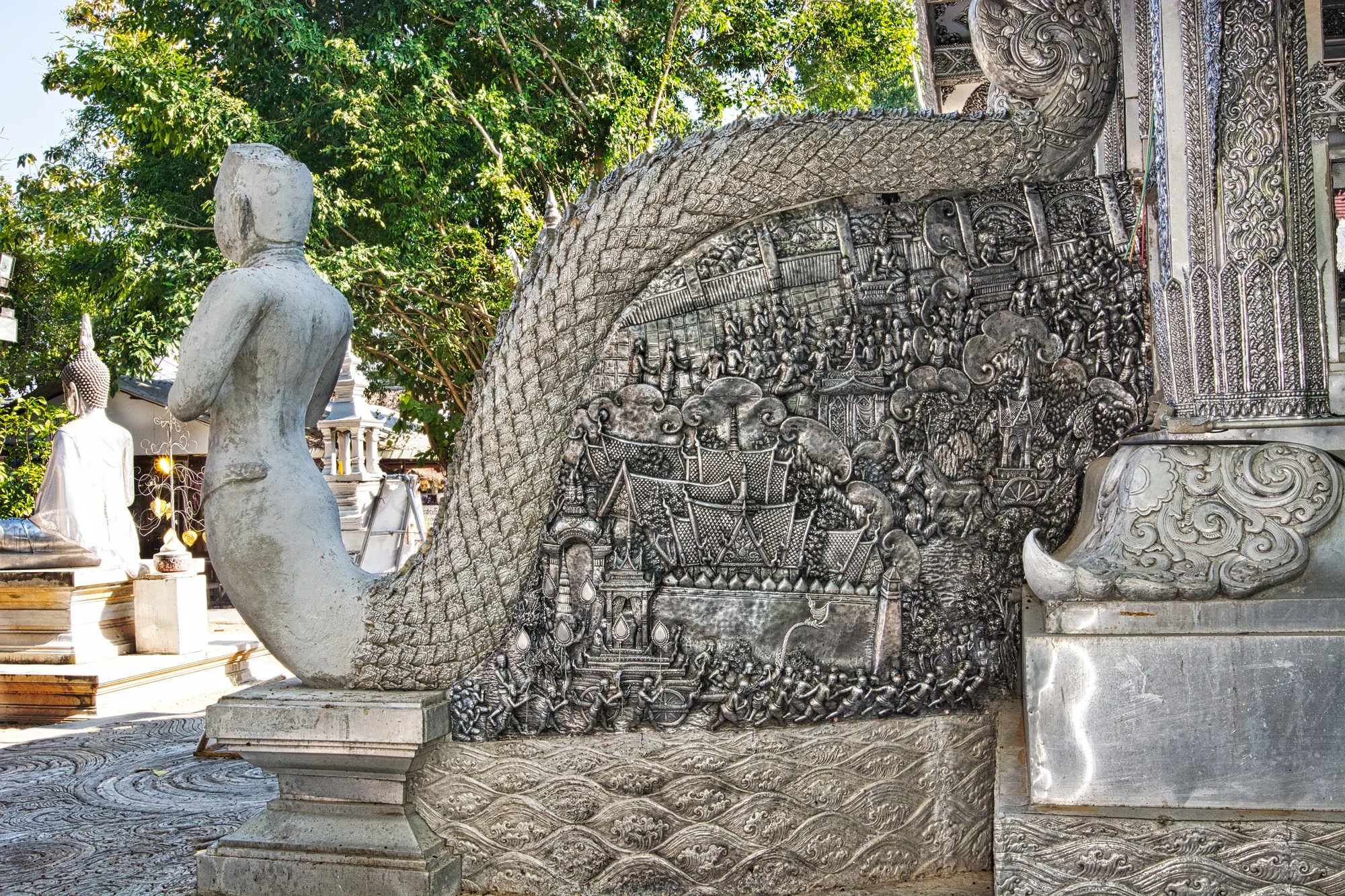
In any event, there is so much detail to admire outside it is not a real loss. Besides the anthropomorphic naga guardian, the stairway “mural” is unbelievable; like a painting in metal. The temple is not just silver; it is embroidery in metal.
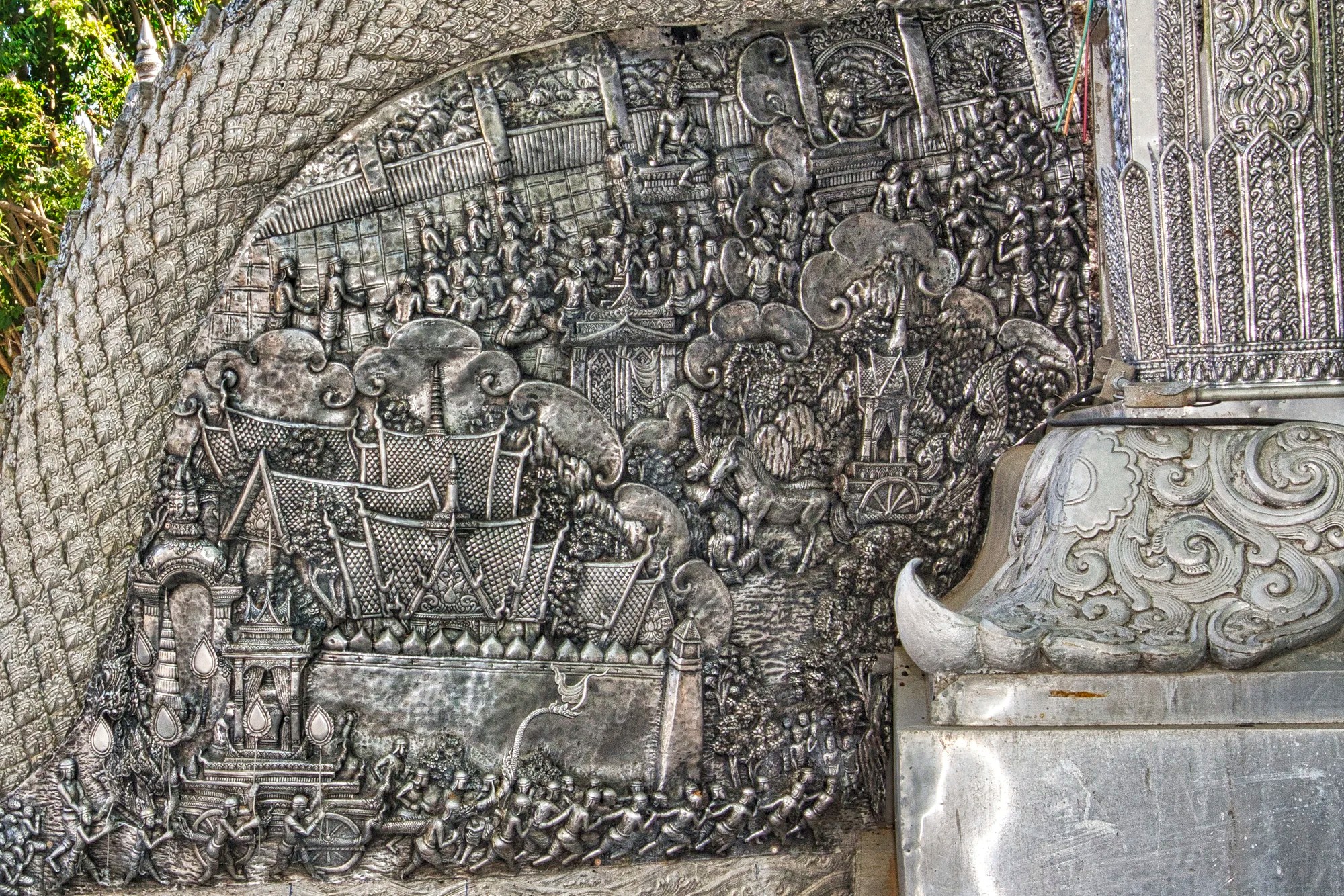
If I were to guess, this panel shows the Inthakin city pillar being paraded in Chiang Mai. The intricate details of the repoussé work are extraordinary. There is a silver repoussé workshop in the wat where you can learn about silversmith techniques.
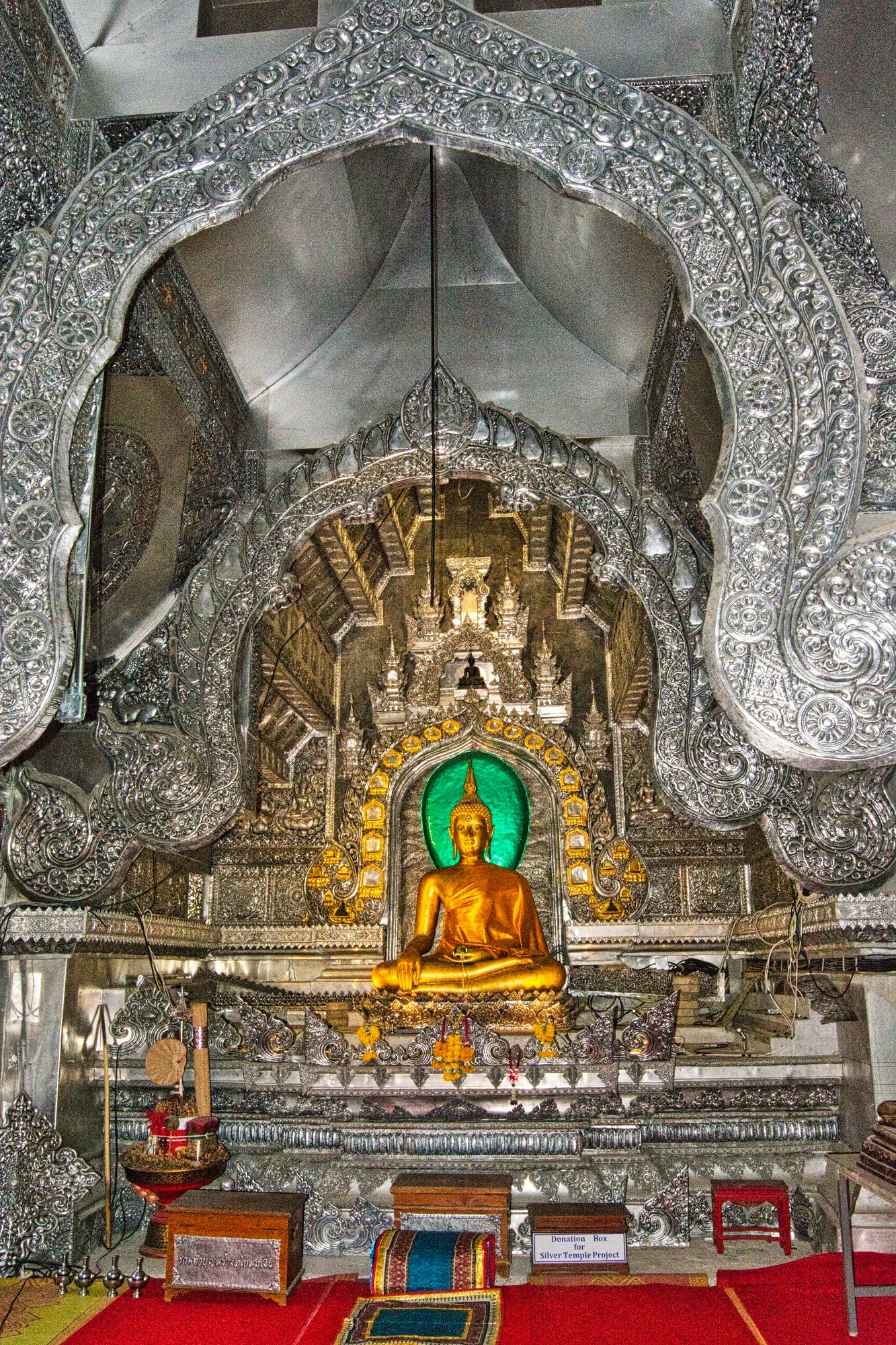
The interior of the ubusot is all silver with a gold Buddha in the Earth Witness mudra.
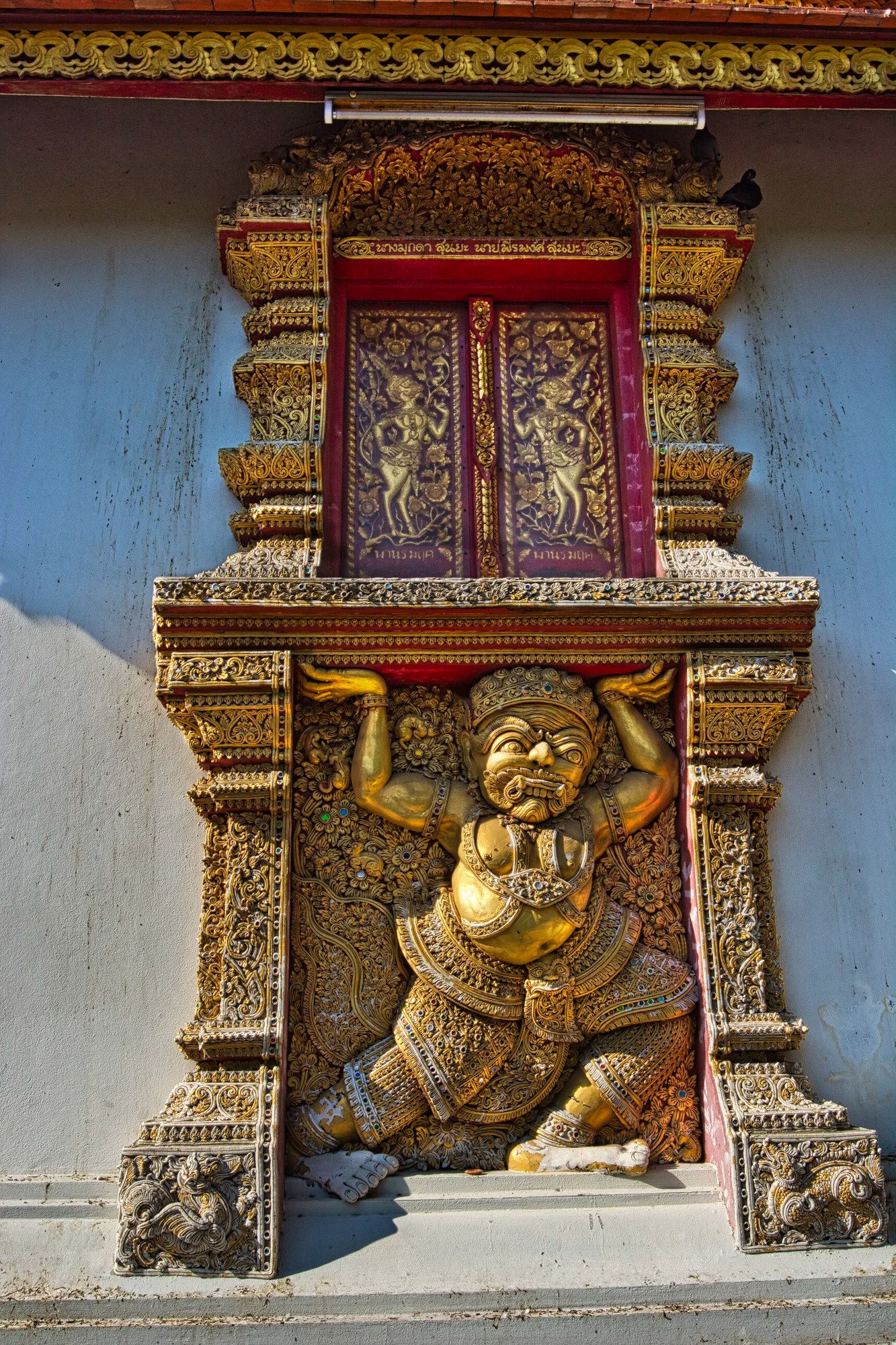
This carved wood window frame seems to be held up by a scary demon. This is part of the incorporation of animism of the early tribal people into Buddhism as discussed in Thailand — a Traveller’s Guide to Buddhism.
Wat Sri Suphan Address and Hours
Address: 100 Wua Lai Road
Open: 09:00 to 21:00 daily
Silver Shop
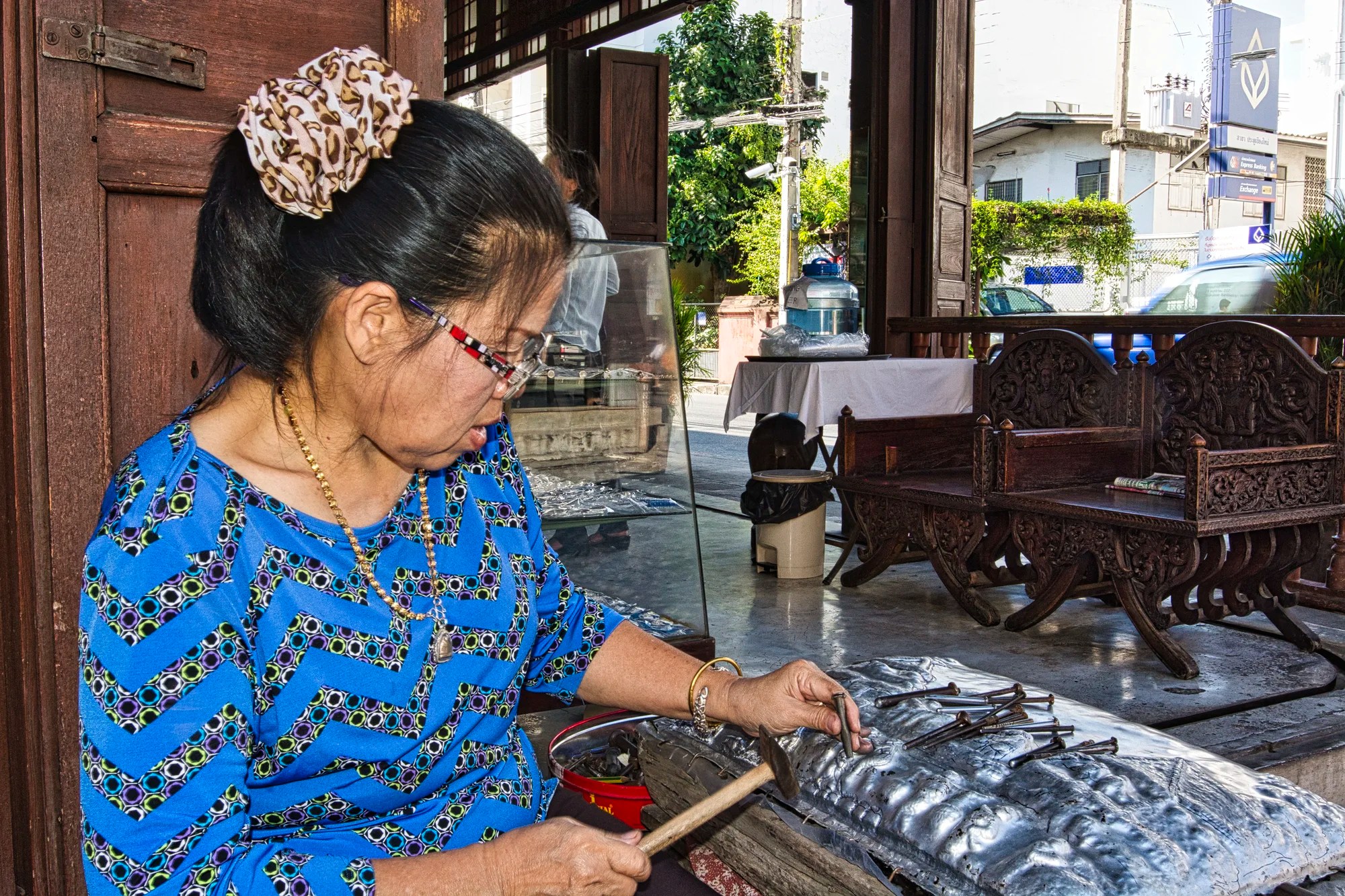
Back on Wua Lai Road in the silver district, we stopped at a silver shop to admire the artifacts for sale. We watched a silversmith perform repoussé work.
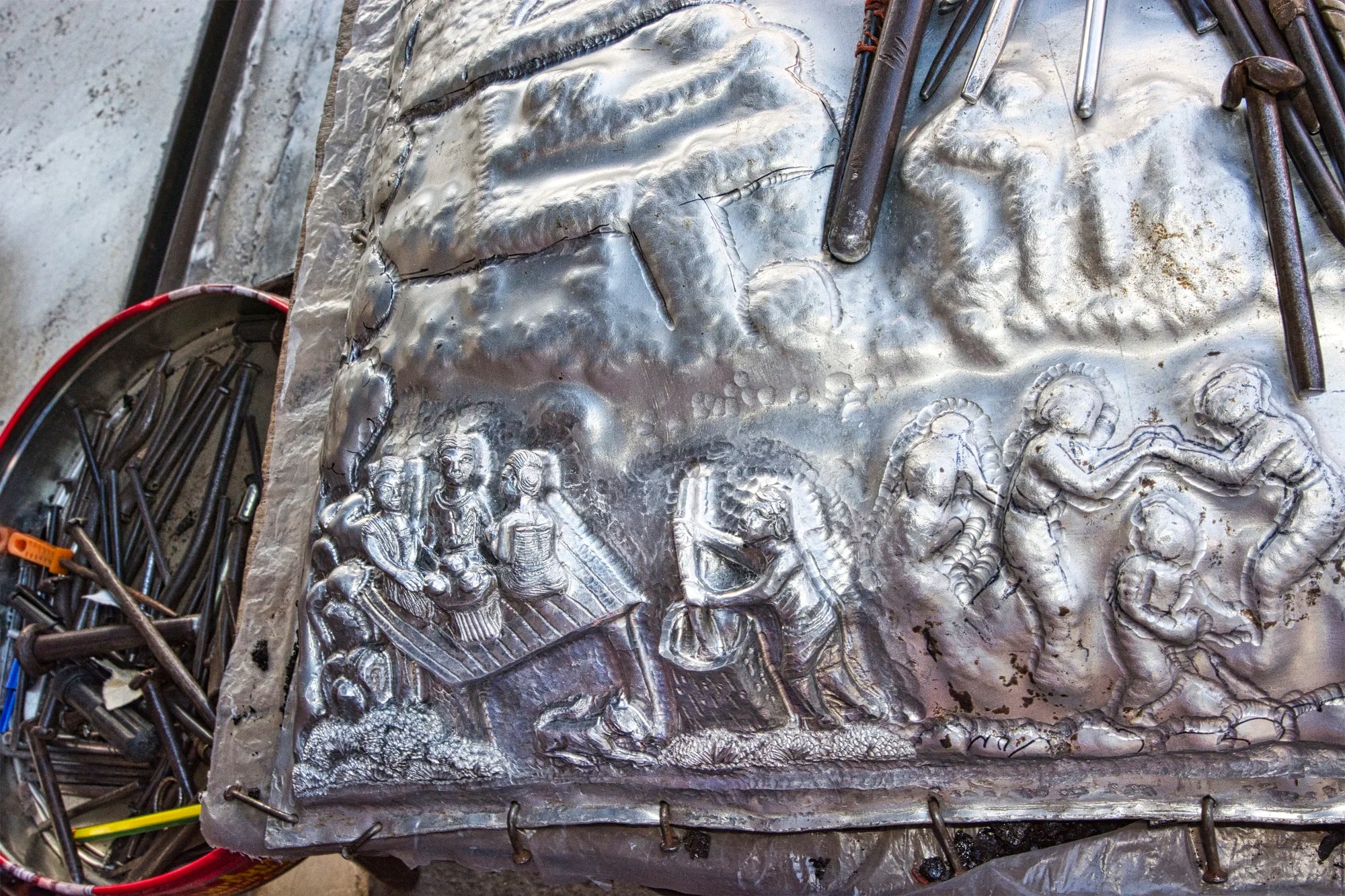
This is a metalworking technique where malleable metal is shaped by hammering on the reverse side to create a bas-relief. Embossing is where the metal is hammered on the front side to depress the metal. The two techniques are used in conjunction.
Night Delights
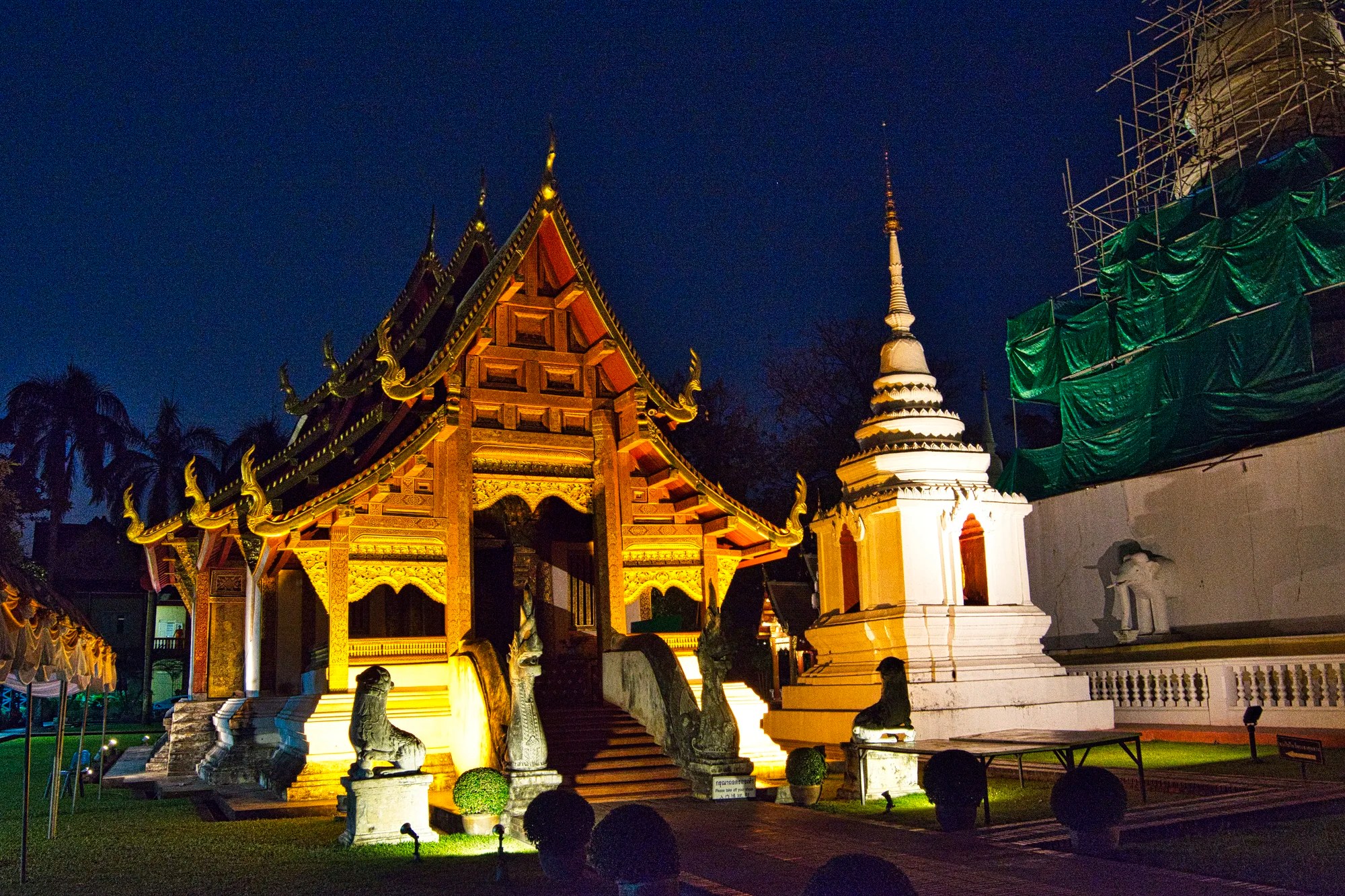
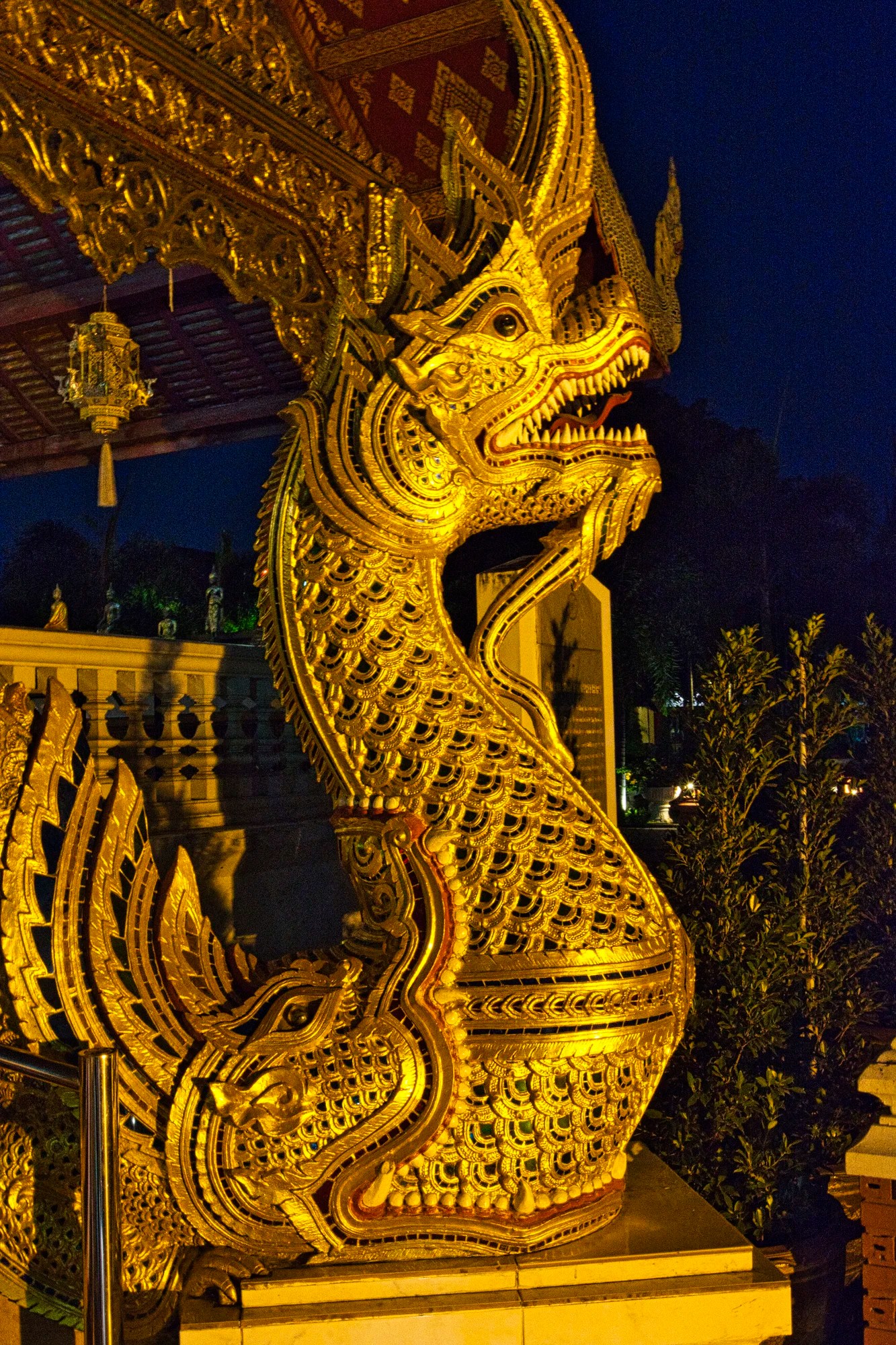
Be sure to visit the Thai temples at night when they are lit up. These photos were taken at Wat Phra Singh.
Final Comments
We hope this post will encourage you to visit intriguing Chiang Mai and learn about Thai temples and culture.
Subscribe
Please subscribe to Terra Encounters because we offer valuable insights to improve your understanding and enhance your travels. We offer itinerary-based guides packed with the best sights and hidden gems. Let our knowledge help you fully appreciate every moment of your amazing journey.
Get travel tips and advice delivered directly to your inbox. The best part is that it is free.
This was only a taste of Chiang Mai. What questions do you have? If you have been to Thailand, share your experiences with us. How long is/was your trip?
Itinerary Map & Resources
TH is the ISO Country Code for Thailand; THB is the ISO Currency Code for Thai Bahts. THB 100 = CAD 3.84, EUR 2.62, GBP 2.27, USD 2.81
Google Maps Ratings
Google Maps provides a rating from 0 to 5 for all sights, hotels and restaurants (but not cities). All of our recommendations are appended with the rating (prefixed with a G) from Google Maps. As it is based on feedback from tourists and locals, it is much more reliable than travel booking websites. We consider a score of 4 to 4.39 to be Very Good; 4.4 to 5 to be Excellent.
Other Places to Add to Your Itinerary
There are many more wats to visit in central Chiang Mai that we did not mention. There are also two places that are outside the city centre: Wat Suan Dok and Wat Doi Suthep, which are better visited as part of a tour of the national parks just north of the city.
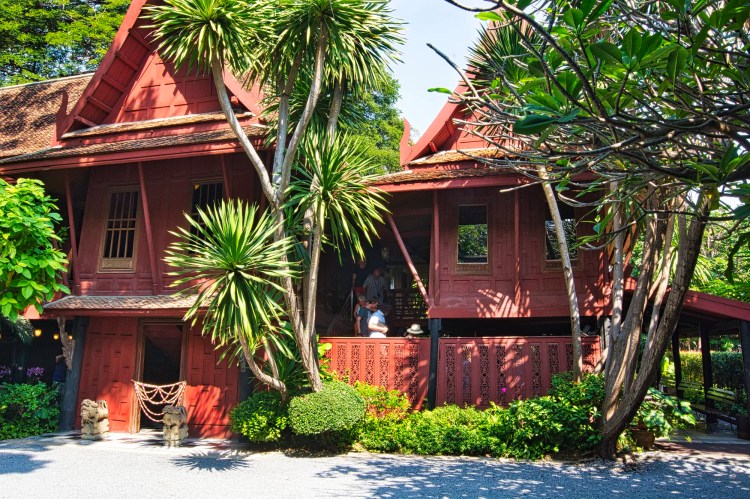

Thai Symbolism and Culture
Understanding symbolism is essential to maximizing your appreciation of Thai art and architecture and preventing the Templed Out syndrome. There is also a lot of terminology that will overwhelm you when you visit Thailand (or any Asian country).
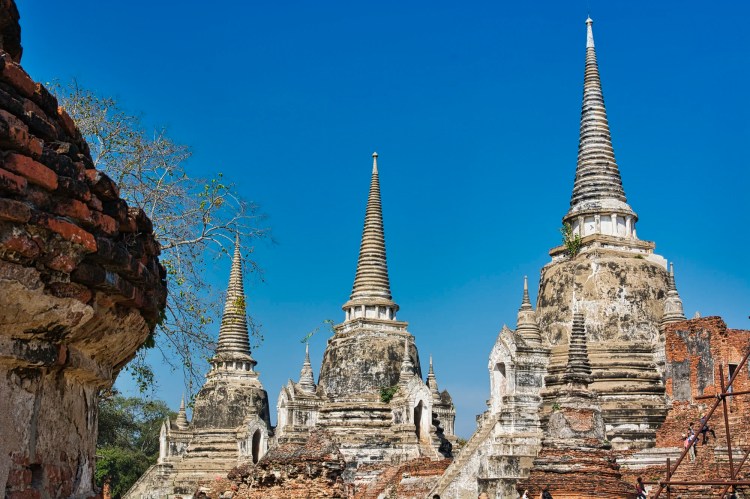
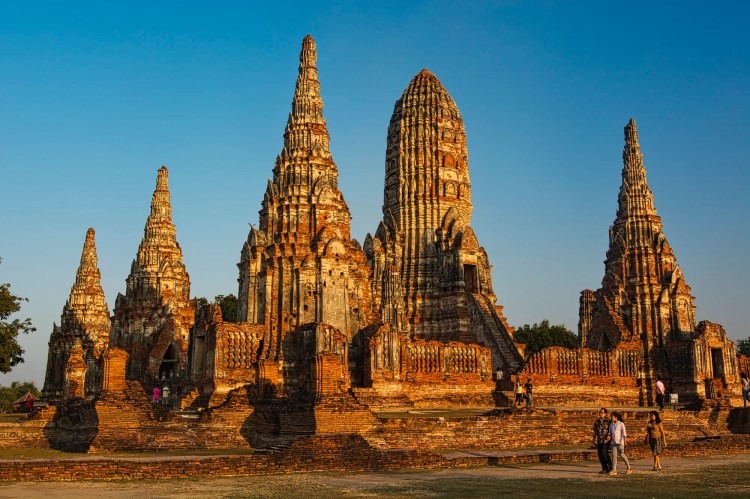
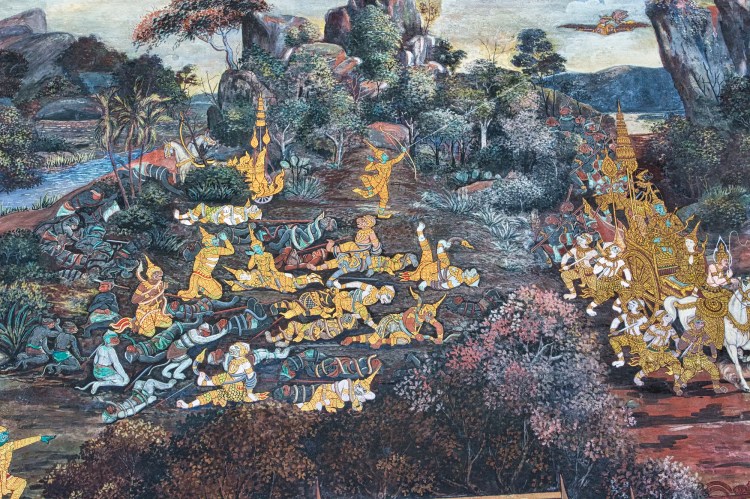
When is the Best Time to Visit?
Based on average maximum temperatures from NOAA:
| Month | Season | Max Temp | Rain Days |
|---|---|---|---|
| Nov-Feb | Cool | 30 to 33°C | Nov = 4 |
| Mar-May | Hot | 34 to 35°C | 5 to 13 |
| Jun-Oct | Rainy | 31 to 33°C | 9 to 17 |
The data supports the fact that November-February is the best season to visit.
Is Thailand Safe?
According to the Numbeo Safety Index, Thailand is a very safe country.
 Terra Encounters
Leave a comment