
Why go to Dinosaur Provincial Park?
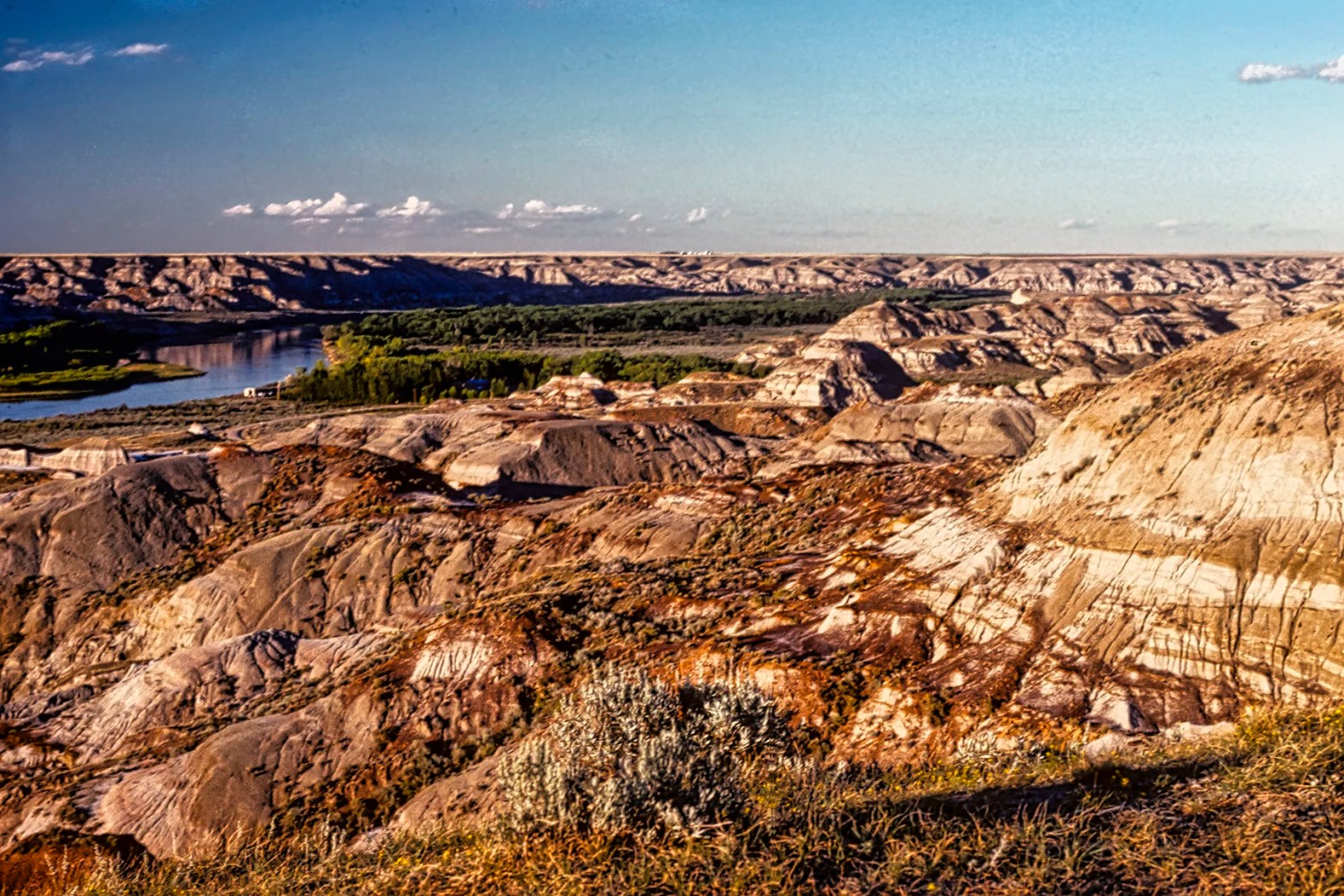
Have you planned on visiting Dinosaur Provincial Park (DPP)? If not, you are missing out on one of the best places to see in Alberta; indeed, it is one of THE must-sees in Canada! Here you can view a stark landscape that is so different from the stereotype of Canada.
Plus, it is a great place for an adventure as a fossil hunter. Contrary to some American-centric websites, this is the best place to find dinosaur bones. Here you can imagine herds of dinosaurs roaming. Except, you would be wrong because Canada then was a lush tropical paradise (for dinosaurs).
Author & Photographer: George Mitchell

Our recommendations are based on our extensive experience living in Alberta. We are avid hikers, nature lovers and photographers (all photos are my own). We were frequent visitors to DPP when we lived ten years in Alberta.
All of our recommendations are top-rated by Google Maps Ratings, which is based on everyone, not just tourists. Each place recommended in our custom Alberta Itinerary Map is appended with a Google Maps Rating (G0 to G5).
Driving to Dinosaur Provincial Park
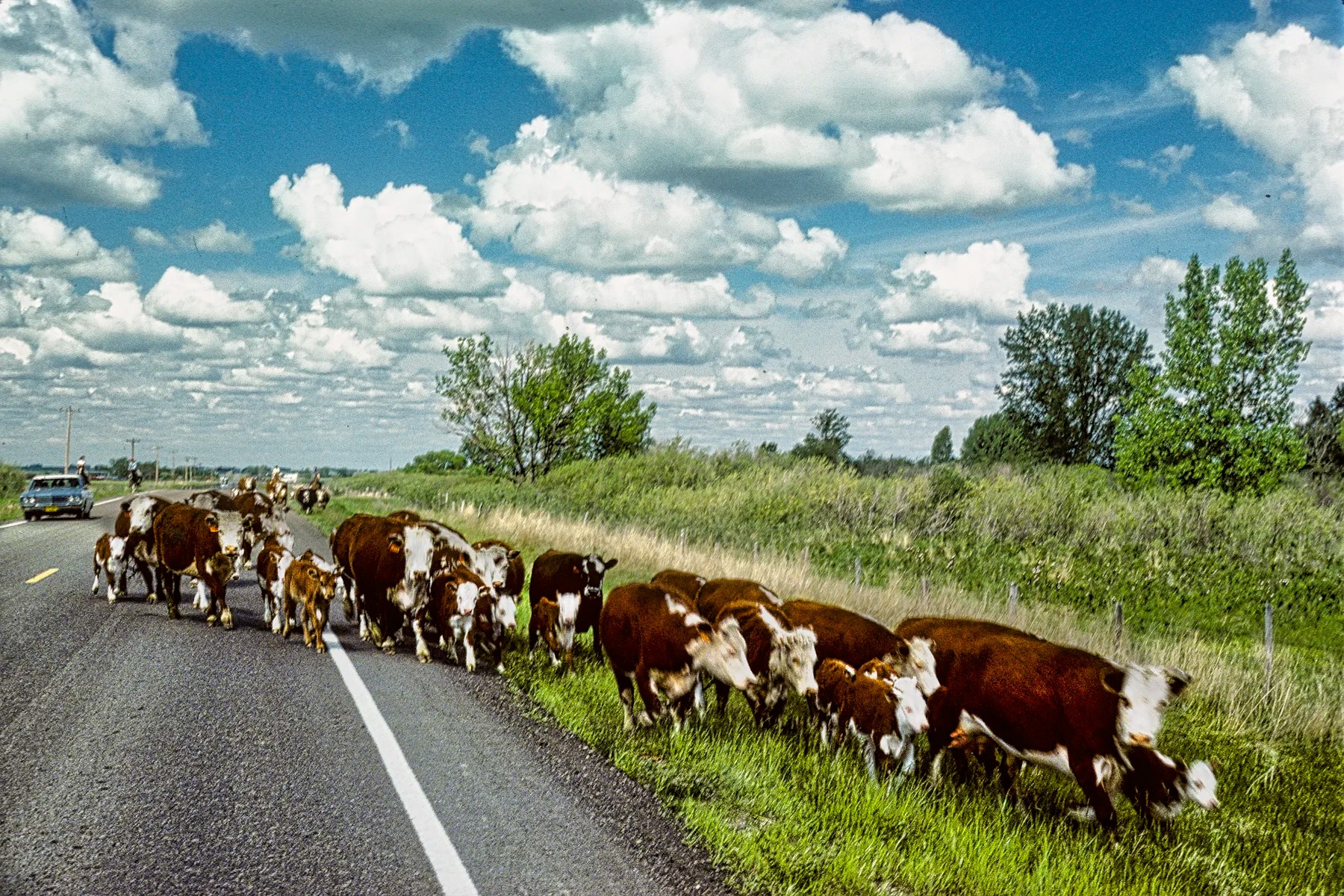
To get to Dinosaur Provincial Park, you have to get off the Trans-Canada Expressway at Brooks, Alberta and drive 48 km along a small highway. You pass through typical cattle farmland — Alberta is famous for its beef. It’s so flat and pastoral.
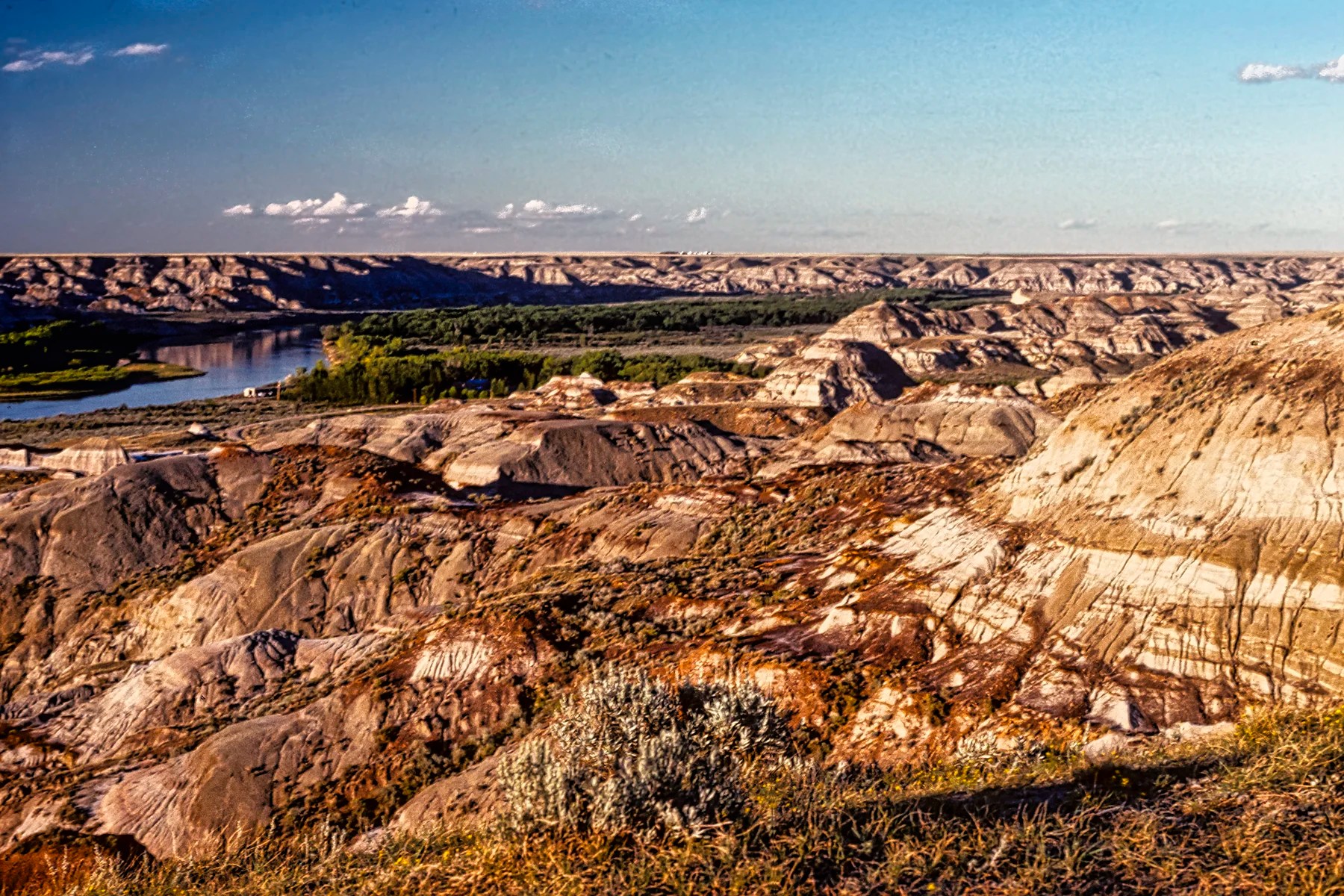
Suddenly, you reach a viewpoint at the signed park boundary where the prairies disappear into a canyon and an other worldly scene stretches before you.
5 Reasons to Visit Dinosaur Provincial Park
1. There are many dinosaur parks in North America, but there is only one Dinosaur Provincial Park (DPP). The first reason to visit is that this is the mother of all dinosaur digs and a must-see for all of you who were fascinated with dinosaurs when you were kids… or adults.
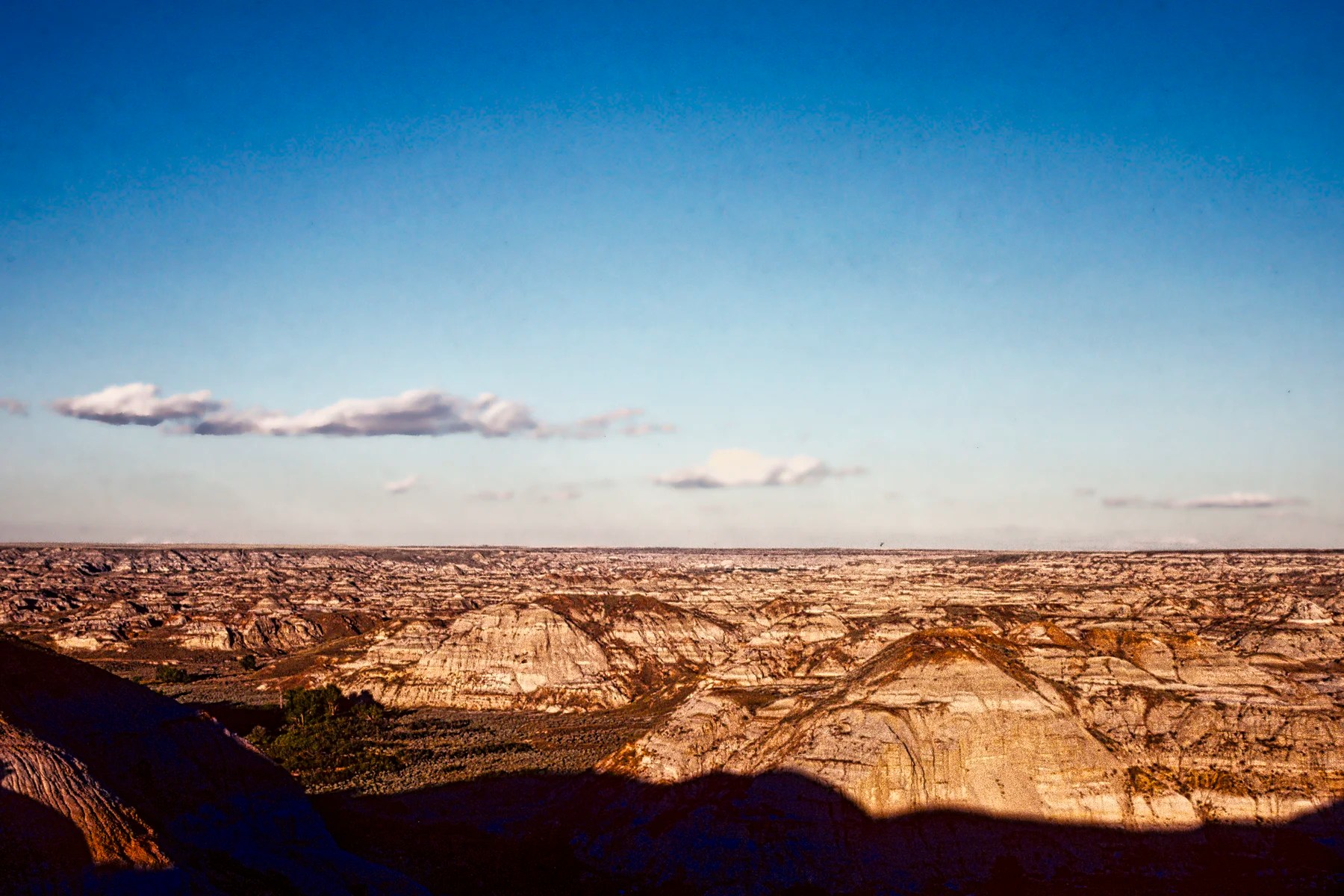
2. It is a photographer’s dream landscape. While it is arid, there is vegetation and the trees along the Red Deer River. It is riddled with creme-coloured buttes covered by red-purple sprinkles.
3. This is Canada’s mini Grand Canyon, located below ground level of the prairies. The canyon is like an oven, providing a very hot microclimate. It is hard to believe that 75 million years ago, this was lush and subtropical. The Red Deer River Valley within the park is 27 km (17 mi) long, 6.4 km (4 mi) wide, and 100 metres (325 feet) deep
4. DPP is one of the best places to find dinosaur bones in the world, which is why it has been a UNESCO World Heritage Site since 1979. Five percent of the world’s known dinosaur species have been found here! Fifty-eight dinosaur species have been discovered, and more than 500 specimens have been removed and exhibited in museums around the globe.
5. But the best reason of all — DPP provides guided fossil safaris so you can find your own bones. Even if you gave up dinosaurs after age six, come here and you will reignite your inner fossil hunter.
It’s Cretaceous, not Jurassic
The film Jurassic Park is bad prehistory with lots of misconceptions. The main characters, Velociraptor and Tyrannosaurus, are not even found in the Jurassic Period, which ended 145 million years ago. The Jurassic world was mainly ocean-dominated by marine reptiles (ichthyosaurs, plesiosaurs) and flying dinosaurs (pterosaurs).
The scary meat-eaters are from the Cretaceous Period (145 to 65 million years ago)! The Velo is from Central Asia and is smaller. The movie was actually based on the Deinonychus (meaning terrible claw), a bigger version of the Velo found in North America. These pack hunting raptors are the scariest creatures.
Why are they called Badlands?
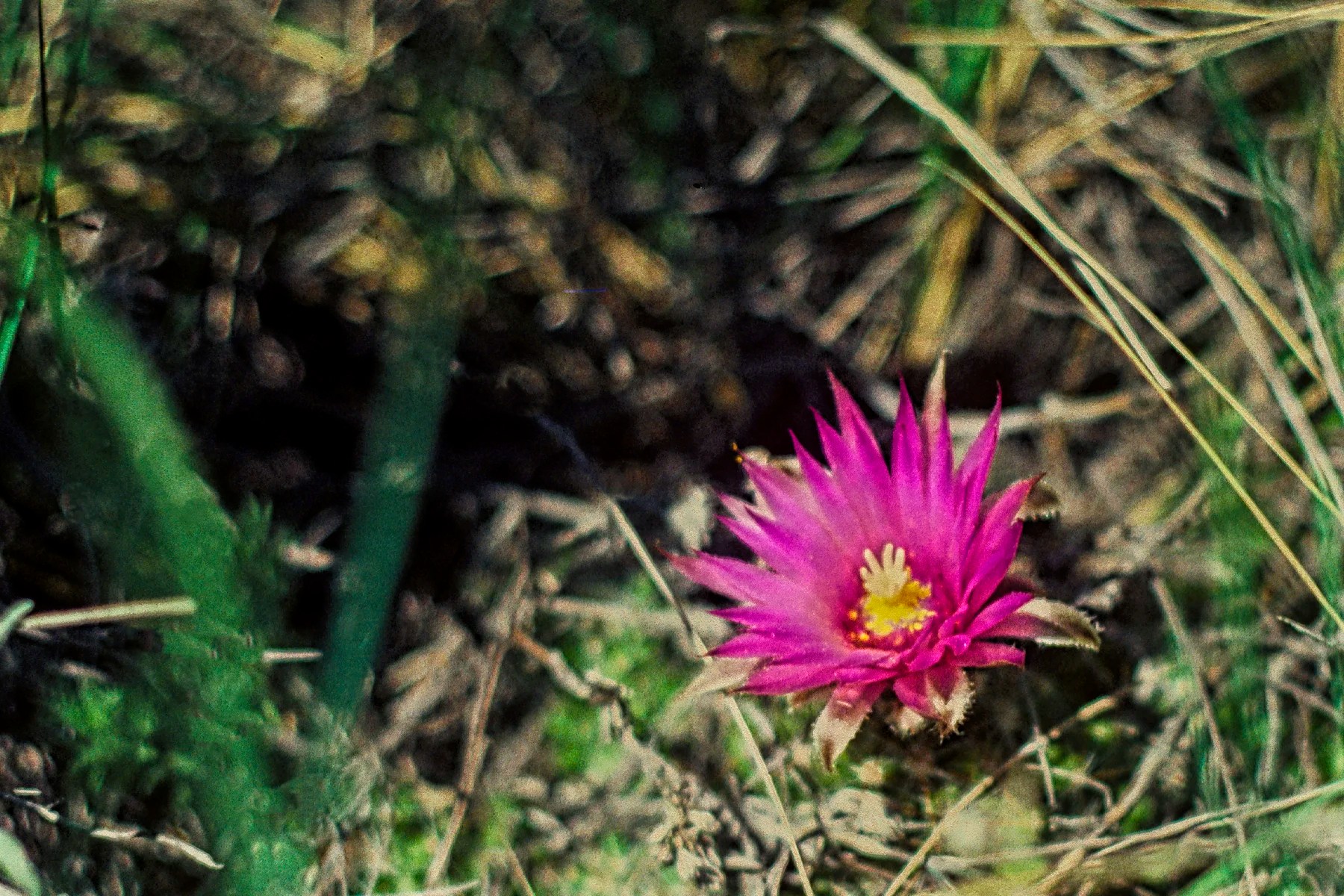
The settlers called this the badlands because it was not suitable for farming. Smaller species of cactus are everywhere, including Opuntia (prickly pear) and Pediocactus (pincushion). They bloom in late June.
Since they are small, watch where you walk, and please don’t wear flimsy sandals. One time when we visited, cactus spines painfully pierced a tourist’s running shoes. We had no idea they could pierce such a thick sole. In fact, you are not allowed to wear sandals, flip-flops, or Crocs on any of the guided tours!
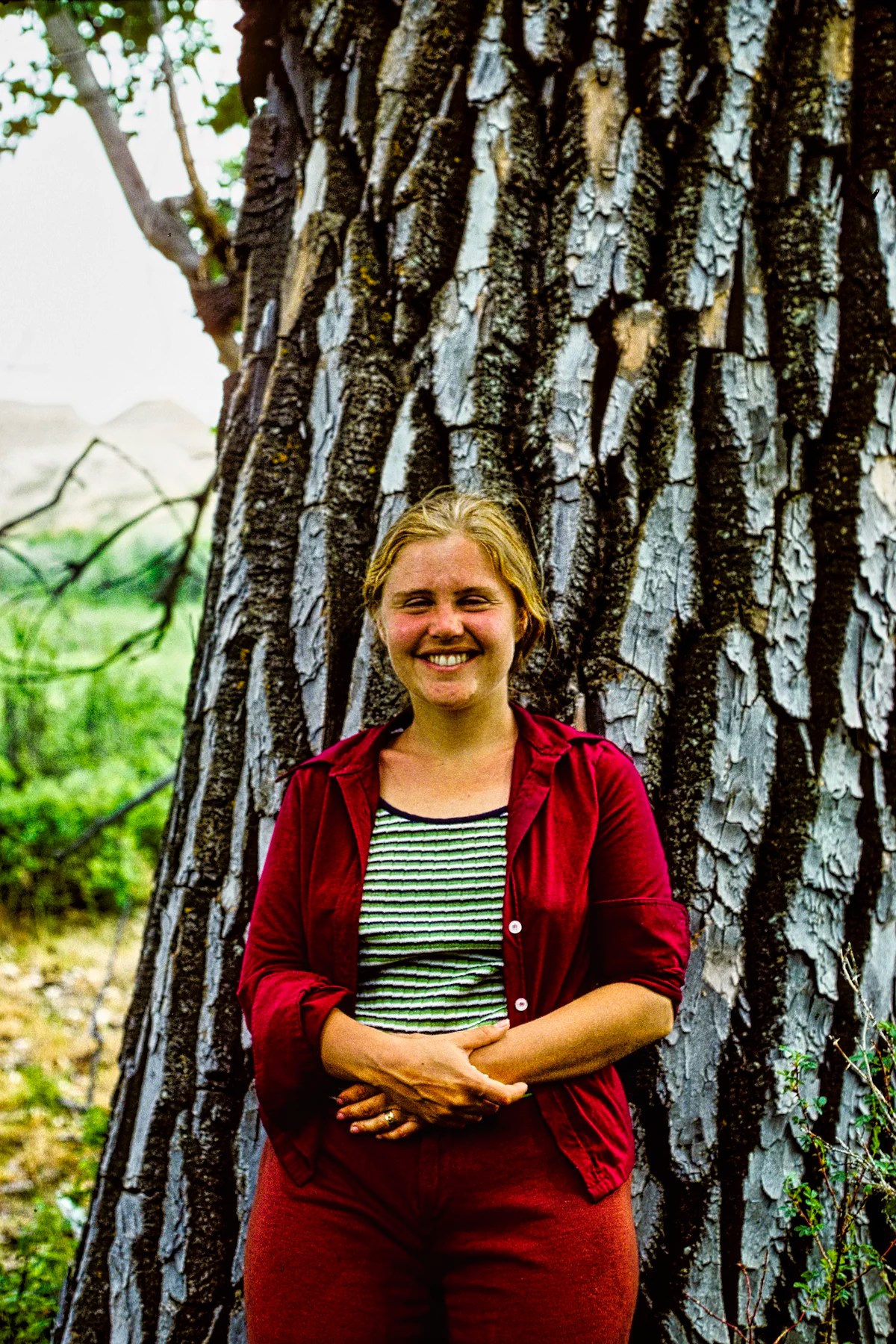
The mean annual precipitation is 40.6 cm (16 in), most rain falling in the late spring. By definition, a desert is a place that receives less than 25 cm (10 in) of annual precipitation. DPP is not a desert as it has cottonwood trees and other vegetation. The cottonwood trees not only have a large girth with deep grooves, but they also grow 30 m (100 ft) tall. They give shade to the campground area. Two other interesting facts are that they are one of the fastest-growing trees in North America and that there are male and female trees!
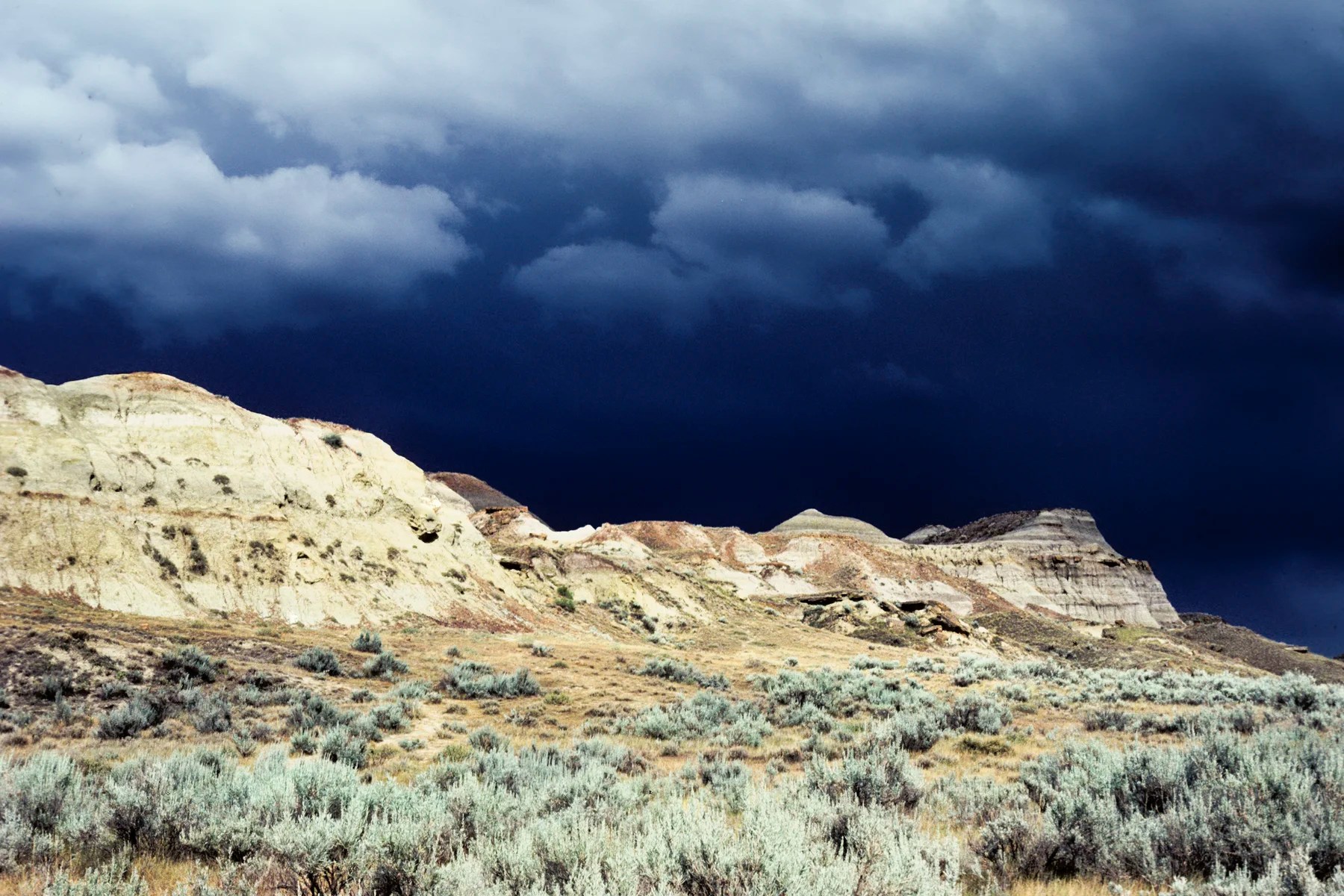
But when it rains, the lightning is dramatic. The desert blooms.
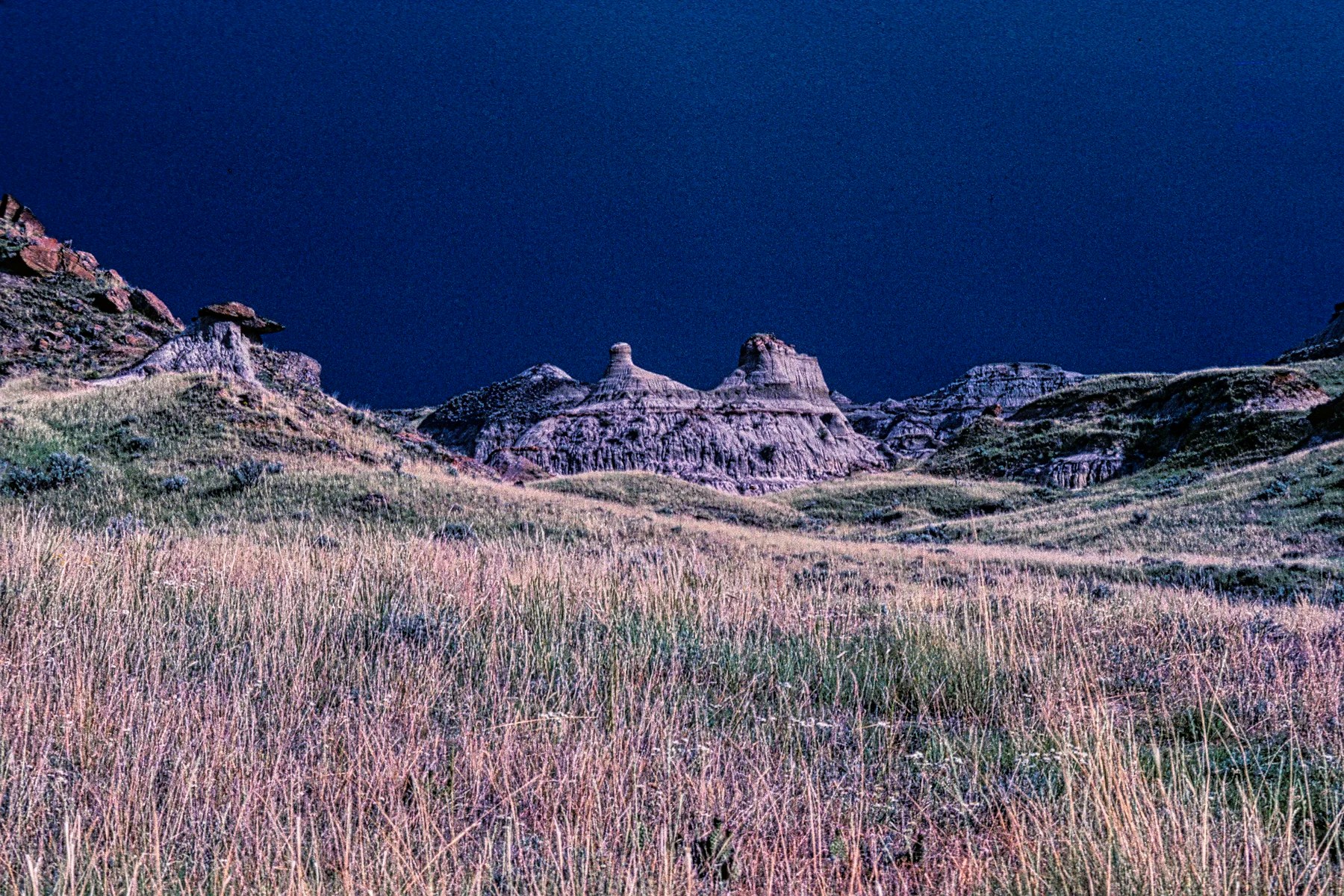
Prehistoric rivers carried sandstone and mudstone sediments to the interior sea, which covered the Prairies (Midwest) region of North America.
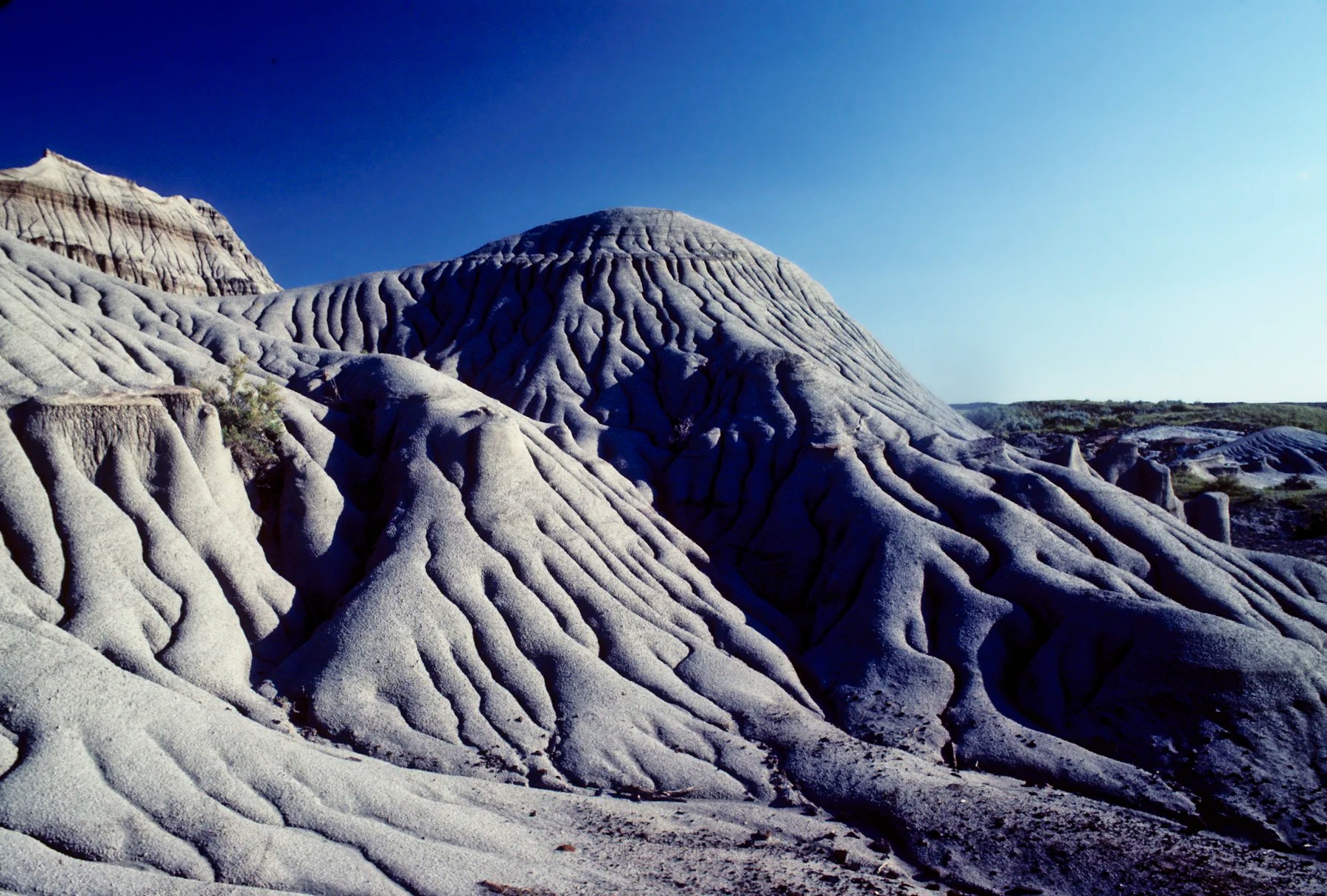
The melting glaciers of the last Ice Age carved the hoodoos and gullies characteristic of the region. If the climate was wetter everything would have already been eroded.
How are Fossils Created?
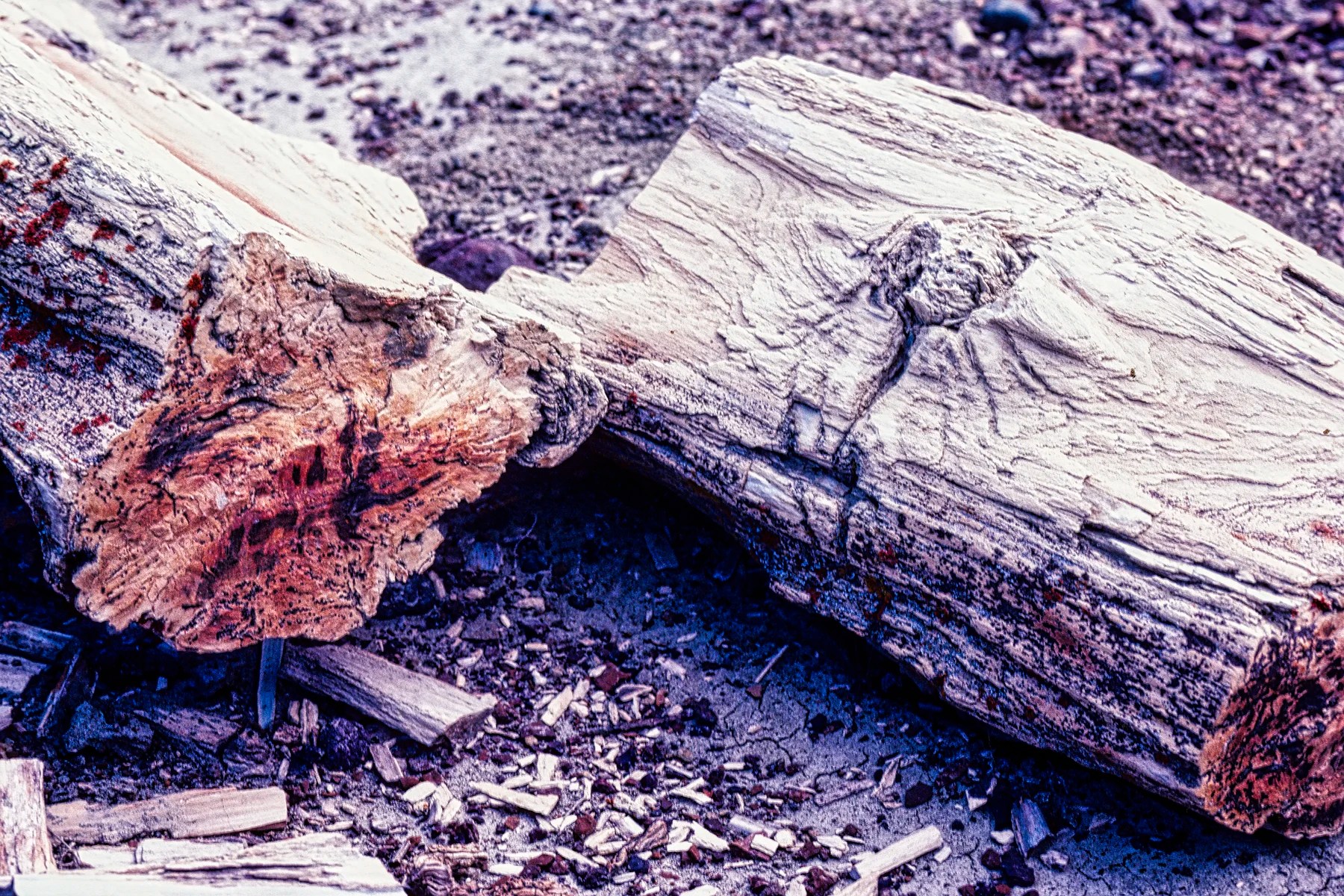
Generally, a skeleton or tree needs to be covered by sediments and dissolved by mineral-rich water. Organic material decays and is filled with minerals, sometimes cell by cell. In the case of this tree fossil, we can see every contour was replaced by minerals. The fossilized rock completely mirrors the tree bark.
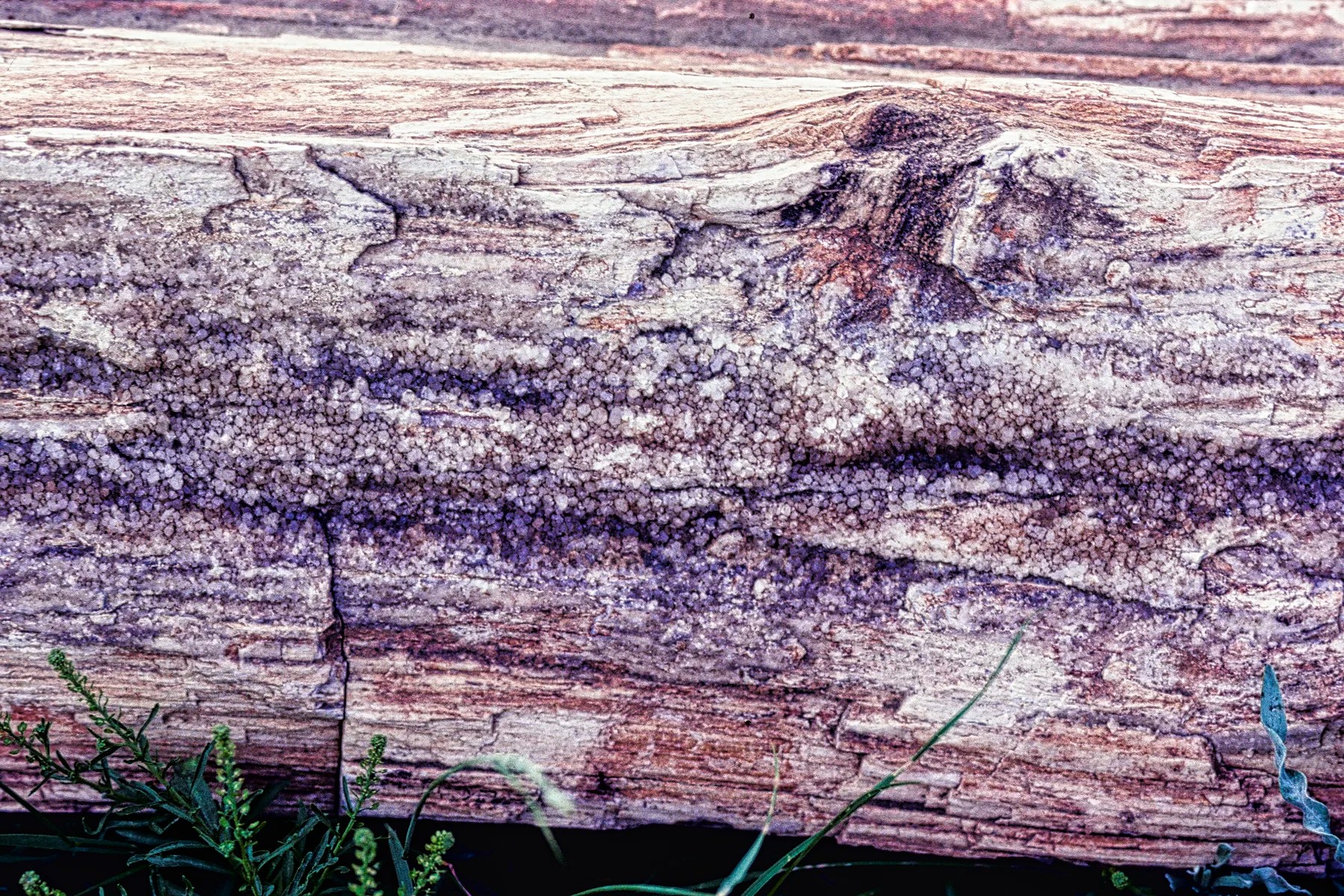
By contrast, the rotted centre is filled with silica crystals.
What are the Things to See or Do?
Fossil Safaris
No, you don’t get to go on a paleontologist’s dig, but there are a few interpretive programs that bring you to a bone bed. These walks are a must-do. You do not realize how much your inner self wants to find a fossil.
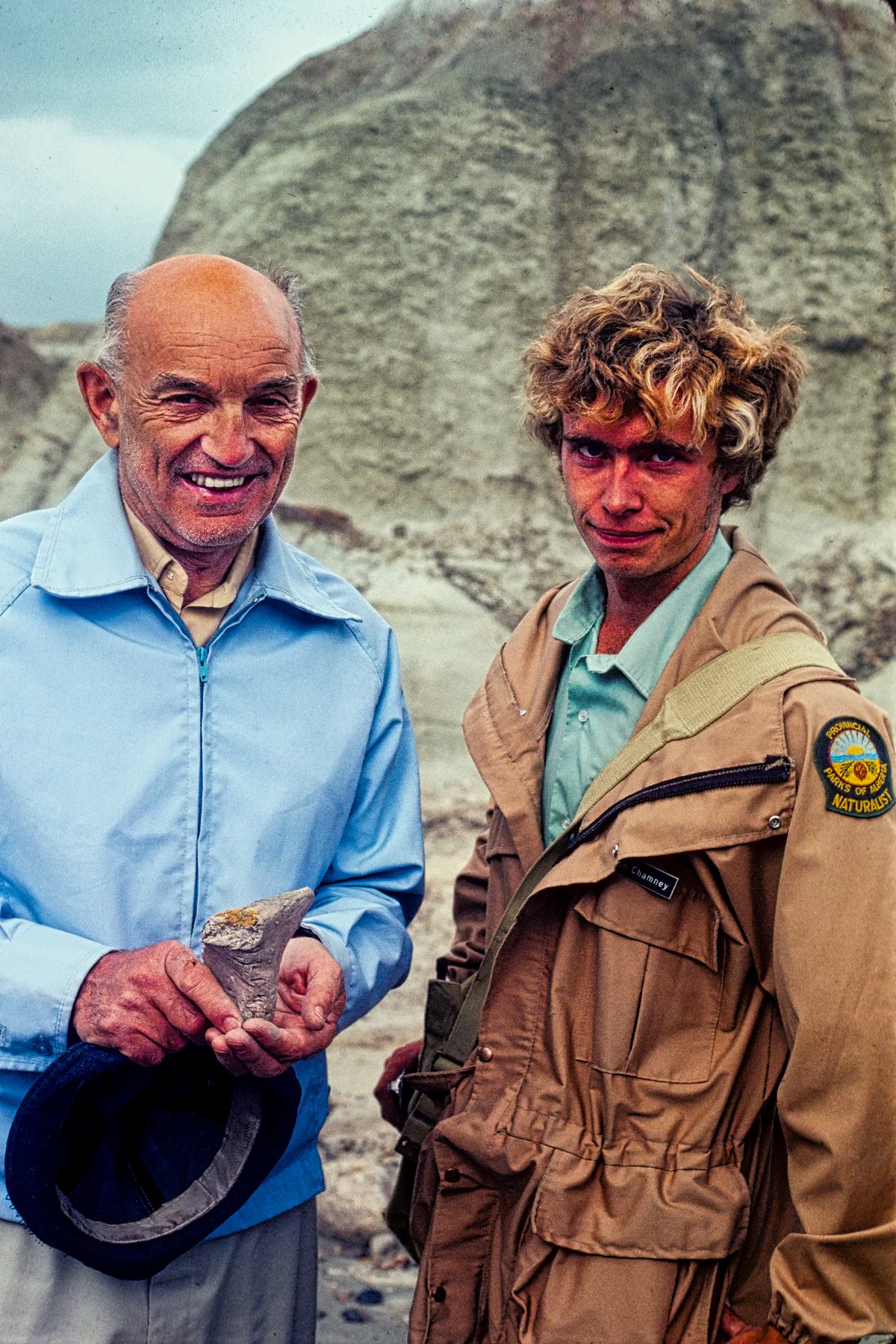
We visited DPP so many times, but we never found anything significant — only some bone fragments and fossilized wood. We brought my father-in-law once. and he found the base of a horned dinosaur! No, you cannot keep any fossil found anywhere in DPP. That is verboten. But you do get a certificate and, if significant, the fossil goes into the museum. Not bad for the ego!
Around the same time as the Klondike, the Bone Wars were a period of intense and ruthless fossil hunting in the United States, marked by theft and destruction of bones. By contrast, there was a friendly rivalry between the paleontologists who came to Dinosaur PP. Barnum Brown explored from 1910 to 1915 and discovered the first remains of Tyrannosaurus. Charles Sternberg prospected 1911–17 and, interestingly, immigrated to Canada. A third paleontologist was Canadian Lawrence Lambe, who discovered several hadrosaurs, such as the Edmontosaurus, named after the city of Edmonton. Some of the species that roamed DPP were:
- Ankylosaurus
- Triceratops
- “Duckbilled” Hadrosaurs
- Spinosaurus
- Iguanodon
- Albertosaurus, a smaller species of Tyrannosaurus
- Tyrannosaurus Rex
The Tyrannosaurus Rex was, in fact, one of the last non-avian dinosaurs to roam before the fifth Great Extinction Event at the end of the late Cretaceous Period.
Scenic Road Loop
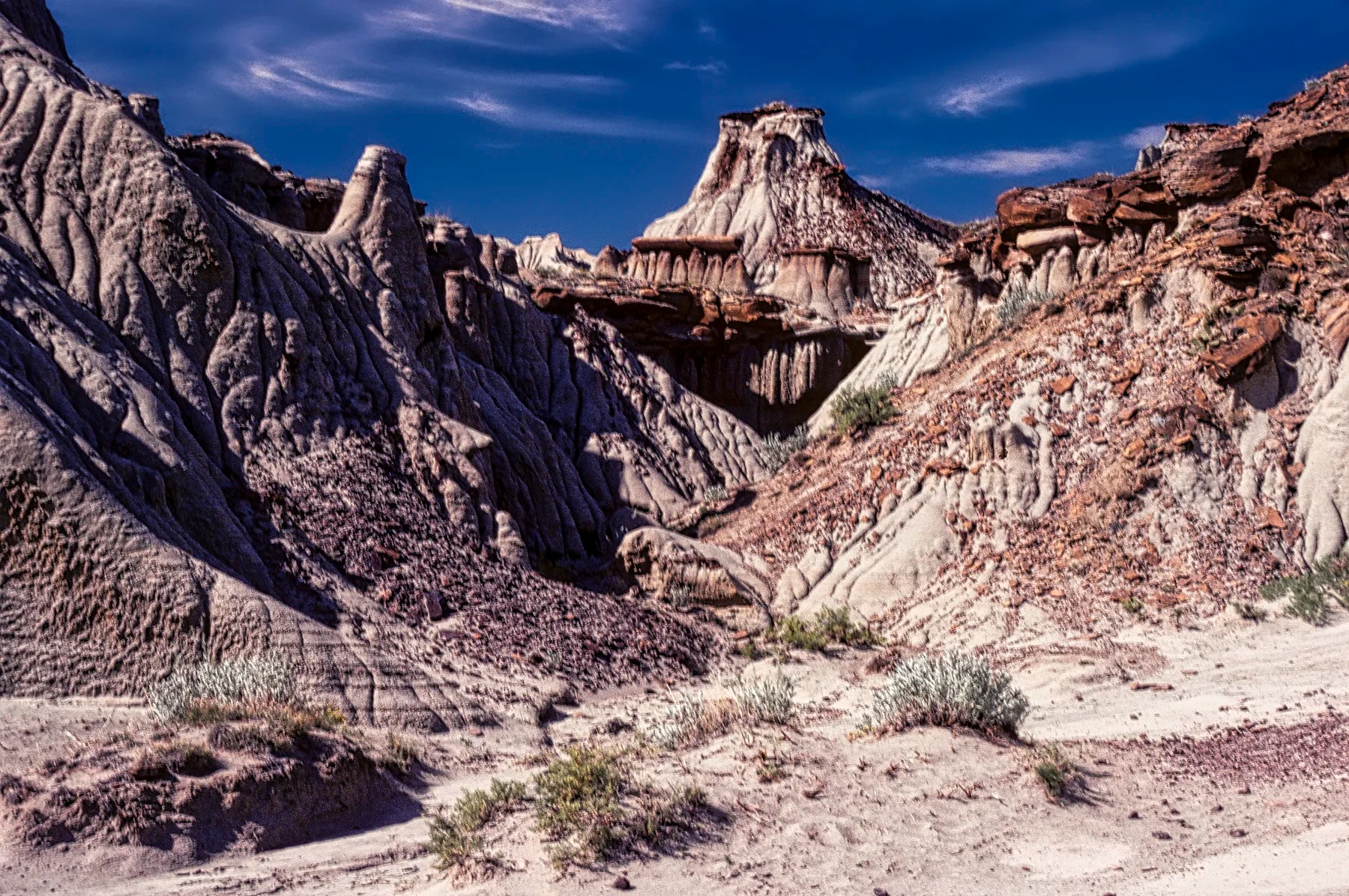
Note that 90% of the park is a restricted area and only accessible by guided tour. That leaves 10% where you can walk on your own, basically the area near the campground and within the loop road. There are quite a few hikes along the ring road, such as the Badlands Trail (1.3 km) and Coulee Viewpoint (0.9 km). There are two exhibits that contain half buried hadrosaur and a Dino dig in progress.
Guided Hikes
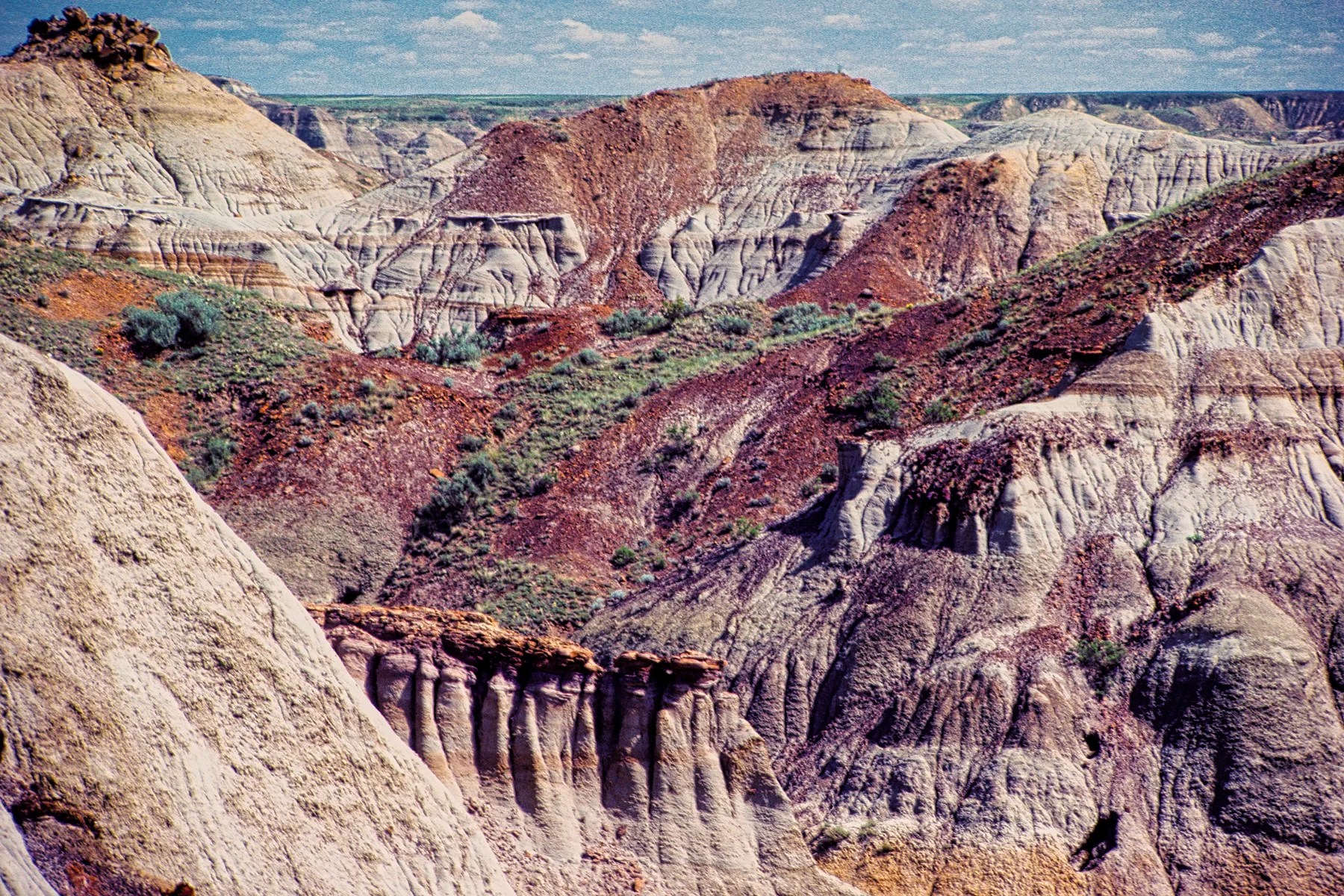
The restrictions are not only to protect the fragile area from trampling tourists. It would be easy to get lost, and there are no marked trails. Pretend you are in the scene above and gaze around you. Everything looks the same. The park contains 73 sq km (28 sq mi) with no landmarks! If you get lost, you have no idea where to go!
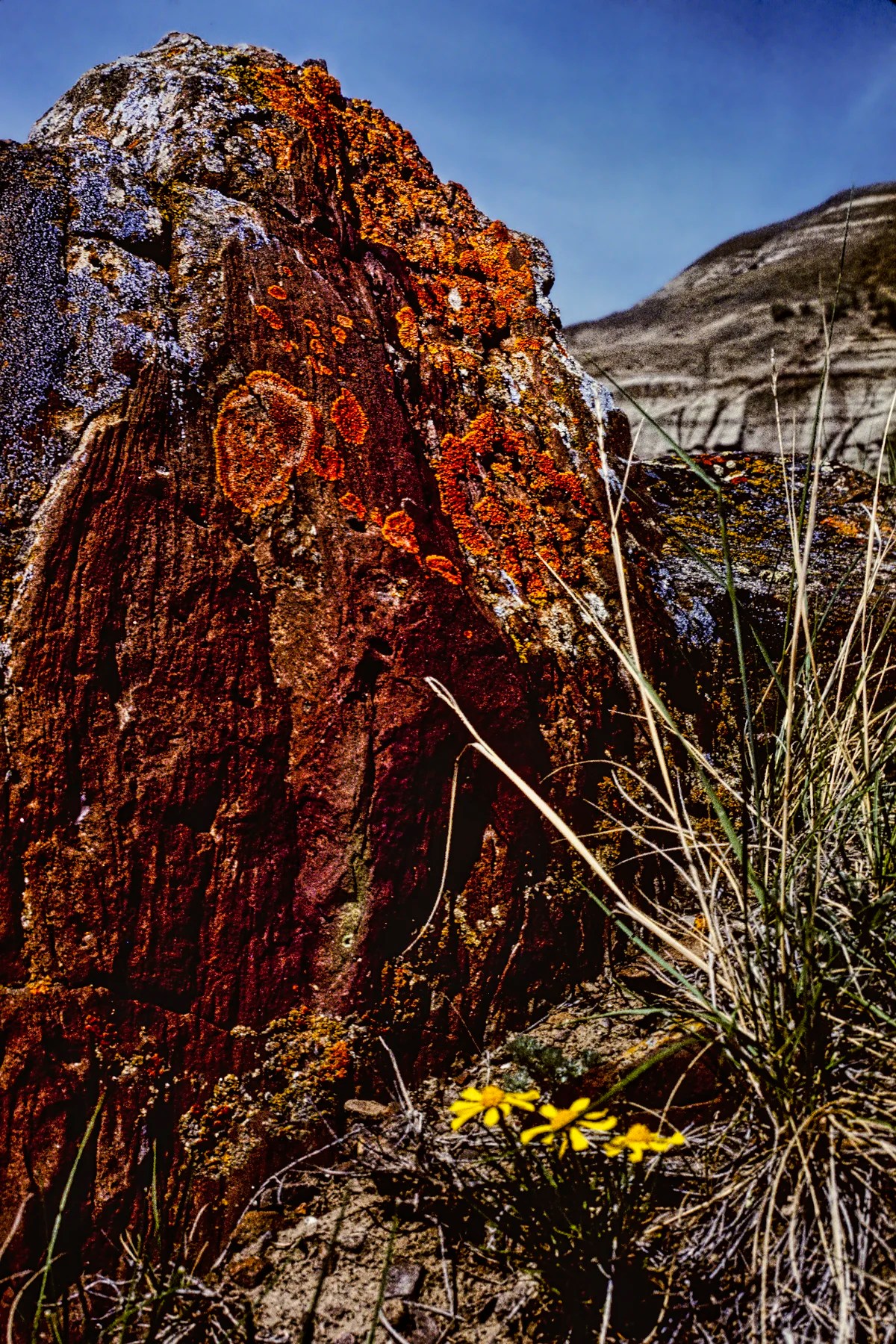
We know from experience! We were on one of the guided hiking tours. On the way back, we were at the end of the group. We stopped to take a photo of the burnt orange lichen.
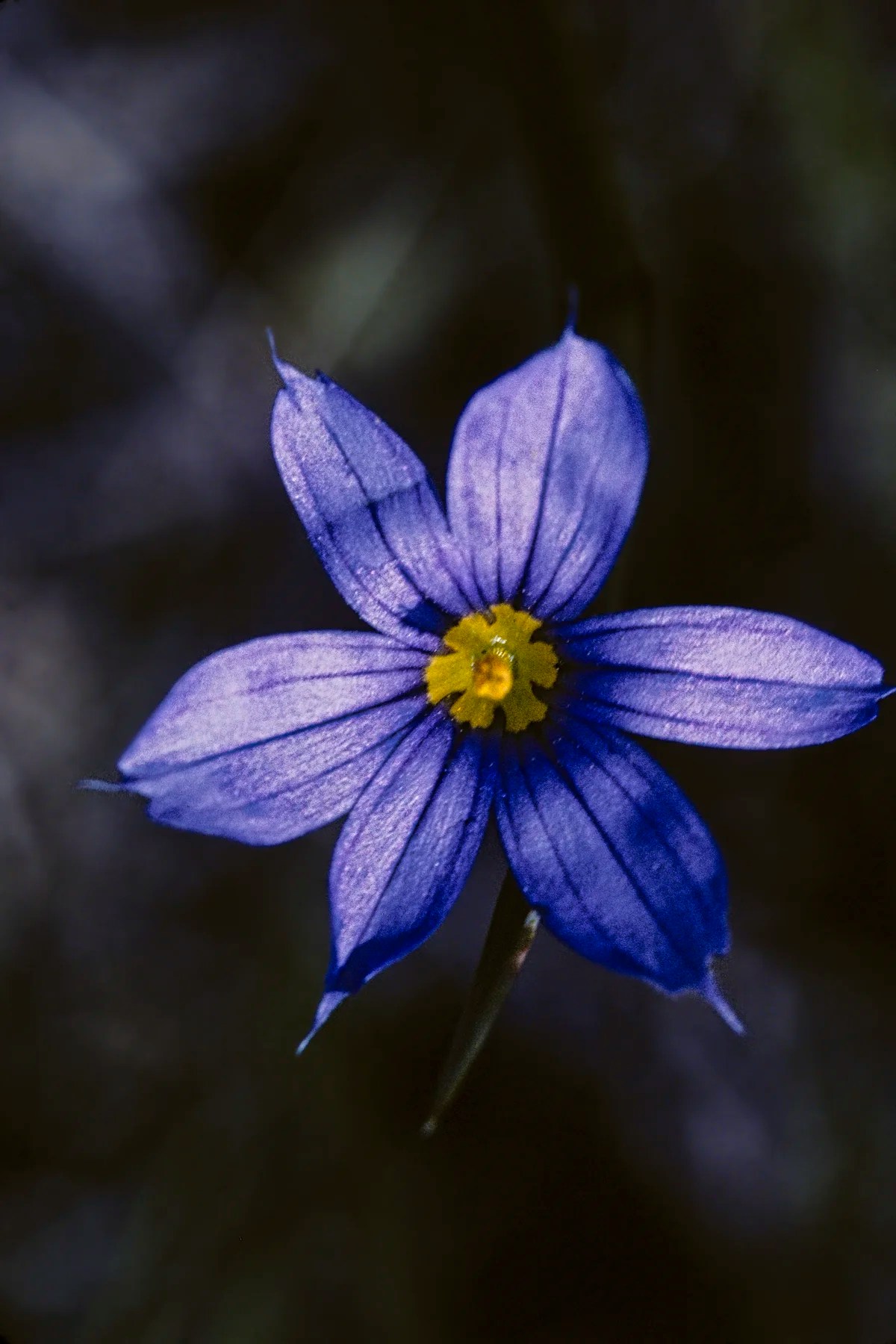
Then I took some flower photos. We looked up and there was no one to be seen. There was just a series of eroded hills that all looked the same. We were lost!!
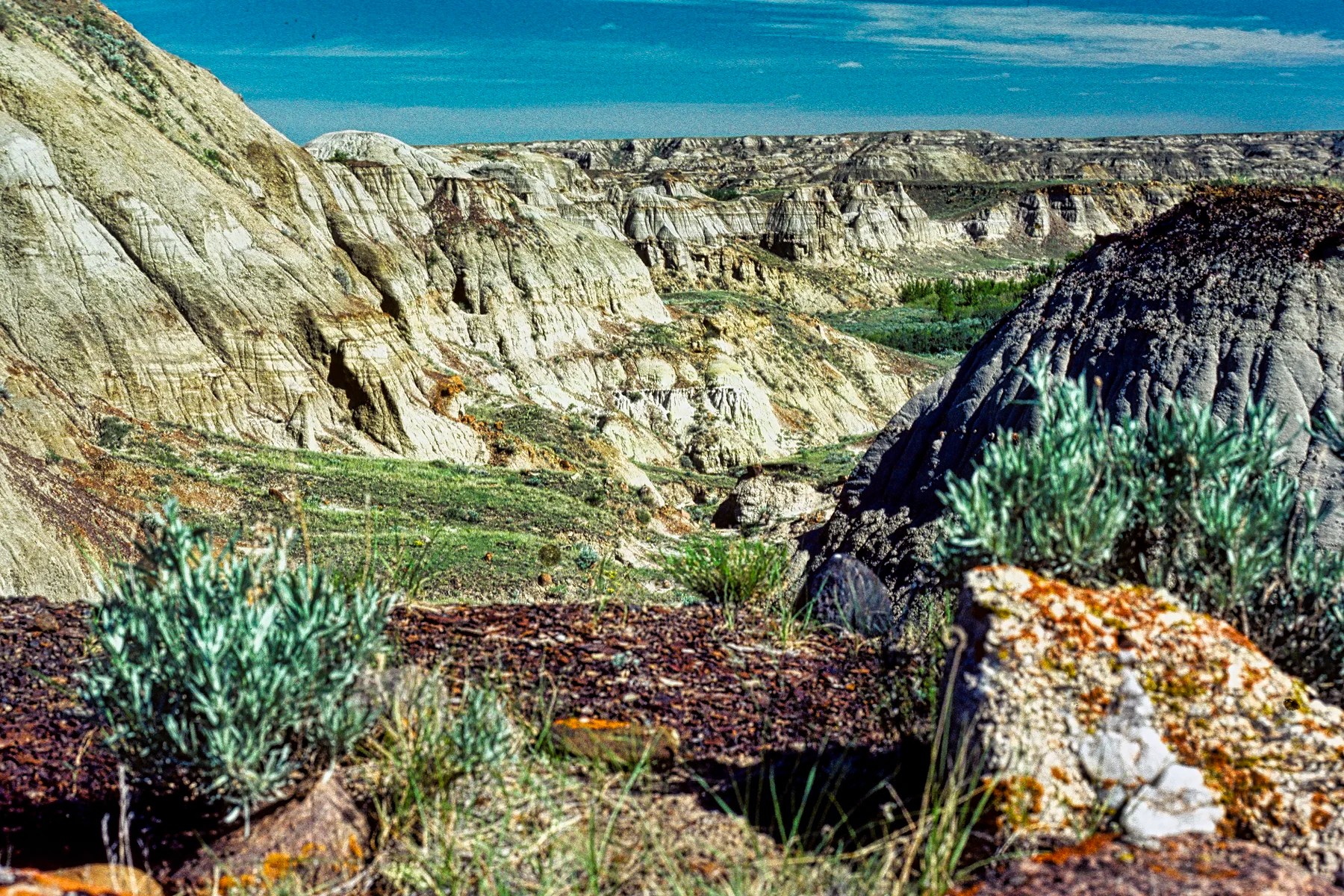
Fortunately, we had paid attention to a previous interpretive program. They said to look for the dried-out stream beds. Water always flows downhill, heading towards the Red Deer River.
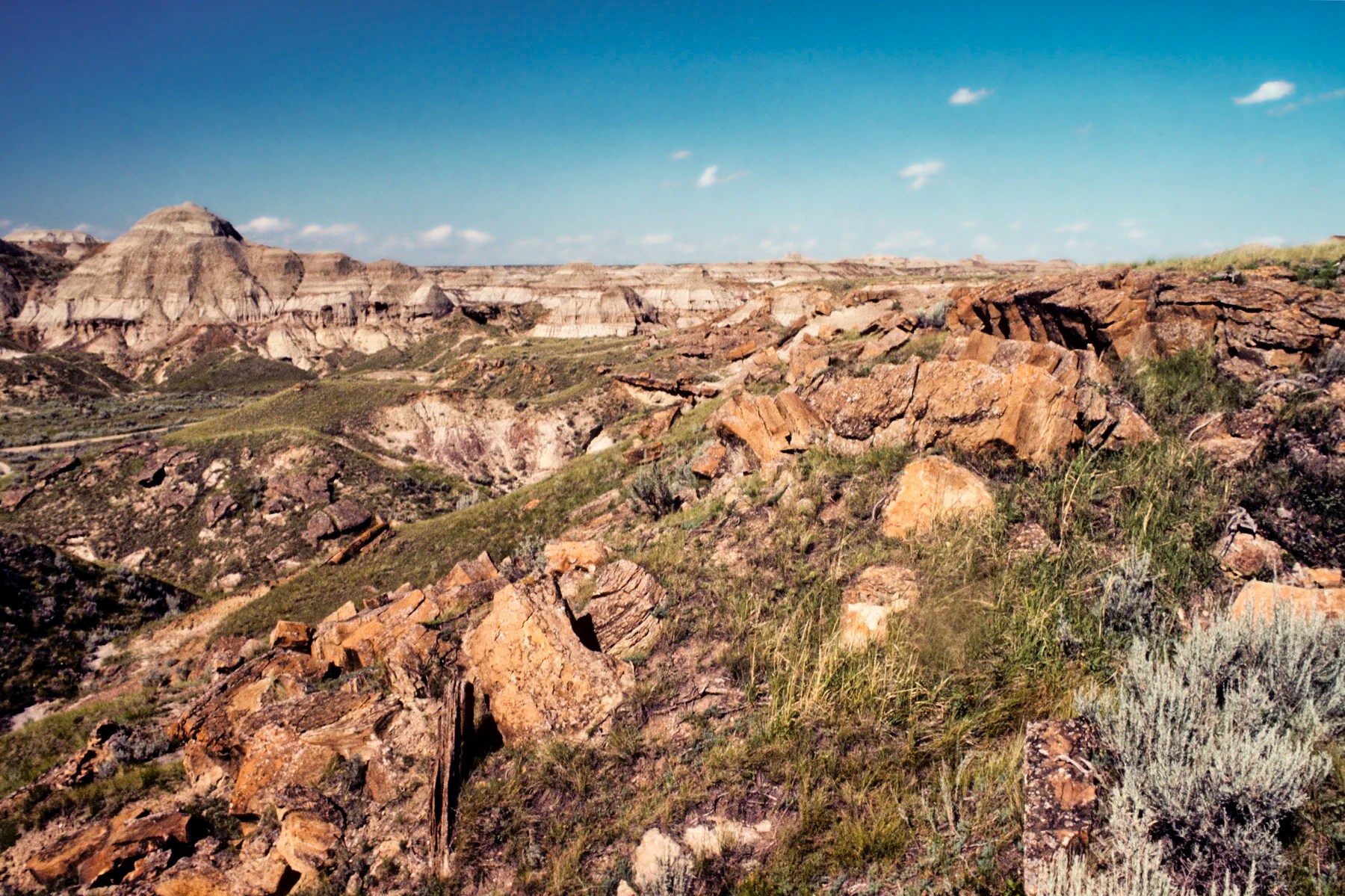
We followed the main dry bed downhill. We never caught up with the tour group! But we did get down to the ring road (left side of the photo above) with a big sigh of relief!
Explorer’s Bus Tour
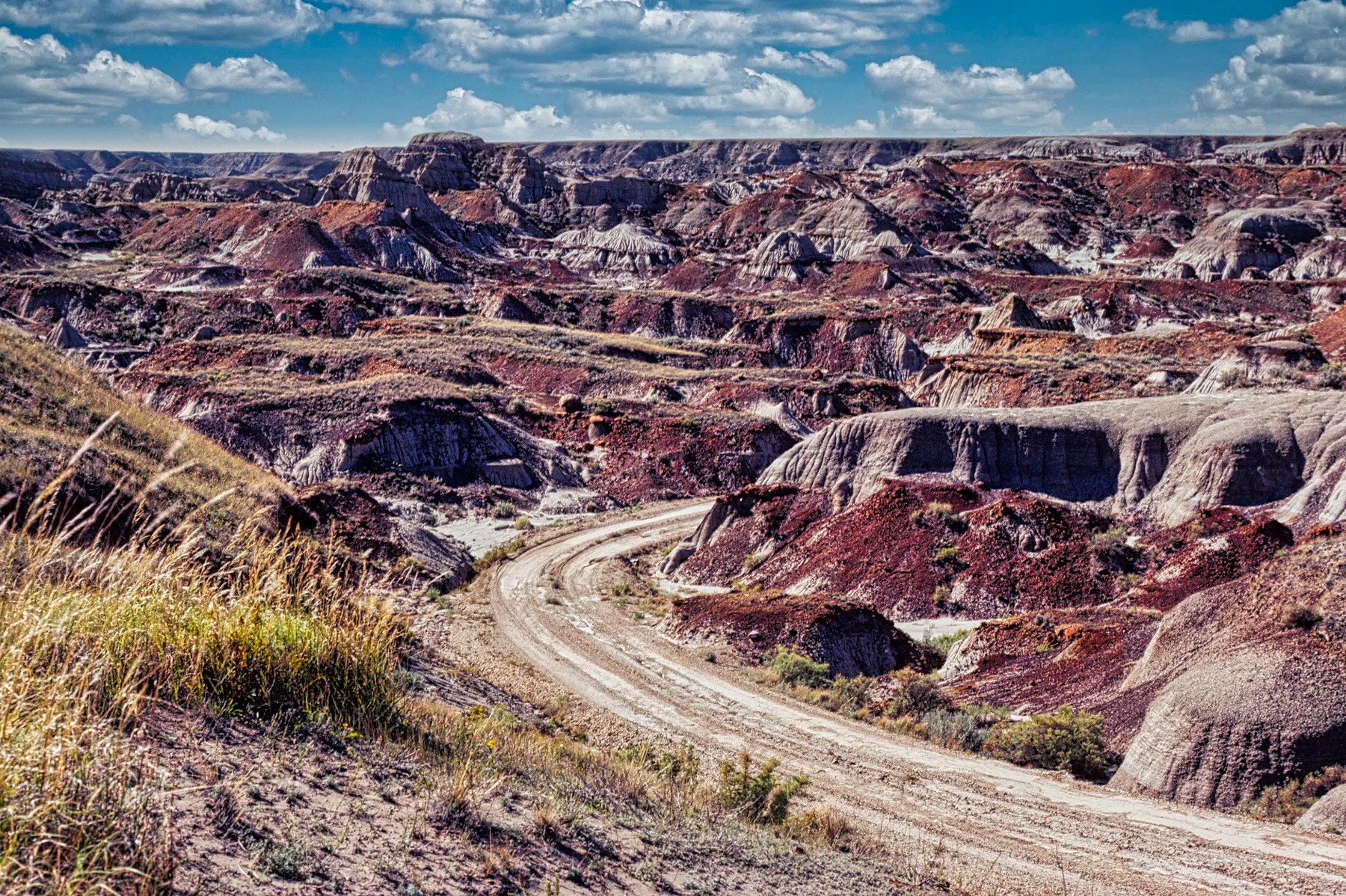
The other tour we loved used a minivan to travel through the restricted area. Today it is called the Explorer’s Bus Tour (2 hrs). It was quiet and peaceful travelling the dirt road. It is total wilderness.
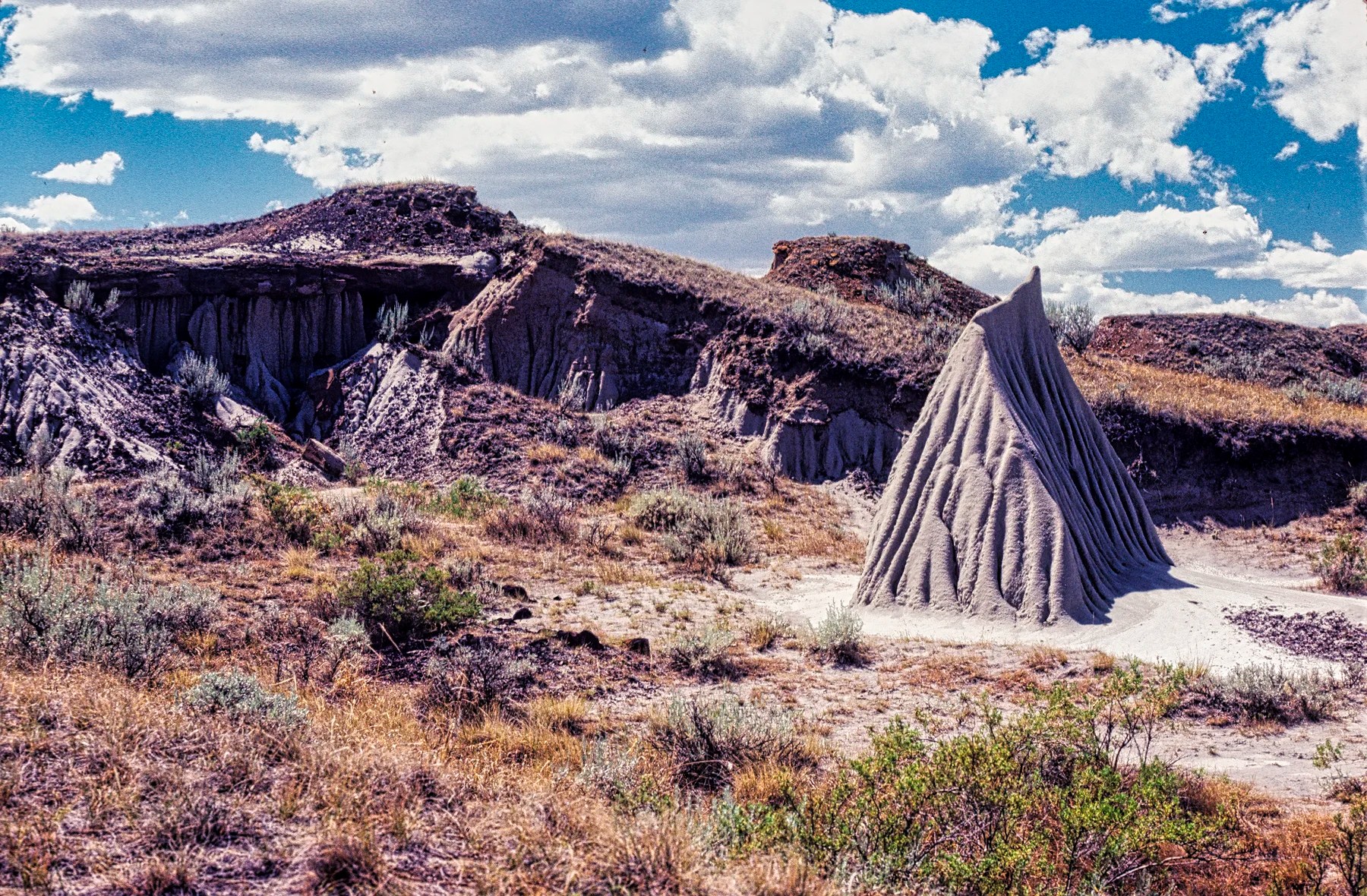
Our interpreters in addition to being educational, were very funny. Every formation was called Fred. There was Fred the Pyramid above.
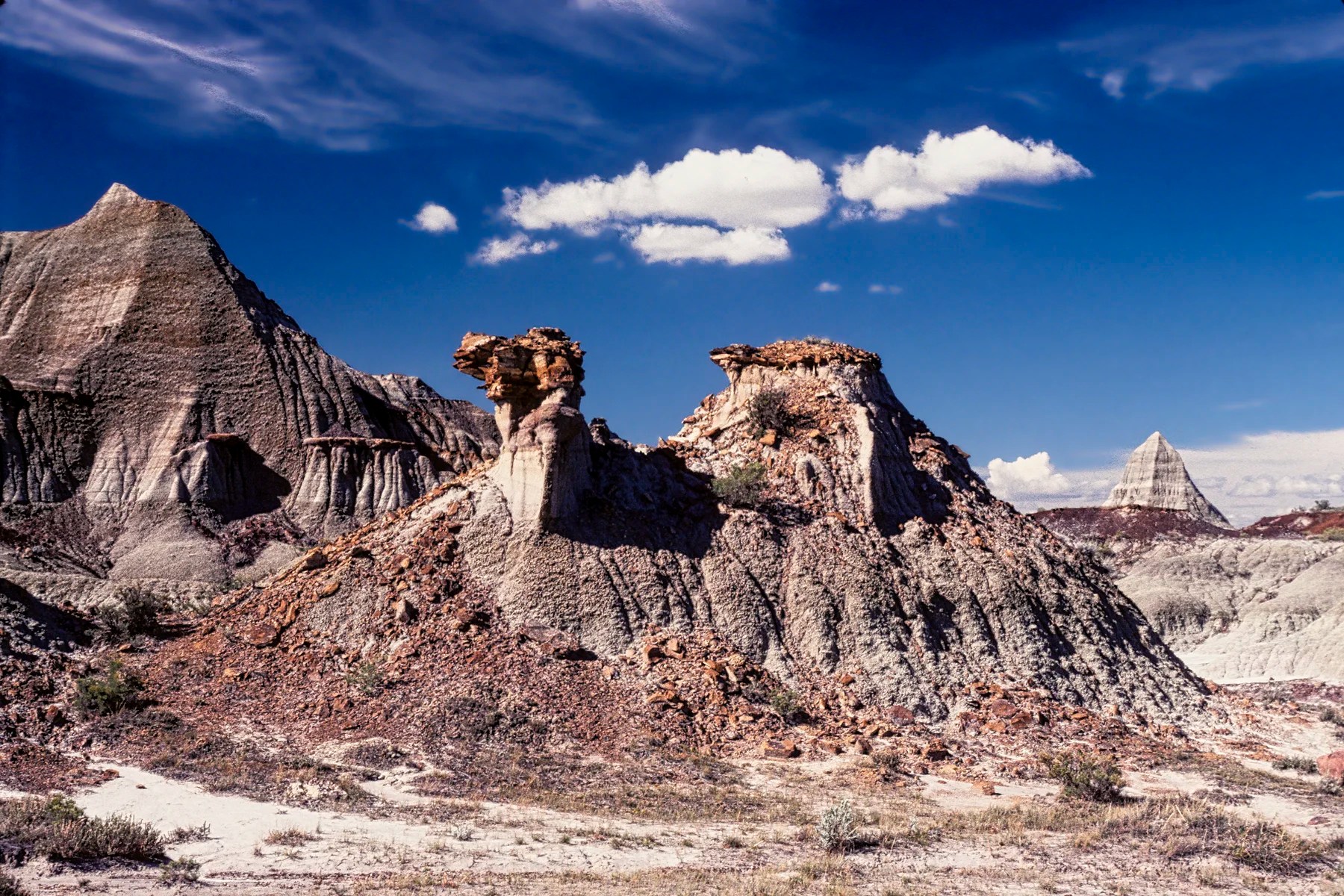
Don’t believe that was a Pyramid? Well, there was also Fred the Camel.
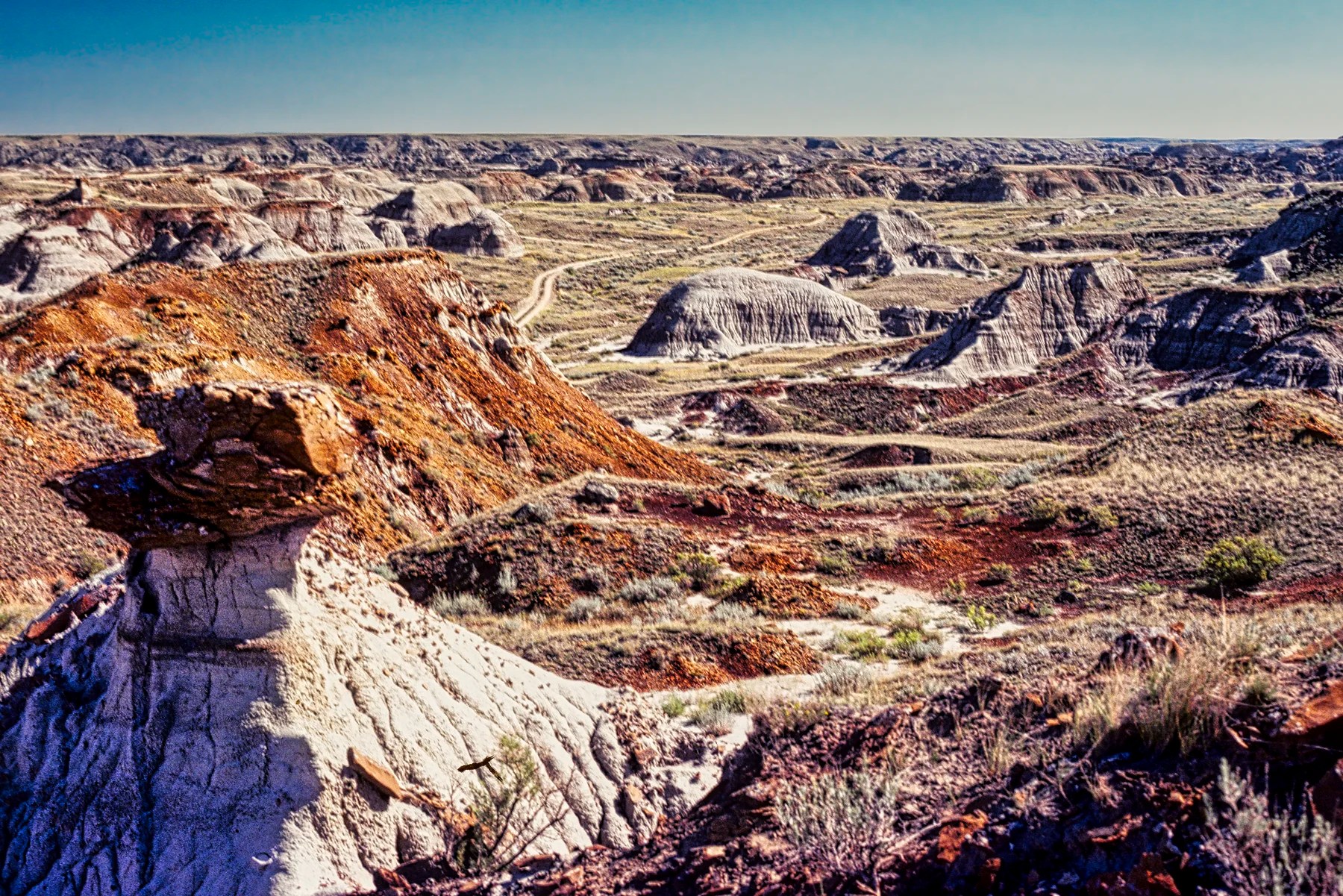
Another tour geared to photographers, Capture the Badlands (2 hrs), travels during the early morning or late evening for softer lighting.
Bentonite Clay
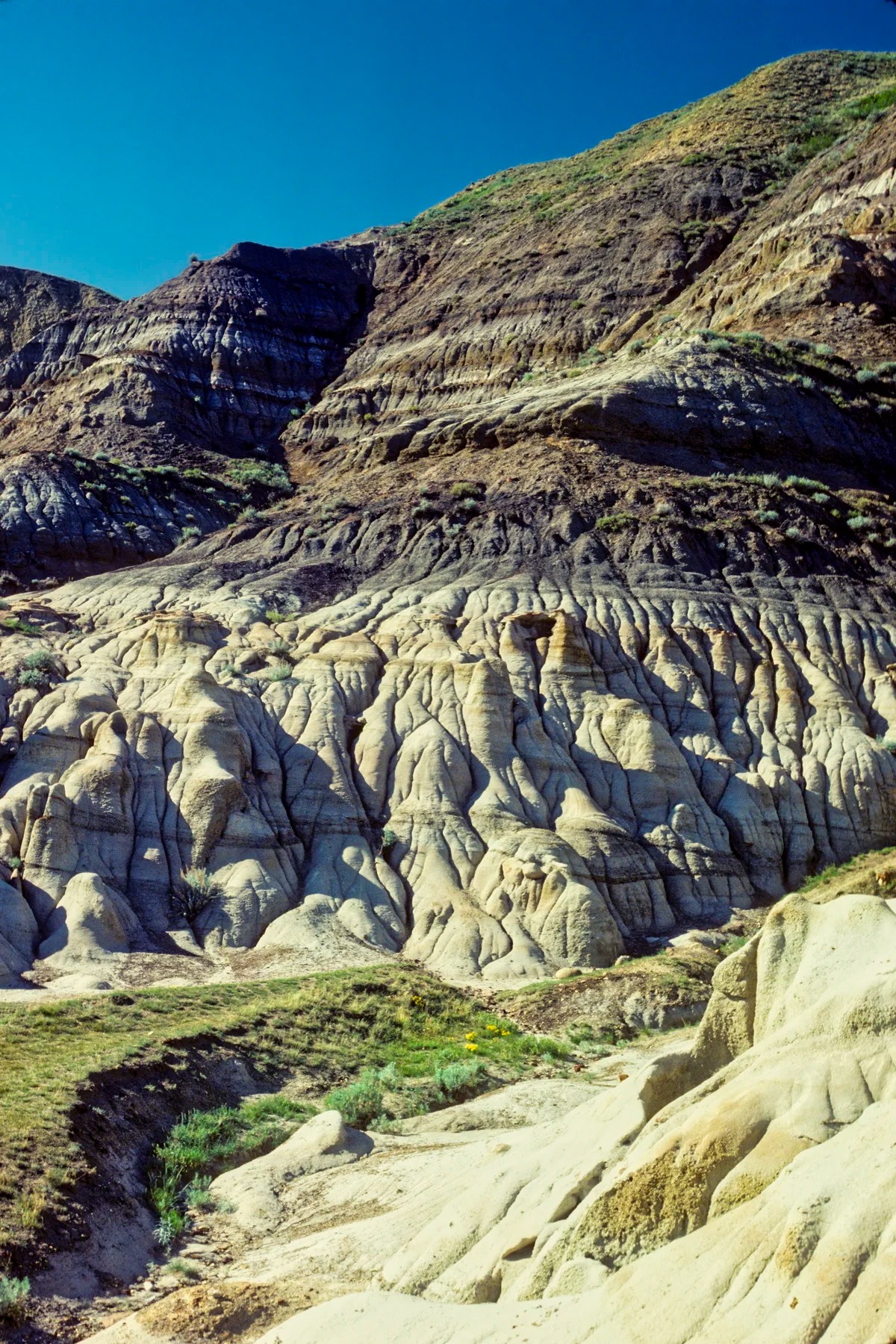
Do you think all this has no relationship to your life? Wait until the end of this topic.
Bentonite is a specific layer in the sedimentation because it came from volcanic ash and tuff. This layer can be over one metre thick. Imagine how much volcanic activity was needed to create and compress that much ash into bentonite clay!
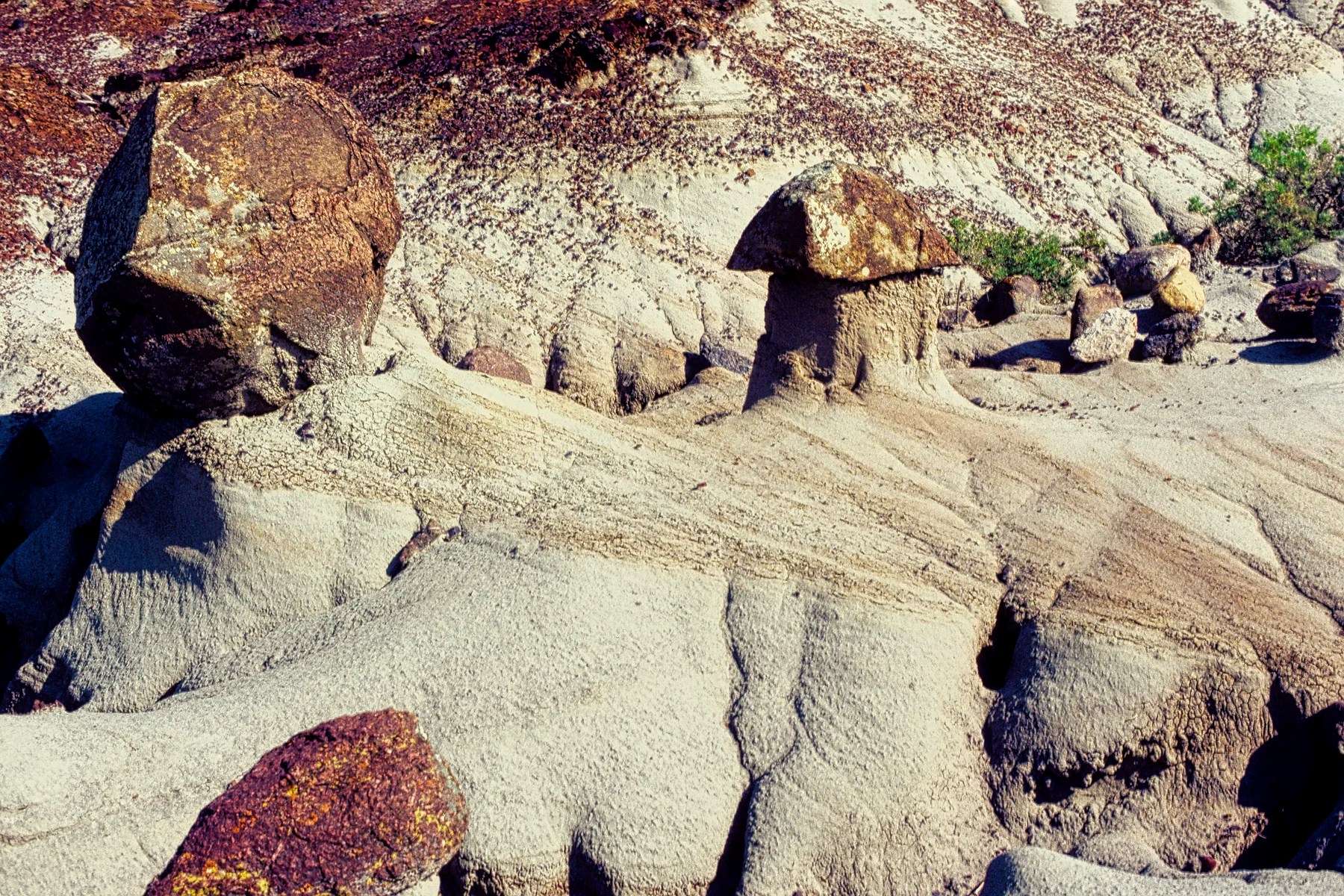
Bentonite beds are usually white and have a popcorn texture on the surface. Bentonite is a swelling clay that can absorb large quantities of water, increasing its volume up to eight times! Warning: Bentonite is very slippery when wet. Do not walk on it.
In southern Alberta, bentonite is found in sediments from 67 to 75 million years ago. The ashes came from active volcanoes in British Columbia and the northwest USA. What happened during this time? The Pacific plate smashed under the North American plate, which squished the land like a piece of tissue, forming a series of mountain ranges ending with the Rockies! At about the same time, the dinosaurs went extinct. Avian dinosaurs survived. Even more dramatically, about 75% of all plants and animals went extinct. The Cretaceous Period ended.
What you may not know is that you use Bentonite clay every day! Bentonite is used to make many products:
- Toothpaste;
- Shampoo and Indigenous soap;
- Acne lotion and sunscreen;
- Face masks, nail polish, and cosmetics;
- Filter for clarifying wine, fruit juices, and oils — to prevent protein denaturing (cloudiness);
- Drilling mud to lubricate and cool cutting tools;
- Ceramic glaze additive to provide plasticity.
This story shows how interrelated everything is.
Fireside Farewell
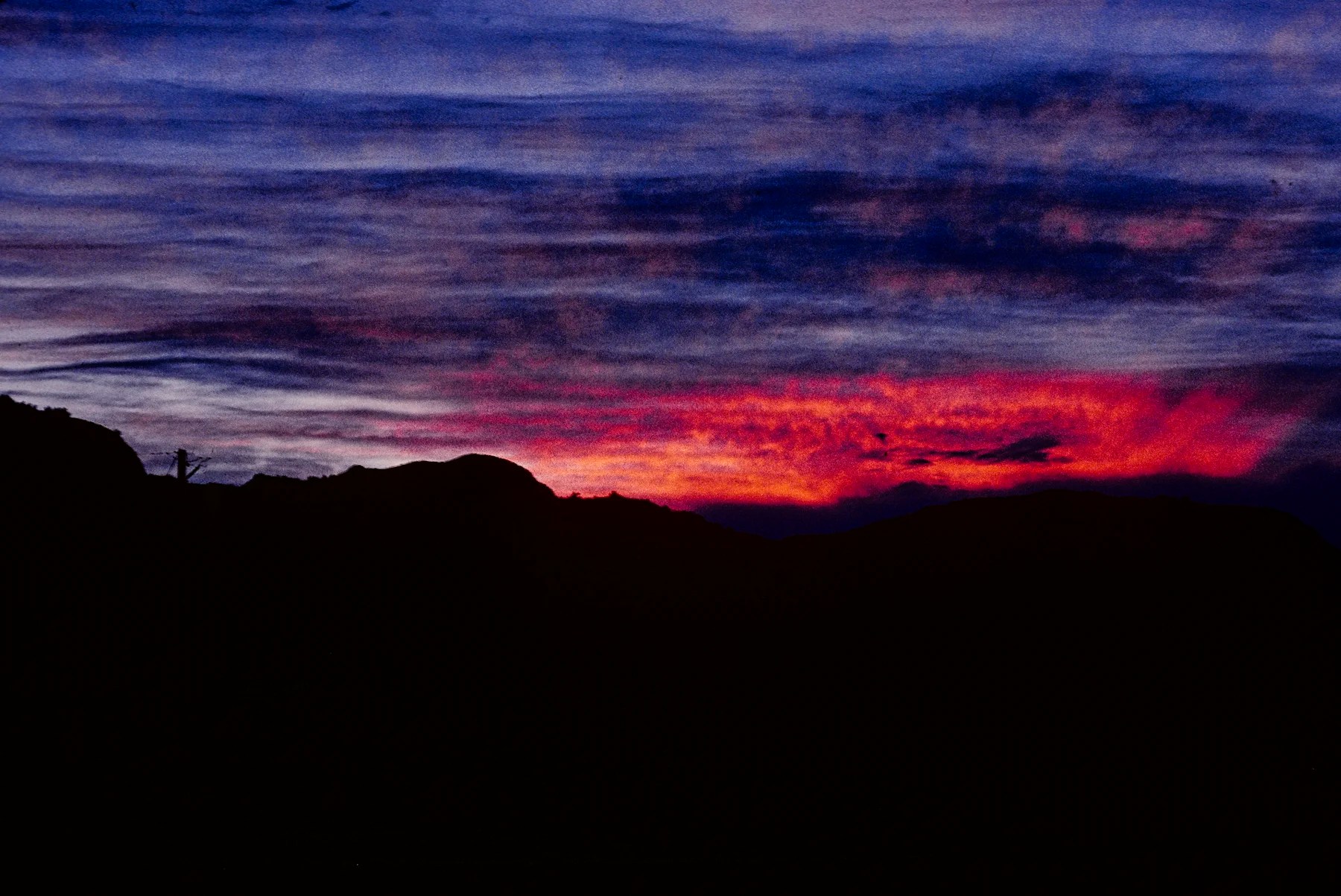
We went to a late evening fireside program. At the end of the program, the interpreters performed a melodious song they wrote about the park. The sun was setting and a white tailed deer appeared on top of the hill at the end of the song. It must have been a special order! Perfect ending to our trip! I missed the deer but I captured the sunset.
Final Comments on this Itinerary
This is a relaxing itinerary where you can get away from the crowds of tourists. What a difference compared to the overcrowded Banff the town and Louise the Lake in Banff NP. Dinosaur PP has not been spoiled.
We just revisited Dinosaur PP. We posted our updated version of this post in
Subscribe
Get travel tips and advice delivered directly to your inbox. The best part is that it is free.
What things in this post fascinate you? What questions do you have? If you have been here, share your experiences with us.
Itinerary Map & Resources
Alberta Itinerary Map — our custom Google map
Dinosaur PP Map — see or download the official park map
Dinosaur PP — the park’s website
Google Maps Ratings
Google Maps provides a rating from 0 to 5 for all sights, hotels and restaurants (but not cities). All of our recommendations are appended with the rating (prefixed with a G) from Google Maps. As it is based on feedback from tourists and locals, it is much more reliable than travel booking websites. We consider a score of 4 to 4.39 to be Very Good; 4.4 to 5 to be Excellent.
What are the costs?
Entry Fee: entry and use of the roads and trails is free; programs have costs
Open: year-round
Where to Stay?
Many years ago, this was one of the hidden gems of Alberta. Only locals visited and you could just come at the last minute and get a campsite or book a van trip.
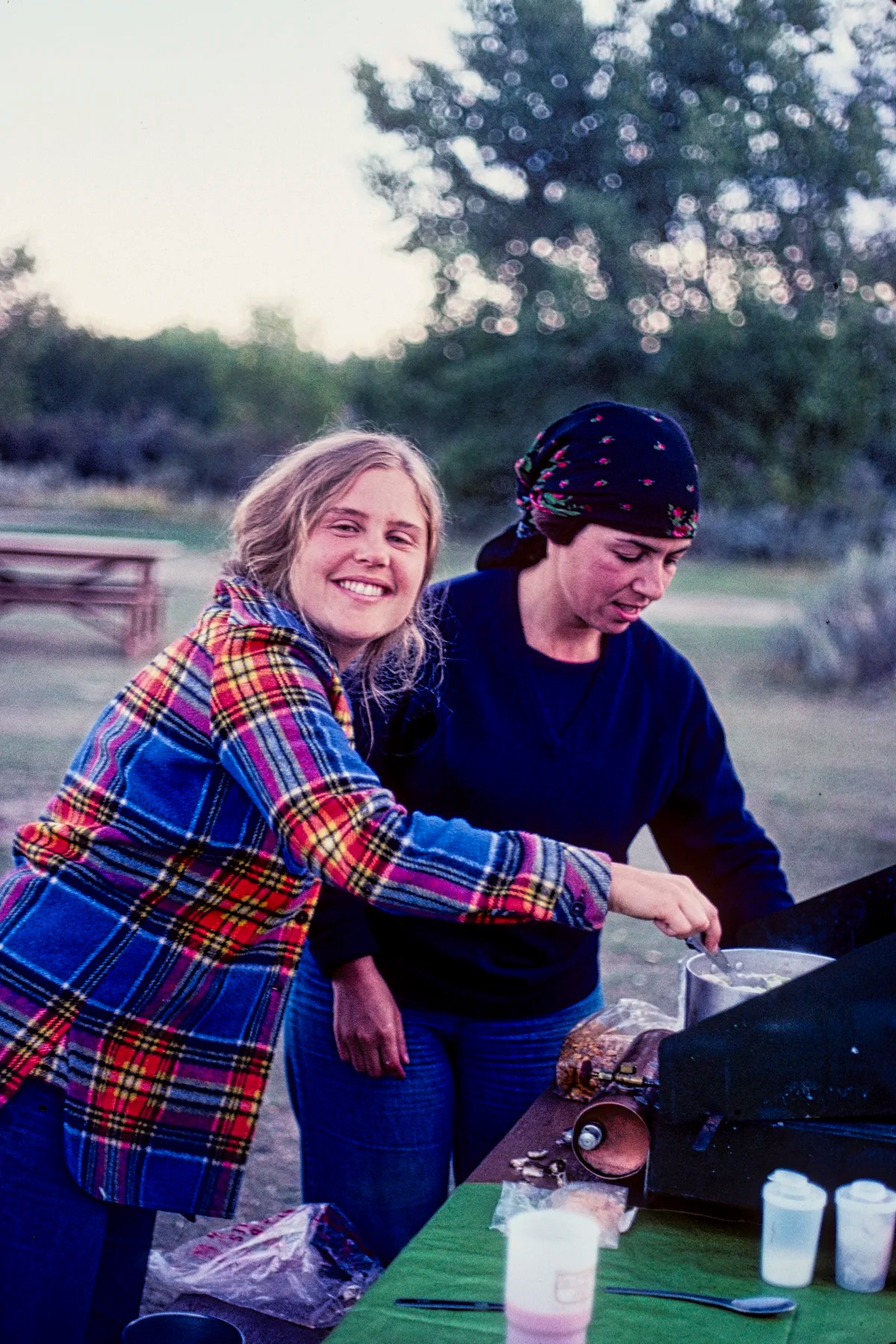
It’s great to stay right inside DPP for ca. 2 or 3 days, but you need to camp. However, July and August are quite busy and sites need to be booked well in advance, especially for weekends and holidays, which should be avoided. Otherwise, you can stay at a motel in Brooks and commute 48 km northeast to DPP.
There are no supermarkets nearby, so you need to bring food and a cooler if you are camping. There is one Cretaceous Café for standard fare. You stop at the Café to check in for the campground.
When to Visit?
The park is open year-round, but you really want to go on the amazing guided tours, which means May to October is the best time. Avoid weekends and holidays when the locals come. The park’s home page is at Dinosaur PP.
Guided Tours
There are four bus tours usually lasting 2 hours. Prices range from $15 to $30 per adult. There are six hiking tours lasting from 2 to 4 hours. Prices range from $25 to $35 per adult. There are several other programs at the visitor site.
The interpretive tours are only available between May 09 and October 29. Tours given vary by day. Some events are only on weekends. For the latest information and schedule, see the official Dinosaur Tours & Events.
There are many more guided tours than when we lived in Alberta. But there are also a lot more tourists, and you must book them in advance during peak season.
Other Places to Add to Your Itinerary
Here are nearby places you might want to explore:
Drumheller
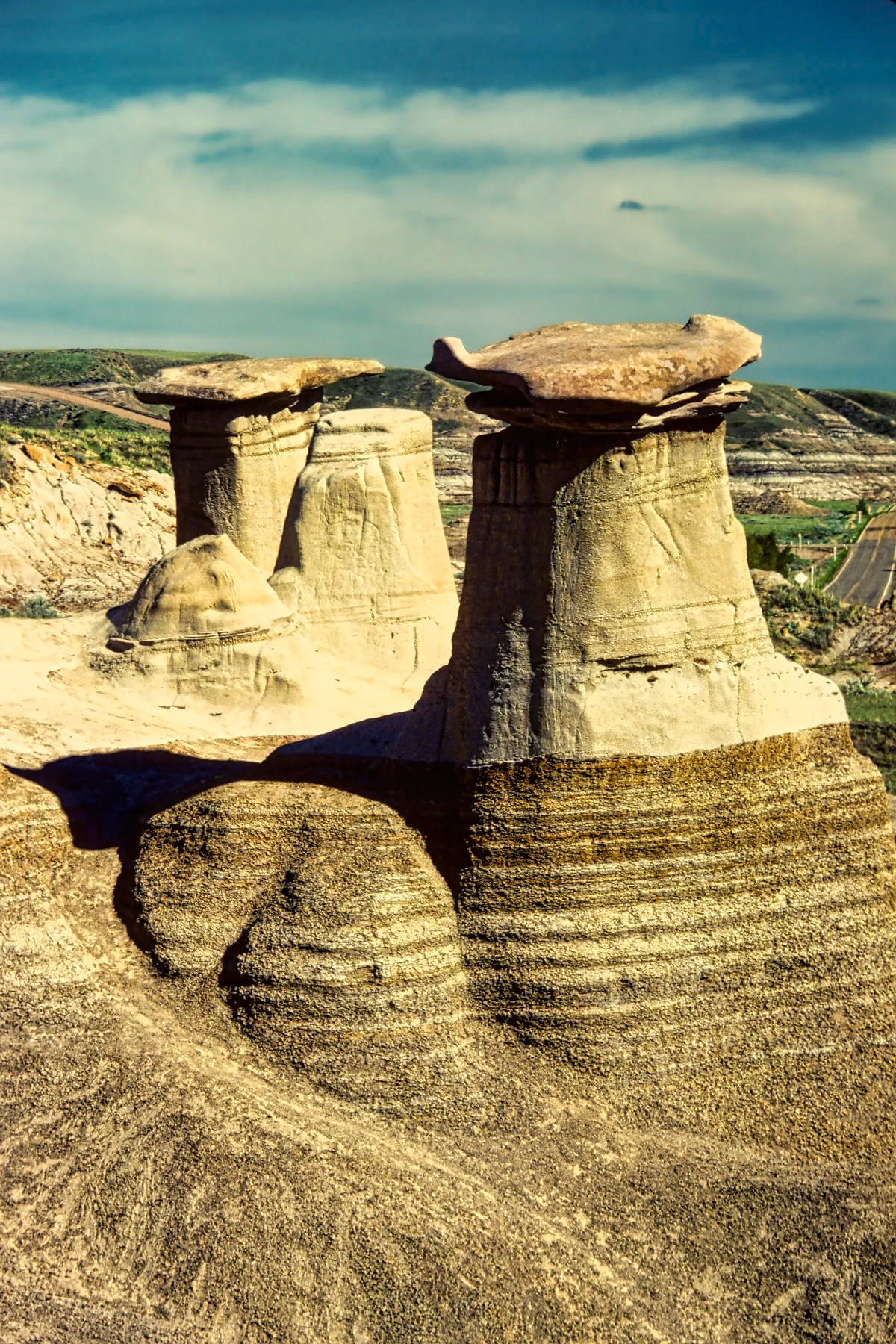
If you want to see full skeletons found in DPP then you can head to Drumheller. One thing to do is photograph the iconic hoodoos above along the Red Deer River. But the must-see is the Royal Tyrrell Museum, where many fossil specimens are displayed. It’s an excellent museum and you could spend a day here. Admission fee is $21 and between May 15 to August 31, the museum is open seven days a week 09:00 – 21:00.
But, do not try to see Drumheller and Dinosaur Provincial Park in one day. You have to drive backroads for 178 km from DPP to Drumheller, which takes ca. 2 hrs.
West or East
The first link is to our latest post about DPP just done last year. Drive 235 km (147 mi) west to Calgary. Head east 504 km, 5 hrs. to Moose Jaw, SK.
Canada FAQ

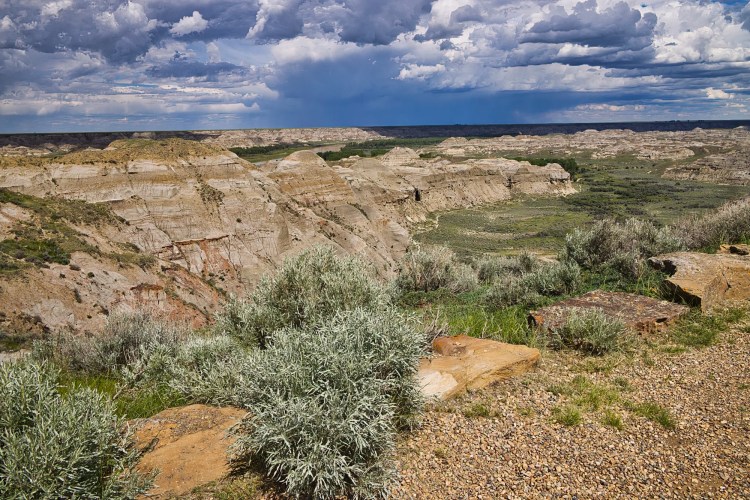
The Exploring Canada post answers Frequently Asked Questions (FAQ) such as:
- Where should I go in Canada?
- What is the best season for travel?
- What is the best clothing?
- Where should I go? What are the must-sees?
- How much time do I need for Canada?
- Can I see everything in a week?
- How safe is Canada?
 Terra Encounters
Leave a comment