
Why You Must Visit Dawson City
After driving across the continent, I wasn’t sure it was worth driving another day to get to Dawson City. We had travelled 4.5 driving days to get from Ottawa to Banff (5898 km 3665 mi) and then another 3.5 driving days to get to Whitehorse (2284 km 1420 mi). Yes, the Yukon is that far north!
I thought there would be little to see in this town of 2000 people. But we were sure glad we went. We think it was the best place we visited in the Yukon.
Author & Photographer: George Mitchell

Our recommendations are not influenced by affiliate links – we have none. Our advice is based on extensive experience driving across Canada as well as travelling for three years around the world.
All of our recommendations are top-rated by Google Maps Ratings, which is based on everyone, not just tourists. Each place in our custom Google Maps is appended with a Google Maps Rating (G0 to G5).
Gold Fever
What draws people to Dawson City? In 1896, an American prospector, George Carmack, his Tagish wife Kate Carmack, her brother Skookum Jim, and his nephew Dawson Charlie found gold in a small creek. The now renamed Bonanza Creek flows into the Klondike River, which joins the Yukon River at Dawson City. The news spread throughout California, where the Gold Rush had ended in 1855. All those eager prospectors headed north to the Klondike.
An estimated 100,000 people sailed and trekked north to the Klondike. Most did not make it! Many died from the cold, starvation, or illness.
In 1897, Canadian authorities introduced rules requiring anyone entering Yukon Territory to bring with them a year’s supply of food; typically, this weighed around 1,150 pounds (520 kg). They even provided a checklist of supplies to bring! This included 400 lbs (181 kg) of flour to make bread!
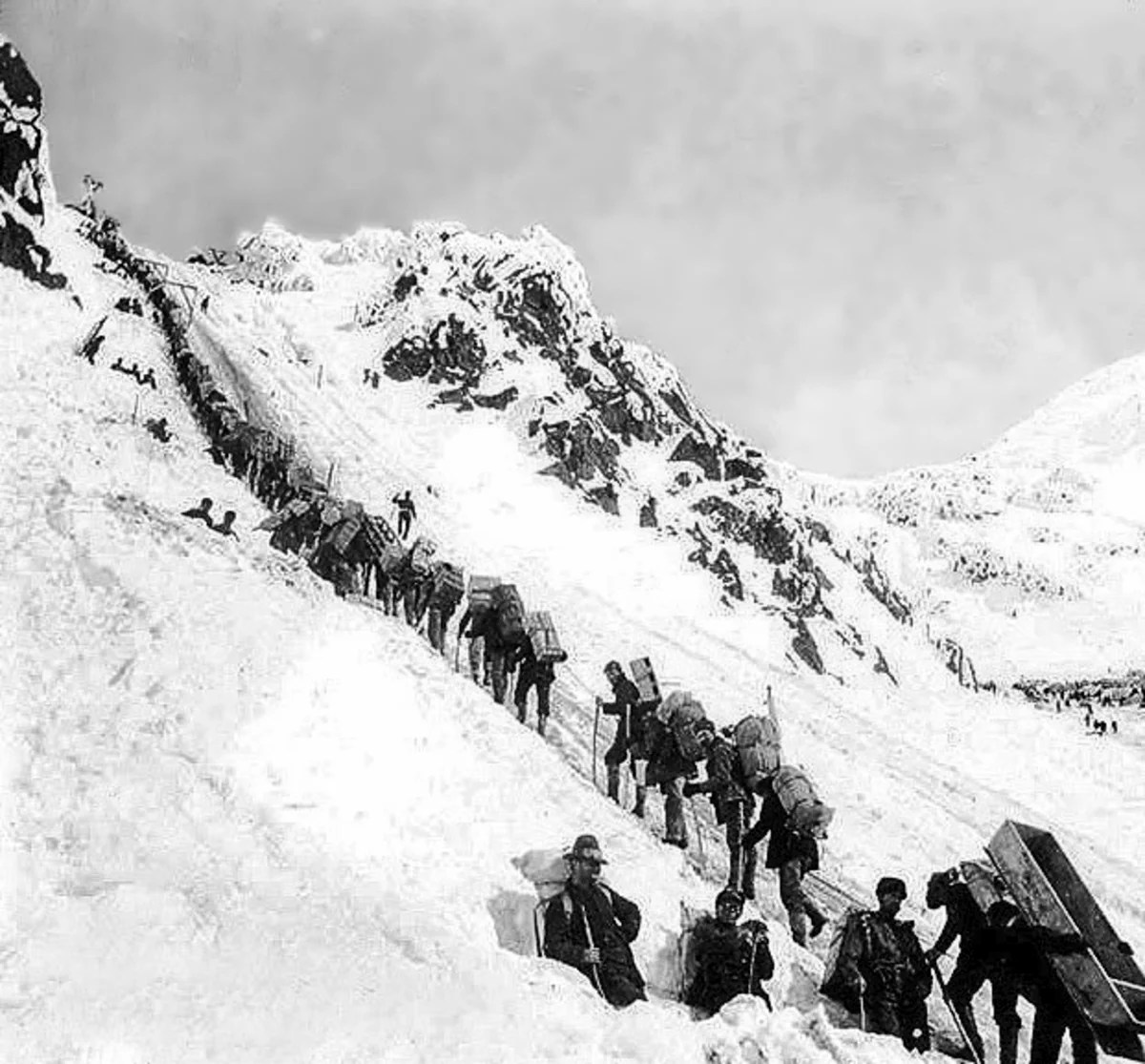
So when we see thousands of prospectors climbing steep Chilkoot Pass in famous photos, you have to remember they had to do this climb 20 to 30 times as they carried a subset of their supplies over the pass.
Five Fingers Rapids
If they survived the rapids through the narrow basalt-lined Miles Canyon, they arrived at Whitehorse. They still had to sail down the Yukon River to Dawson City. Rivers were the highways in the olden times.
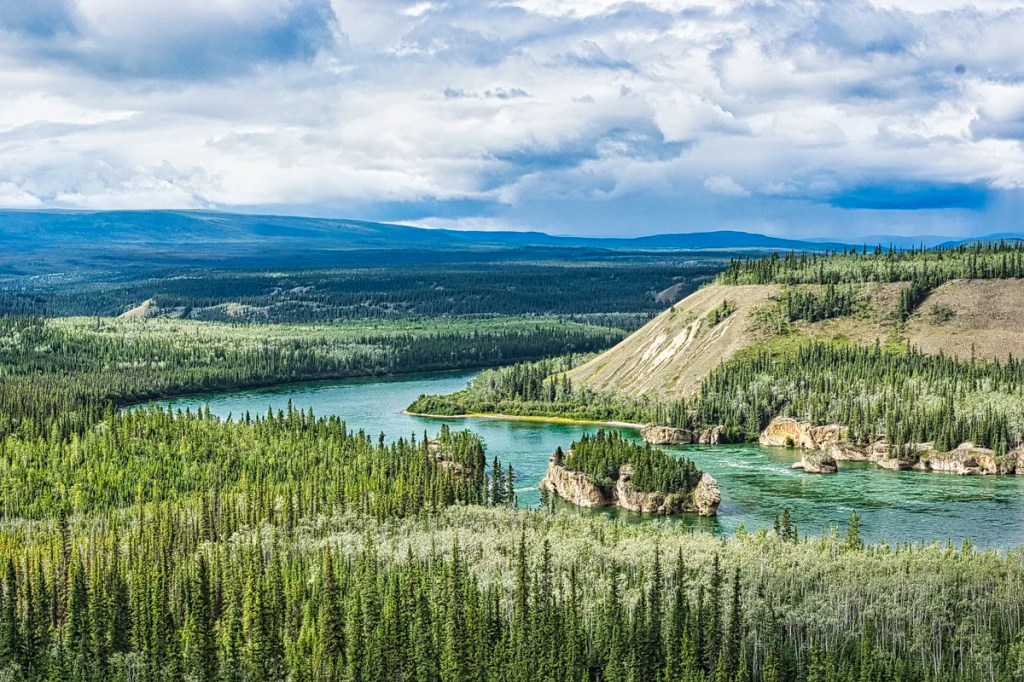
Today, we can simply drive 532 km, 7 hours north to get to Dawson City. There are very few points of interest along today’s uneventful highway. Do stop at the observation platform overlooking the Five Fingers Rapids, another obstacle for gold prospectors. Blasting widened the sole navigable channel after 1900. The Five Finger Rapids are mentioned in Jack London‘s novel The Call of the Wild.
SS Keno Steamship
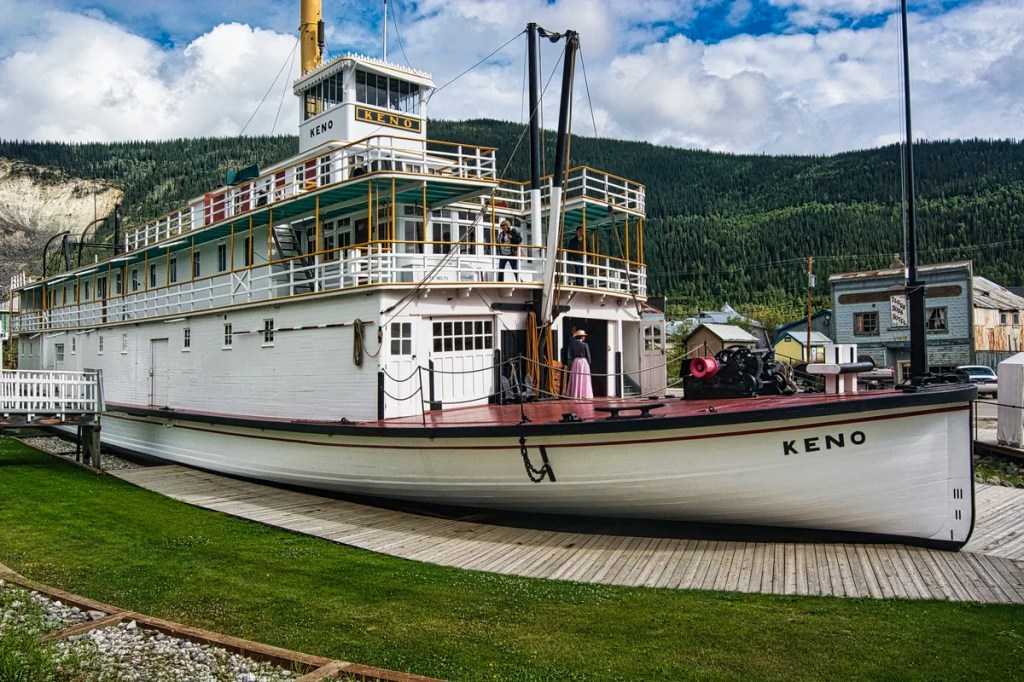
To ease the Klondike era trip to Dawson, a “ferry service” was implemented. SS Keno was one of a fleet of paddle wheelers that worked the Yukon’s rivers. Gold was not the sole attraction, nor was Dawson the only destination. Built in 1922, the SS Keno transported silver, lead and zinc ore from the mines on the Stewart River. Once winter hit, Dawson City was cut off from the outside world until the first steamer arrived in the spring!
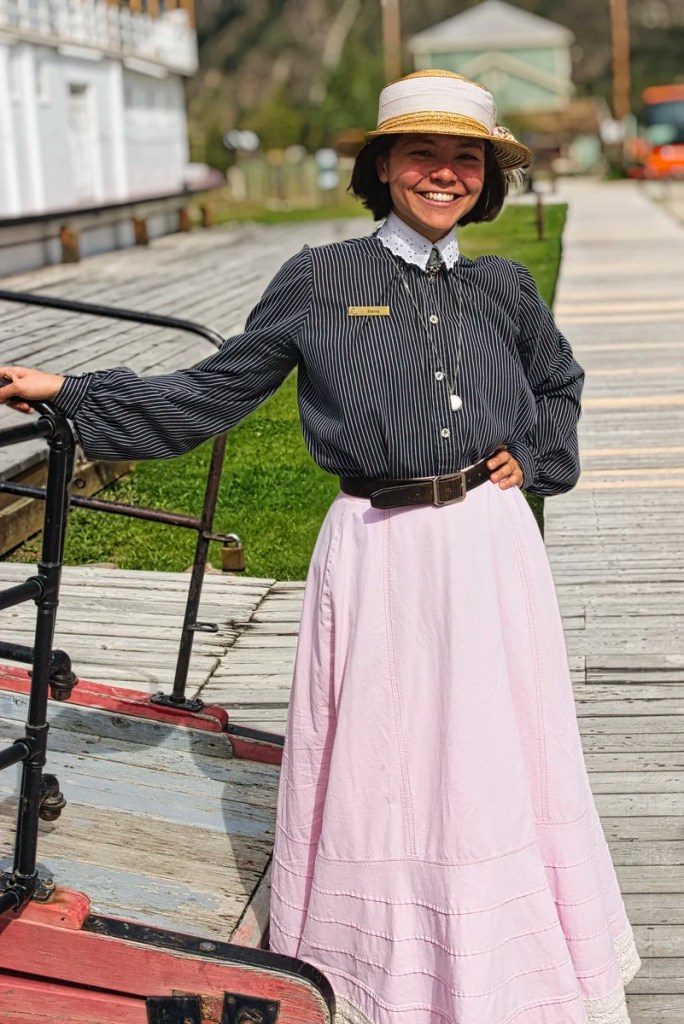
It is worthwhile to tour the boat. Interpreters explain how things worked. The Yukon is full of stories of interesting people who visited and stayed. We met a lawyer and his family from Quebec City who visited the Yukon and stayed to enjoy working and living in this sparsely populated territory.
A short distance east of the Keno is the Dãnojà Zho Cultural Centre, dedicated to the Tr’ondëk Hwëch’in First Nation, whose land was taken away.
Welcome Cheechako
Joseph Ladue, an American, moved to the Yukon in 1882 and ran a trading post on the Yukon River. When the Gold Rush started, Ladue acquired 65 hectares of swamp at the mouth of the Klondike River and named it Dawson City.
He made a fortune selling lots and the lumber to build on them. This is a great example of “mining the miners”. From a population of 500 in 1896, the town grew to about 30,000 people by 1898. Built of wood, isolated, and unsanitary, Dawson suffered from fires, high prices, and epidemics.
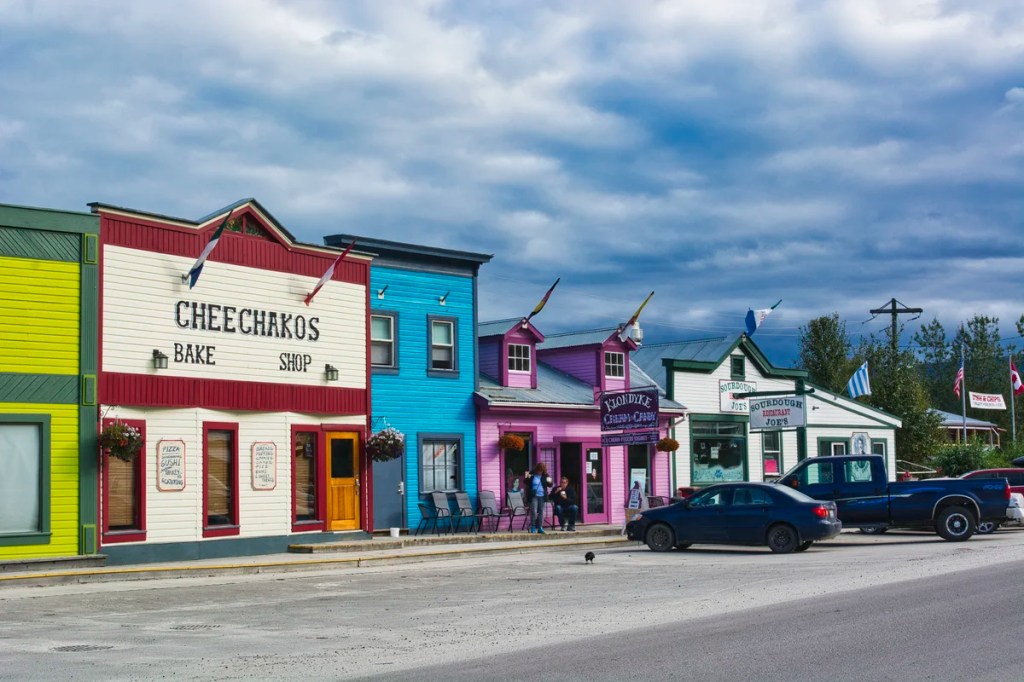
The first thing you’ll notice is that the streets are left unfinished to match the atmosphere. This is the Wild North! The sidewalks are actually boardwalks to keep you above the muddy streets. Then you see touristy stores and bakeries, with one called Cheechakos.
A newly arrived prospector was called a Cheechako. The Indigenous word “chee” means new. After surviving one Arctic winter, you became a Sourdough. The origin of sourdough bread was the California Gold Rush, where miners made this bread recipe as yeast was not available!
Dawson Historical Complex
The Dawson Historical Complex protects over 17 buildings associated with the Klondike Gold Rush. You can view the building exteriors at any time, but we’re not sure if you will get much out of it. These buildings are only open during Parks Canada guided walks. There are several options, but we took the six-walk package, and we were glad we did. The Parks Canada interpreters do not preach facts but instead perform skits in period costumes about some of the colourful characters who came to the Klondike. They made history come alive. Many of the interpreters are young people who visited and fell in love with the Yukon. They found seasonal jobs that enabled them to stay year-round. So many of them head to Whitehorse for the winter.
Our itinerary is shown on our Yukon Google Map. The historical places are described below in clockwise order in case you want to do your own self-guided walk for photography purposes.
Palace Grand Theatre 1899
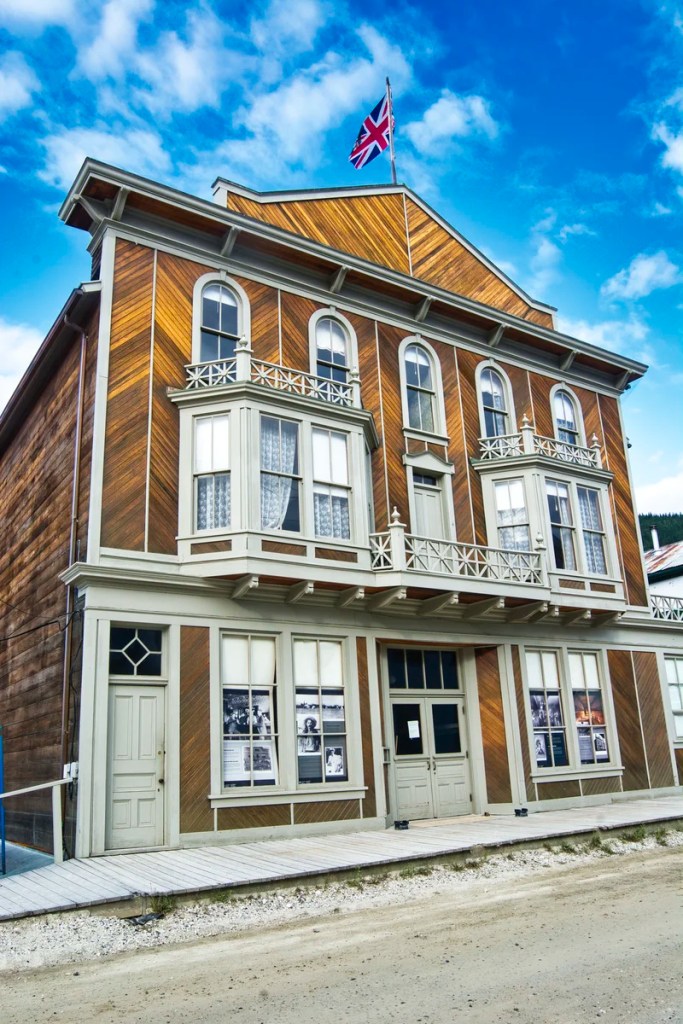
The Palace Grand Theatre is an attractive building; so it was a bit disappointing to find out that the façade is a replica, reconstructed in 1962. The British flag is correct. The Canadian flag was introduced only in 1965.
“Arizona Charlie Meadows” was a Wild West showman, sharpshooter, and competitor of “Buffalo Bill” Cody. In 1897, Charlie and his wife, Mae, came to Dawson City during the Klondike Gold Rush. He built the theatre in 1899, where he served as the master of ceremonies. During the shows, he demonstrated his shooting prowess with a pistol, until one night, he shot off the tip of his wife Mae’s finger.
The Old Post Office 1900
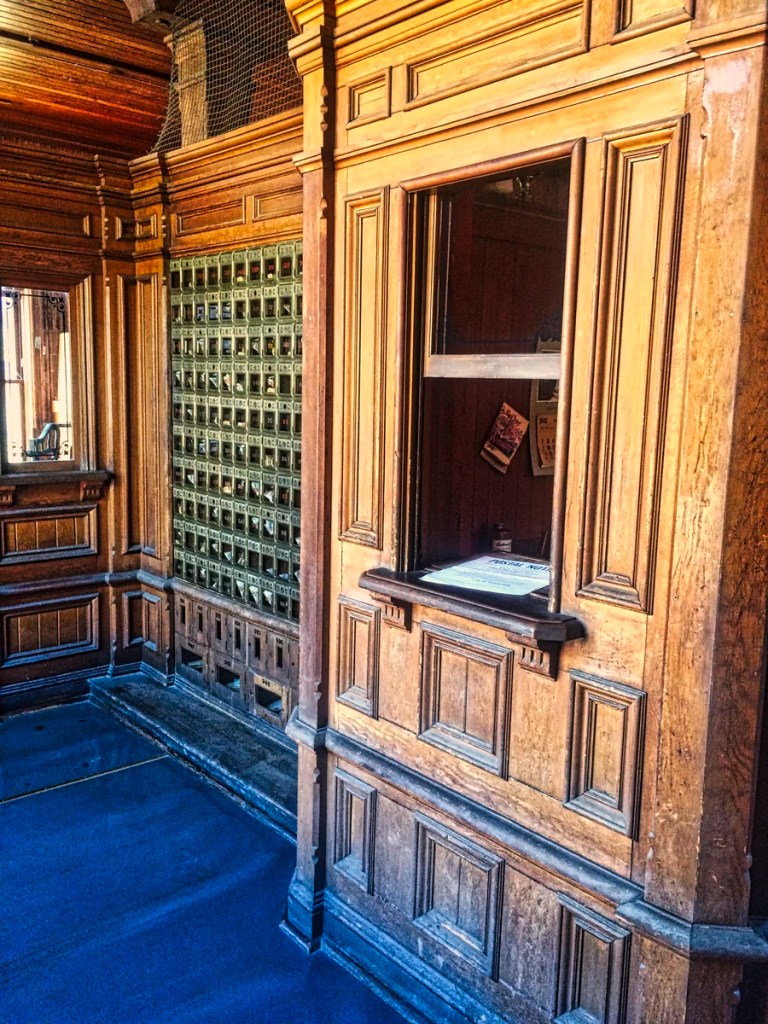
The Old Post Office operated from 1900 to 1923. It was part of shoring up Canadian government authority in the Yukon Territory. The upper story housed the registrar of Crown lands, telegraph and customs offices.
This is your grandfather’s post office with extensive use of beautiful wood. Expert tradespeople had to be brought from as far away as Montreal to construct this heavy building on top of permafrost. If permafrost is scraped away, the ground becomes mushy mud.
Here, park interpreters did a skit about Mary Walsh. In 1910, she sent her prospector husband to Nome, Alaska (the next gold rush) to pan for gold. Meanwhile, she took $100,000 of gold he had found and headed to Seattle. There she had an affair … and a son. BTW, $100,000 is worth $3.2 million today!
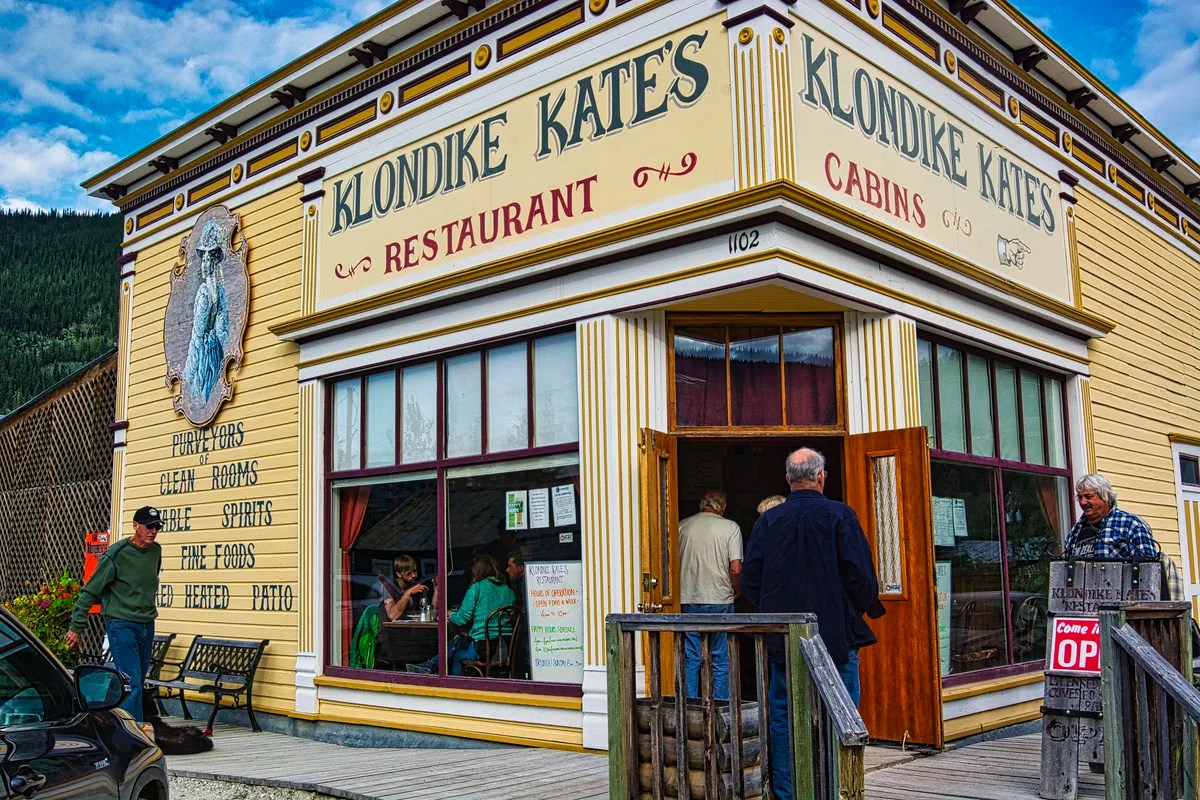
Klondike Kate
Kathleen Rockwell was born in the Midwest, USA. She came as a dancer in chorus lines. Then she got a role in the Savoy Theatre using her stage name Klondike Kate. She was the best entertainer, but the daring pink tights probably helped.
Thanks to tips and refit shares, she claimed she earned $30,000 during her first year! That’s a staggering $1 million in today’s dollars! Kate was so popular with the gold miners, they would hand her gold nuggets just for stopping to speak with them on the streets! She became a wealthy landowner. She died in 1957.
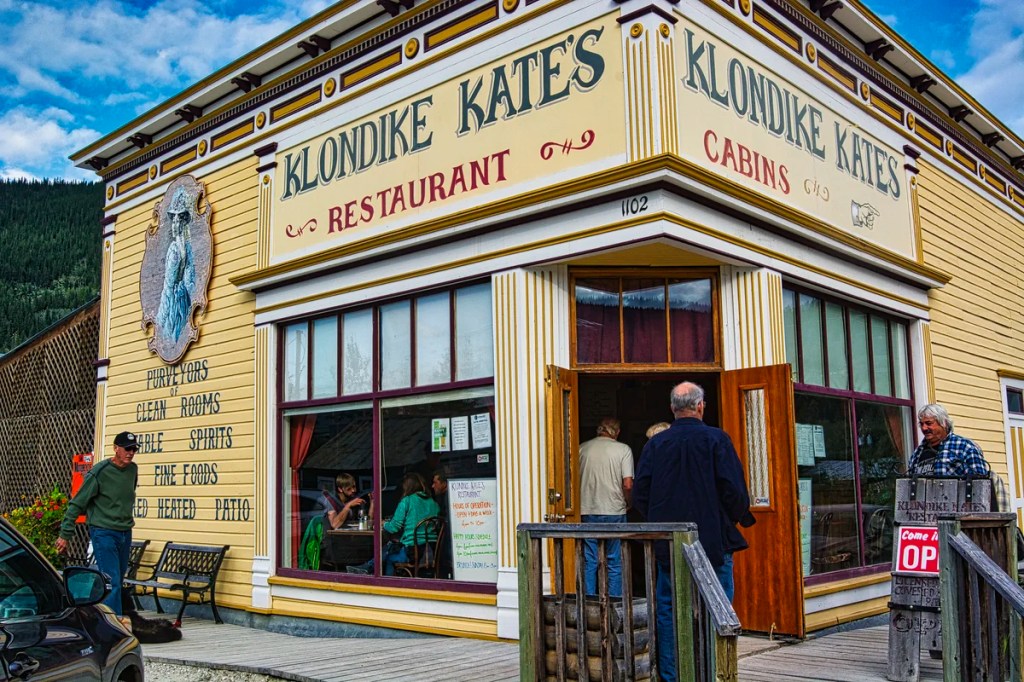
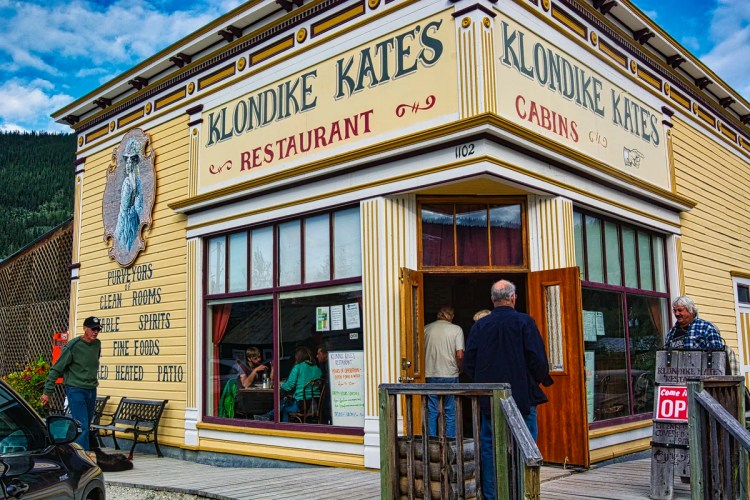
But, this café was started by a second Klondike Kate. Katherine Ryan was a nurse from Vancouver and was one of the first women to join the Klondike. She joined an NWMP detachment in Alaska that helped carry her year’s worth of supplies to Dawson City in exchange for home-cooked meals. She became the first female Mountie and served as a special constable for female prisoners and ensuring that no gold left Canada without paying taxes! She opened the Klondike Kate Café.
Use the Google Map rating when choosing a restaurant or café. It is far more accurate than ratings on sites that are only evaluated by tourists. We were not impressed with the restaurants in Dawson City. They seem to want to make up for only being open 6 months a year. The meals were in the $29 to $36 range. Fortunately, we bought food at the Superstore in Whitehorse and lived off that. Breakfast at the 5th Avenue B&B’s sister hotel was superb!
Madame Tremblay’s Store 1913
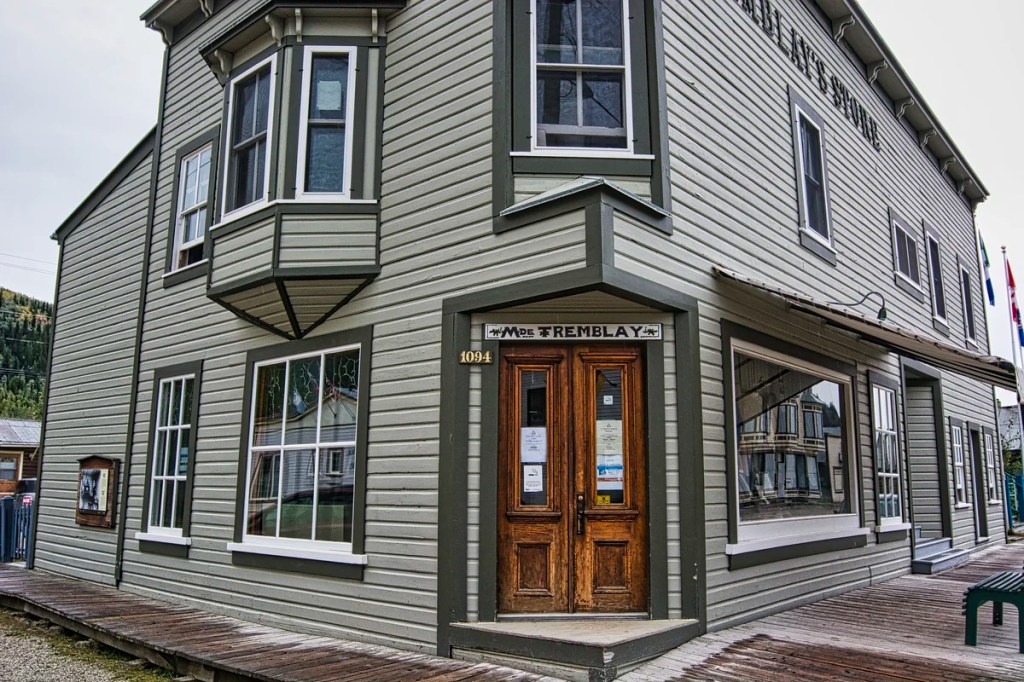
Émilie Tremblay was born in the Lac St. Jean region of Québec. After a five-thousand-mile journey, she became the first white woman to cross the famous Chilkoot Pass and search for gold. She did not speak English. This was in 1894, before the Klondike had started.
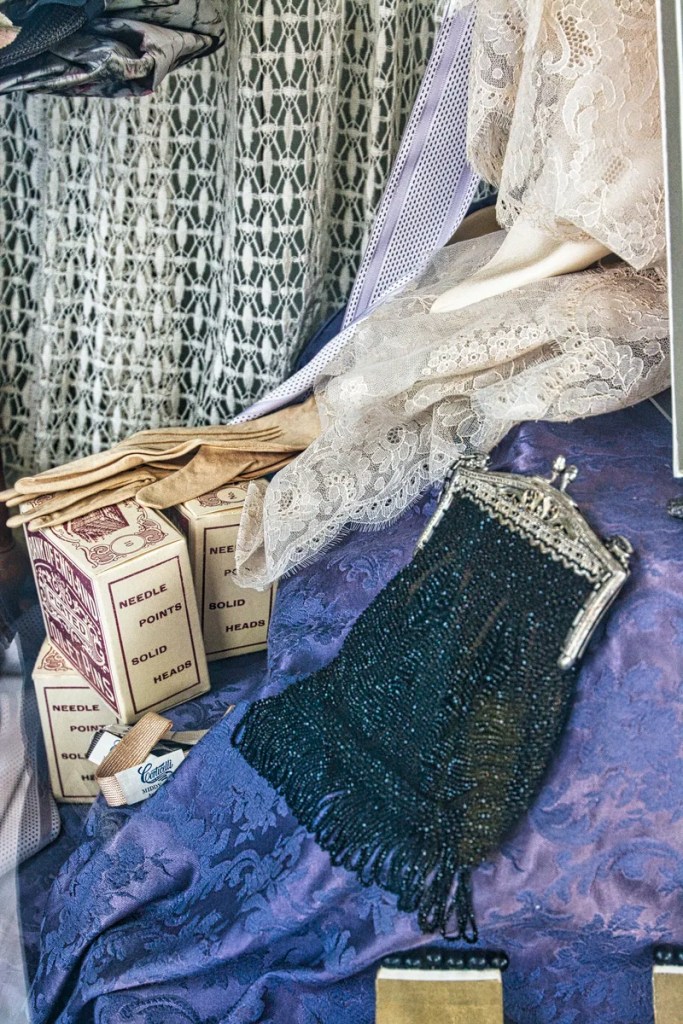
Émilie opened a women’s clothing store called Madame Tremblay. She converted her gold mining career to become a merchant. The building exterior was restored in 1980 to its circa 1915-17 appearance. Actually, the building dates back to 1894.
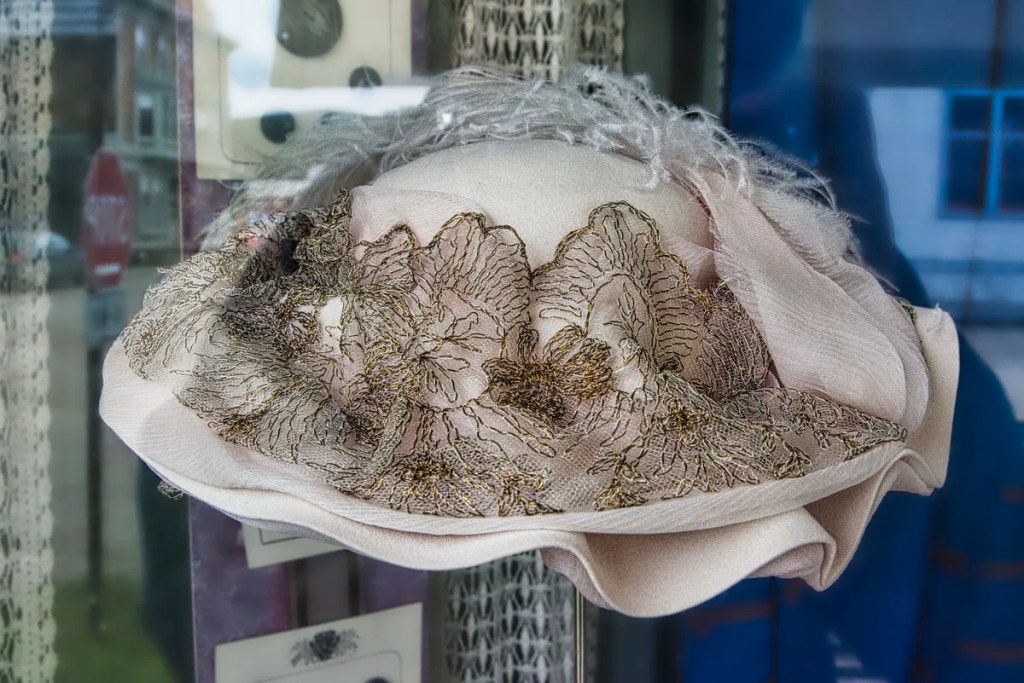
Appearances were of great importance in Victorian times. Apparently, in those days, you could buy anything here shipped from Vancouver, even the latest fashions from Paris!!! Dawson was the upper-middle-class capital of Yukon at that time. The locals (Yukoners) called it mining the miners!
Émilie was also noted for her social activities and her work for travellers, missionaries and widows.
St. Andrews Church 1901
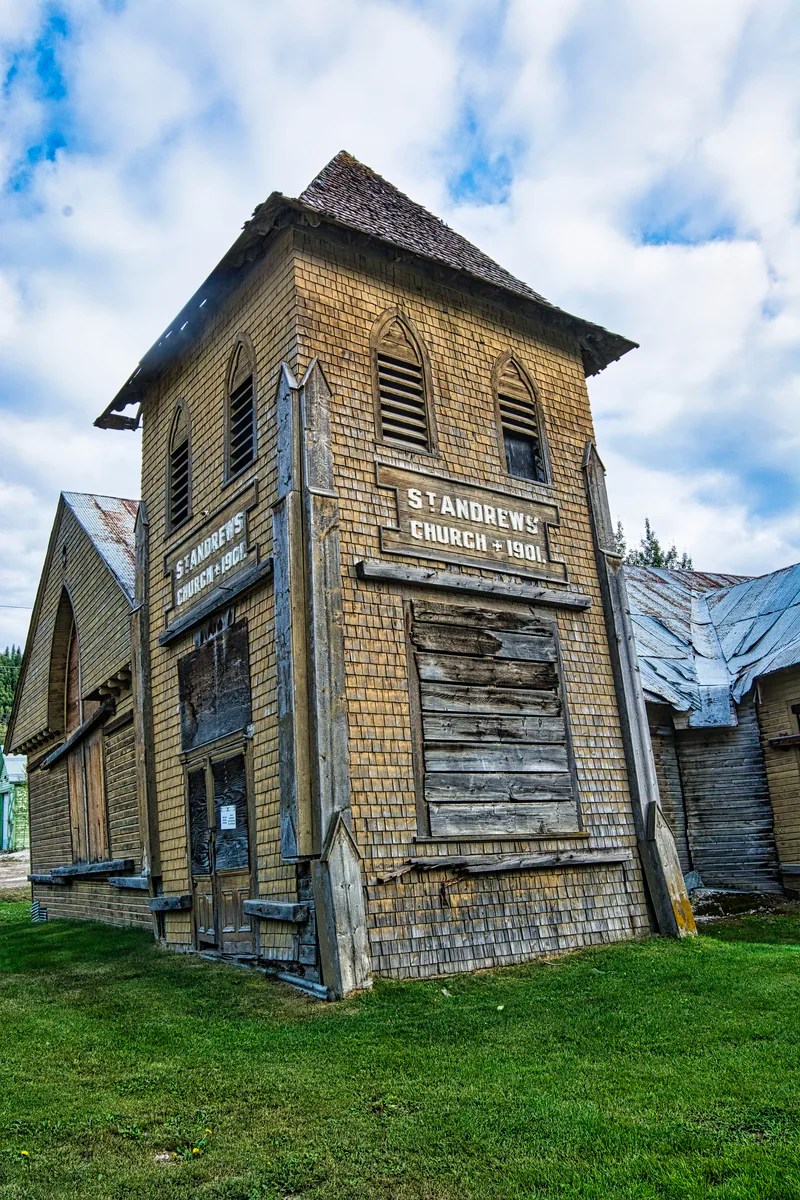
Dawson City had 30,000 inhabitants during the Klondike. But, few of the original buildings remain. Most subsided or collapsed due to the permafrost. St. Andrews church is an example of decay. The are many other examples of dilapidated buildings.
St. Paul’s Anglican Church 1902
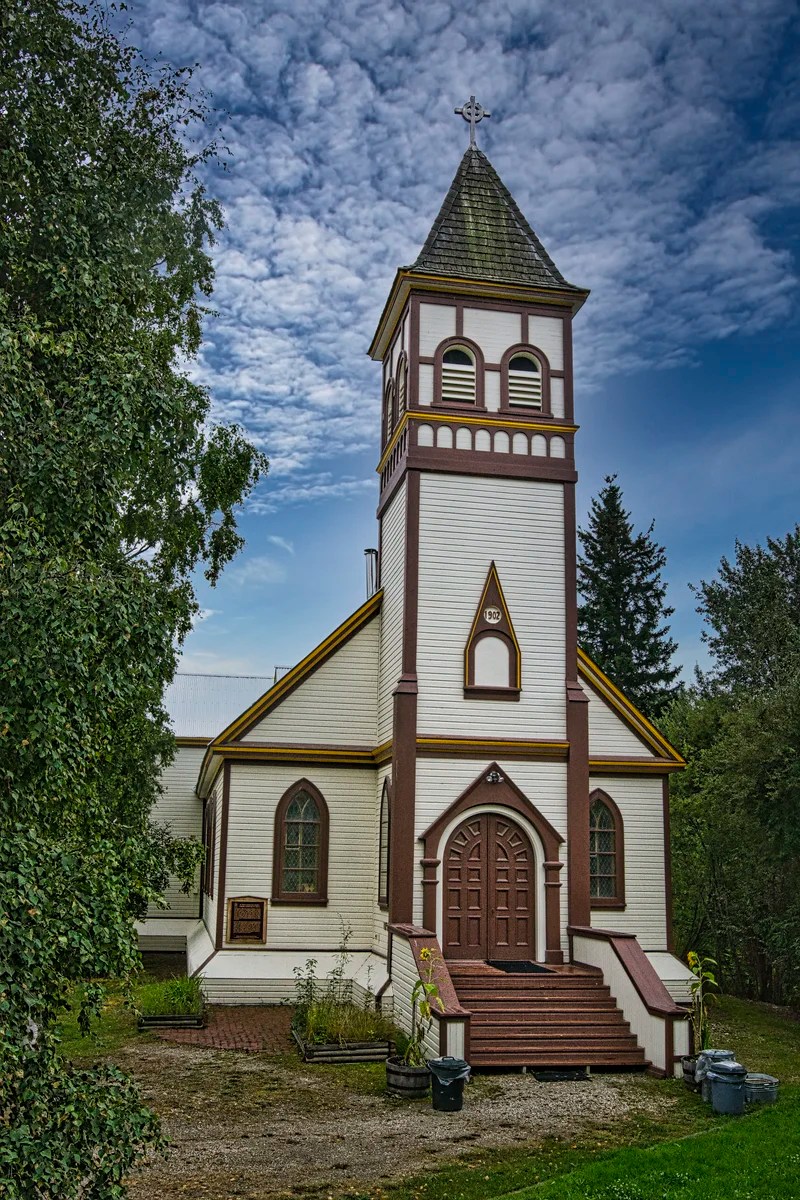
St. Paul’s is an example of a frontier church built in the Gothic Revival style. A castle-like bell tower stands on the west end of the church.
Yukon Hotel 1898
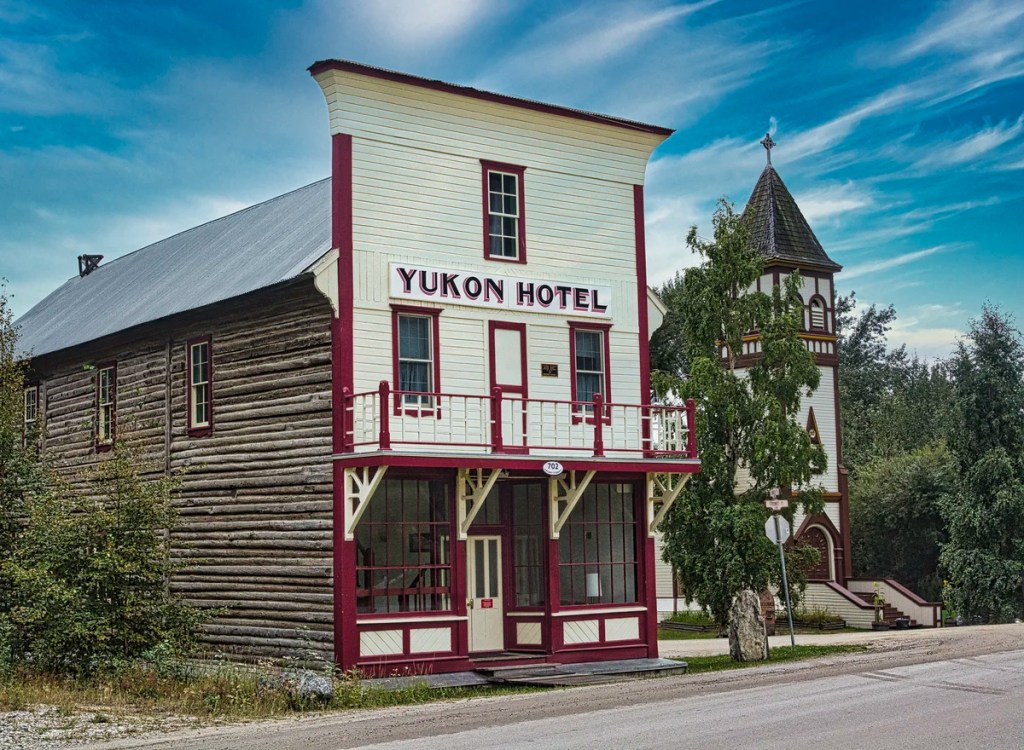
This government office was built in 1898 and became a hotel in 1900. It is representative of commercial structures along First Street, the main road in the Klondike.
The Wild North
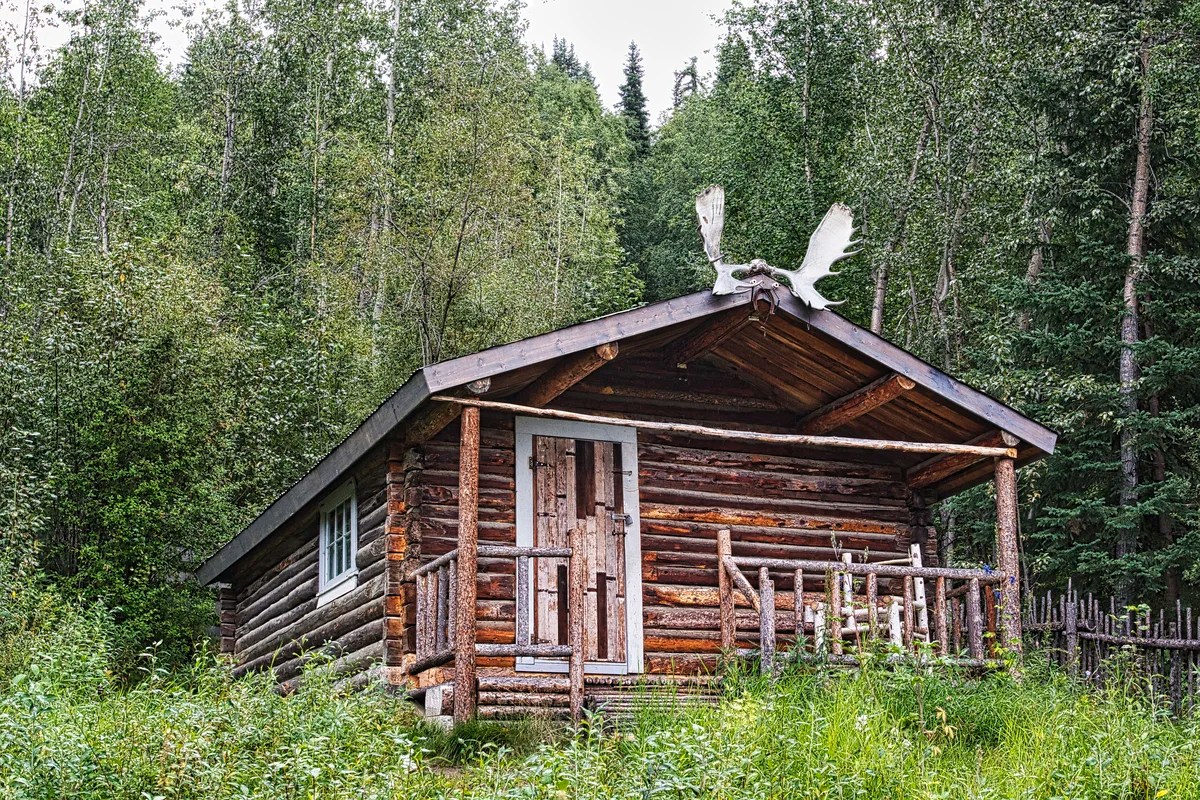
The adventures of the gold rush were romanticized by famous authors who came to Dawson – like Jack London, Robert Service and Pierre Berton. You can visit the log cabin above where Robert Service lived. As historian Pierre Berton said, the Klondike was “just far enough away to be romantic and just close enough to be accessible”.
From 1896 to 1899, $29 million in gold was panned from the rivers around Dawson City. As in California, the shopkeepers probably made more money than most miners. But was this the Canadian equivalent of the Wild West?
The Klondike gold rush was so much more civilized than in California. It would be very difficult to do a robbery and get away with it, as there were no roads up north. The only way out was by steamer.
Miners were not allowed to have guns. Apparently, Wyatt Earp of Tombstone, Arizona fame, came to Dawson City and was shooting up the town. A very short Mountie forced him to hand over his gun. You could count the number of murders on the fingers of your hand on the Yukon side. Everything was controlled by the Northwest Mounted Police (NWMP), now called the RCMP. Apparently, the NWMP would have moved any brothel out of town. This was still Victorian era morality – the brothels would have gone to the mining area where the working rich whites lived.
Dawson became known as the “Paris of the North”: The largest city west of Winnipeg and north of Seattle. Overnight millionaires roamed the streets seeking ways to spend their riches. Of the estimated 100,000 prospectors who attempted the Klondike, only about 4000 became rich.
The best food, drink and clothing were all available for purchase at a high cost. Dance and gambling halls, bars, brothels, restaurants and supply stores all made fortunes “mining the miners”. They said these businesses made the most money!!
Diamond Tooth Gertie’s 1901
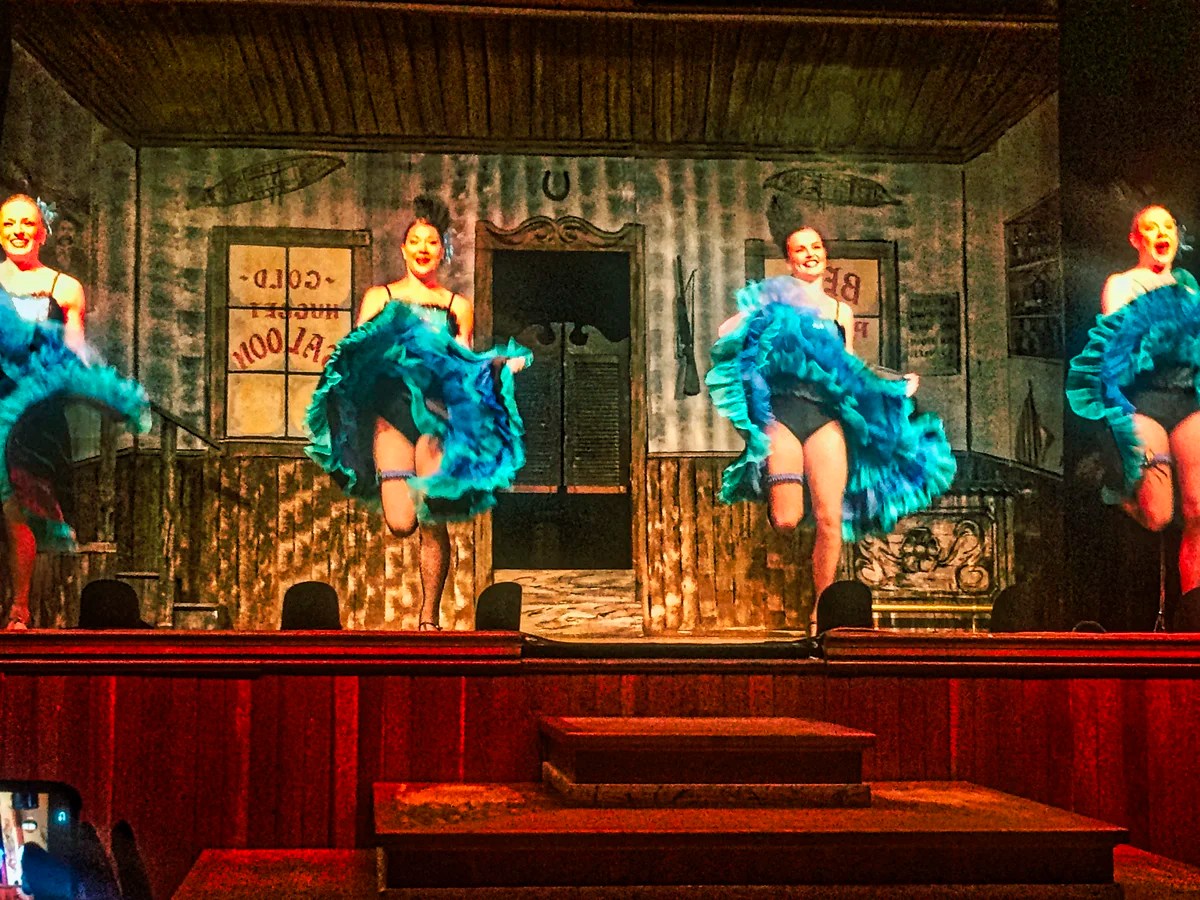
Gertie Lovejoy was a dancehall girl who later married Dawson City’s most prominent lawyer. She did, in fact, have a diamond between her teeth. The wealthy prospectors spent extravagantly, gambling and drinking in the saloons. At historic Diamond Tooth Gertie’s, you can watch dancers and singers, eat, drink, and gamble. Our B&B owner highly recommended it – she danced there for a dozen years!!
All three dance shows and the singers were superb. The first two shows were more traditional in terms of costume and music.
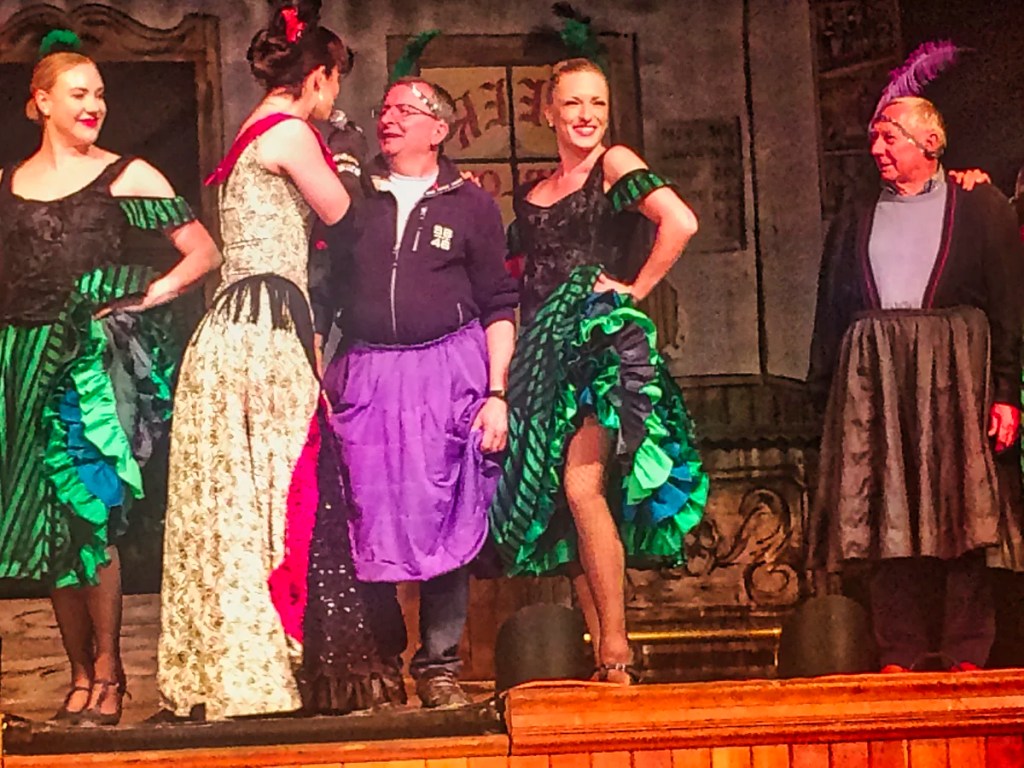
Then they brought some of the old timers onto the stage to try cancan dancing!! The men had to put on dresses. We were all laughing out loud; it was so funny. All of a sudden my number was called. I learned how difficult it was to kick your legs up high! It was a hoot.
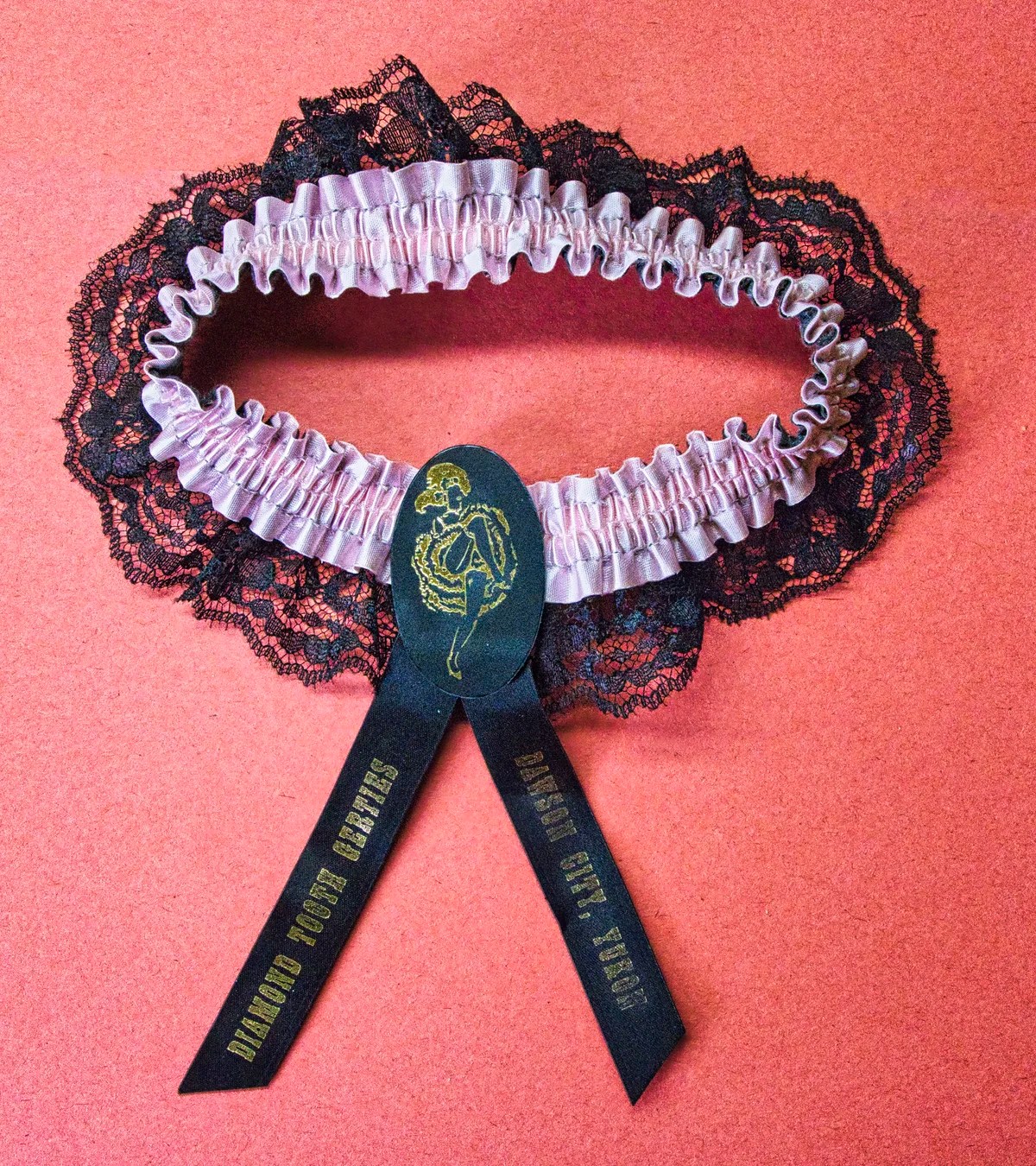
Just to prove I was up on the stage for my cancan try out, I had to take off this garter from my dance partner’s leg! I did get to keep the garter as a souvenir! People would recognize me in the next few days even when we travelled north to Tombstone Territorial Park.
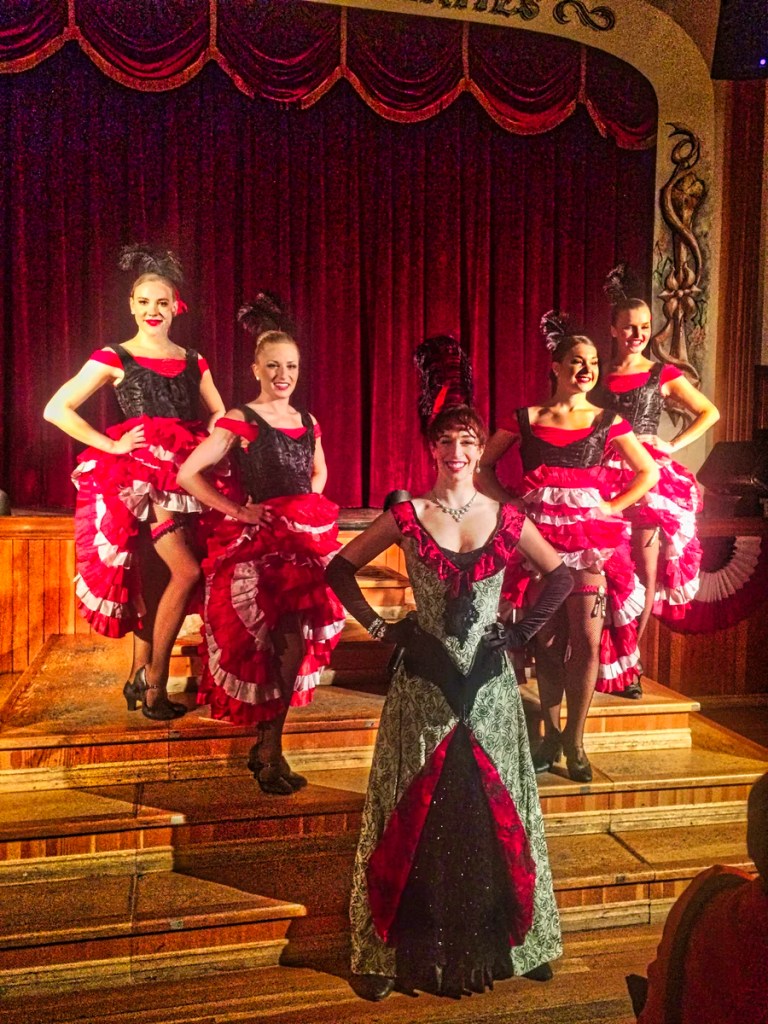
The last show was modern, using very elegant outfits shown above and recent songs. The show ended with the performers posing for photos.
Commissioner’s Residence 1901
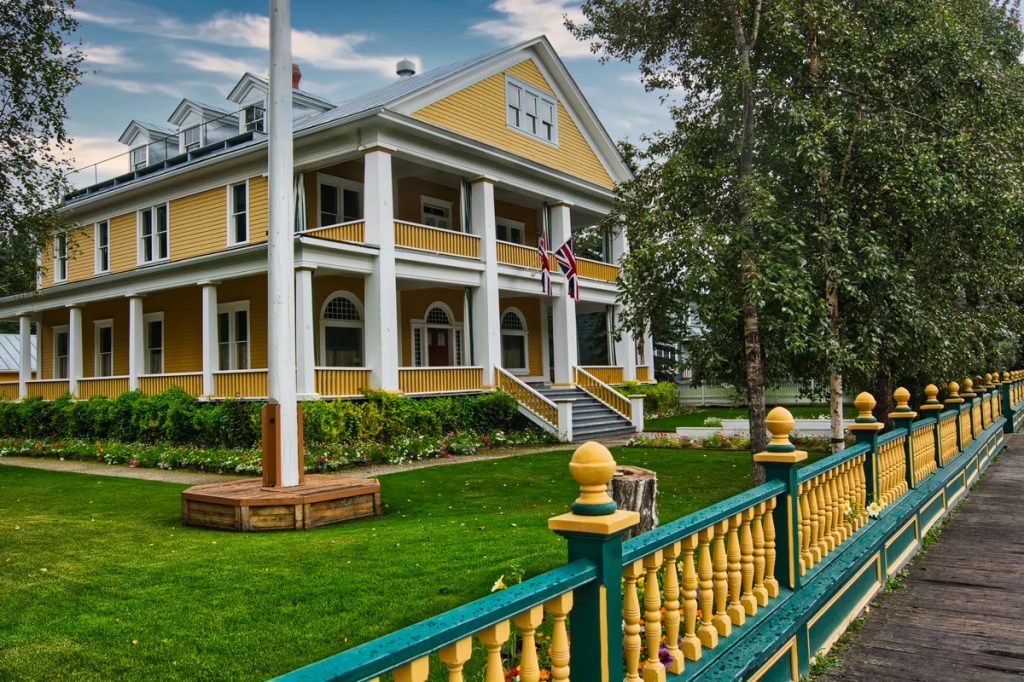
The boundaries with Alaska were still contested and the Canadian government had to establish their authority. The Yukon Territory was established in 1898 and joined the Canadian Confederation. The federal government appointed a Commissioner, the equivalent of a provincial premier or state governor to manage a territory 20% larger than California. Note that the building is adorned with Union Jacks since Canada did not have its current flag until 1965.
An interpreter portraying Martha Black described her southern US style mansion. It features a temple façade with massive columns and wrap-around verandas on the first and second levels.
The building’s foundation was designed so it would not be affected by the permafrost that permeates the North. The structure rests on wooded pillars set 10 feet deep in the ground, far below the permanent frost line. Steam thawers had to be used during construction. Water that accumulates in the cellar during warm weather is drained into the river. Expert tradesmen we’re brought in from as far away as Montreal.
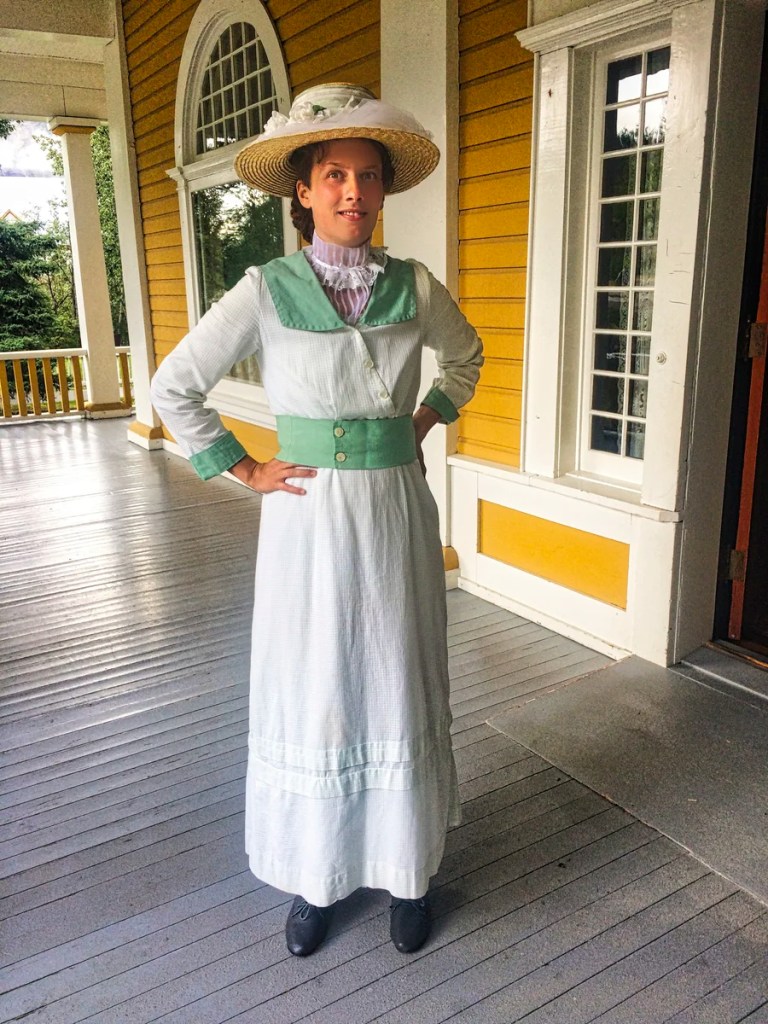
The Commissioner’s Residence was used between 1901 and 1916. Rt. Hon. George Black was the last Commissioner to live there, along with his wife Martha.
Born in Chicago, Martha Louise joined the Klondike Gold Rush in 1898, hiking over the Chilkoot Pass. She stayed in the Yukon and in 1904 she married George Black, a lawyer originally from New Brunswick on the Atlantic coast.
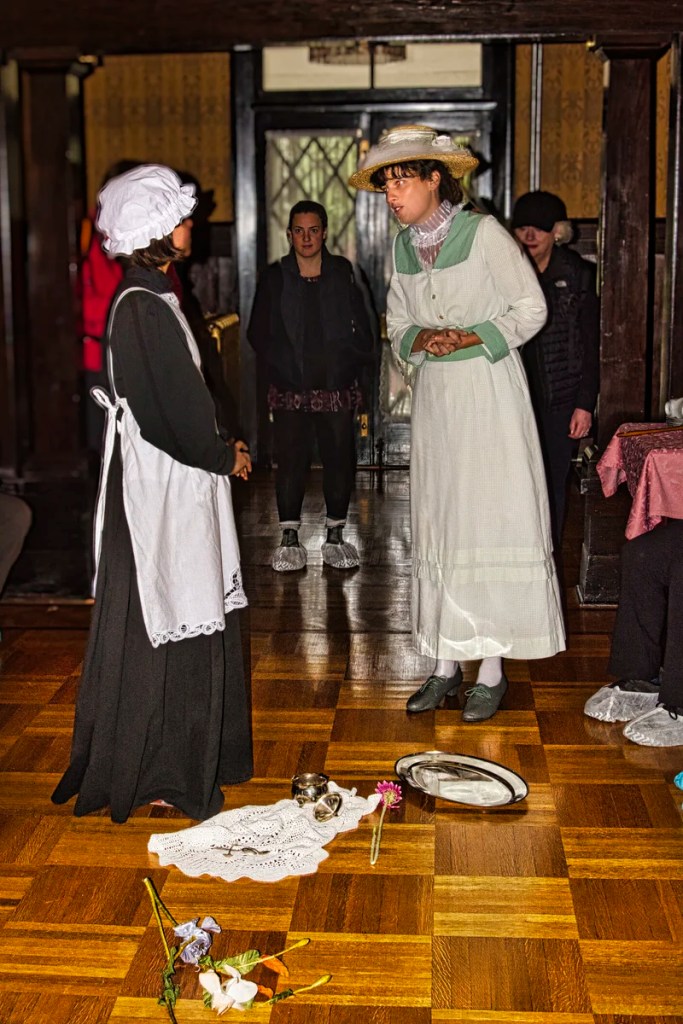
Book a tour to visit the interior of the mansion and watch skits that made the history come alive! Notice the beautiful parquet wood floors.
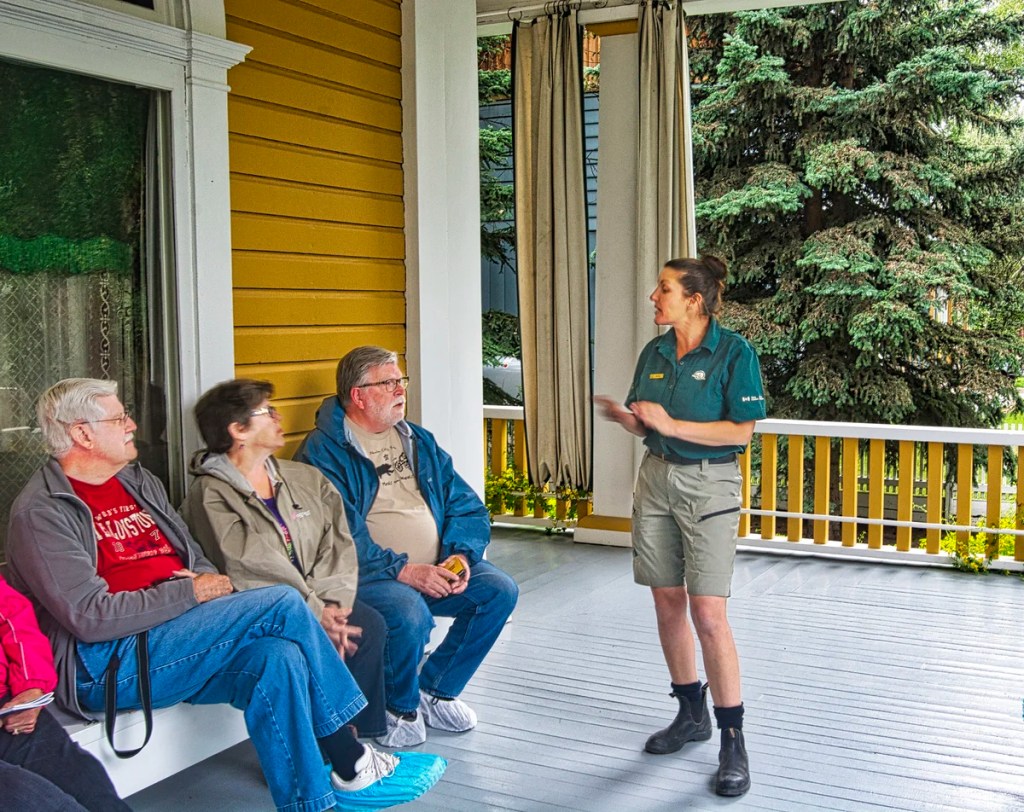
The building was meant to impress. Even the wood floors are spectacular, which is why you have to wear cloth socks over your shoes. Why would they use an architecture style that does not fit the Yukon? The interpreters re-enacted the reception held to get wealthy American businessmen to invest in the gold fields of Dawson. They were successful!!
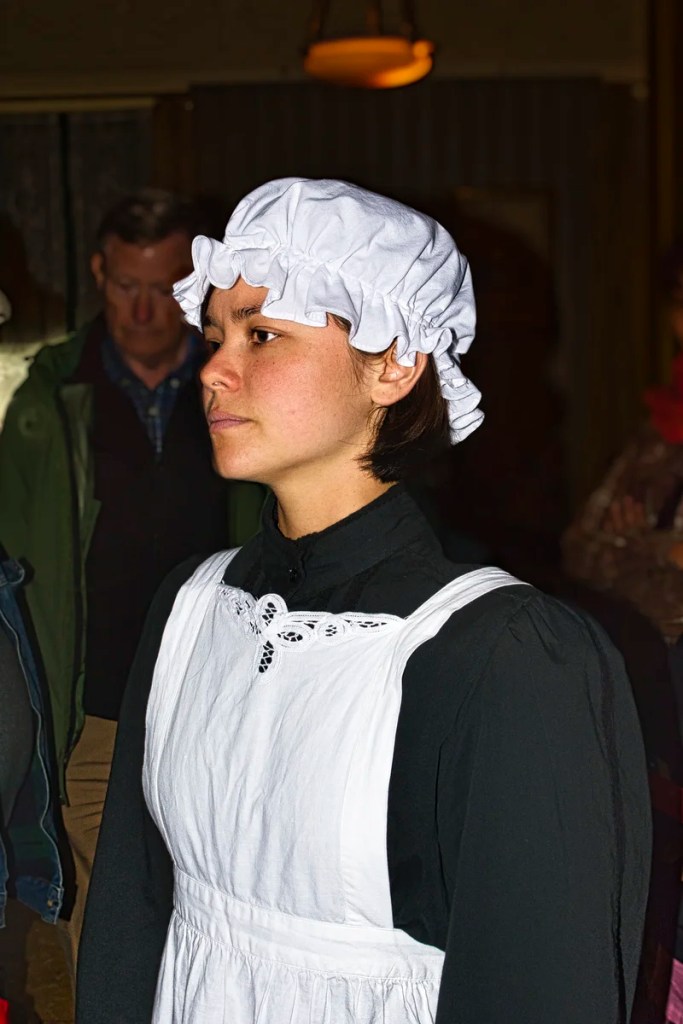
Martha Black oversaw receptions that included not only the territorial elite but “all who wished to come, irrespective of social position.” Guests included miners and dance hall entertainers. Later in life, she was the second woman elected to the Canadian House of Commons (parliament).
Dredge No 4
Did the Klondike Gold Rush just end? Prospectors left in 1898 because there was little gold to be found using the gold panning technique. Placer Mining is the practice of separating heavily eroded minerals like gold from sand or gravel. But, gold panning was replaced by gold dredging, thus prospectors were replaced by big companies. A gold dredge is a placer mining machine that extracts gold from sand, gravel, and dirt using water and mechanical methods.
So did they eventually run out of gold? Today, Canada is the fourth largest gold producer in the world. Yukon gold production is in fourth place within Canada.
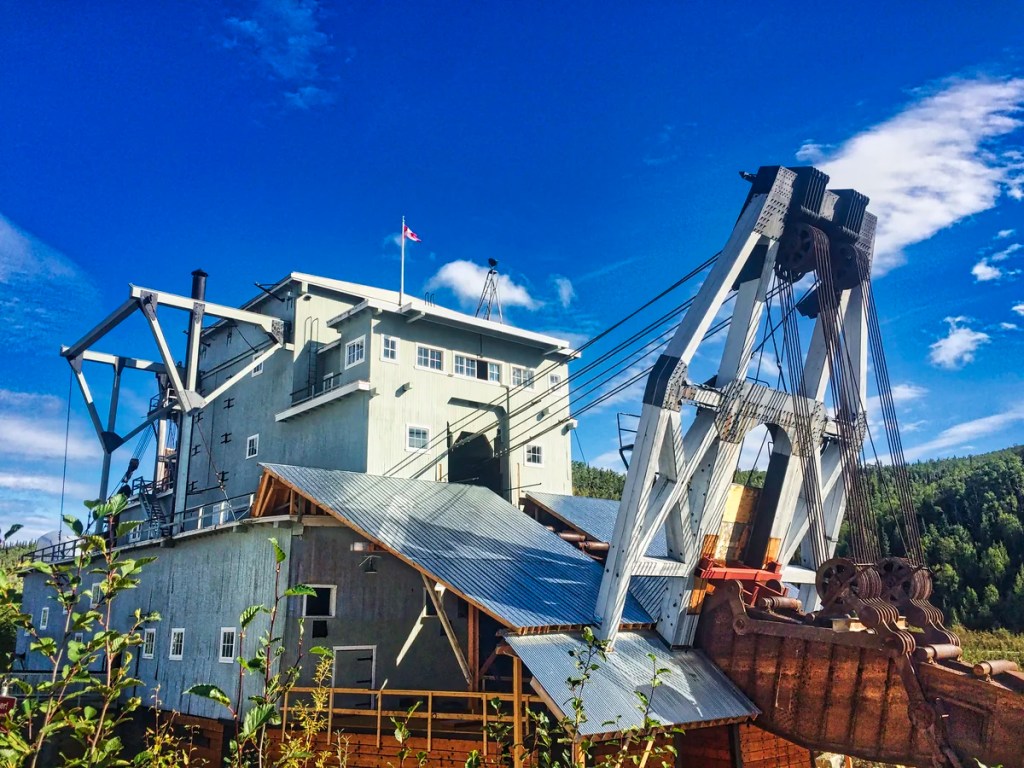
Thirteen km off the Klondike Hwy, is a massive 18 meter high dredging machine that tore up the Klondike Valley. This machine left wavy tailings shown in the photo below, which you still drive past today. Dredge #4 is a National Historic Site that was taken over by Parks Canada because of the importance of dredging operations in the Yukon between 1899 and 1966.
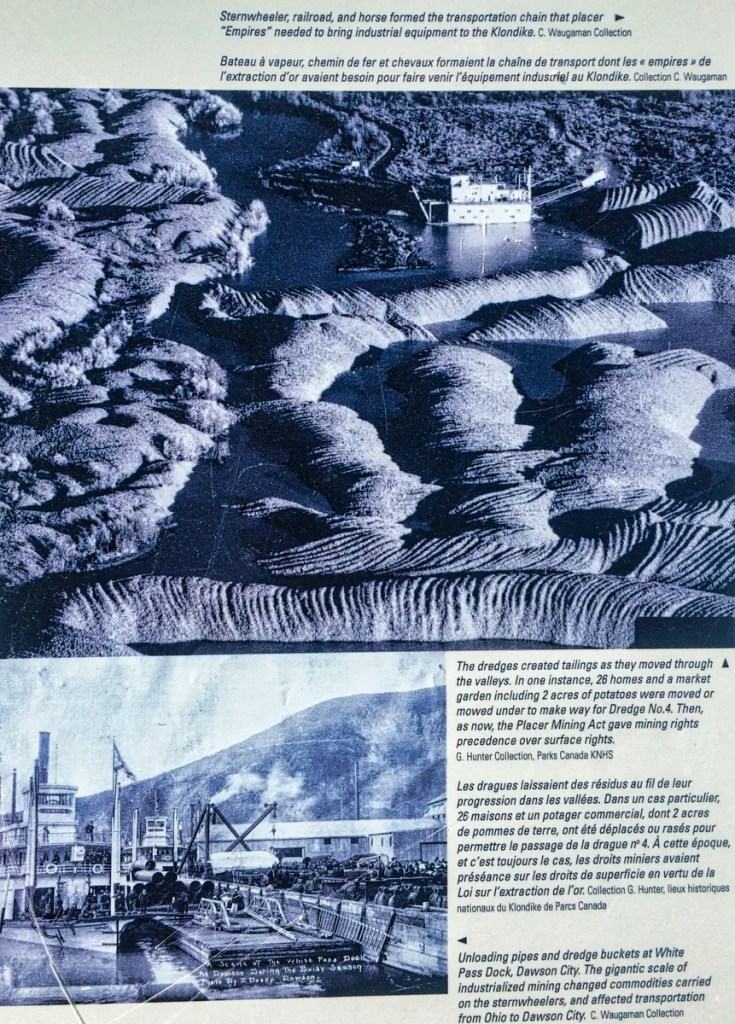
Take a guided tour through the interior of this massive machine with Parks staff and discover the evolution from Placer mining to large-scale gold-digging machines. Tours must be booked at the Visitor Centre ahead of time.
Tombstone Territorial Park
We woke up to 1°C (33.8 °F)!! So much for summer. We drove 114 km 1.5 hours on the unsaved Dempster Highway to the visitor centre in Tombstone Territorial Park (TP). There are no hotels nearby, only a campground, so we commuted from Dawson City.
The 2200 sq km park was a direct result of a land claims settlement with the Tr’ondëk Hwëch’in First Nation (THFN). The park is within THFN territory, and THFN elders participate in the management of the park. The park is half the size of the state of Rhode Island and 85% of the country of Luxembourg.
At the centre, we had some free Indigenous-style tea to warm up while viewing the scenery outside the huge windows. Here, people commented on my performance at the previous night’s cancan show at Diamond Tooth Gertie’s.
Located at 65° North latitude, Tombstone TP is literally just one degree below the Arctic Circle. This park lets you experience the Arctic tundra that you would see as you drive north another 12 hours to Inuvik and the Arctic Ocean.
Tombstone TP is magical with no trees and 360° views all around us. The wide open valleys are covered in typical permafrost soil with small hills of peat-covered ice (pingos). It was now sunny but cold, ca. 9°C.
See Tombstone Territorial Park and Tombstone Territorial Park: Everything You Need To Know blogs or the Official Website for photos.
Many of the mountains are remnants of ancient volcanoes. The mountains are in the distance. To get a closer view requires hiking the 11.5 km Grizzly Lake Trail.
Instead, we drove a very short distance after the centre and turned right at the tower. Here we walked the short Golden Sides Hike. It was a fairly flat trail. People say there are no trees. But some of the low-lying vegetation is dwarf birch and willow. They only grow a couple of inches high!
This area was and still is a frigid desert. Without snow, there can be no glaciers, and so there was never glaciation in Northern Alaska and Yukon! During the last big ice age, sea levels dropped, and the Bering Sea became a massive land bridge. This led to many mammals (horses, bison, mountain lions, bears) moving into North America, including humans!
Final Comments
Is Dawson City, Yukon, worth Visiting? Yes, it definitely is. We thought there would be little to see in this town of 2000 people. But we were sure glad we went. We think it was the best place we visited in the Yukon. Below are more itineraries for the Yukon.
Subscribe
Get travel tips and advice delivered directly to your inbox. The best part is that it is free.
What things fascinate you? How long is your trip? What questions do you have? If you have been to the Rockies, share your experiences with us.
Yukon Itineraries
The Yukon (YT) is a territory of Canada in the Arctic. The Yukon is 14% bigger than California and 9% smaller than Spain! All this wilderness space comes with only 36,000 people. Are you ready for a very different experience in the Great North? The Yukon is a great place to connect with First Nations people. The term First Nation is used in Canada rather than aboriginal or a reserve. Twenty-three percent of the population of the Yukon is Indigenous. They have welcome centres and offer hosts to meet and connect with you.
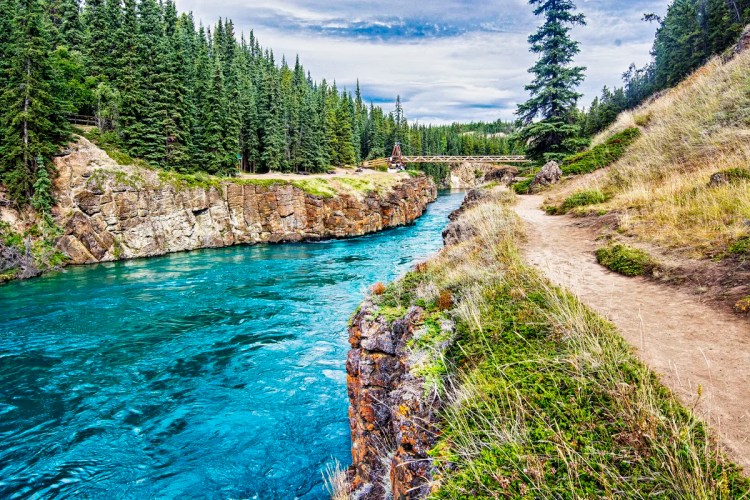
Itinerary Map & Resources
Google Maps Ratings
Google Maps provides a rating from 0 to 5 for all sights, hotels and restaurants (but not cities). All of our recommendations are appended with the rating (prefixed with a G) from Google Maps. As it is based on feedback from tourists and locals, it is much more reliable than travel booking websites. We consider a score of 4 to 4.39 to be Very Good; 4.4 to 5 to be Excellent.
Canada FAQ

The Exploring Canada post answers Frequently Asked Questions (FAQ) such as:
- Where should I go in Canada?
- What is the best season for travel?
- What is the best clothing?
- Where should I go? What are the must-sees?
- How much time do I need for Canada?
- Can I see everything in a week?
- How safe is Canada?
 Terra Encounters
Leave a comment