

Why You Should Double Down in Derry
Derry is a large city with a compact tourist area surrounded by the only walled city in Ireland and the last one to be built in Europe. It is also the place to connect with the causes and events of the Troubles. Unless you were born after 1998, you were immersed in the problems and violence of Northern Ireland (NI) vicariously through the news.
Author & Photographer: George Mitchell

Our content and advice are derived from our personal experience and knowledge, gained from living in Europe for seven years and studying its art and architecture. Our recommendations are not influenced by affiliate links – we do not have any. Ireland is one of our favourite destinations.
All of our recommendations are top-rated by Google Maps, which is based on the opinions of everyone, not just tourists. Each place recommended in our posts and our Ireland North Map is appended with a Google Maps Rating (G0 to G5).
Derry Today

We drove for a second time to Derry after a marathon forced us to go Ambling the Antrim Coast the previous day. We were looking for the border of Northern Ireland. But there was no sign that we were in another country. An open border was a condition of the Good Friday 1998 peace accord. So what will they do with Brexit?
Finally, 40 km from Ramelton, there was a sign in miles. It is like there is only one Ireland. One of our B&B hosts said it will take two more generations before the old timers disappear and are replaced by a younger generation that has known only peace.
The Walled City
Siege of Derry

The modern-day story actually begins when Catholic Jacobite forces attempted to seize the town in 1688. This was foiled by 13 apprentice boys. They were orphans from the Great Fire of London (1666) who were shipped to Derry. The apprentice boys grabbed the keys to the city and closed the gates.

The siege became an icon of Ulster Protestant culture. Since the 19th century, the Apprentice Boys Society has held two annual parades, one on 7th December to celebrate the closing of the gates and on 12th August to celebrate the lifting of the Siege of Derry. The Apprentice Hall above was built in 1873 for this Protestant organization. The Orange Order was established in 1795 to unify the various Protestant factions.
Bishops Gate

Walk up the stairs for some good views from the walls. Bishop’s Gate was one of the original four gates to the city and was named for the adjacent Bishop’s palace.
King James II came here with his army in 1689 and asked Derry to surrender. They fired their cannons. This was an act of rebellion, and the siege continued for 105 days!
The Catholic James II was in Ireland because he was deposed as King of England the previous year by the Protestant Prince William of Orange, a Dutch noble. What we did not know was that William was James’ son-in-law!! I wonder what James’ daughter thought?
But this was only indirectly about religion. The real cause of the war and the later Troubles was political. James was supported by his cousin, Louis XIV of France! William had organized a multinational coalition to oppose French aggression. The real purpose of the coup was to deny Louis XIV a strong ally in Britain. For more on the Battle of the Boyne, see the Neolithic Newgrange post.

St Columb’s Cathedral

In 1600, Henry Docwra invaded pre-Derry and tore down the already ruined cathedral. Henry laid down the streets and is considered the founder of Derry. He used the stones of the cathedral to build the walls of the fort.

St Columb’s Cathedral was the first Anglican cathedral built in Britain and Ireland after the Reformation and the first non-Catholic cathedral in Western Europe.
The present-day Gothic-style St Columb’s Cathedral was actually built in the Baroque Era (1633).
Derry Wall Walk

Do the whole walk along the walls. You get many views and a whole different perspective

It is not long, and you never know who you may meet. Here is a nurse from 1917 who talked about World War I to a large school class.
St. Augustine’s Chapel

St. Augustine’s looks like a 13th-century Gothic church but was built in 1872 on the site of St. Columba’s Monastery (546 CE). It is locally known as ‘the wee church on the walls’. During the Siege of Derry (1689), a cannonball was fired into its graveyard, containing the terms of surrender, which were infamously rejected.

The chapel does not face east because the original monastery faced northwest to fit onto the hill surrounded by oak trees. St. Columba did not want to cut any oak trees down. The name Derry originates from the Irish word “Doire”, meaning oak grove. The city was named after these oak trees, which are also the symbol of the city.

The current church follows the same orientation. As a result, the entrance is right off the western walls. The entrance has some nice flowers, including this white Calla lily.
Downtown Derry
Bishop Street

Back at Bishop Gate, look down Bishop Street. Yes, there really was not much traffic. So it is a pleasant walk down to The Diamond with Guildhall in the distance.
Austins

Established in 1830, Austins was the world’s oldest independent department store. The original store was destroyed by fire. The current building was built in 1906 on Diamond Square. It has an Edwardian-style baroque facade. The store was closed in 2016 due to asbestos. The Inner City Trust has just purchased the building (in 2025) and plans to restore it.
Guildhall

The original 17th-century Guildhall (city hall) occupied the Diamond Square. This beautiful building was built in 1890 in the Beaux Arts style — a combination of French neoclassical, Gothic and Renaissance styles.
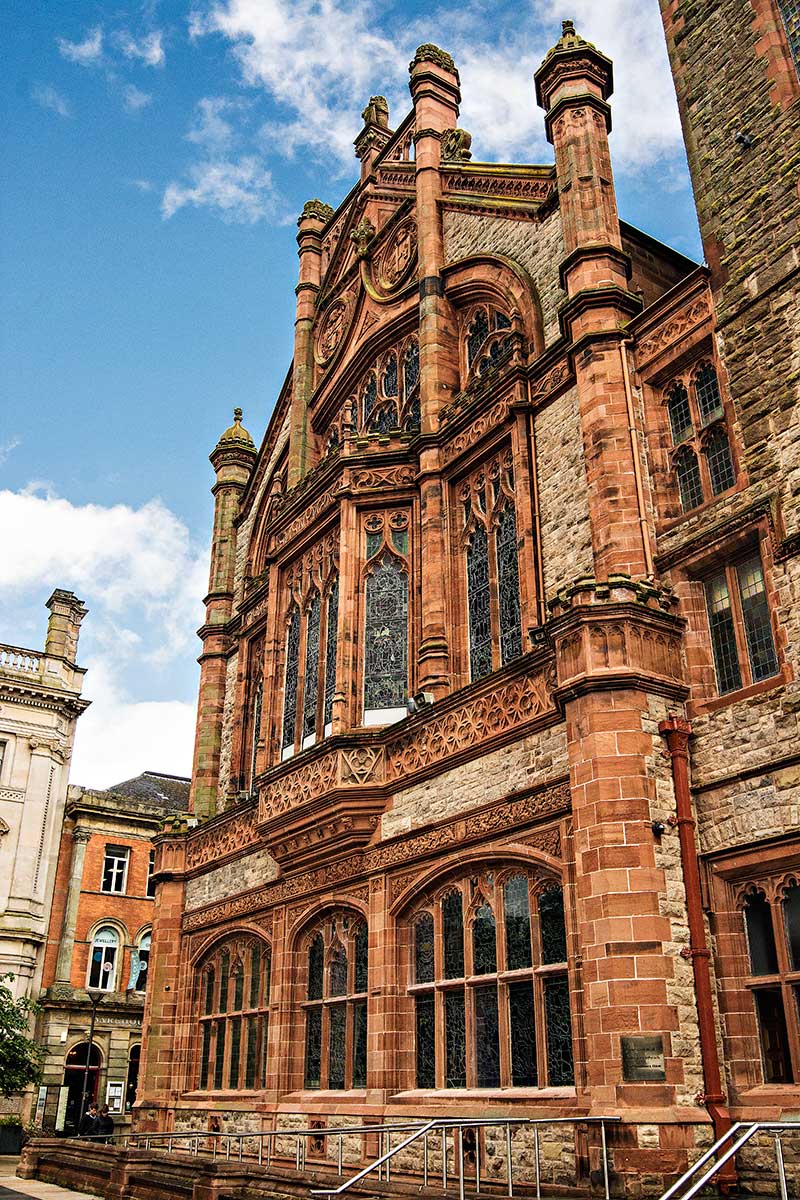
The building boasts 23 stained glass windows that narrate the story of the city.

It has the distinction of being the most bombed building during the Troubles. It cost a mere £19,000 to build, but this is dwarfed by the £9.5 million spent on recent restorations.
Free Derry Corner

Head to Lecky Road, and when you find the Free Derry wall, you have arrived at Bogside. This historical landmark is a free-standing wall that used to be attached to a row of homes. It commemorates a self-declared autonomous nationalist area of the town from 1969 to 1972. Not only have the barricades come down, but this area was demolished to build Lecky Boulevard.
The Bogside Murals
These murals of The People’s Gallery represent the history of the people of the Bogside seeking justice and democratic rights. They offer a visual history much like frescoes in a church. Dating from 1994, they were painted by brothers Tom and William Kelly, and their friend Kevin Hasson. These images are dramatic, powerful, and superb art.
Battle of the Bogside
Refugees from the Potato Famine (1845-49) fled to Derry to find work during the Industrial Revolution. They settled in this boggy side of the city. In more recent times, working-class Catholics remained concentrated in the overcrowded Bogside, below the western wall. In the 1960s, Catholics protested peacefully for civil rights and a fair share of jobs. The Northern Ireland (NI) government favoured the Protestant areas in terms of job opportunities.
The Protestant Unionist politicians isolated the Catholics in a small number of electoral wards. Even though the Catholics were in the majority in Derry, severe gerrymandering meant that Unionists controlled the city government. Thus, the Catholics were marginalized much like the Blacks in America.
The Petrol Bomber Mural

This mural is a scene from the Battle of the Bogside in this area of Derry in August 1969. This is a young boy wearing a gas mask to protect himself while he holds a petrol bomb.
Unfortunately, the protests were met with violence. The Troubles conflict began in Derry with the Battle of the Bogside in 1969.
Bernadette Mural

Bernadette McAliskey, a social activist, is addressing a crowd during the Battle of the Bogside. She received a prison sentence for initiating and participating in a riot. Bernadette would later be elected to parliament at the age of 21.
By 1971, the level of violence across NI was such that the government introduced internment without trial. But, internment was applied predominantly to republicans.
Bloody Sunday Mural

30 January 1972 became known as Bloody Sunday around the world. British soldiers shot 28 unarmed civilians during a protest march against internment — 14 people died.
Death of Innocence Mural

You can see some of the murals as you walk along the western wall of Derry. British snipers used to fire from the wall. Fourteen-year-old Annette McGavigan was killed in 1971 at a place very close to this mural. A British soldier killed her while she stood at the side of the road.
In total, 3,000 people were killed during The Troubles. The large butterfly was painted afterwards as an empty silhouette as they were not sure the peace process would succeed. In 2006, it was filled with colour and symbolized the hope for peace.
The Saturday Matinee Mural

The Saturday Matinee depicts a riot scene that became common on Saturday afternoons in the Bogside between 1969 and the early 1970s.
The Runner Mural

This mural shows a young boy running from the tear gas. Two young teens are shown at the bottom. They were killed by British sniper fire and an IRA bomb, respectively.
Civil Rights Mural
This artwork showcases the struggle for democratic rights for both Protestants and Catholics. These early marches through the streets were inspired by Martin Luther King’s civil disobedience campaigns.
The Peace Mural

The Peace Mural is a dove emerging from an oak leaf. The dove is a symbol of peace and Derry’s patron saint, Columba. The oak leaf is a symbol of Derry. The background is a set of equal-sided squares, which represents the equality of all citizens. On this colourful note, let us hope for a peaceful and prosperous future for Derry.
Final Comments on this Itinerary
This is an action-packed itinerary for one of our favourite parts of Ireland. The places we recommend are all highly rated by local people, as shown by the high Google Map Ratings. Remember, the most important “destination” is meeting the people.
Subscribe
Get travel tips and advice delivered directly to your inbox. The best part is that it is free.
What things fascinate you? How long is your trip? What questions do you have?
Itinerary Maps & Guides
This itinerary is part of our Best Places for 2 Weeks in the North of Ireland and Ireland North itineraries.
Ireland North Map – our custom Google map
Google Maps Ratings
Google Maps provides a rating from 0 to 5 for all sights, hotels and restaurants (but not cities). All of our recommendations are appended with the rating (prefixed with a G) from Google Maps. As it is based on feedback from tourists and locals, it is much more reliable than travel booking websites. We consider a score of 4 to 4.39 to be Very Good; 4.4 to 5 to be Excellent.
Ireland FAQ
The Ireland FAQ post answers Frequently Asked Questions (FAQ) like:
- Where should I go in Ireland?
- What is the best season for travel?
- What is the best clothing?
- Where should I go? What are the must-sees?
- How much time do I need for Ireland?
- Can I see everything in a week?
- How safe is Ireland?
- How much cash should you take to Ireland?
- Should I pay in Euros or my own currency?
- What apps are useful for travel?
- Should I rent a car? Take a Taxi?
 Terra Encounters
Leave a comment