
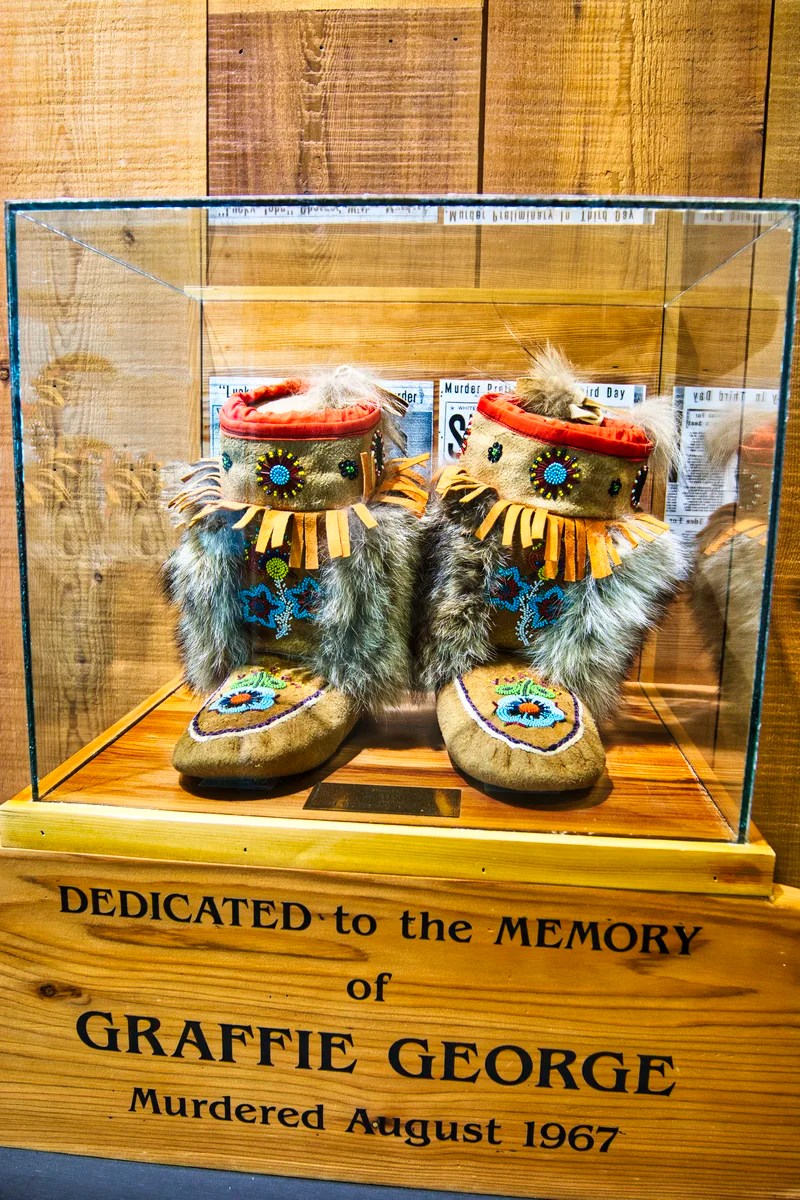
There are many places to see in Whitehorse, Yukon, but there is one thing you must do – mingle with the First Nation (FN) people and learn about their culture. Notice that we no longer use the term Indian or reserve in Canada. Instead the people and their land are called a First Nation (FN). Yukon is one of the best places to do that as 23% of the population are indigenous. No southern province in Canada has such a high proportion of FN residents.
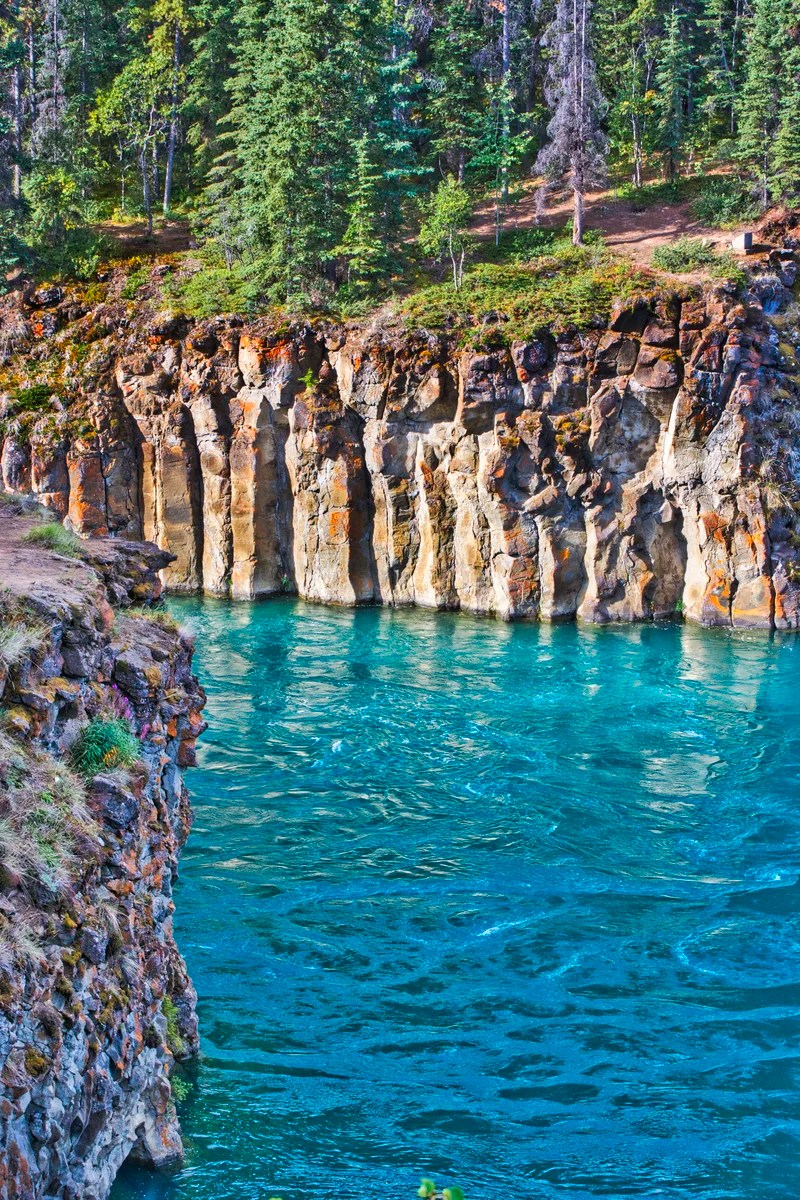
Miles Canyon of Yukon River
The best places to see in Whitehorse – such as SS Klondike steamship (Google rating 4.3) and Miles Canyon (rating 4.8) – are described in the Yukon Green post. All the places mentioned in the Yukon posts can be found on the Yukon Itinerary Map.
But of all the places, the most central to this post is the Yukon River, which is green because its source is the Llewelyn Glacier. Glacier flour (finely ground rock) saturates the water and reflects green light. Whitehorse is built on the traditional lands of the Kwanlin Dün, one of 14 FNs in the Yukon. Kwanlin means “water running through narrow place”, in other words, Miles Canyon shown above.
Place names were changed by prospectors during the Klondike Gold Rush 1896-99. During the Gold Rush, Miles Canyon was consumed by dangerous rapids that resembled the manes of stampeding white horses, the origin of the present day name of this city of 28,000 people. Miles Canyon looks so placid today! What happened to the white water? A hydro dam was built in 1958 that tamed the water.
Friendship Totem Pole

This Friendship Totem Pole was created by Stan Peters in 1973. It is located in Rotary Peace Park near the Yukon River. This totem pole was made to encourage unity and friendship among all Yukoners. As in any art, there is symbolism in everything you see. Starting from the top of the pole:
The Thunderbird with outstretched wings represents power and protection. He controls rain and ensures vegetation growth. Prominent in Indigenous legends, the thunderbird is depicted as strong enough to pull a killer whale out of the water with his talons. Only the most powerful and successful chiefs and families use the thunderbird in their crest.
The Wolf holding “Skookum Jim” Mason, represents one of the major Indian clans. Mason is one of the men credited with finding the first gold nuggets in the Klondike Gold Rush of 1898.
The Crow, represents the second major Indian clan.
The Beaver symbolizes economy and trade, especially the fur trade.
The Bear symbolizes motherhood and is the protector of the animal kingdom. With its great power and human-like qualities, the bear is known as the Elder Kinsman. The bear also symbolizes strength, by supporting everyone above him on the totem pole.
The Colours are also symbolic:
- Black represents the charcoal of campfires
- Red symbolizes mother earth
- White represents the rapids that existed on the Yukon River.
Whitehorse Murals and Monuments
Following in the footsteps of Chemainus and Moose Jaw, many Whitehouse murals are painted on the exterior walls of its buildings. The following are two of our favourite ones.
Crow’s Yukon Journey Mural
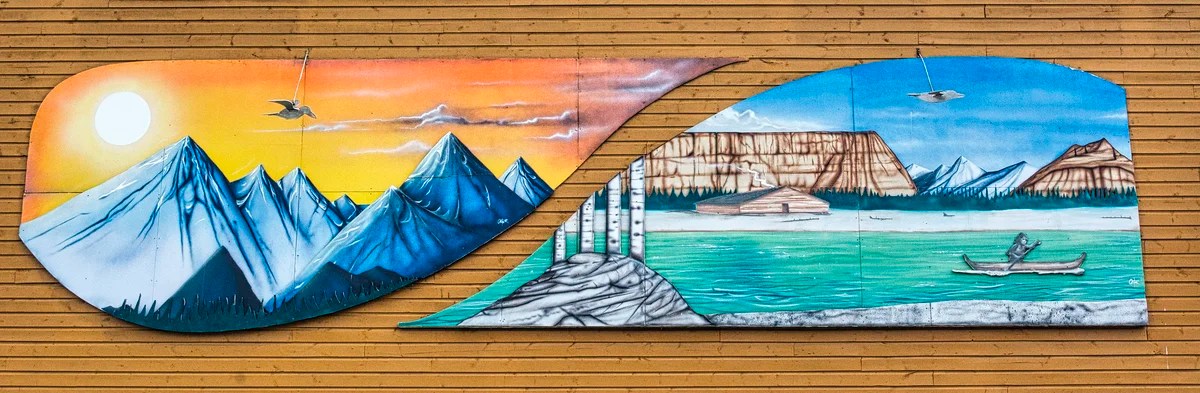
The Lambert Street wall of the Visitor Reception Centre is adorned with the mural called “Crow’s Yukon Journey”. Crow is a major character of Indigenous legends. The crow symbolizes cleverness and slyness, and is often depicted as the Trickster in legends. Interestingly, this is similar to the symbolism used by Australian aboriginals.
This 5-panel piece was created by Bill Oster and David Ashley in 1997. Only the first two panels are shown in the photo. The first scene shows the world before humans changed the landscape, and the second showed the First Nation paddling in a natural environment. I did not find the next threes scenes as interesting since they depict the era of increasing industrialization.
Wrap Around Mural
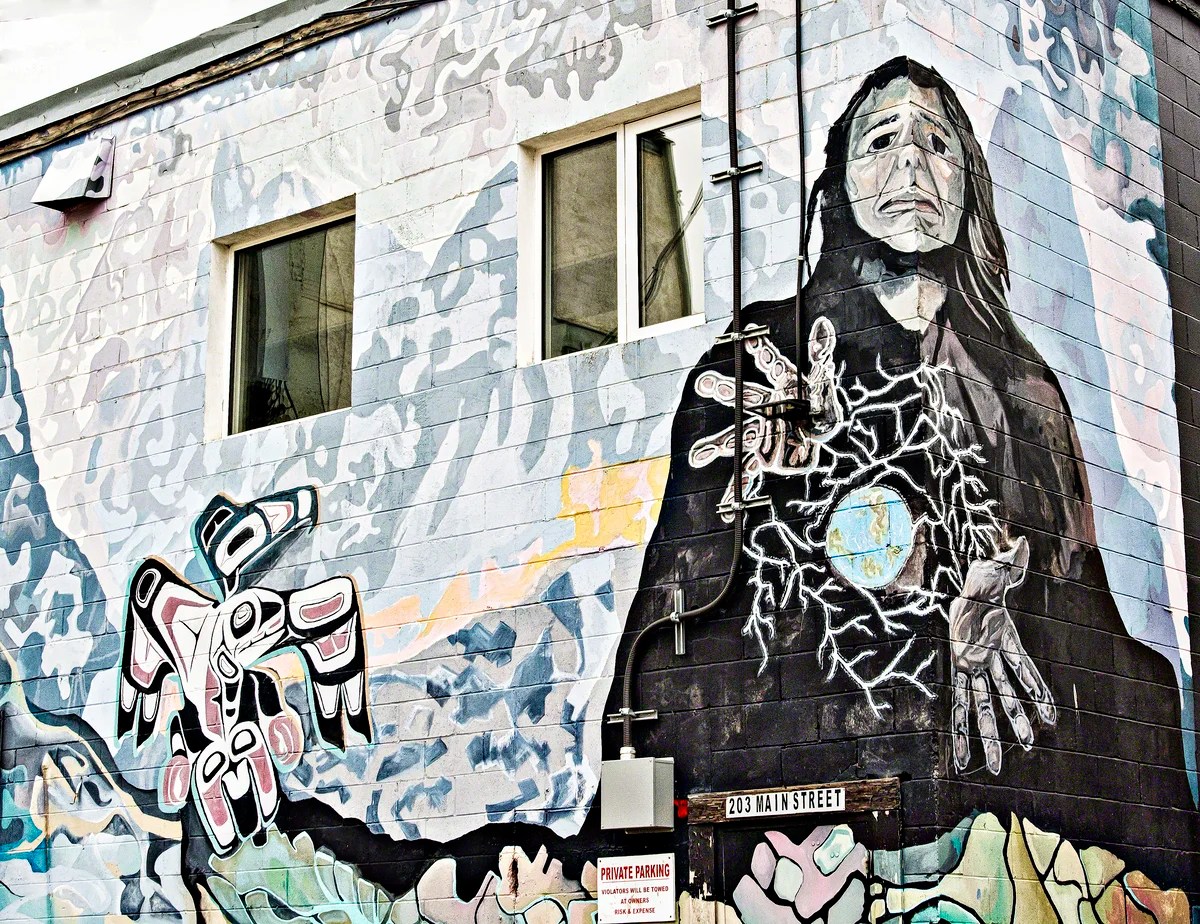
In the alley behind Mac’s Fireweed Books at 203 Main Street is this wrap-around mural painted by Lance Burton and the Youth of Today Society.
Angela Sidney
The monument dedicated to Angela Sidney was moved from Peace Park (in the photo below) to Main Street.
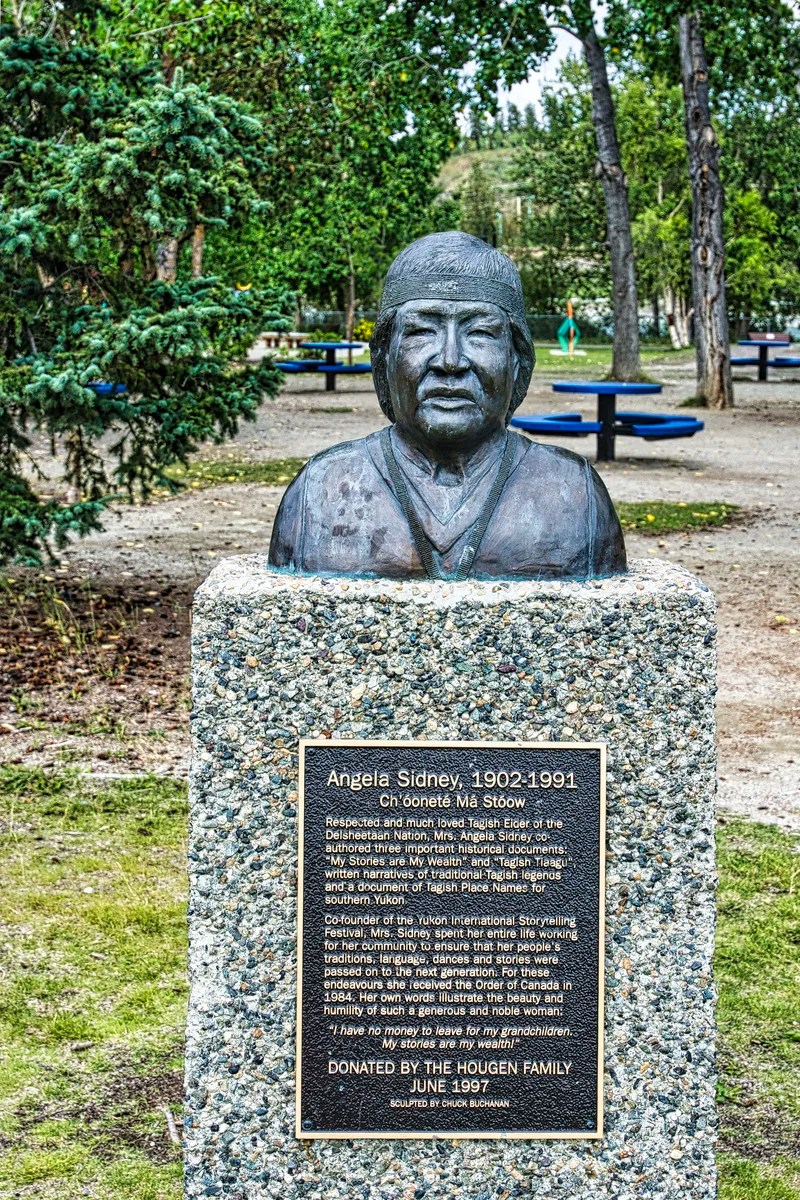
Angela Sidney was born 1902 and married by age 14. Indigenous language loss was worsened by the removal of children to Residential Schools, where they were forbidden from speaking their native language. Angela was fluent in Tagish, Tlingit and English. To preserve the traditions of her people, she told stories about their culture and her family. This included Skookum Jim, Kate Carmack and Dawson Charlie, whose discovery of gold had started the Klondike Gold Rush. Sidney was the first indigenous woman from Yukon to receive the Order of Canada for her work preserving and teaching Tagish and Tlingit languages, cultures and traditions.
Kwanlin Dün Cultural Centre
The Kwanlin Dün Cultural Centre is the one thing you must do in the Yukon. It was built along the Yukon River because this was where the Kwanlin Dün people lived and fished. The Yukon River was also the main transportation route all the way through Alaska to the Bering Sea.
This beautiful building was completed in 2012 at a cost of $23 million. The cultural centre houses the Whitehorse Public Library and a spectacular golden-coloured wood longhouse, used by both Aboriginal and non-Aboriginal peoples for conventions and weddings.
Everyone is welcome to come inside but it’s best to talk with one of the people to learn about Indigenous culture. The young woman we met told us about the impact of the Residential Schools, substance abuse and suicide. We heard many painful and personal stories from the young FN women we met.
Residential Schools
The residential school system (1883-1997) was a deliberate effort to isolate Indigenous children from their culture in order to assimilate them. The boarding schools were administered by Christian churches and intentionally located far from Indigenous communities. But even worse was the malnutrition, starvation, disease, physical and sexual abuse compounded by a lack of medical care. The real number of deaths is unknown as records were not kept, burials were hidden, and parents misled. Estimates range as high as 30,000.
Aboriginal Culture
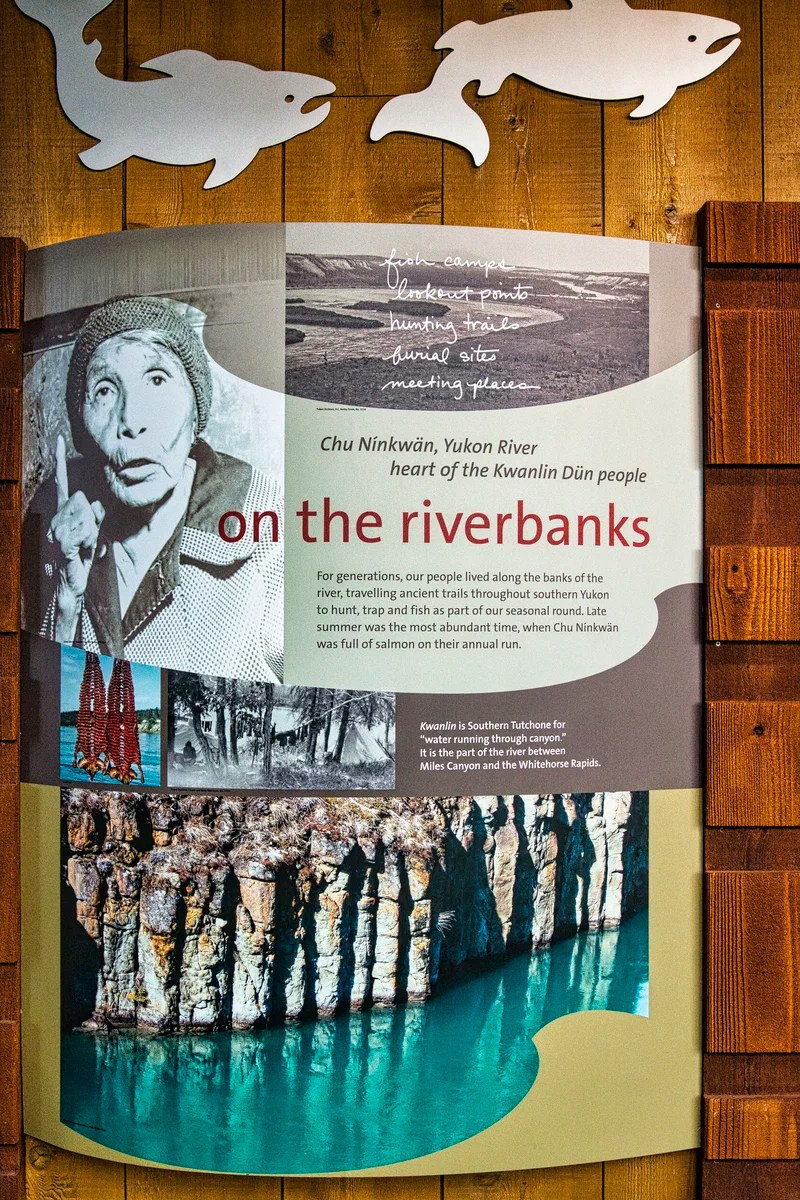
The “River Corridor” feature works by First Nations artists as well as photos and posters explaining their values and customs.
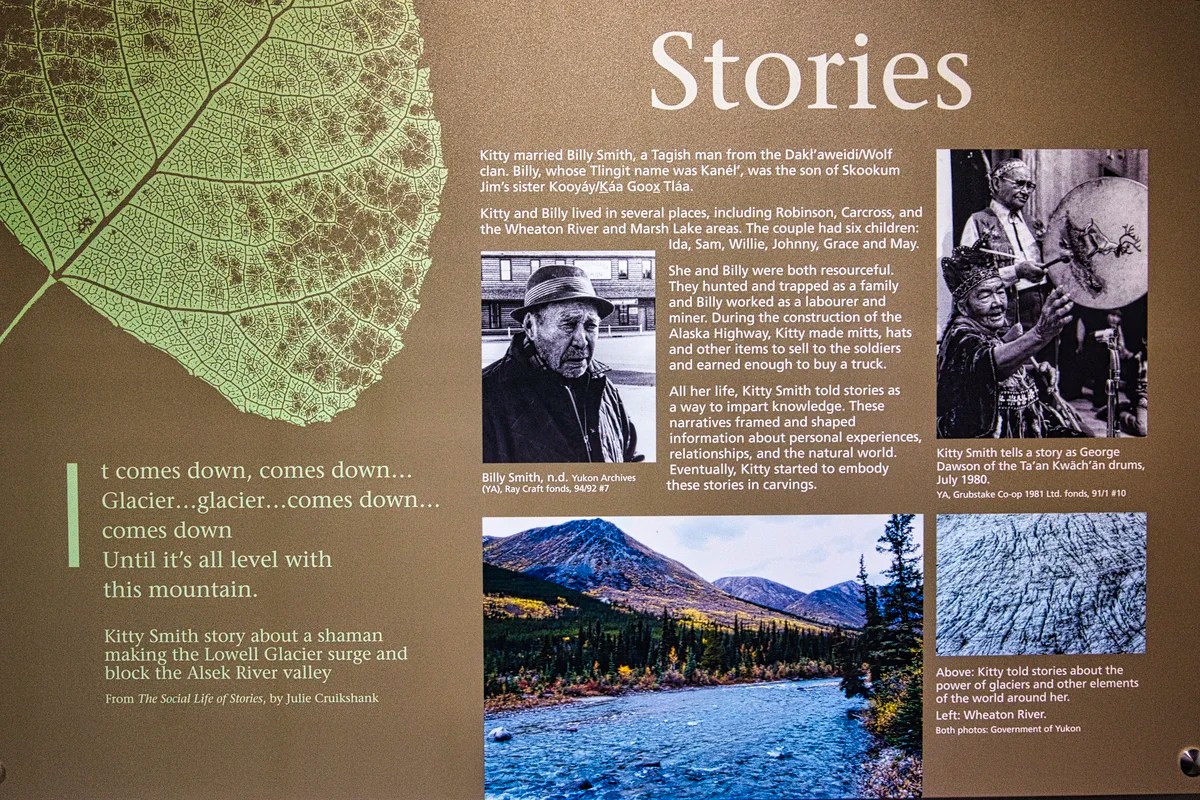
The centre includes several classrooms, an artist studio, a sacred space, and an Elders lounge. These are often used to continue the tradition of story telling.
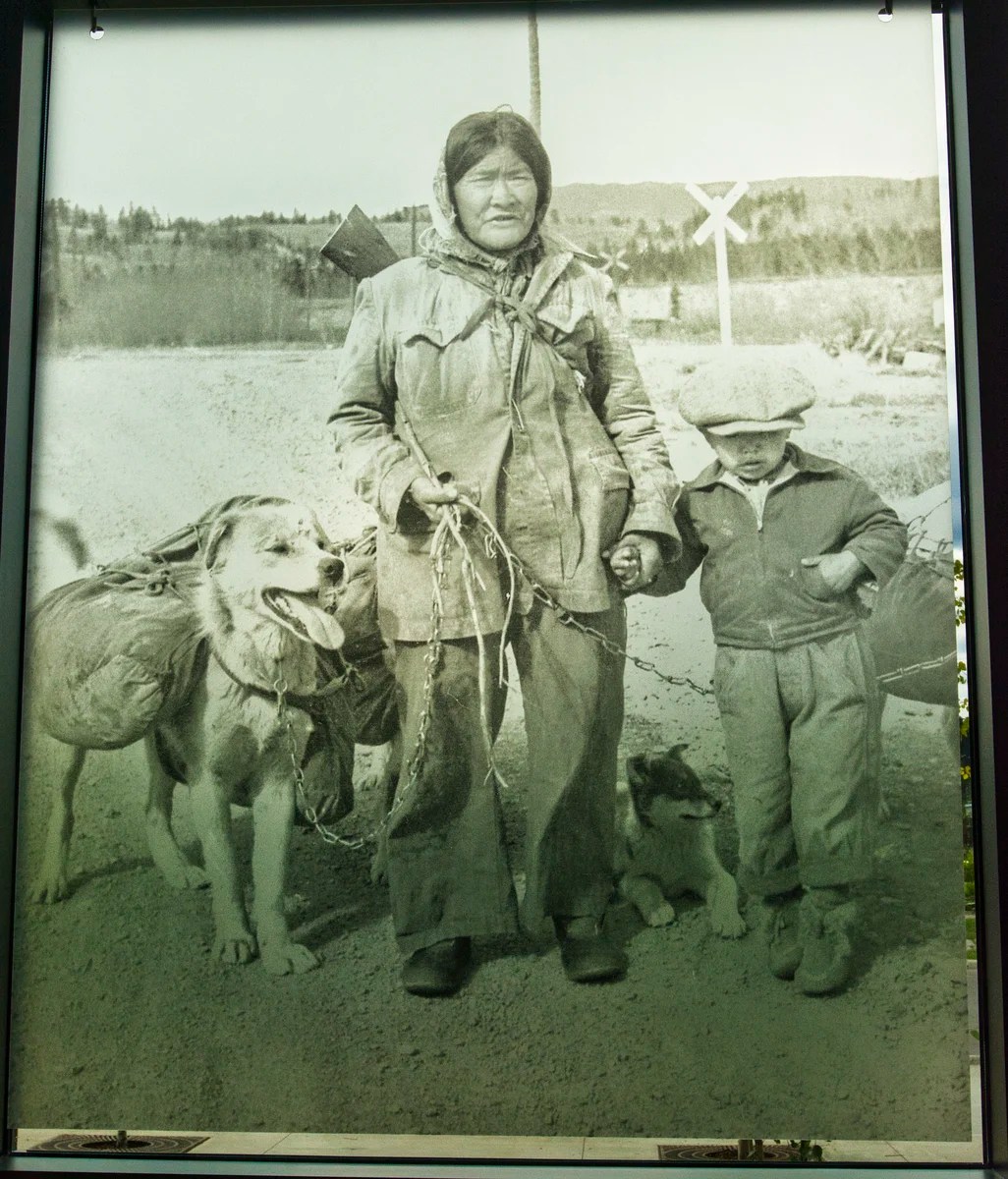
There is an extensive use of natural light via windows, as an effort to conserve energy use. The hall windows are covered in semi-translucent historic photographs.
Judy Gingell’s Wardrobe
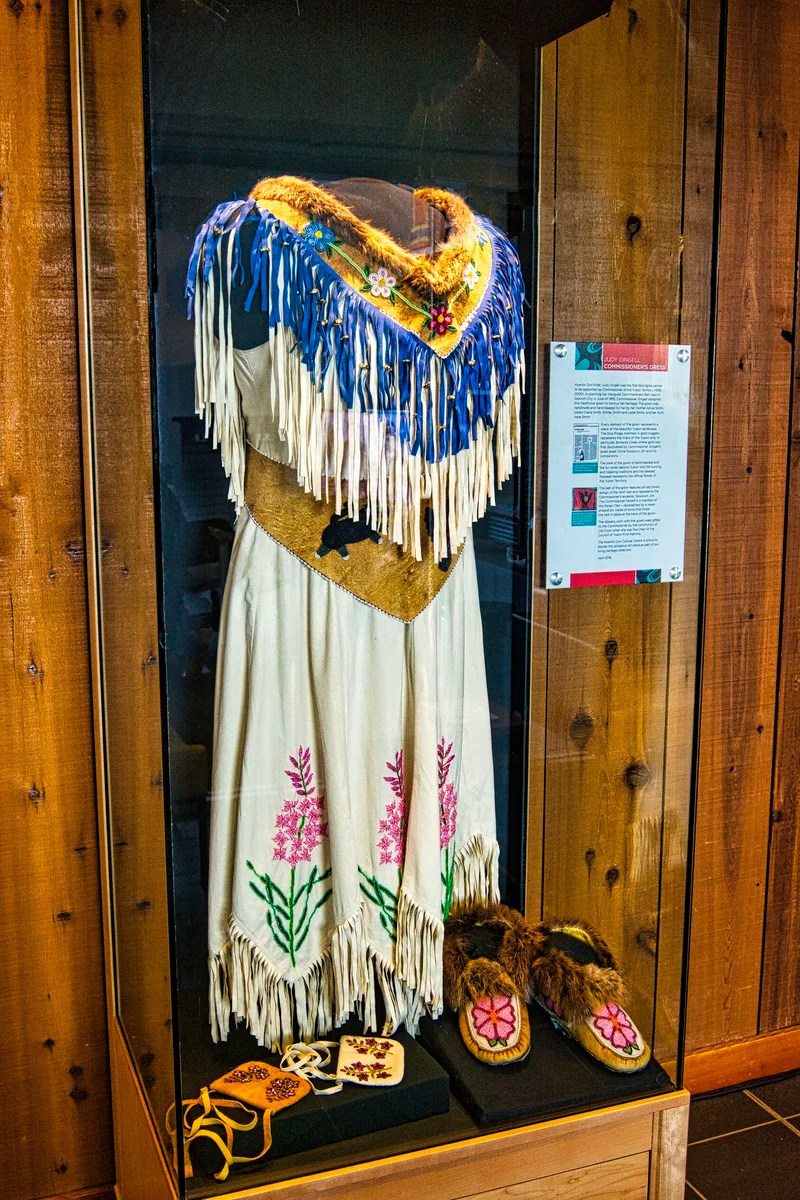
Judy Gingell was instrumental in self-governance and land claims negotiations with the Government of Canada. She served as the Yukon’s first Aboriginal commissioner (1995-2000), equivalent of a premier or governor. This is the specially crafted traditional moose hide dress she wore to her installation in 1995.
She was renowned for her ability to build bridges between peoples, notably by raising awareness of First Nations culture through the annual Commissioner’s Potlatch. As a leader and Elder of the Kwanlin Dün First Nation, she has ensured that First Nations communities are key players in the territorial economy. In 2009, she was made a Member of the Order of Canada “for her contributions, over the past four decades, to the promotion and advancement of Aboriginal rights and governance in Yukon”.
Dugout Canoe

A canoe pavilion houses a 181 kg dug-out cedar canoe built in 2009 as a ceremonial boat for the centre. However, the elaborate prow was a later addition that looked Polynesian. We heard that Māori carvers came on a cultural exchange with Kwanlin Dün. As Tlingit carver Wayne Price said, it’s a Yukon-Tlingit-Maori fusion canoe (open this link to see photos of the work being done)
Indigenous Art

Justin Codey Smith carved this elegant cedar plaque using red and black acrylic to highlight the image. Indigenous society is centred around kinship groups or clans. These clans are matrilineal; i.e. ancestry is traced through the female side.
Each clan is associated to a symbolic animal, such as the Wolf and the Crow. Generally, in European culture the Wolf and Raven (crow) had negative symbolism. The wolf was feared and hated in Medieval Europe.
The contrast of Indigenous to European symbolism cannot be more stark. The Indigenous Wolf is wise and powerful, strong and intuitive. As wolves mate for life, they symbolize perseverance and loyalty.
The Raven is a creator, transformer and trickster. Legend says the raven released the sun and moon from captivity. The raven is a symbol of knowledge and brought the salmon up the rivers to feed man. It taught people how to fish and hunt.
Missing and Murdered Indigenous Women
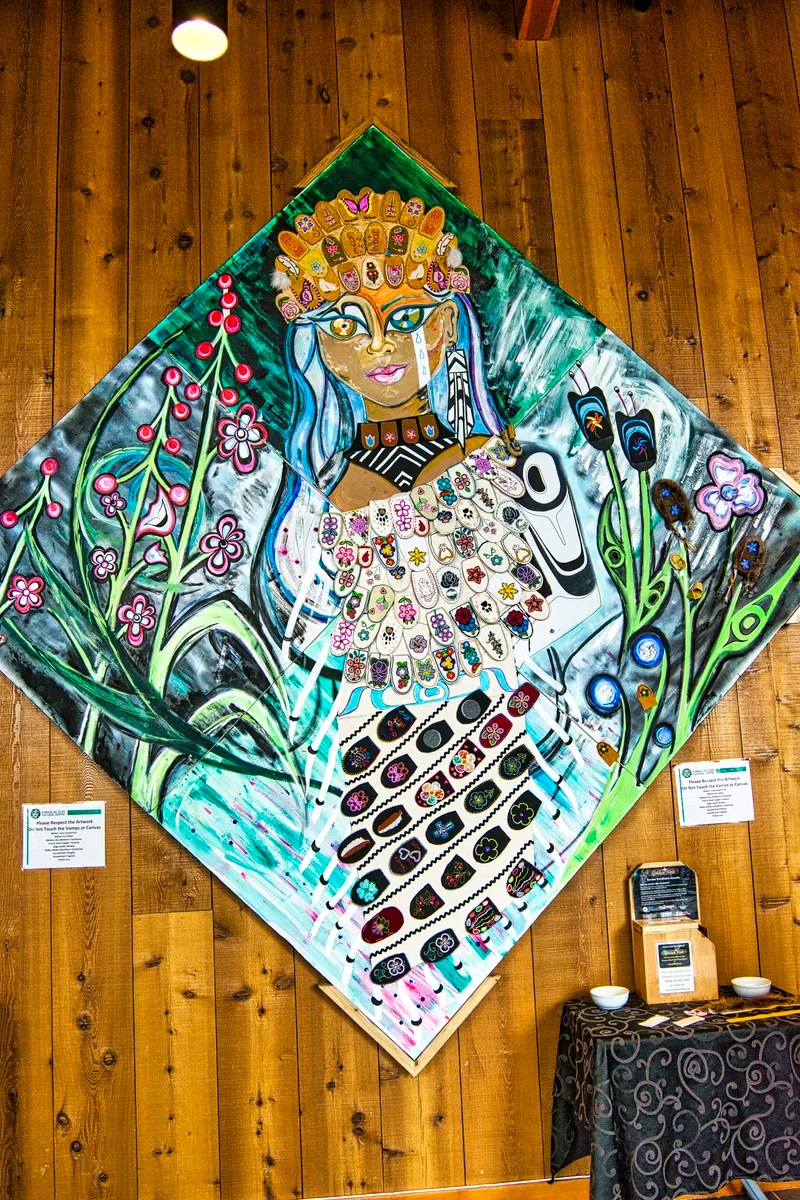
Heather Callaghan created this huge portrait representing Missing and Murdered Indigenous Women, usually abbreviated MMIW. The woman is dressed in vamps – beaded moccasin tops. Even more amazing is that these vamps were sent from communities across Yukon along with a story about the individual woman who had gone missing.
The woman’s eyes were were painted differently to represent her as someone who’s half in this world, half in ‘the other world’. One database counts 1,724 confirmed MMIW cases!
Preserving Our Environment
Our values towards nature and conservation came from years of hiking, photographing, and living near the Canadian Rockies. I was amazed to realize how similar our values are to FN beliefs about nature and the role of humans in protecting and respecting our environment.
Yukon Itineraries and Posts
Here are the posts describing our road trip from Northern BC to the Yukon, as well as two of our customized itineraries (Google Maps).
Mt Robson to Furs – Fort St. James, the last Hudson’s Bay fur trade post
Stewart-Cassiar Highway 37: Bear Glacier, Stewart, Cassiar Jade, Boya Lake
Yukon Green – Miles Canyon, Yukon River, Whitehorse
One Thing You Must Do in the Yukon – Whitehorse
Is Dawson City Yukon Worth Visiting? – Gold Rush
Yukon’s Klondike Highway Must Not Be Missed
– Carcross to Skagway
 Terra Encounters
6 thoughts on “One Thing You Must Do in the Yukon”