
Do not skip Winnipeg?
When we were younger, we were often in a rush to head to our final destination, be it the Canadian Rockies or Vancouver. Winnipeg is one of Canada’s most underrated cities. We are highlighting six reasons why you must visit Winnipeg. If you want a better recommendation, National Geographic added Winnipeg to its best trips on earth list in 2016.
Welcome to another episode of our 19,000 km road trip across Canada.
Author & Photographer: George Mitchell

Our recommendations are not influenced by affiliate links – we have none. Our advice is derived from our personal experience and knowledge based on living in Western Canada.
All of our recommendations are top-rated by Google Maps Ratings, which are based on everyone, not just tourists. Each place recommended in our custom Prairies Itinerary Map is appended with a Google Maps Rating (G0 to G5).
Assiniboine Park
Assiniboine Park is a multi-use area that includes the zoo, gardens, sports fields, restaurants and cafes.
Speaking of zoos, one famous character that never resided here is Winnie the Pooh. This orphaned bear cub was bought by a veterinarian in the 3rd Canadian Division and brought over to the UK. He named the bear “Winnipeg” or “Winnie” for short, after his hometown. She was donated to the London Zoo in 1914 and went on to great fame in A. A. Milne’s popular books.
You could easily spend a full day here, but we will focus on just two of the most spectacular features: the English Garden and the Leo Mol Sculpture Garden. The best part is that these two features are free.
Named for the Assiniboine people, the park covers 1,100 acres (450 ha). It is 30% larger than Central Park in New York. But a big plus is that you can drive in and park near your destination. Make sure you have the Assiniboine Park Map so you do not get lost.
English Garden
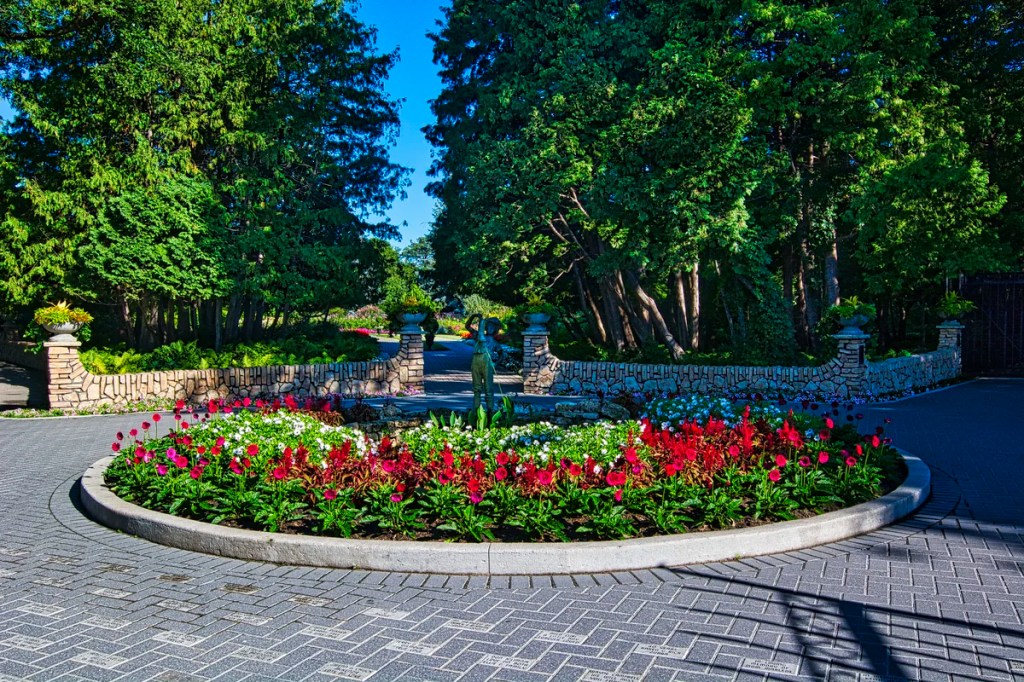
The English Garden (1927) is one of the top gardens in Canada and one of our favourite places in Winnipeg. Three acres of flowers are embedded in the huge Assiniboine Park. We felt like we were in a noble estate rather than a bustling big city. If you love flowers and/or photography, then there are better and closer flower photos in our post, You Must See This English Garden!
Lady in the Park
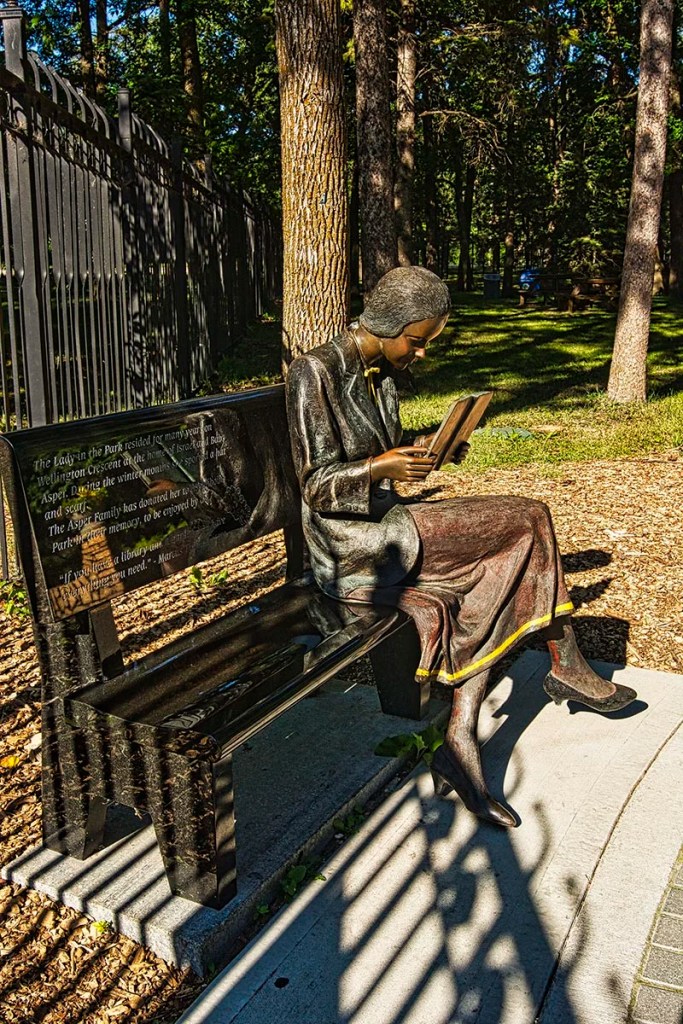
Sitting just inside the gate to the English Gardens, “The Lady in the Park” sits on a park bench, a part of the statue. The script on the park bench is a quote from Cicero. “If you have a library and a garden, you have everything you need.” This bronze statue, created in 1994, stood on the grounds of the home of Babs and Izzy Asper (read who they are later in this post). Before the sale of their home, their estate donated this statue in 2015 to Assiniboine Park.
Flowers and Fountains
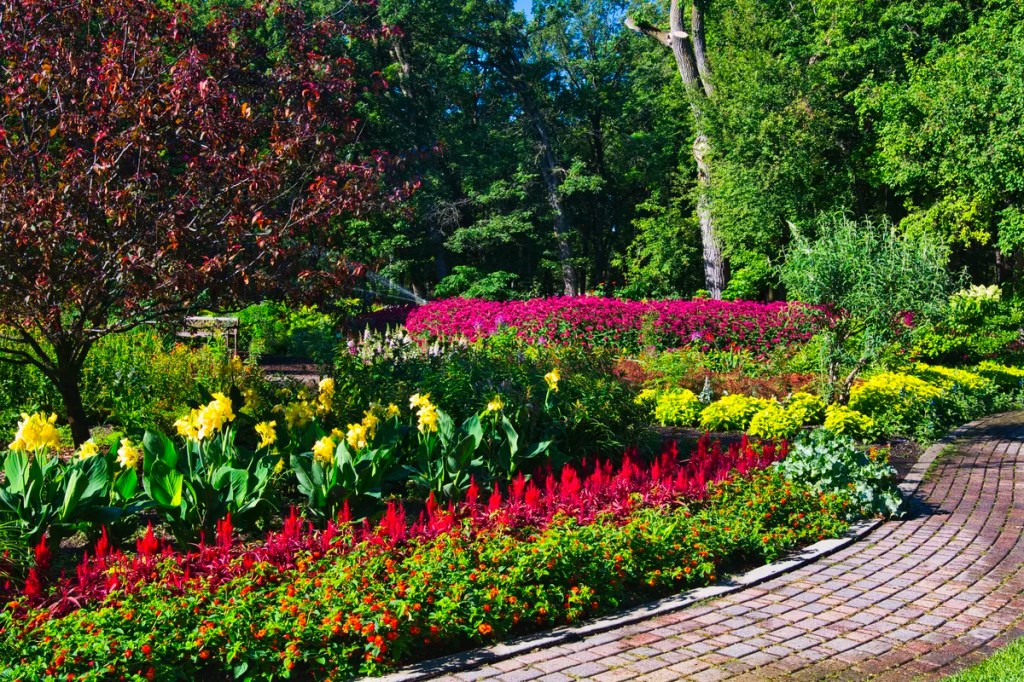
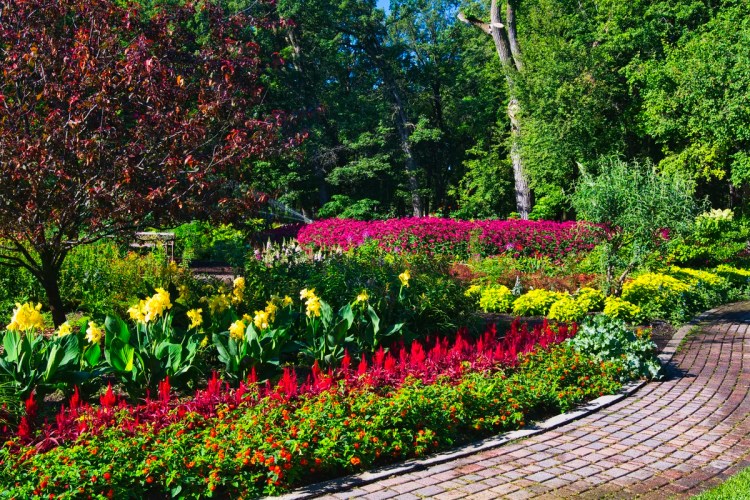
We enjoyed the curving cobblestone paths lined with flowers. It is amazing how the gardeners combine different flowers in bands of colours. The trees made it feel like a natural forest that just happened to be filled with flowers. That is the goal of English garden design.
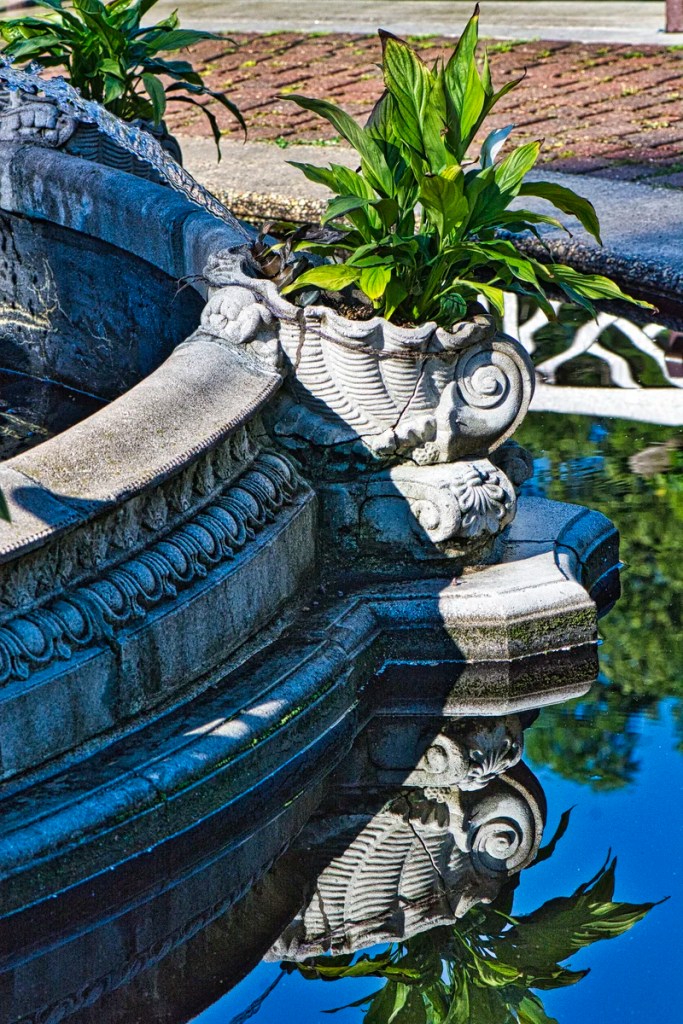
There were several fountains in the gardens, but I really liked the curved shapes of this one as well as the mirror-like reflection.
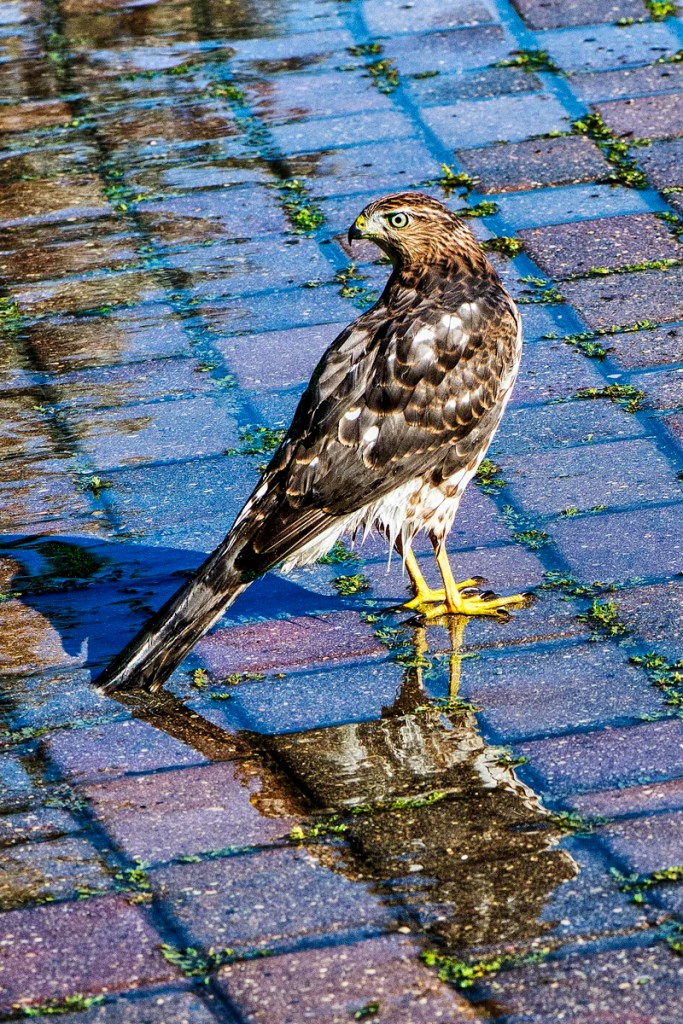
We were surprised to get close-ups of a juvenile red-tailed hawk. I cropped the image to make the hawk appear closer. It did not seem afraid of humans, i.e. me. This was very unusual. I believe someone said the hawk was hatched in the gardens.
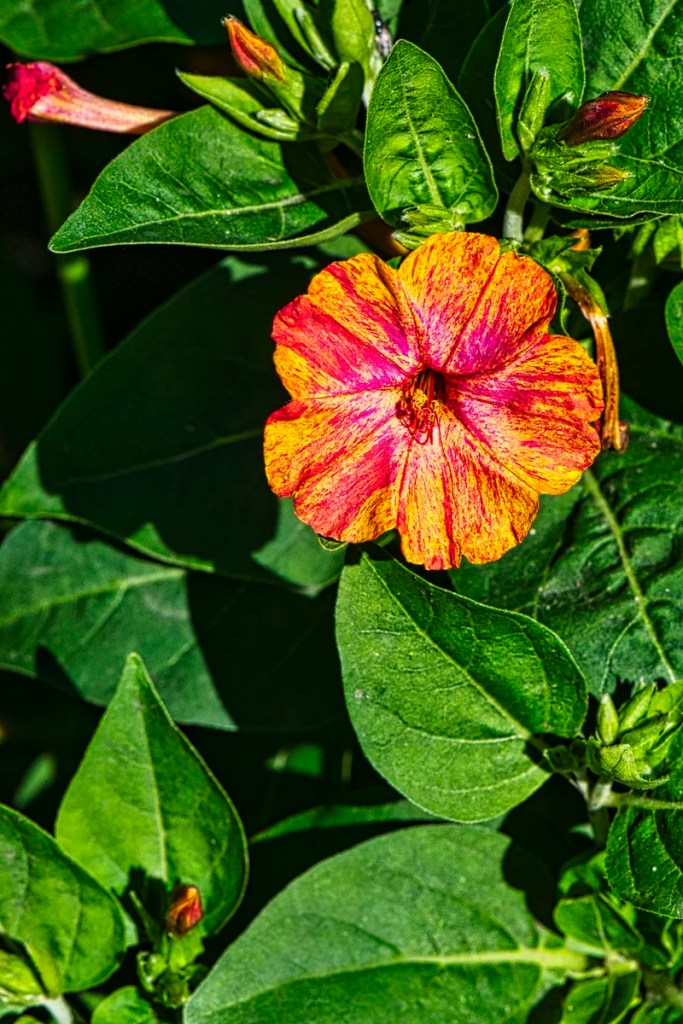
What is amazing about this plant is that an individual flower can be splashed with different colours, or flowers with different colours grow simultaneously on the same plant. The view is amazing! But why is it called Four o’clock flower? This is because the flowers usually open between late afternoon and dusk (between 4 and 8 o’clock).
Leo Mol Sculpture Garden
The Sculpture Garden (1992) displays more than three hundred works by Leonid Molodozhanyn, better known as Leo Mol — including sculptures, paintings and drawings. This is an open-air museum and it’s free!
Leo Mol (1915 – 2009) was born in Polonne, Ukraine. Coincidentally, that it is where my wife’s grandfather was born. Leo immigrated to Winnipeg after World War II, but Canada was only admitting farm workers. Leo applied as a farm hand, but he was only interested in art and soon found commissions creating stained glass windows for many churches.
He is famous for his statues of Terry Fox in Ottawa and Victoria BC and Canadian Sir William Stephenson (code-named “Intrepid”) within CIA Headquarters, Langley. Stephenson was the liaison between the USA and the UK during World War II. He supposedly was the model for James Bond. Leo created another Sir William Stephenson statue, now in nearby Memorial Park, Winnipeg.
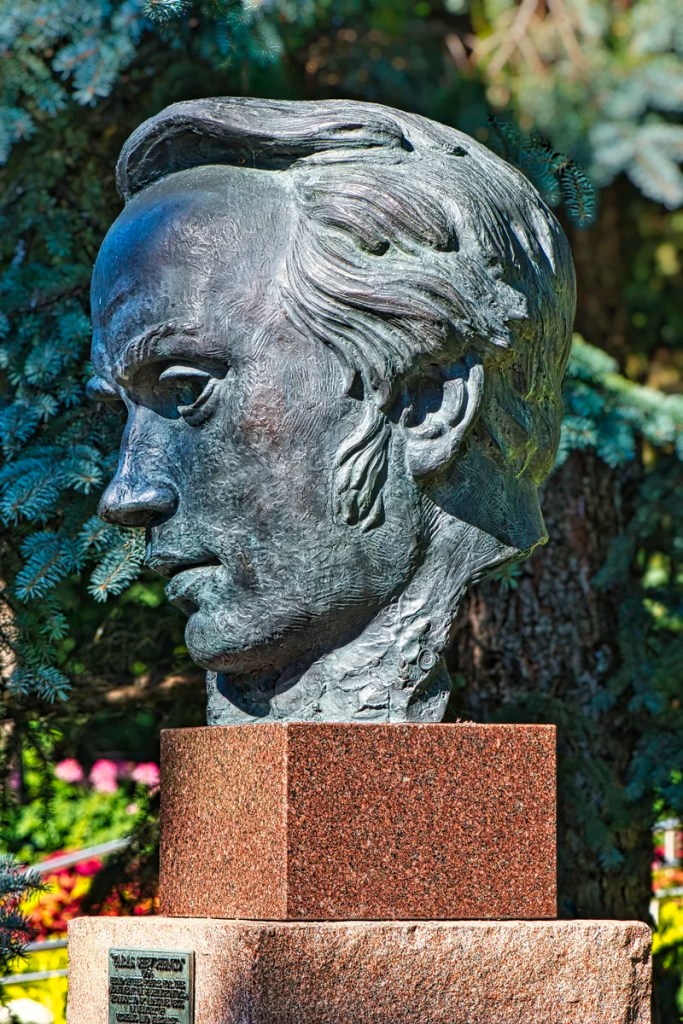
Mol’s international breakthrough came in 1962 when he won a global competition to design a Taras Shevchenko Memorial to Ukrainian poet-hero Shevchenko that stands in Embassy Row in Washington, DC.
Taras Shevchenko (1814-1861) was born into serfdom and became a famous Ukrainian artist, writer, and political figure. In 1847, he was convicted of promoting the independence of Ukraine.
This win led to a commission to create a sculptural portrait of Dwight Eisenhower. Eisenhower was an artistic man who liked to draw. He asked Leo why he did not measure his head, and Leo answered that measuring a character is much more important and complicated. “That is what Leo was known for – discovering human qualities and showing them in the portrait.” Later, he sculpted Sir Winston Churchill, John F. Kennedy, and various Group of Seven painters.
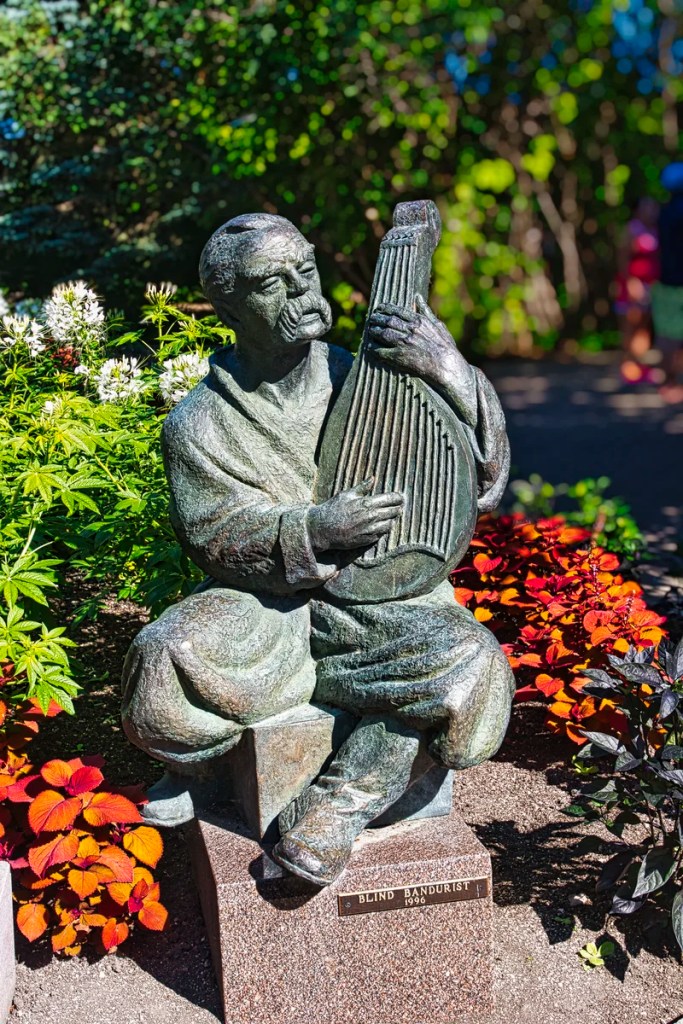
The Blind Bandurist is a very evocative statue positioned among the flowers of the garden. A bandurist is a musician who plays a bandura, a combination of a zither and a lute. Many bandurists were persecuted by the Russian authorities that controlled Ukraine because of the association of the bandura with growing Ukrainian national self-awareness.
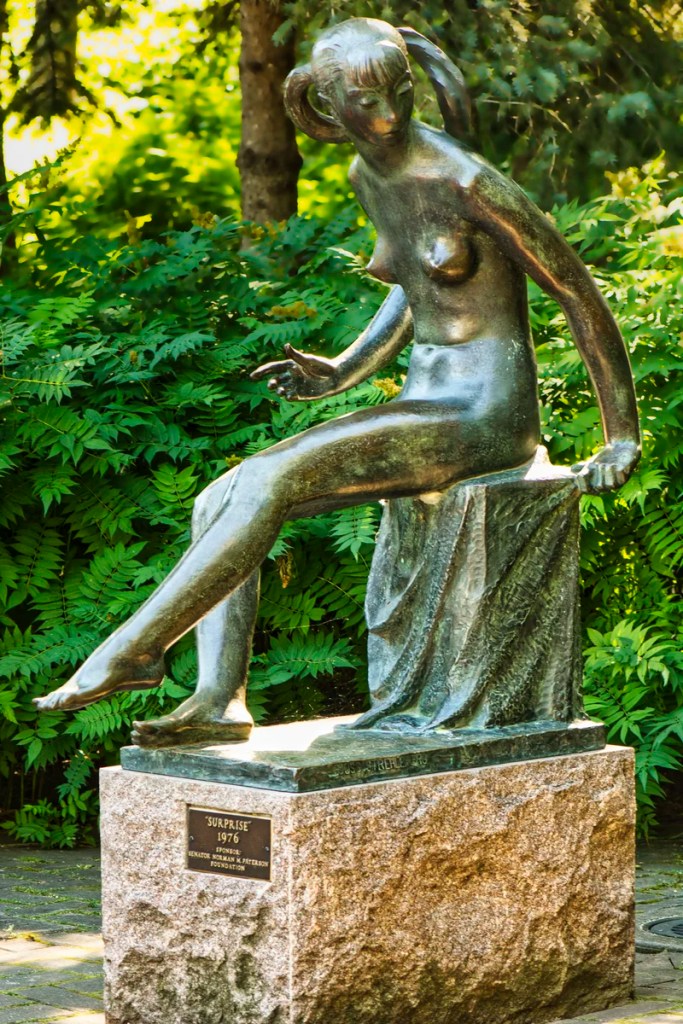
Leo created many lyrical female sculptures, such as Surprise, 1975.
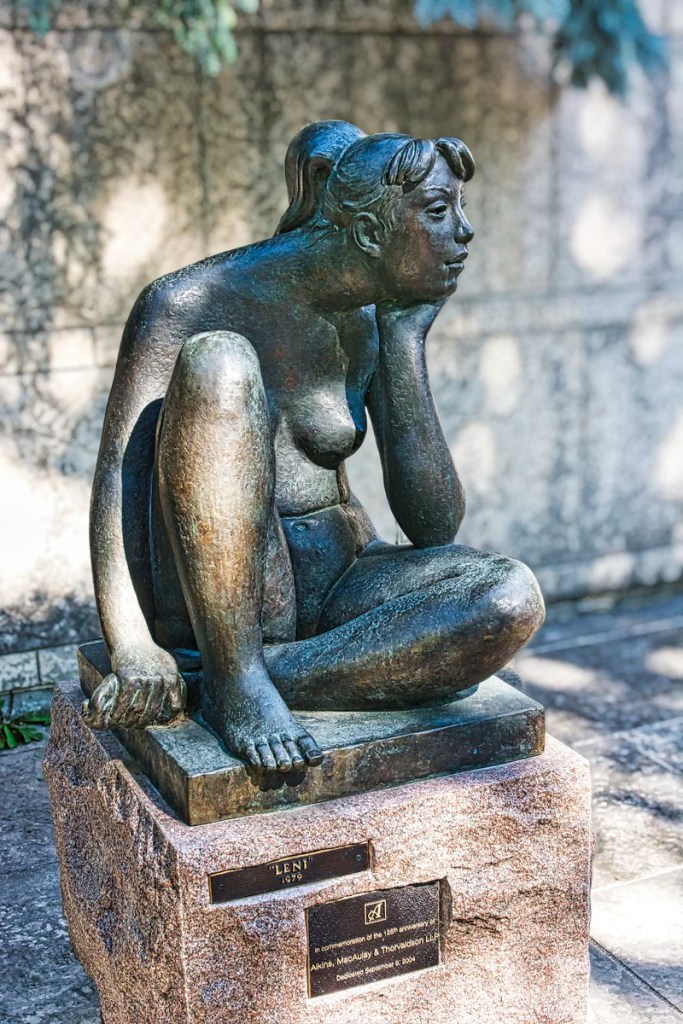
Mol believed that the sculptures should be on display for the public to view, as had been the way in Ancient Greece and Rome. In 1990, he offered his entire collection of bronzes and ceramics, valued at $4 million, to the city. At first, they turned it down! Thank goodness, they changed their mind and established this amazing sculpture park.
The Forks
After entering a parking lot, there was torrential rainfall. We had a power snooze in the van. One hour later, it started to get sunny, so we walked to The Forks.
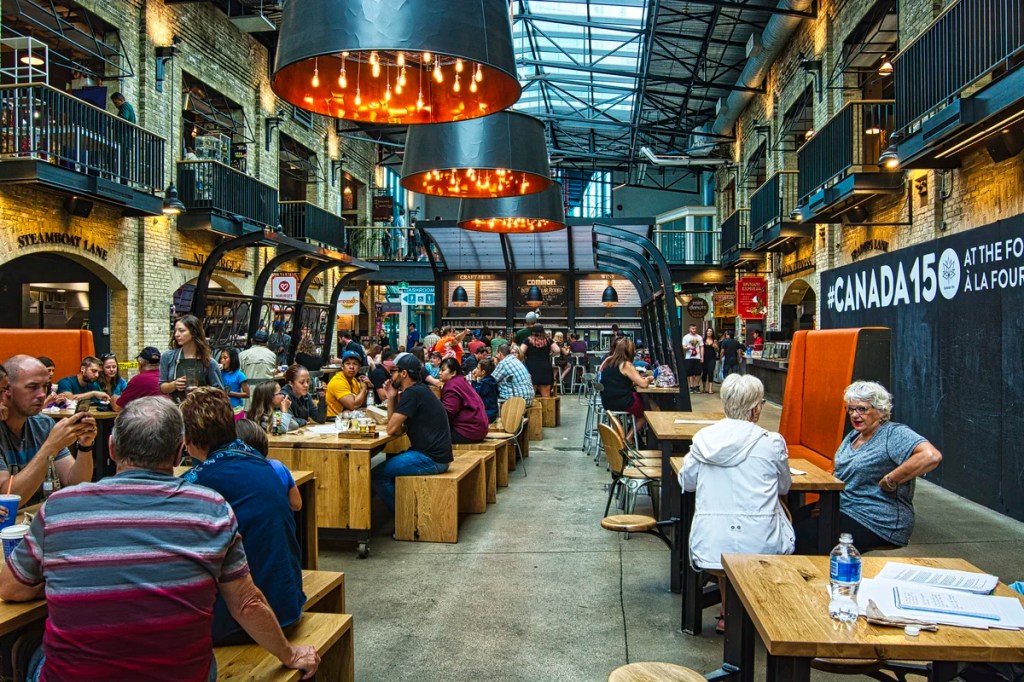
Railway horse stables and warehouses were converted to markets and shops. We had lunch here.
Forks National Historical Site
Aboriginal camps were founded at the intersection of the Red and Assiniboine Rivers. In fact, Winnipeg means muddy waters. This important trading area was used by Aboriginals for at least 6000 years. The rivers were our highways until the railways were built ca. 1886.
Famous explorer La Vérendrye led the first Europeans here in 1738. He erected Fort Rouge, the first of many fur trade posts that opened up the West to colonization. Winnipeg and nearly every other major Canadian city were founded due to the fur trade.
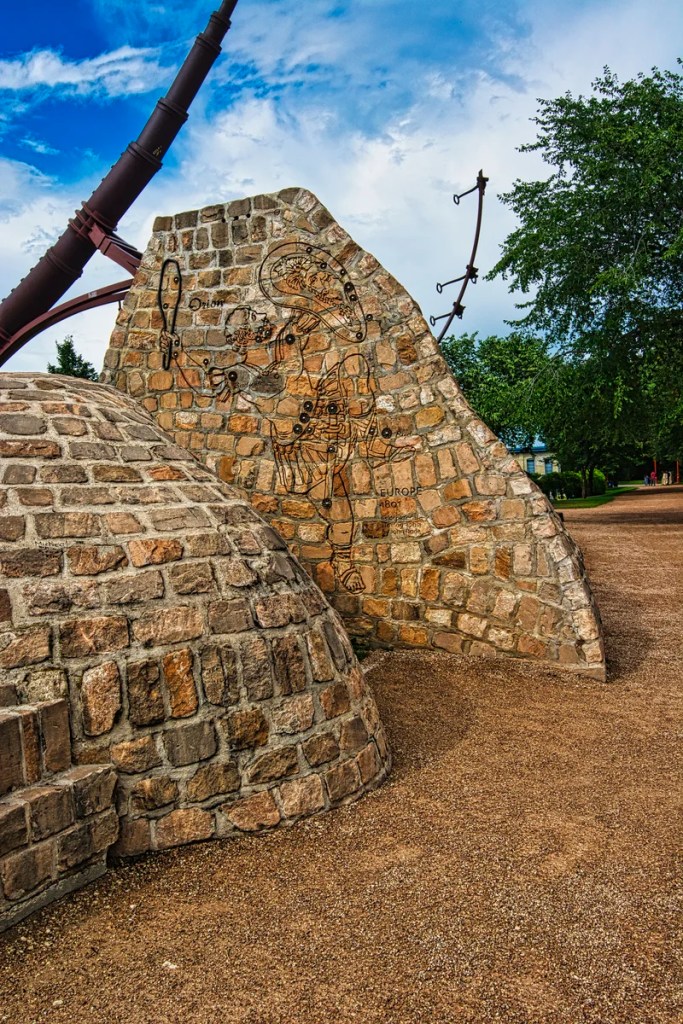
The Oodena Celebration Circle is inspired by the myths and sacred places of the many peoples drawn to The Forks, not just Aboriginal. Oodena is Ojibwe for “heart of the community”. This pier has a metal sculpture of the constellation Orion. In Greek mythology, Orion was killed by a giant scorpion, and the gods raised both Orion and the Scorpion to the stars.
The Forks is considered Treaty One Territory. The area has remained true to its history as a meeting place. Annual Aboriginal Day on June 21 (the summer equinox) and powwows are held during the summer months.
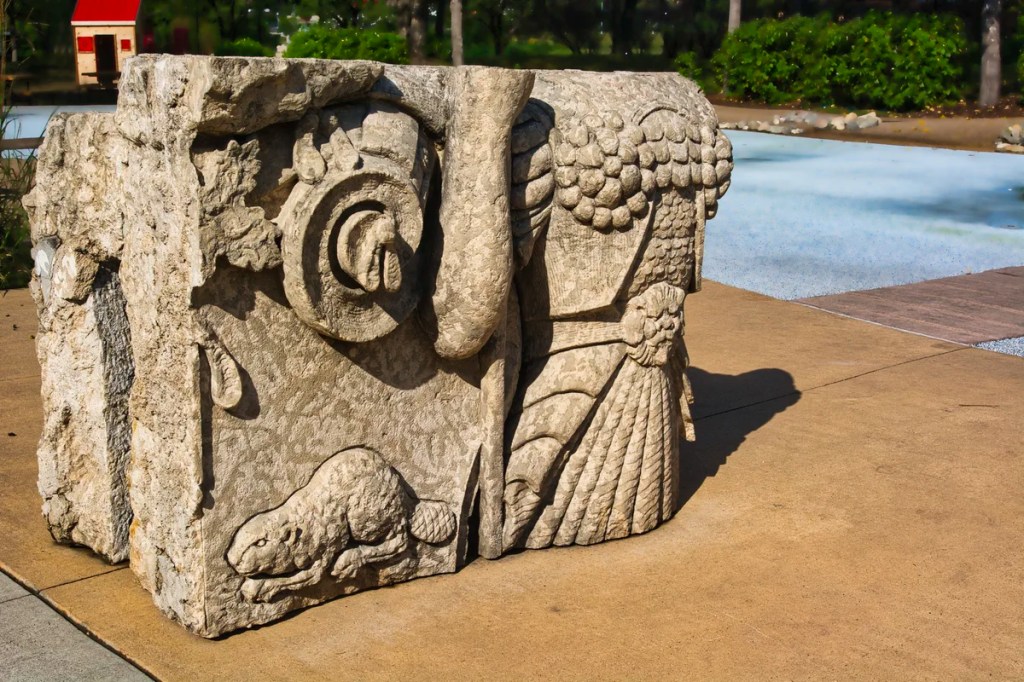
They carved decorative blocks of Tyndall limestone, mottled with fossils! On this one, you can see a beaver and wheat, two of the major products of historical importance.
Esplanade Riel
We went on the river walk to see where the Assiniboine and Red Rivers join. This is also the scene of many dramatic floods over the years. Then we walked north towards a bridge.
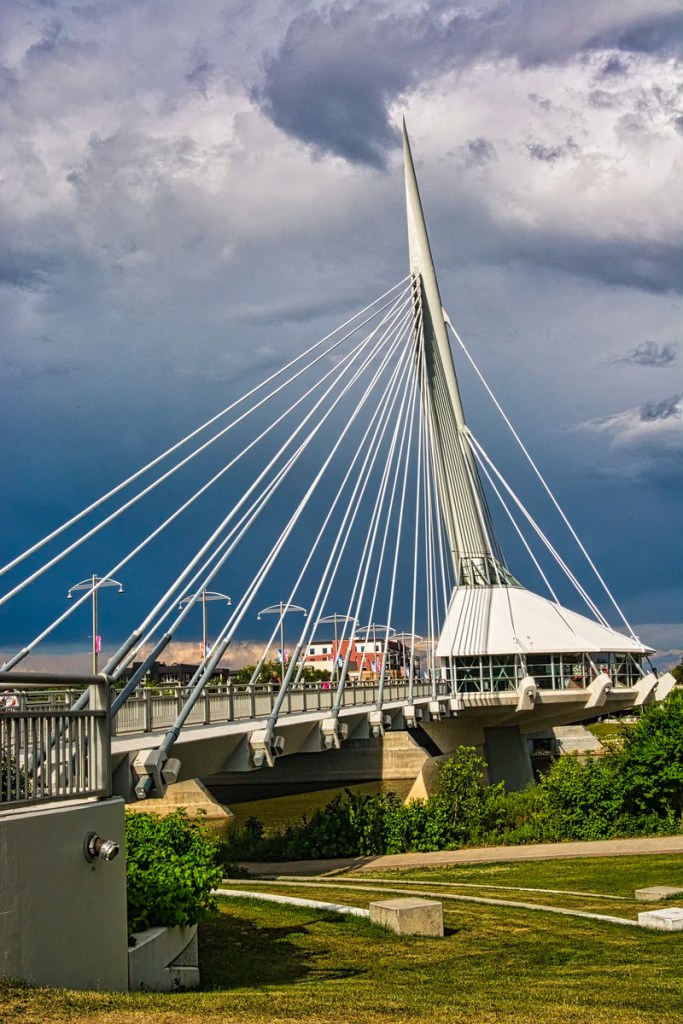
Esplanade Riel (2004) is a pedestrian suspension bridge linking St. Boniface across the Red River. Its angular suspension wires made me think of a sailboat. It has a semi-circular restaurant in the middle.
In 1869, the Hudson Bay Company (HBC) was forced by Britain to sell Rupert’s Land, which includes Manitoba, to Canada. The Métis originated as the offspring of European (French and Scottish) fur traders and Aboriginal women. Many of them originally worked for HBC as translators and trade post employees.
The Métis were not consulted on joining Canada, so Louis Riel led a rebellion and formed a provisional government to force Canada to the negotiating table. They captured Upper Fort Garry at the Forks. Canada finally negotiated with the Métis, and the province of Manitoba was created in 1870.
Mahatma Gandhi Statue
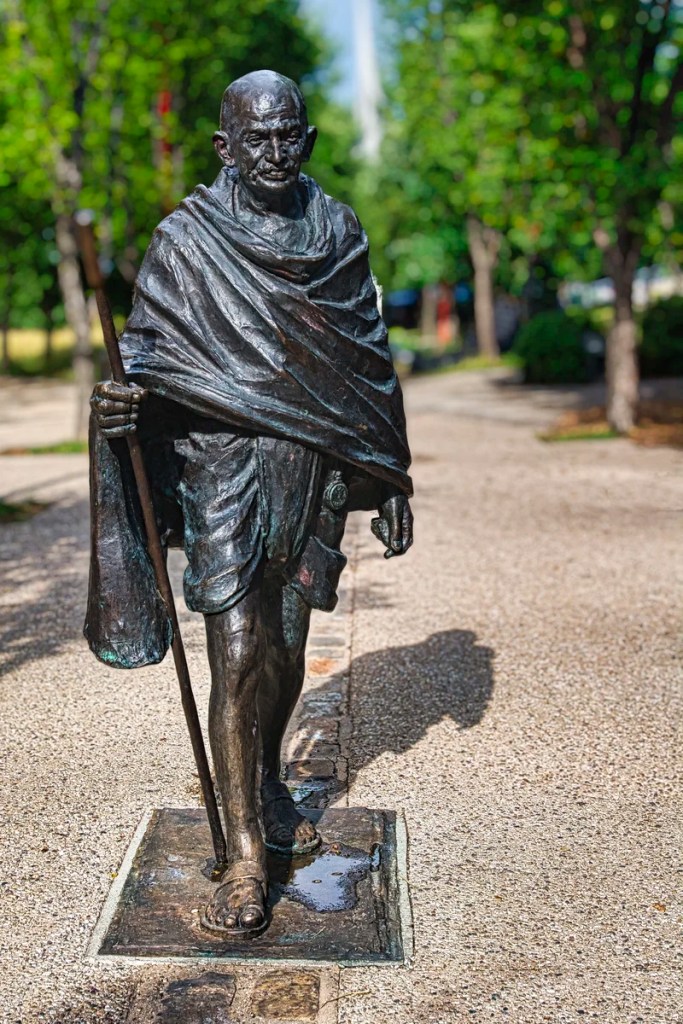
The sculpture of Mahatma Gandhi (2004) was donated by the Indian High Commissioner to Canada. Gandhi symbolizes the struggle for human rights. Appropriately, it stands just before…
Canadian Museum for Human Rights
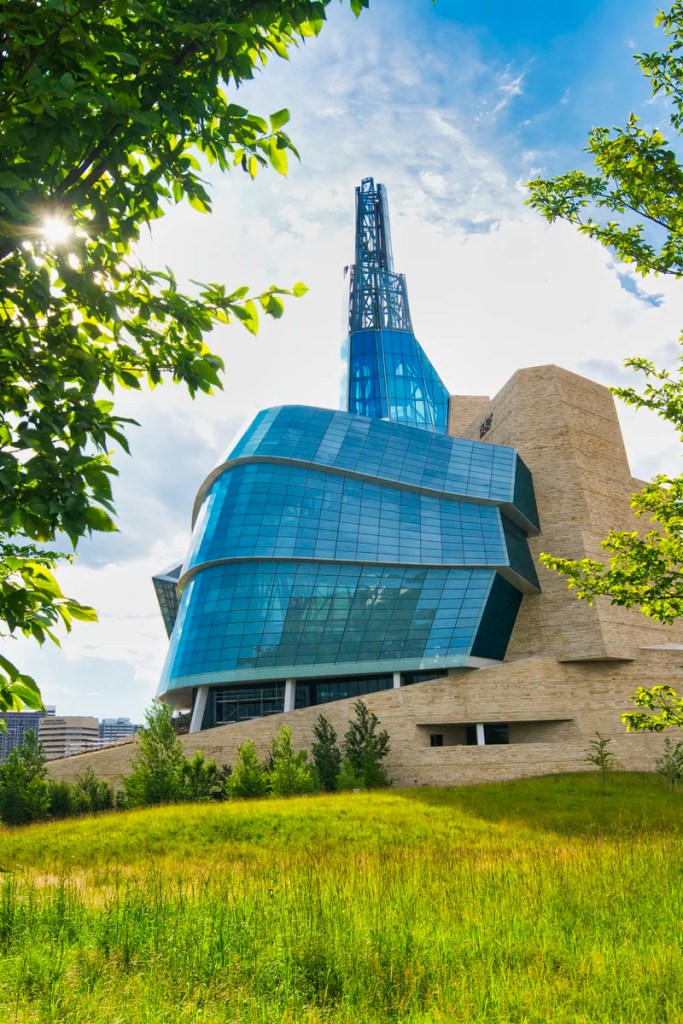
Israel or “Izzy” Asper acquired the fledgling Global TV Network in Ontario and laid the foundation for the Winnipeg-based Canwest Global Communications. He then acquired New Zealand’s TV3 and Australia’s Network 10. Global TV is one of the major networks in Canada.
The Canadian Museum for Human Rights (CMHR) was the vision of Izzy Asper. To quote the Albuquerque architect, Antoine Predock:
“The Canadian Museum for Human Rights is rooted in humanity, making visible in the architecture the fundamental commonality of humankind – a symbolic apparition of ice, clouds and stone set in a field of sweet grass. “
Antoine Predock, Canadian Museum for Human Rights
Queen Elizabeth II unveiled the building’s cornerstone in 2010. Embedded in it is a piece of stone from the ruins of St. Mary’s Priory at Runnymede, England, where the Magna Carta was signed by King John in 1215. It is very symbolic.
Manitoba Legislature
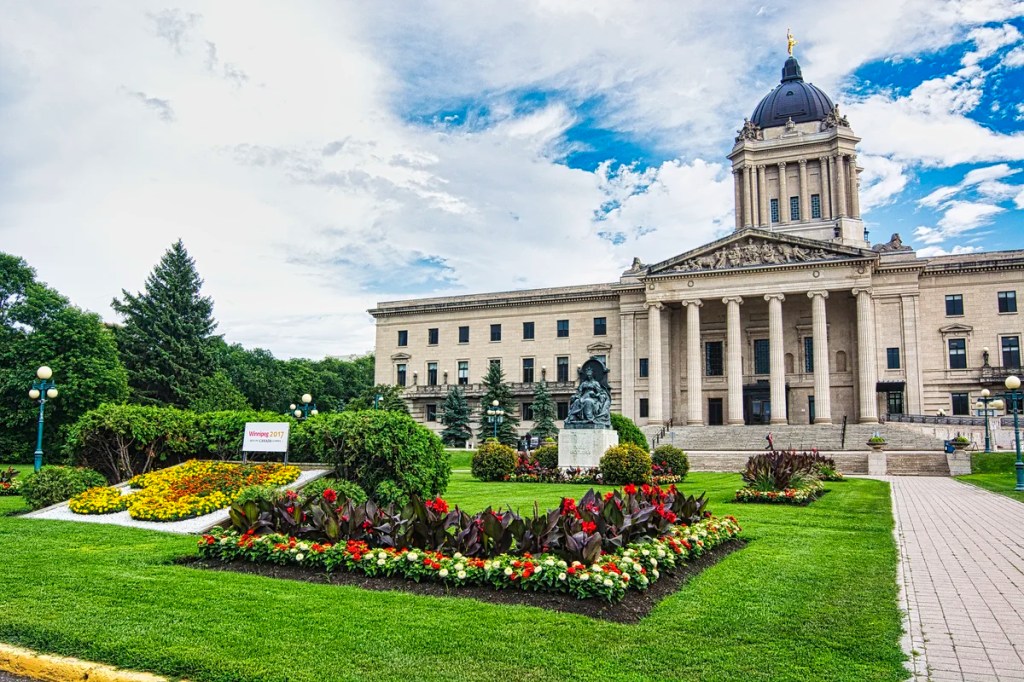
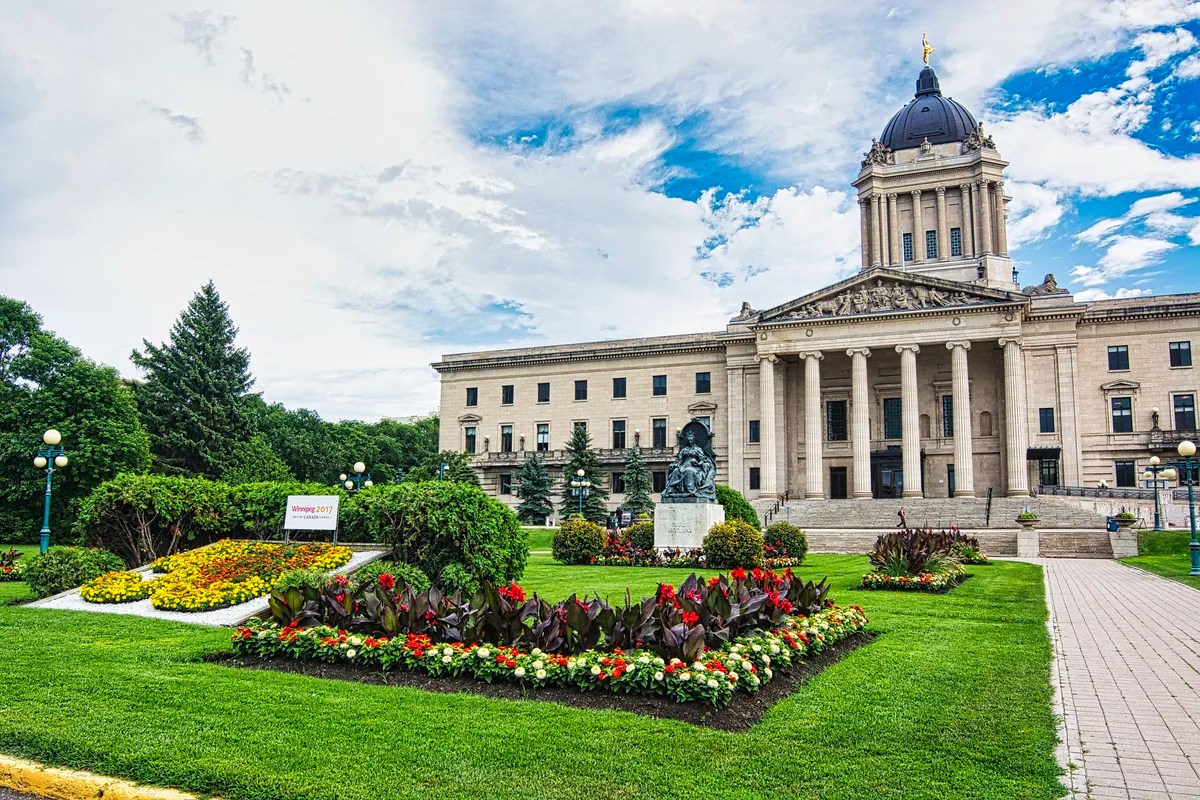
Another place worth visiting is the Manitoba Legislature. The Beaux-Arts-style building was completed in 1920 using Tyndall blocks. The final cost of the building was CAD 9,379,000 in 1920 dollars. That is worth $125 million today. This led to a corruption scandal that caused the fall of Premier Roblin and his government.
The dolomitic limestone called Tyndall Stone was quarried at Garson, about 20 km (12 mi) northeast of Winnipeg. It is a cream-coloured rock with a dark mottling that gives a tapestry-like effect. Part of this mottling is fossils, which contribute to its aesthetic appeal. The fossils date back to about 540 million years ago. The appearance of sea life with hard shells started in the Cambrian Era. Imagine how many shells there were since limestone is so common around the world. Manitoba was under the ocean then.
Tyndall Stone has been used for important buildings throughout North America. Some of the most famous ones in Canada are the Empress Hotel, Victoria; Banff Springs Hotel, Banff; Canadian Parliament Buildings, Ottawa; and the Canadian Museum of History, Gatineau.
There is a small but beautiful garden at the front of the Legislature. The statue of Queen Victoria (1904) was coated in red paint in 2020 during protests against the deaths of Indigenous children in Canadian residential schools during the previous century.
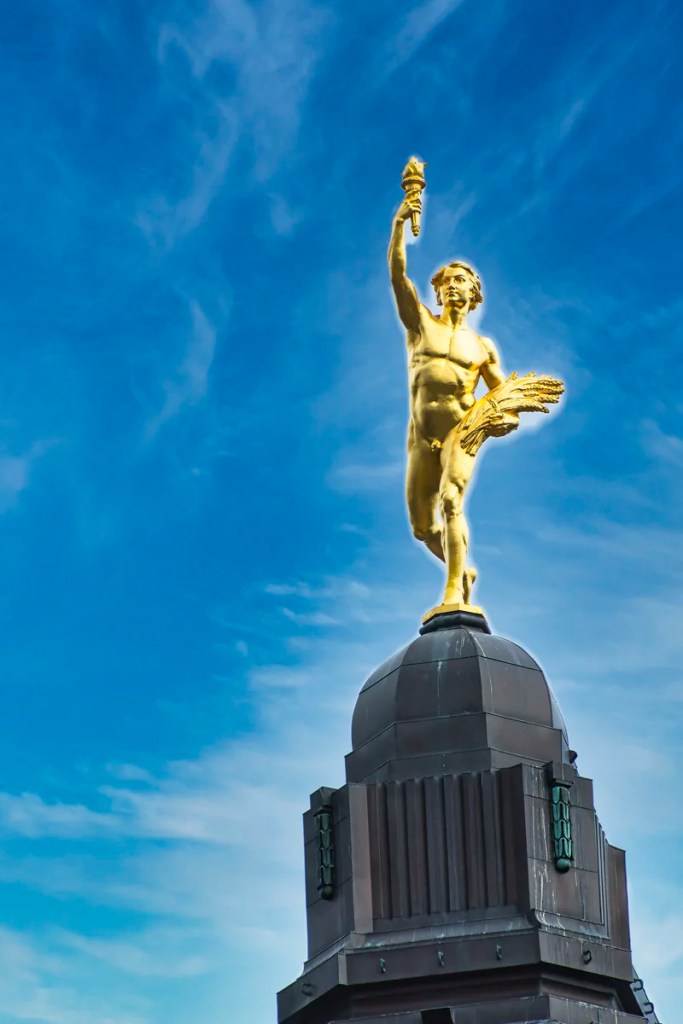
The statue at the top of the Legislature is called Golden Boy, but it is actually the Roman god Mercury. Mercury is the messenger god known for his incredible speed, which is symbolized by his winged sandals. The name Mercury is derived from the Latin word merces, meaning “merchandise.” Mercury is the Roman god of trade and commerce, especially the grain trade. Notice that he holds a sheaf of wheat.
Mercury is typically depicted as a handsome young man, plus the statue was gilded in real gold — hence the name Golden Boy.
Final Comments on this Itinerary
This is an action-packed itinerary where you can enjoy big city life without the overtourism found in Asia and Europe.
Subscribe
Get travel tips and advice delivered directly to your inbox. The best part is that it is free.
Itinerary Map & Resources
CA Prairies Itinerary Map — our custom Google Map
Google Maps Ratings
Google Maps provides a rating from 0 to 5 for all sights, hotels and restaurants (but not cities). All of our recommendations are appended with the rating (prefixed with a G) from Google Maps. As it is based on feedback from tourists and locals, it is much more reliable than travel booking websites. We consider a score of 4 to 4.39 to be Very Good; 4.4 to 5 to be Excellent.
Other Places to Add to Your Itinerary
There are more city areas to visit. For instance, the Exchange District has old buildings and top restaurants. There are over 600 Murals In Winnipeg.
To the north, visit Gimli with its Icelandic heritage, Oak Hammock Marsh for birders and nature lovers, and Lower Fort Gary for a National Historic Site.
To the east, drop into the Royal Canadian Mint and visit the Bothwell Cheese factory for the best prices and tastes. Bothwell is so good that it is sold by Costco in Ottawa.
Heading east or west of Winnipeg, see any of the following posts:
Canada FAQ

The Exploring Canada post answers Frequently Asked Questions (FAQ) such as:
- Where should I go in Canada?
- What is the best season for travel?
- What is the best clothing?
- Where should I go? What are the must-sees?
- How much time do I need for Canada?
- Can I see everything in a week?
- How safe is Canada?
 Terra Encounters
Leave a comment