
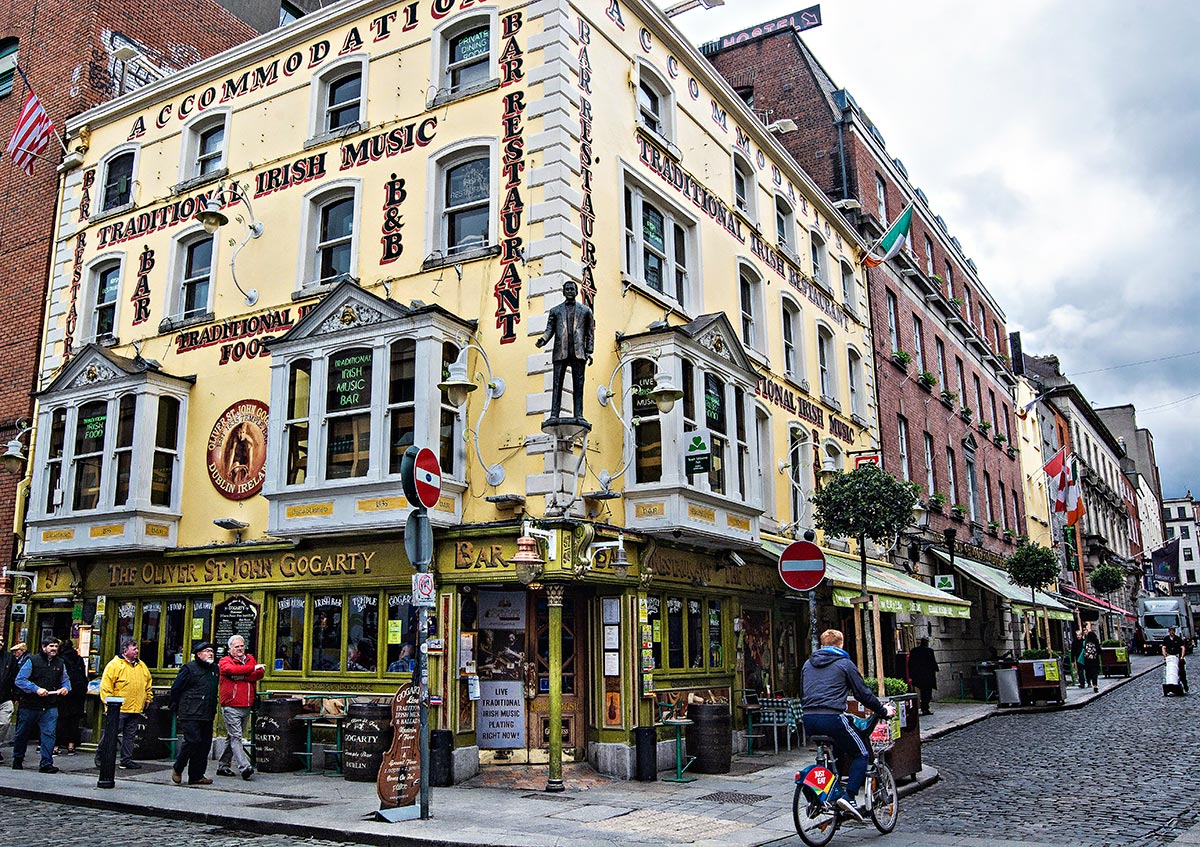
Dublin is for decanting the good life — walking, shopping, eating, drinking — and learning. It offers a pleasant walk on cobblestone pedestrian streets in a very compact area.
The route for this post can be seen in Dublin Map 2. The numbers on the map correspond to the numbers in this post. The first post on Dublin can be seen at 9 Perfect Places for Dabbling with Dublin.
Author & Photographer: George Mitchell

Our content and advice are derived from our personal experience and knowledge, gained from living in Europe for seven years and studying its art and architecture. Our recommendations are not influenced by affiliate links – we do not have any. Ireland is one of our favourite destinations.
All of our recommendations are top-rated by Google Maps, which is based on the opinions of everyone, not just tourists. Each place recommended in our posts and custom maps is appended with a Google Maps Rating (G0 to G5).
1. Temple Bar District
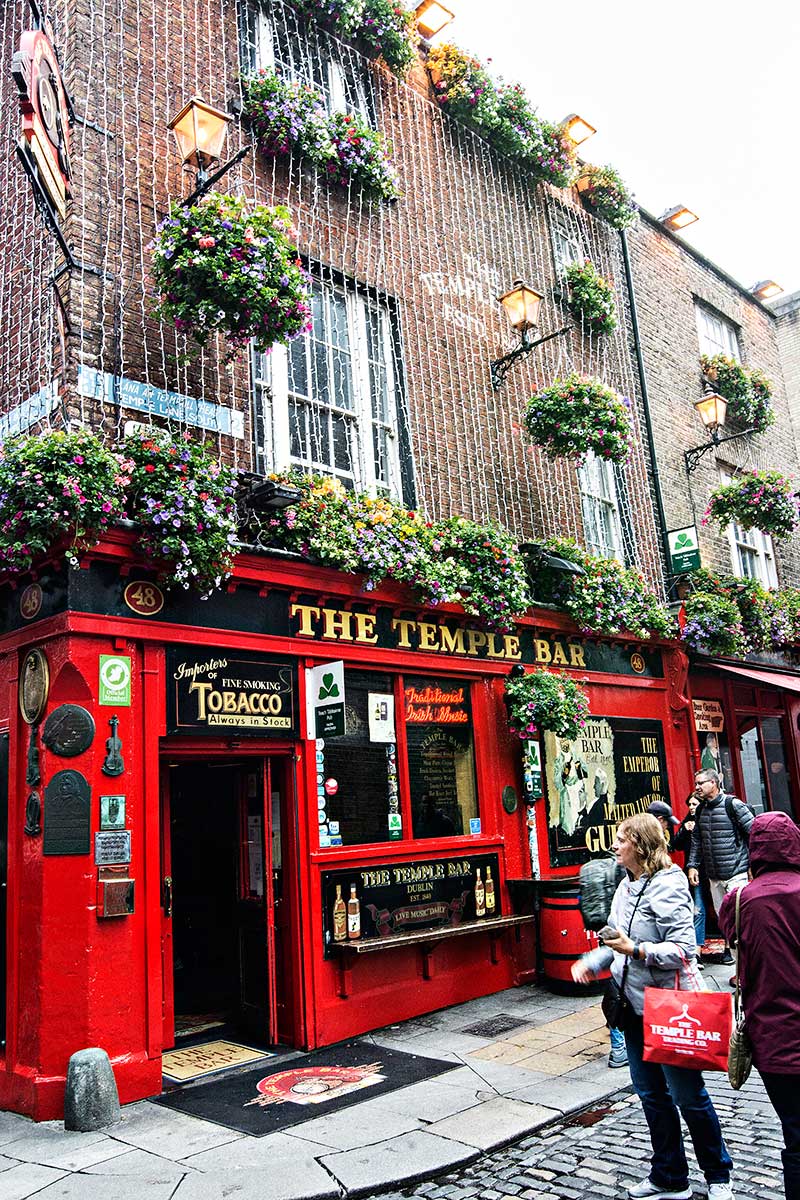
No, the Temple Bar area does not refer to its current status as a pub district!
You may be forgiven for thinking the biggest contribution of the Norman conquest of Ireland is the now crumbling castles dotting the Emerald Isle. But the biggest impact of the Norman rule was on the English language. As discussed in the Staying Trim in Ireland post, 45% of all English words have a French origin. Bar is derived from the 12th-century French word barré, meaning barrier.
The barrier protected the 17th-century estate and gardens of Sir William Temple. The Temple family are said to descend from the Knight Templars, a powerful order during the Crusades. After they were suppressed by Pope Clement V and disbanded, many fled to Britain.
Note that Temple Bar in London, UK, was named after a gateway near Temple Church, which belonged to the Knights Templar!
William Temple was born in Britain. He came to Ireland as part of the subjugation of the Irish colony. He regarded the destruction of the Irish language and culture as a necessary prerequisite to defeating the native Irish way of life.
Temple worked for the University of Dublin, aka Trinity College. He also served as a member of Dublin University in the Irish House of Commons from 1613 until his death.
Note that elected representatives were always landowners of British origin. Irish Catholics were prohibited from owning land, voting or holding elected office under the Penal Laws.
Decanting Irish Myths
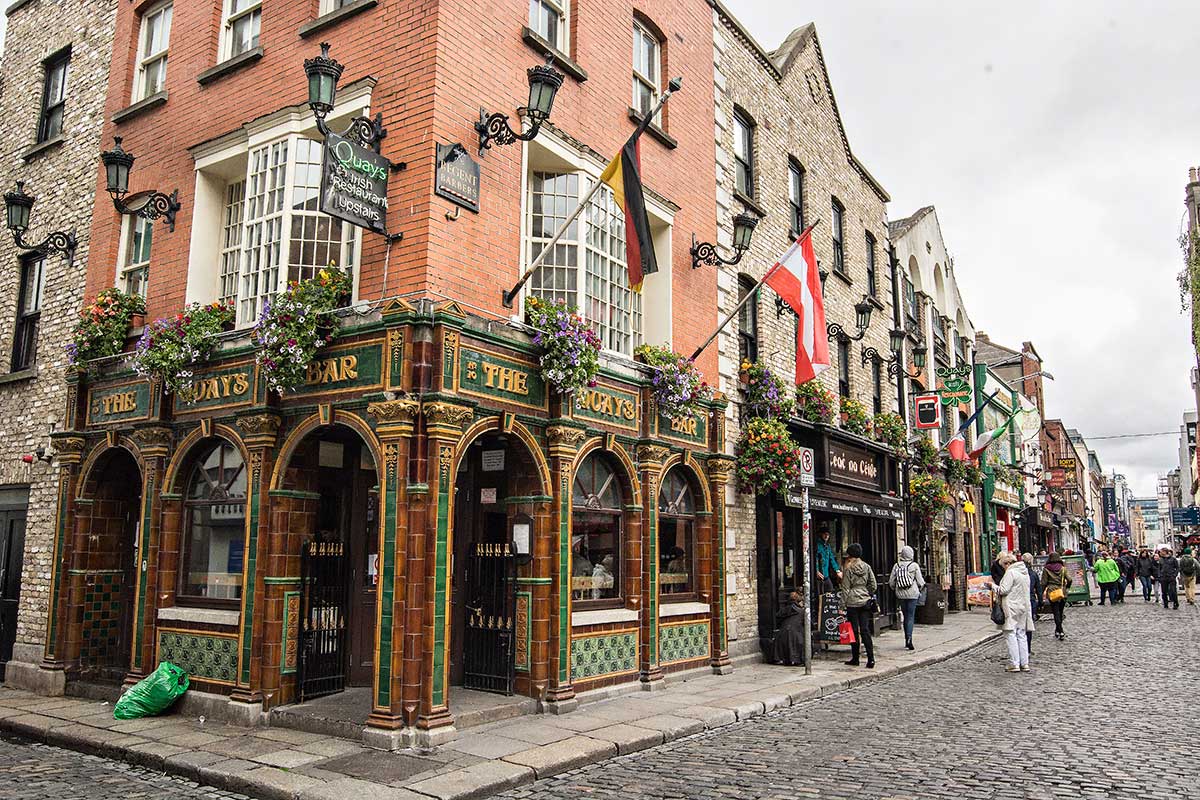
Some of the streets from the Temple Bar to the Ha’ Penny Bridge are cobblestone pedestrian ways. The buildings are covered in gaudy lights, bright colours, and pretty flowers. The bars are the most ornately decorated.
While we are on the subject of myth-busting, Ireland’s patron saint, Patrick, was not Irish! At the age of 16, he sailed most likely from Wales and was captured by Irish pirates. He spent six years in captivity in Ireland.
The first St. Patrick’s Day parade was held in the United States, not in Ireland. It was hosted by the Charitable Irish Society of Boston in 1737. It was a non-sectarian parade in support of all Irish immigrants.
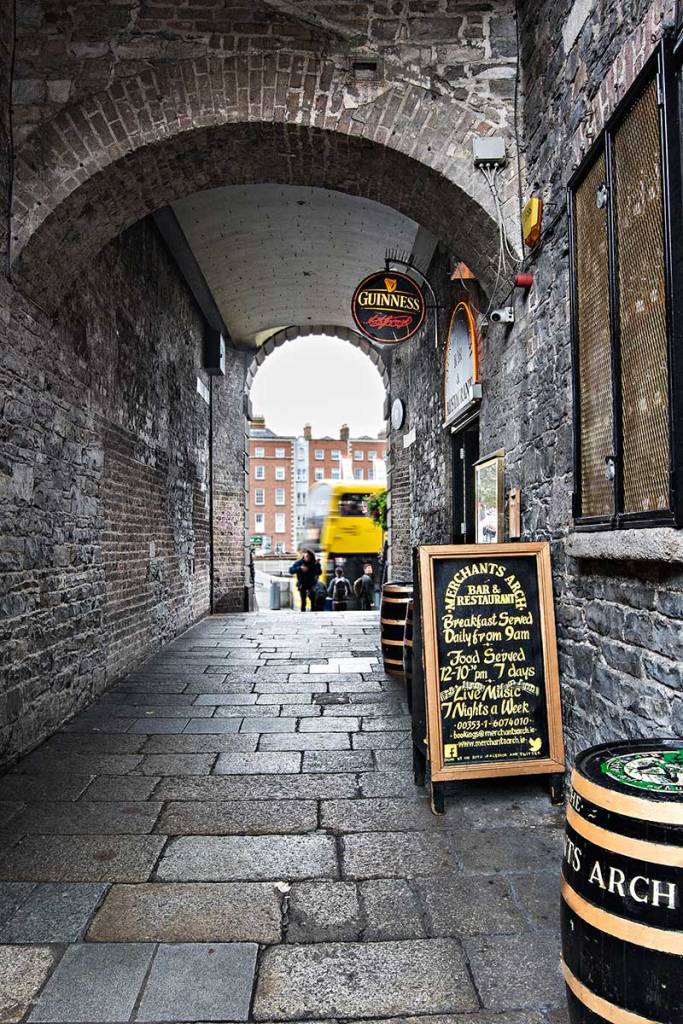
Guinness is one of Ireland’s most famous exports, but it is actually owned by British beverage firm Diageo. Ireland’s oldest beer is not Guinness, it’s Smithwick’s. Smithwick’s Brewery was founded in Kilkenny in 1710. Guinness came about in 1759. Ireland ranks sixth worldwide in the average consumption of beer per person.
Baileys Irish Cream is a liqueur made from Irish whiskey, cream, cocoa extract and herbs. It was launched in Ireland in 1974 after three years of development. It is now the most popular liqueur in the world. Once again, it is actually owned by the British company, Diageo.
5. Ha’ Penny Bridge
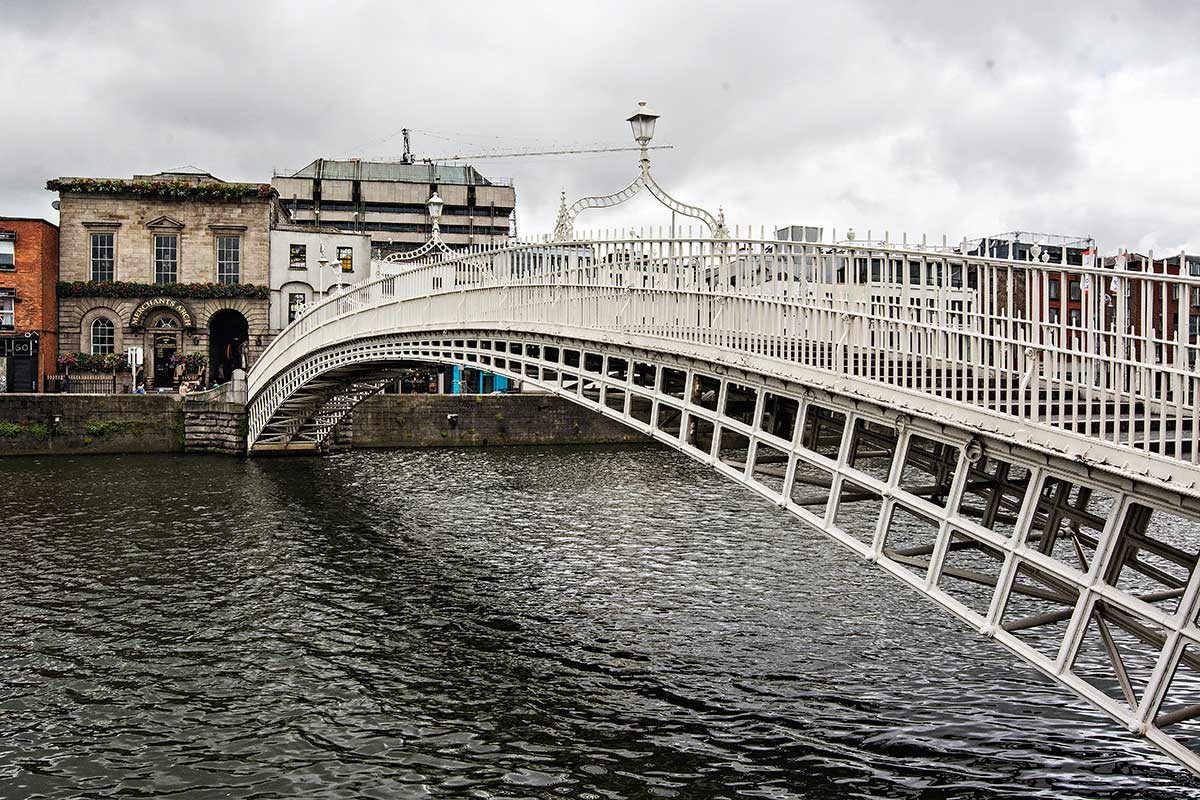
Once upon a time, there were seven ferries to get people across the River Liffey dividing Dublin. They were in very bad condition. The operator, William Walsh, was told to either fix them or build a bridge. He built the Ha’ Penny Bridge in 1816 and was granted the right to extract a toll from anyone crossing it for 100 years! Sweet! The ha’penny charge was based on the cost of a ferry ride. The fee did increase over time to 1½ pence, but was dropped in 1919. More recently, in 2013, the council removed over 300 kg of locks from the bridge. I wonder if they will ever take off the locks left by departing university students on our “Bridge of Locks”.
On the north side of the river was Montgomery Street. It was once the largest red light district in all of Europe. Over 1600 prostitutes walked the streets of Dublin, loudly and proudly selling their services!
6. Daniel O’Connell Statue
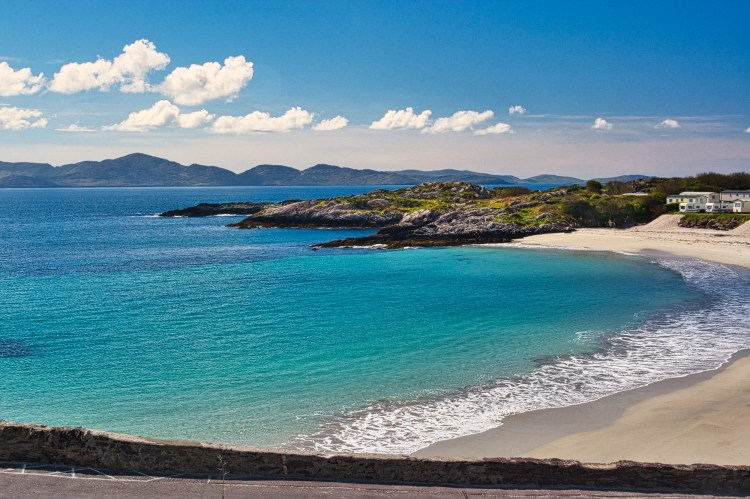
O’Connells were once a wealthy Catholic family that had been dispossessed of its 320-acre (1.3 km²) estate. The family home (an OPW museum site) still exists in Derrynane next to a spectacular beach, which we visited in the Real Ring of Kerry.
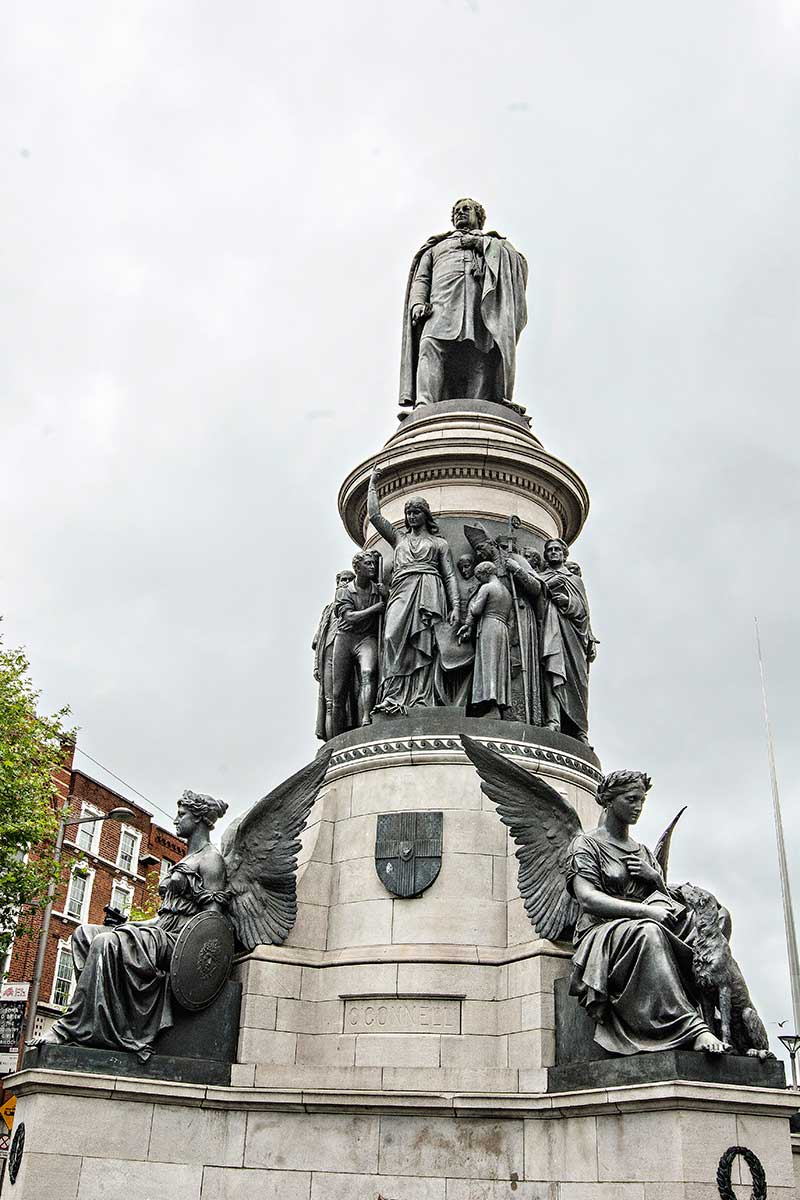
At the beginning of O’Connell Street is the Daniel O’Connell Monument (1882). The 3.7 m (12 ft) statue is so high up (12 m 40 ft) you need binoculars or a zoom lens to see O’Connell.
The Irish started to gain access to many middle-class professions from which they had been excluded. In 1798, Daniel O’Connell became a barrister. He strongly supported an emancipation campaign to give Catholics equal rights within the United Kingdom.
Many Irish Catholics fought to protect Ireland from Napoleon. This led to the British army giving freedom of worship to Catholic soldiers in 1811. Thanks to public opinion, aka the press, elected MPs changed their attitudes. O’Connell set up an association to fund pro-emancipation members of parliament (MPs) in the British House of Commons
The Irish Catholic contribution to the Napoleonic wars may have contributed to increased support. BTW, the same Duke of Wellington who defeated Napoleon and later became prime minister, was an Irish-born Protestant!
O’Connell denounced the corrupt 1815 Dublin City Council as a “beggarly corporation”. John D’Esterre, a member of city council and noted duellist, challenged him to a duel at Dublin Castle. D’Esterre was mortally wounded.
The Emancipation
After O’Connell won election, he was unable to take his seat as MPs still had to take the Oath of Supremacy; in other words, reject Catholicism. While they opposed Catholic participation in parliament, Prime Minister Wellington and Home Secretary Robert Peel saw that denying O’Connell his seat would cause outrage and could lead to another major uprising in Ireland, which was about 85% Catholic. Catholics were granted full rights with the Catholic Emancipation Act in 1829. O’Connell was now an MP.
In 1841, Daniel O’Connell became the first Catholic Mayor of Dublin since the reign of Catholic King James II, who was repulsed at Derry and defeated at the Battle of the Boyne by William of Orange.
The Catholic emancipation campaign served as a precedent for the emancipation of British Jews (1858), eliminating the Oath of Allegiance to the true Christian Faith and allowing Jews to become MPs. Daniel O’Connell became friends with former slave Frederick Douglass, who campaigned for the abolition of slavery in the US.
Winged Victory
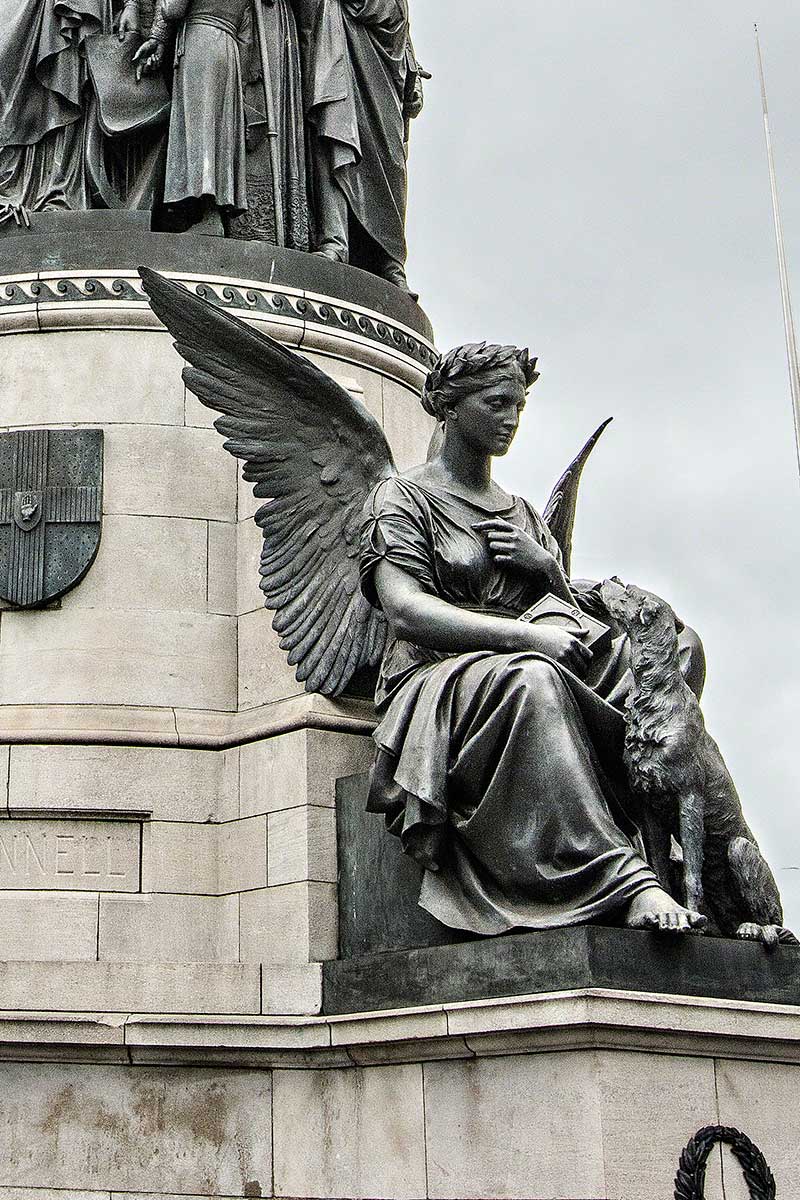
The four winged women sitting around the base of the O’Connell statue represent fidelity, eloquence, courage and patriotism. There are bullet holes in two of the women, a legacy of 1916-1922 war of independence. No, the four women are not angels!
They are Classical Greek goddesses! Winged Victory is a common marble sculpture of Nike, the Greek goddess of strength, speed, and victory. It is called Winged Victory because the Roman name for Nike is Victoria.
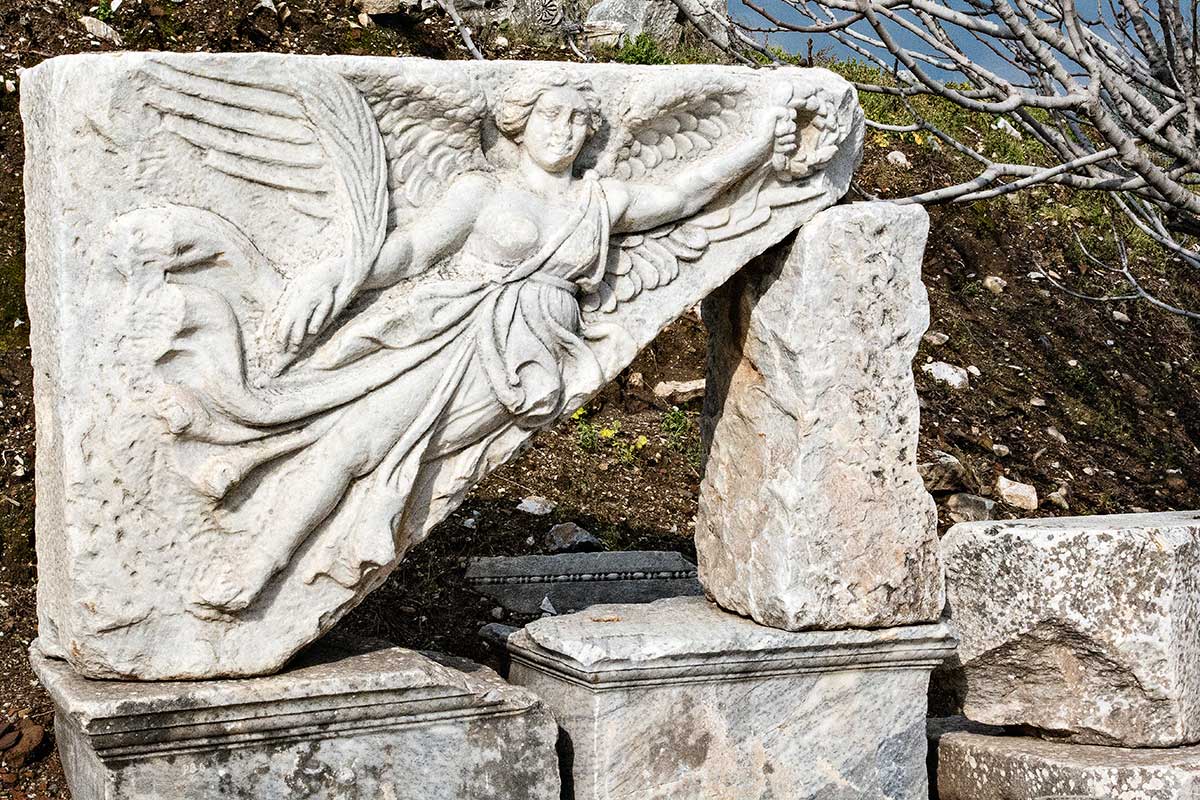
This sculpture is in Ephesus, the second largest city of the Roman Empire which played a major part in the New Testament. Why did all roads lead to Ephesus? Ephesus was the terminus of the Silk Trade Routes! Ephesus is now in Turkey.
Winged Victory conveys a sense of action and triumph. Symbols of Nike include golden sandals, wings, and a wreath, which you can see in her hair in the Dublin monument. Nike flew around battlefields rewarding the victors with glory and fame, symbolized by a wreath of laurel leaves (bay leaves).
So is this relevant today? Very. Wreaths were give to the victors in the Olympic Games. Roman Emperors used wreaths. Names stemming from Nike include Nicholas, Nicole, Nikita, Nikki, Veronica, and, of course, the sports wear giant, Nike.
7. William Smith O’Brien
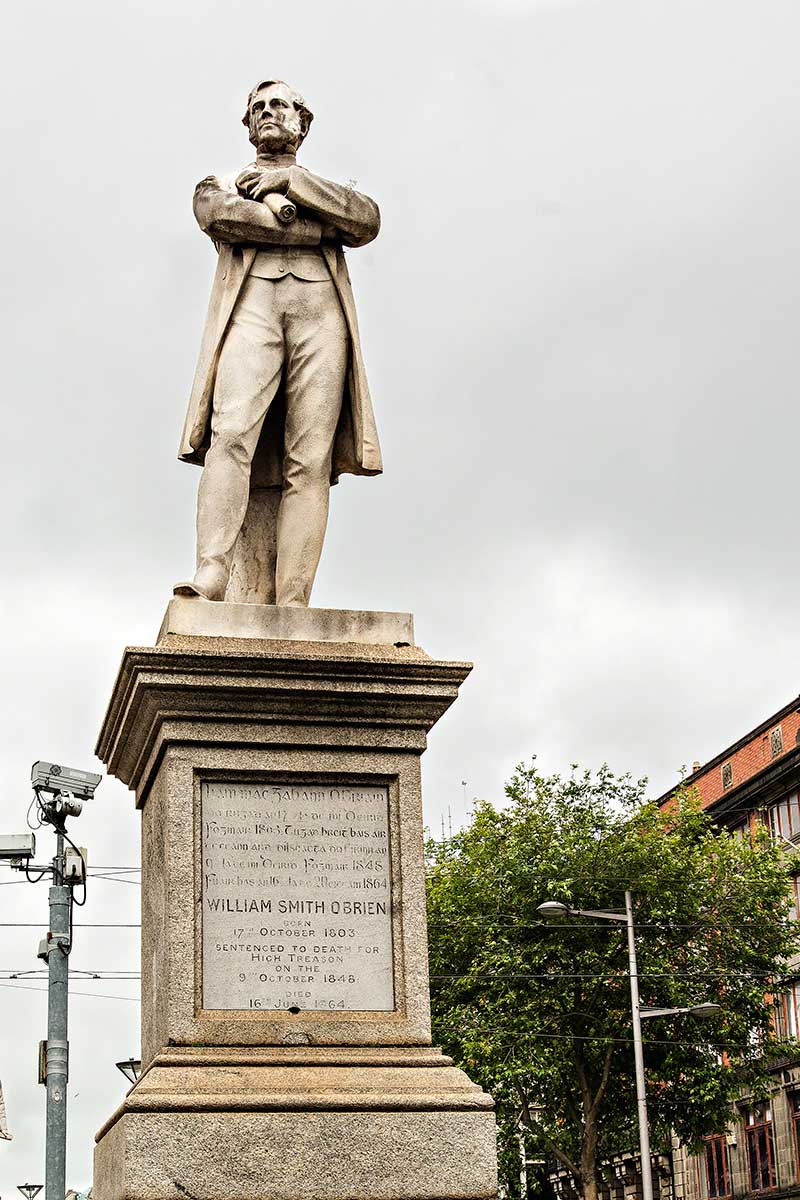
O’Brien (1803-1864) was a leader of the unsuccessful rebellion of 1848. In fact, 1848 saw uprisings in France, Germany, Austria-Hungarian Empire, Italy, Denmark and Poland. These uprisings were liberal democratic movements to demand more participation in government and eliminate the monarchy. It was also the first stirring of socialism.
O’Brien’s white marble statue (1870) was the first monument erected in Dublin to commemorate an individual who had carried out armed resistance against British rule.
8. Sir John Grey
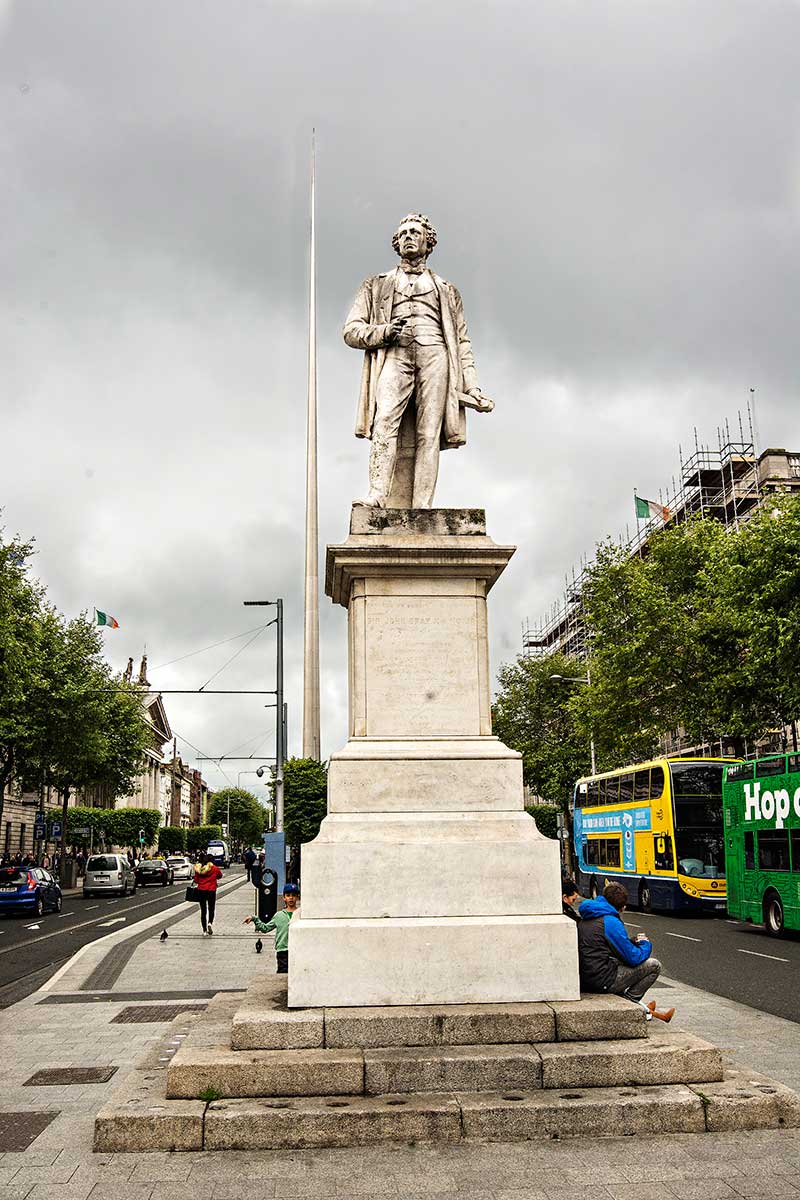
Gray (1815-75) was the owner of the Freeman’s Journal, a strongly nationalist newspaper. Public opinion was very important in changing Ireland. This white marble sculpture (1879) depicts Gray as a Victorian gentleman, complete with open coat and confident stance symbolized by one foot placed forward.
Nelson’s Pillar was located behind the Grey statue until it was destroyed by Irish Republicans in an explosion in 1966. The uninspiring Spire of Dublin was erected on the site of the Pillar in 2003.
9. General Post Office
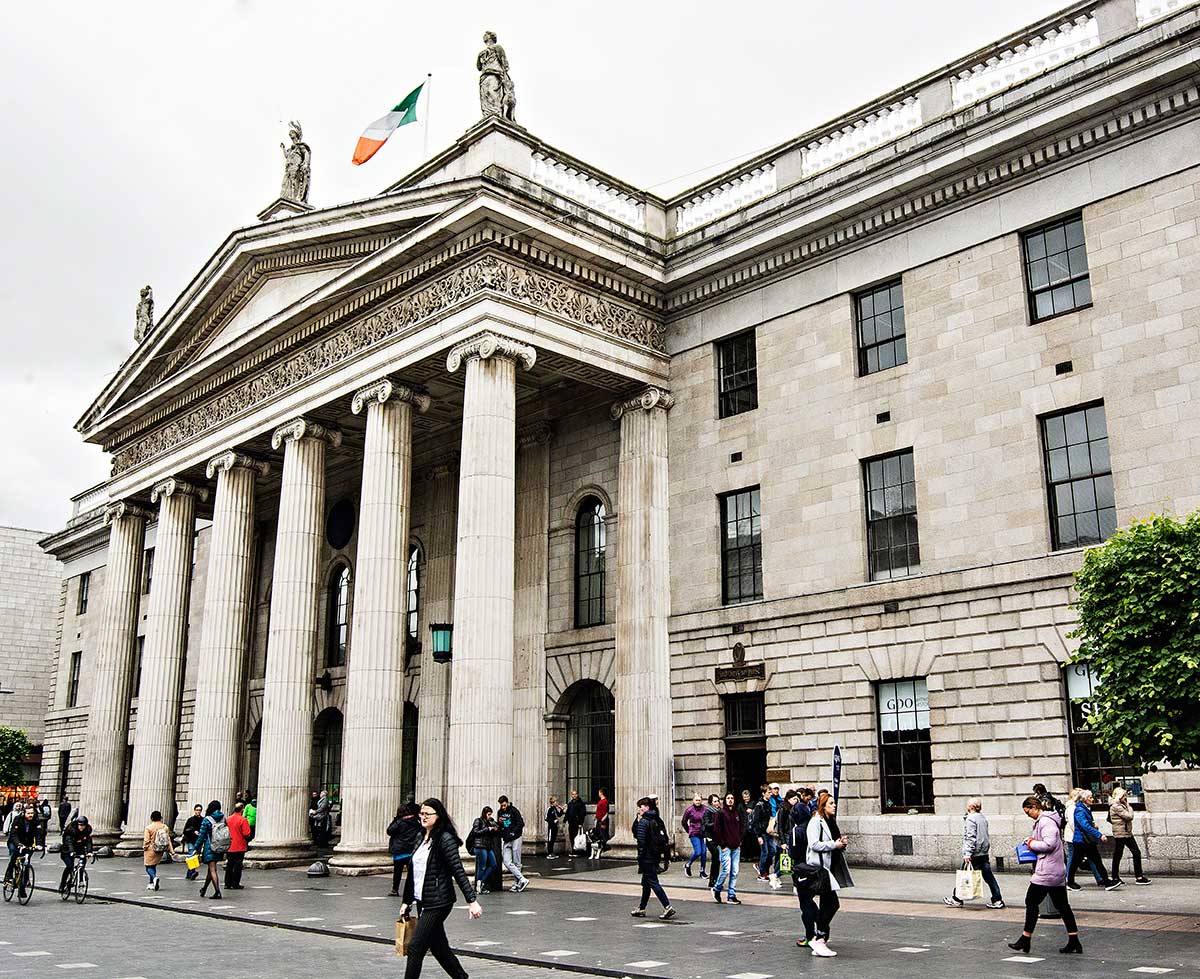
The General Post Office (GPO) is an imposing neoclassical building with ornate interior as well. It is a Georgian building dating from 1818. The Greek hexastyle portico simply means it had six fluted Ionic columns. The frieze above the columns is highly decorated
Ireland is one of the few countries in the world, and the only country in the EU, that does not have postal codes (with the exception of Dublin).
The GPO is the site of many protests. During the Easter Rising of April 1916, the GPO served as the headquarters of the uprising’s leaders. Patrick Pearse read out the Proclamation of the Irish Republic from the GPO. But the Rising was brutally suppressed by the British and the building was destroyed by fire except for the granite facade. This led to the 1919-21 Anglo-Irish War, which saw many atrocities on both sides, by the Irish Republican Army (IRA) and by the British government. The Irish Republic became reality in 1922.
Final Comments on this Itinerary
This is an action-packed itinerary where you can see the best parts of Dublin. Remember, the most important “destination” is meeting the people.
What things fascinate you? How long is your trip? What questions do you have? Do you want more information? Then subscribe for free.
Subscribe
Get travel tips and advice delivered directly to your inbox. The best part is that it is free.
What things fascinate you? How long is your trip? What questions do you have?
Itinerary Maps & Guides
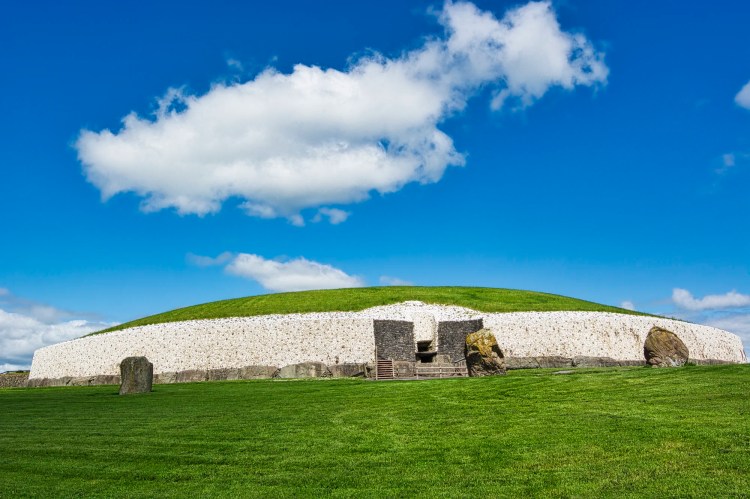
This day trip can be part of any of our ready-made itineraries. If you have more time in Dublin, then you can add day trips to Trim, Newgrange, and the nearest sights in the Ireland East itinerary.

Google Maps Ratings
Google Maps provides a rating from 0 to 5 for all sights, hotels and restaurants (but not cities). All of our recommendations are appended with the rating (prefixed with a G) from Google Maps. As it is based on feedback from tourists and locals, it is much more reliable than travel booking websites. We consider a score of 4 to 4.39 to be Very Good; 4.4 to 5 to be Excellent.
Ireland FAQ
The Ireland FAQ post answers Frequently Asked Questions (FAQ) like:
- Where should I go in Ireland?
- What is the best season for travel?
- What is the best clothing?
- Where should I go? What are the must-sees?
- How much time do I need for Ireland?
- Can I see everything in a week?
- How safe is Ireland?
- How much cash should you take to Ireland?
- Should I pay in Euros or my own currency?
- What apps are useful for travel?
- Should I rent a car? Take a Taxi?
 Terra Encounters
Leave a comment