
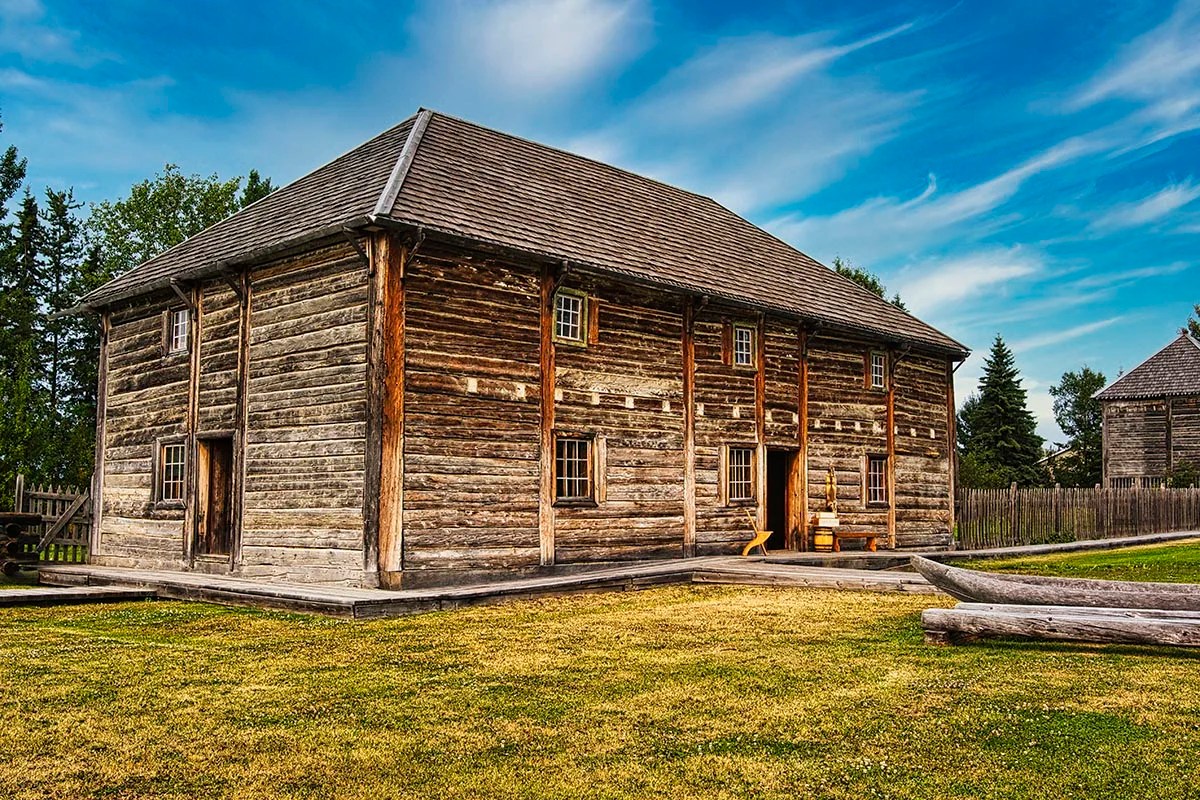
Visit this Real Canadian Fur Trade Post
This story is about the very foundation of the country of Canada. We visited an actual fur trading post with buildings dating from the 19th century. Historic Fort St James was in use until 1951!!!
You can step back in time and see the largest collection of wooden heritage buildings, restored and restocked to what it used to look like! But the most important part was listening to the stories of the interpreters in period costume who gave us a glimpse of what it was like to live then. It was not an easy life. Imagine living here at -30°C (-22°F) or colder with no central heating, no insulation and no running hot water!
Author & Photographer: George Mitchell

Our recommendations are not influenced by affiliate links – we have none. Our content and advice is derived from our personal experience and knowledge based on living in Western Canada as well as travelling for three years around the world.
Northern BC
Our destination is located in Northern BC, which is 60% of the total area of the westernmost province of British Columbia (BC), Canada. Only 256,977 people live in an area 3% bigger than France and 34% bigger than California!! While there are very few residents, the best part is that there are even fewer tourists.
Mt Robson
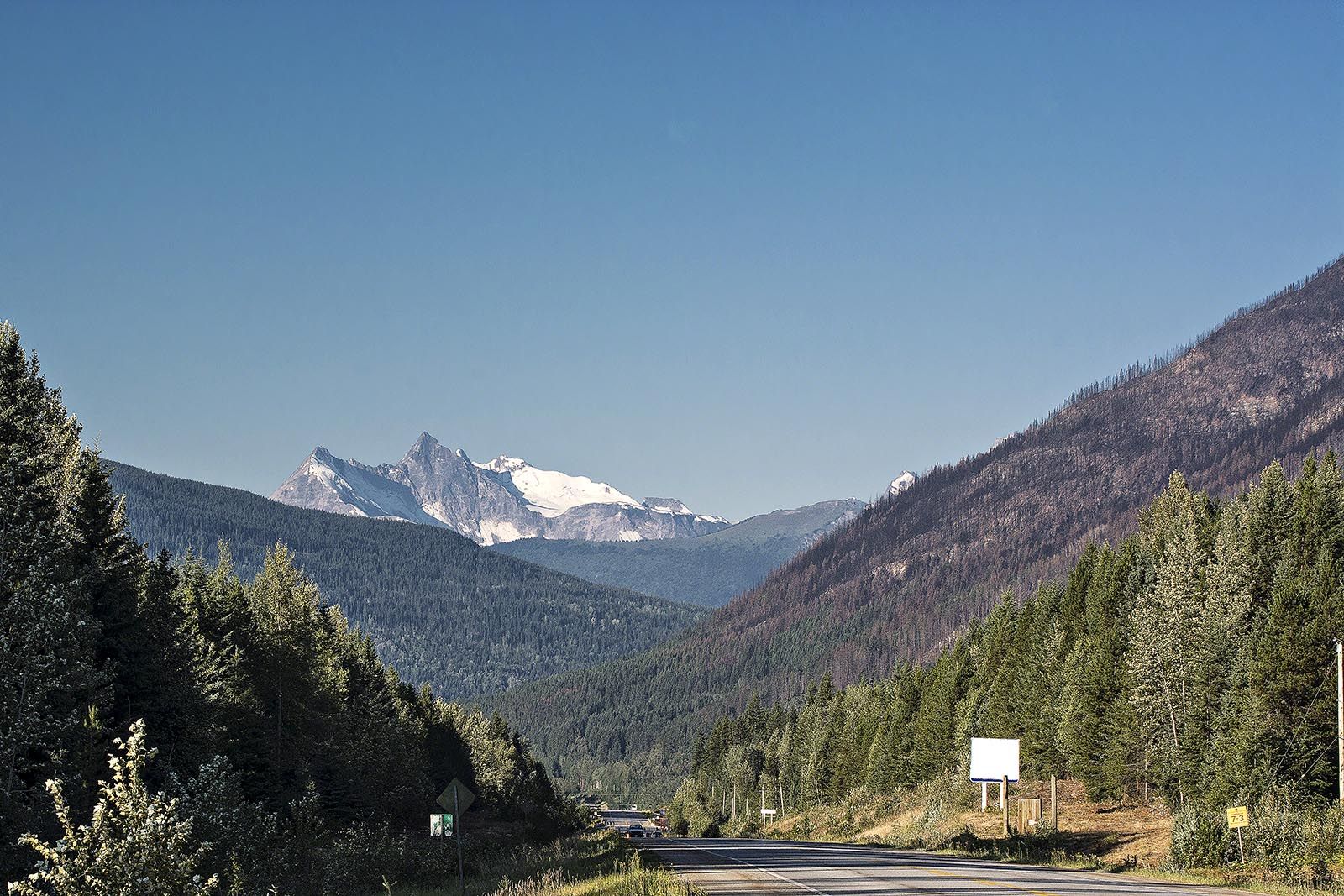
We woke up to another glorious sunny day with clear views of Mt Robson as shown in our Jasper & Mt Robson post. The scenery heading west was not as dramatic, so we stopped at the end of the PP to have a look at the good views behind us.
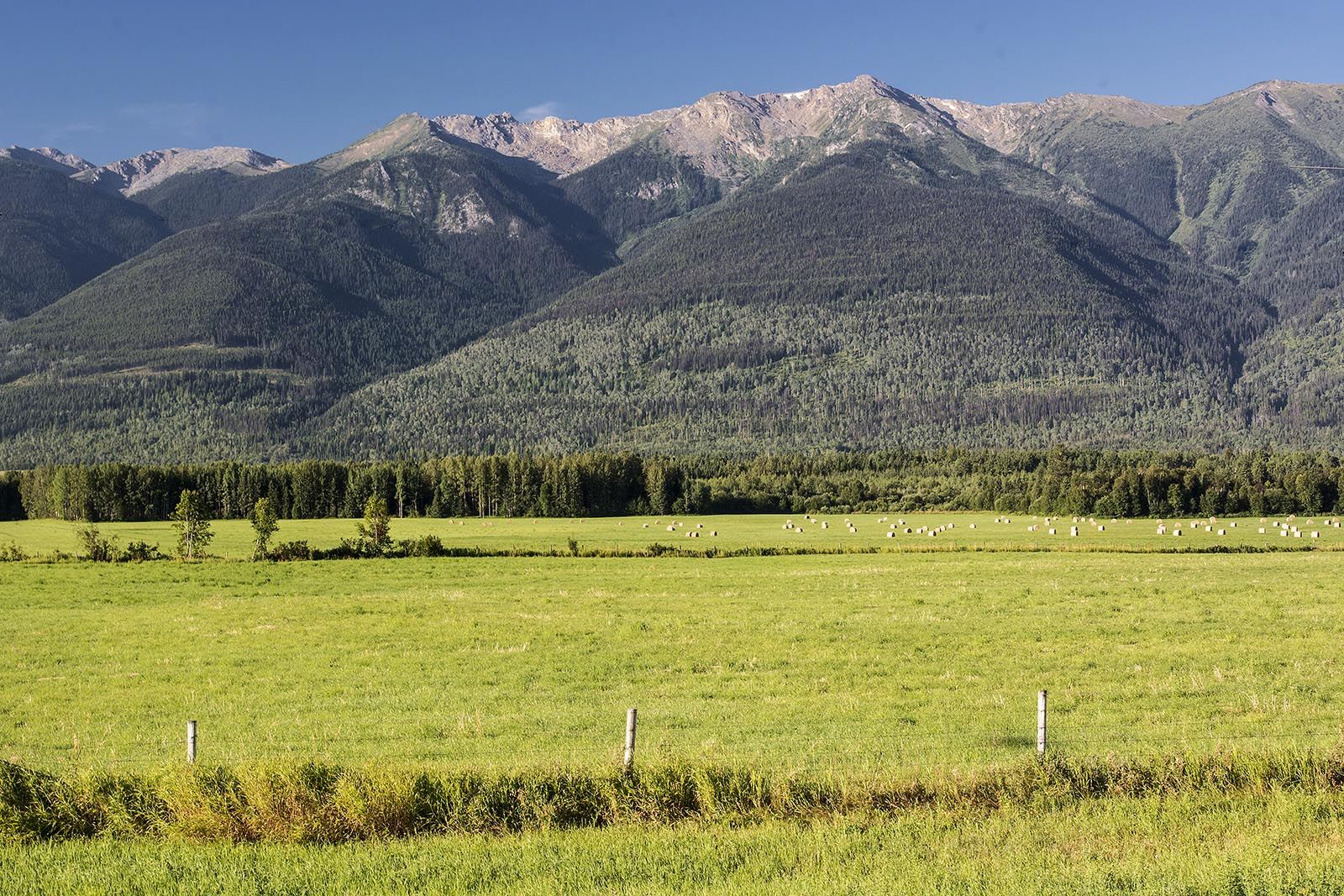
After that, we saw only wide open spaces (farmland). Did we mention that hardly anyone lives up in Northern BC?
McBride
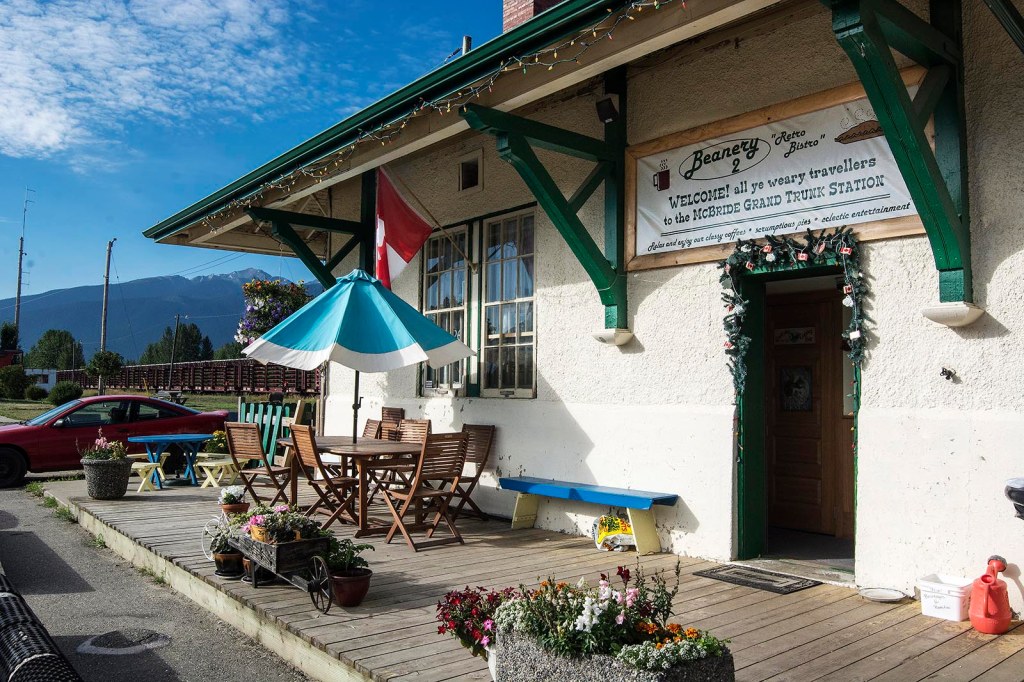
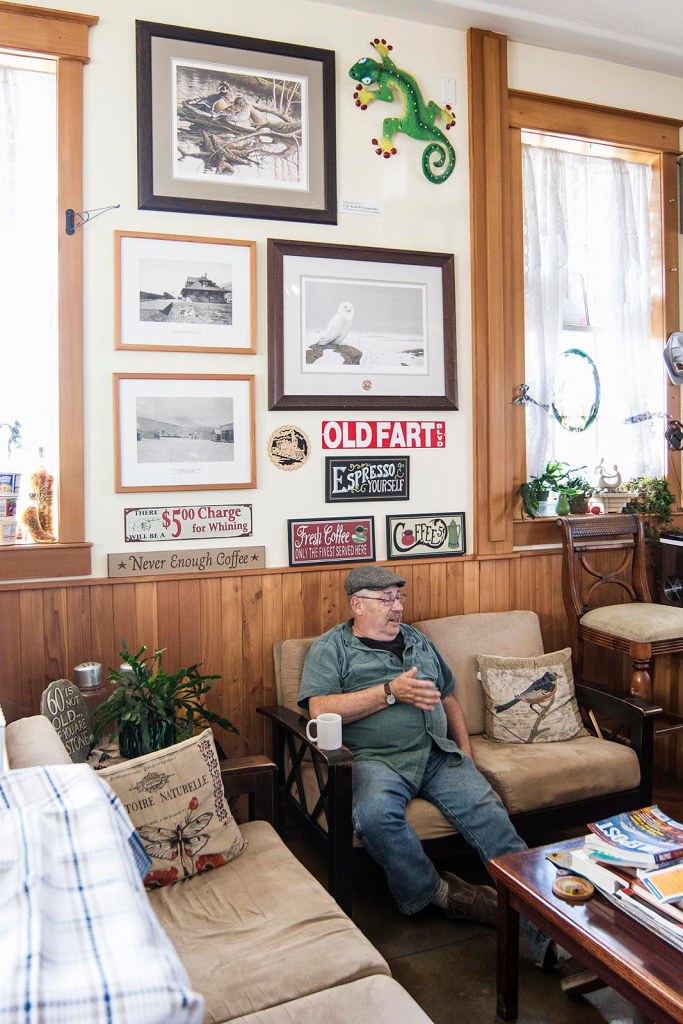
Needless to say, one has to stop in little villages to get one’s morning cup of coffee. So our first stop was McBride, population 616. The old train station was converted into a cozy coffee shop, The Beanery, decorated with old-fashioned memorabilia. It felt like dropping into someone’s house with the owner preparing dishes for lunch right next to the “living room” area. One local regular client sat on the sofa and talked with us.
Prince George
Prince George is the major city of Northern BC but it only has 73,000 people. Here is where we stocked up on food – you have a wide choice of stores. But Costco and Real Canadian Superstore are right along the Yellowhead Highway 16 on the south side of town past the Cariboo Highway 97 exit. There are no large towns heading north to Whitehorse (Yukon) so you need to resupply here.
Fort St. James National Historic Site

In the 19th century, this was the “neighbourhood” trading post. Imagine you had to paddle hundreds of kilometres to get to it. Fort St James (FSJ) was founded in 1806 by explorer Simon Fraser and remained in use until 1951!! FSJ was the HQ for New Caledonia, the Latin name for Scotland and original British name for British Columbia.
From here, the furs could be transported down the “fur highway” (my nickname) from Prince George to Vancouver. It is called the Fraser River in his honour. Simon Fraser University (SFU) in Vancouver is also named after the famous fur trader-explorer.
Run by Parks Canada, FSJ is open year-round, but costumed interpreters magically appear only between 1st June to mid-September. It is the interpreters who make this site come alive.
Hudson’s Bay Company
Hudson’s Bay Company (HBC) was the oldest North American company. It went bankrupt in 2025. The idea behind HBC was to sail ships from UK to the Hudson’s Bay thus bypassing New France (Québec) controlled by France.
But in 1670, HBC was more than a major fur trade company. It actually controlled and administered the 3.9 million sq km of Rupert’s Land, 40% of the land area of Canada! That is the size of Western Europe! The UK did not declare it a colony because it could not be bothered ruling it!
The power struggles of the North American fur trade in the late 18th century is the subject of Netflix’s program, Frontier. Apparently they were not as polite as we are today. But then again this was not yet Canada.
Here is an interesting connection. William Keswick and his grandson Sir William Johnstone Keswick served at HBC. The Keswick family are the Scottish business dynasty that controls the Hong Kong-based Jardine Matheson now worth USD 42 billion! Tai-Pan is an excellent novel by James Clavell about European traders who move into Hong Kong in 1842 following the end of the First Opium War. The Noble House of this novel is based on Jardine Matheson.
HBC Employees
The “Factor” was the chief business agent and manager of the factory (aka trading post). Both words are derived from Latin factoria. Instead of a salary, the Factor had 2 shares of the HBC. The other staff were paid: clerks made < £100 per year. Guides, tradesmen and boatmen made < £45/year. The Canadian Pound (£), worth $4, was used until 1858 when Canada converted to decimal currency, the dollar. Typical wages in 1870 for the skilled trades in Ontario were $1.30 to $2.30 per day.
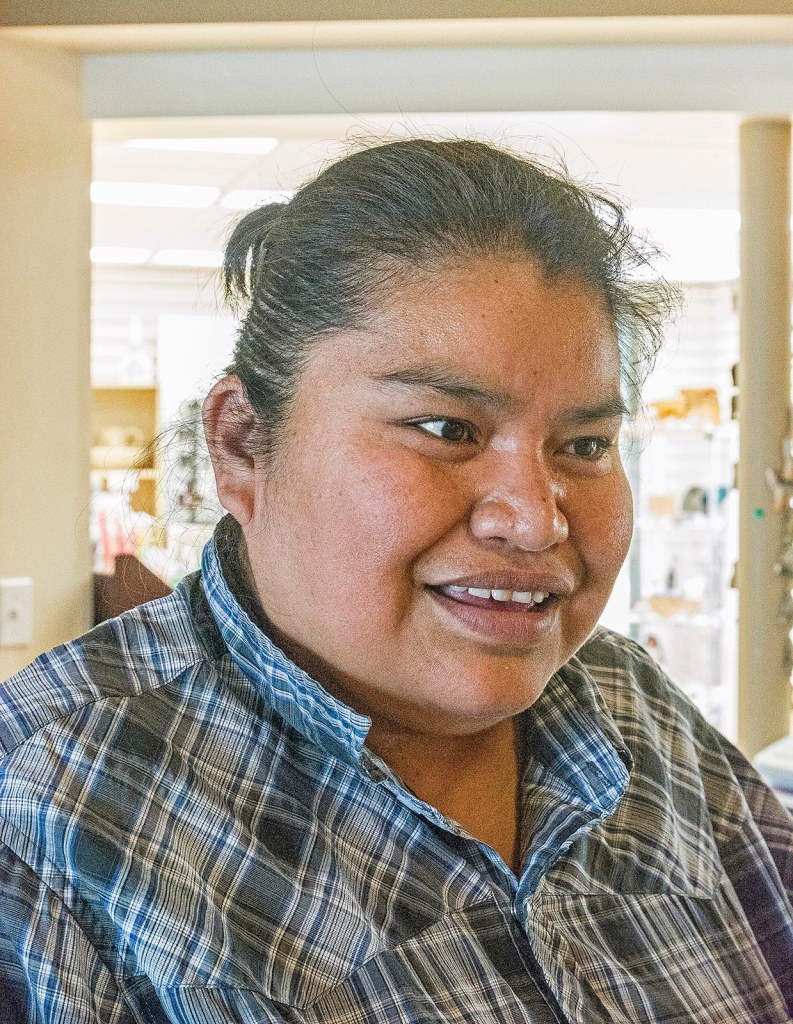
There was an interesting relationship between HBC and the First Nations (FN) people. First of all, Europeans only filled the top levels of HBC at the trading post. Second, they came as single men, so most of them intermarried with local FN women. The big learning point is…
Did you know that the majority of HBC employees were First Nation or Metis? (mixed marriage). Because of their roles as liaison and hunters, the FN had more influence during the fur trade era than after it ended.
“Probably the root of the misunderstandings was that, while the Carrier [the local FN people] saw trade as primarily a social act, the fur trade companies saw it, first and foremost, as a business transaction.”
First Nations
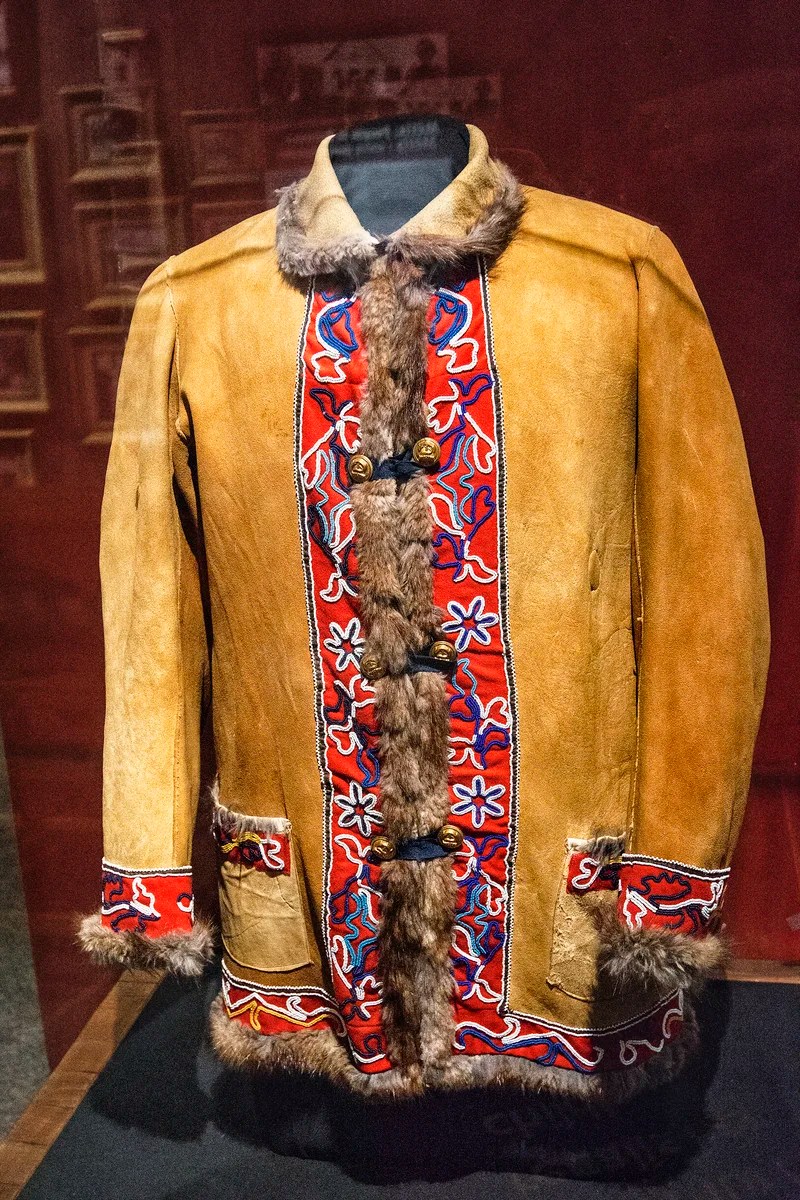
Without the Indigenous peoples, the Europeans would not have survived their first winter in Canada. First Nation (FN) inventions not only enabled Europeans to live in Canada but have since been adopted throughout the world. For a more detailed examination, see Have Canadian Innovations Made an Impact on the World? The following are just a few examples:
Clothing: Inuit parkas (insulated jackets), Inuit snow goggles, fur coats, moccasins, mukluks, snow shoes, and camouflage (for both hunting and warfare).
Medicines: foxglove (genus Digitalis) to treat heart disease and black willow bark as a painkiller, which after ingestion turns into salicylic acid, the main ingredient of aspirin.
Food: Native Americans have contributed many staples of our modern diet: beans, chocolate and cocoa, corn and popcorn, cranberries, maple syrup and sugar, potato, pumpkin, peanuts, sunflower, tomato, vanilla, and yams.
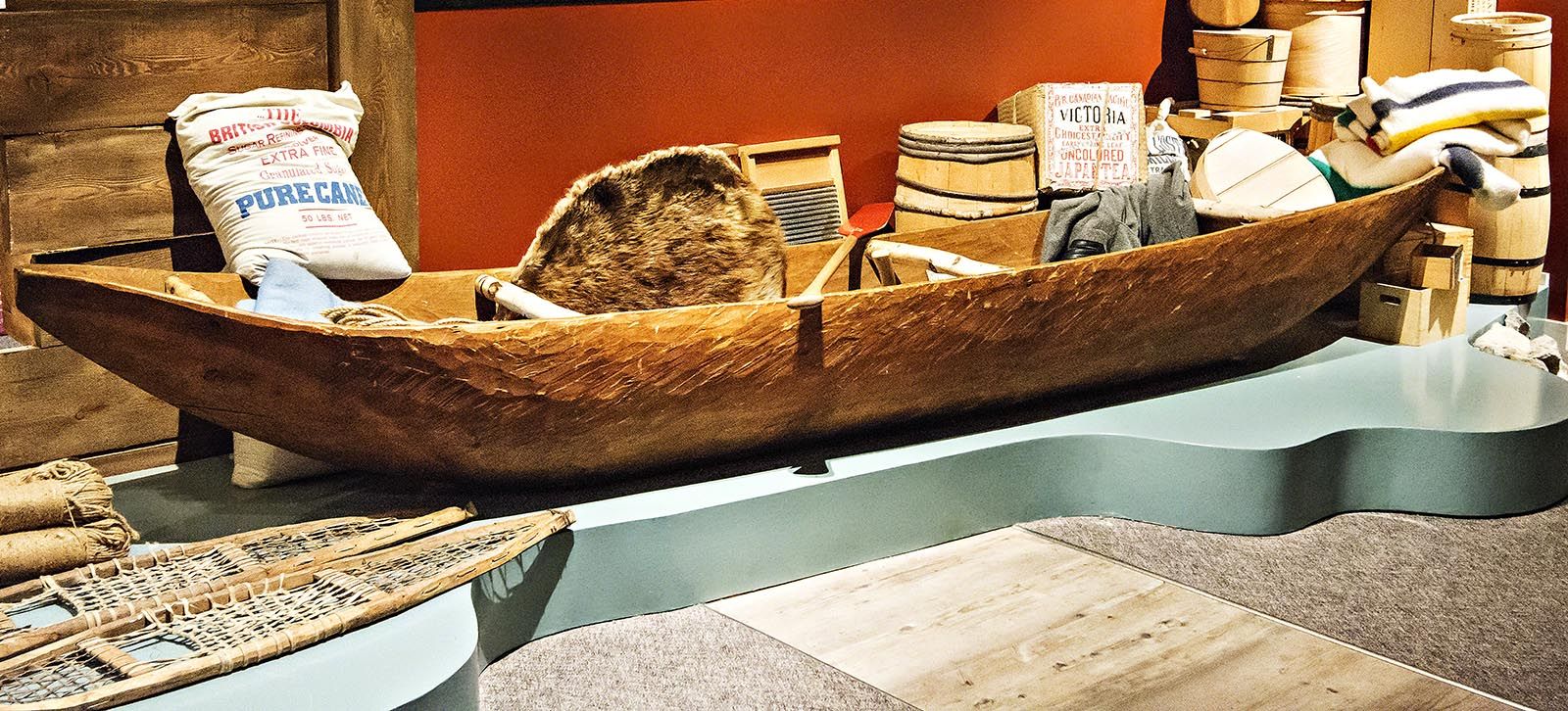
Transportation: Birch bark canoes and kayaks were FN inventions. Yesterday’s transportation is today’s sports. Dugout canoes can be found around the world and were used to move supplies and furs.
The fur trade had a great impact on Indigenous peoples. As a result of their involvement in the fur trade, many abandoned their traditional lifestyles and economy and became reliant on European-manufactured goods and foodstuffs for survival.
The arrival of Europeans also introduced diseases, such as smallpox, that devastated the aboriginal population. Less than 4% of Canadians are FN people. But 16.6% of the indigenous population live in British Columbia.
Fur Warehouse (1888-89)
Warehouse Exterior
How do you construct buildings in the wilderness without trained tradesmen and modern materials? How do you construct buildings quickly and easily? Well, there are lots of trees. So they came up with “post and sliding piece” construction. Two sets of double posts provide a bay where whole logs are piled – it’s easy to replace rotten logs, expand a building, or even relocate it!
Caulking
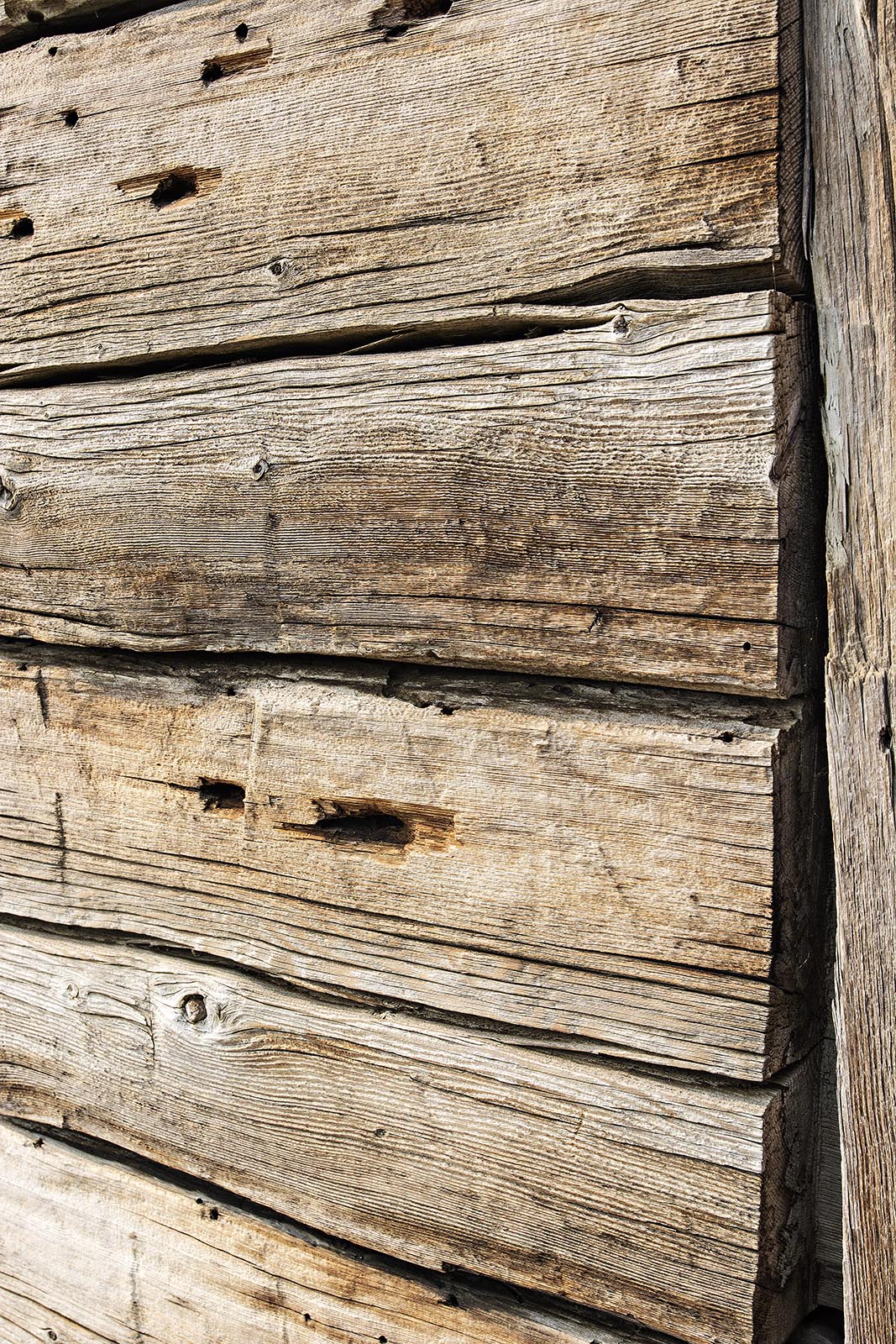
Essentially, it’s a log house, but the timbers are squared. All this squaring had to be done by hand. There was no insulation,n but they had to keep wind and water out. The horizontal spaces or joints between logs are “chinked” with moss, clay, and/or dried animal dung and “daubed” with a mixture of clay and lime. Chinking and daubing completed the exterior walls of the log pen by sealing them against driving wind, rain and snow as well as blocking the entry of vermin.
Did you know that the caulking gun was invented by a Canadian in 1894: it was adapted from a cake decorator!!!
Warehouse Interior
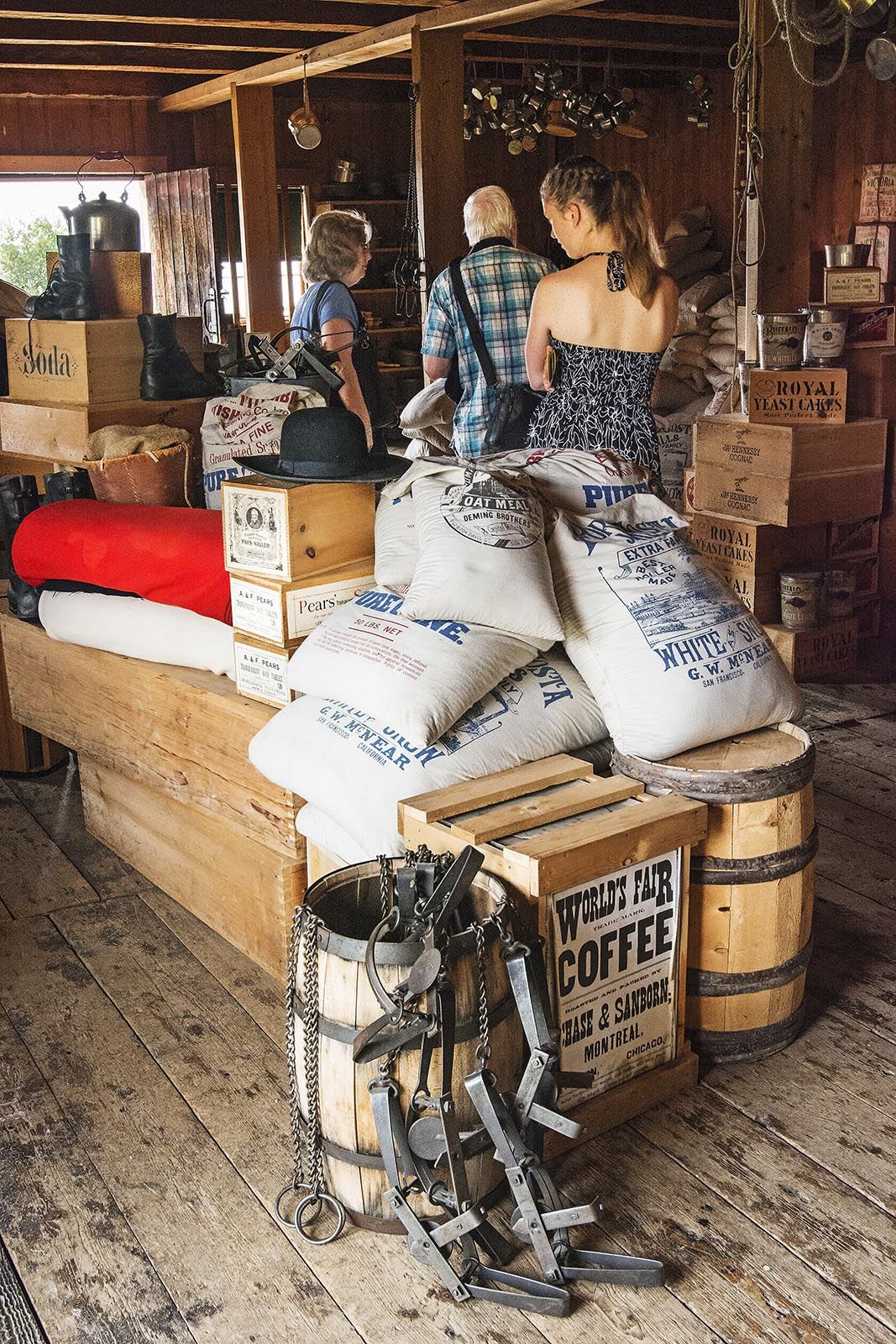
When we were there, some German traders were exploring the stacks of supplies, including sacks of sugar and oatmeal, crates of coffee and traps, and boxes of soap and yeast. But they had not brought any beaver pelts.
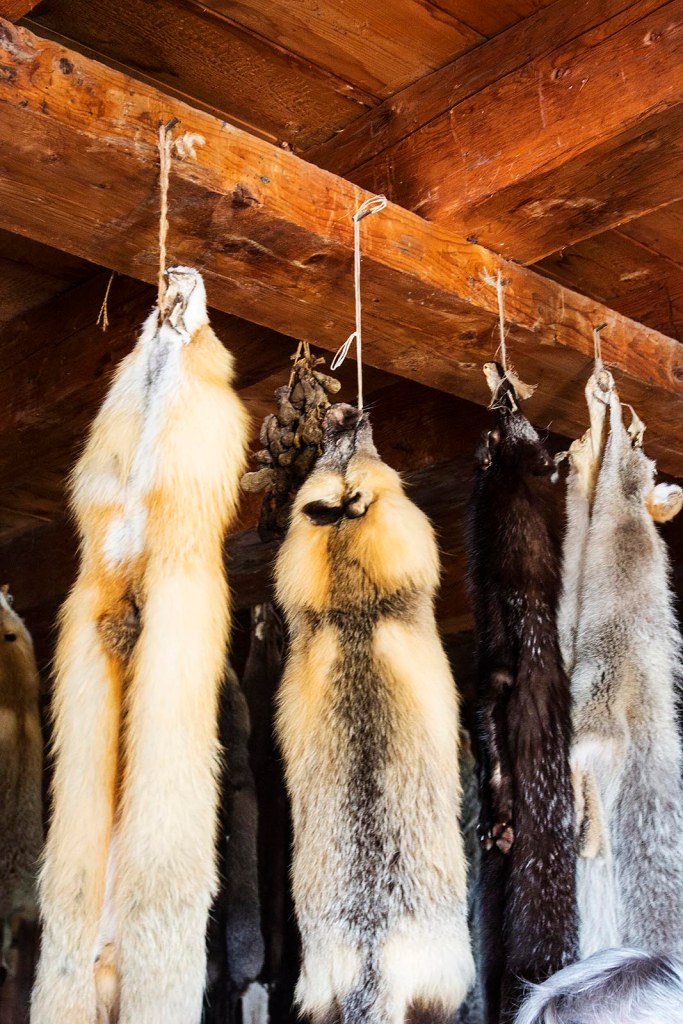
Furs were hanging from the rafters, waiting for transport to Victoria. Beaver wasn’t the only fur. The most important furs in order of exports were beaver, marten, otter, mink, fox, bear, deer… You get a chance to touch the furs. Some are amazingly soft.
Beaver Felt Hats (1550-1860)
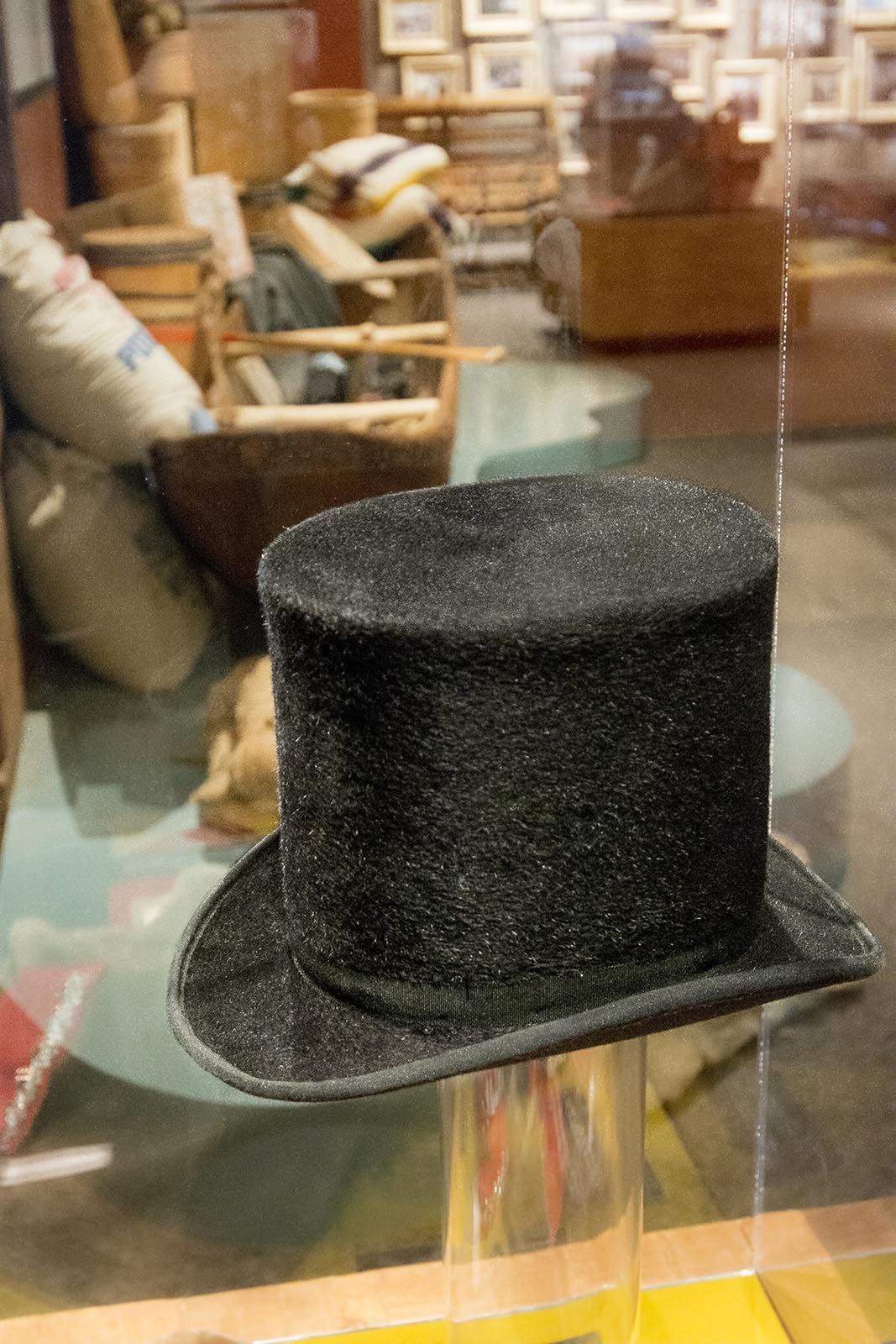
Did you know that the beaver is North America’s largest rodent? But why was the beaver the most desirable fur? Its amphibious body is covered with a soft, felt-like underfur that is one inch thick. It made the top hats water repellent. After all, the beaver is a water rat.
Fashion was the primary cause of fur demand and business. Who knew that the beaver hat fashion was inspired by Swedish soldiers during the Thirty Years’ War (1618-48)?
Tricorne and top hats were used by the military, aristocrats and eventually by other social classes. The beaver had been hunted to extinction in Europe. The best quality hats were made from beaver as it has the most luxurious fur. HBC promoted itself in the beginning by providing free hats (£34) to important men.
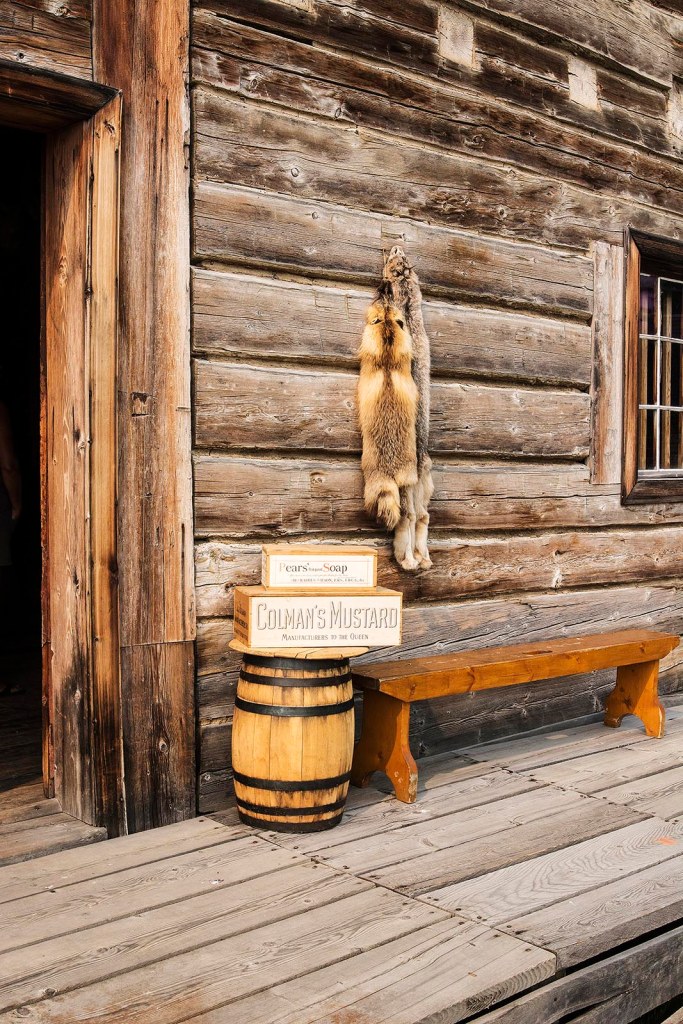
So what did FN and traders buy? On the barrel outside we see two products you can still buy today! Pear’s transparent soap started in London 1807 and Colman’s Mustard founded in 1814.
Foods shipped into the posts included salt pork, wheat flour, corn, cheese, chocolate, condiments, rum and high wine.
Boardwalks are raised wood platforms to keep feet out of puddles and horse poop. Moving clockwise, we pass the Fish House where they dried salmon to keep for future meals. The Fish House is on stilts to prevent entry by animals. Turning right, we get to…
Men’s House (1884)
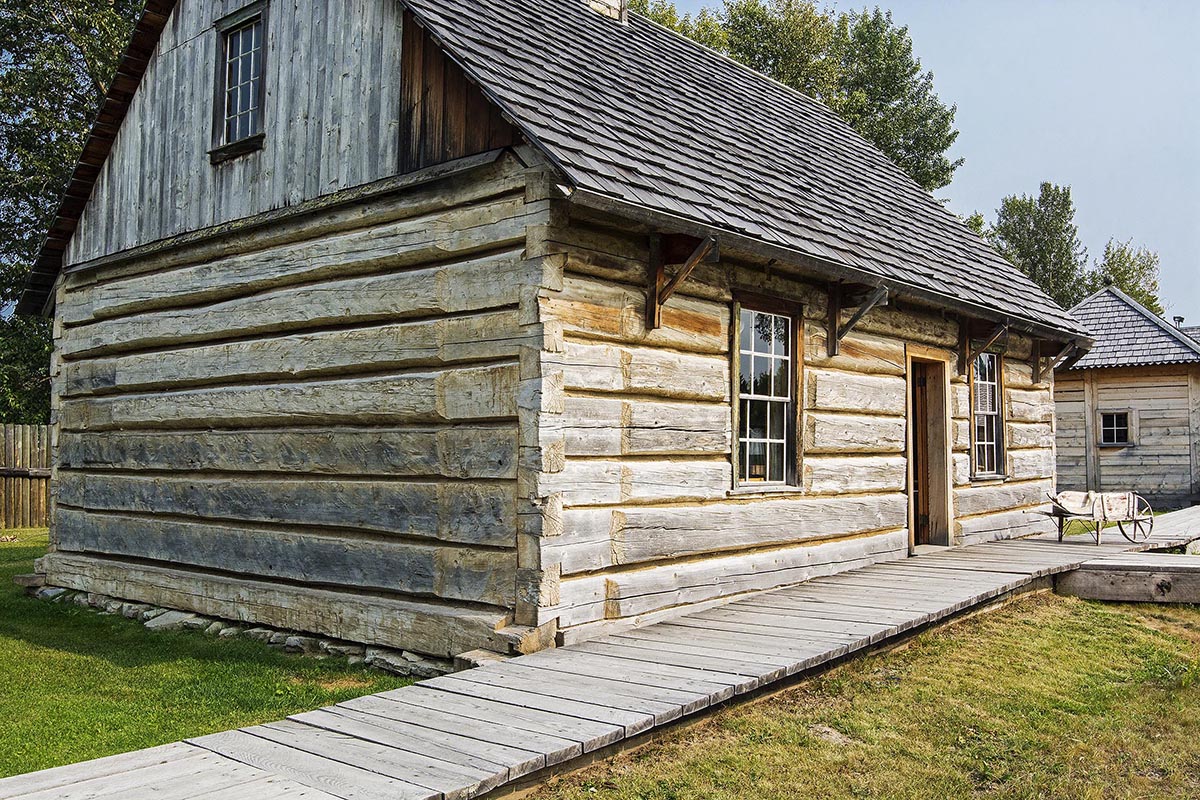
This log building served as a company employees house, and a guest house. As a rule, windows were covered with parchment (rawhide). Glass at inland settlements was a luxury and must have been added later.
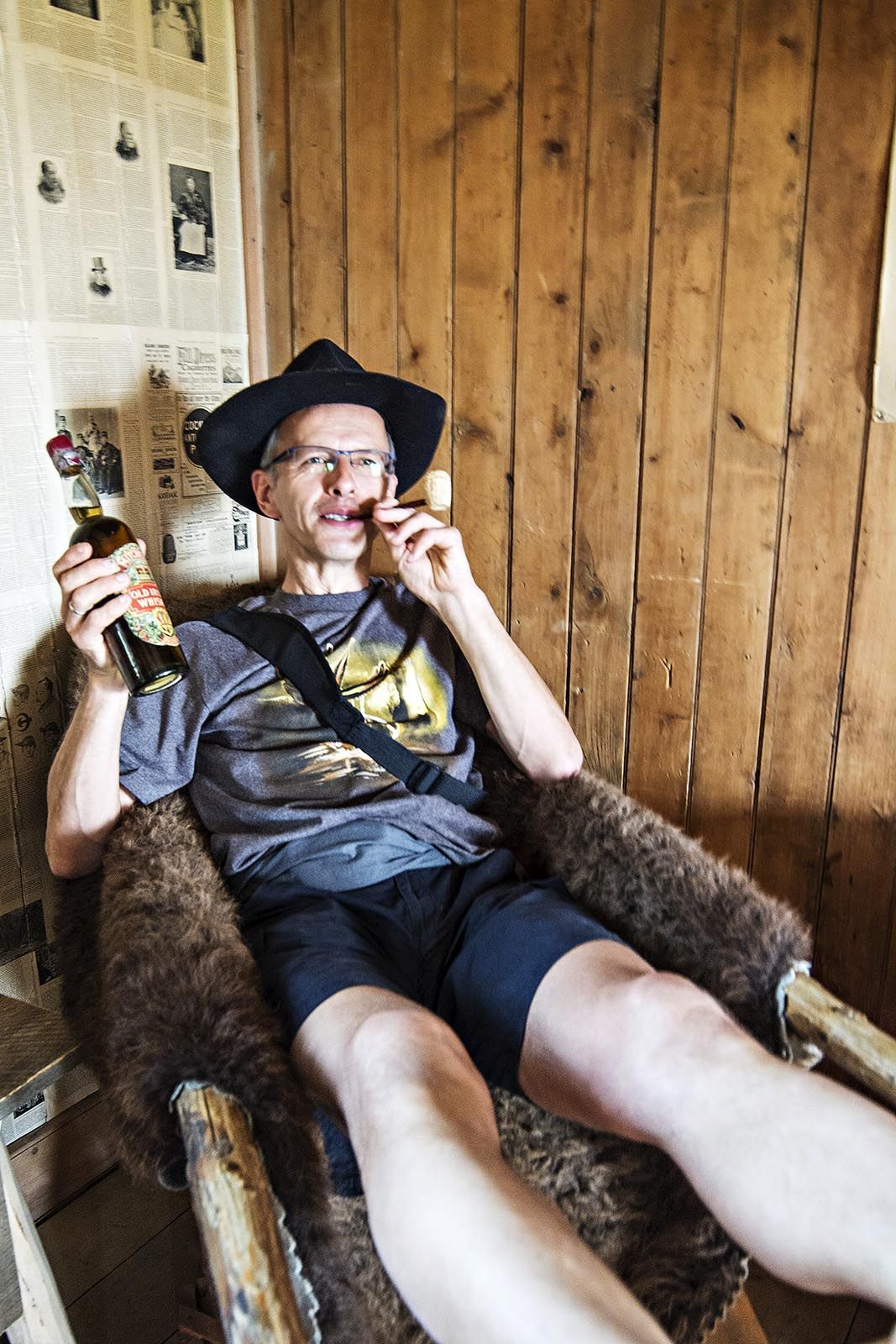
Here we have a trader from Germany trying out the best whiskey. He’s relaxing in an early model of the lazy boy recliner with the best bear fur seat and an elevated foot rest.
Do you think you could live here? Let’s get rustic! No plumbing. No running water. Feed the stove logs to keep warm. Notice the newspapers on the wall. These were used to keep out drafts.
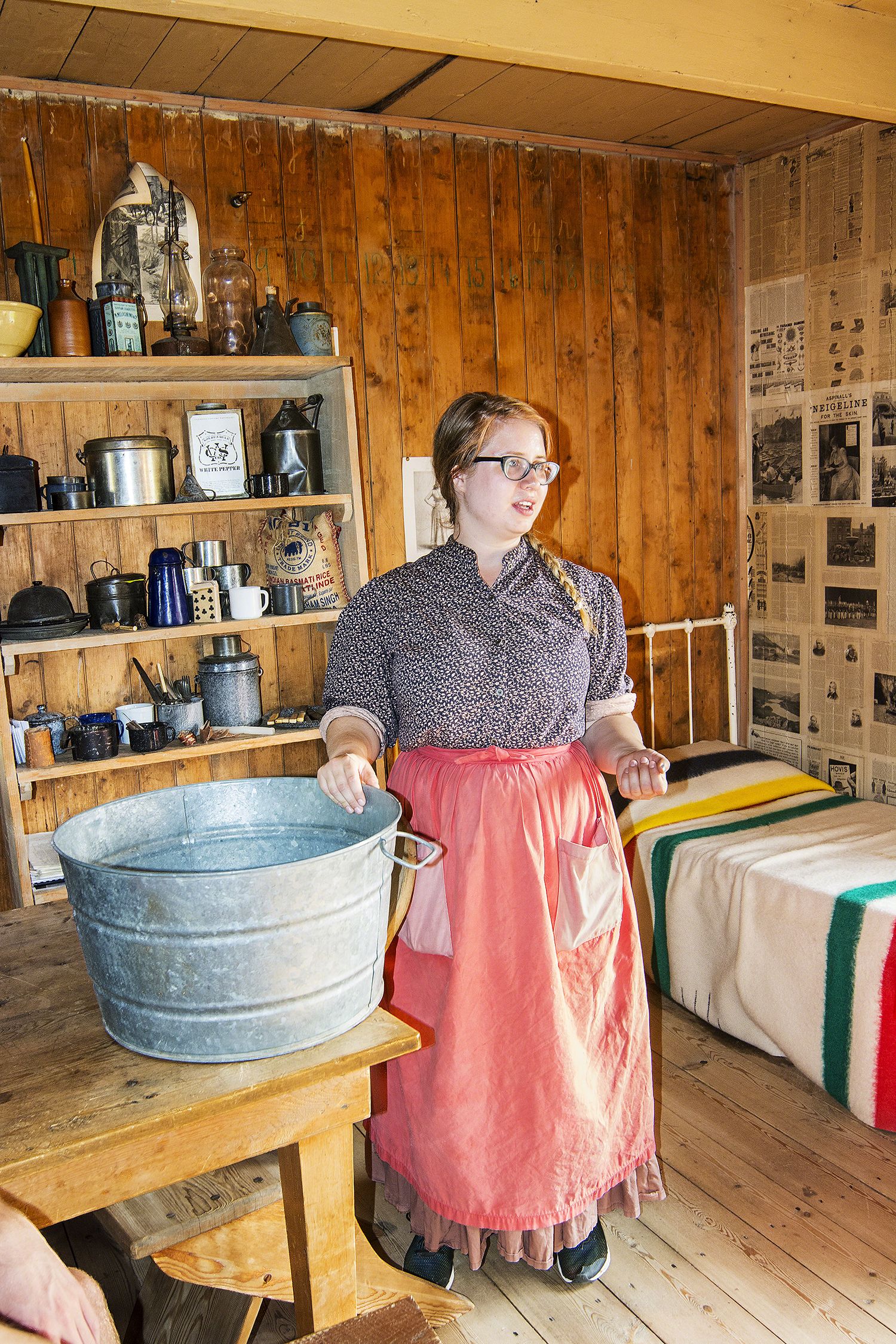
Look for the alphabet along the wall over the bed covered with an HBC blanket! This log building once served as a school.
Men back then wouldn’t bathe often. To keep warm, they wore many layers. Instead of taking their long johns off when they started to wear out, they would put another pair on top. By the end of winter, they would have three or more pairs that they had yet to take off all season. Summertime would arrive, and then came the time for the removal process. Their body hair would have grown through the fabric, which means taking them off was a painful process. One interpreter told us that sometimes the underwear fused to their skin!!!
Lead
Canned fruit and vegetables were imported to the Great North. The tin can was invented in London in 1810. Early cans were sealed with a tin-lead alloy, which could lead to lead poisoning. HBC used boats to bring trade goods to Canada and return with furs via Hudson’s Bay to Europe.
Here is a connection to the fur trade. In 1845, there was an expedition to discover the remainder of the Northwest Passage through the Arctic to Asia. Both of Sir John Franklin’s ships were recently found by Canada. Autopsies of the Sir John Franklin Expedition showed that crew members suffered from severe lead poisoning, caused by eating from lead-soldered tin cans and drinking water from lead water pipes!
Medicine
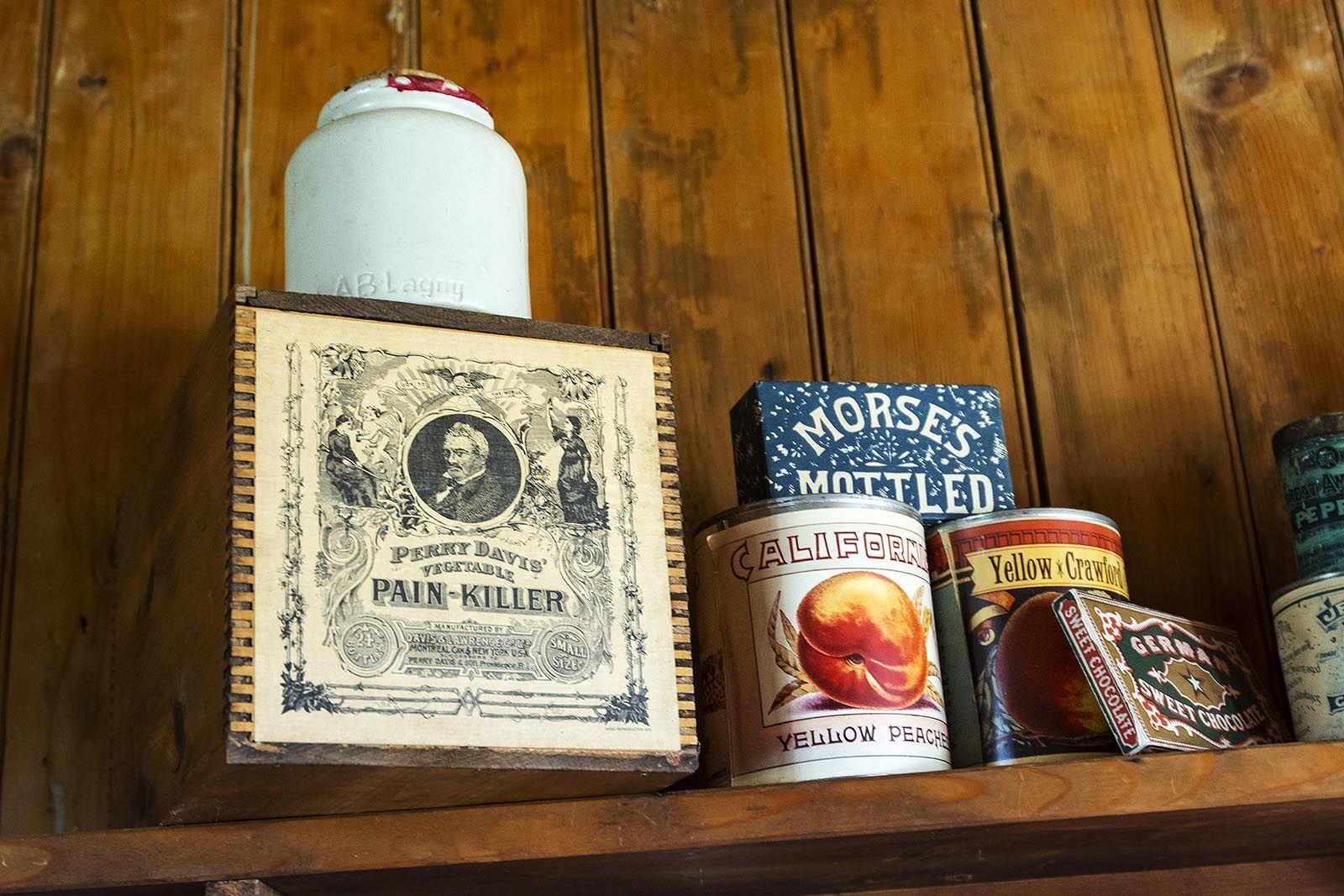
Notice the box marked “Perry Davis’ Vegetable Pain Killer”. When we watch Western movies, we think of con men selling fake products. But, this drug actually worked! Patented in 1845, it was the first drug to be nationally advertised, selling for $1 per bottle
It was distributed around the world by Christian missionaries who had no idea of its ingredients. Since “Perry Davis Pain Killer” was a registered brand name, there was no legal requirement to make its ingredients public on the bottle. The painkiller was indeed entirely natural, and it worked because it was made primarily from alcohol and opiates.
Trade Store (1884)
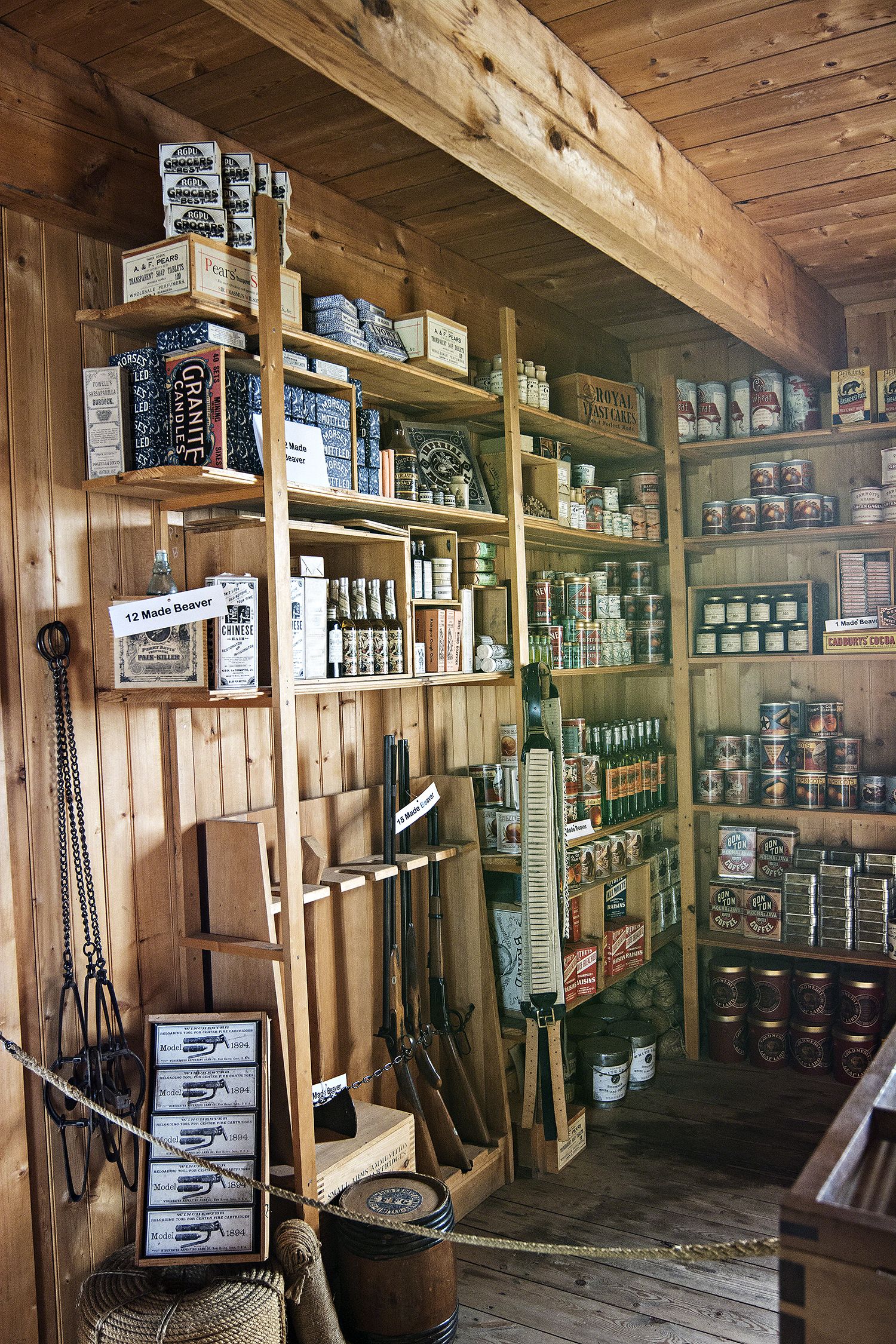
This was the first The Bay department store! The fur trade was the primary reason for Europeans to interact with the aboriginal population. The Trade Store was also the first post office in the region.
This is a reconstructed building, as the original burnt down in 1919. The Dakelh (Carrier) people quickly discovered they could get most of the things they wanted from the trade store without ever bringing in furs. This was because the traders were in such desperate need of salmon and traded for them from the Dakelh in huge quantities. To encourage the trapping and trading of furs, the Company eventually adopted a policy to accept only furs in trade for the most valued store items, like blankets or metal pots.
The Made Beaver

The Hudson’s Bay Company trade with the First Nations was carried out through bartering. The HBC standardized the unit of account as the Made Beaver (MB), or one high-quality male beaver skin, to ensure consistent pricing for pelts throughout Rupert’s Land. A trapper might make 300 MB per season.
However, the value of products did vary. In 1795, a pistol could be purchased for 4 made beaver pelts (MB); a rifle for 10-12 MB. So what did 1 MB buy? German chocolate, kettle, gallon brandy, shoes, 2 shirts, 2 lbs sugar, 1 trousers,… Today 1 MB = $31.
By 1700, the famous and colourful striped HBC blankets accounted for more than 60% of the trade. They cost 1 to 3 MB, depending on size and quality. The 100% wool blankets are still sold today for $70.
The Buck
Americans trace the term buck meaning deer skins back to 1748, about 44 years before the first U.S. dollar was minted. Whoa, not so fast: that was not the original buck. The HBC struck a coin in the 17th century that was equal to the value of one buck-toothed male beaver pelt – it was known as a “buck”. The beaver became the national symbol of HBC and later Canada. It is still found on the tail side of the Canadian nickel (five-cent coin).
Factor’s House (1884)
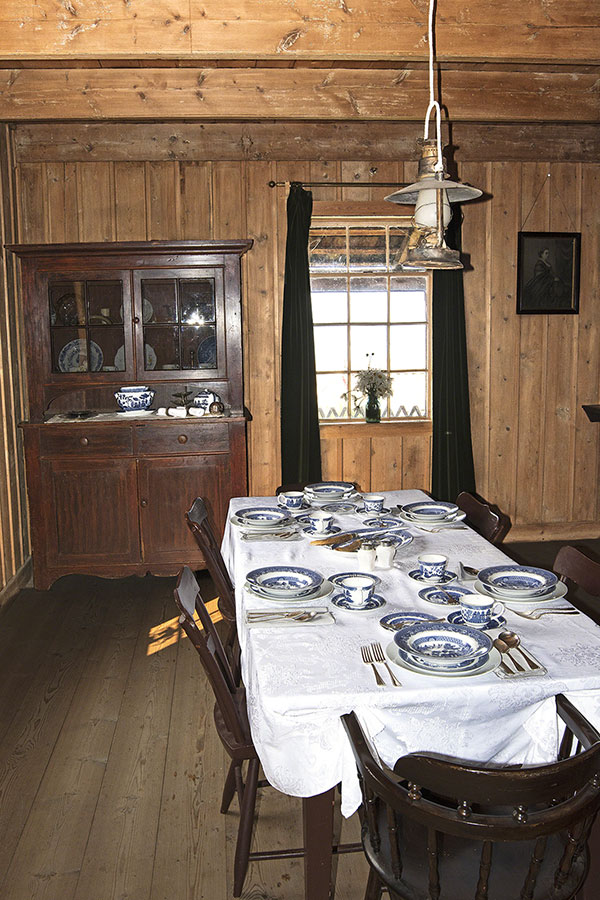
The Chief Factor’s house underwent many changes over the years but has been restored to the period when Chief Factor A.C. Murray and his family occupied the house (1886).
By looking at the furniture in the living room and the fancy dinnerware in the dining room, you can see that the factor lived in relative luxury compared to everyone else. You too can spend the night in the Murray House Bed and Breakfast and enjoy the solitude without any tourists once the fort closes for the day.
Sir James Douglas
Sir James Douglas was born in Demerara, Guyana. Yes, that is the town where we get the name for one of our sugar varieties. After schooling in Scotland, he worked for the Northwest Company in the fur trade. The NWC was based in Montreal, which became the financial capital of Canada thanks to the fur trade. In fact, many of Canada’s cities started off in the fur trade – such as Winnipeg, Calgary, Edmonton, Vancouver and Victoria. Think of the fur trade as the original gold rush in North America.
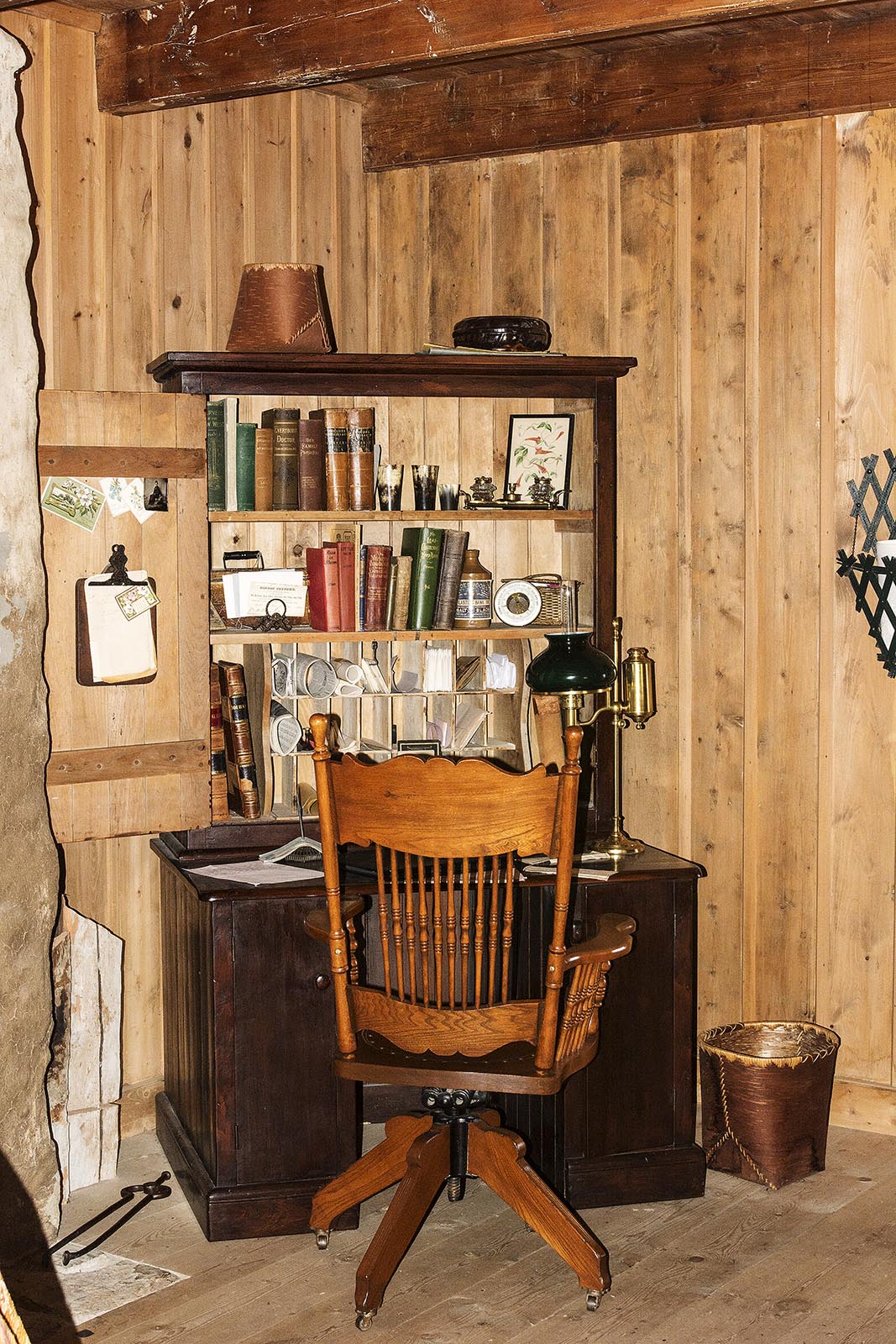
Early in his career, Douglas served as a fur trade clerk at Fort St. James. His wife was Métis (part native). Douglas became the chief factor of HBC when the NWC merged with HBC in 1821. He would have sat on the chair in this photo of the factor’s office.
He is best remembered for a famous confrontation he had there with the Dakelh Chief Kw’eh in 1828. After that, he was moved south.
In 1843 he founded Fort Victoria, which is still the capital of British Columbia (BC). In 1851, James Douglas had to resign from the HBC as he was appointed governor of the colony of Vancouver Island.
The population of New Caledonia (the BC mainland) was largely American and other foreigners. When gold was discovered in the Fraser Valley (1858), Douglas predicted 10,000s of American prospectors could tilt the future BC to become part of the US. The first wave was 25,000 people!
Douglas asserted British sovereignty over the “mainland” – technically, it wasn’t under his jurisdiction as it wasn’t part of Vancouver Island. He asserted authority over American miners and undermined American territorial ambitions.
Shortly thereafter, the UK Colonial Office formally ratified Douglas’ proclamation of sovereignty and established a new colony encompassing the mainland. But there was already a French territory in the South Pacific called New Caledonia (Nouvelle-Calédonie actually), so Queen Victoria named the new colony British Columbia. Douglas was appointed the first governor of the Colony of British Columbia in 1858.
The area of British Columbia (944,735 sq km) is 7% bigger than France and UK combined, 21% larger than Turkey, and 35% bigger than Texas!
Future of Canada
Adversity is the mother of invention. And many things have been invented by Canadians, from Pablum to poutine.
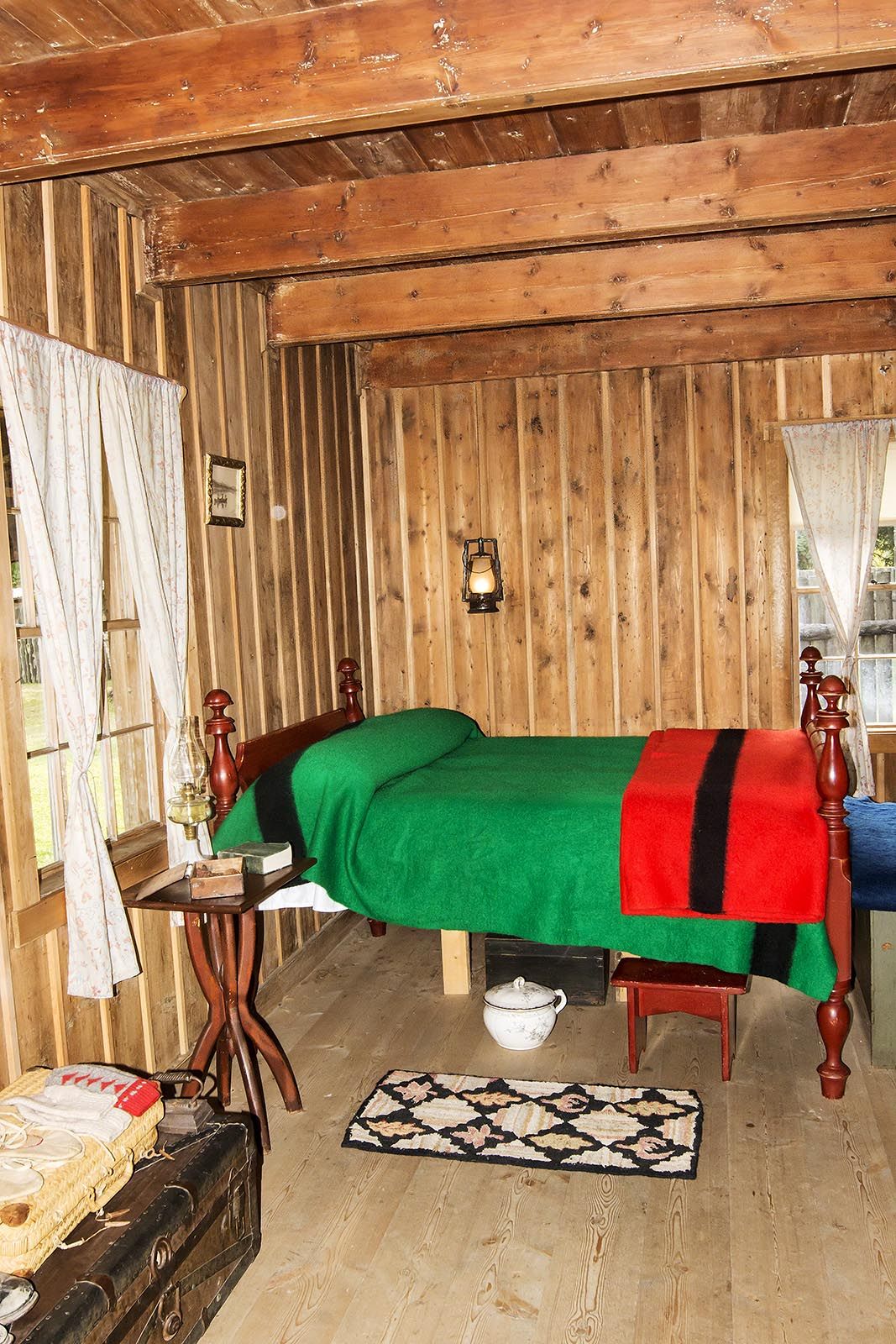
Note the replica kerosene lamp in the photo. The kerosene (aka paraffin) distillation method was invented by Canadian geologist Dr. Abraham Gesner in 1846.
Even if you have never had a kerosene lamp, most of you have used kerosene. It’s also called jet fuel.
James Douglas was the governor of BC from 1858 to 1864 and is often called the Father of BC. All land became crown land, owned by the government. He relied on his gold commissioners to lay out reserves for the indigenous peoples, record mining and land claims, and arbitrate mining disputes.
Without the approval of Great Britain, Douglas built a wagon road 640 km long following the Fraser River to distant Cariboo, where gold nuggets had been found (see Cariboo Road). It was extended in 1865 to Barkerville, the gold rush town that changed Canadian history. It is a must-see.
In 1869, HBC rejected an American government offer of CA $10,000,000 to buy Rupert’s Land. That would have been quite a steal considering the $7 million spent to buy much smaller Alaska. Instead, the British pressured HBC to sell it to Canada for $1.5 million. That was quite a deal, except HBC never paid for it in the first place!! This land became the Northwest Territories, Manitoba, Saskatchewan, and the northern parts of Ontario and Quebec. Manitoba became the fifth province to join Confederation in 1870.
British Columbia joined Confederation on 20 July 1871, becoming Canada’s sixth province. This was spurred on by the gold rushes and the promise of a transcontinental railway link. The railway was not completed until 1883. You can see where the Canadian Pacific Railway used advanced engineering to build the Spiral Tunnel in Yoho NP to descend west out of the Rocky Mountains. The ends of the tunnels are visible from two viewpoints in Yoho NP (which is in BC).
Where to Stay in Fort St James
Since we arrived late in Fort St James, we wanted to continue the tour the next day. Fort St James is also an FN town with three hotels. We do not know how busy it gets, as we easily got a room at the last minute at 17:00 hrs. We stayed at The View hotel ($138) right behind the National Historic Site.
In addition to local camping and hotels, one can also stay in the town of Vanderhoof, which has lots of hotels and restaurants since it is on the Yellowhead Highway. But you would have to commute 61 km (41 mins.) one way north on Highway 27.
Final Comments on this Itinerary
This is an action-packed itinerary where you can get away from the crowds. It is an escape to the time of the founding of Canada.
Subscribe
Get travel tips and advice delivered directly to your inbox. The best part is that it is free.
What things fascinate you? How long is your trip? What questions do you have? If you have been to the Rockies, share your experiences with us.
Itinerary Map & Resources
CA BC Mt Robson to Furs and Jade Map — our custom Google map
CA BC North Map — our custom map with points of interest
Yukon Itinerary Map — our custom map with points of interest
Rocky Mountain Itinerary Map — our custom map with points of interest
Google Maps Ratings
Google Maps provides a rating from 0 to 5 for all sights, hotels and restaurants (but not cities). All of our recommendations are appended with the rating (prefixed with a G) from Google Maps. As it is based on feedback from tourists and locals, it is much more reliable than travel booking websites. We consider a score of 4 to 4.39 to be Very Good; 4.4 to 5 to be Excellent.
Other Places to Add to Your Itinerary
Here are nearby places you might want to explore:
Canada FAQ

The Exploring Canada post answers Frequently Asked Questions (FAQ) such as:
- How do you plan a trip to Canada?
- How safe is Canada?
- What is the best season for travel?
- Can I see everything in 3 or 3 weeks?
- What are the best places to see in Canada?
 Terra Encounters
Leave a comment