
Best Places to See Quintessential Italy?
Fall in Love with Central and Northern Italy! If you want to see some of the best cities and scenery in Italy, then this is the itinerary for you. It’s a feast not only for the eyes but also for wine lovers.
We like to explore what makes Italy (or any country) unique, what is quintessential Italy. Below are the best places to visit in Central and Northern Italy.
There are so many more places that you could include; we have added a few more suggestions at the end of this post. If you have more time, you could also include Venice, which is covered in the What are the Must-sees of Italy? post. If you have limited time, then keep to the primary route.
Author & Photographer: George Mitchell

Our advice below is not based on a couple of tourist trips. Our recommendations are based on our extensive experience living in Italy for four years. We are avid hikers, nature lovers and photographers (all photos are my own).
All of our recommendations are top-rated by Google Maps Ratings, which is based on everyone, not just tourists. Each place recommended in our custom Central to Northern Italy Itinerary Map is appended with a Google Maps Rating (G0 to G5).
Central to Northern Italy Itinerary
The first major destination is Siena. If you are starting from Rome, you have a decision to make. There is a fast Hill Town Route or the slow Festival Route. The primary route follows the main Autostrada (expressway) A1 but includes brief visits along the way to Siena.
1. Hill Town Route Option
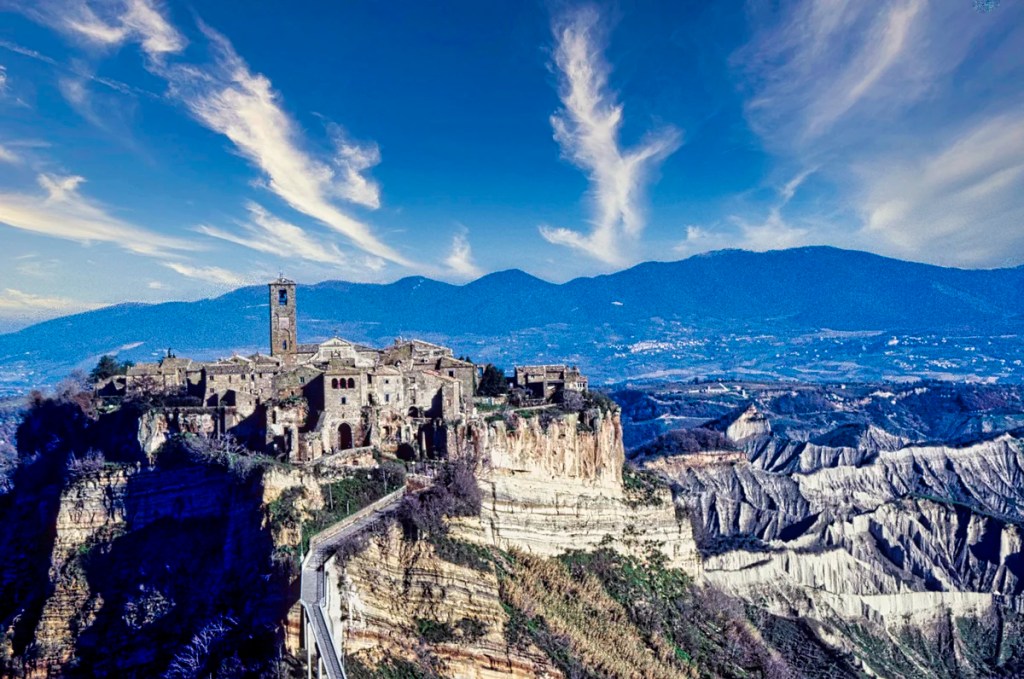
One of the quintessential aspects of Italy is the Hill Town. This idea was started before the Roman Empire. Etruscans (ca. 900 to 500 BC) built towns on hills defended by walls. Why does Italy have so many cittadina collinare (literally “little cities on a hill”)?
Italy is a younger country than Canada! It was only unified in 1871. Since the Fall of Rome, the country consisted of at least 11 city-states that controlled their own large territories, plus provinces ruled by foreign powers. The Holy Roman Empire and later Spain ruled the north. The central provinces, aka the Papal States, were ruled by the Vatican. The French ruled the Northwest. The Kingdom of the Two Sicilies (i.e. Sicily and Southern Italy) was ruled first by Constantinople, then the Muslims, and later by the French and Spanish Habsburgs.
There was no central government or army — there was no Italy. Italian hilltop settlements were built for defensive purposes, in a land with continual wars and shifting of borders. Steep embankments or cliffs protected towns from invasion. San Gimignano, described below, is the quintessential hill town of Italy, and that’s the reason it was included in this itinerary.
Civita di Bagnoregio
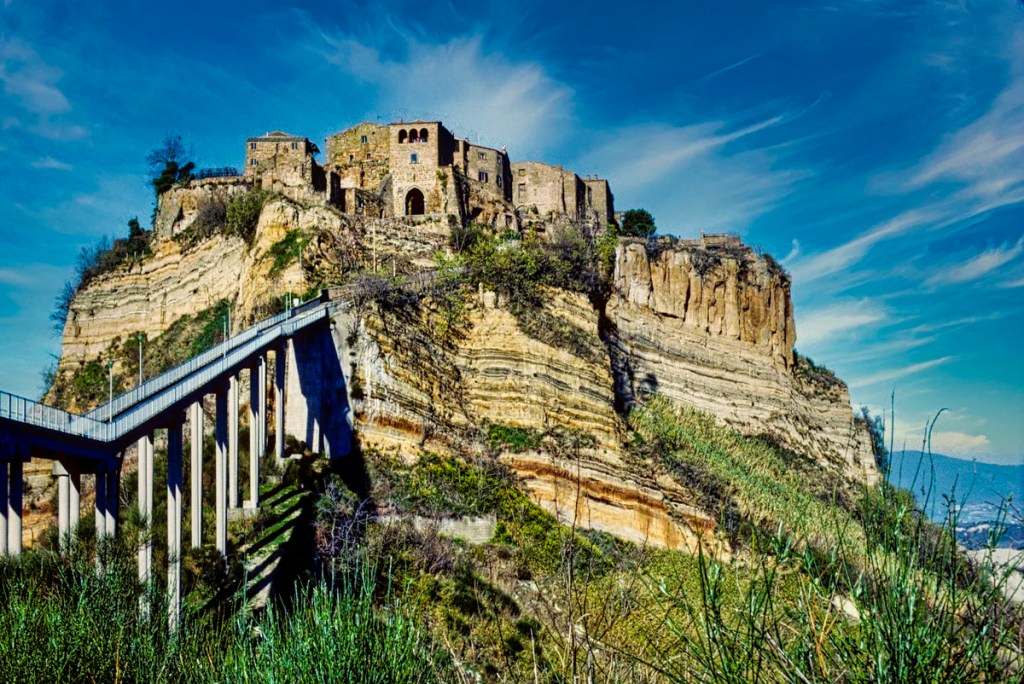
We frequently visited Civita di Bagnoregio (G4.7) as it is a short day trip, 124 km, 1:45 hrs north of Rome. From the parking lot (€5), you have to walk up a steep pedestrian bridge. The view above conveys the meaning of hill town, and that alone makes this a worthwhile stop.
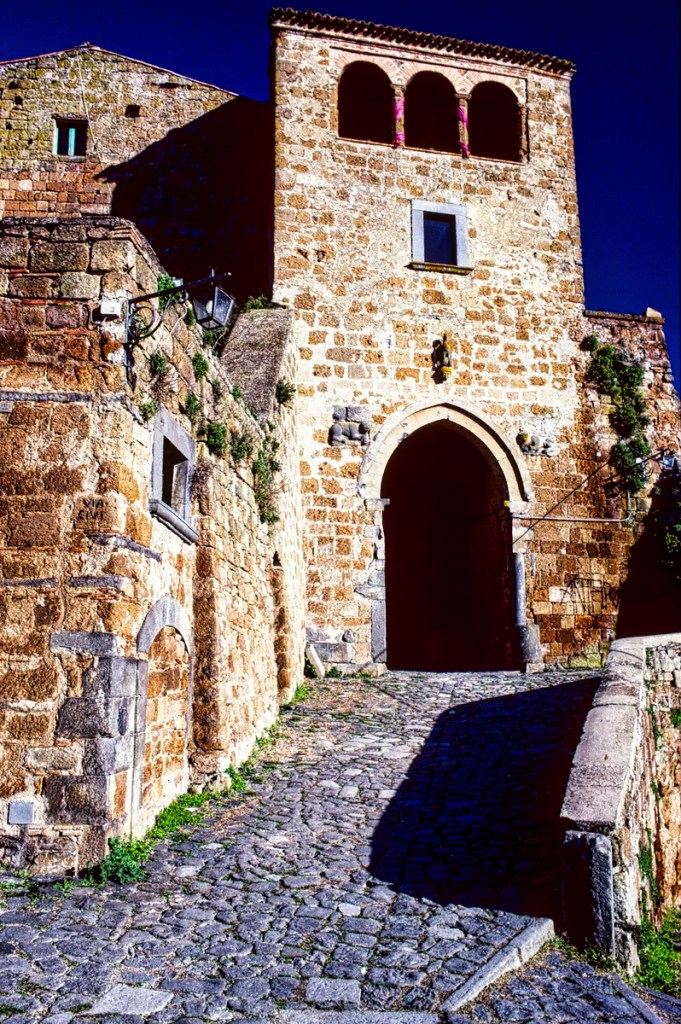
The gate Porta Santa Maria (G4.8) was dug out of the tuff stone wall in the times of the Etruscans. Tuff is volcanic rock. Then you enter a medieval world of narrow lanes. There is not much to see, but it was atmospheric.
Other Hill Towns
We would recommend that you focus on the primary itinerary, but there are many stunning hill towns to explore. The primary route takes you through Orvieto (famous white wine), 22 km, 0:32 hrs from Bagnoregio. You can also visit hill towns of Perugia (famous chocolate), Cortona, Urbino and Ceri.
Ceri
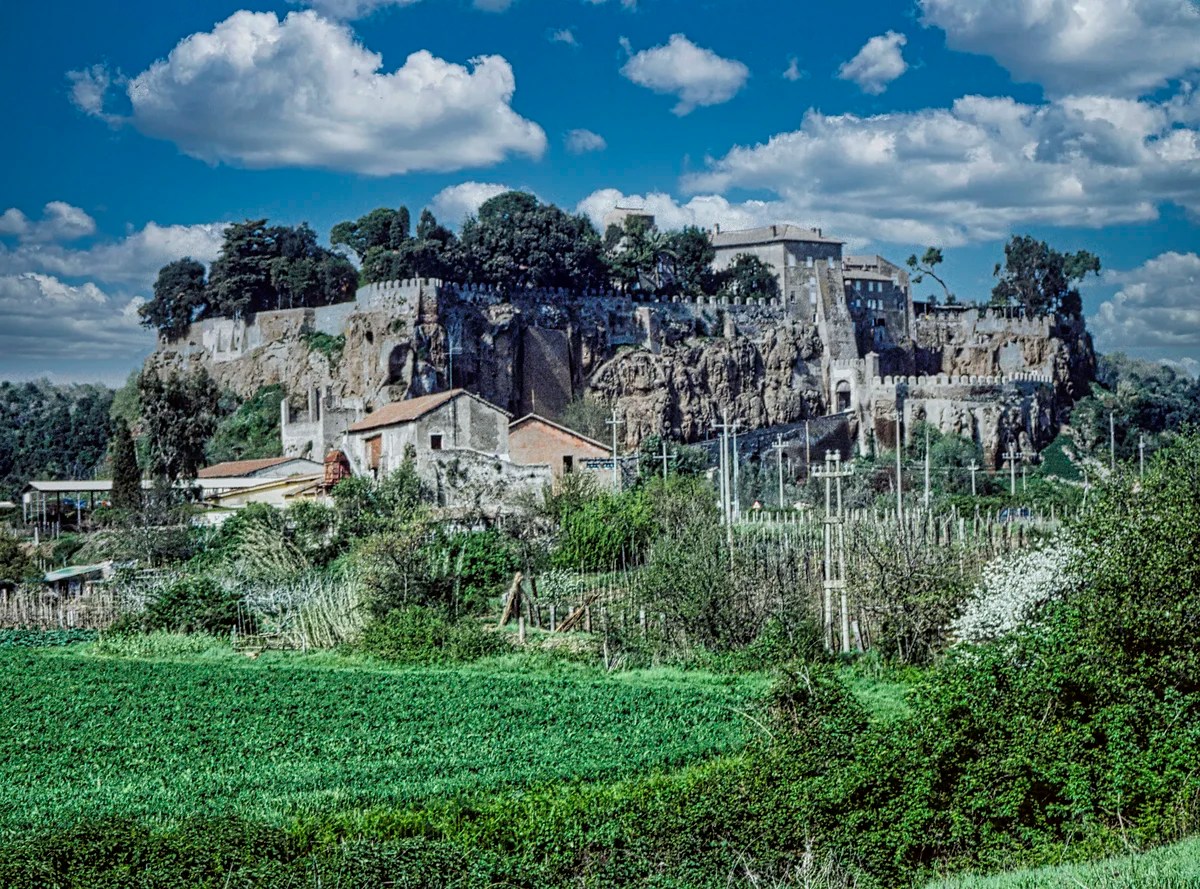
Ceri (G4.5) is only 42 km, 56 minutes northwest of Rome. The hill town was founded in 1236, but this area was settled since the 7th century BC by the Etruscans, who came here to worship Vesta, the goddess of the sacred fire. The cult of Vesta is the origin of the Vestal Virgins in the Roman Forum.
2. Festival Route Option
This alternate route requires driving 214 km, 2:47 hours northeast to Ascoli Piceno. If you leave early, you will have time for some quick stops.
Italy is a land of festivals. While there are many places to see, attending a festival is a unique experience. Some stops are only viable for specific dates of the year. Plan ahead.
Infiorata di Genzano di Roma
Travel: 41 km 0:55 h south of Rome, not included in Festival route
Art and style are quintessential traits of Italy throughout history. One example is Infiorata, a spring festival where streets are decorated with flowers. This can be seen at Noto (May), Bolsena (June), Spello (June) and Genzano (June).
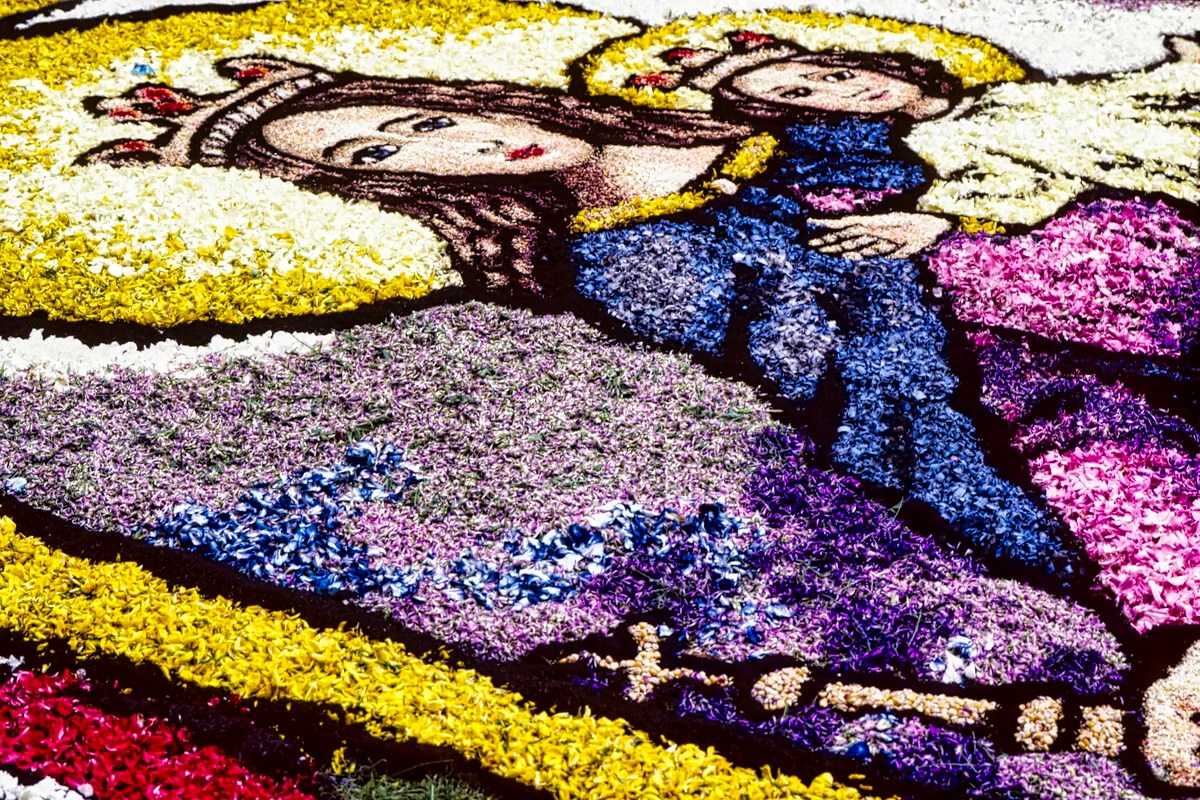
We loved the Infiorata di Genzano (G4.6), which dates back to the 18th century. A floral carpet is laid on the street to the Church of Saint Maria of Cima for the feast of Corpus Christi. But here is what is unique. It is not random flowers. It is a series of “paintings” made with flowers!
Quintana
Travel: 262 km, 4 hrs to Ascoli Piceno, including side trips
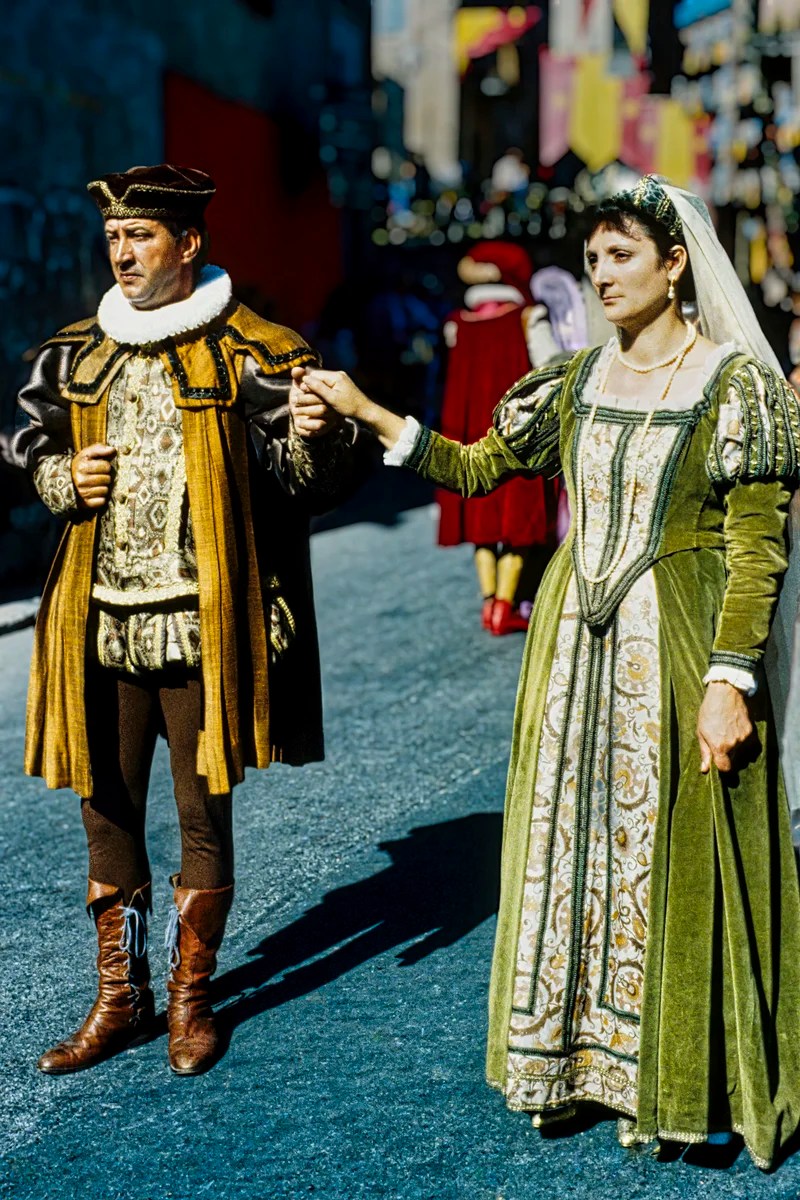
Who doesn’t like to dress up? One quintessential feature of Italy is the Quintana festival held in many towns throughout the country. A Quintana is a multi-day festival that originates from medieval jousting competitions.
Subiaco
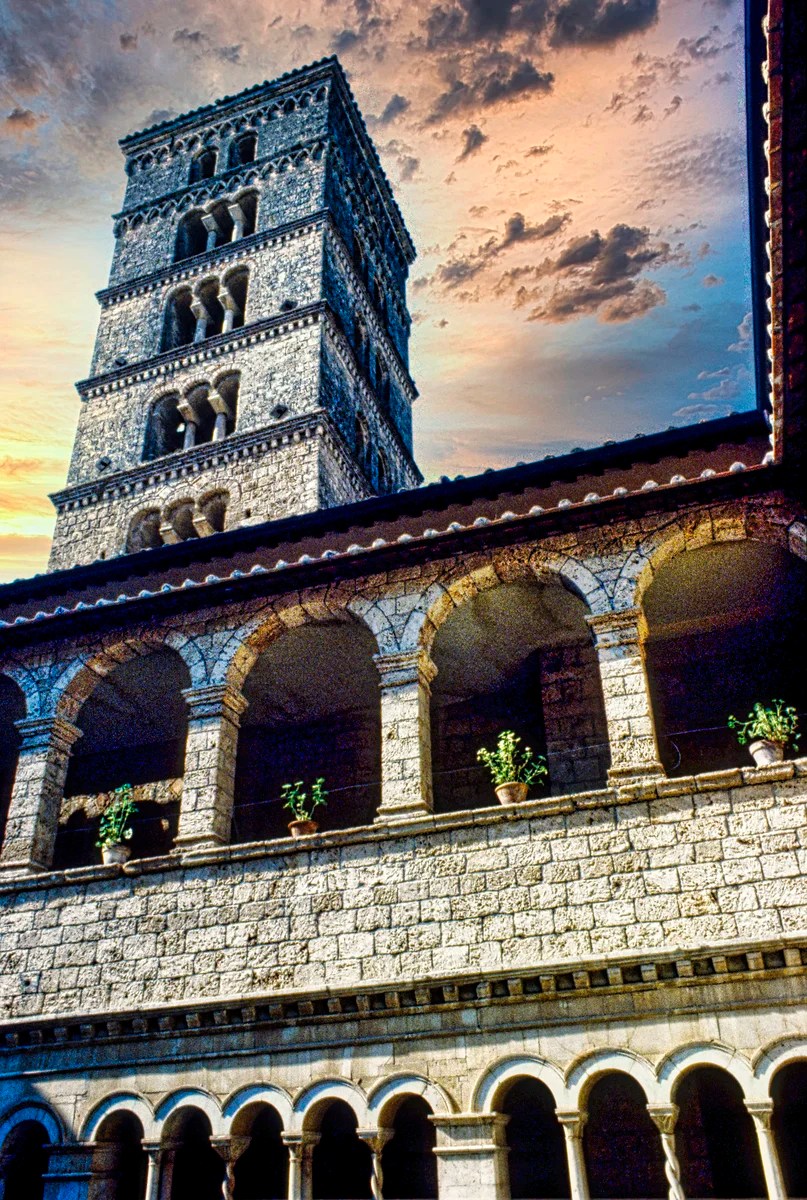
The first stop is just a fly-by to see the Monastery of St. Scolastica (G4.6). It has gorgeous Romanesque architecture.
Aquila
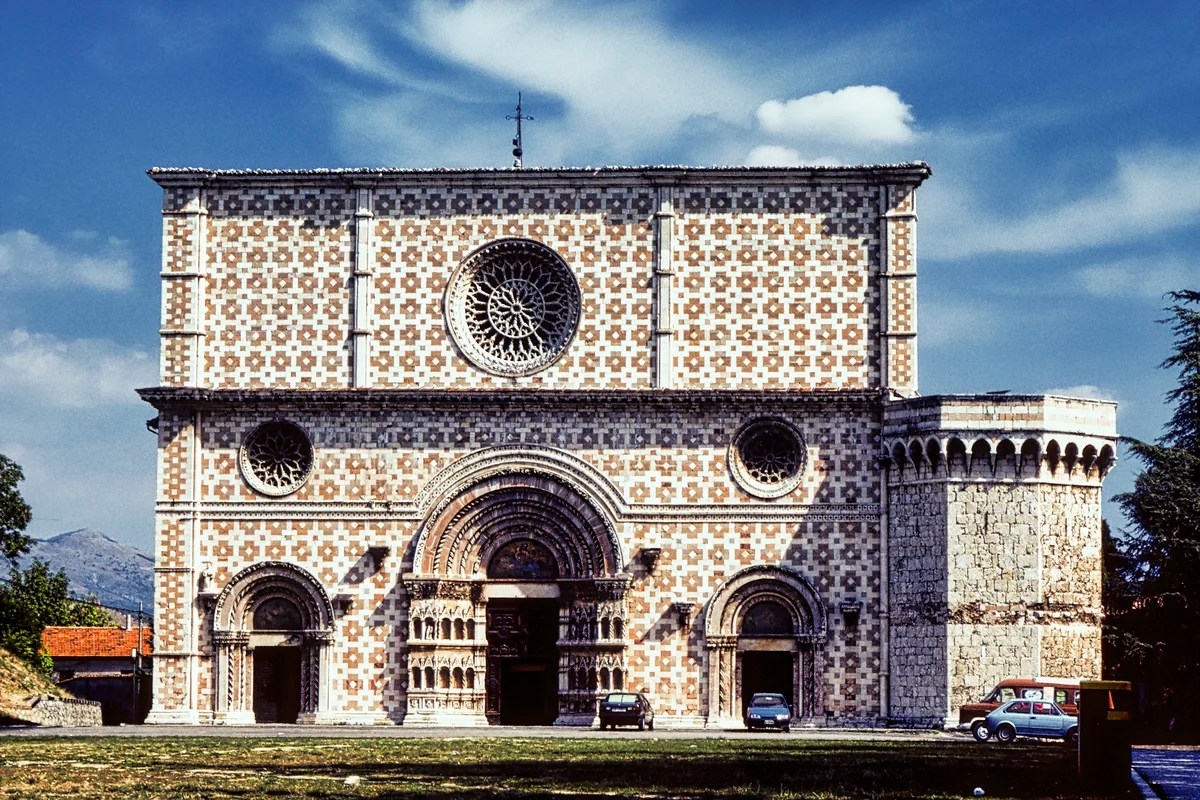
We liked the town of Aquila in the mountains, but the only photo I found was the Basilica di Santa Maria di Collemaggio (G4.8). It has a beautiful multi-coloured façade and is worth a stop. Next, you pass through the Gran Sasso Mountains.
Ascoli Piceno
We really enjoyed the Quintana in the medieval town of Ascoli Piceno (G4.7). It is held twice each summer: the second Saturday of July and the first Sunday of August. We were also able to position ourselves at a very good spot with unobstructed views.
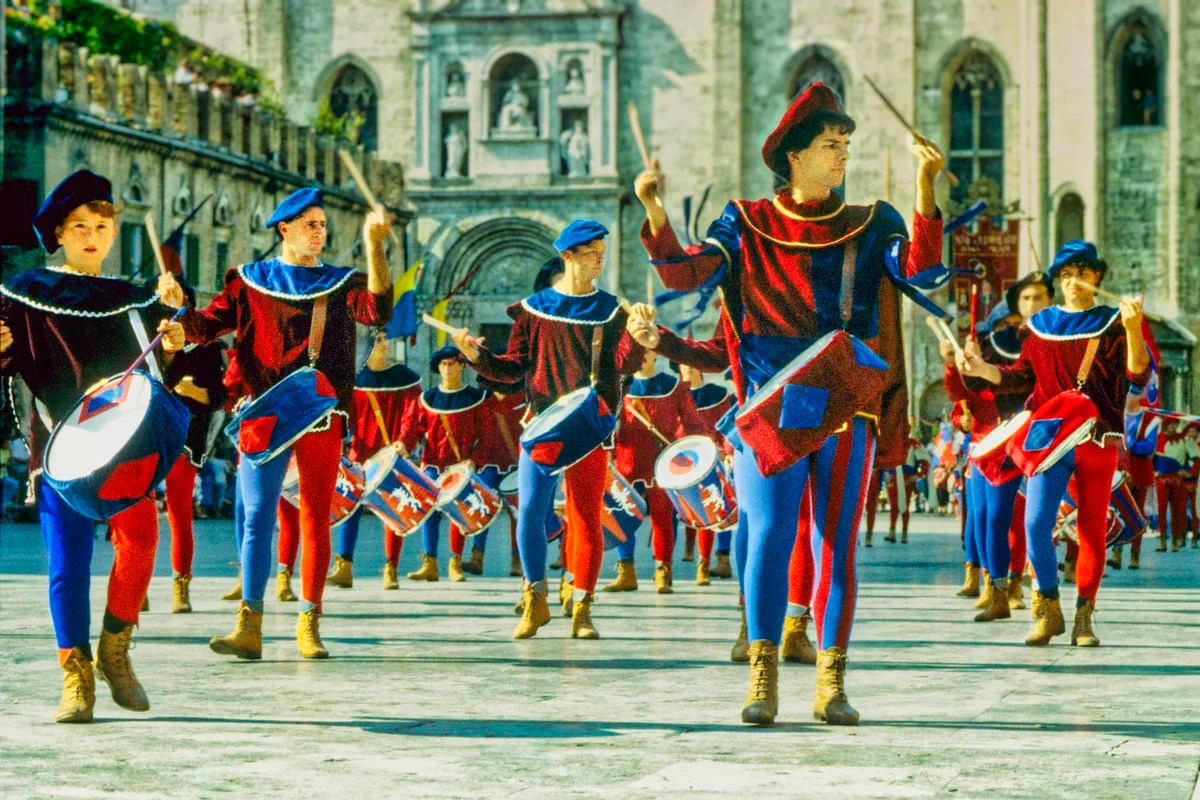
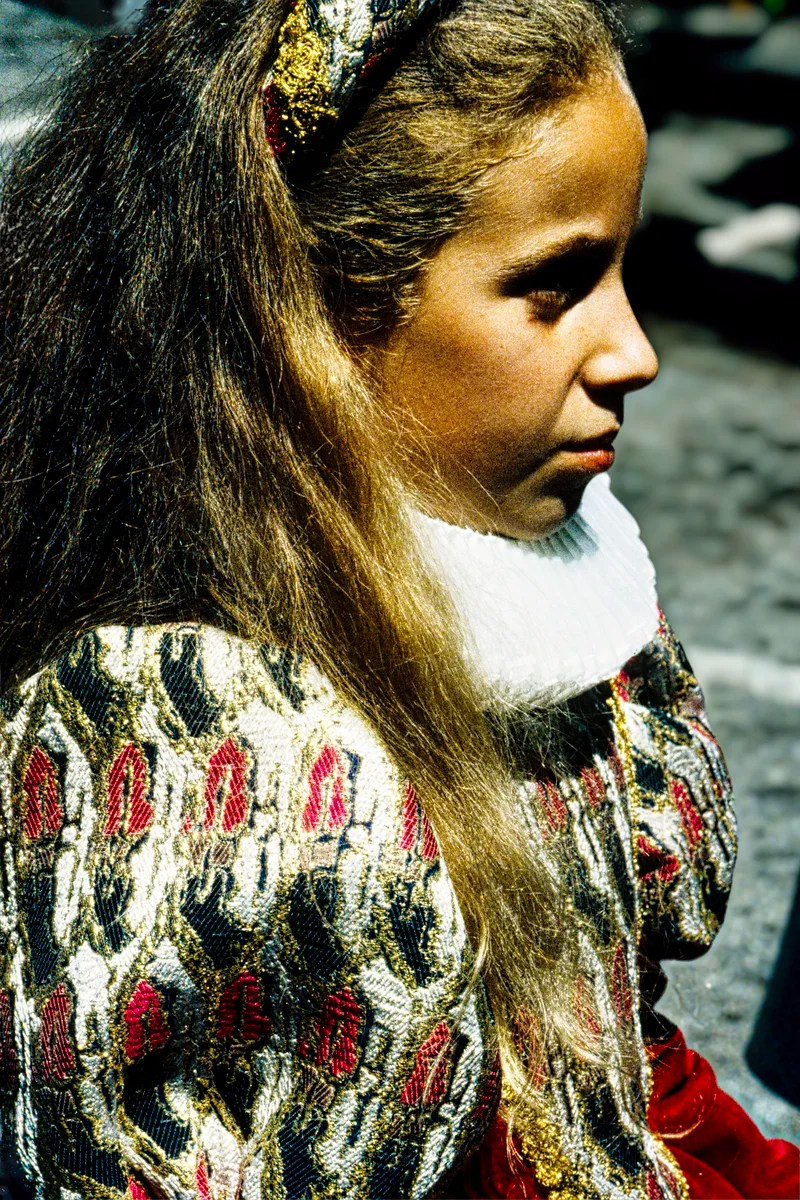
There are parades of nobles, archers, drummers, pages, and children in period costumes.
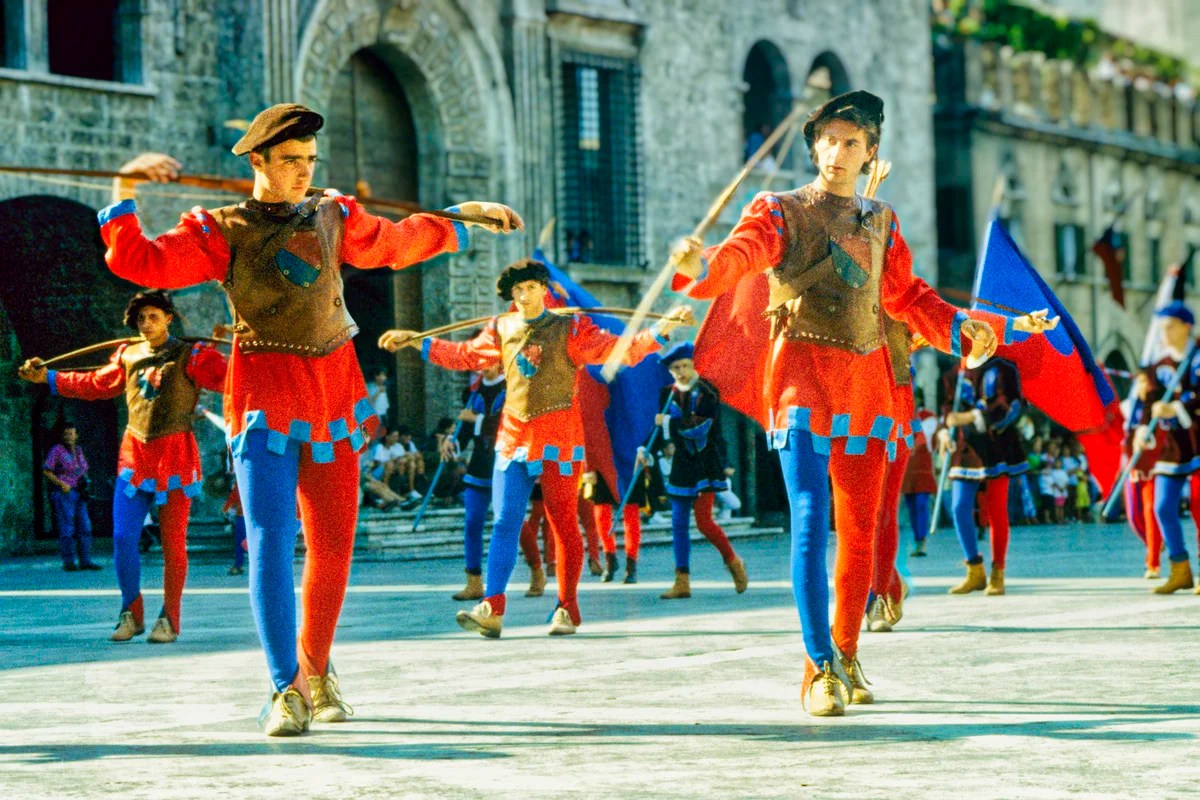
Many events have flag throwers. The art of flag-throwing dates back to medieval guilds. A guild’s banner or flag was considered a symbol of purity, and as such, it was not allowed to touch the ground. Flags were primarily used for wartime communications and directions for the troops. The flags were adorned with coats of arms that identified their town or dukedom. The flag tossing and transferring to their partners is so amazing, synchronized and graceful. The festival ends with archery and jousting competitions.
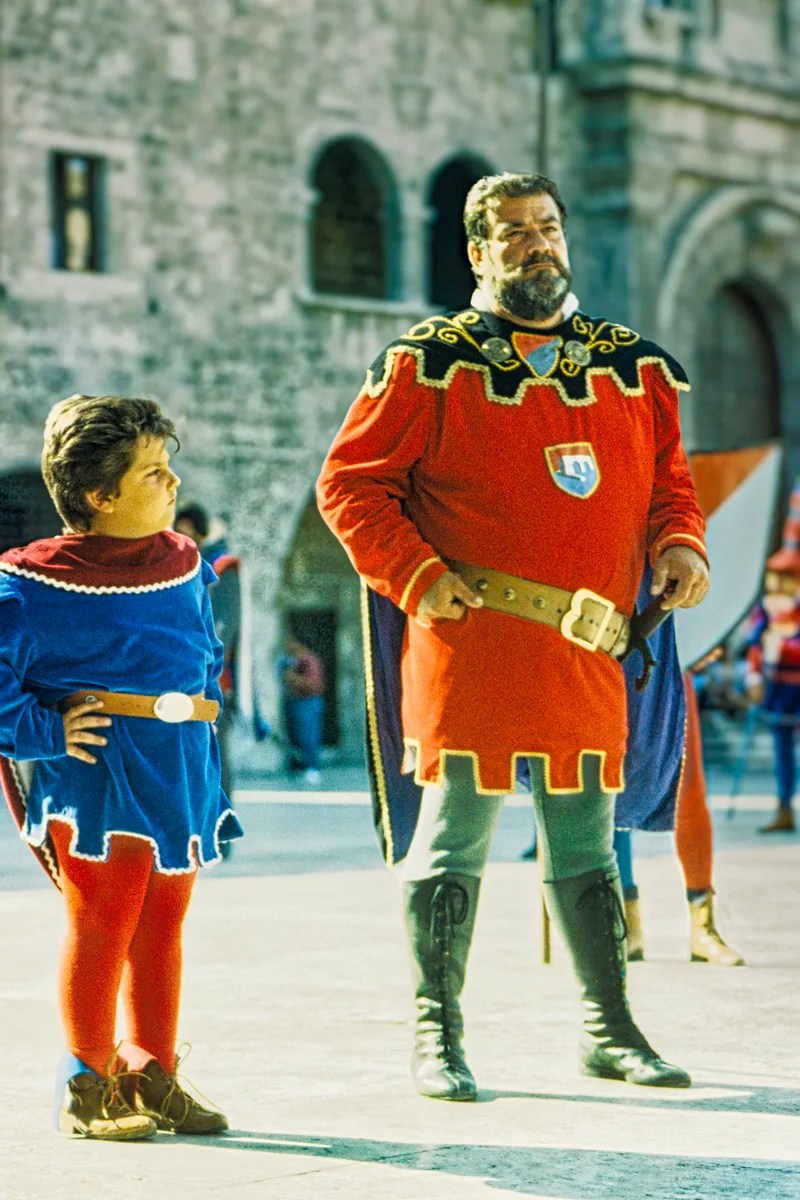
This festival dates to the Medieval Era — it was mentioned as far back as 1377.
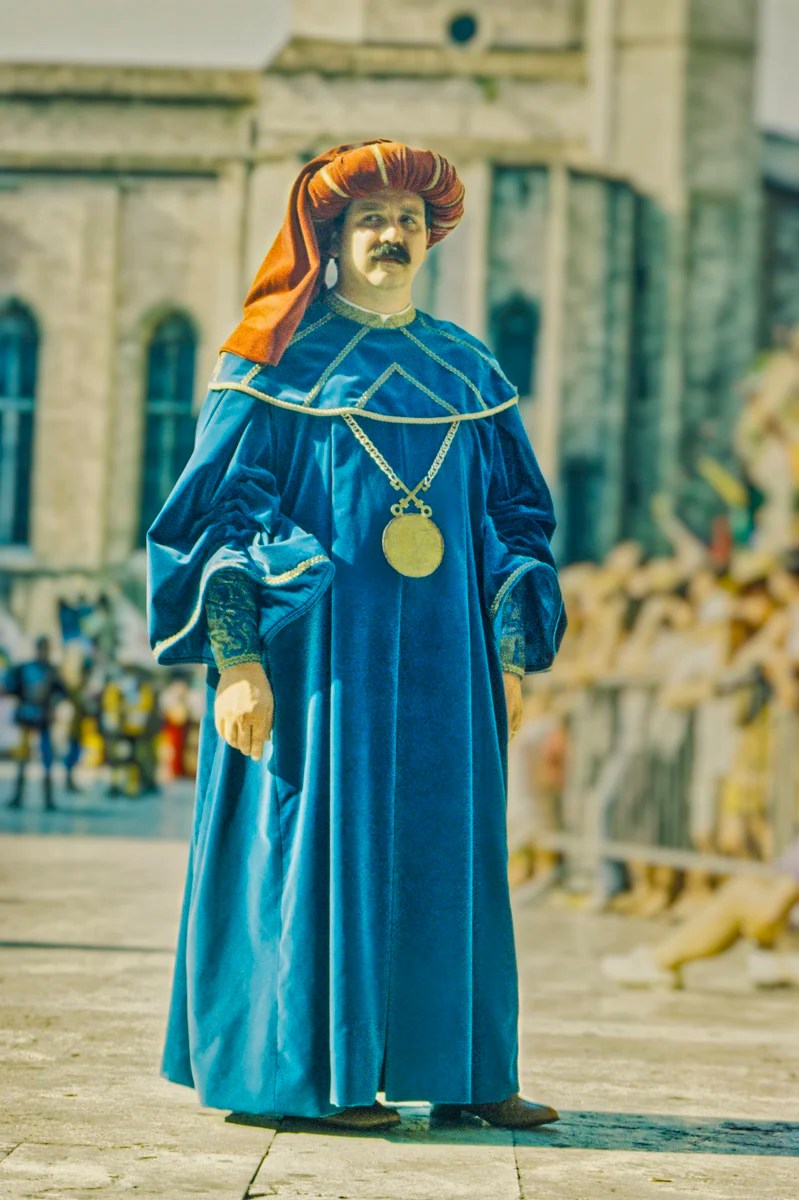
We watched the parade of elaborate, regal costumes that date to the 15th century (early Renaissance). I assume this blue-gowned man is a religious figure as he is wearing the Keys to St. Peter. My photos above were taken in the Piazza del Popolo, which was very atmospheric.
From Ascoli Piceno, you would then drive 258 km, 3:35 hours northwest to Siena. You can stop at the interesting hill town of Perugia.
Tuscany
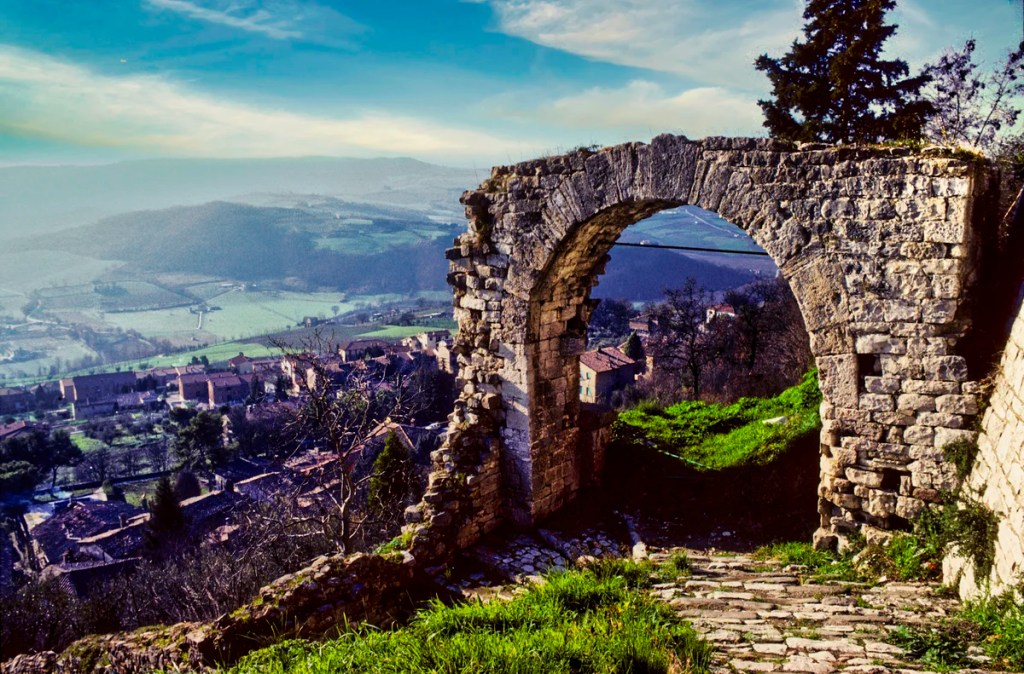
Are you looking for rolling hills with orchards and vineyards? Tuscany (Toscana in Italian) is the place to experience the Italian countryside. Why is Tuscany so important, not just to Italy but to the modern world?
Etruscans
The province of Tuscany was named after the Etruscans. Guess who gave us Chianti wine? Cities built on a grid plan? Sewage and drainage systems? Togas? The Latin character set? The arch?
The arch was one of the most important elements of “Roman”, i.e. Etruscan engineering and architecture. It enables tall buildings, aqueducts and bridges. The Etruscans originated the triumphal arch and the concept of marching victorious armies through them. Military tactics like the phalanx formation of troops were adopted by the Romans.
The Romans may have conquered Etruria (Tuscany) militarily, but the Etruscans conquered Rome culturally. Etruscan prisoners of war who fought to the death were the origin of the Roman gladiatorial games. The concept of demons was passed down to Christians. Yes, the Etruscans had an impact on both Roman and Christian religions. The Etruscans gave the Romans their version of the Greek pantheon.
The Temple of Vestal Virgins in Rome originated from the Etruscan worship of Vesta, goddess of the sacred fire. The high priest of the Temple of Vesta in the Roman Forum was called the Pontifex Maximus. But wait, isn’t that the title of the Pope?
The most significant towns in today’s Tuscany (Florence, Pisa, and Siena) were Etruscan. Rome was also founded by the Etruscans, whose territory stretched north almost to Venice. The earliest buildings in Ancient Rome were Etruscan, such as the Hippodrome (horse race course near the Roman Forum, as seen in the movie Ben Hur). In fact, one of the only three intact buildings of Ancient Rome, the Temple of Portunus, is Etruscan architecture.
Siena
Travel from Rome: 268 km 4:00 h; Florence: 85 km 1:15 h
Another quintessential aspect of Italy was the independent city-state of merchants and tradespeople that arose during the Medieval Era. This was history-making as the city state and the Black Death led to the fall of feudalism, the end of serfdom, the rise of paid labour, and the rise of capitalism. And it started in Italy, which was at the forefront of European history. Italy led the development of banking and finance, Renaissance art and architecture, science and naval technology.
You want to visit these city-states because all the buildings that are now tourist attractions were monuments to the wealth and power of these cities. In Siena, visit the Duomo and walk the narrow, flagstone streets Via di Citta and Via Banchi di Sopra.
Duomo di Siena
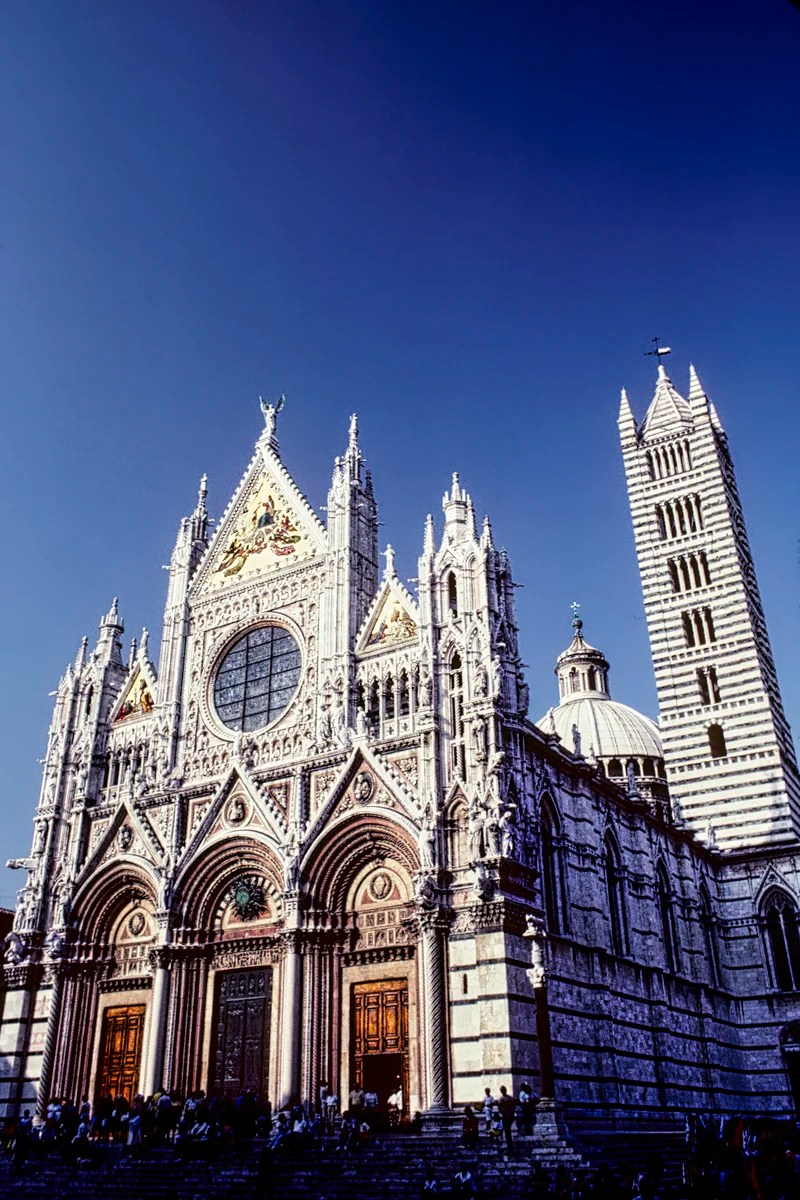
The first church was erected in the 9th century on the site of a temple serving the cult of Minerva. It was typical for Christian churches to be built on top of pagan temples as part of co-opting the heathens to Christianity.
Duomo di Siena (G4.8) is an Italian Gothic and Romanesque church completed in 1263. The church was supposed to be much larger. The project was cancelled due to the Black Death (1348), which killed 80% of Siena’s population.
The walls are constructed of white and greenish-black marble in alternating stripes, with some red marble on the façade. The Romanesque campanile (1313) has similar black-and-white stripes, symbolic colours of Siena.
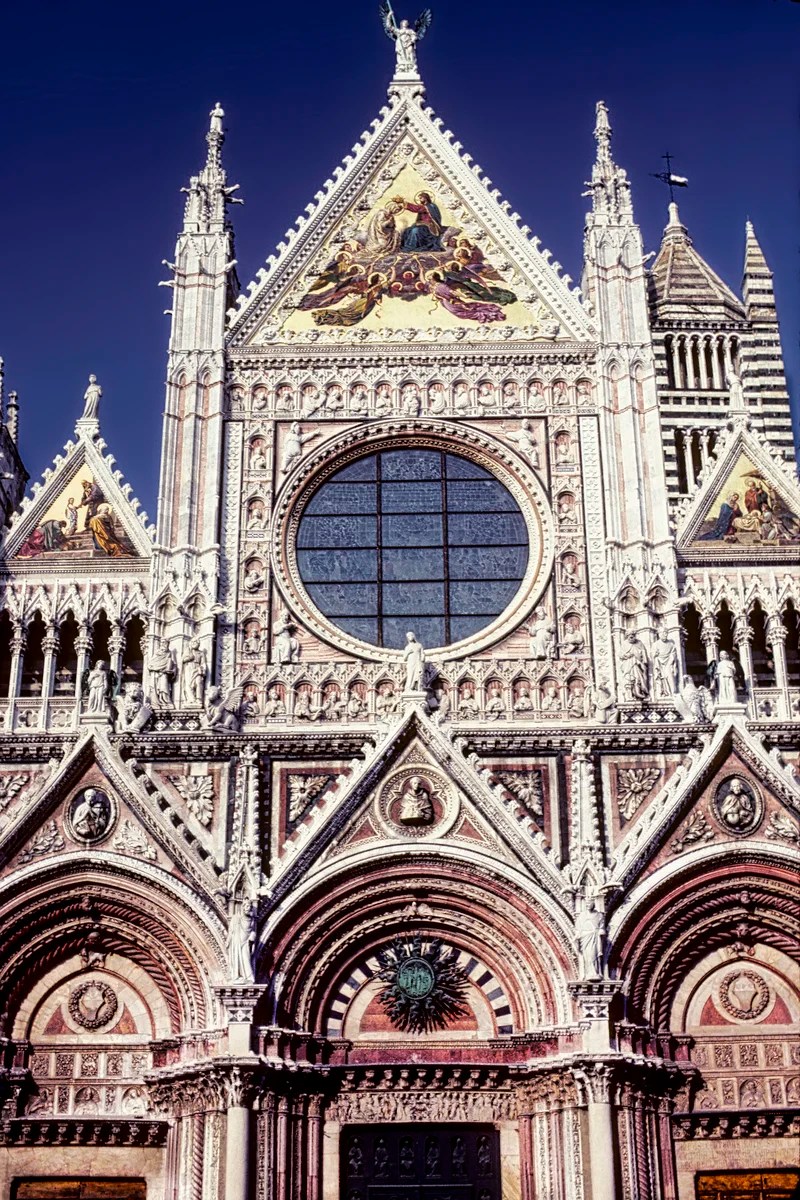
At the top of the church is a statue of Michael, the archangel warrior. All the statues on the façade, many designed by Giovanni Pisano, were replaced with replicas in the 1960s. The top pediment (triangle) contains the Coronation of Mary. That is a mosaic! Classical acanthus leaves decorate the columns. The most incredible art in the Church is its marble mosaic inlay and graffito floor.
Palio
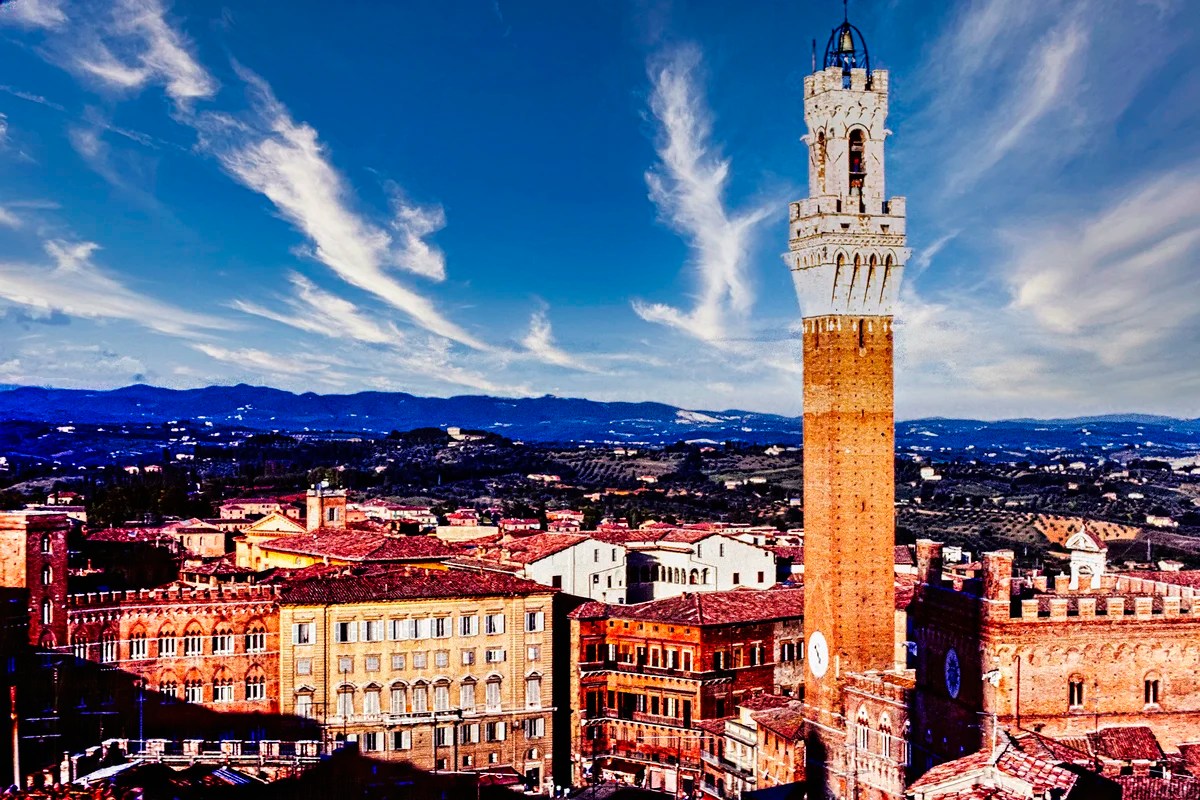
Siena was a major banking, trading, and military power. The major sources of revenue were money lending, silver, copper, and especially the salt monopoly. Siena was an independent republic from 1125 to 1555. With a population of about 50,000 people, it was one of the largest cities in Medieval Europe. In 1472, it founded the Monte dei Paschi, the oldest surviving bank in the world. The Palazzo Pubblico (town hall G4.7) — the shadow at the bottom of the photo below — was built to project the power of this city-state.
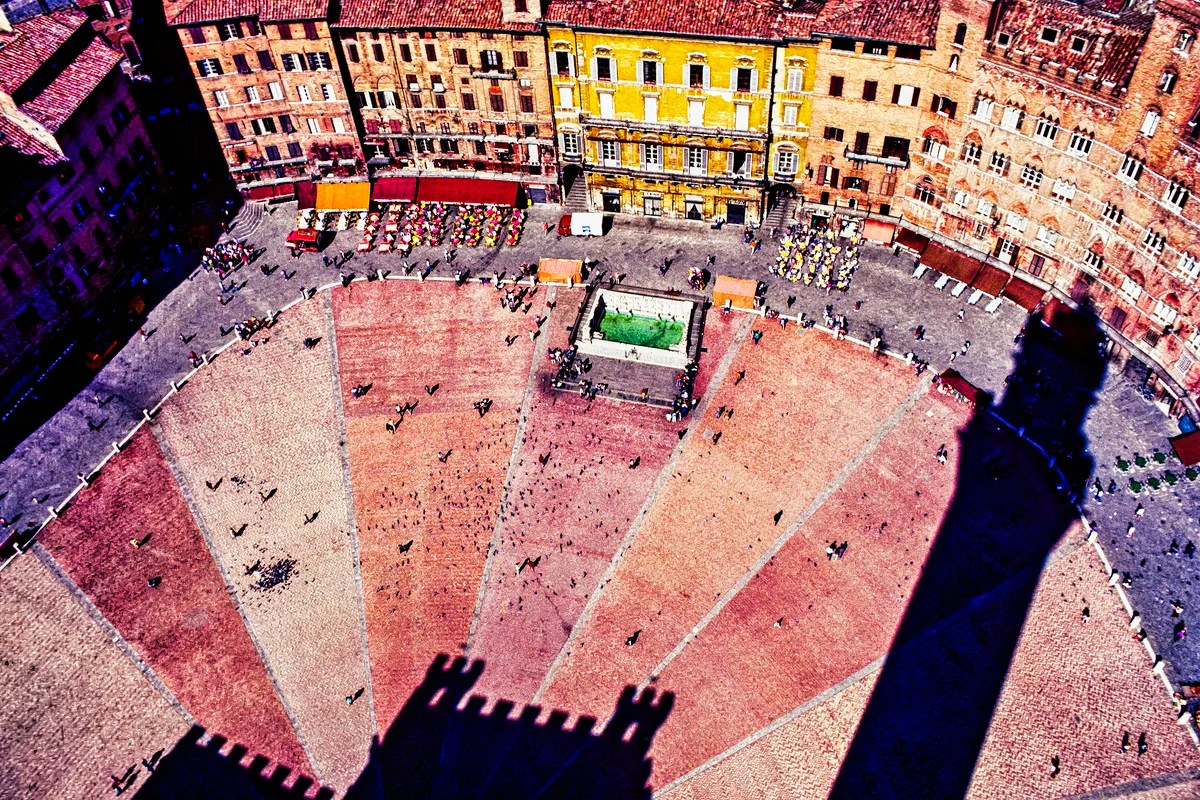
Siena has an incredible fan-shaped Piazza del Campo (G4.8) that hosts the Palio, a horse race held twice a year since 1590. The 90-second race around the piazza is a competition between 10 contrade, or neighbourhoods of the city.
The Ancient Romans and Greeks are descendants of the Proto-Indo-European tribes (PIE, formerly called Aryans) who were a horse-riding culture from the Caucasus. The PIE invented the chariot, and it was the primary war technology that enabled the PIE tribes to invade both India and Europe. Does this explain our fascination with horse racing today?
Torre del Mangia
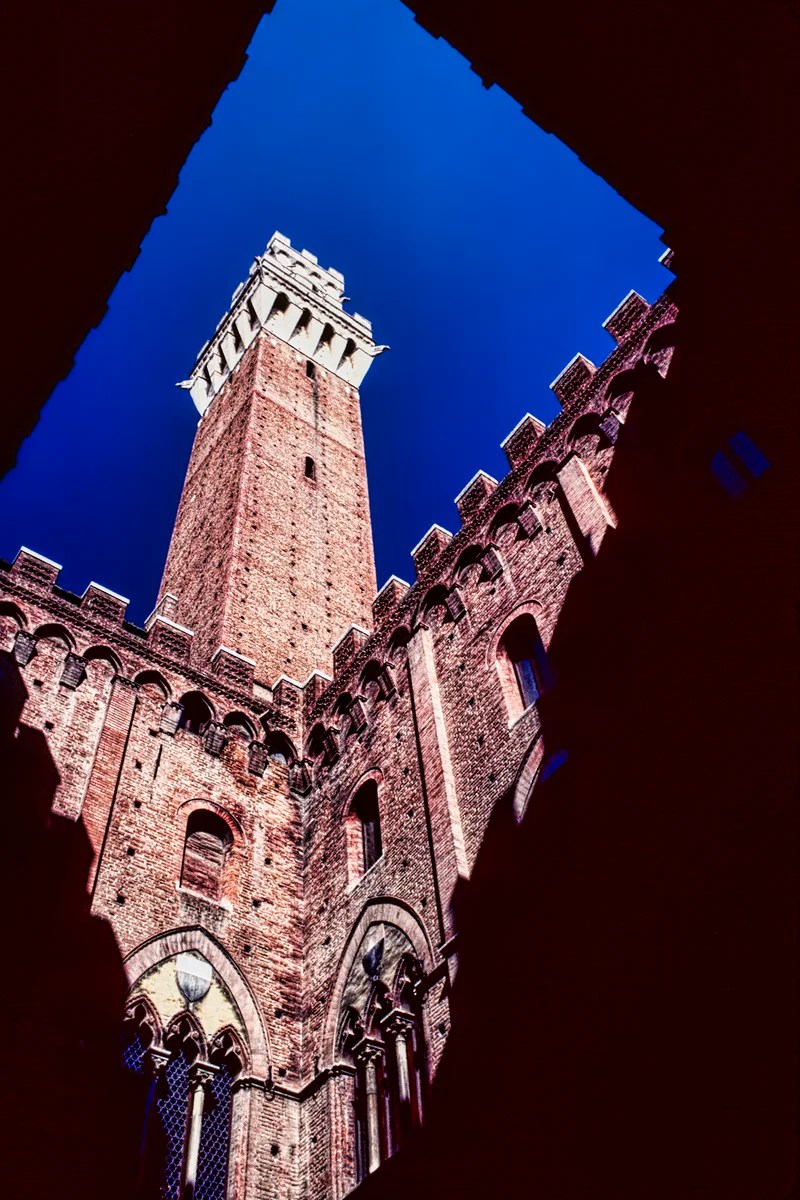
The campanile or bell tower, Torre del Mangia (G4.6), was completed in 1344. The tower was purposely built to be the tallest structure in medieval Italy. In other words, it had to be taller than the tower in their rival, Florence. This is the view from inside the Palazzo Pubblico.
The decline of Siena started with the Black Death of 1348. It often fought with its rival, Florence, and was finally conquered by the Medici family in 1555.
North of Siena is Chianti Country. We found a bodega in the capital of the Lega di Chianti that gave us great advice on the best Chianti to try. We like the Rocca delle Macie (94), Castello del Volpaia (92-93), and Isole e Olena (92).
San Gimignano
Travel from Siena: 54 km 0:50 hrs.
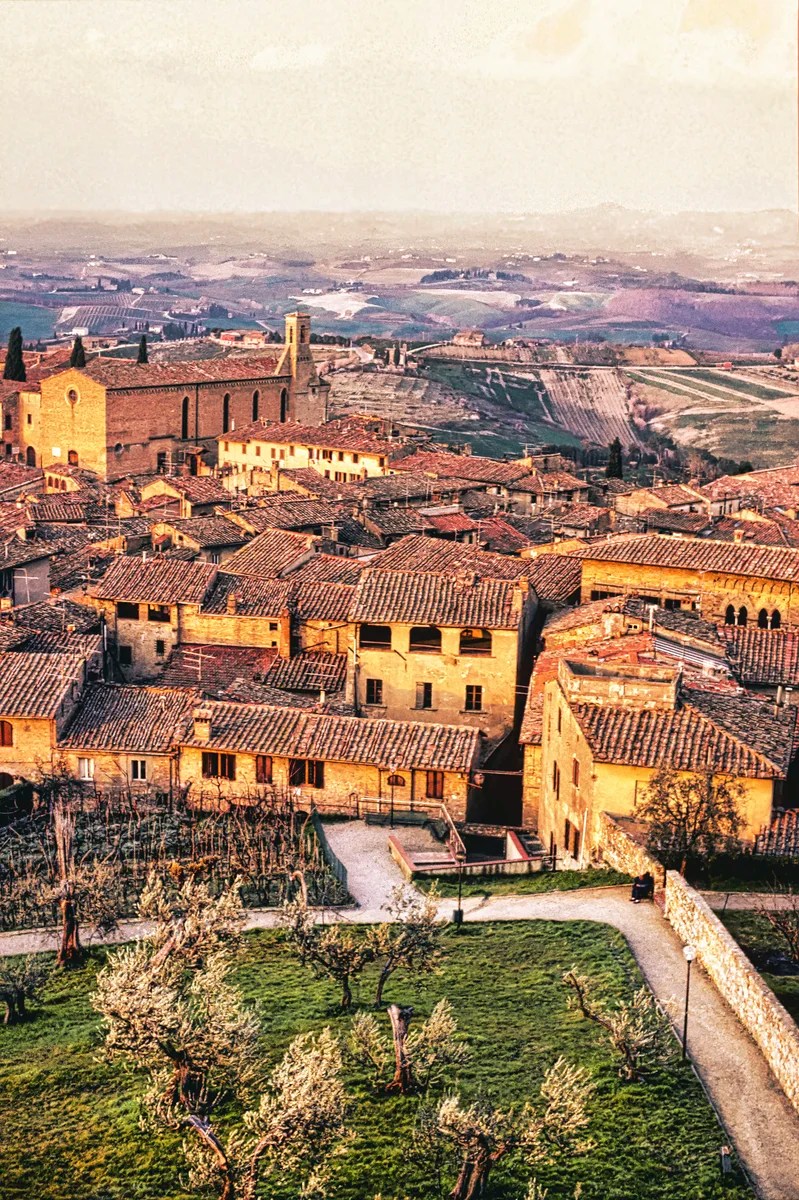
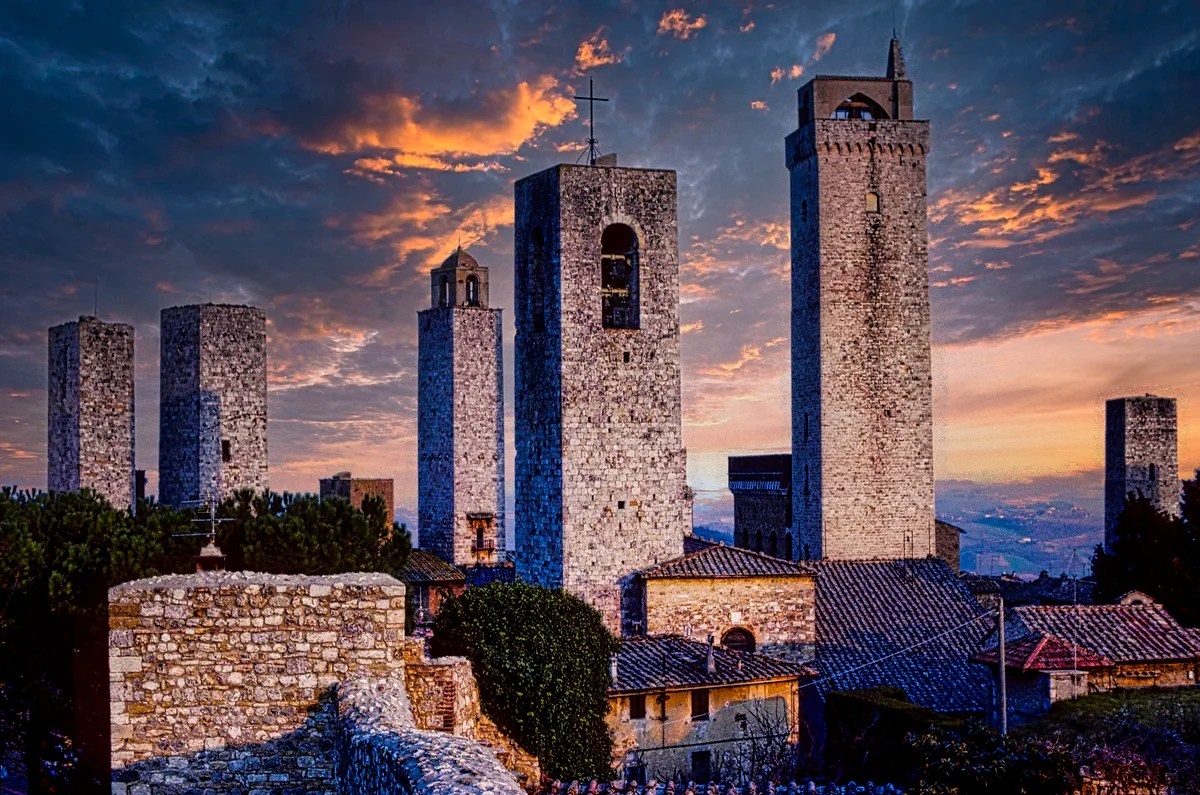
The small, quintessential medieval town of San Gimignano is surrounded by clay tile roofs, orchards and medieval walls. Leave your car in the parking lots outside the walls and enjoy the medieval atmosphere.
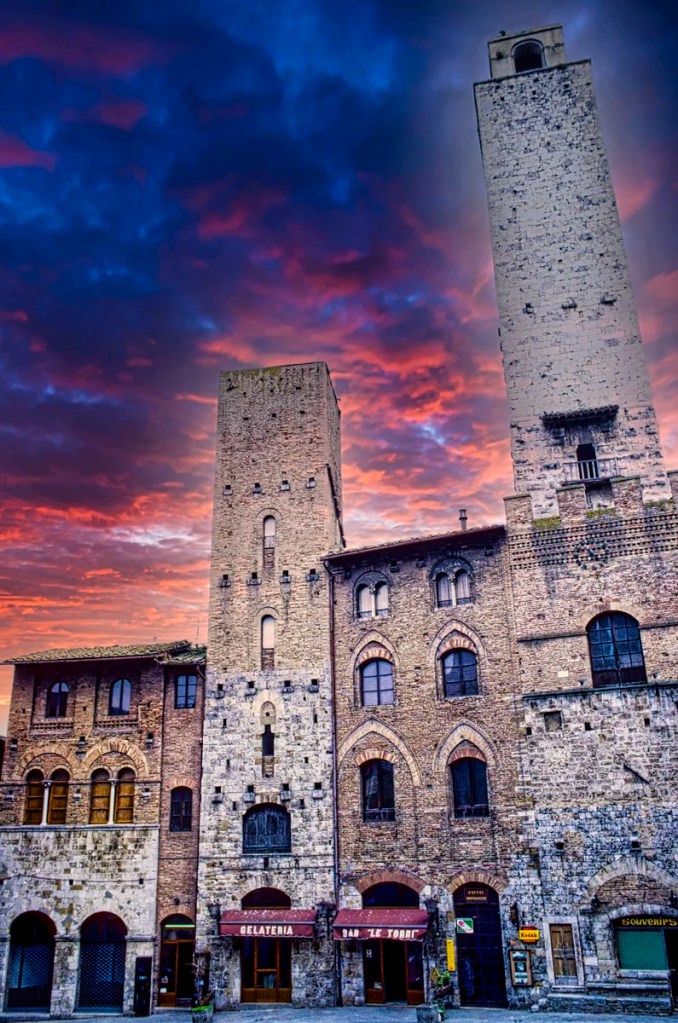
The key question for travellers is why are there so many towers? San Gimignano sat in a strategic location for trade between Pisa, Siena and Florence. Other sources of wealth were wine (Vernaccia) and saffron. The towers were the medieval way of showing off your family’s wealth and power. The taller Torre Rognosa (G4.6) was the tower of the municipal reeve. A law in 1255 prevented any tower from being built higher than this one.
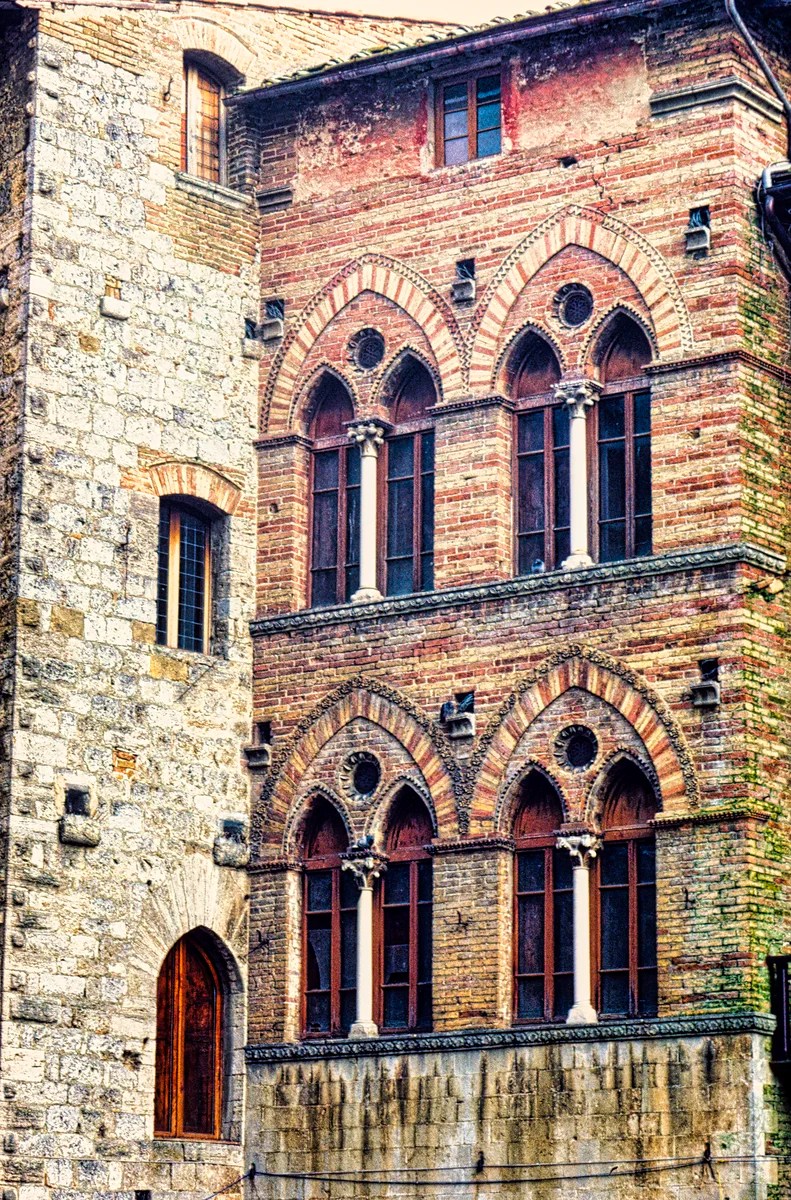
If you look closely, you will find many photogenic subjects. I liked the double row of elegant twin windows of Palazzo Tortoli. The ogival (pointed) arch is the defining element of Gothic architecture. However, note the intervening slender columns reminiscent of Romanesque Architecture. On the left is a truncated 12th century tower. This 14th century palace of intermingled stone and brick is now a B&B.
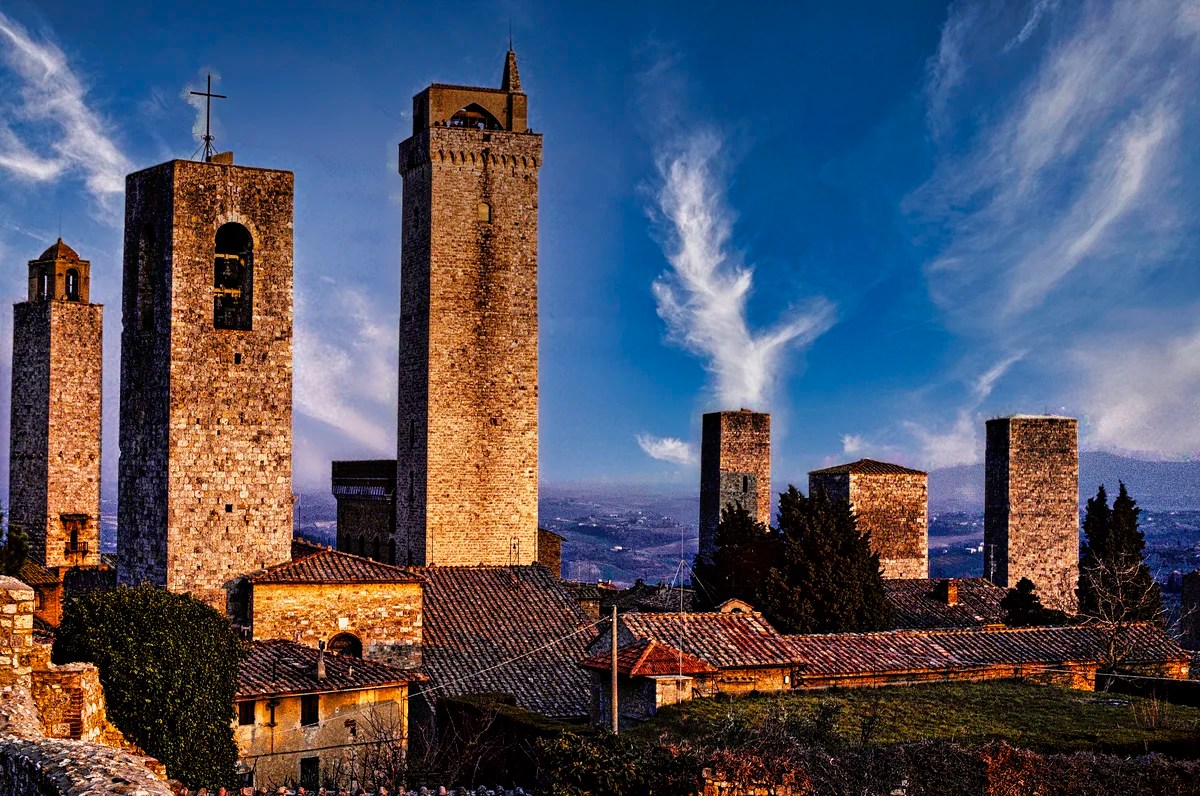
Our favourite site was Rocca di Montestaffoli (G4.6), where the view is filled with many towers. Originally, there were 72 towers in this town, but today only 14 remain! San Gimignano was the Medieval Manhattan!
Lucca and Area
Lucca is considered by many to be the most beautiful city in Tuscany, plus it is very small with a population of about 89,000. It may be worth staying in Lucca as a base for an exploration of Pisa and Villa Garzoni Gardens, as well as Lucca itself. Lucca is only 21 km, 29 minutes NE of Pisa.
Pisa
Travel from San Gimignano: 79 km 1:25 hrs.
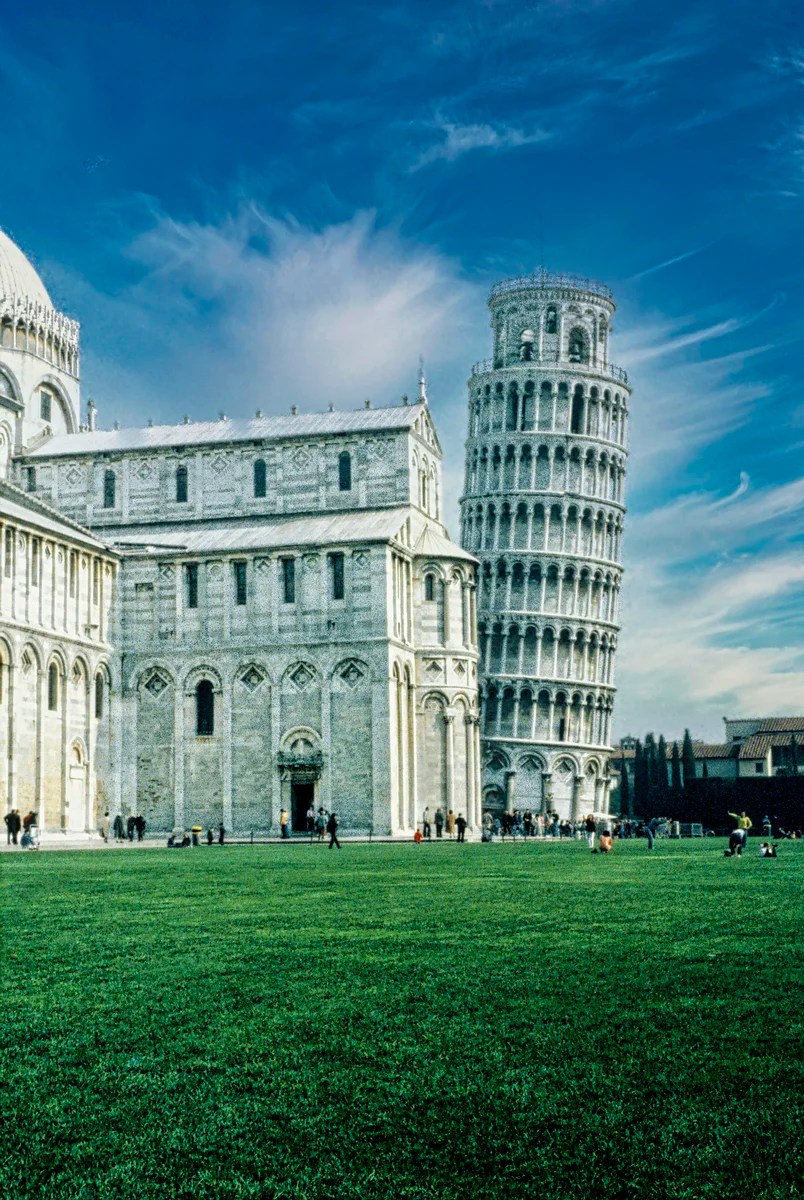
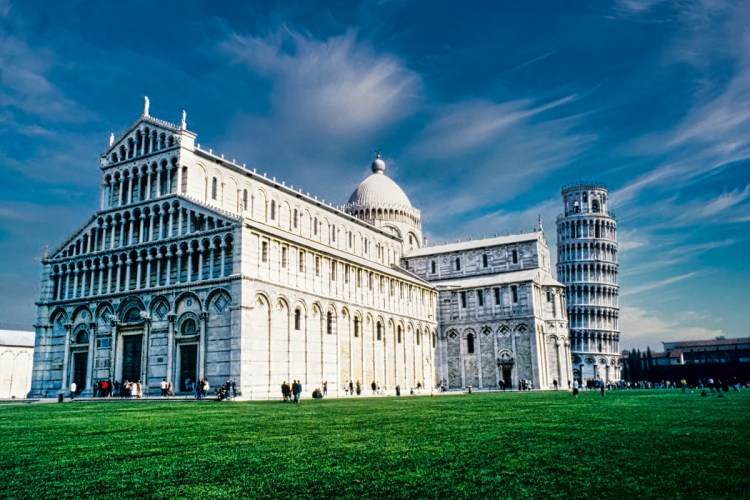
Pisa has the world-famous Leaning Tower (G4.7). It is not the only leaning tower in Italy. You can see the San Giorgio dei Greci Campanile in Venice. So why is the Leaning Tower of Pisa so special?
1. Work started in 1173, but it is not Gothic style at all. This tower is very beautiful because of its use of 207 marble columns and Romanesque arches. This style was based on the Roman Classical era.
2. The Leaning Tower is a Campanile or bell tower to a sumptuous cathedral, which is also worth a look.
3. Why did it take nearly 200 years to build? Pisa was often at war with nearby Florence, Genoa and other city-states.
4. Why did it start tilting only five years after construction began? It was built on a foundation of sand and clay, which was not ideal for a 56 m tower weighing 14 tons.
5. On the other hand, it survived four earthquakes. The same soil that caused the leaning cushioned the tower from tremors.
6. Galileo Galilei used it for his gravity experiments. Galileo dropped two cannonballs and found that the heavier one fell faster than the lighter one. Galileo was prosecuted by the Catholic Church for his belief in a heliocentric solar system.
Lucca
Originally, this city was founded by the Etruscans. It is worth visiting Lucca just for the two medieval churches below. However, it also offers the ability to walk in a car-less, walled medieval city. During the Renaissance, Lucca was the third largest Italian city-state (after Venice and Genoa). One of Lucca’s main exports was marble, and Carrara is nearby, should you wish to visit.
Chiesa di San Michele in Foro
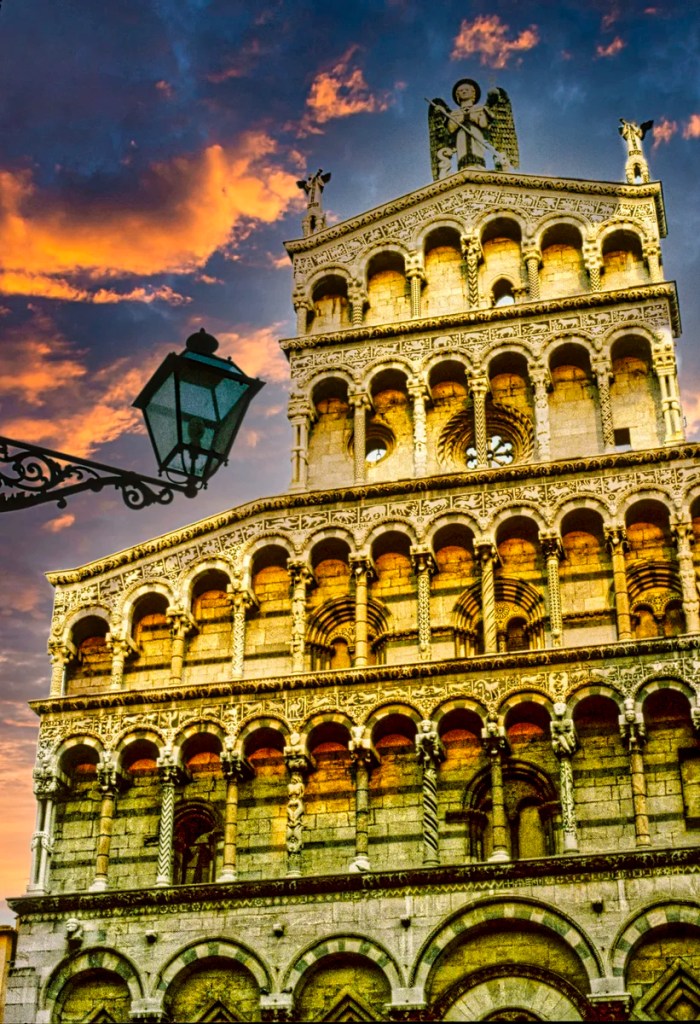
Chiesa di San Michele in Foro (G4.6) was built on top of an ancient Roman forum, which accounts for the “in foro” part of its name. Its elaborate façade from the 13th century has four levels of loggias with Romanesque arches. Every pillar is ornate and different. Some have intarsia, inlaid pieces of marble.
Duomo di San Martino (St Martin Cathedral)
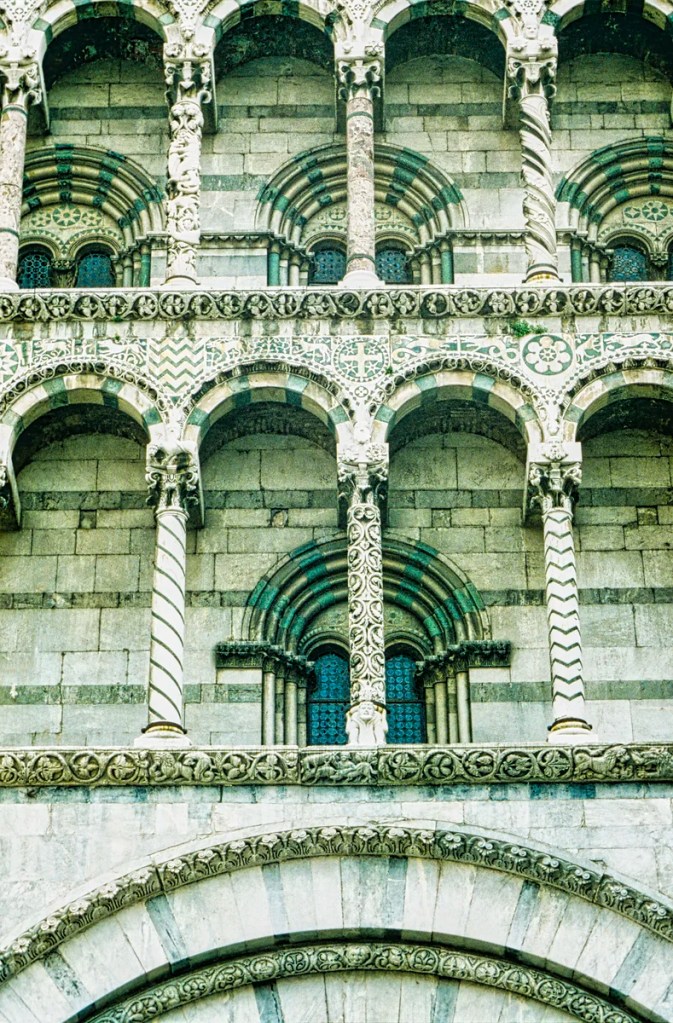
St Martin Cathedral (G4.6) was begun in 1063 by Bishop Anselm, who later became Pope Alexander II. The façade and portico with three large arches are made with pink, green and white marble. The magnificent Romanesque façade adorned with intricate carvings was begun in 1204. Why does every column have a different style? In 1233, Lucca held a competition to decide who would construct the columns. Instea,d they used all of the entries. Inside the church, the nave ceiling is decorated in gold and royal blue.
Giardino Garzoni (Villa Garzoni Gardens)

Villa Garzoni Garden (G4.0) is a botanical garden, open daily from March to October. The elaborate Italianate garden (1652) has geometric flower beds, a family emblem, and two circular pools with fountains. The garden then climbs up the hill, which is where I took the photo. It’s a combination of a Renaissance garden and a Baroque palace.
Cinque Terre
Travel from Lucca to La Spezia: 78 km 1:00 hr.
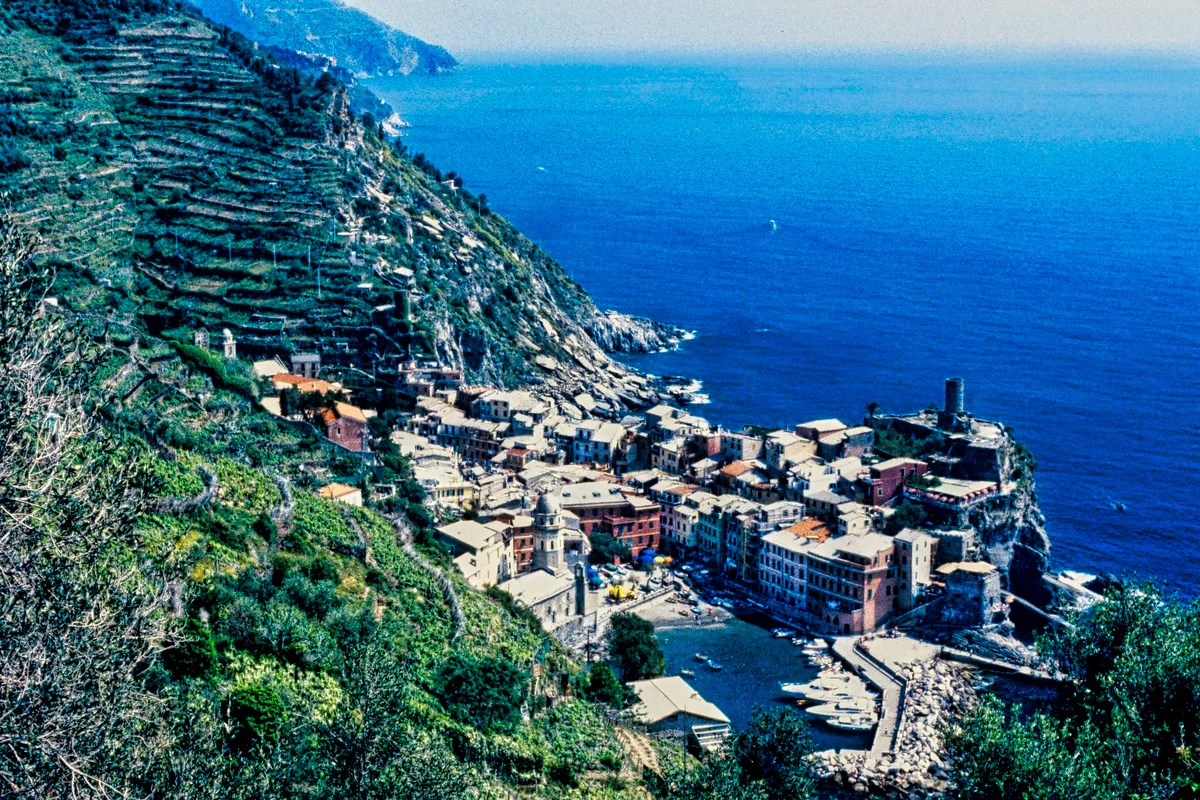
Cinque Terre (five lands G4.5) is a beautiful hike between small towns along the rugged shores of the Mediterranean. We parked in La Spezia and took the train to the furthest town, Monterosso, then hiked back. The towns are reachable only by hiking trail, boat or train. It’s also possible to just train from town to town.
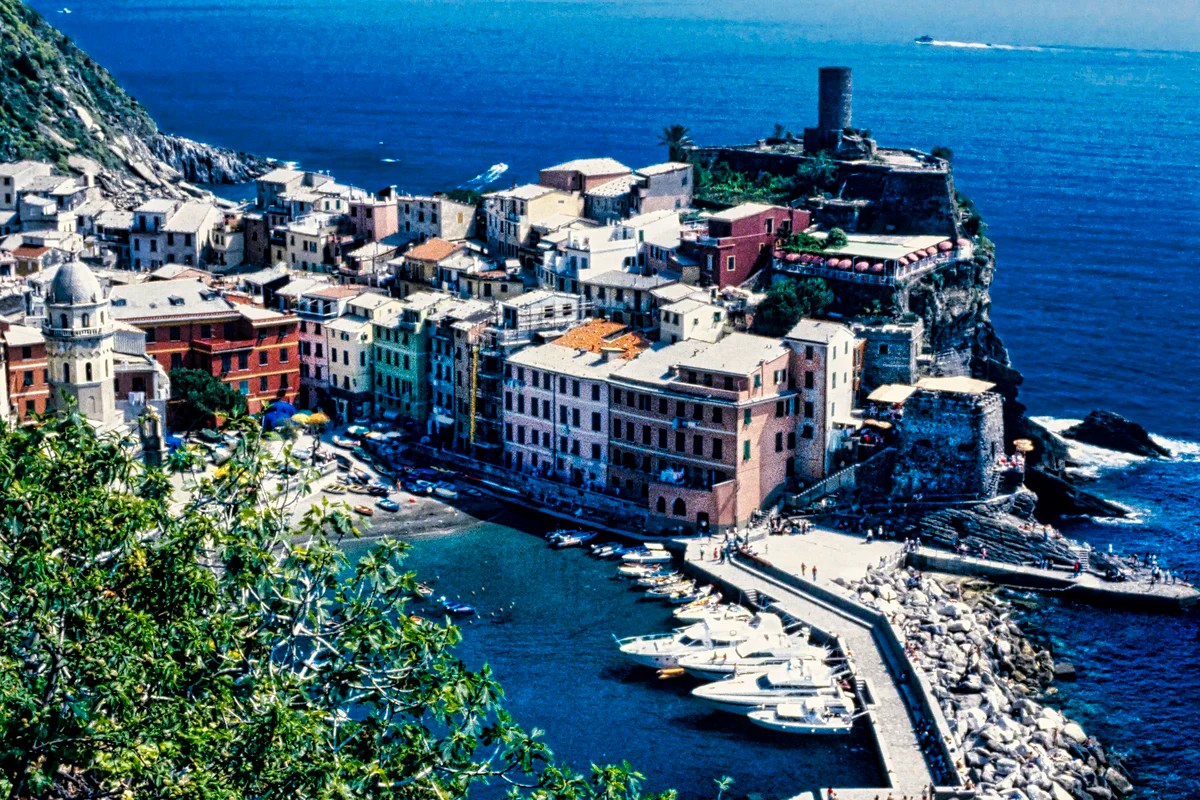
Our favourite villages were Vernazza and Manarola. Corniglia is the most preserved village of the five. We hiked this trail with our son in a baby backpack before it was discovered by mass tourism. We were all alone on the trail.
Verona Route
At this point, the primary itinerary heads to the beautiful and famous town of Verona.
Verona
Travel from La Spezia: 262 km 3:00 hrs. Travel to Venice: 120 km, 1:30 hrs.
Verona is a small city that is linked to Shakespeare’s Romeo and Juliet. Interestingly, I don’t seem to have a photo of Juliet’s house. With a population of 250,000, Verona is a charmingly compact and walkable city. It is also conveniently on the way to Venice.
Ponte Pietra
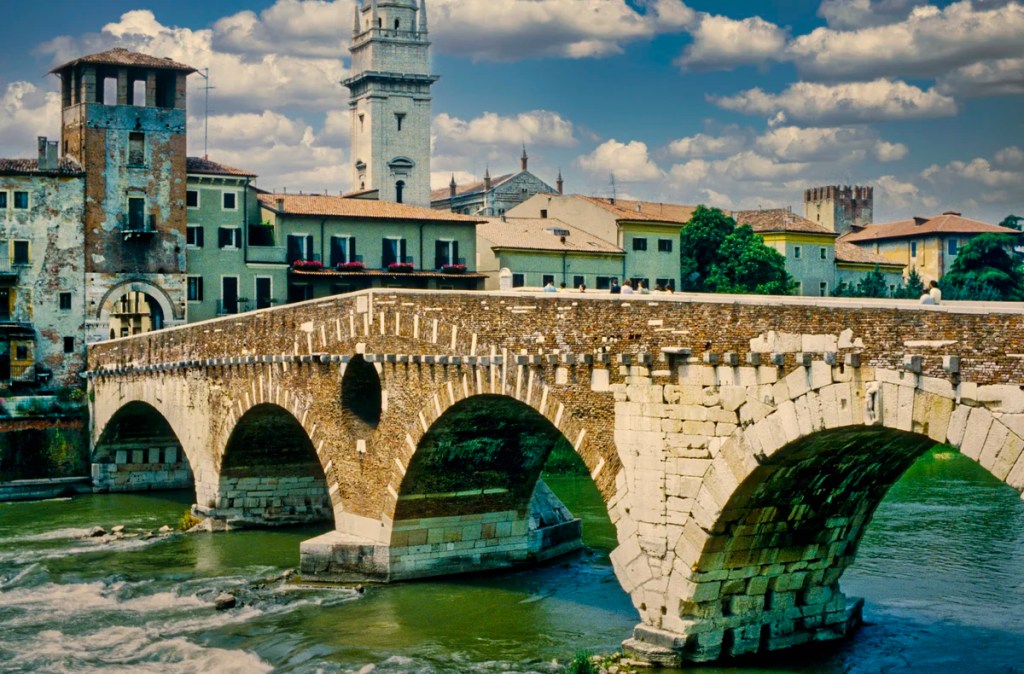
The photogenic Ponte Pietra (“Stone Bridge” G4.7) crosses the Adige River. The bridge was built by the Romans in 100 BC. Four of the five arches of the bridge were blown up by retreating German troops in World War II, but were rebuilt to the original design in 1957.
Case dei Mazzanti
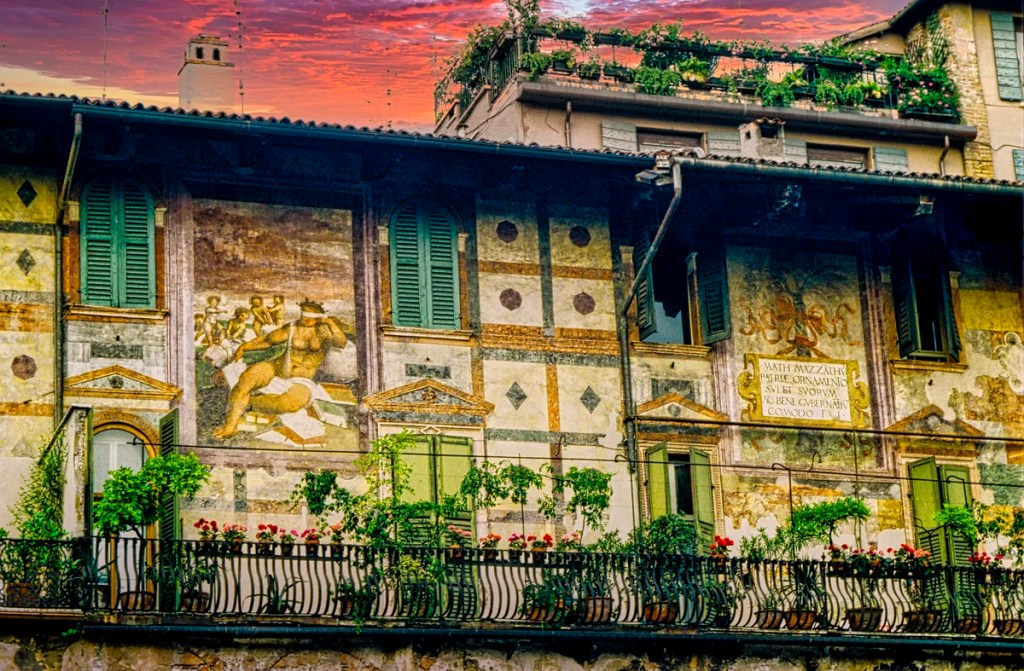
The quintessential sight of Verona is Piazza delle Erbe (G4.7). The central piazza of today used to be the site of the Forum. Roman era buildings became ruins thanks to an earthquake in 1117.
What I really liked were the Case dei Mazzanti (Mazzanti Houses G4.5) on the northeast side. These houses date from 1511 and are entirely covered by colourful frescoes. Exterior frescoes became a defining element of Verona architecture. In fact, Verona used to be known as the “painted city”.
Loggia del Consiglio
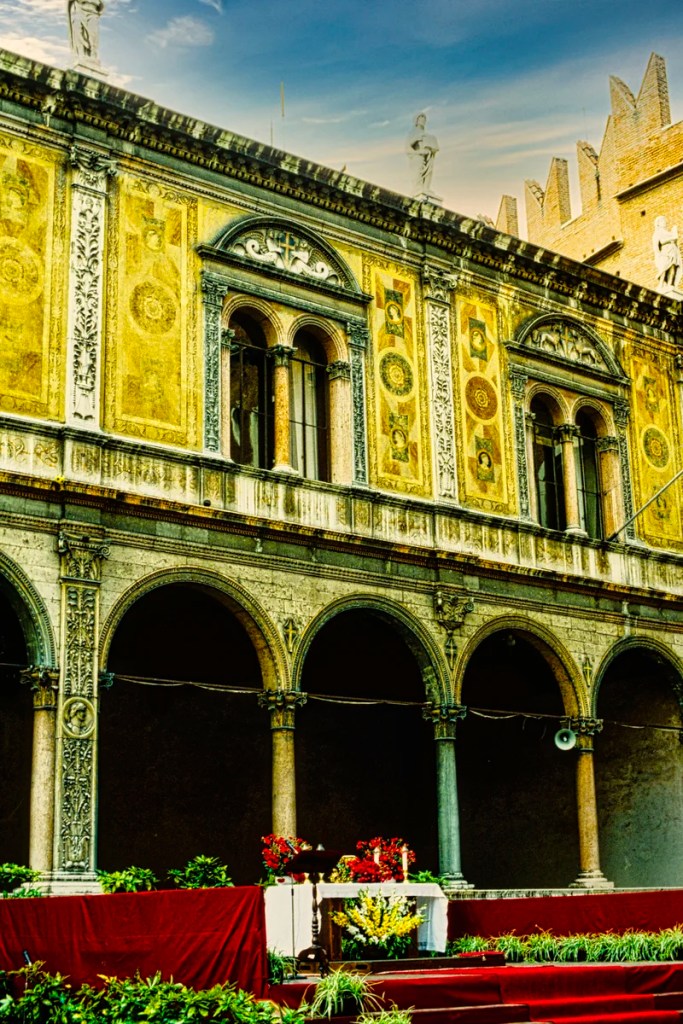
The Municipality of Verona constructed this Renaissance building in 1493 to host its Council. The Loggia del Consiglio (G4.6) is covered in beautiful frescoes and crowned with the statues of the five most famous Veronese of antiquity. There are only two names I will mention as they are important not just for Ancient Rome but for world history.
Vitruvius
Vitruvius was a Roman architect and author of De architectura, which detailed how Ancient Rome built its temples, basilicas and domes. It was rediscovered in 1414 by Florentine scholar Bracciolini in the library of Saint Gallen Abbey, Switzerland. This book helped Filippo Brunelleschi, the father of Renaissance architecture, build the Duomo in Florence.
Pliny the Elder
Pliny the Elder was a Roman author, naturalist, philosopher, and naval and army commander of Ancient Rome. He led the naval rescue during the eruption of Vesuvius in AD 79. Pliny died from asphyxiation caused by the toxic gases when he tried to rescue a friend. Ancient Romans did not know what a volcano was and did not even have the word volcano in their vocabulary! People did not know that one of the main causes of death from volcanoes is the toxic gas.
Ravenna Route Option
Alternatively, from La Spezia, one could head to Venice via Ferrara and Ravenna.
Ferrara
Travel from La Spezia: 256 km 3:00 hrs.
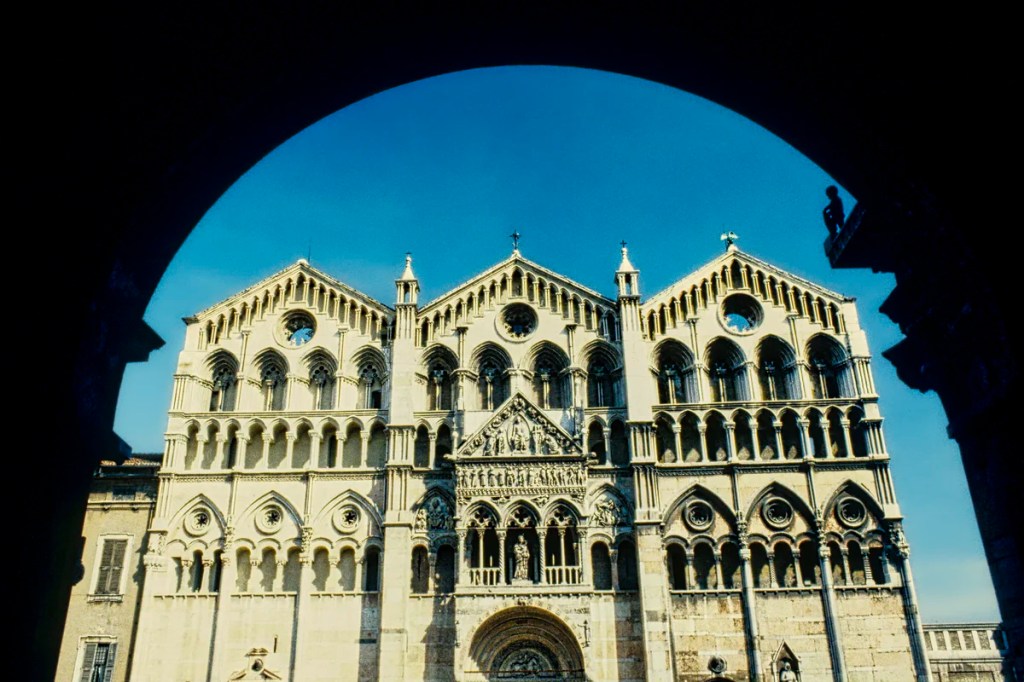
Ferrara has an incredible Cathedral (G4.5) with ornate decoration. The Duomo di Ferrara began 1135. The Romanesque design is most visible in the central loggia with numerous bas-reliefs. A lunette shows Saint George, patron saint of Ferrara, slaying the dragon.
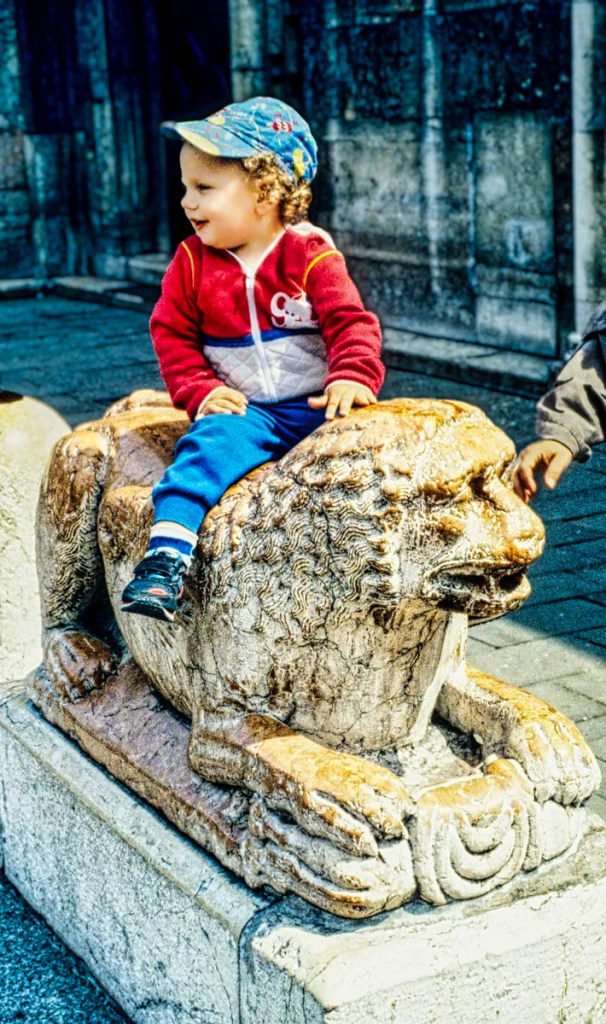
Our two-year-old son was not too impressed with the Romanesque architecture, but he did enjoy the stone lions guarding the portal.
Ravenna
Travel from Ferrara: 76 km 1:10 hr.
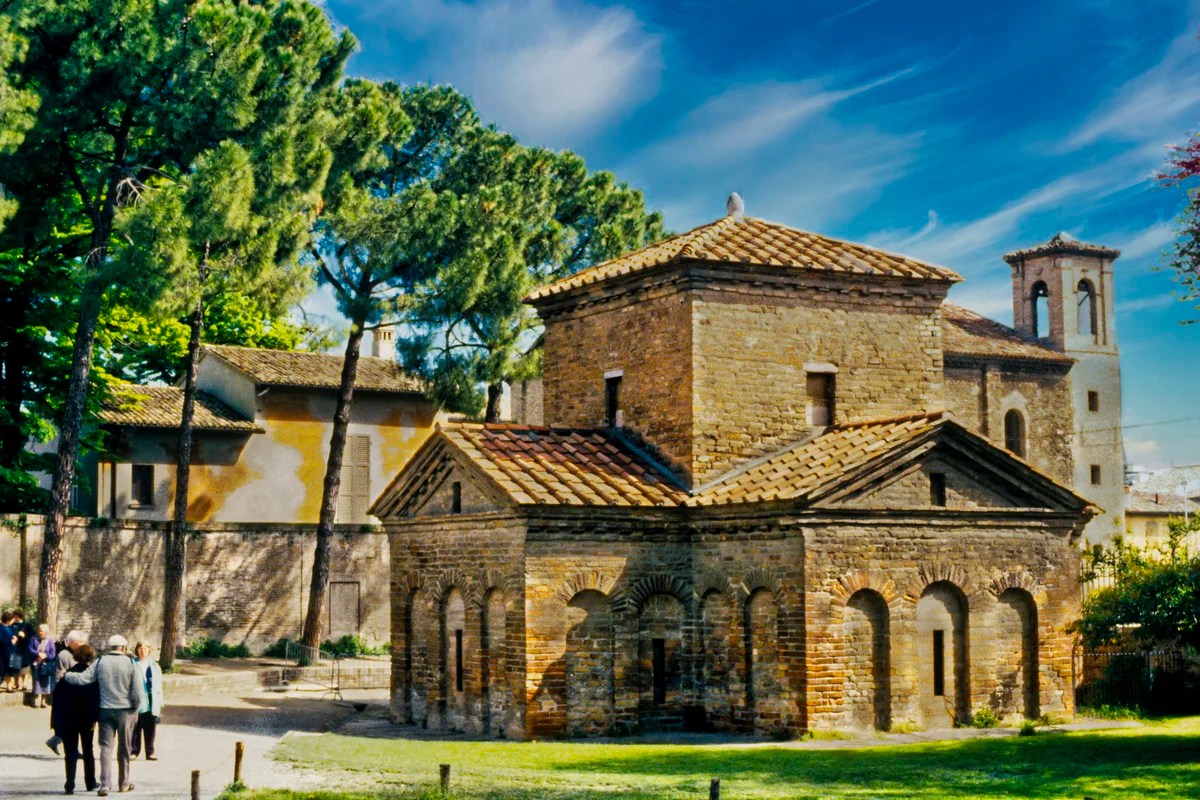
After the Fall of Rome the city in 476, Italy was ruled by the Ostrogoths, who established their capital in Ravenna. By 540, Constantinople retook part of Italy from the Ostrogoths and the province of Africa from the Vandals. Italy had been devastated and depopulated, so the capital of the Eastern Roman Empire stayed in Ravenna.
Constantinople did not last long in Italy. Venice declared itself a republic in 697. The Germanic Lombards conquered Ravenna in 751, creating a kingdom controlling most of Northern Italy except for Venice.
Mausoleo di Galla Placidia
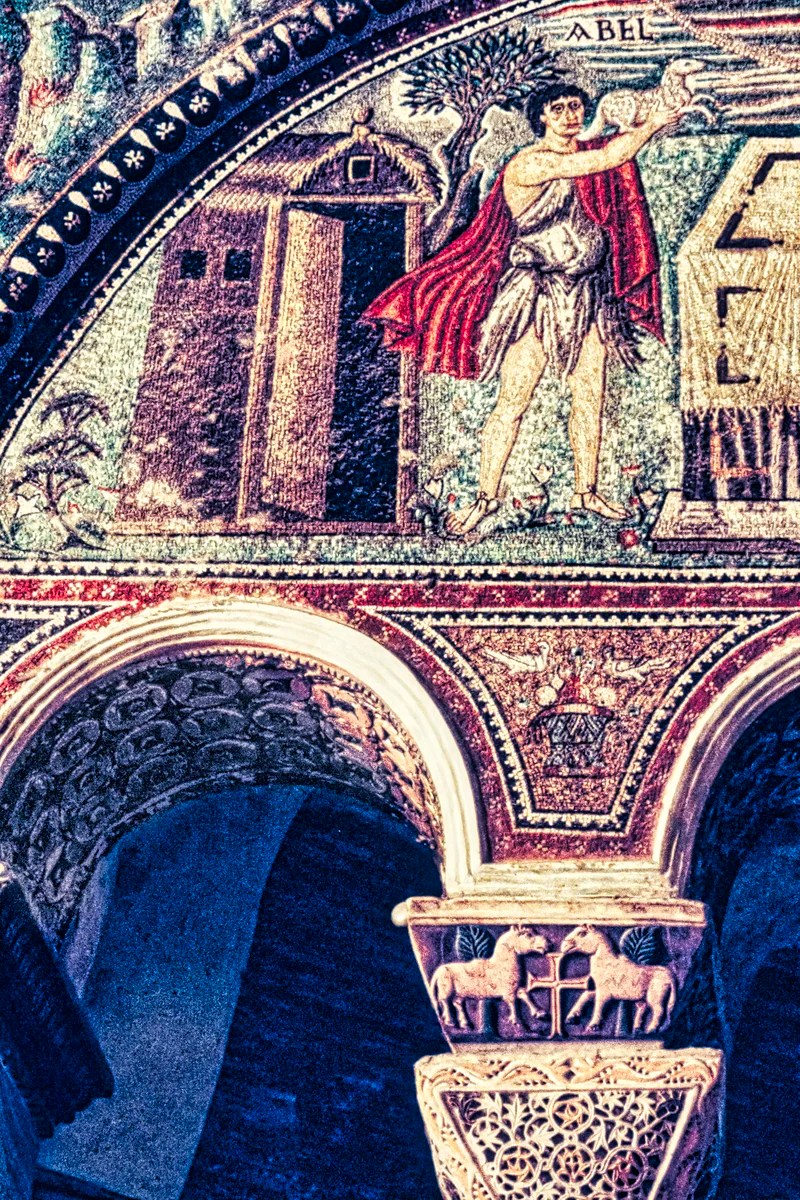
Mausoleo di Galla Placidia (450 AD, G4.8) is quite small but full of beautiful Byzantine mosaics. Galla Placidia is not buried in this mausoleum, but was probably the patron of the construction. She was the daughter of Theodosius I, the Roman emperor from 379 to 395. In other words, he ruled from Constantinople.
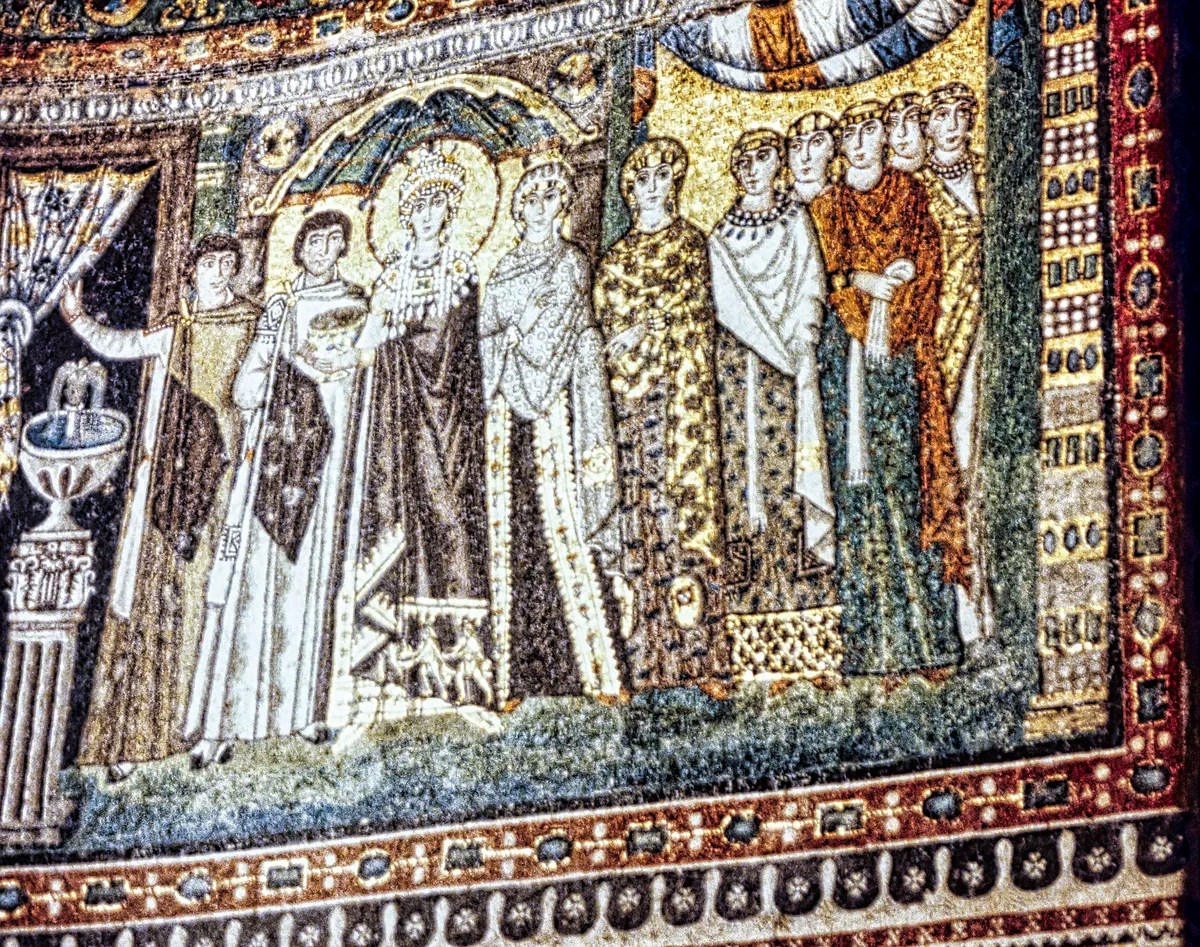
Empress Theodora and Her Attendants panel shows Theodora with a halo, crown and jewels, and a group of court women and eunuchs. What looks like gold is gold wafers embedded in mosaic glass tessera.
Basilica of San Vitale
The sixth-century Basilica of San Vitale (G4.8) is an important surviving example of early Christian Byzantine art and architecture. It is very plain on the outside and very sumptuous on the inside.
Dolomiti (Dolomites)
Driving from Venice 158 km, 2:30 hrs. From Verona
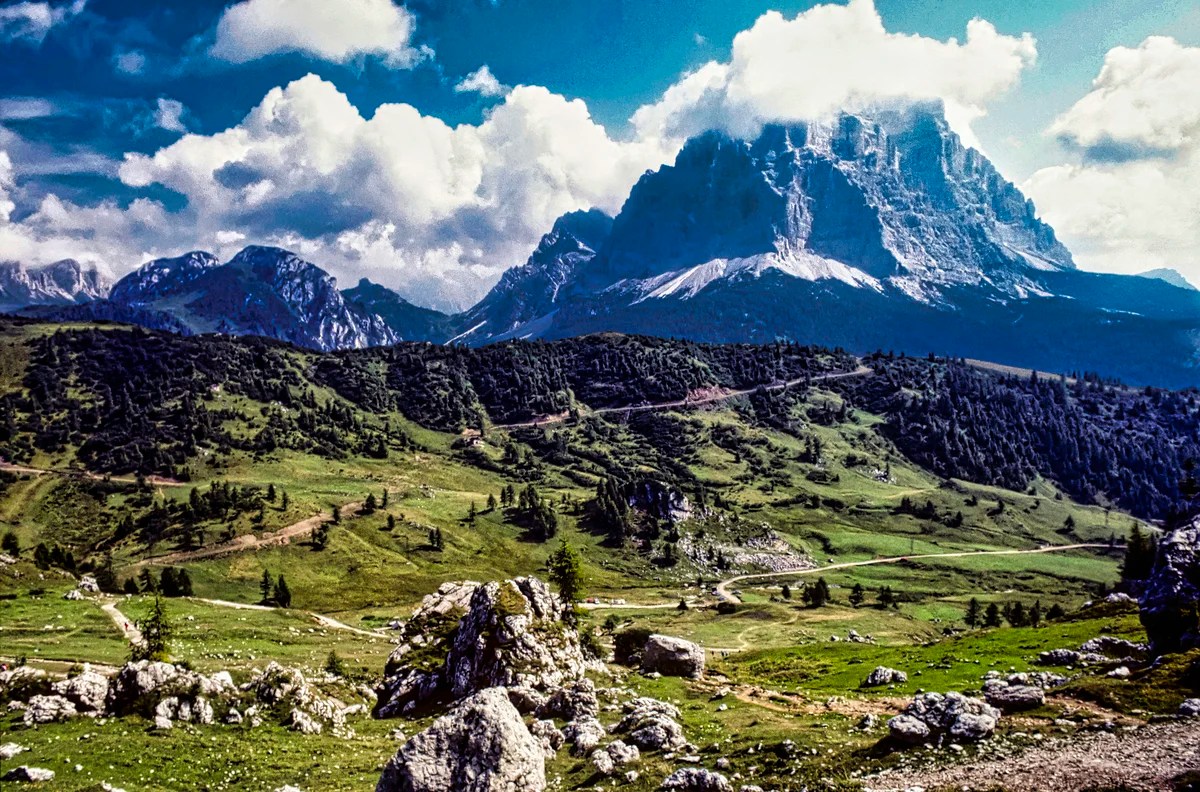
When you think Alps, do you think about Switzerland or Austria? In fact, 27% of the Alps call Italy their home, second only to Austria. The Dolomites may be the biggest secret (it’s not) destination for non-Europeans. The Dolomiti are the Italian Alps, but they have a different look.
Tre Cime di Lavaredo (Drei Zinnen)
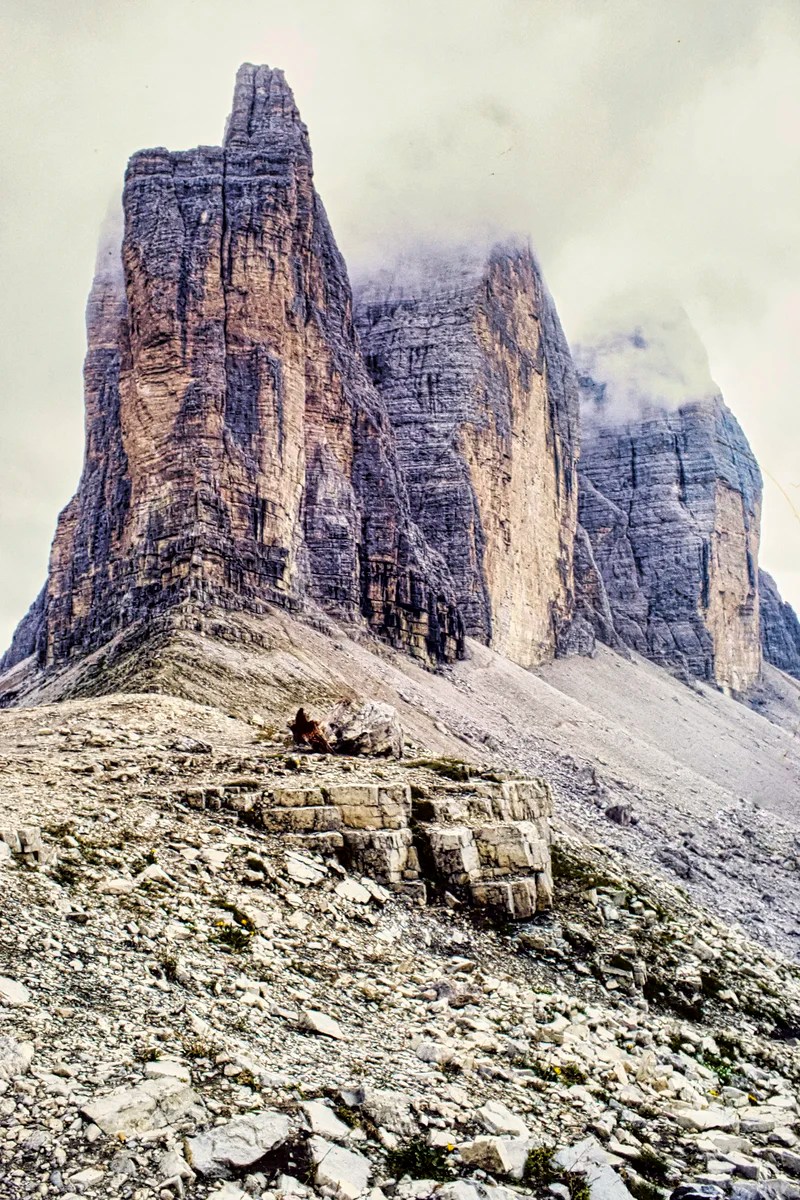
The characteristic rock of the Dolomites consists of fossilized coral reefs and seashells formed during the Triassic Period (around 250 million years ago) by organisms and sedimentary matter at the bottom of the ancient tropical Tethys Ocean. The Alps arose as a result of the collision of the African and European tectonic plates, forcing the rocks at the point of impact to soar skyward.
The Italian Alps are unique because of their sharp peaks, such as the Tre Cime di Lavaredo (Drei Zinnen G4.8). This karst landscape was shaped by water dissolving the dolomite.
The most easily accessible point near Drei Zinnen is Rifugio Auronzo (Auronzo hut, 2320 m). Tre Cime is just north of Misurina and Cortina d’Ampezzo, on the most eastern part of this itinerary.
Hiking in Italy
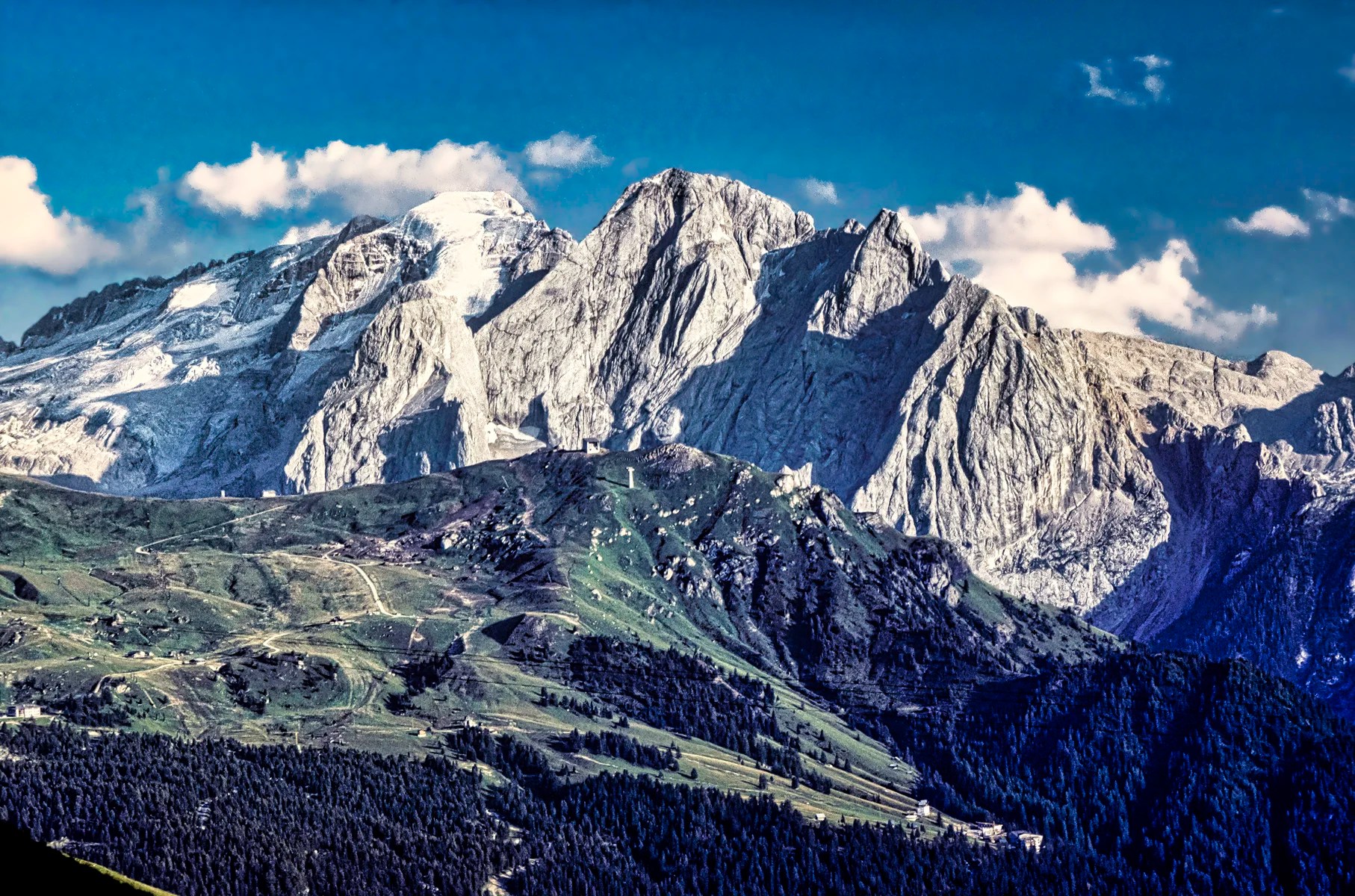
When you want to go hiking in Europe, you may not think about Italy as a destination. You can hike in various places in the Abruzzi and Gran Sasso mountains, as well as Cinque Terre.
But the best hiking with the best scenery is in the Dolomites. This means you have to come between June and October; otherwise, you may need to bring skis. For more information on hiking in the Dolomites, see Guide to Hiking in the Beautiful Alpe di Siusi and Alpe Di Siusi – a fairy-tale plateau in the Dolomites.
Since one of us had to carry the baby backpack, we always took the funivia (cable car) at least uphill. It makes the hiking so much less effort!
Alpe di Siusi (Seiser Alm)
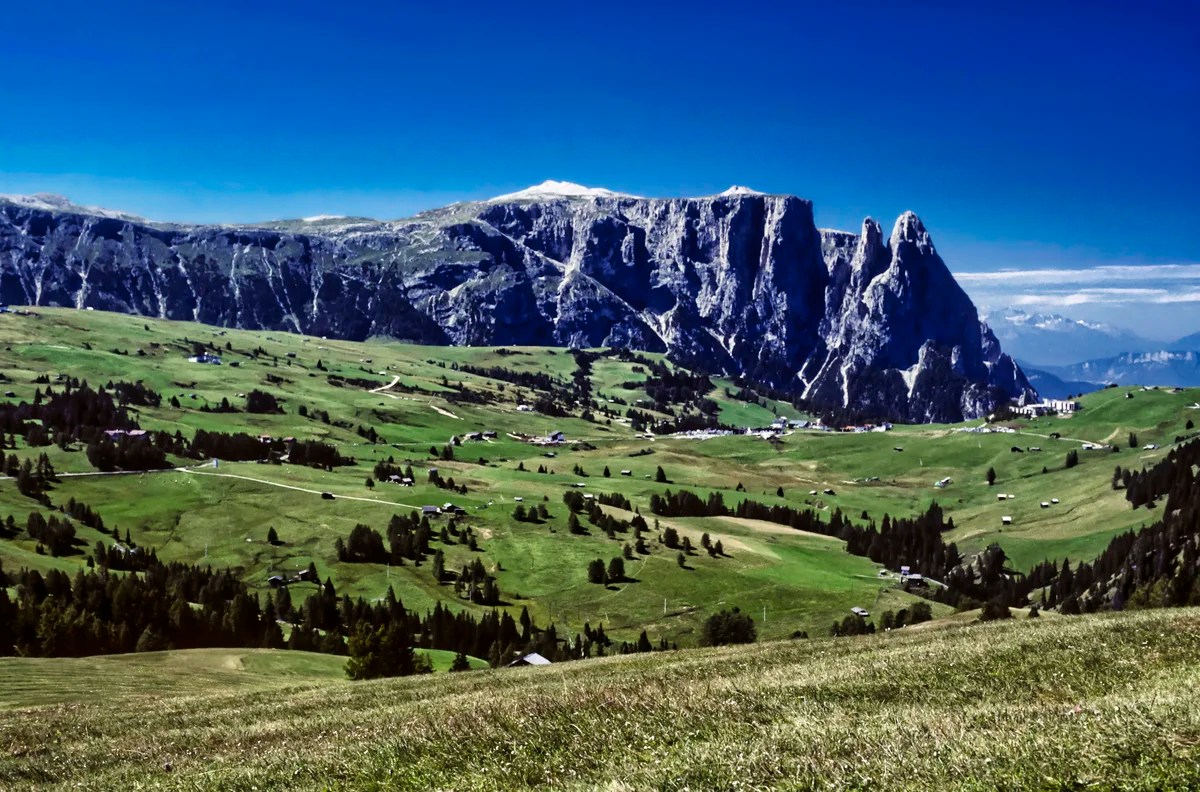
After exiting the Autostrada A22 soon after Bolzano, you will arrive at the Alpe di Siusi, or Seiser Alm in German. With an area of 52 km², Alpe di Siusi is the largest high-altitude Alp (alpine meadow) in Europe. In one direction, you can see Massiccio Dello Sciliar (Schlern G4.8).
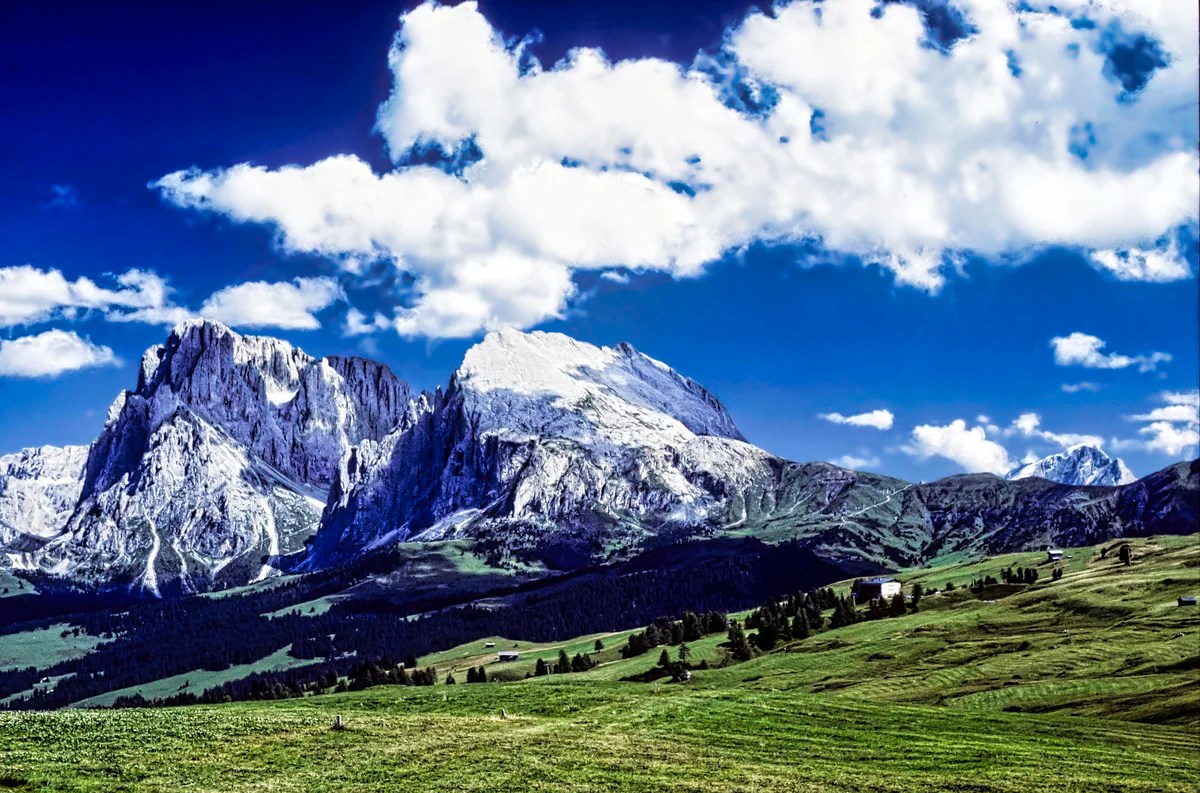
Alpe di Siusi is one of the best hiking areas since the wide expanse of meadows and lack of human development ensure wide-angle views. It is just south of the town of Ortisei.
Thanks to a little internet research, I found a similar photo confirming that the mountains in the background are the 3181 m Sassolungo (Langkofel G4.9). BTW, only hotel guests can drive on the roads in this alp.
Italy did not enter World War I right away, waiting to see which side was going to win. It negotiated with both sides to see which one would give it the most territory if they won! In April 1915, it joined the Allies. At the end of World War I, the provinces of Trentino, South Tirol and Trieste were taken from the Austro-Hungarian Empire and given to Italy.
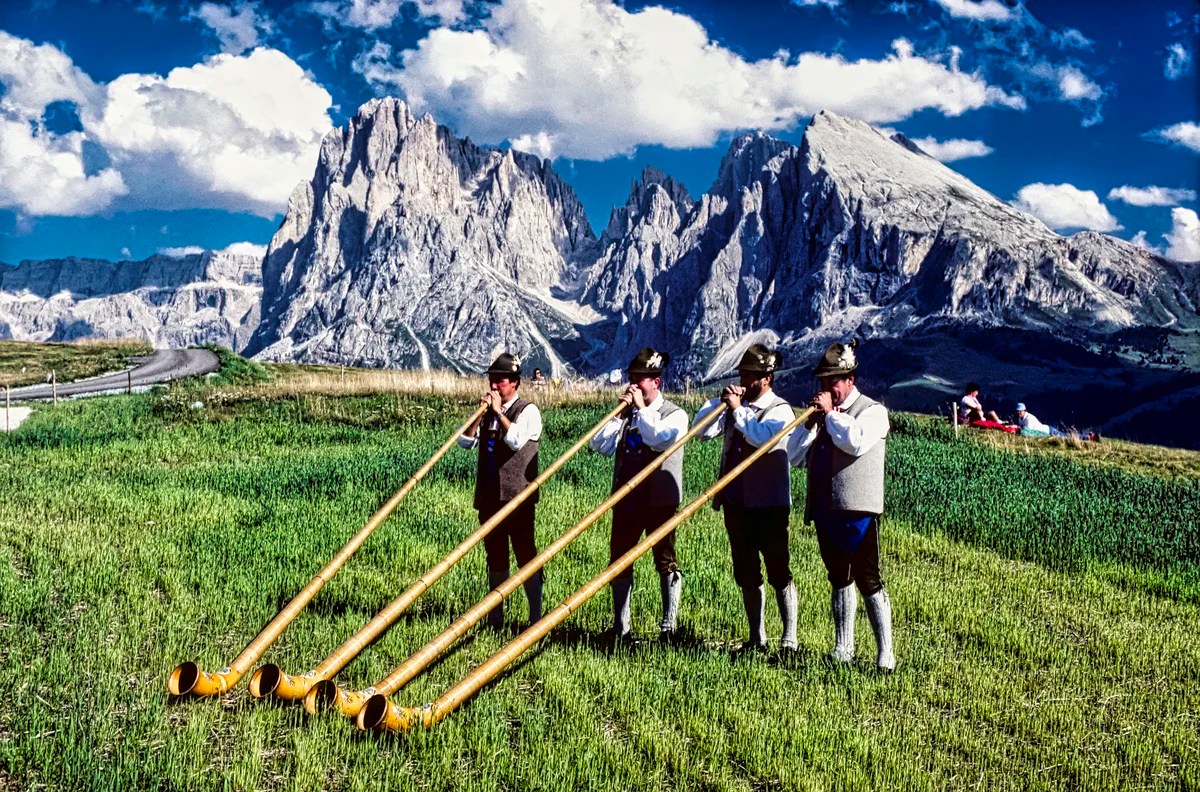
So you will not be surprised to hear German being spoken and alpenhorns being played! The alpenhorn players rotate among a few places. They generally perform between 13:00 and 14:00 hrs. I believe this concert was at the Hotel Saltria.
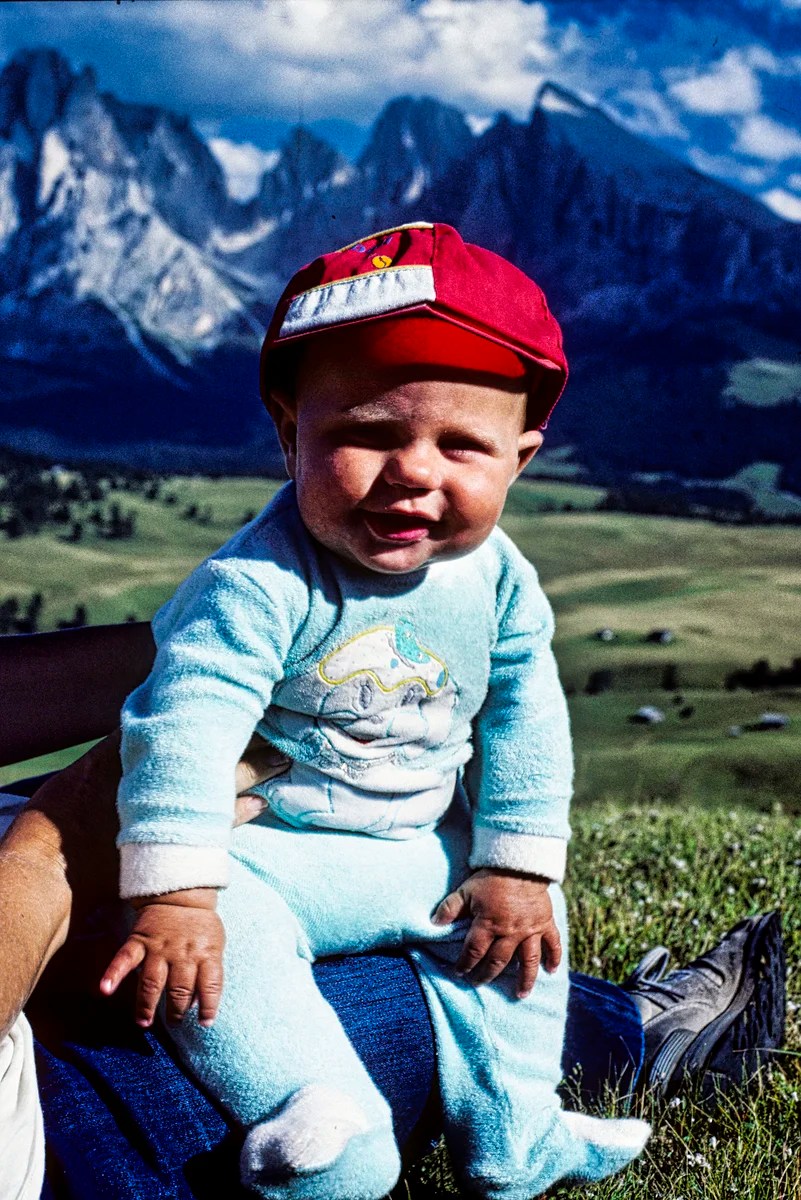
What was very unusual — for the locals not us — was to see a baby hiking! We carried our less than one-year-old bambino in a baby backpack that doubled as a chair when we stopped. Dozens of hikers surrounded him when we stopped at the rifugios. He loved the attention! There is nothing like children to break the ice when you travel in Italy. When they found out he was born in Italy, they exclaimed “un vero Romano”. Love for children is a big part of Italian culture. Even little boys were interested in babies and wanted to play with him.
Final Comments on this Itinerary
This is an action-packed itinerary where you can get away from the crowds of the big three tourist cities. Our recommendations are all highly rated by the people, as shown by the high Google Map Ratings.
Subscribe
Get travel tips and advice delivered directly to your inbox. The best part is that it is free.
What things fascinate you? How long is your trip? What questions do you have? If you have been to Italy, share your experiences with us.
Itinerary Map & Resources
Central to Northern Italy Itinerary — our custom map with points of interest
Google Maps Ratings
Google Maps provides a rating from 0 to 5 for all sights, hotels and restaurants (but not cities). All of our recommendations are appended with the rating (prefixed with a G) from Google Maps. As it is based on feedback from tourists and locals, it is much more reliable than travel booking websites. We consider a score of 4 to 4.39 to be Very Good; 4.4 to 5 to be Excellent.
Other Places to Add to Your Itinerary
Here are nearby places you might want to explore:
25 More Beautiful Small Towns
If you have more time, there are many other quaint villages you can visit. Inspired by its French predecessor, Les Plus Beaux Villages de France, each year new towns are added to the I Borghi più belli d’Italia, the most beautiful small towns of Italy. Many of the recommended places in our three posts are on this list. The following are 25 quaint and often less-visited places in Northern Italy. These places were added to the Central to Northern Italy Itinerary Map using a special symbol.

 Terra Encounters
Leave a reply to Terra Encounters Cancel reply