
Italy is one of the best places to visit in Europe, if not the world. It’s a feast not only for the eyes but also for the stomach.
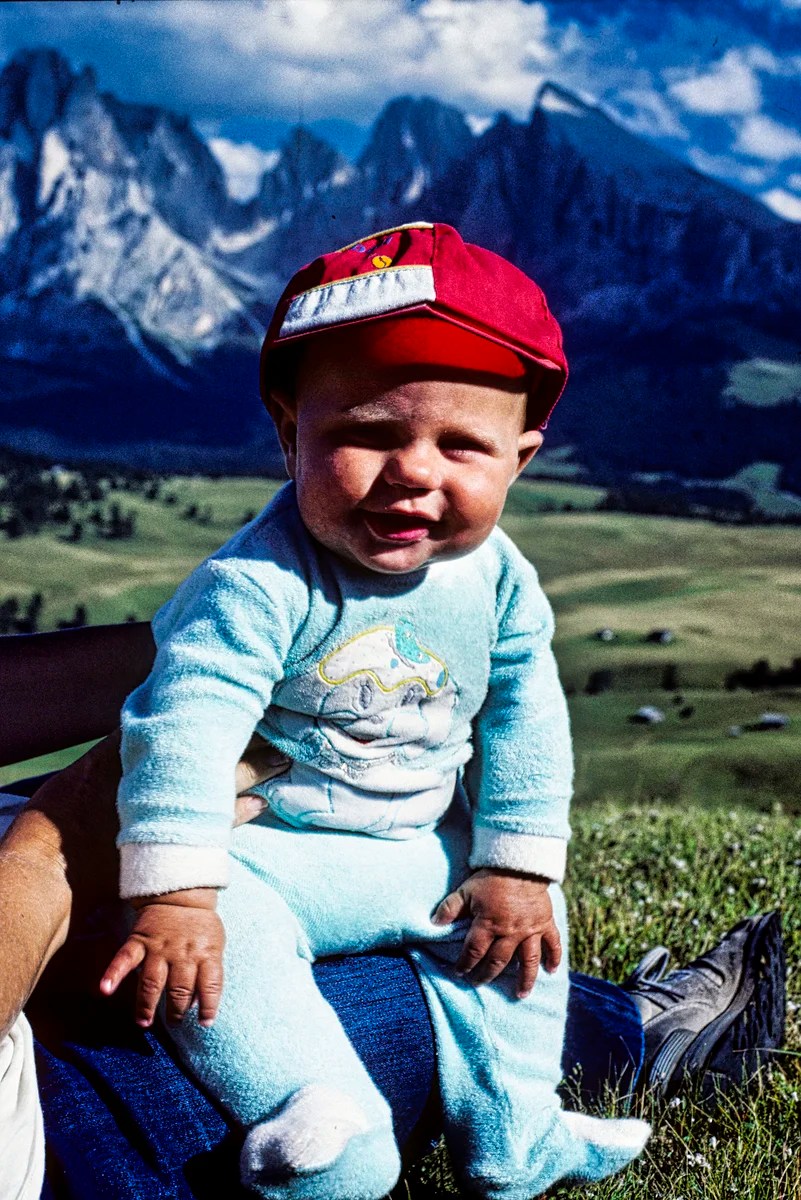
We have not just visited Italy a few times, we lived (worked) in Rome for four years. Our son was born there, un vero Romano. The Italians love bambini. Every weekend we would go sightseeing. Even if you were lucky enough to live there as we did, you can never get enough.
Author & Photographer: George Mitchell

Our recommendations are not influenced by affiliate links – we have none. Our advice is derived from our personal experience and knowledge based on living in Rome for four years and studying its art, architecture, and culture. We also gave a course on Discovering Our Ancient Routes in the Mediterranean at the University of Alberta.
Best Places to See Quintessential Italy?
Where do you want to go? We like to explore what makes Italy (or any country) unique, what is Quintessential Italy. This post is about the three best places to see in Italy — Roma, Firenze & Venezia. The Three Cities Itinerary may be over-touristed, but it still offers the best places to experience quintessential Italy. We will ask you questions to make you think about why you should visit these famous tourist sights and what you should learn about Italy.
At the end of this post, we provided links to ready-made itineraries, each one can be a two (or more) week vacation.
Three Cities Itinerary
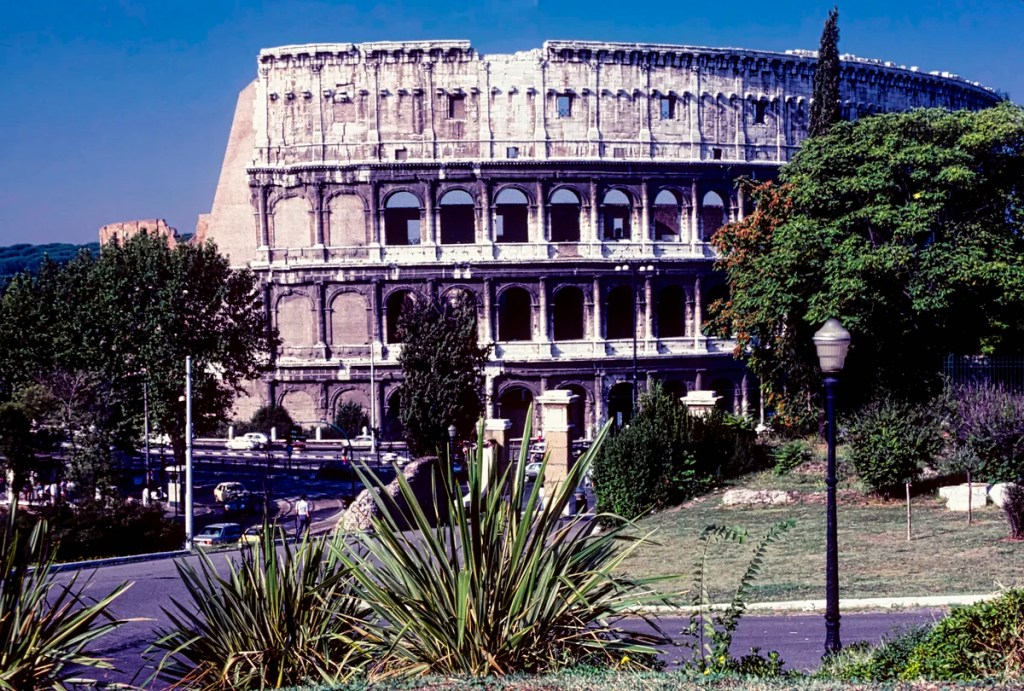
What is Quintessential Italy? Italy has made the biggest impact on world history in terms or art and architecture, civil and military engineering, banking and the demise of feudalism, culture and cuisine. Italy has the most World Heritage Sites on the planet! These three cities will give you an appreciation of the wealth of artistic and architectural heritage of Italy.
Rome, Florence and Venice are THE must-sees for first-time visitors to Italy. If you have a very limited schedule — less than 12 days — then this is really all you have time for. You need at least 4 days for Rome, 3 days for Florence, and 2 days for Venice, plus ½ to one day for travel time between cities. If you like art, architecture and museums, you need more time.
On the plus side there is no value renting a car as driving in these cities is not recommended and there are no roads in Venice. Since we had a baby, we drove everywhere. We had no problem, but most Italians drive like they are the only car on the road. Take public transit. The old cities were small and easily walkable.
Rome (Roma)
Only in Rome can you travel in time as you wander through the Centro, the historical centre. On each short two km walk, you cross from the Classical era to modern times, from the Gothic Era to the Baroque. Rome is special for three themes: Ancient Rome, Christian Rome, and Baroque Rome. The detailed itineraries for seven self-guided walks can be found under the 7 Best Routes to See the Amazing Sights of Rome. The points of interest for Rome can be found on the Rome Itineraries Map. Click on the bold, underlined links below for more details on each topic.
Why is Ancient Rome so important?
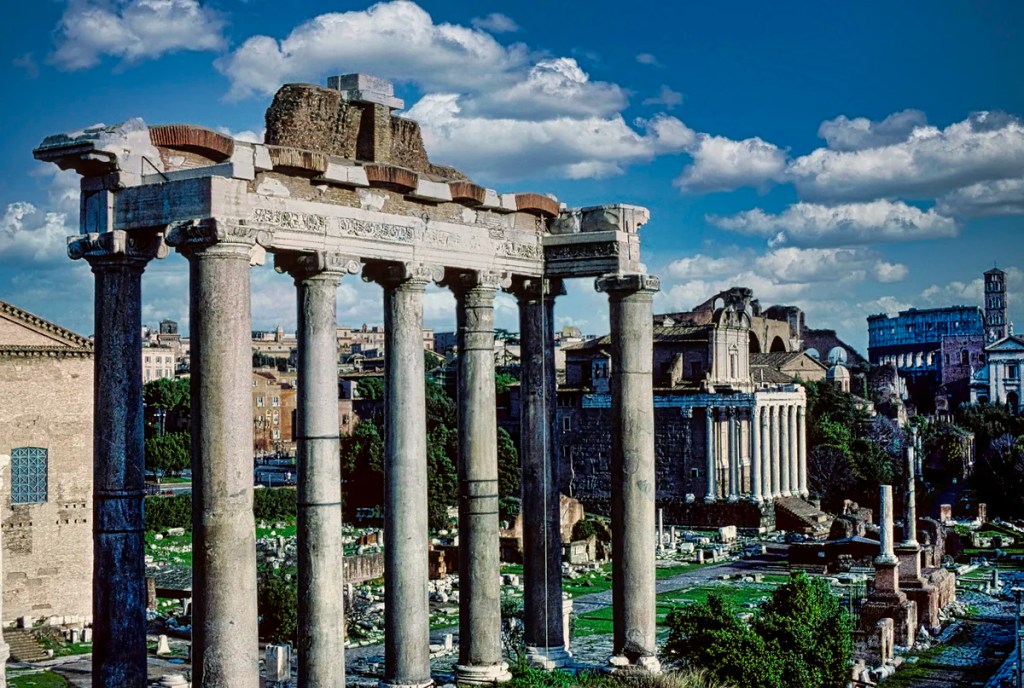
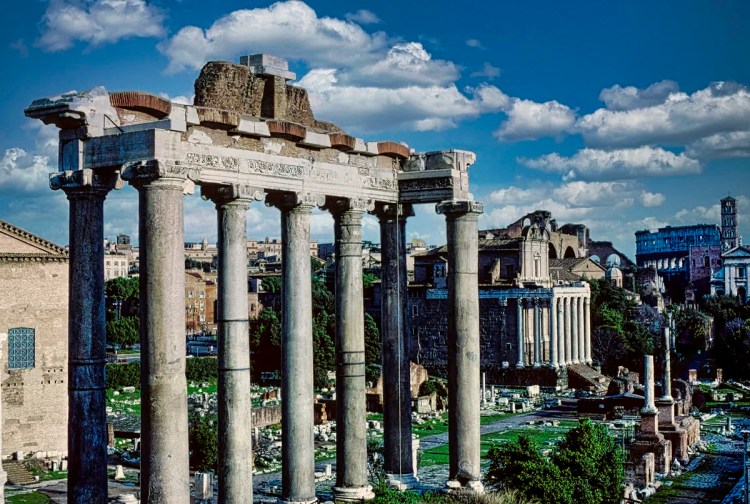
Besides the exquisite Capitoline Museum with its famous Ancient Greek and Roman sculptures, the viewpoint of the Forum from Capitoline Hill is a must. Why was this temple to Saturn, the god of agriculture, so important to Ancient Rome? Why is it one of the biggest influences on the culture of the modern world? Click the link Temple of Saturn and learn about its world-changing festival. Trust me, you have heard of it.
Pantheon
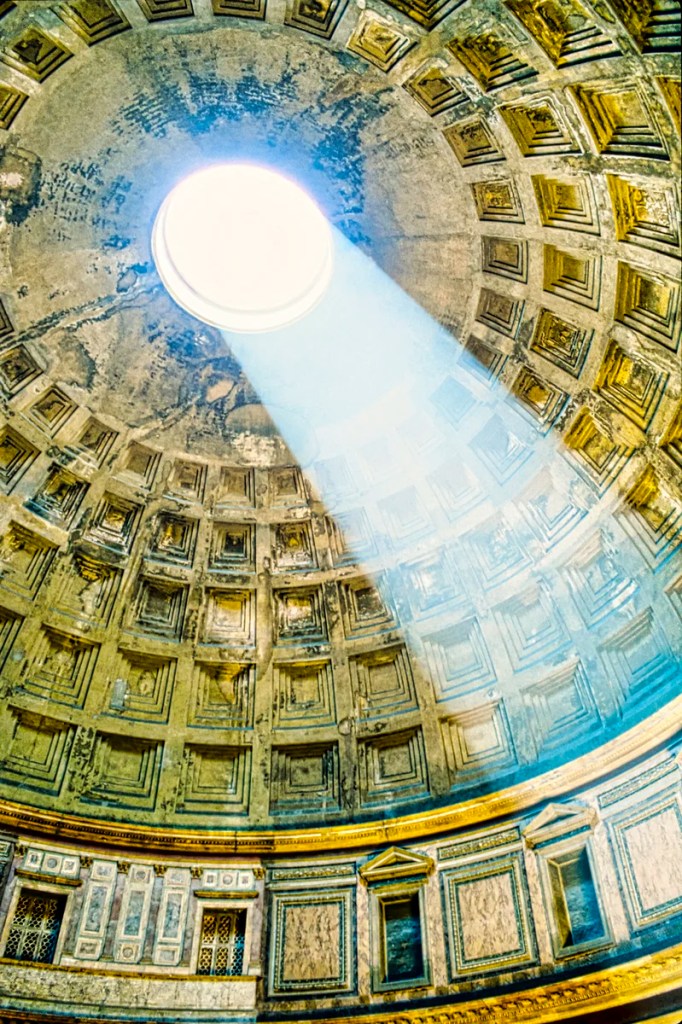
Why is the Pantheon the most important temple to visit, possibly in the whole world? It is much more than being one of only three intact temples in Rome. How has it influenced modern architecture? Without this Roman invention (see link), we would not have the massive buildings of today.
Ponte Fabricio
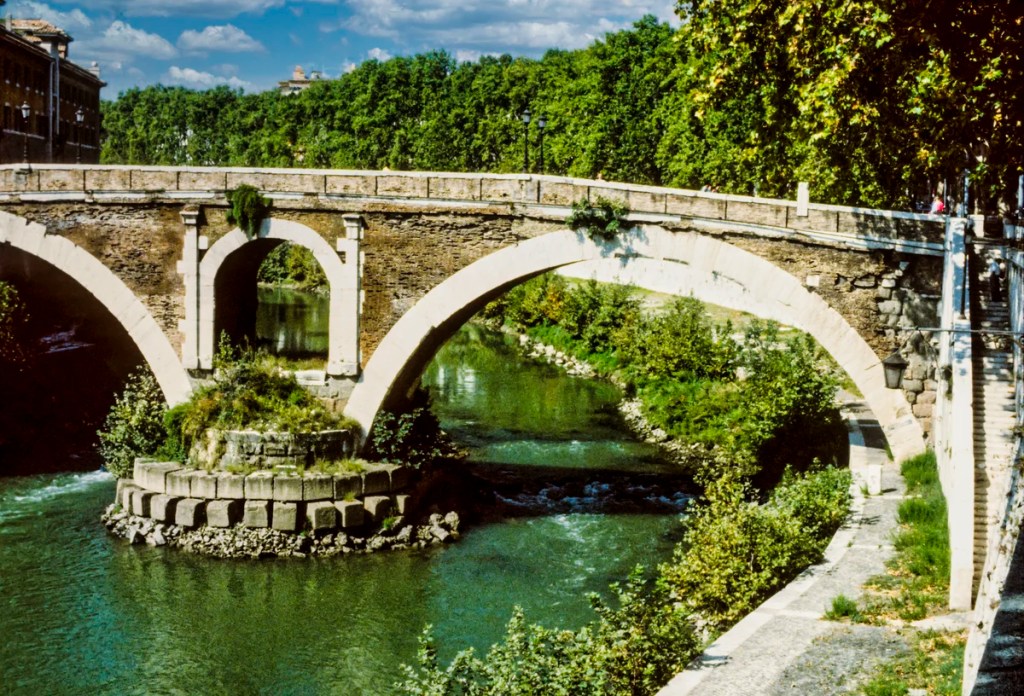
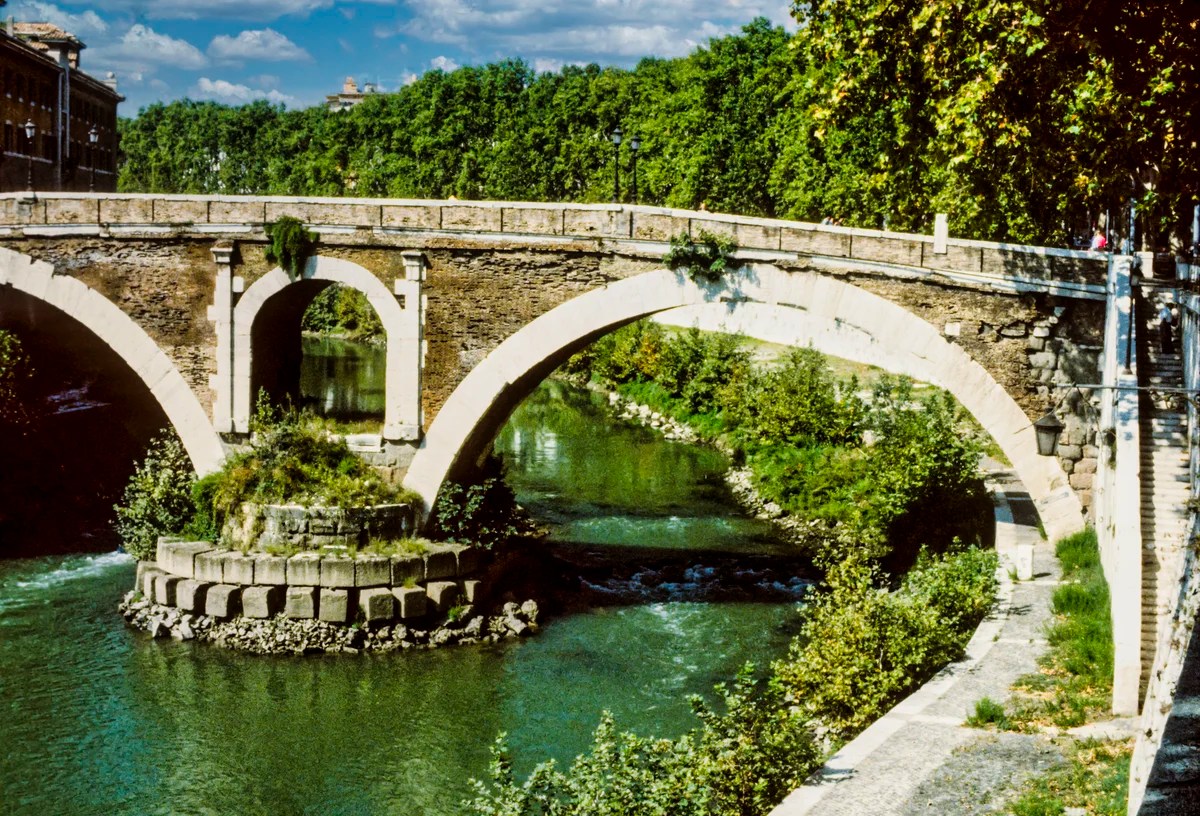
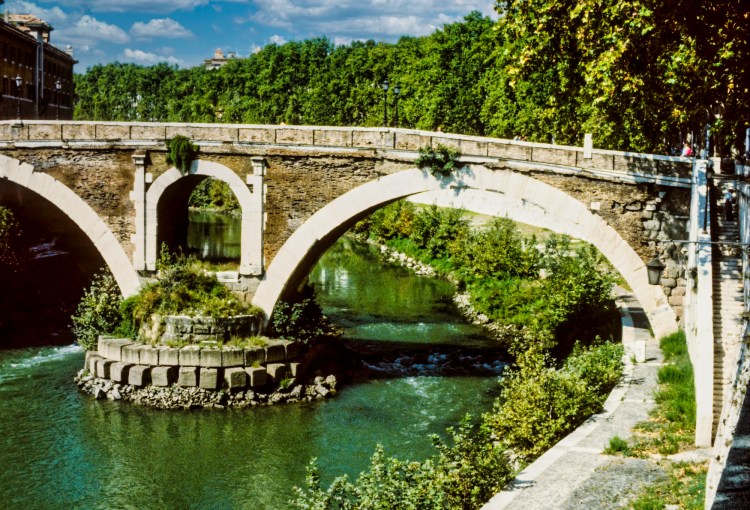
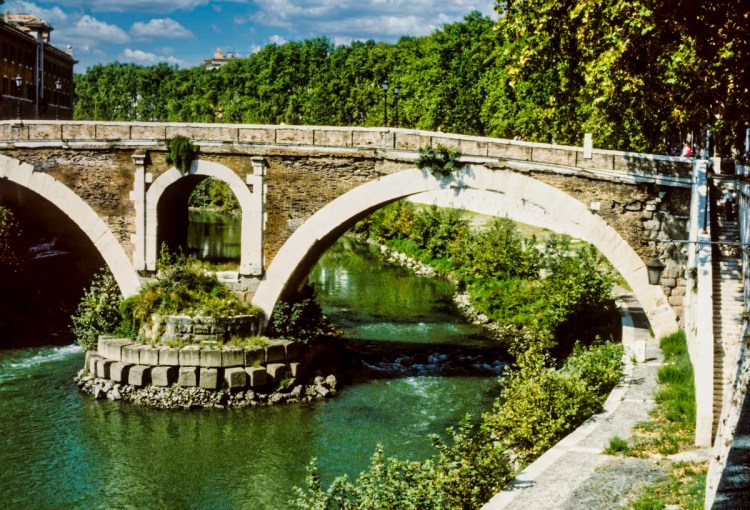
Why is the rarely visited Ponte Fabricio important? This is the last Ancient Roman bridge still standing in Rome. It is a reminder that the arch is one of the most important contributions to modern architecture. But the Romans did not invent the arch, the Etruscans did. They lived in the province of Tuscany, named after them.
Basilica Aemilia, Forum
Use my self-guided 7 Best Walks to See Amazing Rome and do buy a few guide books if you want to get more out of visiting Rome. Italy provides excellent guidebooks. For instance, the Forum is predominantly ruins and the names of fallen temples. The guidebook Rome Past and Present uses plastic foils to show past and present views of the ancient buildings.
A good guide book to a city or museum should identify what artifacts you must see as well as provide a story about why they are unique. Alternatively, there are many good guided tours. A friend of mine highly recommended The Roman Guy.
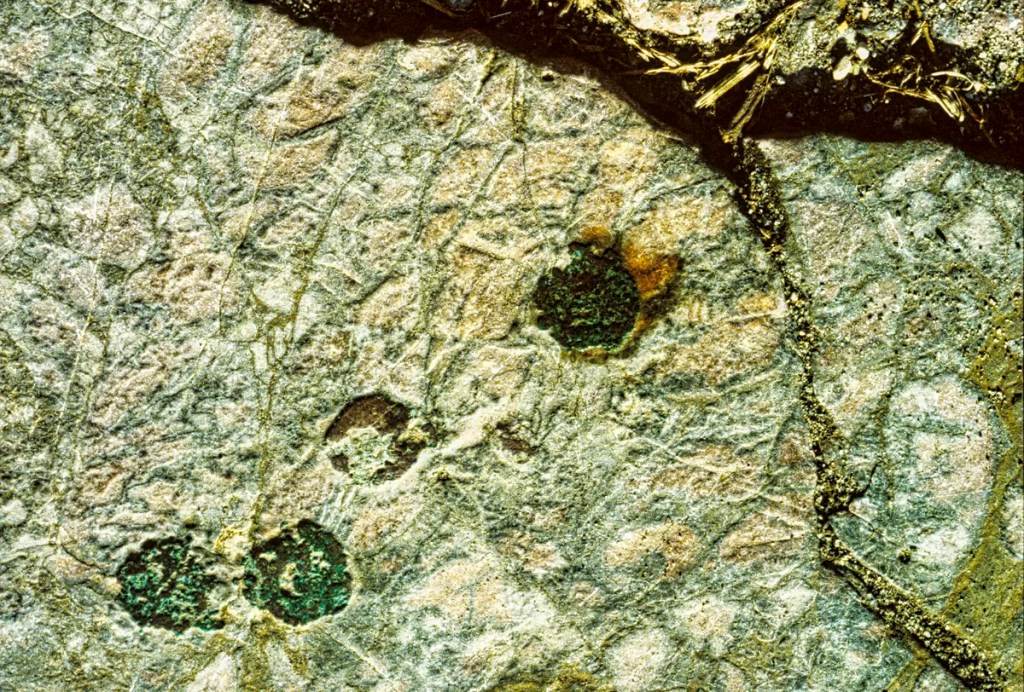
The Companion Guide to Rome taught us to pay attention to detail and look for these spots in the marble floor of the Basilica Aemilia. Basilicas were not temples: they were commercial or legal buildings with a colonnaded central nave. Today’s major churches were named and based on the Ancient Roman basilica architecture. Those spots are foreign coins that melted into the floor during the sack and fire of 410 AD. This was the money changers’ area.
Christian Rome
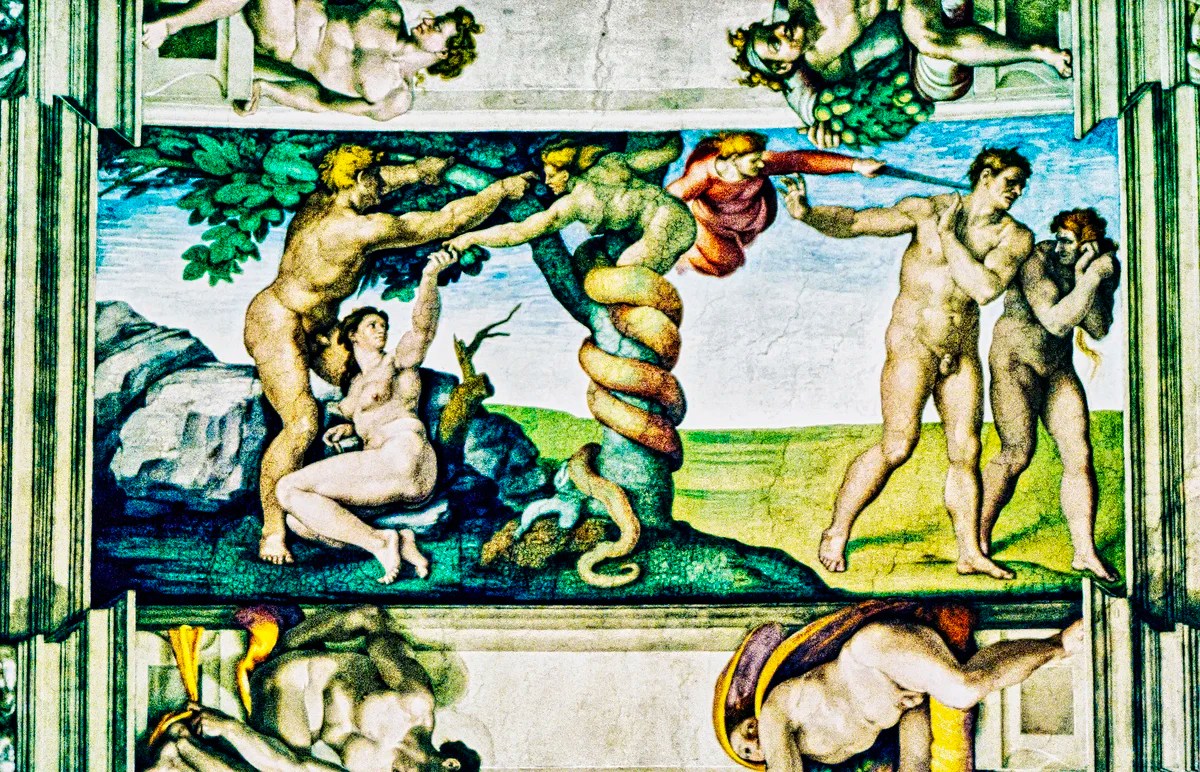
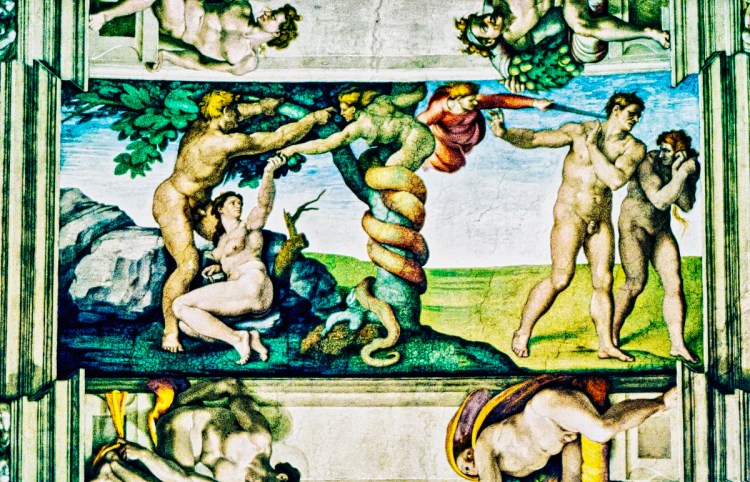
Why are the Vatican Museums so important? Sure, you must see the Sistine Chapel painted by a famous sculptor, Michelangelo. He got the commission thanks to jealous Raffaello, who thought he would fail! BTW, artists were the rock stars of those days. Do you notice that they are called by their first name alone?
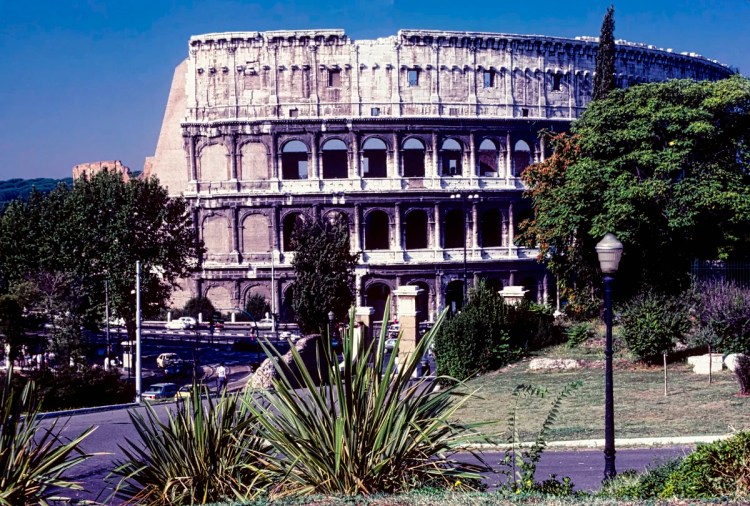
What is really significant is that former popes were great collectors of ancient art. Popes came from highly educated nobility. Their personal collections protected “pagan” art and sculpture that otherwise may have been destroyed by Christians. Yes, this was a significant cause of the destruction of the Coliseum and other sites. The museum was started in 1506 by Pope Julius II, who commissioned the Sistine Chapel.
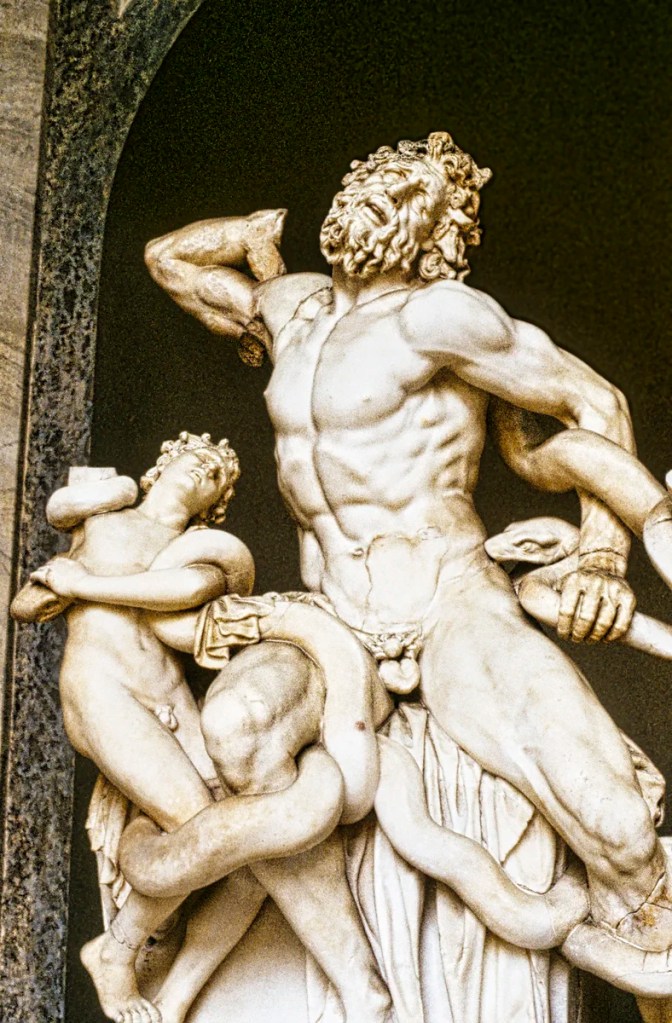
Another must-see inside the museum is the Octagonal Court. This courtyard is filled with the most exquisite ancient sculptures but the most famous is the Laocoön. This sculpture depicts a giant serpent sent by the goddess Athena to kill the priest Laocoön who wanted to burn the Trojan horse!
Why is it important? It is a supreme example of agony and was used as the model by many artists in their paintings and sculptures. Michelangelo was impressed by its depiction of the robust male figure with straining muscles. This influenced many of Michelangelo’s later sculptures for the tomb of Pope Julius II.
Baroque Rome
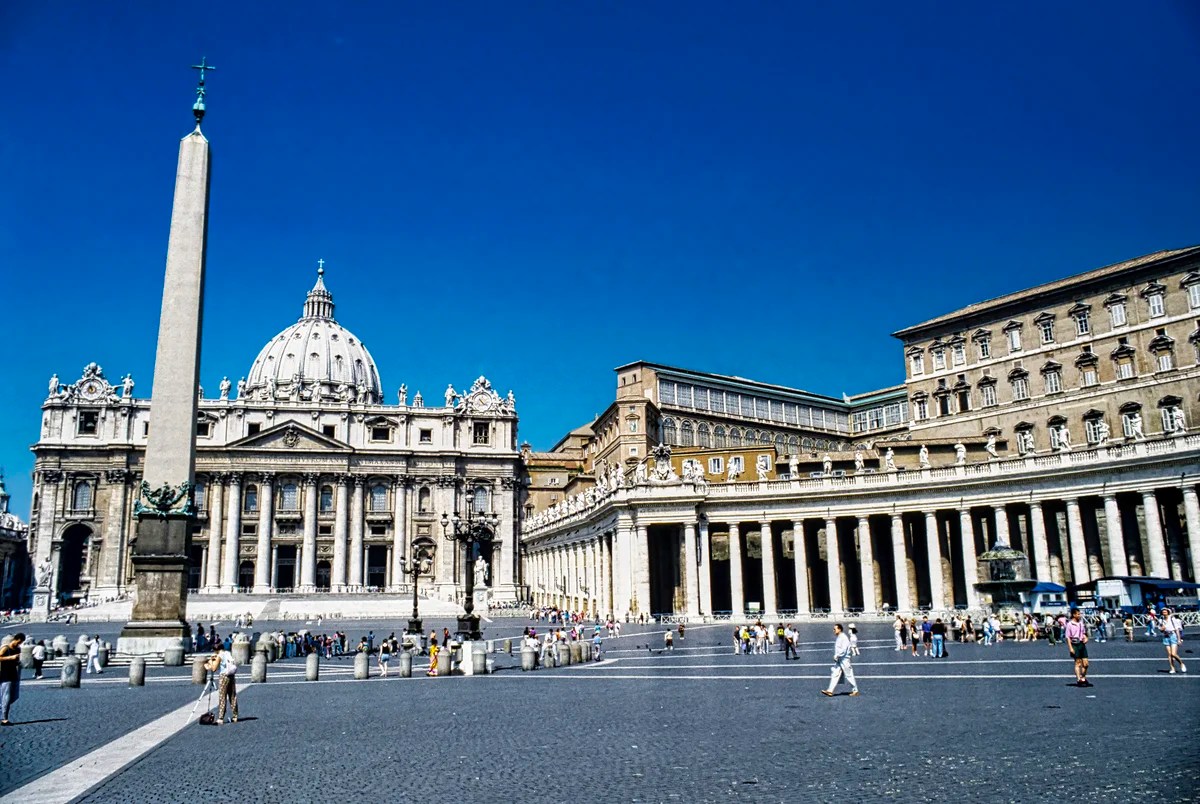
When you think of ornate European palaces and estates, most of them are Baroque. Why is Rome the place to see Baroque art and architecture? The Catholic Church began and sponsored the Baroque Era to regain its followers after the Reformation with a new style that inspired surprise and awe.
The façade and colonnade of Saint Peter’s Basilica by Carlo Maderno was the first Baroque architecture. The curved colonnade arms, which represents the “embrace of the Church”, is tame compared to the overly decorative style of Late Baroque.
Other techniques used in Baroque art were trompe-l’œil (illusion of three dimensions) and chiaroscuro (dramatic light on the subject contrasted against a dark background) — think Caravaggio and Rembrandt.
Villa Borghese
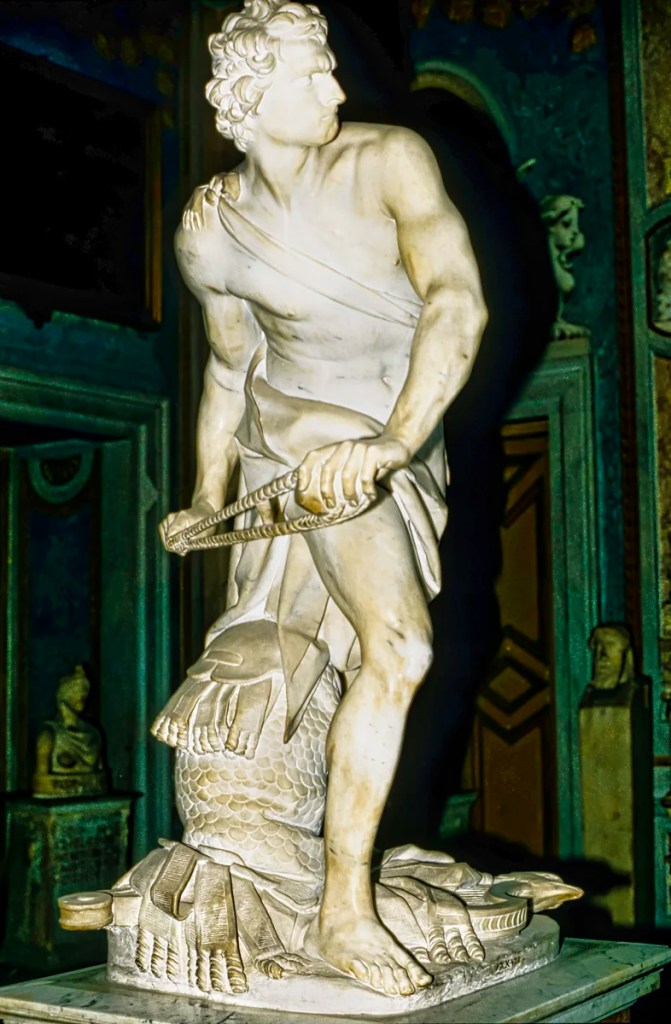
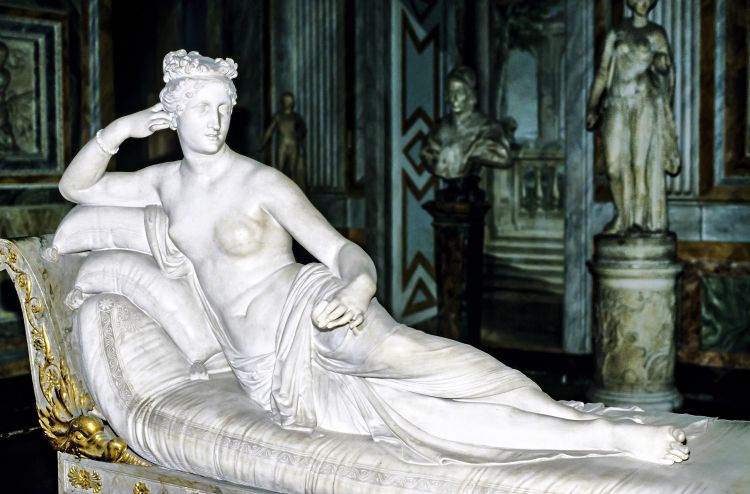
Be sure to visit Galleria Borghese, with sculpture masterpieces by Bernini. Up until 1624, David was always portrayed in a static pose. Bernini uses serpentinata (twisted S form) to show the drama and motion of David about to fire the sling. Another interesting fact is that Bernini sculpted himself as David!
Fontana di Trevi (Trevi Fountain)
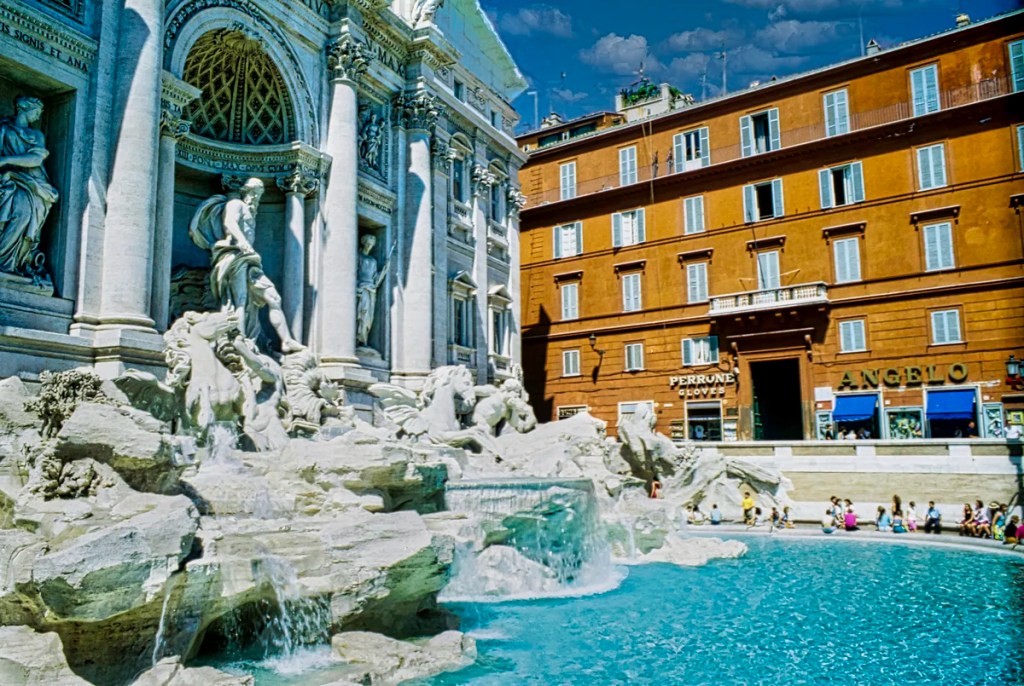
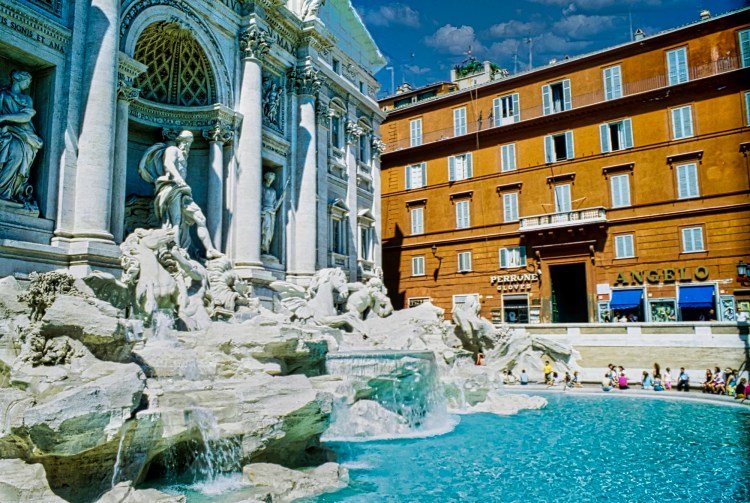
Perhaps the most romantic part of Rome is the piazza (square) adorned with Ancient Egyptian obelisks and baroque fountains. The most famous one is Trevi Fountain that appears to emerge out of the side of a palace. An ancient Roman aqueduct brings the water from the mountains to this fountain!
Santa Maria della Vittoria
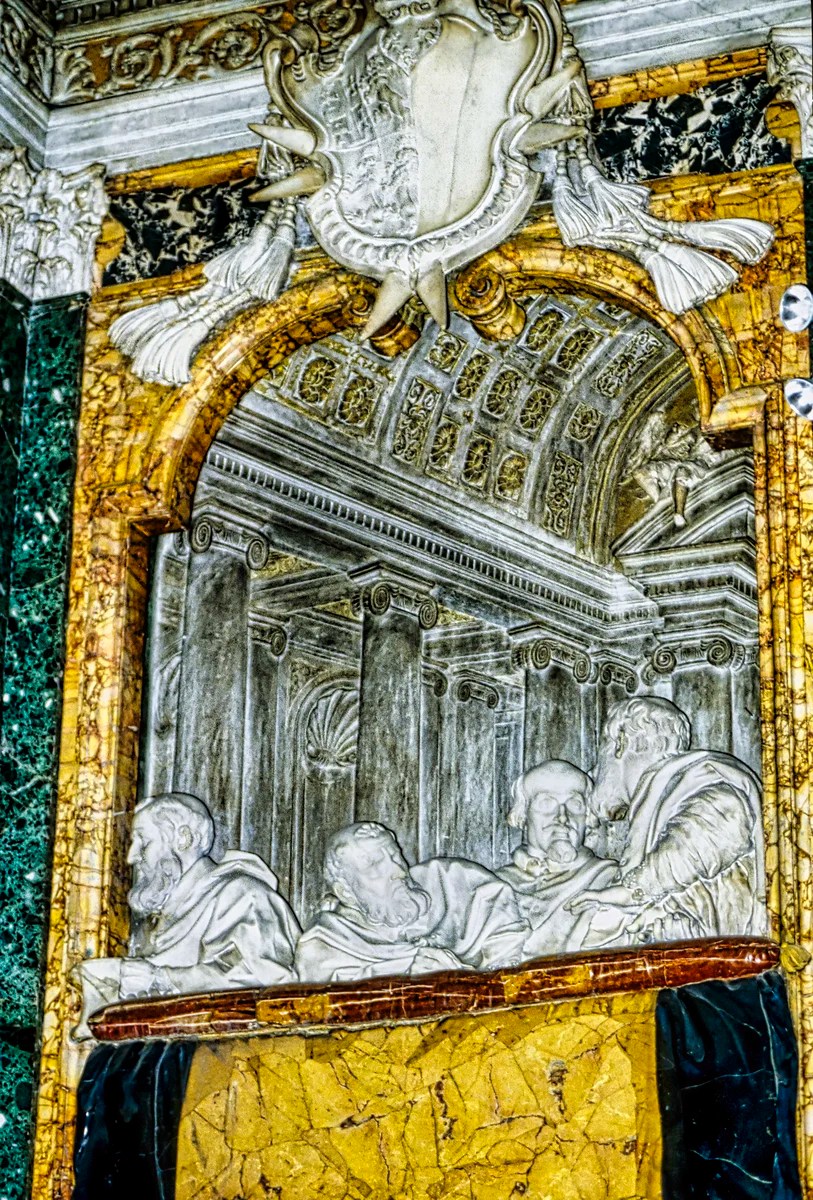
With the artistic gems they contain, many churches are worth visiting. Chiesa Santa Maria della Vittoria hosts the massive sculpture Ecstasy of St. Teresa, one of Bernini’s best works. But my favourite scene in the Cornaro Chapel (1652) is the faux theatre box with the Cornaro family, including Cardinal Cornaro who commissioned the chapel. This wealthy Venetian family look as if they are watching the opera, i.e. the Ecstasy of St. Theresa. The three dimensional lines of the faux vault give an impression of great depth.
Sant’ Ignazio di Loyola (St. Ignatius of Loyola)
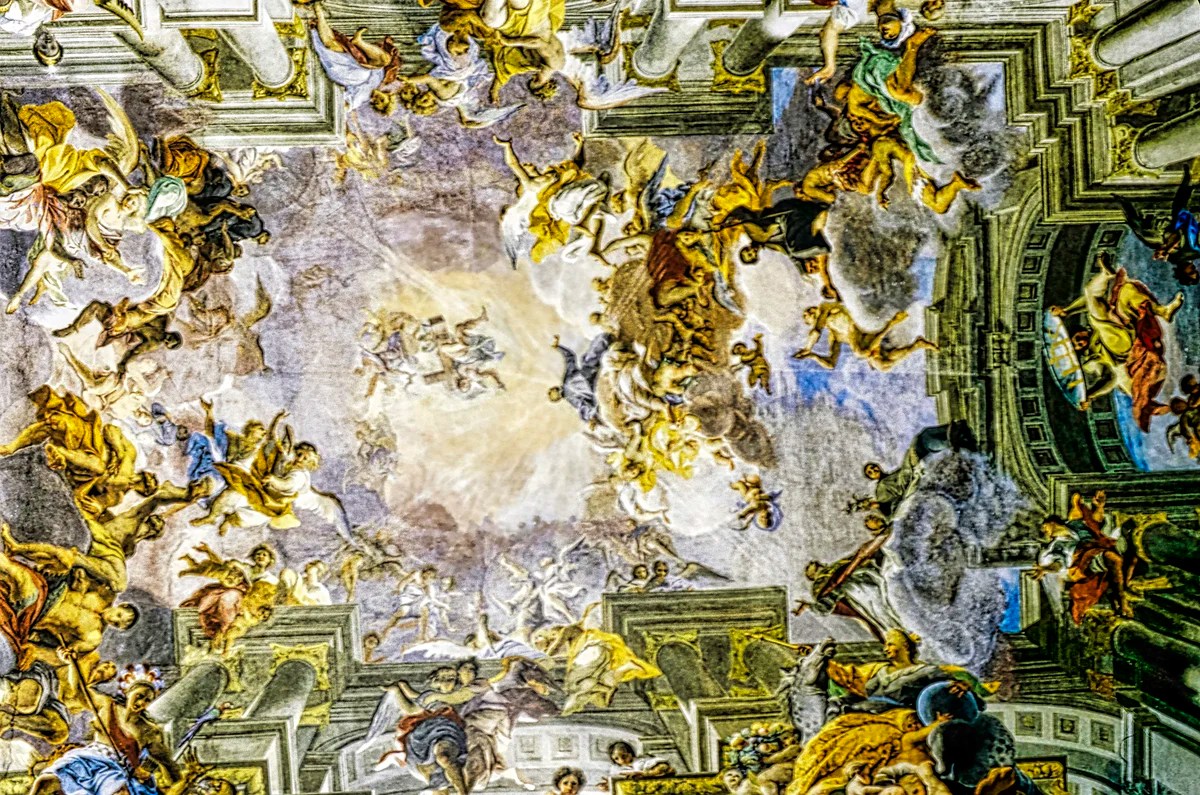
One specialty of the Baroque era is trompe-l’œil. The ceiling of Chiesa Sant’ Ignatio di Loyola (1540) was painted by Jesuit painter-priest Andrea Pozzo. The perspective is incredible, giving the illusion of a palace opening to the sky with figures flying through the air. St. Ignatius of Loyola was the founder of the Jesuits, who were very active in Canada and Latin America. They tried in Japan but were allowed a base solely in Nagasaki. How ironic.
Florence (Firenze)
Travel time from Rome: 273 km, 3 hrs.
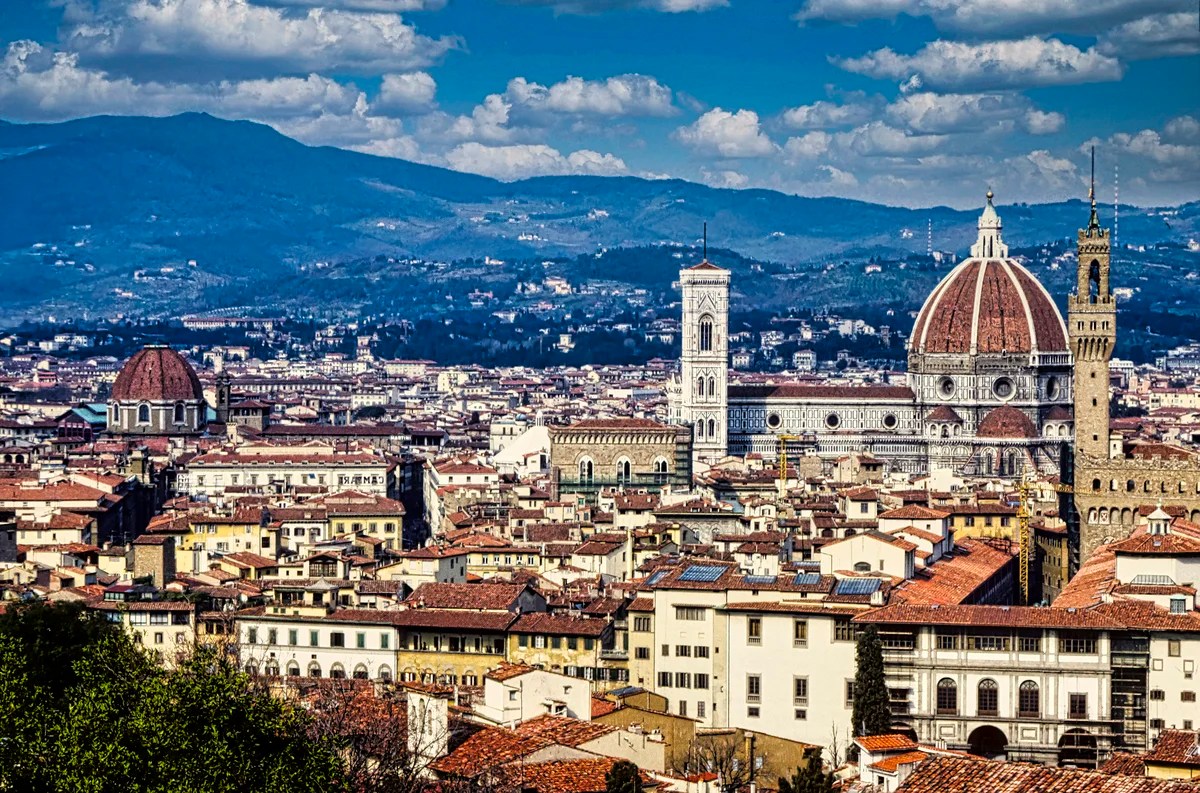
Florence was a centre for textile and banking industries with branches across Europe. Banking helped break the stranglehold of feudalism and laid the foundations for capitalism. Florentine merchants used their profits to demonstrate their wealth via art. That’s why Florence was the birthplace of the Renaissance. Static, two-dimensional Gothic art was replaced by implied movement, perspective, and three dimensions. The points of interest for Florence are on the Central to North Italy Itinerary Map.
Duomo (Santa Maria del Fiore)
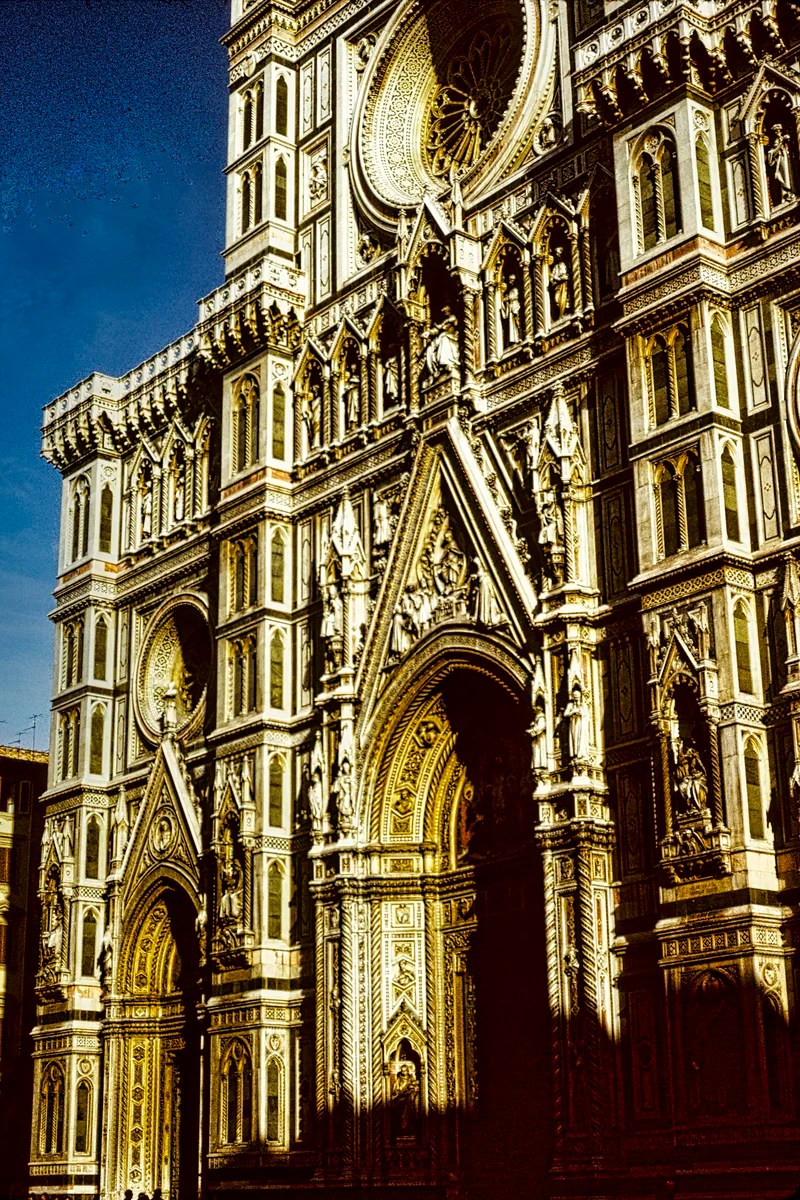
Why is the Duomo (1436) a must-see? Its’ real name is Cathedral of Santa Maria del Fiore, but it is mainly called “the Dome”. Since it took so many years to build, it actually is in Italian Gothic style, a mixture of Romanesque and Gothic architecture. The lower part in polychrome marble was begun around 1284. But, the façade was only finished in 1887!
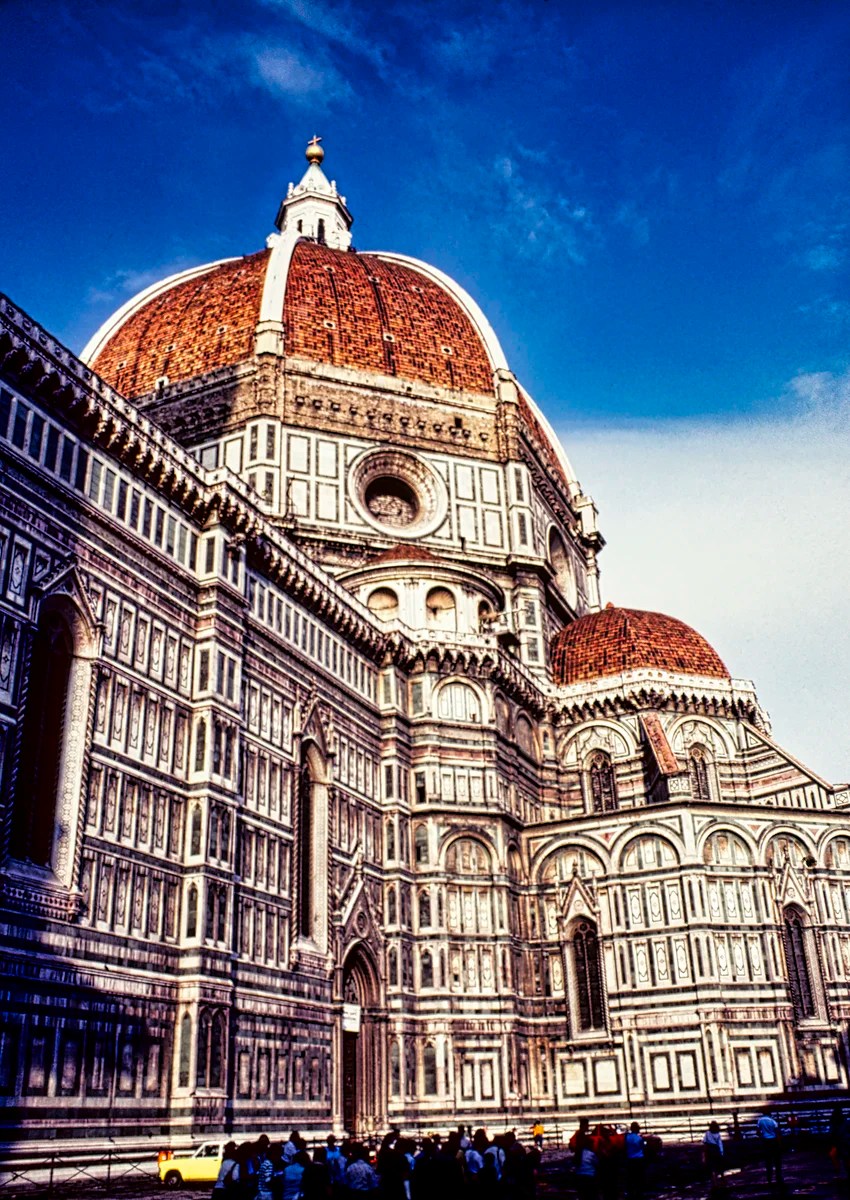
How do you build a large dome when your wood framing is limited by the length of a tree? With a diameter of 45.5 m (149 ft), the dome is the largest masonry vault in the world and took 16 years to build! The Duomo was the first large dome raised since the Roman Empire completed the Aya Sofia in Constantinople. Thus the architect, Filippo Brunelleschi, is considered the father of Renaissance architecture.
Giotto’s Campanile
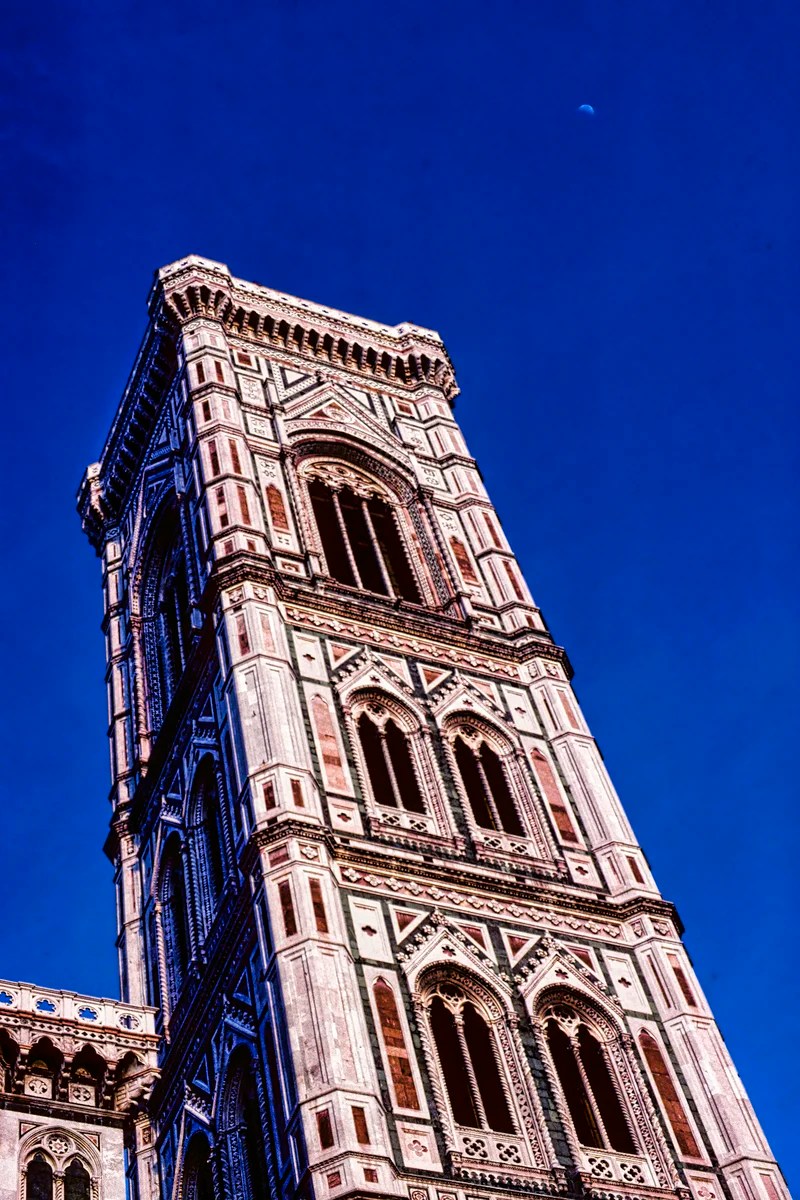
Enjoy the elaborate Gothic bell tower (1359) of the Duomo. It is often called Giotto’s Campanile. The architect was one of the greatest Gothic painters, Giotto. The 85 metres (278 ft) tall tower took 25 years to build! In fact, many people worked on it but they followed the design of Giotto. This is not your typical Gothic style of Northern Europe. This is Italian Gothic style using polychrome marble insets. Giotto’s design was in harmony with the polychrome cathedral.
Battistero di San Giovanni (Baptistery)
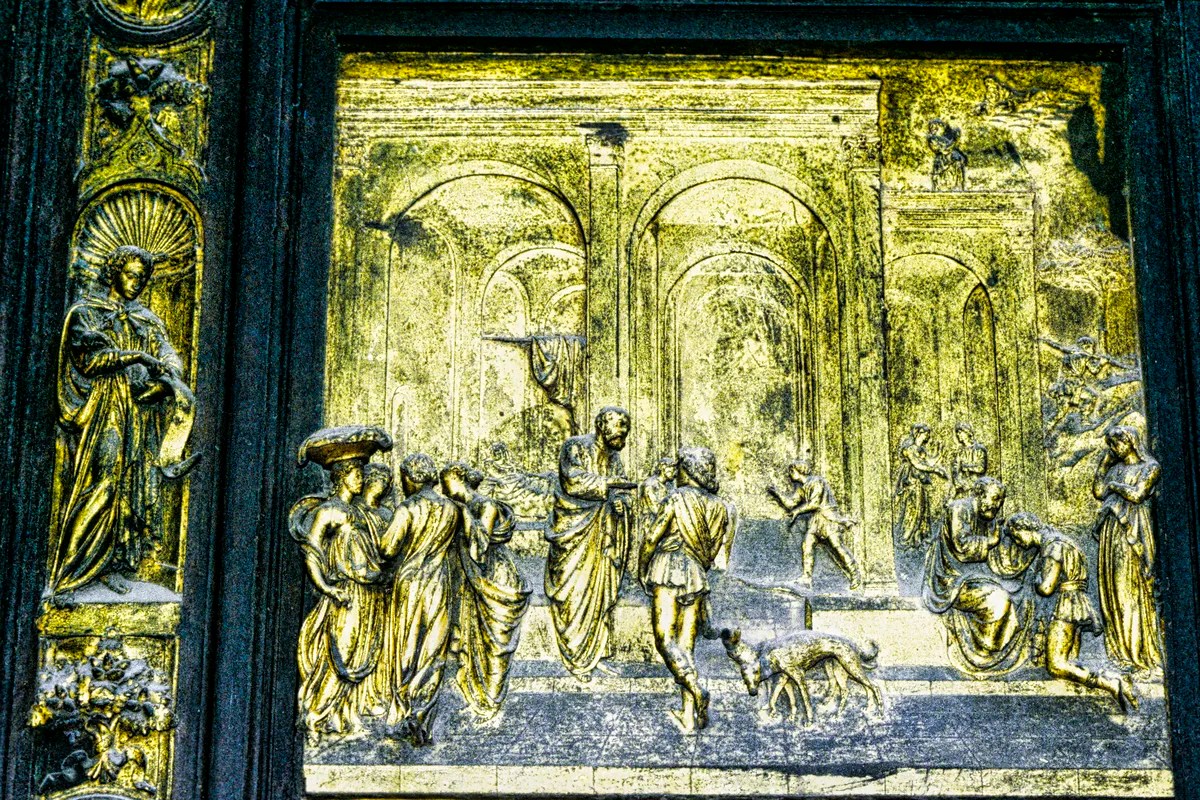
A big surprise on our first trip to Europe was that sculptors had to create a sample bas-relief for a competition to create panels for the doors of the Baptistery of the Duomo in 1402. This competition had a direct impact on the start of the Renaissance. Because Brunelleschi lost the competition, he gave up on sculpture in favour of architecture. He went on to raise the large dome of the Duomo.
Lorenzo Ghiberti won the competition with his Gothic quatrefoil of The Sacrifice of Isaac. This was a major milestone for the start of the Renaissance. Ghiberti introduced diagonal motion through space and molded the subjects to fit the unusual quatrefoil shape.
In 1425 Ghiberti began work on a second pair of gilt-bronze doors. They took 27 years to complete!! Michelangelo thought they were so good that he invented the moniker, the Gates of Paradise.
The Jacob and Esau Panel above has since been restored and re-gilded. Ghiberti employed nearly three-dimensional foreground figures against an incredible perspective based around a vanishing point framed by the central arch of a Renaissance loggia.
Santa Maria del Carmine
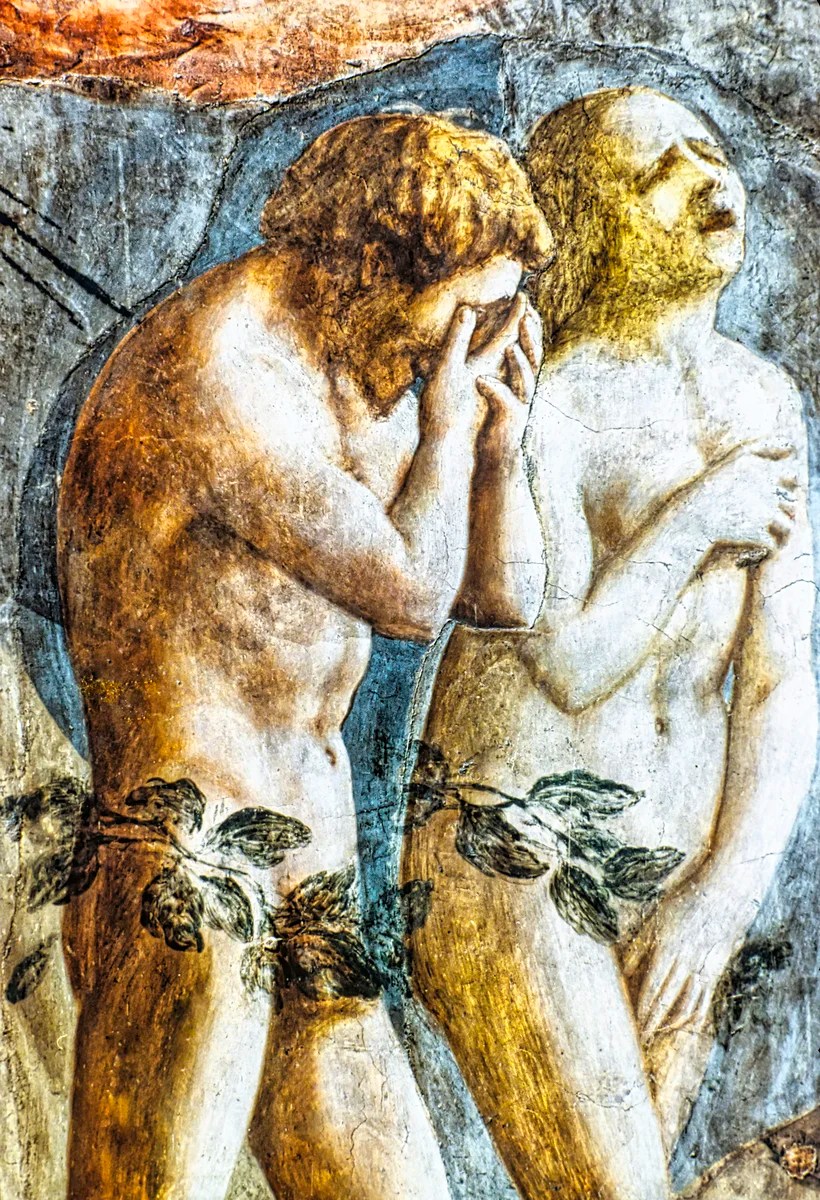
Why is Expulsion from the Garden of Eden (1425) such an important painting? Why is the painter Masaccio not a household name? One reason is that he died at age 26. But his work influenced all the painters that came after him. This was one of the first uses of strong, emotion, three dimensions, and implied motion. He is considered the father of Renaissance art. Be sure to include the frescoes in the Brancacci Chapel of the Santa Maria del Carmine church.
Gallerie degli Uffizi (Uffizi Gallery)
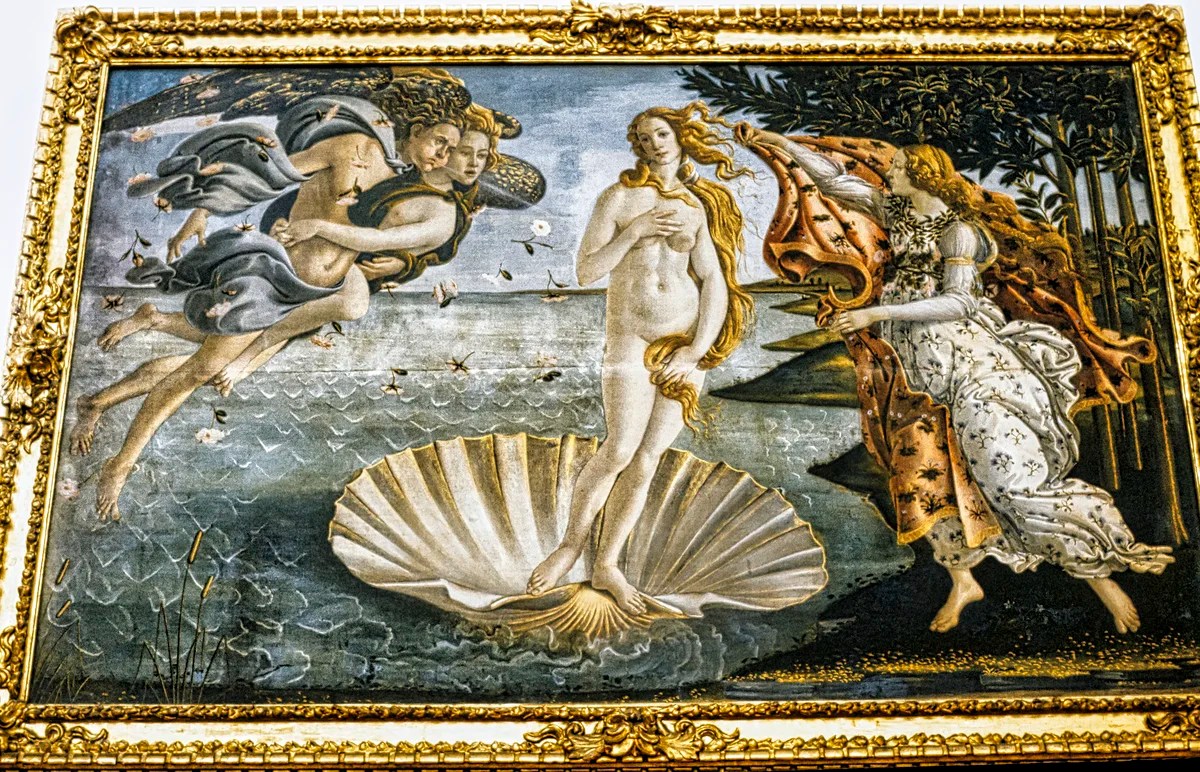
The Uffizi Gallery has art work from many periods but it has probably the best collection of Renaissance art in the world. The Birth of Venus (1486) is considered the epitome of Renaissance art. The painting embodies the rebirth of civilization, the growth of humanism and hope following the Black Plague and the end of feudalism. Do not miss the art of Botticelli, da Vinci, et al in the Uffizi Gallery. Fra Angelico is not just the name of the famous liquor. Fra Angelico was a Dominican friar and a famous painter! “Fra” in this context means friar or brother.
Ponte Vecchio
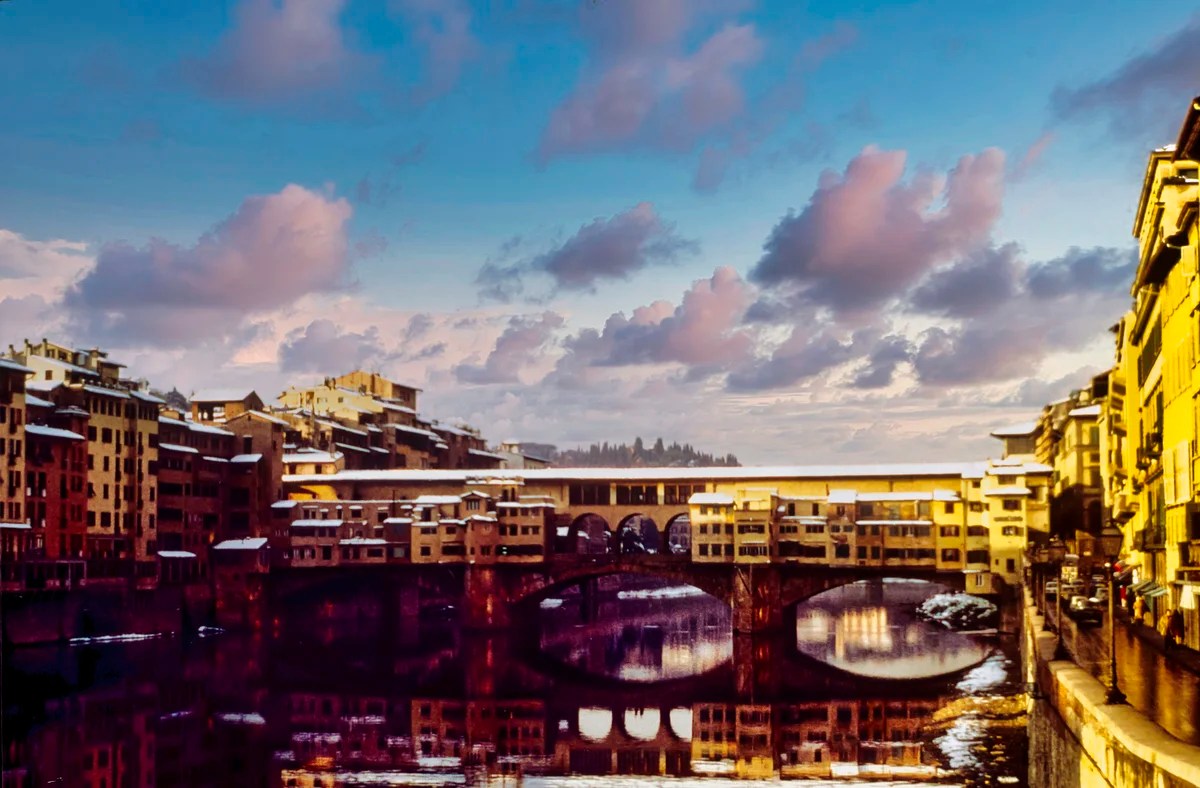
Ponte Vecchio (1345), the really “Old Bridge” was the only Florentine bridge spared from destruction during the Second World War! It is covered with shops. What is that white stuff on all the roofs?
Santa Maria Novella
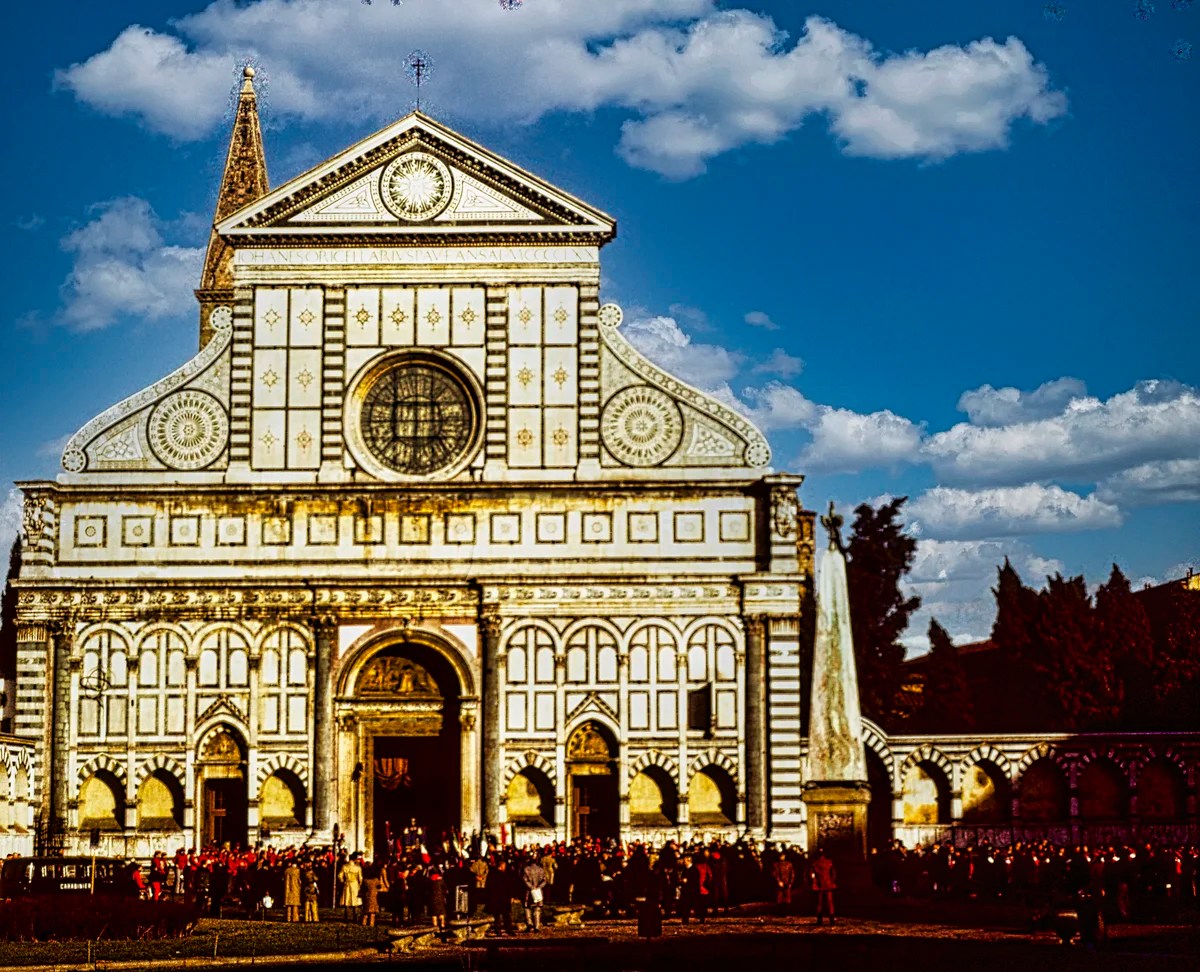
The Santa Maria Novella church façade looks pretty elaborate for the Gothic Era. But this is Italy. Note how the architect added purely decorative scrolls to the sides of the upper storey to add pleasing curves and circles and eliminate a boxy feel of rectangular lines.
Basilica of San Miniato al Monte
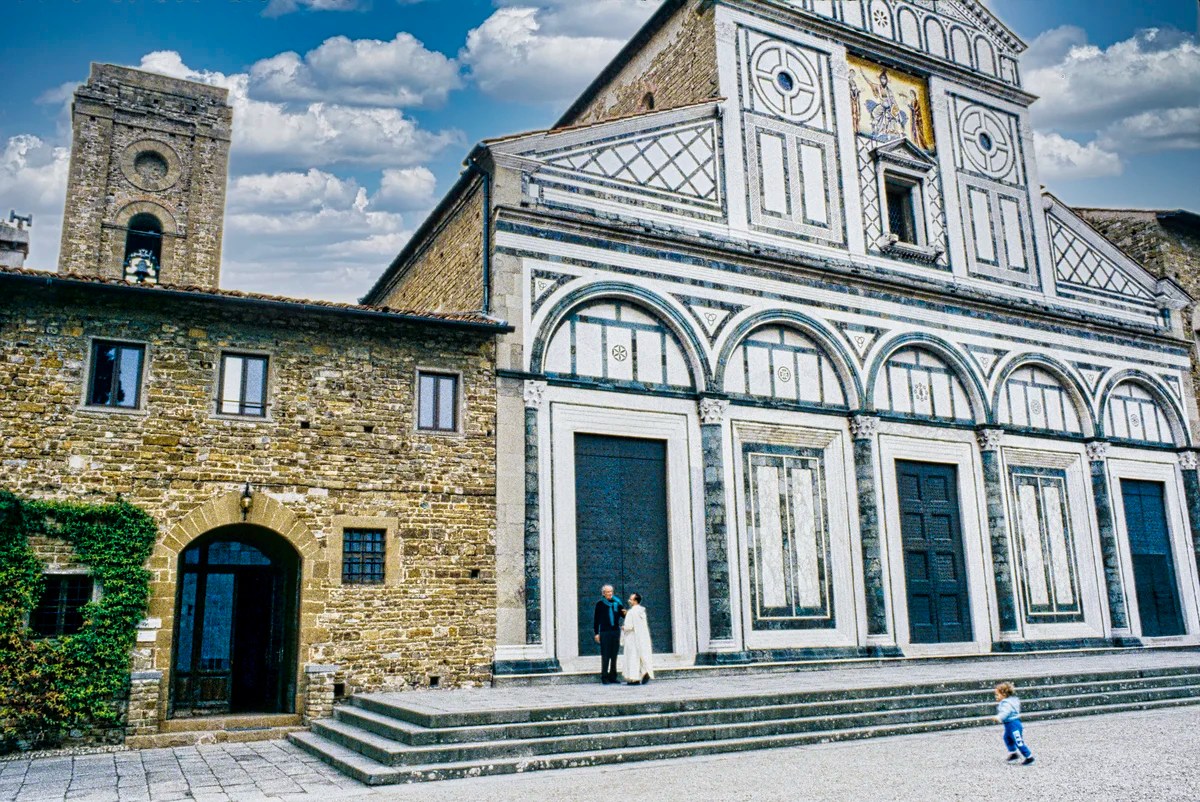
Sitting on a high hill (monte) south of the Duomo, San Miniato al Monte is one of the finest Romanesque structures in Tuscany. The geometrically patterned marble façade was probably begun in about 1090. Note our vero Romano running around the entrance.
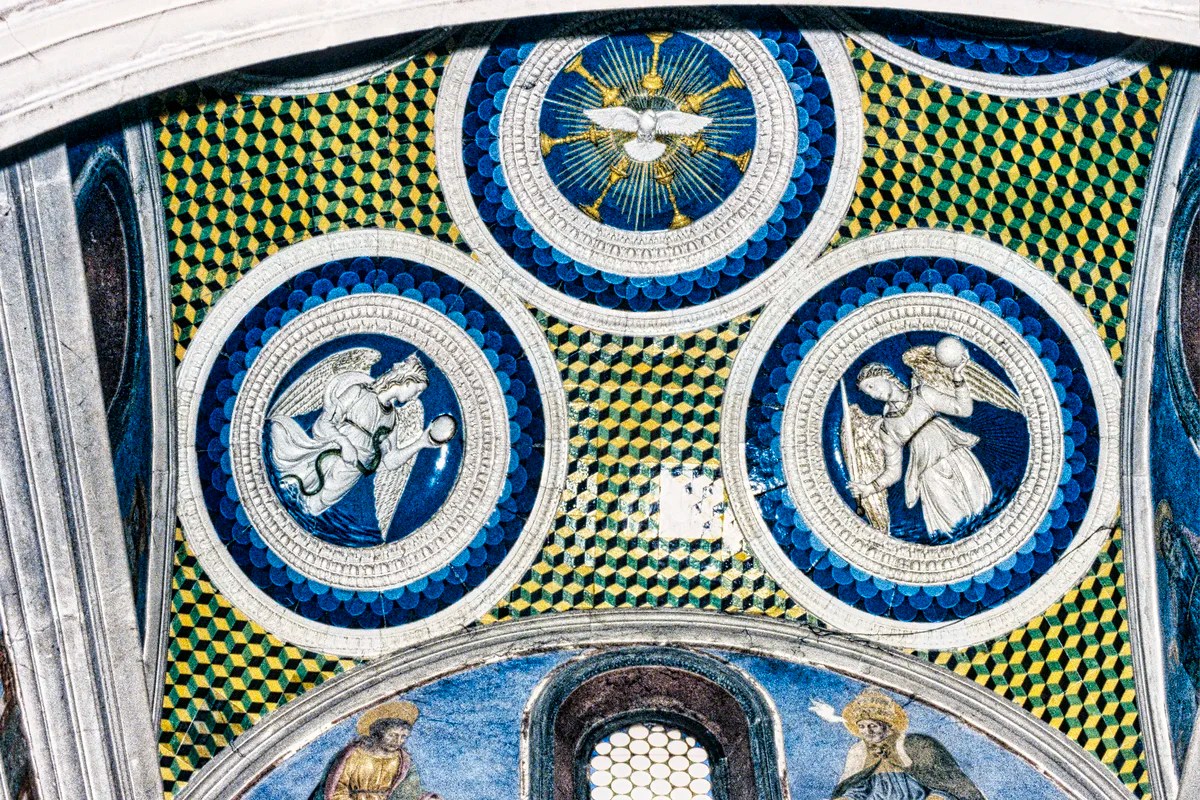
The pièce de résistance is the terracotta vault by Luca della Robbia in one of the chapels. In the center is the Dove of the Holy Spirit surrounded by the Four Cardinal Virtues. Della Robbia is noted for his vibrant, polychrome glazes and expressive figures. Although a leading sculptor in stone, after developing his technique in the early 1440s he worked primarily in terracotta.
Most art is symbolic. What is special about the small colored cubes in the background? First, they are a three-dimensional illusion. Second, yellow, green and purple are the heraldic colors of the Portugal. Cappella del cardinale del Portogallo was built for Cardinal Giacomo, a member of the royal family of Portugal.
We fell in love with Luca della Robbia after seeing his cherubic singers in the Cantoria (singing loft) sculpture (1438) in the Museo dell’Opera del Duomo.
Accademia
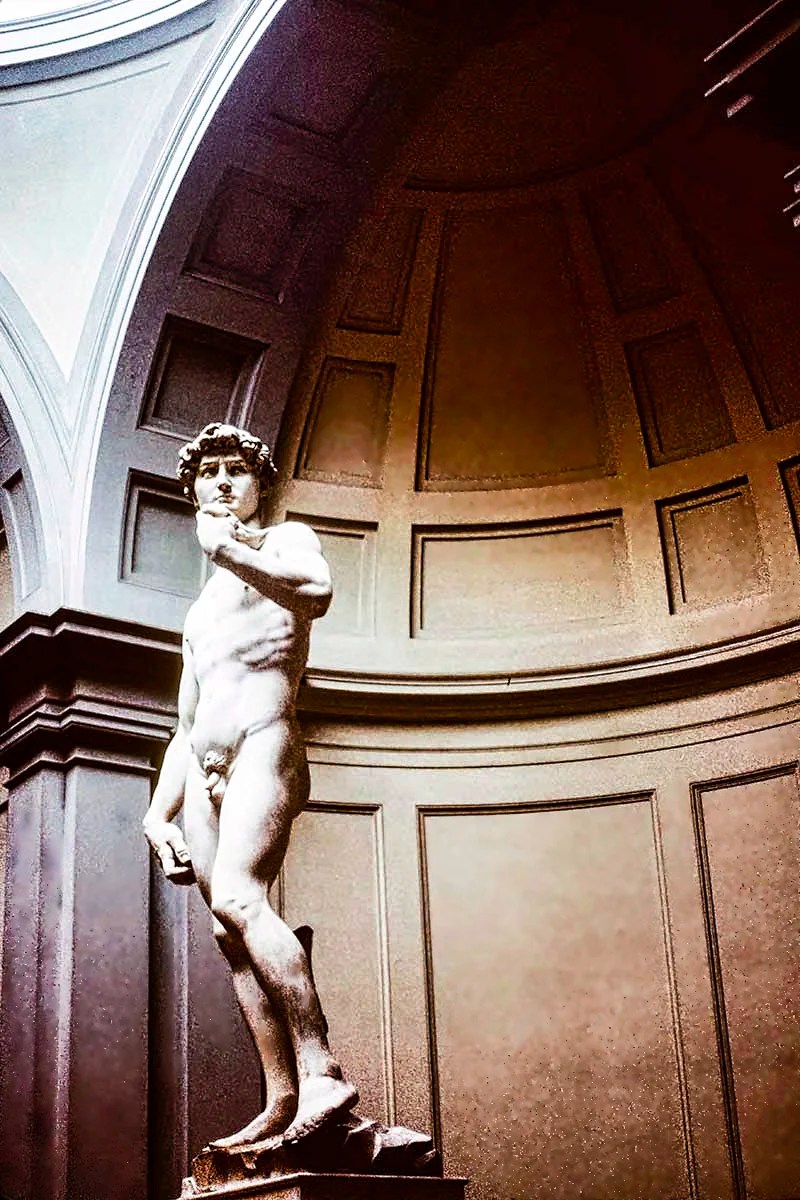
Other musts-sees are the Piazza della Signoria (1330), filled with open-air sculptures; and Michelangelo’s David in the Galleria dell’ Accademia. Last but not least be sure to taste gelato in the city where it was invented!
Venice (Venezia)
Travel time from Florence 269 km 2:55 hrs.
The points of interest for Venice are on the North-Central Italy Itinerary Map.
During the Middle Ages, Venezia (Venice) declared independence from the Roman Empire in 697 AD! Yes the Roman Empire! Only Rome the City fell in 476 AD. The rest of the empire continued on as the capital had already been moved to Constantinople in 330 AD. The name Byzantine Empire is fiction invented by a 16th century German historian. It was still called the Roman Empire by the people of that time.
Palazzo Ducale (Doge’s Palace)
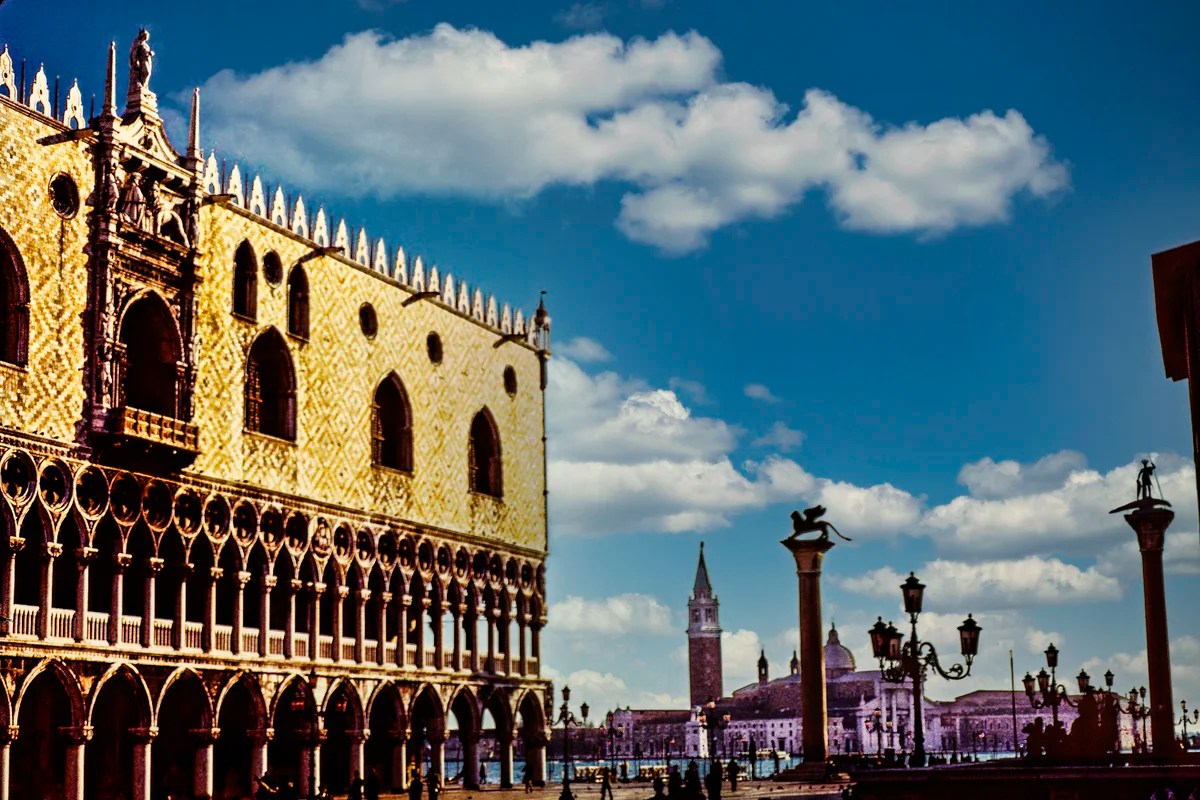
The backwater lagoons became the Serene Republic of Venice. Their leader, the Doge, lived in the Palazzo Ducale (1340) above. But it is far more than a residence; it is also the government of Venezia including the law court. The words doge and duke both originate from the Latin dux, meaning either “spiritual leader” or “military commander”.
This is probably the single most incredible building to see in Venice. It was built to show the wealth and power of Venezia. Venice secured a sole-trade deal with Constantinople, which meant they controlled the trade between the Silk Trade Routes and Western Europe.
Their contact with the East affected their architectural style as they used Saracenic arches rather than purely Gothic arches. This style became known as Venetian Gothic and is unique to Venice. Note the Saracenic (pointed) Arches, quatrefoil openings with stone tracery, decoration along the roof line, and coloured patterning to the wall surfaces. These are all Saracenic architectural elements.
Venice = Naval Power
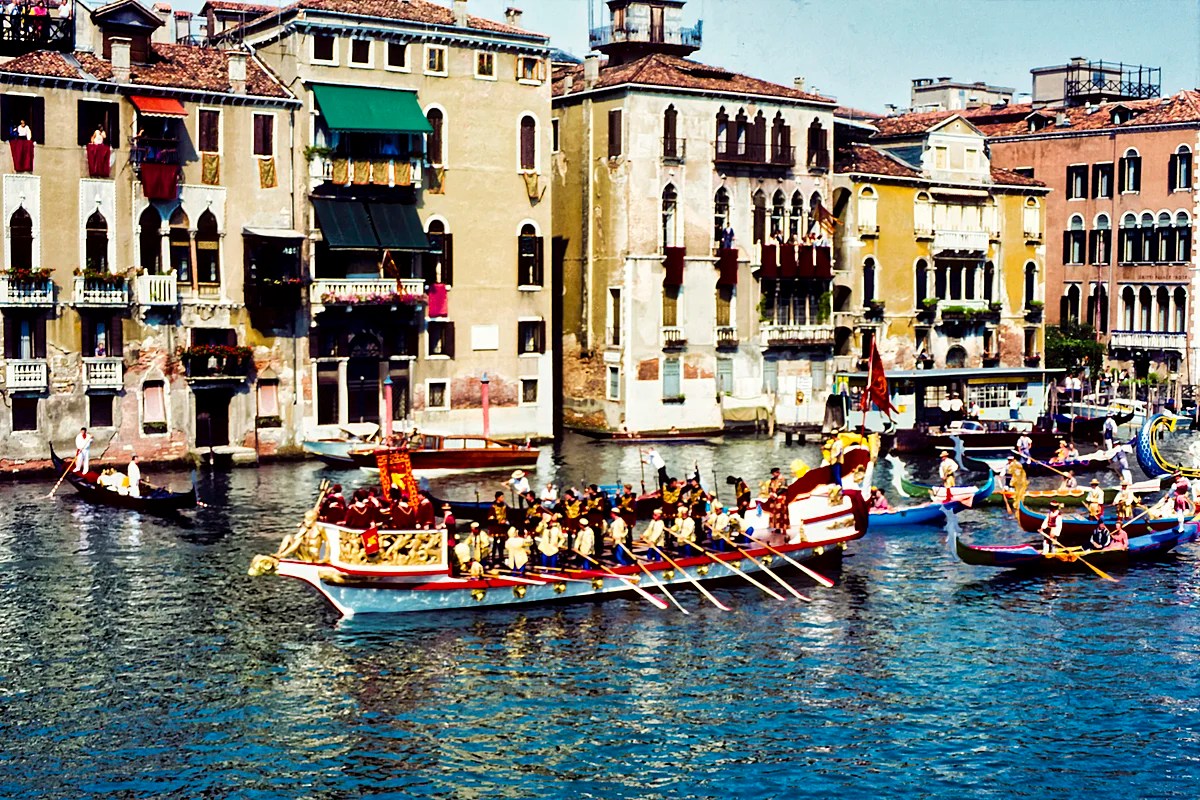
How did Venezia become so powerful? They designed ships in a top-secret facility called the Arsenal that were faster than anything that had previously existed. They made a fortune transporting armies for the Crusades to the Holy Land.
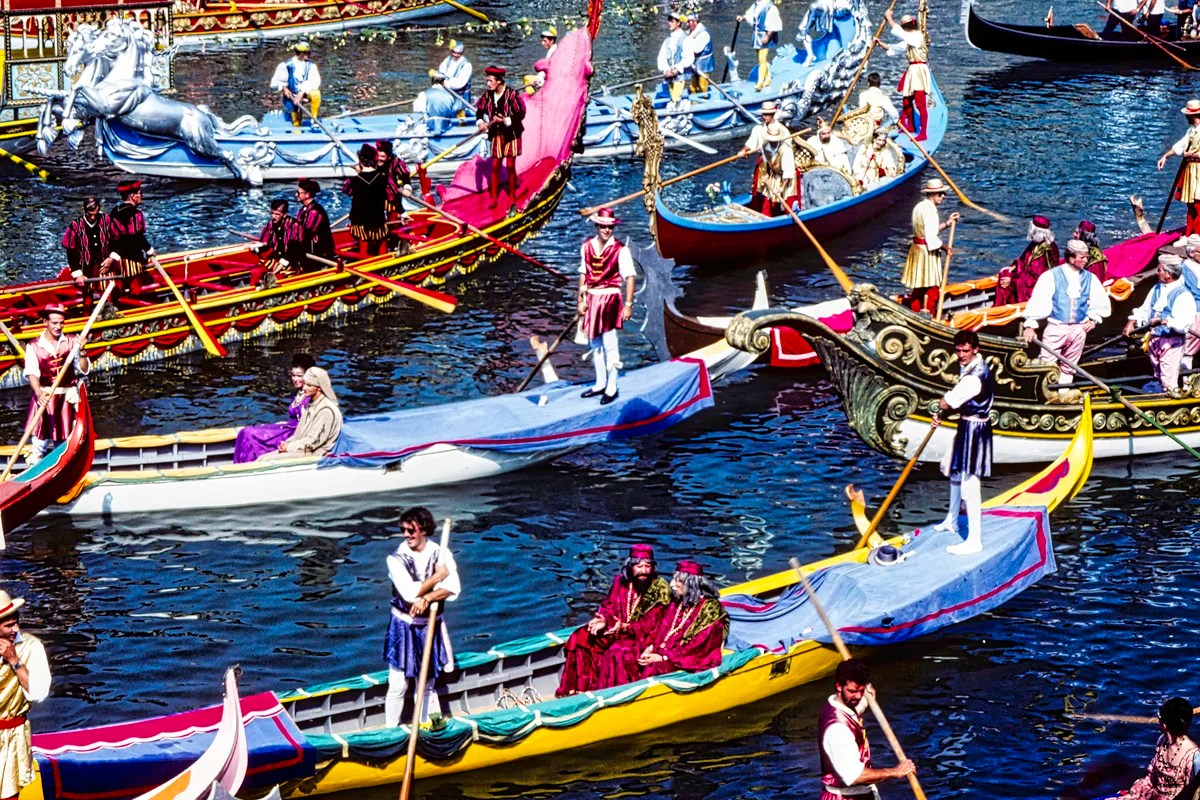
No, these are not the ships of the Serene Republic. This is a historical regatta with participants in costumes paddling down the Grand Canal, a reminder of Venice’s origin as a naval power. There are hundreds of regattas and race competitions held throughout the year.
The Venetians even invented the quarantine, a term derived from Italian quaranta (40) days that ships had to dock on two of their islands during the Bubonic Plague from 1347 to 1351. Unfortunately, the rest of Europe did not follow these rules and lost between 30 to 60 percent (ca. 100 to 200 million) of its people!!
Venice is not a collection of cute buildings and Instagram sights for today’s tourists. Venezia was the most important and largest city in Western Europe. It was the major European power that controlled the Silk Route trade. That is why Venice was so wealthy and has such amazing buildings. There were no Dark Ages in Venezia. The Serene Republic of Venice ruled from 697 until Napoleon conquered it in 1797!
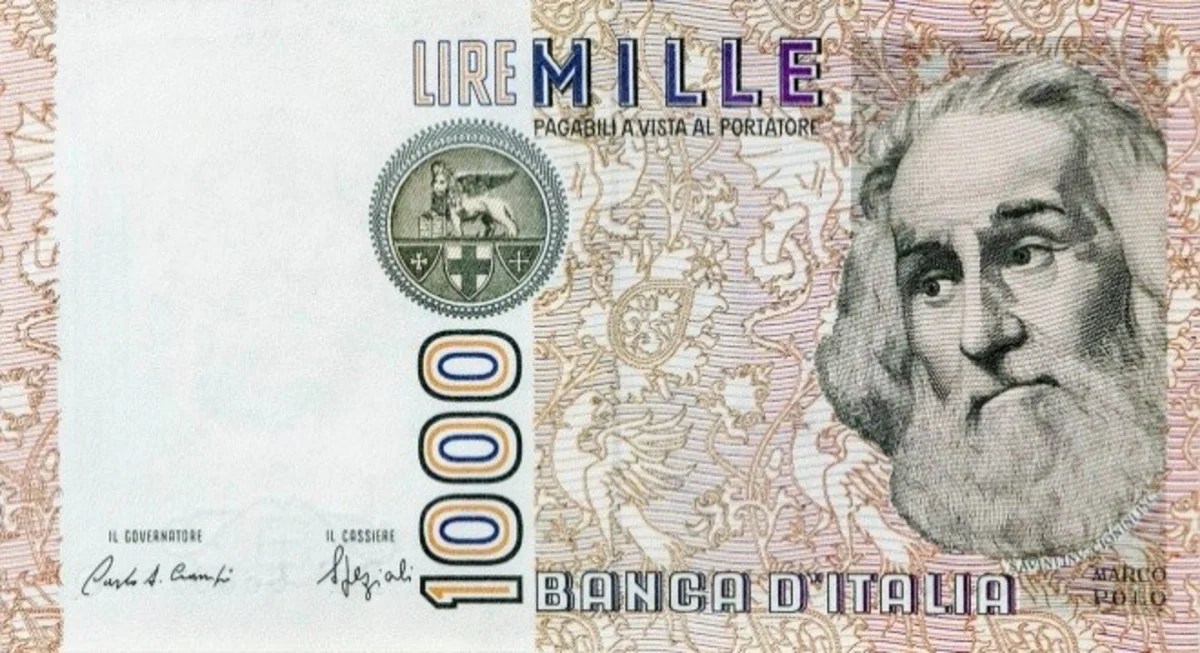
The Silk Routes and Marco Polo brought Europe the Four Great Inventions of China — paper, printing, gunpowder and the compass. The introduction of paper money to the West was a result of this contact with China. Thanks to these inventions, Europe went on to become the ruler of most of the world.
Basilica San Marco (St. Mark’s Basilica)
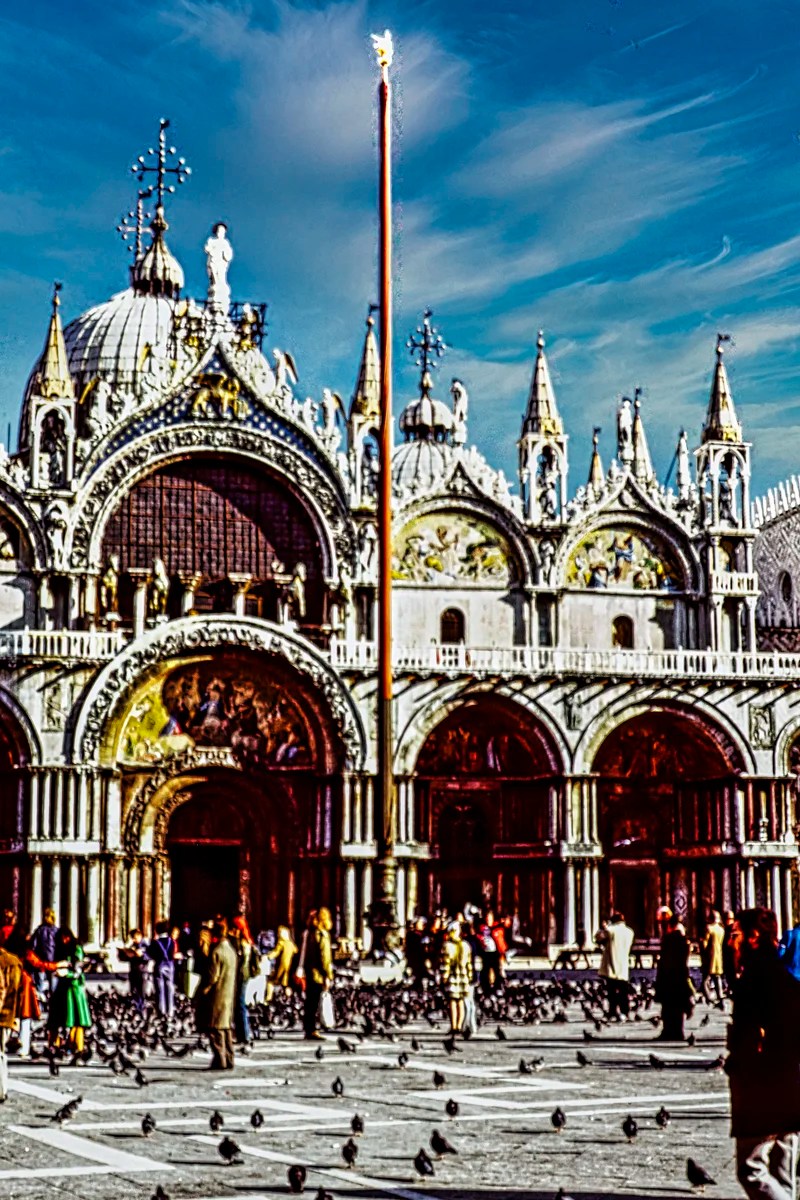
What is special about Basilica San Marco (1094)? Look at how large it seems. How did they build such large structures? Underneath is a waterlogged lagoon, not solid bedrock. So buildings need to be light. The five big domes make the building seem very large. But they are fake! It’s like a movie set made of wood covered with a thin layer of lead. They are empty inside. The real roof is actually much lower down.
Another big shock is that the body remains of Saint Mark were stolen from Alexandria, Egypt in 828 and brought to Venice. The Venetian ruling class decided that Venice needed an impressive patron saint to increase the prestige of their now powerful city. The lion is a symbol of Saint Mark, so it is a common motif throughout the city.
The porticos and interior of San Marco are decorated with Byzantine mosaics, continuing the shared tradition when Venice was a colony of Constantinople. What looks like gold is actual gold leaf embedded in the glass tiles!
Venezia was much bigger than the city of Venice and controlled other land areas. Venice conspired with the Crusaders to sack Constantinople in 1204 rather than journey to the Holy Lands for the Fourth Crusade. The Roman Empire’s territories were divided up among the participants. Venezia gained the Ionian islands (off the Turkish Coast), Crete, and Naxos. Constantinople became a rump state consisting solely of European Turkey and the Peloponnese Peninsula, Greece. This had major historical impacts. Constantinople never regained its economic strength, and it was weakened militarily so that it eventually fell to the Ottoman Empire in the 1453 Siege. Forget what we were taught in school — the Renaissance started in Italy well before the fall of Constantinople.
The third impact was the theft of art and gold from Constantinople. The famous bronze horses from the Hippodrome (horse race track) were sent back to adorn the façade of St Mark’s Basilica. You can see three of them above the portico. They have since been moved indoors. There are more than 500 columns and capitals in the Basilica of Constantinople, some of which can be seen in the photo.
There also is a 323-foot (98.6-meter) campanile associated in the Piazza San Marco. It originally was constructed in the 9th century; but it had to be rebuilt in 1903 to the original design! The reason? It collapsed! It had been reworked in the 16th century, and apparently not that well.
Torre dell’ Orologio (Clock Tower)
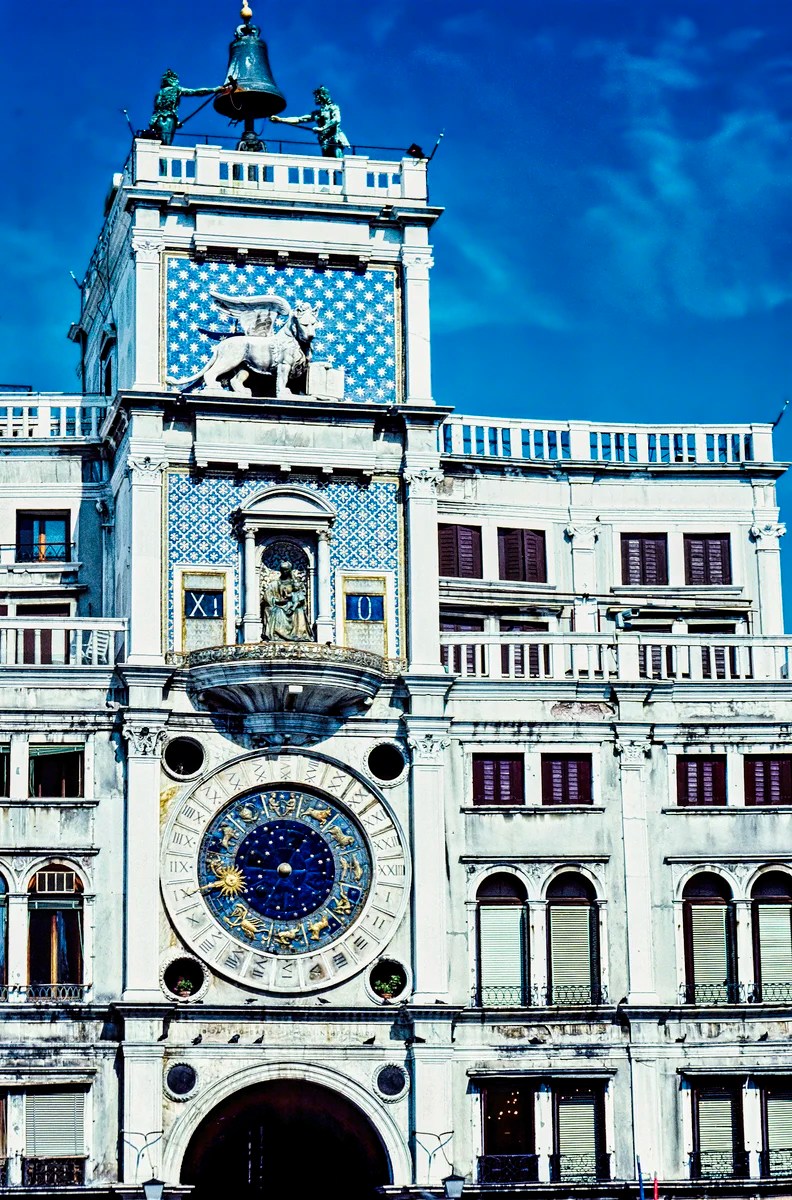
Torre dell’Orologio (Clock Tower) is a Renaissance building (1499) on the north side of the piazza. At the top of the tower are two great bronze figures that strike the bell on the hour. Do not believe the tourist literature that these are mystical Moors. They are actually Italian shepherds whose bronze was seriously oxidized. The clock displays the time, moon phase and Zodiac sign. The winged lion is the symbol of St. Mark.
Palaces of the Grand Canal
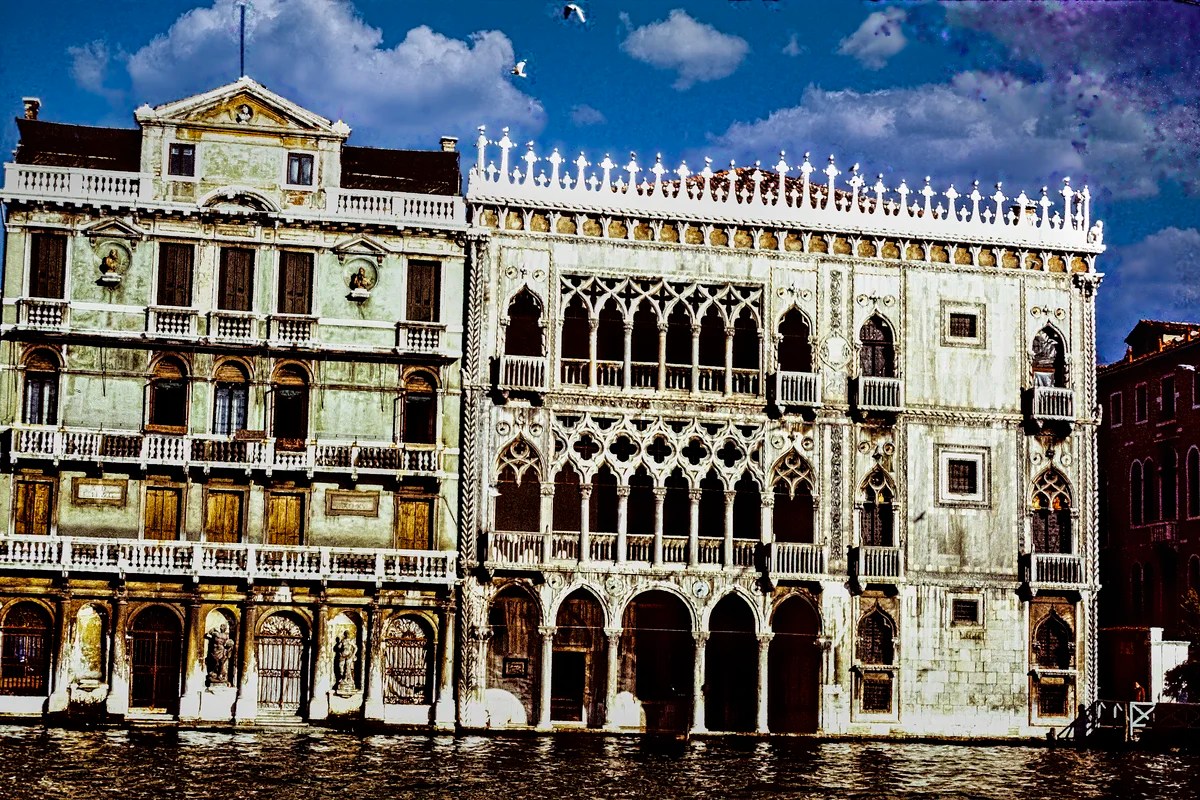
Ca’ d’Oro means house (casa) of gold, because the external walls used to be full of gold and polychrome decorations. The capitals of every column were gilded. The façade copied the Doge’s Palace. Note the Venetian-Gothic elements, such as the loggia-like window group of closely spaced columns, the heavy tracery and quatrefoil openings above.
The palace was completed in 1430 for the Contarini family, who provided Venice with eight Doges. Today, this priceless building stores an important art gallery amassed by the last owner, Baron Giorgio Franchetti.
Even in the Renaissance, merchants still copied the style of the Palazzo Ducale in their palaces. They feature loggias with slender columns supporting quatrefoil openings with heavy tracery above, decoration along the roof line, and some coloured patterning to plain wall surfaces. Together with the ogee arch, these are the most iconic characteristics of the style.
Other attractive buildings are Ca’ Foscari, Palazzo Dario, and Palazzo Pisani Moretta. On the left is the Neoclassic-style Palazzo Giusti, built in 1766
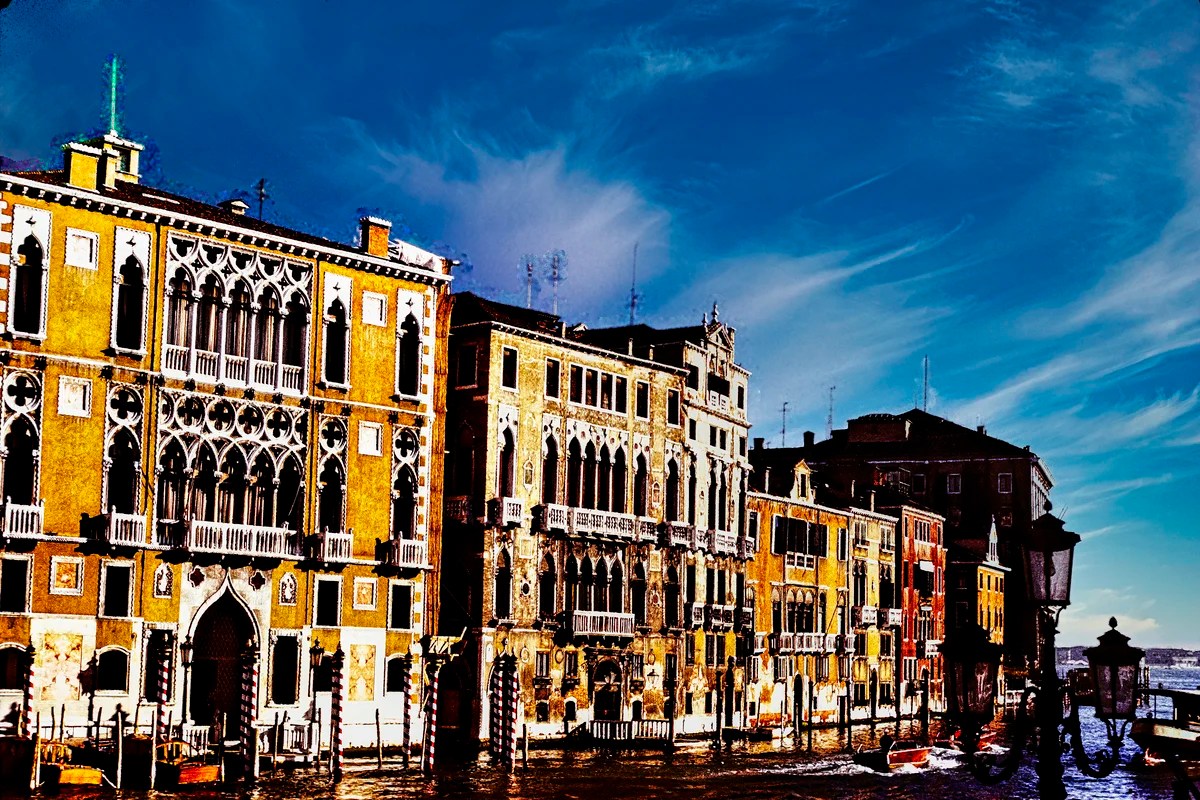
Palazzi Cavalli-Franchetti was erected in 1565. After 1840, the palace was owned by Archduke Frederick Ferdinand of Austria, who intended to set up a Habsburg presence in Venice, which was ceded to the Austria-Hungary Empire after the Napoleonic Wars. To the right, the Venetian Gothic style Palazzo Barbero was built in 1425.
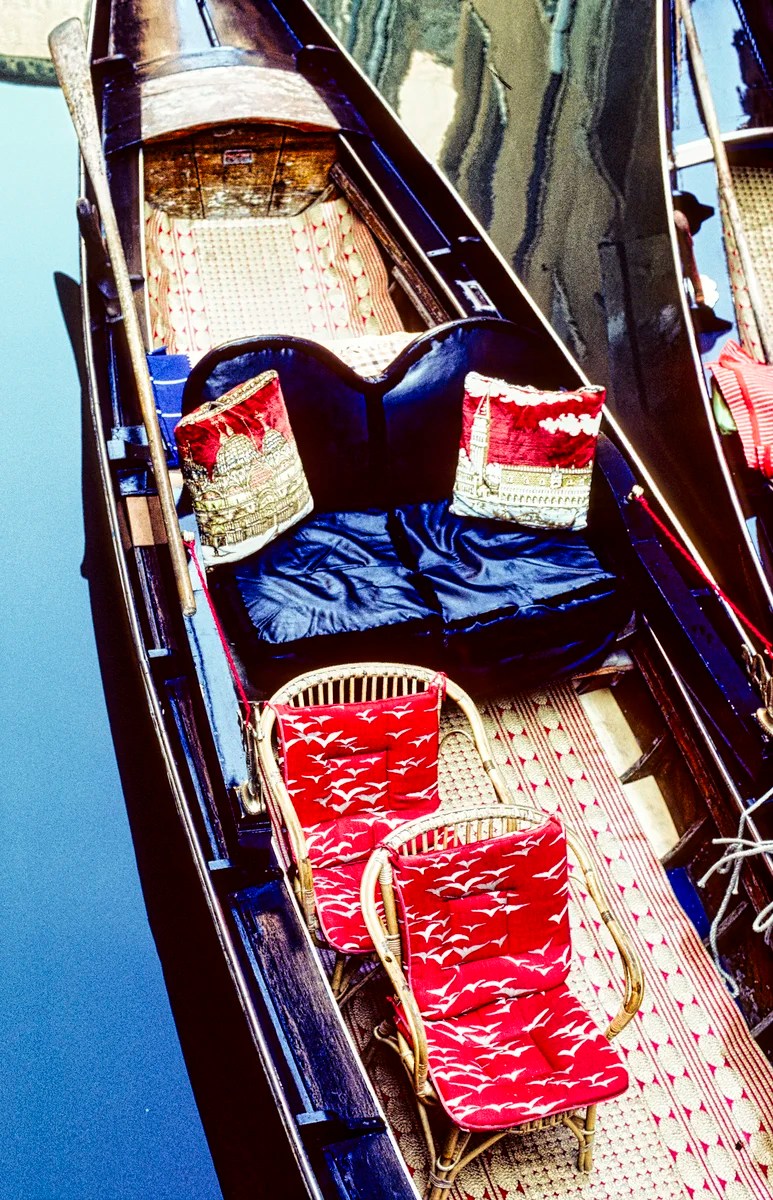
The Quiet Side of Venice
Some tourists think Venice is overrated and overcrowded. That’s a shame and reflects that most tourists don’t appreciate how important Venice was to our history. There are a few things you can do about this. If you don’t like crowds, then avoid travelling during the peak season. If that’s not possible, then get up early. The busiest time for tourists in any country is between 10:30 and 15:30 hrs. Another option is to sightsee less busy areas, especially during the midday period. In Venice, we randomly walked away from the Grand Canal. We had no idea we would find something special.
Liassidi Palace
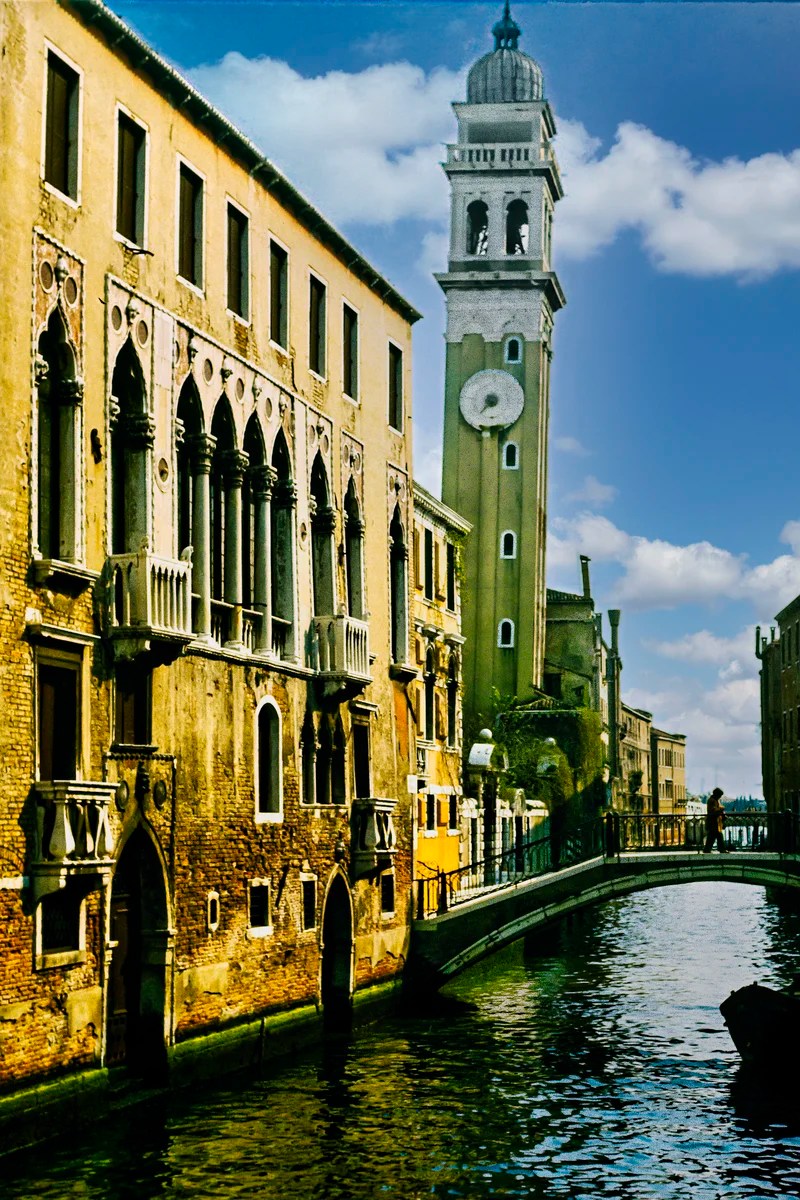
We strolled down the paths along the Rio di San Lorenzo (canal) to the beautiful Venetian-Gothic Liassidi Palace (1436), now a hotel. From the bridge we saw the Church of San Giorgio dei Greci (Saint George of the Greeks). Or rather, we saw the Leaning Tower of Venice! The Campanile (bell tower to St. George) was completed in 1592 but its foundations subsided during construction. Four hundred and thirty years later, it is still standing.
Murano
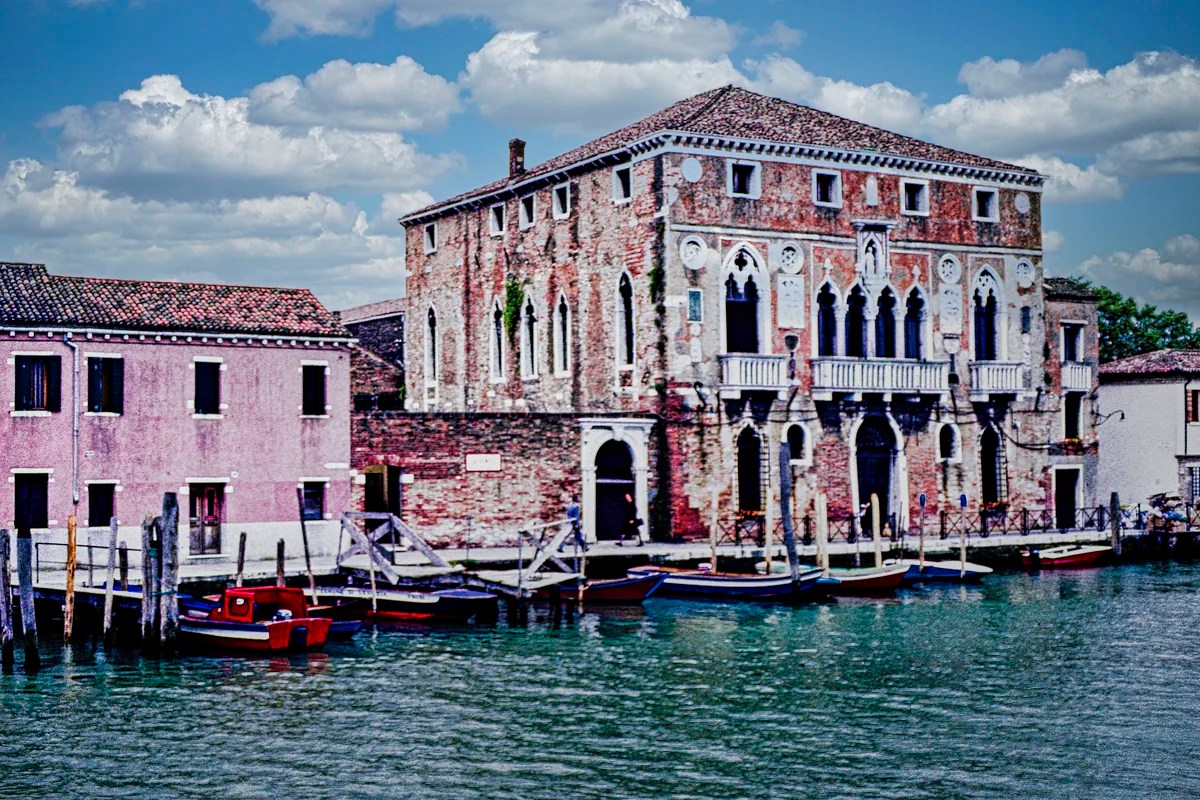
Another option is to take a ferry to other islands. Murano is 1.5 km north of Venice. It is somewhat touristy if you visit the glass-blowing shops. But we also walked the canals and found the pink palace, Palazzo da Mula. The island does not offer as many architectural gems as Venice, but it does give you a good idea of what the lagoons were like many years ago.
Burano
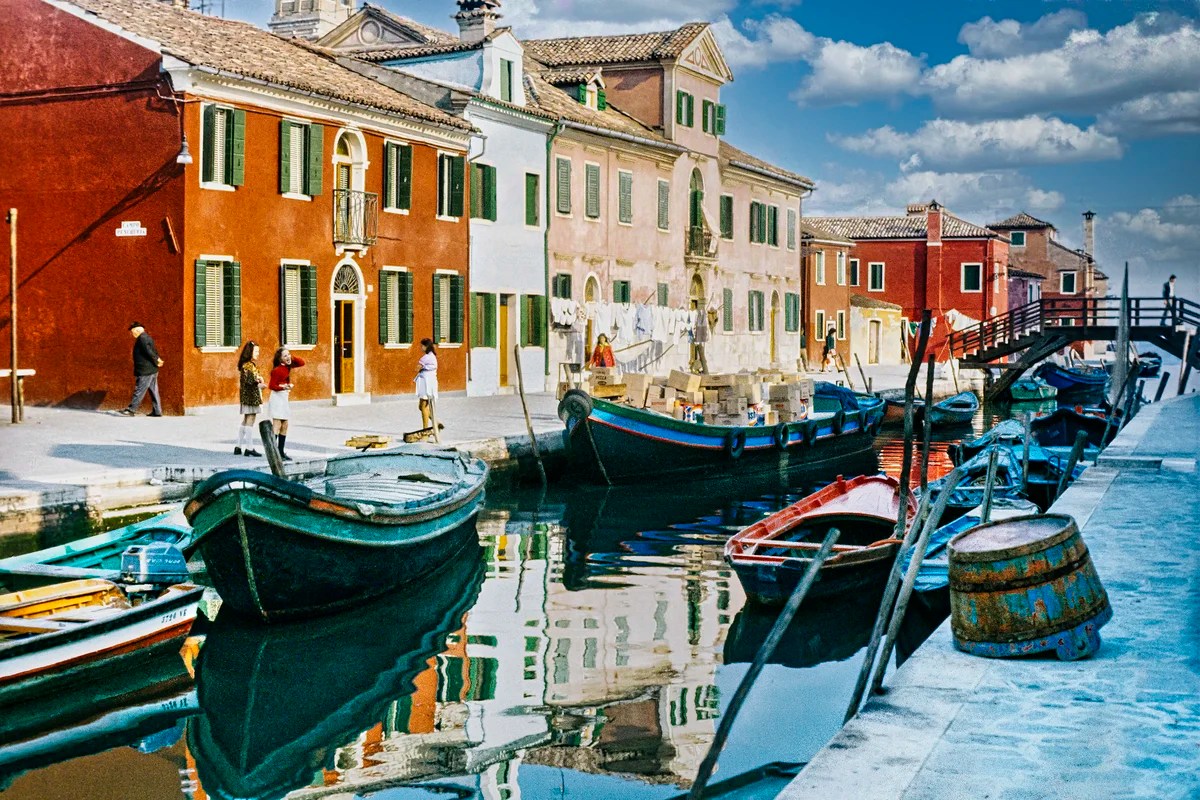
Finally, we toured the island of Burano, which was very quiet with simple architecture. But it has colourful buildings and fishing boats. This may have been Ponte Pontinello or Tre Ponti.
Final Comments
Rome, Florence and Venice are over-touristed. But we hope you have learned that these are the best places to experience quintessential Italy. We hope you now understand why the places in the Three Cities Itinerary are significant and how they have had such a great influence on the history and culture of the world.
Subscribe
Please subscribe to Terra Encounters because we offer valuable insights to improve your understanding and enhance your travels. We offer itinerary-based guides packed with the best sights and hidden gems. Let our knowledge help you fully appreciate every moment of your amazing journey.
Get travel tips and advice delivered directly to your inbox. The best part is that it is free.
This was only a taste of Rome. What questions do you have? If you have been to Rome, share your experiences with us. How long is/was your trip?
Itinerary Map & Resources
Roman Itineraries Map — our custom Google Map
Central to Northern Italy Itinerary — our custom Google Map
Google Maps Ratings
Google Maps provides a rating from 0 to 5 for all sights, hotels and restaurants (but not cities). All of our recommendations are appended with the rating (prefixed with a G) from Google Maps. As it is based on feedback from tourists and locals, it is much more reliable than travel booking websites. We consider a score of 4 to 4.39 to be Very Good; 4.4 to 5 to be Excellent.
Other Posts You May Like
Rome’s Top 8 Self-Guided Walks
Here are eight itineraries to explore Rome in more detail:
Itineraries Outside of Rome
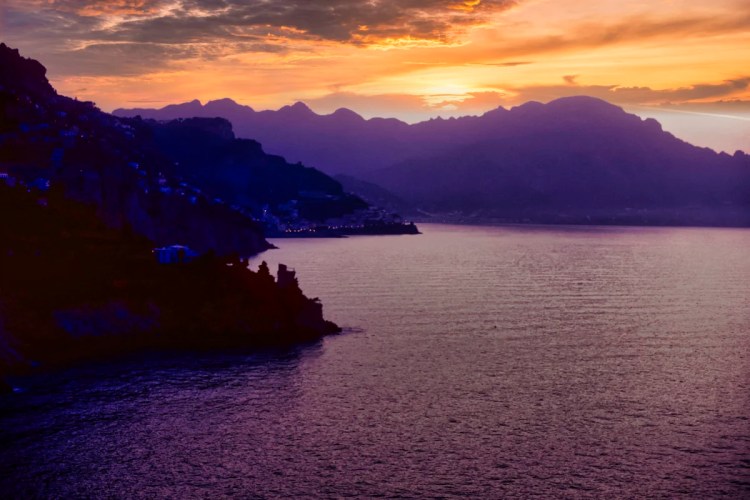
Here are itineraries to explore the north from Tuscany to the Dolomites, and south from Pompeii to Sicily:

Understanding Italy
The Italy FAQ post answers questions such as:
- When should I go?
- What is the best season for travel?
- Where should I go?
- Can I see everything in a week?
- How much time do I need for Italy?
- How much cash should you take to Italy?
- Should I pay in Euros or my own currency?
- How safe is Italy?
- Should I rent a car? Take a Taxi?
 Terra Encounters
Leave a reply to Terra Encounters Cancel reply